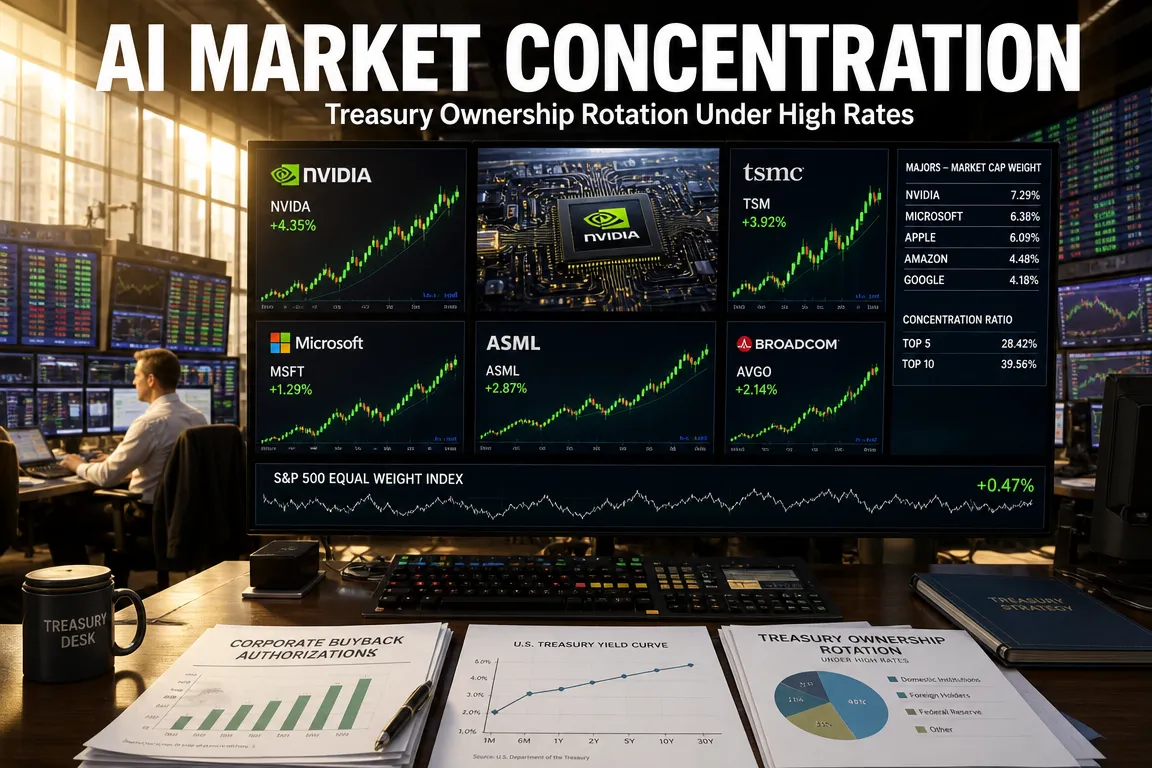
● AI-Rally, Nvidia-Record, Market-Laggers
Nasdaq and Nvidia at Record Highs, Yet Many Portfolios Are Falling: The Real Core of the AI Rally Is Concentration
The key issue in the current market is not simply that “the Nasdaq rose.”
On the surface, U.S. equities appear strong, but a closer look shows that gains are concentrated in a very small number of stocks, while most names remain weak.
In particular, Nvidia, AI infrastructure, semiconductor ETFs, big tech earnings expectations, and the interest-rate outlook are all interacting, creating an unusually narrow rally.
This article summarizes why indices are hitting records while many portfolios are under pressure, why Nvidia remains the market’s center of gravity, how the AI agent competition is reshaping equities, and whether a fourth-quarter rally remains plausible.
1. Why Are Indices at Records While Many Stocks Lag?
The market’s defining feature is the gap between index performance and portfolio-level returns.
The Nasdaq and Nvidia have reached record highs, but many investors are not experiencing the same strength in their holdings.
The reason is straightforward.
Upside is not broad-based; it is concentrated in a limited number of large AI-related names.
- The share of stocks in short-term uptrends is estimated at around 25%.
- Roughly 75% of stocks are either declining or moving sideways.
- Indices remain firm, but individual-stock participation is weak.
- Goldman Sachs has noted that market breadth is near its worst level since the dot-com era.
Market breadth refers not to how much an index rises, but to how many stocks participate in the move.
If indices are advancing while internal participation deteriorates, underlying market health is weak.
That is the current setup.
2. The Two Groups Still Benefiting
At present, there are two main groups of investors still seeing relatively comfortable returns.
- Investors who have consistently accumulated the Nasdaq ETF
- Investors holding AI semiconductor stocks led by Nvidia
By contrast, investors positioned in dividend stocks, consumer staples, small-cap growth names, and traditional industrials are seeing far less benefit from the rally.
Many stocks are breaking prior lows or drifting toward the lower end of their trading ranges.
This explains why many investors ask why U.S. equities are rising while their own portfolios are not.
This is not only a matter of individual stock selection.
Global capital flows are being redirected toward AI infrastructure, large-cap technology, and semiconductors.
3. Why Nvidia Has Reached Records Again
Nvidia remains the center of the AI rally.
It is the world’s largest company by market capitalization and continues to carry strong growth expectations.
Its share price is up more than 25% this year, making it one of the strongest large-cap performers.
The main drivers of Nvidia’s advance can be grouped into three areas:
- Expectations for expanded AI infrastructure spending
- A record-scale share repurchase program
- A financial structure designed to expand the AI ecosystem
The buyback program is particularly important.
Historically, Apple has been the benchmark for shareholder returns.
Even as Apple faced criticism for slowing innovation, it supported its stock through large buybacks and dividends.
Nvidia’s announcement of an even larger buyback sent a strong signal to the market.
Jensen Huang has expressed confidence that Nvidia stock remains inexpensive.
He has also emphasized that the company generates substantial cash and that one of the best uses of that cash is to buy Nvidia shares.
This is not simply promotional commentary.
It indicates that Nvidia is evolving into both a growth company and a shareholder-return company.
Even if AI growth moderates later, strong free cash flow and buybacks may support the stock’s downside.
4. The Key Issue Often Missed: Nvidia Is Building an AI Financial Ecosystem
Most coverage focuses on Nvidia’s GPU sales, data center revenue, and buyback program.
But a more important development is underway.
Nvidia is extending beyond chips and is helping build the financial architecture that expands the AI infrastructure market.
The most important element is the concept of chip-backed lending and insurer participation.
In simple terms, Nvidia is helping create a structure in which its GPUs can function as collateral-like assets.
- AI data center operators need Nvidia chips.
- However, the upfront capital requirement is very large.
- Nvidia is working with Wall Street financial firms to design chip-backed lending structures.
- Insurers may also participate to reduce credit risk.
- As a result, more companies may be able to purchase Nvidia chips.
In practical terms, this is similar to a mortgage model, but for chips.
Instead of borrowing against a house, financing is based on the residual value of GPU assets.
Insurers can build products using data on used-chip values and depreciation.
Financial firms can extend more loans while limiting risk through insurance coverage.
AI startups and cloud companies can proceed with data center buildouts without full upfront capital.
Ultimately, Nvidia sells more chips.
The significance is that Nvidia is becoming not only a supplier, but also a market architect.
In the AI gold rush, it is no longer only selling shovels; it is also helping customers finance the purchase of those shovels.
5. The AI Agent Competition Is Accelerating
The competitive landscape in AI is changing quickly.
Previously, the main question was who could build the smartest chatbot.
Now the focus is on who can build the most useful AI agent.
An AI agent is more than a question-answering chatbot.
It is a personal assistant that can perform actual tasks on behalf of the user.
- OpenAI has introduced Operator.
- Meta is expanding AI services around AI Assistant and Movie Gen.
- xAI is rolling out an enterprise-focused version of Grok.
- Google is using Gemini to expand into government and enterprise markets.
Sam Altman has said the industry is moving from the chatbot era to the AI assistant era.
OpenAI’s Operator is built on a virtual computer environment.
It can continue working even when the user’s device is off and can complete tasks while the user is asleep.
This is not a minor technical update.
It marks a shift from AI as an information search tool to AI as a production and execution tool.
6. OpenAI’s Faster AI and the Emerging Intelligence Gap
Another important direction from OpenAI is speed.
A higher-priced option offering substantially faster responses has been introduced.
The original text compares this to buying an 8x booster in a game.
Sam Altman has said that using faster AI changes the way people think and solve problems.
The shorter the wait time, the less likely the human thought process is to break.
However, this also raises an important social issue.
- Individuals and firms with more capital can access faster AI.
- Paying more may effectively purchase faster intelligence.
- Differences in AI speed may translate into differences in productivity.
- This could widen intelligence inequality over time.
This is easy to overlook in mainstream coverage, but it is significant over the long term.
Future corporate competitiveness may depend less on headcount and more on how quickly and effectively AI can be integrated into operations.
7. Nvidia Also Benefits from the AI Agent Race
As AI agents become more prevalent, compute demand rises.
Faster AI, more users, and more complex tasks all point to higher GPU demand.
When OpenAI highlighted its faster AI services, Nvidia immediately linked them to its latest semiconductor capabilities.
The message is that such performance is enabled by Nvidia’s advanced chips.
As AI software competition intensifies, Nvidia’s strategic position as infrastructure provider strengthens.
More AI applications increase cloud usage, which raises data center investment, which in turn drives GPU demand.
8. The U.S. Government Is Also Pushing AI
The original text also highlighted the Trump administration’s AI push.
The U.S. government is working to consolidate around 29,000 government websites into a more unified digital service model.
There is also discussion of applying AI chatbot interfaces to a unified government portal such as america.gov.
The key point is not simply administrative efficiency.
It is that the government is beginning to apply AI agents to public services.
- Government services may use models such as Gemini and Grok.
- Collaboration between Google, xAI, SpaceX, Nvidia, and the government is strengthening.
- AI-related government budgets and projects could become new revenue sources.
- AI is moving from consumer applications into public infrastructure.
The original text also noted Trump’s symbolic reference to AI as SI, or Super Intelligence.
The main point is not the terminology itself, but that the U.S. views AI leadership as a strategic national priority.
9. The Environment Is Closer to Self-Regulation Than Tight Regulation
As AI expands rapidly, security, hacking, malfunction, and privacy risks will increase.
However, the U.S. policy stance appears closer to self-regulation than strict regulation.
Major technology firms have joined self-regulatory commitments, but these are closer to voluntary pledges than legally binding rules.
For markets, this is positive in the near term.
It reduces the likelihood that strict regulation will interrupt the AI growth cycle immediately.
Over the longer term, however, AI security should become increasingly important.
If AI agents send emails, process payments, and access data on behalf of users, the impact of a security breach becomes much larger.
That is why cybersecurity firms, AI security providers, and cloud security companies may gain more attention.
10. AI Model Release Cycles Are Already Unusually Fast
The intensity of AI competition is visible in release speed.
The original text states that two years ago a new AI model appeared roughly every 70 days, while now a new model arrives about every 10 days.
In practical terms, this is similar to a new iPhone launching every week.
For investors, it is difficult to keep up.
- OpenAI continues to release new features and models.
- Meta is rapidly expanding consumer-facing AI agents.
- Google is preparing the next generation of Gemini models.
- xAI is strengthening Grok for enterprise use.
- Anthropic is building momentum in enterprise AI while also attracting IPO speculation.
The more intense this competition becomes, the lower AI service prices may go, while usage and cloud and semiconductor demand may continue to rise.
In other words, competition among software firms may ultimately support AI infrastructure companies.
11. Meta AI’s Rapid Growth and Monetization Potential
Meta AI is another important focus.
Even with limited geographic availability, it is expanding quickly.
Compared with ChatGPT, which took more than a month to reach 5 million users, Meta AI’s adoption rate appears comparatively fast.
Meta’s advantage is its massive existing user base.
It can integrate AI naturally into Facebook, Instagram, WhatsApp, and Messenger.
Its monetization options are broad.
- AI shopping recommendations
- Commerce referral fees
- Advertising efficiency gains
- Enterprise AI tools
- Content production automation
If AI agents begin handling shopping decisions, Meta could sit directly inside the user’s purchase journey.
Wall Street has suggested that, under optimistic assumptions, 8% to 10% of Meta’s revenue by 2030 could come from AI agent-related sources.
12. When Macro Conditions Worsen, Capital Moves Toward AI
The market is currently facing shifting expectations for rates, oil prices, geopolitical risk, and political events.
In such periods, investors tend to move capital away from uncertain sectors and into areas with clearer growth visibility.
AI infrastructure is the clearest example.
- Cloud data centers
- GPU and AI semiconductors
- Memory semiconductors
- Power infrastructure
- Optical networking and communications equipment
- AI security
As a result, one week may favor memory semiconductors, the next may favor equipment suppliers, and another may favor optical networking or custom-chip names.
Short-term corrections can still be triggered by supply concerns, such as major expansion announcements from companies like Kioxia.
But the larger trend remains continued AI investment.
13. Investment Strategy: ETFs May Be More Practical Than Single Names
In a market with this level of concentration, stock selection becomes more difficult.
Indices can rise while individual holdings lag.
In this environment, Nasdaq ETFs or semiconductor ETFs may be a more practical way to capture the AI cycle.
For investors with full-time jobs, it is difficult to track every AI headline and earnings event.
The advantages of ETF exposure are clear.
- They provide exposure to Nvidia, Microsoft, Apple, Meta, and other core leaders in one vehicle.
- They reduce single-stock risk.
- They allow participation in the long-term AI infrastructure trend.
- They reduce the frustration created by market concentration.
Even so, ETFs remain volatile.
AI-related semiconductor ETFs can move sharply on rates, earnings, supply concerns, and regulatory developments.
For that reason, staged accumulation is preferable to a single large purchase.
14. Fourth-Quarter Rally Potential: Historically Favorable, but Conditional
The original text also emphasized seasonal patterns in the fourth quarter.
In particular, the fourth quarter of midterm-election years has historically been strong.
- Since the 1950s, 16 out of 19 midterm-election fourth quarters have been positive.
- Down years included 1978, 1994, and 2018.
- In those cases, the main drivers were tight policy, rising rates, and inflation pressure.
The central variable this year remains the Federal Reserve and the rate outlook.
If Powell adopts a more hawkish stance than expected, the market could correct.
If rate pressure eases and election uncertainty recedes, a fourth-quarter relief rally remains possible.
History does not guarantee future performance.
But seasonal tendencies suggest the fourth quarter may require both risk management and selective opportunity seeking.
15. Key Events to Watch
Several upcoming events may affect the market.
AI-related company events and major earnings releases could add volatility.
- Marvell Investor Day: potential impact on optical networking, custom semiconductors, and AI networking stocks
- Microsoft AI event: attention on Jensen Huang’s participation and AI infrastructure collaboration
- Micron investment expansion: potential effect on memory semiconductors and equipment suppliers
- Pepsi and airline earnings: the start of the broader earnings season
- Big tech earnings: could determine market direction from late October
- Anthropic IPO possibility: watch for a listing before Thanksgiving
Anthropic’s potential IPO could have a meaningful effect on AI sentiment.
As competition continues among OpenAI, Anthropic, xAI, Meta, and Google, a large AI listing would create a new benchmark for the market.
16. AI Security Is Set to Become More Important
As AI agents become embedded in daily work, convenience will rise but so will risk.
If AI opens email, reads files, processes payments, and accesses enterprise systems, the damage from hacking could be much greater.
The major security issues ahead include:
- AI agent permission management
- Protection against privacy leakage
- Control over internal enterprise data access
- Defense against AI-enabled phishing and impersonation
- Response to automated cyberattacks
As AI grows stronger, cybersecurity should also gain importance.
From an investment perspective, AI semiconductors, cloud, software, and cybersecurity should all be monitored.
The Most Important Point Not Often Emphasized
The most important point in the original text is Nvidia’s financialization strategy.
Most investors view Nvidia only as a company that sells GPUs well.
In reality, it is helping build an ecosystem with Wall Street, insurers, cloud providers, and data center operators to expand the AI infrastructure market.
This is a major shift.
Nvidia is no longer simply waiting for demand; it is actively helping create it.
The second major point is the monetization of AI speed.
In the future, two users may access the same AI model, but one may use a slower version while another pays for one that is much faster.
That difference is not just about convenience; it can affect work pace, decision speed, investment decisions, and corporate productivity.
The third point is that governments are beginning to treat AI as national infrastructure.
AI is moving beyond search boxes and chat interfaces into administration, defense, public services, and enterprise systems.
If this trend continues, AI infrastructure investment should be viewed not as a short-term theme, but as a long-term industrial cycle.
Investment Perspective
The current market is not a broad-based bull market.
It is a concentration-driven market in which a small number of stocks are lifting the index.
That makes single-stock investing difficult.
At the same time, the long-term AI infrastructure cycle remains intact.
Nvidia, Microsoft, Meta, Google, AMD, Broadcom, Micron, Palantir, and cybersecurity firms are likely to remain in focus.
In short, this is not a market in which everything rises.
It is a market in which capital flows must be tracked carefully.
Rather than relying on the Nasdaq record high alone, investors should review how closely their portfolios are aligned with AI infrastructure and large-cap technology leadership.
[Related Articles…]
- Nvidia and the Next Phase of the AI Semiconductor Rally
- AI Agents and the Global Technology Investment Outlook
*Source: [ 소수몽키 ]
– 나스닥 엔비디아는 신고가인데 내 주식은 왜? 역대급 기묘한 랠리 이어질까
● Bond Shock, AI Surge
Will Korean Government Bond Yields Rise Further: The “Ownership Rotation” in Treasuries and the New High-Rate Regime Driving AI Capital Concentration
The key issue today is not simply whether the Federal Reserve will cut policy rates.
The more important question is who holds U.S. Treasury securities, because that ownership shift is making long-term yields less likely to decline meaningfully.
At the same time, crude oil, inflation, the U.S. economic outlook, and AI semiconductor earnings are reinforcing a more concentrated flow of capital into the AI value chain.
Superficially, this appears to be a market in which bond yields are high while the Nasdaq remains strong. Structurally, however, it is closer to a market where capital has few destinations other than AI.
1. The main market issue: why U.S. Treasury yields are not falling easily
The central focus of the financial markets is currently U.S. Treasury yields.
In particular, elevated 10-year and 30-year Treasury yields are putting pressure on global asset markets.
Normally, higher Treasury yields weigh on equities, real estate, and other risk assets.
Yet recently, U.S. yields have remained high while the Nasdaq and AI-related stocks have stayed firm.
To understand this, one must look beyond short-term rate moves to the shift in Treasury holders, or what can be described as an “ownership rotation” in Treasuries.
2. What “Treasury ownership rotation” means
Treasury ownership rotation refers to a change in the institutional holders of U.S. government bonds.
Historically, the Federal Reserve and other public-sector institutions held a large share of Treasuries.
More recently, however, the Federal Reserve and other public institutions have reduced their holdings, while private investors and non-Fed entities have absorbed a larger share.
This matters because public and private investors have fundamentally different risk preferences.
3. Why yields rise when the Fed sells and private investors buy
The Federal Reserve has traditionally held Treasuries on a large scale.
During the pandemic, quantitative easing pushed the Fed to buy Treasuries aggressively and helped suppress market rates.
Since 2022, however, quantitative tightening has reduced the Fed’s Treasury holdings.
When the Fed buys less or reduces its holdings, the market must absorb the supply through private investors.
The issue is that private investors demand higher returns than the Fed.
In simple terms, private investors want to buy only at lower prices.
A lower Treasury price means a higher Treasury yield.
4. BIS research points to a key mechanism: more private absorption means higher long-term yields
According to BIS research, each time the Fed reduces around $200 billion of Treasuries and private investors absorb that amount, long-term yields can rise by about 0.1 percentage point.
This is important because it shows that the current rise in yields is not merely a sentiment issue but a supply-demand issue.
In other words, it is difficult to assume that Treasury yields will fall sharply simply because the Fed may cut policy rates.
Even if the Fed lowers policy rates, long-term Treasury yields may remain elevated because private investors require higher compensation.
5. When Treasuries move from public to private hands, rate sensitivity changes
Public institutions often hold U.S. Treasuries for strategic or reserve-management purposes.
As a result, they may continue holding Treasuries even at relatively low yields.
Private investors, by contrast, are driven primarily by return comparisons.
If U.S. Treasury yields are not attractive enough, they can choose other assets.
Those alternatives include equities, corporate bonds, gold, commodities, and cash-like instruments.
As Treasury ownership becomes more private-sector-driven, market yields become more sensitive.
The result is a structurally higher floor for yields than in the past.
6. A structure similar to FX: even after declines, it is hard to return to prior levels
Treasury yields now resemble recent foreign-exchange dynamics.
For example, even if KRW/USD weakens from prior peaks, it may stabilize around a higher range rather than return easily to older levels such as 1,100.
Apparent stabilization may still be high by historical standards.
The same applies to Treasury yields.
They may decline in the short term, but structural factors make a return to the previous low-rate environment unlikely.
This is the core of the new high-rate regime.
7. The short-term drivers: crude oil and geopolitical risk
Treasury yields are driven not only by structural factors.
In the short term, crude oil and geopolitical risk matter significantly.
If Middle East risks ease and oil prices fall sharply, inflation pressure may moderate.
That could temporarily push Treasury yields lower.
Conversely, if geopolitical tensions rise and oil prices increase again, inflation concerns may re-accelerate and yields may rise again.
In this framework, short-term Treasury yields are influenced by oil and war risk, while long-term yields are constrained by the structural rotation in Treasury ownership.
8. The first consequence of high yields: slower growth pressure
If Treasury yields remain elevated, the broader economy faces slower growth pressure.
Borrowing costs for corporations rise, household debt service becomes heavier, and the government faces higher interest expenses on public debt.
In particular, property development finance, construction, small and medium-sized enterprises, and low-return industries struggle in a high-rate environment.
By contrast, only a limited set of firms can continue investing under such conditions.
That limited area is the AI value chain.
9. Why the Nasdaq remains strong despite high Treasury yields
Normally, higher Treasury yields should weaken growth stocks.
However, the Nasdaq has remained resilient.
The reason is that capital is not spreading across the market broadly; it is concentrating in AI semiconductors, cloud infrastructure, data centers, and large platform companies.
This is not a broad liquidity-driven rally.
It is a market in which capital is flowing selectively toward the names with the clearest combination of growth and earnings visibility.
This is the reversal of capital flow toward the AI value chain.
10. Semiconductors are now a macro variable, not just a micro story
In the past, semiconductor earnings were often treated as company-specific events.
That is no longer the case.
AI semiconductors have become a macro variable that influences the global economic outlook.
Earnings from Samsung Electronics, SK hynix, Micron, ASML, TSMC, and Nvidia are no longer just corporate results.
They are key indicators for the AI investment cycle, global capital expenditure, data center demand, power infrastructure investment, and even U.S. growth.
In particular, memory semiconductors and HBM demand are directly tied to AI server investment.
As a result, semiconductor earnings releases are now essential not only for investors but also for macro analysts.
11. Polarization between the AI value chain and non-AI industries
In a high-rate environment, corporate polarization becomes more pronounced.
Companies in the AI value chain can still access capital thanks to high growth and profitability.
By contrast, firms not directly linked to AI face much more difficulty issuing bonds or obtaining loans.
The key market distinction increasingly becomes whether a company is part of the AI ecosystem.
This pattern is visible in equity markets as well.
Indexes may rise while the broader economy feels weaker, because only a small number of large AI-related stocks are leading.
12. Not all AI companies are equal: the selection phase has begun
A critical point is that not every company labeled “AI” will survive.
In a high-yield environment, selection within the AI sector becomes more severe.
Companies with weak cash flow, heavy capital expenditure requirements, or unclear monetization paths may face pressure.
By contrast, firms that already control platforms, semiconductors, cloud infrastructure, and data center demand are likely to strengthen further.
Rather than treating the entire sector as an AI bubble, it is more accurate to distinguish weak AI names from core AI winners.
13. The real background behind the AI slowdown debate
As AI develops rapidly, calls for slowing its pace have increased.
Concerns have grown because AI is being applied to weapons systems, autonomous drones, humanoid robots, and surveillance systems.
Knowledge workers such as lawyers, accountants, developers, and researchers are also being affected, especially at the junior level.
However, slowing AI development in practice is extremely difficult.
14. Why AI speed control is difficult from a game-theory perspective
If all AI firms slowed down together, that would be ideal in theory.
But each firm wants to move faster while others slow down.
This resembles the prisoner’s dilemma in game theory.
The same applies to the U.S.-China technology competition.
The U.S. wants China to slow down, and China wants the U.S. to slow down.
Yet neither side wants to be the first to stop.
As a result, AI competition is likely to intensify further.
15. The slowdown debate may be more about funding than principle
Viewed differently, the slowdown debate is also tied to funding constraints.
AI companies must spend heavily on data centers, GPUs, power infrastructure, and talent acquisition.
When Treasury yields are high, corporate bond issuance becomes more expensive.
For firms with limited balance-sheet capacity, calls for an AI slowdown may serve as a convenient rationale.
By contrast, companies such as Nvidia and Meta, or major semiconductor firms with stronger financial flexibility and direct monetization, are less likely to favor slowdown.
This is an important point that is often overlooked in other coverage.
16. AI regulation is possible, but slowing AI development is difficult
Although slowing AI development is difficult, regulating its use may be possible.
Historically, dangerous technologies have rarely been fully stopped, but specific applications have been restricted.
Examples include restrictions on human cloning, the Chemical Weapons Convention, the Nuclear Non-Proliferation Treaty, and the Montreal Protocol.
AI may follow a similar path: development itself is unlikely to stop, but regulations may tighten around lethal weapons, illegal surveillance, cyberattacks, and threats to human life.
The key issue ahead is therefore not slowing AI development, but building AI governance and regulatory frameworks.
17. Why crude oil and war risk matter again
Crude oil is a key variable for inflation and the policy-rate outlook.
When war or geopolitical tension increases, oil and LNG prices rise.
Higher energy prices then lift costs across fertilizers, agriculture, transportation, and manufacturing.
This can reignite consumer inflation.
When inflation becomes less stable, the Fed has less room to ease policy.
Crude oil is therefore not just a commodity price; it is a macro variable that affects monetary policy and asset markets.
18. The U.S. economy remains resilient, but internal polarization is widening
The U.S. economy remains relatively resilient in terms of employment and growth.
Unemployment is still at historically low levels, and GDP growth is closer to moderate expansion than sharp contraction.
This is one reason the Fed has not rushed to ease policy.
However, beneath the aggregate data, the gap between the AI value chain and non-AI industries is wide.
AI-related firms are growing, while consumer goods, real estate, small businesses, and traditional manufacturing continue to face high-rate pressure.
Accordingly, the U.S. outlook should be assessed through sectoral divergence rather than only headline averages.
19. Key indicators to watch ahead
First, watch the 10-year and 30-year U.S. Treasury yield trends.
If long-term yields remain elevated, growth stocks, real estate, and credit markets will continue to face pressure.
Second, monitor the pace of quantitative tightening and changes in the Fed’s Treasury holdings.
The extent to which the Fed reduces its holdings and the private sector absorbs supply will be central to long-term yields.
Third, track crude oil and Middle East geopolitical risk.
Higher oil prices could reshape inflation expectations and the policy-rate path.
Fourth, follow AI semiconductor earnings and data center investment plans.
Earnings from Samsung Electronics, SK hynix, Micron, Nvidia, TSMC, ASML, and major cloud platforms are a direct gauge of the AI investment cycle.
Fifth, monitor the corporate bond market and funding costs.
Within the AI sector, companies with weak cash flow may come under pressure quickly in a high-rate environment.
20. The most important point other coverage often misses
The key market issue is not when the Fed will cut policy rates, but who will buy Treasuries.
When the Fed and other public institutions absorbed Treasuries heavily, low rates were easier to maintain.
Under a private-sector absorption structure, higher yields are required.
This shift is raising the lower bound for long-term Treasury yields.
Another critical point is that the high-rate regime is not killing AI investment; it is accelerating the separation between AI winners and losers.
As money becomes more expensive, only AI companies with real earnings power are likely to survive, while names that merely carry the AI label may be phased out.
Ultimately, the market is likely to remain a complex environment shaped by the new high-rate regime, Treasury ownership rotation, the AI value chain, semiconductor earnings, and crude oil.
21. Investment implications
Treasury yields may fall in the short term.
However, structurally, it is difficult to expect a return to the very low-rate environment of the past.
In a high-rate setting, the market is more likely to show selective concentration rather than broad-based liquidity-driven gains.
The center of that concentration is likely to remain AI semiconductors, large-cap technology, data centers, and power infrastructure.
By contrast, property development finance, highly leveraged companies, and firms with weak cash flow should be treated with greater caution.
Going forward, the decisive factor may be less about the growth story and more about whether a company can withstand high funding costs with durable earnings and cash flow.
< Summary >
The main reason U.S. Treasury yields are not falling easily is the “ownership rotation” from the Federal Reserve and public institutions toward private investors.
Because private investors demand higher compensation, the floor for long-term yields may now be structurally higher than before.
Crude oil and geopolitical risk drive short-term yield moves, while Treasury ownership rotation creates the structural high-rate regime.
In a high-rate environment, the broader economy faces slower growth pressure, but capital may continue to concentrate in AI semiconductors and the large-cap technology value chain.
Not all AI companies are equally positioned, and selection based on cash flow and funding capacity is likely to intensify.
The key variables to monitor are Treasury yields, policy rates, crude oil, inflation, and AI semiconductor earnings.
[Related Articles…]
U.S. Treasury Yields and the New High-Rate Regime
AI Semiconductors and the Global Growth Outlook
*Source: [ 경제 읽어주는 남자(김광석TV) ]
– [생방송] 국채금리 더 치솟을까? ‘국채 손바뀜’이 가져올 효과 [즉시분석]