● Tesla, SpaceX Shockwave, Telecom Bloodbath
Why SpaceX’s 800MHz Spectrum Purchase Matters for Tesla’s Stock and the October 21 Earnings Release
The core of this development is not simply that SpaceX bought another frequency band.
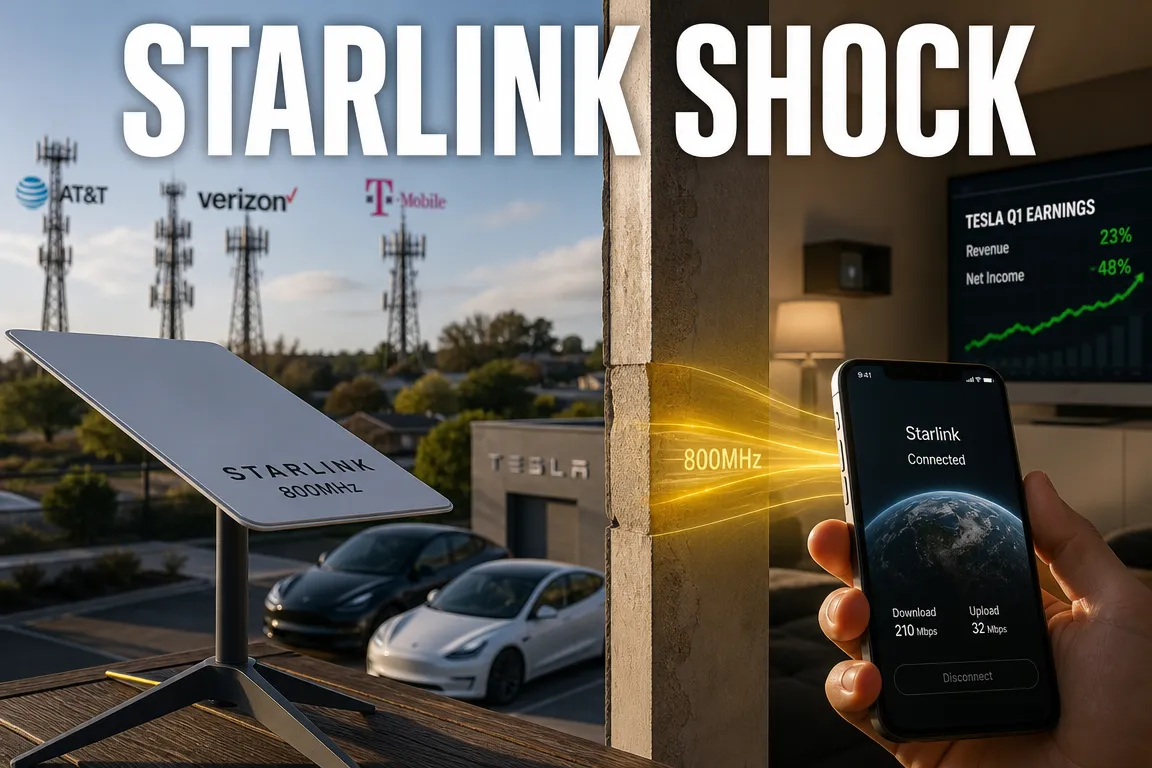
By securing 800MHz low-band spectrum, which can penetrate walls and reach indoors, SpaceX is increasing the likelihood that Starlink can expand beyond “internet from space” toward mobile network functionality.
The immediate market reaction, including an after-hours decline of about 7% in AT&T, Verizon, and T-Mobile, reflects that implication.
More importantly, this shift connects Tesla earnings, Tesla stock, robotaxi autonomy, Optimus, and AI data center demand in a single narrative.
For Tesla’s October 21 earnings release, investors may need to focus not only on vehicle deliveries, but also on SpaceX equity valuation and Starlink integration strategy.
1. Market backdrop: U.S. equities were pressured by AI revenue data and interest rates
On the referenced trading day, Tesla traded around $375 and fell 0.74%.
The Nasdaq declined 1.25%, with technology shares broadly weaker.
Tesla underperformed slightly but was less weak than the broader technology market.
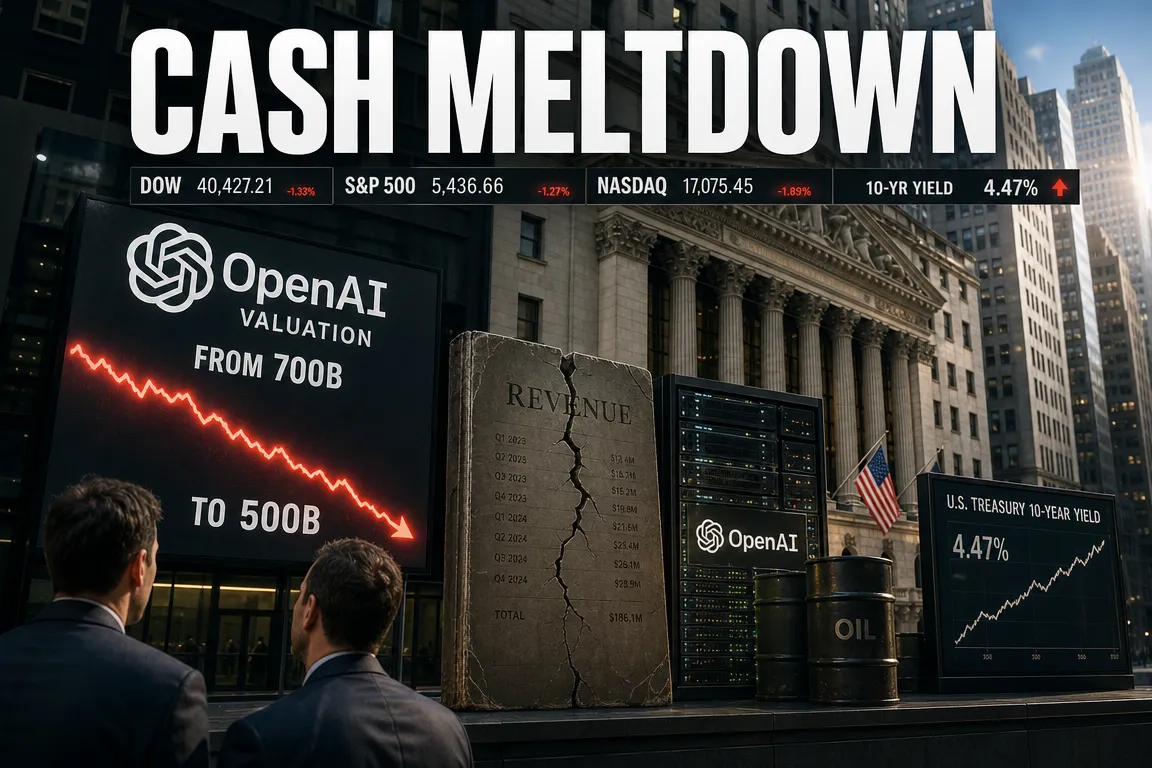
The Nasdaq was pressured by reported OpenAI revenue figures.
According to the Financial Times, OpenAI’s annualized revenue as of September was about $50 billion, below the $70 billion level previously discussed in the market.
The key issue is not that OpenAI misreported figures, but that the revenue calculation methodology differed.
Anthropic appears to have included revenue routed through Amazon and Google Cloud, while OpenAI reportedly excluded such amounts.
AI revenue scale is directly linked to AI data center spending, semiconductor demand, and cloud infrastructure investment expectations.
Lower revenue expectations can therefore weigh on investor sentiment toward Nvidia and other technology and semiconductor shares.
Bond market conditions also added pressure.
Demand at the U.S. 30-year Treasury auction was weaker than expected, while 10-year Treasury yields remained elevated.
Higher Treasury yields increase auto financing costs.
For Tesla and other automakers, that translates into higher purchase affordability pressure.
Federal Reserve expectations also remain a source of market tension.
Markets currently assign a relatively high probability to a policy hold later this month, but recent Fed communications have also left open the possibility of one additional rate hike this year.
For Tesla investors, the relevant framework now extends beyond deliveries to include rates, consumer demand, and the AI investment cycle.
2. The key development: SpaceX bought 800MHz low-band spectrum
The central news is that SpaceX agreed to acquire 800MHz spectrum for nationwide use in the United States.
The seller was identified as Grain Management, an investment firm.
The transaction price was not disclosed, and Federal Communications Commission approval is still required.
800MHz is important because it is a low-band frequency that can penetrate buildings more effectively than higher-frequency signals.
Higher frequencies can carry more data but have weaker penetration and shorter range.
Lower frequencies carry less capacity but travel farther and pass through walls more effectively.
In practice, 800MHz is a critical “last-mile” frequency for mobile communications.
If prior SpaceX spectrum holdings functioned as a highway, this 800MHz position could serve as the local network that reaches homes and indoor spaces.
Musk described the transaction as a “quake” for those who understand the spectrum battle, even if it may look minor to the public.
Spectrum in telecom is a limited strategic asset regulated by governments and available to companies only through licensing or approval.
That is why telecom operators spend billions to secure it through auctions.
3. Why AT&T, Verizon, and T-Mobile sold off after hours
Following the SpaceX spectrum announcement, AT&T, Verizon, and T-Mobile reportedly fell by about 7% in after-hours trading.
The market reaction reflected concern that SpaceX had addressed one of the core arguments against its telecom strategy.
The main criticism from traditional carriers and Wall Street has been that satellite signals struggle to penetrate buildings.
AT&T CEO John Stankey reportedly said only nine days earlier that Musk’s telecom strategy was not feasible.
The argument was that building a dense terrestrial network requires substantial capital, and a satellite-only system cannot solve indoor coverage limitations.
SpaceX’s acquisition of 800MHz low-band spectrum directly addresses that weakness.
As a result, investors interpreted the transaction not as a simple spectrum purchase, but as a potential shift in the competitive structure of the U.S. telecom market.
The spectrum was originally associated with T-Mobile, later acquired by Grain Management in August, and then sold to SpaceX.
T-Mobile is also a partner of SpaceX in satellite messaging services, but the asset effectively moved into the hands of a potential competitor.
4. SpaceX is not becoming a major U.S. carrier overnight
Despite the significance of the announcement, it should not be overstated.
SpaceX buying spectrum does not mean it will replace AT&T immediately.
The referenced comparison indicated that the three major U.S. carriers collectively hold about 1,020MHz of spectrum.
Including SpaceX’s pending holdings, the total was described as roughly 90MHz, still well below the scale of the incumbents.
FCC approval is also required.
Network deployment, satellite launches, handset compatibility, and regulatory clearance could all take years.
This is therefore better understood as the opening of a credible entry path rather than an immediate market disruption.
For investors, however, that distinction is meaningful.
Telecom networks generate durable cash flow once established.
If SpaceX evolves from a rocket company into a satellite internet provider and then into a global telecom infrastructure platform, valuation frameworks could change materially.
5. Why SpaceX wants to become a telecom operator: machine connectivity is the real market
A key point often underemphasized is that the future telecom customer may be machines rather than people.
Musk’s view is that AI, humanoid robots, and autonomous vehicles will drive far greater data demand than in the past.
Telecom networks have historically been designed around human smartphone users.
Future demand may come from robotaxis, Optimus robots, drones, logistics robots, autonomous vehicles, and industrial AI systems operating continuously.
In that scenario, the core telecom customer becomes a machine that exchanges data 24/7.
This is especially relevant for Tesla.
A driverless robotaxi requires uninterrupted connectivity.
Optimus robots operating in factories, logistics centers, or homes require stable data links.
Vehicles and robots that continuously exchange and update data may require less dependence on traditional mobile carriers.
This is where the strategic link between Starlink and Tesla becomes more important.
If SpaceX secures both satellite connectivity and terrestrial low-band spectrum, Tesla may be able to reduce reliance on external carriers such as AT&T over time.
6. Tesla and AT&T: vehicle connectivity may change
Tesla is currently understood to use AT&T’s network for vehicle connectivity in the United States.
Tesla vehicles need mobile network access for music streaming, internet connectivity, map data, and remote functions.
Musk reportedly said in August that Starlink would eventually be integrated into all vehicles.
There were also reports that Cybercab would already include a Starlink antenna.
If this direction materializes, Tesla vehicles could become connected AI endpoints within the Starlink network.
As robotaxis scale, the strategic value of Tesla owning its own connectivity layer increases.
Improved coverage could also expand the operational footprint of robotaxi services.
7. What to watch in Tesla’s October 21 earnings release
The main question for this earnings report is not only how much Tesla earned, but where the earnings came from.
The referenced material notes that Tesla holds a stake in SpaceX, and changes in SpaceX’s valuation can affect Tesla’s net income.
In the second quarter, Tesla’s $1.114 billion net income was said to have been materially influenced by gains from its SpaceX stake.
By contrast, operating income from automotive and energy businesses was reported at about $398 million.
This distinction matters.
Investors need to determine whether earnings strength came from core operations or from mark-to-market gains on holdings.
The third quarter may look different.
SpaceX-related equity was described as declining from about $170 at the end of June to around $150 at the end of September, implying a decline of roughly 11%.
Because earnings are likely calculated using a September 30 reference point, the valuation tailwind seen in the second quarter may be smaller.
Accordingly, investors should not focus only on GAAP net income.
They should separate automotive margins, energy storage revenue, FSD revenue recognition, cash flow, and SpaceX valuation effects.
8. Key checkpoints for Tesla shareholders near $375
At around $375, Tesla already appears to be priced as more than a pure vehicle manufacturer.
That suggests investors are valuing Tesla as an AI, autonomy, robotics, energy, and connectivity ecosystem company.
However, a higher multiple also means a higher bar at earnings.
Investors should focus on the following:
- First, whether profitability in the core automotive business is improving.
- Second, whether the FSD and robotaxi timelines are becoming more specific.
- Third, whether Starlink-Tesla connectivity strategy is mentioned explicitly.
- Fourth, how much SpaceX valuation contributes to net income.
- Fifth, how higher rates and auto financing costs may affect demand.
Tesla shareholders now need to evaluate more than vehicle deliveries.
The relevant framework includes SpaceX, Starlink, xAI, Optimus, and robotaxi strategy.
9. Cybercab regulatory issue: U.S. authorities are requesting documentation
The U.S. National Highway Traffic Safety Administration reportedly issued a special order requiring Tesla to provide materials related to Cybercab.
Tesla reportedly requested an extension, citing the volume of requested documents.
The referenced report indicated a request to extend the deadline by about eight weeks to November 20.
The key issue is the sequencing of the October 21 earnings call and the regulatory response deadline.
If Tesla makes aggressive statements about Cybercab expansion during the earnings call and submits a different position in later regulatory filings, that could create inconsistencies.
The extension request may therefore reflect an effort to align earnings-call messaging with regulatory documentation.
Robotaxi deployment is not determined by technology alone.
It also requires regulatory approval, liability allocation, insurance, data disclosure, and safety validation.
For Tesla investors, the NHTSA document process may matter as much as the product announcement itself.
10. Korea FSD issue: the U.S. requests documents while Korea remains in a holding pattern
Tesla’s FSD issues were also discussed in South Korea’s parliamentary audit process.
The referenced data indicated 238,968 Tesla vehicles registered in Korea.
Of those, 185,491 were China-made Model 3 and Model Y units.
That implies that close to 80% of Tesla vehicles in Korea face limitations on FSD access.
Tesla Korea’s representative reportedly acknowledged that no FSD test had been formally requested from the Ministry of Land, Infrastructure and Transport or the Korea Transportation Safety Authority.
The company said it would undergo testing once a formal channel and process were available, but did not specify when it would apply.
The ministry reportedly said there is no international standard for FSD.
It also noted that Tesla continues to assign accident responsibility to the driver, which makes global standardization difficult.
This remains a practical constraint.
The United States is actively reviewing Tesla through document requests, while Korea is waiting for a formal process and citing the absence of global standards.
As a result, Korean consumers may continue to lag the U.S. market in access to FSD features.
11. Trump and Musk: political signaling remains relevant
The referenced material also noted that President Trump awarded Musk the National Medal of Science at a White House science event.
Trump described Musk as a modern-day Thomas Edison.
He also referred to Tesla as the first successful new car company in 75 years and praised its consumer-facing autonomous driving technology.
He further said Starlink saved lives during a hurricane.
This is more than praise; it signals that Tesla and SpaceX are being recognized as strategic infrastructure companies.
However, political support is not the same as regulatory approval.
Even with favorable political rhetoric, agencies such as NHTSA and the FCC will still act according to safety and communications rules.
Investors should therefore distinguish between political goodwill and regulatory risk.
12. The most important point other reports often miss
First, SpaceX’s telecom ambition is not only about smartphone subscribers.
The larger market may be machine connectivity for robots, autonomous vehicles, AI devices, and industrial systems.
Second, the quality of Tesla earnings matters.
Investors should separate SpaceX valuation gains from core earnings generated by automotive and energy operations.
Third, Starlink could alter Tesla’s connectivity cost structure.
If Tesla reduces dependence on AT&T and builds a more integrated network ecosystem, robotaxi operating economics and data strategy could change materially.
Fourth, timing with regulators matters.
If Tesla discusses Cybercab and Starlink integration at the October 21 earnings call, that messaging should be consistent with later NHTSA filings.
Fifth, SpaceX has not captured the telecom market.
It has secured a critical first component that could weaken the defensive arguments of incumbent carriers.
That distinction is important for avoiding both excessive optimism and excessive skepticism.
13. Investor conclusion: Tesla can no longer be evaluated as a vehicle company alone
SpaceX’s 800MHz spectrum purchase matters for Tesla shareholders as well.
Tesla’s future value can no longer be explained solely by EV deliveries.
Robotaxis, Optimus, AI infrastructure, Starlink connectivity, and SpaceX equity value are becoming interconnected.
The central question for the October 21 earnings release is this:
Is Tesla generating profits from its automotive business?
Or is it relying on asset valuation gains to support net income?
And is the Starlink-linked machine connectivity strategy progressing toward a real revenue model?
At around $375, Tesla investors should focus less on short-term share price movement and more on this structural transition.
If SpaceX develops into a telecom infrastructure platform and Tesla vehicles and robots connect to that network, the synergy between the two companies could increase materially.
If FCC approval is delayed, regulation remains slow, FSD liability issues persist, and interest rates stay high, the conversion of expectations into earnings may take longer.
< Summary >
SpaceX acquired 800MHz low-band spectrum, increasing the likelihood that Starlink can expand toward mobile connectivity.
The announcement triggered an after-hours selloff in AT&T, Verizon, and T-Mobile.
800MHz is important because it can penetrate buildings and challenge the defensive position of incumbent carriers.
FCC approval and network deployment are still required.
For Tesla, investors should separate SpaceX valuation gains from core automotive earnings.
The October 21 earnings release will be most important for any update on Starlink, robotaxi, and Optimus strategy.
Tesla shareholders now need to evaluate deliveries, SpaceX, Starlink, AI infrastructure, and regulatory developments together.
[Related Articles…]
- Tesla Earnings and the AI Infrastructure Valuation Framework
- How Starlink Is Reshaping Global Telecom Competition
*Source: [ 오늘의 테슬라 뉴스 ]
– AT&T CEO가 “불가능”이라던 걸 SpaceX가 9일 만에 샀다 — 10월 21일 테슬라 실적표엔 어떻게 찍힐까, $375 주주는?
● K-Economy Split Boom-Bust Shock
1 Million Self-Employed Businesses Closing: The Real Reason Financial Markets and the Real Economy Have Separated
The core issue is not simply that self-employment is difficult.
This report explains, from a structural perspective, why equity and property markets appear strong while restaurants, franchise operators, and small businesses are under pressure.
It also links together higher interest rates, self-employed debt, franchise closure costs, semiconductor-driven market distortion, failed retirement entrepreneurship, and rising investment fraud.
Official indicators may suggest that the Korean economy is holding up, but conditions on the ground indicate simultaneous weakness in the real economy and consumer sentiment.
This report also examines two issues often overlooked in news coverage: debt that remains after closure, and why retirees continue to enter chicken shops and franchise businesses.
1. The current Korean economy: strong equities, weak self-employment
The most striking feature of the current environment is the divergence between asset markets and the real economy.
Equities remain firm on semiconductor strength and liquidity expectations.
In some areas, the property market has also regained momentum.
Yet self-employed operators, younger workers, retirees, and small business owners are seeing little meaningful recovery.
This is a classic case of K-shaped divergence.
On one side, semiconductors, large corporations, and capital markets are improving headline indicators.
On the other side, restaurants, franchise businesses, neighborhood retail, youth employment, and mid-career reemployment remain under pressure.
The key point is that this gap is increasingly structural rather than cyclical.
In other words, it is not a problem that will automatically normalize over time; debt, high rates, weak consumption, and labor-market insecurity may reinforce one another.
2. Why the figure of 1 million closures is significant
The most frequently cited figure in the discussion is 1 million self-employed closures.
The number is significant, but the quality of closures matters more.
In the past, businesses closed because sales were weak.
Now, many businesses close only after owners can no longer service debt.
Franchise closures are particularly burdensome.
Termination fees may apply.
Inventory and goods purchased from the franchisor may remain unpaid.
Interior investments and equipment are difficult to recover.
Landlords may also require restoration costs at exit.
As a result, even after operations stop, owners may face several million won in losses, and in some cases KRW 200 million to 300 million in total burden.
Many cases then move into individual rehabilitation or bankruptcy proceedings.
3. Why franchises are especially exposed: profits do not accumulate into capital
Franchising often appears to be a stable option because the brand is established, the operating manual exists, and the franchisor seems supportive.
In practice, however, the structure is much tighter.
Franchisees face fees for joining, training, interior construction, logistics, royalties, and advertising contributions.
Even when sales are strong, the owner retains only a limited portion of the profit.
When sales weaken, most of the losses remain with the franchisee.
The discussion referenced the closure of a pizza franchise store.
Pizza, chicken, and Chinese-food businesses have long been seen as core self-employment sectors in Korea.
However, with weaker dining-out demand and higher delivery costs, these categories are no longer safe havens.
Fixed costs also do not fall easily when sales decline.
Rent, labor, electricity and gas, raw materials, and delivery-platform fees all remain under pressure.
Even a modest decline in sales can push operations below breakeven quickly.
4. Why higher interest rates are especially damaging to self-employed operators
The most important variable in the discussion is higher interest rates.
Rate increases affect all economic participants, but self-employed operators are hit much more directly.
First, many rely on debt to sustain operations.
Salaried workers borrow for living expenses or home purchases, but business owners often carry both start-up and operating loans.
When sales fall short, borrowing is sometimes used to cover wages, raw materials, and rent.
Second, self-employed borrowers often become multi-debt borrowers.
Bank loans, credit-card loans, capital-company financing, policy loans, and informal borrowing can all accumulate.
Once a borrower has obligations from three or more sources, resilience declines sharply in a rising-rate environment.
Third, higher rates suppress consumer sentiment.
As interest burdens rise, consumers reduce spending on dining out, delivery, coffee shops, and leisure.
Most restaurants and franchise businesses depend on household consumption rather than business-to-business demand.
5. How failed income-property investments lead to rehabilitation or bankruptcy
Another highly relevant issue is the failure of income-generating real-estate investments.
Retirees and self-employed operators often buy retail units, officetels, or industrial facilities in an effort to secure retirement cash flow.
Sales campaigns commonly use messages such as:
“The unit costs KRW 200 million, but only KRW 20 million is needed upfront.”
“The remainder can be covered with interim and final payment loans.”
“Because it is near a station, tenants will come quickly.”
“A larger multi-unit purchase is needed to attract a major tenant.”
These claims suggest that monthly rental income can be generated with limited capital.
However, the main risks are financing costs and vacancy.
For example, if interim financing was around 3% in 2021, a rise to 6-7% after 2023 changes the economics materially.
At a KRW 700 million loan balance, 3% implies annual interest of about KRW 21 million, or roughly KRW 1.75 million per month.
At 6%, annual interest rises to about KRW 42 million, or roughly KRW 3.5 million per month.
If business sales also weaken, even one or two missed payments can trigger a credit decline.
Lower credit scores can block final financing.
If final financing is unavailable, registration and tenant placement become difficult.
The result is a situation in which the asset is not fully usable, while interest expense continues to accrue.
This is why failed income-property investments increasingly lead to individual rehabilitation or bankruptcy.
6. Semiconductor strength is masking economic weakness
A key distinction is required when assessing the Korean economy.
Improving aggregate indicators do not necessarily mean that most households are better off.
The discussion pointed out that semiconductor strength is masking broader weakness.
When semiconductor exports rise sharply, headline export data improves.
But if other sectors remain weak, the real economy will still feel subdued.
This is a classic average effect.
When Samsung Electronics and SK hynix perform well, the national economy may appear stronger.
However, those firms employ only a small share of Korea’s roughly 29 million workers.
Most households do not directly experience improved income, job security, or consumption power from semiconductor exports alone.
Semiconductor strength may support equities.
But its immediate effect on neighborhood commerce and self-employment remains limited.
7. Why retirees move into chicken shops and franchises
Many ask why people enter businesses without sufficient preparation.
However, the issue cannot be reduced to individual capability alone.
In Korea, reemployment after the late 40s or 50s is difficult.
Even workers with long experience at large corporations, telecom firms, IT companies, or manufacturers often struggle to create an independent business after retirement.
Skills that were valuable inside a corporate system do not always translate into cash flow in the open market.
The discussion referenced retirees from firms such as SKT and KT, as well as AI developers.
Not all AI developers can immediately build a viable post-retirement business.
Technical expertise inside a large organization is often different from skills that generate revenue in small-business markets.
As a result, many retirees face a narrow set of options.
Reemployment is difficult.
Independent monetization of technical skills is also difficult.
Living expenses still need to be covered.
Retirement payouts are available.
Franchise entrepreneurship becomes the default path.
This is not merely an individual preference; it reflects labor-market structure and retirement-income insecurity.
8. Self-employment risk is structural, not simply personal failure
A central point of the discussion is that self-employment distress should not be viewed only as an individual failure.
There are certainly cases of poor preparation, excessive leverage, weak location analysis, and flawed investment decisions.
But the current wave of distress is unfolding within a much larger structure.
First, the labor market does not provide enough quality jobs.
Second, retirement ages are falling while life expectancy is rising.
Third, many people are pushed into entrepreneurship and investment as a way to generate retirement income.
Fourth, higher rates have sharply increased the burden of debt.
Fifth, inflation is causing consumers to cut dining-out spending.
Sixth, franchise structures concentrate failure costs on the operator.
Seventh, strong asset markets can intensify both investment anxiety and fraud risks.
These factors are combining to weaken the resilience of self-employed operators and small businesses.
9. Why investment fraud increases: equities rise, but individual returns lag
When the real economy weakens, people look for faster returns.
When equities are near record highs, anxiety increases further.
The perception that others are making money while one is falling behind creates strong pressure.
The discussion cited a case involving an investment professional who had worked as a producer in economic broadcasting.
He was financially sophisticated, experienced in equities, and had accumulated more than KRW 2 billion in assets.
Even so, retirement-related anxiety made him vulnerable to a stock seminar and group chat-based fraud scheme.
The reported loss was approximately KRW 1.3 billion.
This case is notable because the victim was not financially inexperienced.
Even knowledgeable investors can become vulnerable when uncertainty is high.
The fraud pattern is generally similar.
It begins with plausible instruction on charts, waves, and stock analysis.
Victims are then moved into group chat rooms.
The operators promote ideas such as “building a collective position,” “raising returns through joint investment,” or “depositing funds into a dedicated platform.”
Small gains are shown at first, then larger deposits are encouraged.
Eventually withdrawals are blocked or the platform disappears.
Fraud risk tends to rise when equity markets are strong but the real economy remains weak.
10. Consumption shifts: supermarkets and convenience stores gain while dining-out weakens
When inflation and rates rise at the same time, consumers reallocate spending.
Consumption does not disappear entirely, but more expensive categories are reduced first.
Typical cuts occur in dining out, delivery, coffee shops, alcohol-related spending, and leisure.
By contrast, supermarkets, convenience stores, ready-to-eat meals, and lower-cost options may benefit.
This is particularly damaging for self-employed operators.
Restaurants face higher raw-material and labor costs while customer traffic falls.
If prices are raised, demand weakens further; if prices are held down, margins disappear.
As a result, revenue may appear stable while net profit declines sharply.
11. The most important point rarely emphasized in media coverage
The most important point is that closure is not the end; it is the beginning of a new burden.
Many reports focus on closure counts, lower sales, and vacancy rates.
But in practice, the post-closure debt structure is often more severe.
Franchisees may lose the ability to recover key money.
Interior investment is often written off.
Termination fees may apply.
Restoration costs under the lease can be significant.
Operating loans remain outstanding.
Credit-card debt and unsecured personal loans remain as well.
Tax arrears and social insurance contributions can also accumulate.
In other words, once a business closes, a self-employed operator cannot easily restart as a salaried worker.
Credit is already impaired, debt remains, and reemployment is difficult.
A second important point is that retiree entrepreneurship is often a forced outcome rather than a free choice.
It may appear that individuals voluntarily invested retirement savings in a business.
In reality, many were pushed out of the labor market, faced retirement-income insecurity, and had limited alternatives.
A third important point is that semiconductor strength can distort perceptions of the economy.
Claims that the Korean economy is improving do not automatically translate into better sales for individual businesses.
If export-led gains do not reach domestic self-employment, divergence may deepen further.
12. Key indicators to watch going forward
To assess self-employment stress, the stock index alone is insufficient.
The following indicators should be monitored together.
First, delinquency rates among self-employed borrowers.
Rising delinquency rates often signal more individual rehabilitation and bankruptcy filings.
Second, the share of multi-debt borrowers.
As the number of self-employed borrowers with obligations to three or more lenders rises, rate sensitivity increases.
Third, dining-out consumption data.
Lower dining-out spending increases pressure on franchises and neighborhood restaurants.
Fourth, export trends excluding semiconductors.
It is important to determine whether recovery is broad-based or concentrated in semiconductors alone.
Fifth, individual rehabilitation and bankruptcy filings.
These are among the clearest late-stage warning indicators in the real economy.
13. What individuals should be cautious about now
First, putting all retirement savings into a new business is highly risky.
At least one to two years of living expenses and emergency reserves should be kept separate.
Second, before starting a franchise, speak first with former franchisees who closed rather than with the franchisor’s success stories.
The cost structure after failure matters more than the sales of top-performing stores.
Third, if purchasing income property with debt, the calculation should be based not on 3% rates but on the ability to survive 7-8% rates.
If the investment cannot withstand six months to one year of vacancy, it is too risky.
Fourth, group-chat investment schemes, guaranteed returns, high-yield promises, and “deposit into our platform” instructions should be treated with extreme caution.
Even people who appear to be financial experts can be fraudulent.
Fifth, rising equity prices do not mean an individual’s investment skill has improved.
In a bull market, both fraud and overconfidence tend to increase.
< Summary >
Korea is currently experiencing a large divergence between financial markets and the real economy.
Semiconductor strength is supporting exports and equities, but self-employed operators and small businesses still face weak demand.
Self-employment closures are not simply business failures; they reflect the combined effects of high rates, debt, weaker consumption, and franchise economics.
In particular, closure often leaves behind franchise termination fees, restoration costs, and operating loans, which can lead to individual rehabilitation or bankruptcy.
Retirees are drawn into franchises and income-property investments because reemployment is difficult and retirement income remains uncertain.
Rising equity markets can also increase both investment anxiety and fraud exposure, requiring caution.
[Related Articles…]
Self-Employed Debt Pressure Under Higher Interest Rates
Semiconductor-Led Growth and Korea’s Market Divergence
*Source: [ 경제 읽어주는 남자(김광석TV) ]
– “100만 명이 문 닫았습니다” 주식시장과 실물경제가 완전히 갈라진 이유 | 경읽남과 토론합시다 | 박기태 변호사 [1편]