● AI Agent Commerce War
Amazon blocked Muse, while Walmart and Shopify opened up: Why AI agent commerce is shaking up the holiday shopping landscape
The core point of this issue is not simply that “Amazon blocked an AI shopping agent.”
The really important point is that the starting point of shopping can shift from the Amazon app to an AI agent.
This also connects at once to advertising revenue in the e-commerce market, impulse buying, logistics scale economies, payment systems, cloud computing, data center investment, and AI device strategy.
In simple terms, an AI agent like Muse is not just a service that finds products for you; it is a technology that changes the starting point of platform power.
1. Summary of the event: Amazon blocks it, Walmart and Shopify allow it
Recently, Muse, an AI agent-based shopping service, has emerged as a hot variable in the commerce industry.
Amazon has blocked Muse’s access, while Walmart and Shopify are showing a trend of actively cooperating.
On the surface, privacy or security issues may be cited as reasons, but the real core point is control over customer touchpoints.
- Amazon believes shopping must begin with the Amazon app or Amazon.com.
- If Muse comes in between, consumers can buy products without visiting Amazon directly.
- Walmart and Shopify see this as an opportunity to shake up Amazon, the No. 1 player, and are joining hands with AI agents.
- Shopify is rapidly jumping into agent commerce by connecting its own store ecosystem, Shop Pay, and Stripe’s payment network.
As mentioned in the video, the trend that holiday season sales at Walmart and its own stores increased by about 10% may seem small, but from Amazon’s perspective, it is extremely threatening.
That is because Amazon’s commerce business runs on overwhelming transaction volume and logistics efficiency rather than high margins.
2. The first reason Amazon dislikes Muse: the shopping starting point changes
In platform business, the most important thing is “where the user opens first.”
In the past, when people searched, they opened Naver or Google.
When they shopped, they opened Amazon, Coupang, or Naver Shopping.
But once AI agents take hold, users will call on an AI assistant first rather than a shopping app.
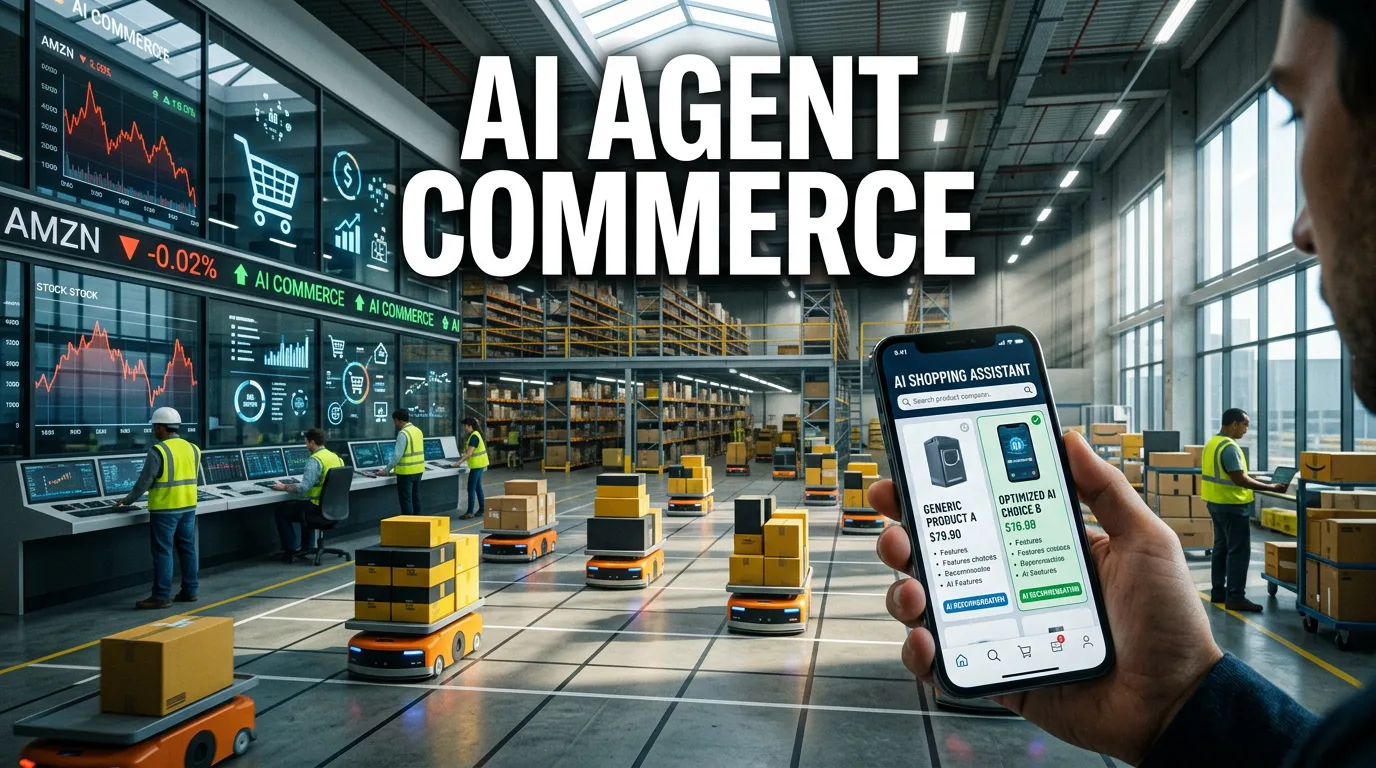
For example, if a consumer says, “Choose a cost-effective cordless vacuum and order it for me,” an AI agent can compare Amazon, Walmart, Shopify’s own stores, Coupang, and Naver Store.
In that case, the consumer does not need to open a specific shopping app.
From the platform’s perspective, this means losing the first screen that connects with customers.
This change is also important from the perspective of the global economic outlook.
If AI agents become the gateway to commerce, the enterprise value of distribution companies may be reevaluated not just by sales, but by the structure of being selected by agents.
3. The second reason Amazon dislikes Muse: AI agents do not impulse buy
Human customers waver once they enter a shopping mall.
They may intend to put only one item in the cart, but after seeing recommended products, they buy more.
If they are 1,200 won short of the free shipping threshold, they may add a 12,000 won item.
They keep reacting to flash deals, time sales, reviews, banner ads, and recommended products.
But AI agents are different.
AI agents do not view ads emotionally.
They are not swayed by free shipping slogans.
Even when analyzing reviews, the goal is to choose “one product most suitable for the user.”
- Impulse buying decreases.
- Upselling and cross-selling effects weaken.
- Exposure to in-mall ads declines.
- Retail media ad revenue may be shaken.
- The average order value may fall.
This point is especially painful for Amazon.
Amazon generates enormous revenue not only from product sales but also from its advertising business.
But if AI agents buy on behalf of consumers, fewer people will see ads.
In the end, from a commerce platform’s perspective, AI agents are “efficient but annoying customers.”
4. A more important issue: a 10% decline in sales can lead to a logistics cost shock
The core point that is often missed in other news is the scale economy of logistics.
Companies like Amazon and Coupang design their logistics centers, inventory management, delivery vehicles, and last-mile systems around enormous transaction volume.
In this structure, a 10% drop in sales does not simply end with a 10% decline in revenue.
For example, delivery trucks need to be full to be efficient.
Inventory turnover at logistics centers must be high to reduce storage costs.
Fast delivery services like Prime delivery or Rocket Delivery work only when a certain volume is maintained.
But what happens if AI agents disperse consumers across Walmart, Shopify’s own stores, and other platforms?
Amazon’s delivery network will have empty space, and the average operating cost of the remaining 90% of volume will rise.
That is the real threat.
In other words, Amazon’s dilemma is simple.
Should it keep blocking Muse to protect customer touchpoints?
Or should it cooperate with Muse and give up some control in order to maintain transaction volume?
This choice is a problem that all large e-commerce players will face going forward.
5. Potential winners of the holiday shopping season: Walmart, Shopify, and payment companies
Based on the current trend, the short-term beneficiaries of the holiday shopping season are Walmart and Shopify.
Walmart has a strong reason to cooperate with AI agents as a rival to Amazon.
Shopify, as an infrastructure provider connecting countless independent stores, can gain even greater opportunities in the AI agent era.
- Walmart: It can become an alternative option for consumers and AI agents looking to reduce dependence on Amazon.
- Shopify: It can become a key gateway connecting individual stores with AI agents.
- Shop Pay: It can expand its role in simple payments during AI shopping.
- Stripe: Its presence can grow in agent-based payments and merchant payment infrastructure.
- Consumers: They can save time and money as AI handles price comparisons, review analysis, and delivery condition comparisons.
On the other hand, Amazon is likely to take a defensive stance in the short term.
However, in the long term, Amazon may also reframe the playing field through its own AI assistant or an AWS-based AI strategy.
6. Applied to the Korean market: Coupang, Naver, and Kakao’s choices matter
It is not easy for an AI agent like Muse to enter Korea right away.
That is because payment systems, personal information, domestic platform integration, logistics data, and shopping mall accessibility issues all need to be resolved.
But although it will take time, the direction is clear.
In Korea, Coupang, Naver, Kakao, and Toss are likely to become key players.
- Coupang: It may face the same dilemma as Amazon, as the No. 1 player.
- Naver: It is highly likely to build an AI agent based on search, blogs, email, Naver Pay, and Smart Store data.
- Kakao: It can challenge external commerce connections based on the powerful everyday touchpoint of KakaoTalk and the gifting experience.
- Toss: It can have strengths in the financial AI agent area based on financial data and MyData.
In particular, Naver is highly likely to move.
Naver already possesses search data, shopping data, content data, and payment data.
AI agents need user data to make good recommendations, and Naver has a strong foundation for that.
Coupang has to make a choice.
Will it block AI agents created by Naver or Kakao?
Or will it cooperate to some extent and maintain transaction volume?
Depending on this choice, the pace of digital transformation in the Korean e-commerce market could also change significantly.
7. It is not just a commerce issue: travel, finance, and insurance are also shaken
The impact of AI agents does not stop at shopping.
It can extend to travel, hotel reservations, financial products, insurance, and card management.
Looking at the travel industry, large booking platforms such as Expedia and Booking.com currently dominate hotel databases and reservation systems.
Hotel reservations are not simply a matter of searching for a room.
There are many cumbersome tasks such as checking room inventory, price fluctuations, cancellation processing, customer complaints, and reservation changes.
But if AI agents can handle these cumbersome tasks, the situation changes.
AI can negotiate directly with hotel websites, compare conditions, and confirm reservations.
In that case, the power of intermediary platforms may weaken.
The same goes for finance.
When MyData and AI are combined, users’ card spending, insurance premiums, loan interest, subscription services, and investment products can be managed comprehensively.
For example, if an AI agent saves even 50,000 won a month, consumers will feel strong utility.
If it saves 300,000 won a month, there is also a sufficient chance it could establish itself as a financial super app.
8. The super app competition starts again
For a while, super app competition centered on platforms like KakaoTalk, WeChat, Toss, and the Naver app.
But in the AI agent era, the standard for a super app changes.
What matters is not how many functions are inside the app.
It is which AI the user calls first.
Going forward, users may delegate schedule organization, email handling, shopping, travel booking, banking tasks, card management, insurance comparisons, and mobility calls to AI.
If that happens, the AI agent becomes the first screen of the smartphone.
The entertainment area is a bit different, however.
Watching YouTube Shorts, watching Netflix, and taking a break while watching a baseball game are experiences AI cannot replace.
AI can recommend or summarize content, but it is difficult for it to replace the time people directly enjoy themselves.
9. The technical meaning of the Muse moment: cloud shifts from storage to a personal computer
The most important technological change in this issue is the changing role of the cloud.
Until now, cloud for individuals has mainly been storage space.
iCloud, Google Drive, and Dropbox were closer to stylish external hard drives.
But in the AI agent era, the cloud becomes not storage but a personal computer.
Each user gets a virtual laptop inside the cloud, and inside it, AI opens browsers, runs apps, fetches data, and handles payments.
- An individual AI workspace is created inside the cloud.
- Computing resources such as GPU, HBM, CPU, and SSD are allocated to user tasks.
- Smartphones or laptops may become devices mainly for issuing commands.
- The heavy computation is actually processed in the data center.
This change can explosively increase demand for data center investment.
There are already stories that data centers are insufficient even for B2B AI demand alone, but when B2C AI agents become fully active, demand for computation at the individual user level is added as well.
In the end, cloud computing will move even faster from a simple storage industry to an AI infrastructure industry.
10. Reinterpreting AI devices: rather than replacing smartphones, the key is a “lightweight terminal”
There have already been failures in the AI device market.
Products like Rabbit R1 and Humane AI Pin had good ideas, but agent technology was not mature enough.
They were slow, frustrating, and limited in what they could actually do.
But now the situation may be somewhat different.
If AI actually handles work inside a personal workspace in the cloud, devices do not necessarily need powerful computing performance.
Wearable charms, employee badge-style AI terminals, earbuds, smartwatches, and thin laptops may regain relevance.
The key point is not that the device itself must be smart.
It is how naturally the device connects to my own AI computer in the cloud.
From this perspective, future laptops can become lighter.
A structure where only the display, keyboard, battery, and network connection are present, while actual computation is handled by AI in the cloud, becomes possible.
11. A fee model is more realistic than a paid subscription
Another important question is whether an AI agent like Muse will be monetized quickly.
But charging consumers by tokens may be unfavorable for mass adoption.
Ordinary users are likely to find technical billing methods like “you used up this week’s tokens” inconvenient.
A more realistic business model is transaction fees.
If an AI agent purchases a product, it can receive a fee from the seller.
If it arranges insurance, it can receive a fee from the insurer.
If it connects a financial product, it can earn revenue from the financial company.
Of course, an advertising model could also come in.
However, if advertising is mixed into AI recommendations, there may be a trust issue.
Even so, because search advertising already works in that way today, there is a strong chance AI advertising will not be completely excluded either.
12. The most important point that other YouTube channels or news outlets don’t emphasize enough
- First, AI agents shake the margin structure before sales.
A company like Amazon may see a 10% drop in sales lead to rising logistics, inventory, and delivery costs. - Second, AI agents expose the weakness of ad-based commerce.
Humans look at ads, but AI only looks for the target product. - Third, the competitor of a shopping mall becomes not another shopping mall, but the “first AI called.”
Going forward, platform competition may depend more on AI call frequency than on app installation counts. - Fourth, the cloud market shifts from storage space to personal computing space.
This can be a factor that extends the investment cycle for GPU, HBM, and data centers. - Fifth, alliances and realignments among Coupang, Naver, Kakao, and Toss in Korea may open up again.
Even if the current No. 1 and No. 2 remain in place, the market structure is likely to change.
13. Key points from an investment perspective
This change is not just news about the launch of an AI service; it is closer to a structural industry shift.
If AI agents actually handle purchasing, reservations, payments, and financial management, beneficiary industries and pressured industries may clearly diverge.
- Potential beneficiaries: cloud companies, data centers, GPU/HBM semiconductors, payment infrastructure, AI agent platforms, own-store solution companies
- Potential pressure points: existing e-commerce ad models, intermediary booking platforms, distribution based on impulse buying, closed marketplaces
- Strategic variable: whether Amazon chooses defense, cooperation, or restructuring around AWS
- Korean variable: Naver AI agents, KakaoTalk-based commerce, Coupang’s blocking or cooperation strategy, Toss’s expansion into financial AI
In the end, AI agents are a time-saving assistant for consumers.
But for platform companies, they are pressure that forces the customer touchpoint and revenue model to be redesigned.
To understand this difference, you need to properly see the future changes in the AI industry and the e-commerce market.
< Summary >
Amazon blocked Muse to protect customer touchpoints, advertising revenue, impulse buying, and logistics efficiency.
Walmart and Shopify are embracing AI agents as an opportunity to shake up Amazon.
AI agents can expand not only into shopping but also into travel, finance, insurance, and payments markets.
The biggest change is the super app competition where AI, not shopping apps, becomes the first screen.
Also, the cloud is shifting from storage to a personal AI computer, likely increasing demand for data center investment and AI infrastructure.
In Korea, the strategic choices of Coupang, Naver, Kakao, and Toss are expected to become the key variables in the future e-commerce and financial AI markets.
[Related Articles…]
- How AI Agents Are Reshaping Global Platform Competition
- The Next Cycle of Data Center Investment and Cloud Computing
*Source: [ 티타임즈TV ]
– 아마존은 뮤즈 차단, 월마트와 쇼피파이 허용, 연말 승자는? (강정수 블루닷AI 연구소장)