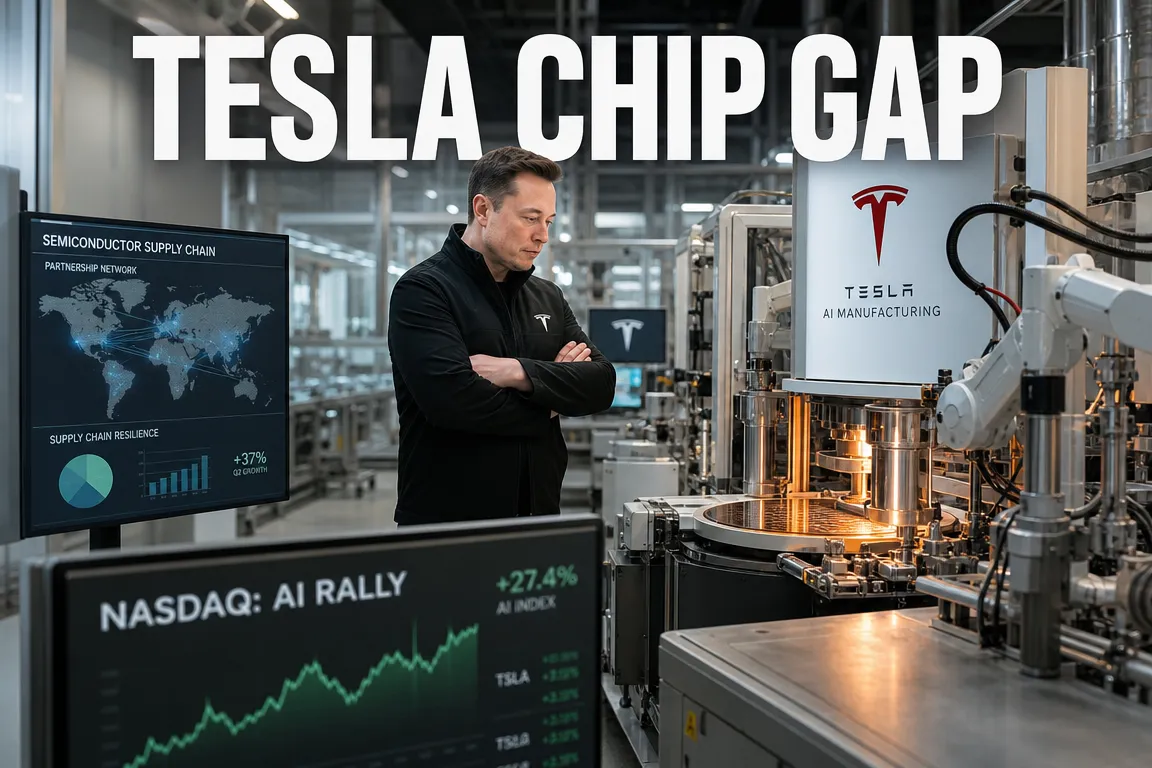
● Musk spots one fatal gap in Samsung TSMC Intel fabs, Tesla at 382 faces an AI manufacturing shock
What Musk Saw as the “One Gap” After Visiting Samsung, TSMC, and Intel Plants: What Tesla Investors Should Focus on Near $382
The key point in this statement is not simply that Tesla wants to make semiconductors.
After visiting semiconductor factories operated by Samsung Electronics, TSMC, and Intel, Elon Musk identified a core gap: advanced equipment exists, but there is a shortage of custom manufacturing equipment designed to fundamentally reshape the factory itself.
This suggests that Tesla is not simply aiming to design chips like Nvidia in the AI semiconductor market, but to redesign the manufacturing process itself in order to improve wafer throughput and iteration speed.
This topic should be viewed in connection with Tesla stock, AI semiconductors, autonomous driving, robotics, and global supply chains.
For investors holding Tesla shares near $382, the more important question is whether Tesla can be revalued as an AI manufacturing company, rather than focusing only on vehicle delivery volume.
1. The Gap Musk Identified in Samsung, TSMC, and Intel Fabs
Musk acknowledged that semiconductor manufacturing is among the most difficult industrial processes in the world.
However, after touring the fabs of Samsung, TSMC, and Intel, he highlighted an unexpected issue.
He said the leading-edge fabs were impressive, but that much of the equipment appeared to be standard tools from the same suppliers.
In other words, fabs are largely built around equipment supplied by global vendors such as ASML, Applied Materials, and Lam Research, while large-scale independent development of proprietary manufacturing equipment that materially changes the entire process appears less common.
The gap Musk identified is therefore not chip design, but chip manufacturing methodology.
Tesla already has experience designing and improving custom manufacturing equipment across its automotive production operations.
Its Gigafactories, battery production lines, body assembly lines, and gigacasting processes have shown that Tesla is not just a carmaker, but a manufacturing automation company.
Musk appears to intend to apply this approach to semiconductor fabs as well.
The initial step would be to use existing semiconductor equipment, identify bottlenecks, modify machines where needed, and potentially develop proprietary equipment to increase wafer throughput.
2. Tesla Is Targeting an AI Manufacturing Platform, Not Just a Semiconductor Company
Many investors interpret Tesla’s semiconductor push as a simple attempt to compete with Nvidia.
However, the direction of Musk’s remarks is different.
His focus is on a structure that integrates design, manufacturing, packaging, testing, and mask production within a tightly connected loop.
In the current semiconductor industry, a new chip design reaching mass production in around two years is already considered fast.
Musk wants to compress that cycle significantly.
He referred to a framework that could support roughly 10 chip design and testing iterations per year.
If achieved, Tesla would not merely be a company that buys and uses AI chips, but one that rapidly improves AI semiconductors optimized for autonomous driving and humanoid robots.
FSD, robotaxi operations, and Optimus all require substantial AI computation.
Relying solely on external chip suppliers creates constraints in cost, supply chain resilience, and performance optimization.
For that reason, Tesla’s long-term goal appears to be internalizing AI semiconductor capabilities to directly control the cost structure of autonomous driving and robotics.
3. The Core Point Other Reports Often Miss: Tesla’s Advantage Is Custom Equipment
The most important but often overlooked point in this statement is not that Tesla lacks semiconductor expertise, but that Tesla is a company that changes manufacturing equipment directly.
Musk said he still does not know how to make chips.
But he also noted that he once did not know how to make cars or rockets, and eventually built both.
The essence of this statement is not self-promotion, but Tesla’s problem-solving approach.
Rather than accepting existing supply chains and standard equipment as fixed, Tesla tends to redesign the process when bottlenecks emerge.
The Model 3 production crisis in 2018 is a clear example.
At the time, Tesla faced a survival-level problem if it could not produce 5,000 Model 3 units per week.
When the conventional assembly line became the bottleneck, Tesla built an interim production line in a parking lot and used unconventional equipment and routing to raise output.
This was not merely a colorful anecdote.
It signals that if Tesla identifies bottlenecks in semiconductor fabs, it is likely to go beyond standard equipment and redesign the process itself.
In other words, Musk’s gap analysis was not that Samsung or TSMC cannot do the job, but that the semiconductor industry as a whole tends to be risk-averse and relatively slow in repeating process innovation.
4. Why the Gigafactory Texas Research Center Matters
Musk indicated that Tesla is building a semiconductor research facility at Gigafactory Texas.
The important point is that this is not just a laboratory, but a structure intended to link chip design, fabrication, testing, packaging, and mask production into one loop.
Speed is the core competitive variable in semiconductor development.
The shorter the cycle from idea generation to design, fabrication, testing, and redesign, the faster technological progress can occur.
Musk believes that significantly increasing this iteration speed could produce different outcomes in AI chip competition.
In particular, AI chips for autonomous driving and robotics have different requirements from general-purpose data center GPUs.
Because they must operate inside vehicles and robots, power efficiency, latency, thermal management, safety, and cost all matter.
If Tesla connects vehicles, robots, software, data, and chip design into one system, it may achieve optimizations that external suppliers cannot easily replicate.
5. Optimum? No—Optimus Reveals the Real Supply Chain Risk
Musk said Optimus production expansion remains at an early S-curve stage and is progressing slowly.
The reason is that robots are more complex than cars, and there is almost no existing supply chain for them.
The automotive industry has decades of established component suppliers, but the humanoid robotics industry does not yet have that structure.
Musk also said that China’s restrictions on magnet exports for electric motors delayed the Optimus program by two to three months.
He joked that this resulted in a robot without arms, but the underlying point is a serious supply chain risk.
To mass-produce Optimus, Tesla must secure stable supplies of motors, reducers, sensors, actuators, batteries, AI chips, magnets, and other critical components.
If any country restricts exports of strategic materials or parts, robot production can be disrupted immediately.
That is why Musk continues to emphasize the need for the U.S. to produce as many critical components as possible domestically.
This is directly connected to U.S. industrial policy, reshoring, and supply chain reconfiguration.
6. Why Robotaxi Expansion Appears Slower Than Expected
Musk said robotaxi expansion may look slow on the surface, but that the monthly growth rate remains strong.
However, Tesla is being highly cautious about accidents.
He said that if a Tesla robotaxi injures or kills someone, it would become a global headline.
He is aware that while roughly 1 million people die in road accidents each year worldwide, a single Tesla robotaxi incident could trigger immediate regulatory intervention.
For that reason, Tesla is carefully validating railroad crossings, ambiguous intersections, local road layouts, and edge cases before expanding into new cities.
Musk even mentioned the challenge of detecting a gray kitten on gray asphalt at night.
While this may sound trivial, it underscores the need for autonomous driving AI to handle highly rare and ambiguous situations.
For FSD to evolve into a robotaxi business, Tesla must prove not just that it performs well in most situations, but that it remains safe in highly unusual ones.
7. Musk’s Concept of “Real AI” Versus Demonstration Robots
Musk argued that many robot demonstrations are not real AI, but rather pre-scripted routines.
Even a complex-looking robot demo is not equivalent to a general-purpose AI system if it only operates in a prearranged environment.
For him, real AI is the ability to adapt to unfamiliar situations.
For example, FSD must work not only in familiar environments, but also in new cities and road conditions.
The same applies to Optimus.
It must not merely repeat predefined motions, but respond to new objects, new spaces, and unexpected human behavior.
The challenge is greater for robots than for cars because robots have much higher degrees of freedom.
A car mainly manages direction, speed, braking, and lane changes, whereas a humanoid robot must handle fingers, arms, legs, balance, and object manipulation.
That is why Optimus could create a very large market if successful, but why early production scaling is likely to remain slow.
8. What Investors Near $382 Should Focus On
Tesla’s valuation near $382 can no longer be explained by the framework of a pure auto company.
At this level, investors should ask whether Tesla can expand beyond electric vehicle manufacturing into an AI infrastructure company.
The first checkpoint is the pace of robotaxi city expansion.
The key issue is whether Tesla can extend operations into additional markets while managing regulatory risk and avoiding accidents.
The second checkpoint is FSD safety data.
Tesla must continue building evidence that its system is materially safer than human drivers for robotaxi value to be reflected in the share price.
The third checkpoint is supply chain localization for Optimus.
Repeated issues such as China’s magnet export restrictions could continue to delay large-scale robot production.
The fourth checkpoint is the practical progress of the Gigafactory Texas semiconductor research facility.
Investors should watch whether Tesla can actually accelerate chip design cycles and improve both AI chip performance and cost.
The fifth checkpoint is manufacturing equipment innovation.
If Tesla can demonstrate concrete cases where existing semiconductor equipment is modified to improve wafer throughput, the market may begin to value the company differently.
9. Near-Term Risks Remain Clear
Although the statement is notable, it would be difficult to argue that all of this will be reflected in the share price immediately.
Semiconductor fabs require massive capital expenditures.
The technical barrier is high, and trial-and-error cycles may take significant time.
Musk himself said the process could take several years.
If Tesla attempts to manufacture chips directly, how it cooperates or competes with the existing foundry ecosystem will also be an important variable.
Robotaxi expansion faces substantial regulatory risk because a single accident can rapidly change the policy environment.
Optimus has a very large potential market, but large-scale production and real-world deployment still require validation.
Accordingly, investors should not focus only on whether EV sales rise or fall.
They should also assess whether Tesla’s four core pillars—AI semiconductors, robotics, autonomous driving, and manufacturing automation—translate into actual financial results.
10. One-Sentence Summary
Musk’s next gap for Tesla is not simply becoming a better AI chip designer, but becoming a company that can build AI chips faster, test them faster, and change manufacturing processes faster.
Samsung and TSMC remain world-class semiconductor manufacturers.
However, Musk appears to believe that the existing semiconductor industry’s dependence on standardized equipment and stable processes creates an opportunity in ultra-fast iteration and custom manufacturing equipment innovation.
If Tesla succeeds with this strategy, the market may begin to value it as an AI manufacturing platform rather than only an electric vehicle company.
If it fails, the resulting capital burden and delay risk could weigh on the stock.
For Tesla shareholders near $382, the central question is straightforward.
Can Tesla move beyond selling more cars and directly control the manufacturing infrastructure of the AI era?
< Summary >
After touring semiconductor factories operated by Samsung, TSMC, and Intel, Musk identified the lack of custom manufacturing equipment as the key gap.
Tesla is not stopping at existing equipment and is likely pursuing a strategy that modifies bottlenecks to improve wafer throughput and chip development speed.
The Gigafactory Texas research center may become a structure that combines chip design, fabrication, testing, packaging, and mask production in a single loop.
Optimus has been delayed by China’s restrictions on magnet exports, highlighting the importance of supply chain localization.
Robotaxi expansion is being pursued cautiously because of accident and regulatory risks.
At around $382, Tesla investors should evaluate not only vehicle deliveries, but also progress in AI semiconductors, autonomous driving, robotics, and manufacturing automation.
[Related Articles…]
Tesla AI semiconductor strategy and stock outlook
Key developments in the robotaxi market
*Source: [ 오늘의 테슬라 뉴스 ]
– 삼성·TSMC 공장 다 둘러본 머스크 “딱 하나가 없더라” — 테슬라가 파고들 빈틈, $382 주주는?
● Treasury-Yield Shock, Nasdaq Soars, AI Mania
U.S. Treasury Yields at a 24-Year High: Why Are Nasdaq and AI Companies Still Rising?
The key issue in today’s market is not simply that interest rates are high.
The core point is that while most assets are under pressure in a high-rate environment, capital is concentrating in Nasdaq stocks and U.S. AI companies.
When U.S. Treasury yields rise to their highest level in 24 years, equities, real estate, gold, and bitcoin would typically face broad pressure.
In practice, however, Nasdaq has reached new all-time highs, and AI-related companies have continued to outperform.
This is not a simple liquidity-driven rally. It is better understood as a capital rotation into assets and companies that are perceived as durable winners.
This report reviews the impact of higher U.S. Treasury yields on the real economy and asset markets, explains why Nasdaq can rise despite high rates, and outlines the key factors investors should monitor.
1. Why Rising U.S. Treasury Yields Matter: The Global Benchmark
U.S. Treasuries are regarded as the safest assets in global financial markets.
In simple terms, they represent lending money to the U.S. government in exchange for interest income.
Whereas corporate bonds are loans to companies, government bonds are loans to sovereign issuers.
The key difference is credit quality.
All else equal, investors prefer lending to governments over companies.
And when multiple countries offer similar yields, global capital generally favors U.S. Treasuries.
This is why the U.S. dollar and U.S. government bonds are treated as safe-haven assets.
The problem is that when U.S. Treasury yields rise, other markets cannot remain unaffected.
If U.S. Treasuries offer around 5% yields, investors have less incentive to buy bonds from countries offering materially lower returns.
As a result, rising U.S. Treasury yields tend to exert upward pressure on global borrowing costs.
For this reason, U.S. Treasury yields function as the benchmark for global interest rates.
2. How Higher Yields Weigh on the Real Economy: The Crowding-Out Effect
When Treasury yields rise, the government must pay more to borrow.
If the government issues more debt to finance fiscal spending, bond supply increases.
Higher bond supply pushes bond prices lower and yields higher.
This also affects the private sector.
Corporations that need capital for expansion or capital expenditure must issue debt as well, and higher Treasury yields lift corporate borrowing costs too.
For example, if U.S. Treasuries offer a 5% yield, a riskier corporate borrower cannot easily issue debt at 5%.
Investors would demand compensation for additional credit risk.
As a result, companies often need to offer 6%, 7%, or 8% or more.
This makes it harder for lower-margin businesses to fund operations.
Investment slows, hiring weakens, and consumption moderates.
Fiscal expansion can therefore end up tightening private-sector financing conditions.
This is the crowding-out effect.
3. The Real Meaning of a High-Rate Environment: Selectivity
High rates do not affect all companies equally.
Instead, they divide the market into two groups.
The first group consists of companies that can still issue debt, continue investing, and prove earnings power despite higher rates.
The second group consists of companies that cannot absorb higher interest expense, cannot refinance easily, and face restructuring pressure.
This is the selective environment created by higher rates.
South Korea’s real estate project-financing stress since 2022 is a relevant example.
During the low-rate period, property development projects were easier to finance.
Borrowing costs were low, and expectations for strong sales remained intact.
As rates rose sharply, unsold inventory accumulated, debt-servicing burdens increased, and some builders and financial firms came under pressure.
The market began distinguishing between stronger and weaker credits.
Although painful, this process improves sector discipline over time.
The same dynamic is now visible in the U.S. equity market.
Not all technology stocks are rising; only companies that can demonstrate growth and cash flow under high rates are being rewarded.
4. Interest Rates as the Gravity of Asset Markets
When rates rise, they act like gravity across asset markets.
The reason is straightforward: higher rates reduce the relative appeal of risk assets.
By holding U.S. Treasuries, investors can earn a defined return as long as the U.S. government remains solvent.
That reduces the incentive to allocate to more volatile assets such as equities, gold, bitcoin, and real estate.
In particular, higher long-term yields pressure growth stocks because their valuations depend heavily on future earnings.
When discount rates rise, the present value of those future earnings declines.
In theory, Nasdaq should therefore weaken in a high-rate environment.
Yet the opposite is happening.
This is the key point for understanding the current market.
5. Why Is Nasdaq Rising?
Nasdaq is rising not because the entire market is strong, but because capital is concentrating in U.S. AI companies.
Higher yields are pressuring the bond market.
Real estate remains constrained by financing costs.
Gold can become less attractive relative to yield-bearing assets.
Bitcoin and cryptocurrencies may benefit from structural adoption trends, but high rates make a broad liquidity-driven rally more difficult.
In this environment, global capital is searching for the areas with the clearest growth profile.
That has led to concentration in U.S. AI companies and Nasdaq leaders.
Capital is flowing into AI infrastructure, semiconductors, cloud services, data centers, power infrastructure, and firms with AI-related competitive advantages.
These companies can still raise capital at elevated rates, expand capex, and strengthen their competitive position.
By contrast, companies with weak earnings and unstable cash flow are being left behind, even if they are labeled as AI-related.
In this context, the Nasdaq rally reflects concentrated leadership, not broad-based strength across all technology stocks.
6. Not a Simple Liquidity Rally, but a Capital Rotation into AI
During prior low-rate periods, capital was distributed broadly.
Equities, real estate, crypto, and growth stocks all benefited from abundant liquidity.
The current environment is different.
Rates are high, financing costs are elevated, and investors are more selective.
As a result, capital is not dispersing broadly.
It is concentrating in the strongest areas.
This can be understood as a rotation rather than a broad liquidity wave.
While higher government borrowing and rising Treasury yields may tighten market liquidity overall, they can also intensify capital concentration in leading AI firms.
Investors are looking for growth rates that can offset the cost of capital.
A company with 5% operating margins cannot easily expand if it borrows at 7%.
But a company with strong revenue growth and earnings momentum from AI demand can more readily absorb that financing cost.
That is where the market is separating winners from losers.
7. The Semiconductor Cycle: What Corporate Results Show
The original text also refers to Samsung Electronics’ earnings as an example.
The key point is that even in a high-rate environment, companies with clear earnings improvement can be re-rated by the market.
When the semiconductor cycle moves out of a trough and into recovery, operating profit growth can accelerate sharply.
Comparatively weak prior-year results can also create large year-over-year growth rates.
The important issue is not the headline percentage alone, but the direction of the business cycle.
What matters is whether AI server demand, high-bandwidth memory, data center investment, and high-performance chip demand are translating into actual earnings.
As AI capex rises, the effect extends beyond software names to semiconductors, equipment makers, power infrastructure, and cooling systems.
AI investment is therefore an industrial capital cycle, not just a software theme.
8. A Less Discussed Point: The Stress Often Starts at the Periphery
Much of the commentary focuses on U.S. fiscal risks.
Rising debt and higher interest expense are important concerns.
However, the more immediate stress often appears first in emerging markets, smaller economies, and weaker corporates.
The United States issues the world’s reserve currency, and U.S. Treasuries remain the benchmark safe asset.
By contrast, emerging markets face capital outflow pressure when U.S. yields rise.
Their currencies can weaken, external debt servicing becomes more difficult, and domestic policy rates may need to stay elevated.
The same applies to companies.
Large U.S. AI firms can continue investing even in a high-rate environment, while lower-rated firms may struggle to refinance at all.
In other words, the first signs of stress usually appear in the weakest parts of the system.
The more practical question is not whether the United States will “break,” but which borrowers and markets cannot absorb higher rates.
9. Three Variables to Watch for the Rate Outlook
First, monitor U.S. Treasury issuance.
If fiscal deficits expand and bond supply increases, yields may remain under upward pressure.
Second, track inflation and growth.
If inflation remains sticky, the central bank will be more cautious about easing.
If growth slows sharply, markets may begin to price in lower rates earlier.
Third, watch political developments.
Election outcomes, fiscal policy, tax changes, and spending decisions can all affect the Treasury market.
Political uncertainty can also increase long-end yield volatility.
Rate expectations should therefore be viewed through Treasury supply, inflation, growth, and capital flows, not only the central bank’s policy rate.
10. How Investors Should Interpret the Current Market
The current market should not be read simply as a risk-on rally because Nasdaq is rising.
More precisely, it is a market in which a small number of large AI companies are driving index-level gains.
Investors should therefore focus on market breadth rather than only headline index levels.
Not every Nasdaq constituent is participating.
Even if the S&P 500 reaches new highs, smaller companies and highly leveraged businesses may remain under pressure.
In this environment, investors should assess revenue growth, operating margins, cash flow, leverage, refinancing capacity, and exposure to AI-related demand.
Credit spreads in the corporate bond market also deserve attention.
Equities may appear strong even while credit conditions weaken, and that divergence can eventually matter for the real economy.
If rates later decline, assets that were previously compressed could rebound.
At that stage, equities, real estate, gold, and bitcoin may again benefit from easier financial conditions.
However, the market’s reaction will depend on whether rates fall because inflation cools or because growth deteriorates.
11. Conclusion: Companies That Rise in a High-Rate Environment Have a Reason
When U.S. Treasury yields are high, asset markets are usually under pressure.
Interest rates function as gravity in financial markets.
However, the current environment is producing an exception.
Capital is not spreading across the market; it is concentrating in U.S. AI companies.
The reason is that these firms are demonstrating growth and funding capacity that can withstand higher rates.
By contrast, companies with weak balance sheets, low margins, and limited growth are becoming less competitive.
In that sense, the current market is less a broad-based bull market than a test of resilience.
The substance of the Nasdaq rally is not broad liquidity, but a selective re-rating of AI leaders.
For investors, the relevant response is not simply to buy technology stocks, but to identify AI infrastructure and earnings leaders that can outperform in a high-rate environment.
What Other Coverage Often Misses
First, rising U.S. Treasury yields are not only a domestic issue; they raise funding costs globally and act as the benchmark for capital markets.
Second, higher rates do not necessarily break the entire market; they often eliminate weaker borrowers first.
Third, Nasdaq’s strength reflects concentrated flows into AI leaders, not uniform strength across technology stocks.
Fourth, the most visible stress may emerge first in emerging markets, levered companies, and industries with limited refinancing capacity.
Fifth, AI investment is not a narrow theme; it is a capital reallocation cycle that affects semiconductors, power grids, data centers, cloud infrastructure, and credit markets.
[Related Articles…]
- U.S. Treasury Yields and Global Capital Flows Outlook
- AI Investment Cycle and Nasdaq Leadership Analysis
*Source: [ 경제 읽어주는 남자(김광석TV) ]
– 금리는 24년 만에 최고인데 왜 나스닥만 오를까? | 클로즈업 | 국채불안 [3편]