● Memory Shock, AI Capital Risk, CXMT Sparks Selloff
Why Memory Semiconductors Fell While Nasdaq Remained Quiet: CXMT, Crude Oil, U.S. Treasury Yields, and AI Infrastructure Capital Risk
The key issue in this market was not a broad decline in U.S. equities, but why memory semiconductor stocks fell so sharply.
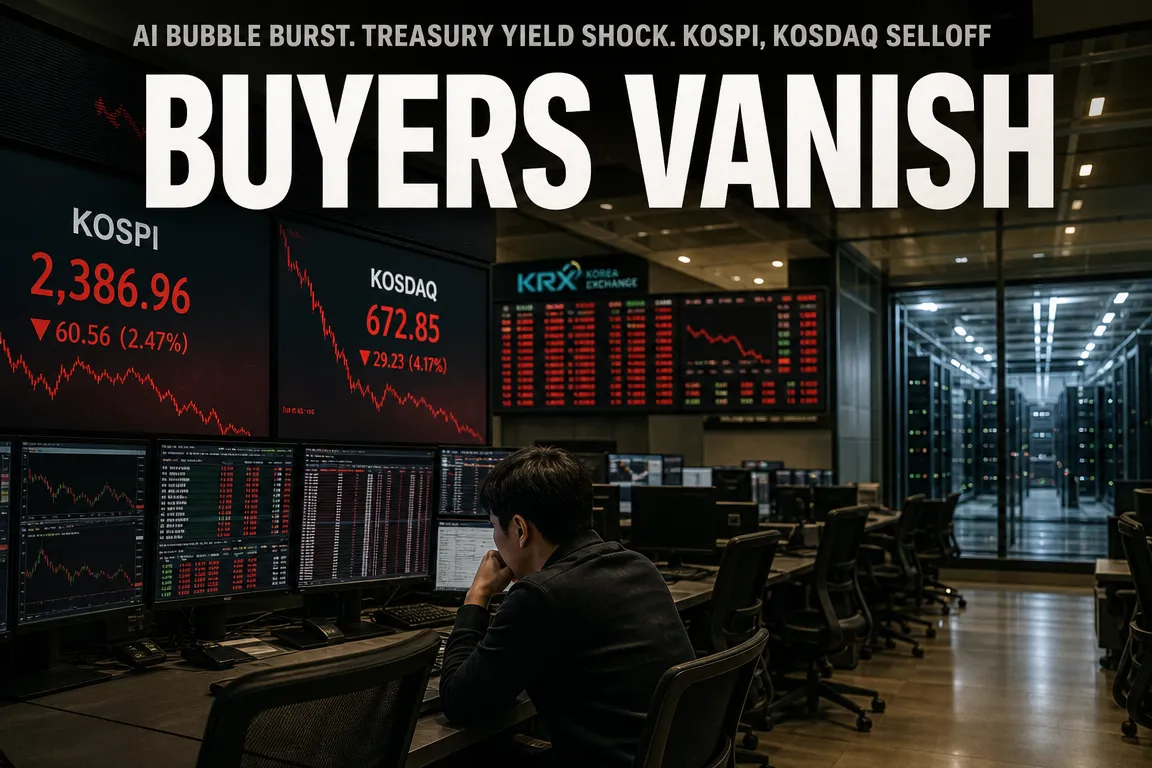
On the surface, Nasdaq was only modestly lower and the Dow rose, while after-hours Kospi futures fell nearly 2%, creating a weaker tone for Korean semiconductor investors.
This move cannot be explained simply as a valuation correction in semiconductors.
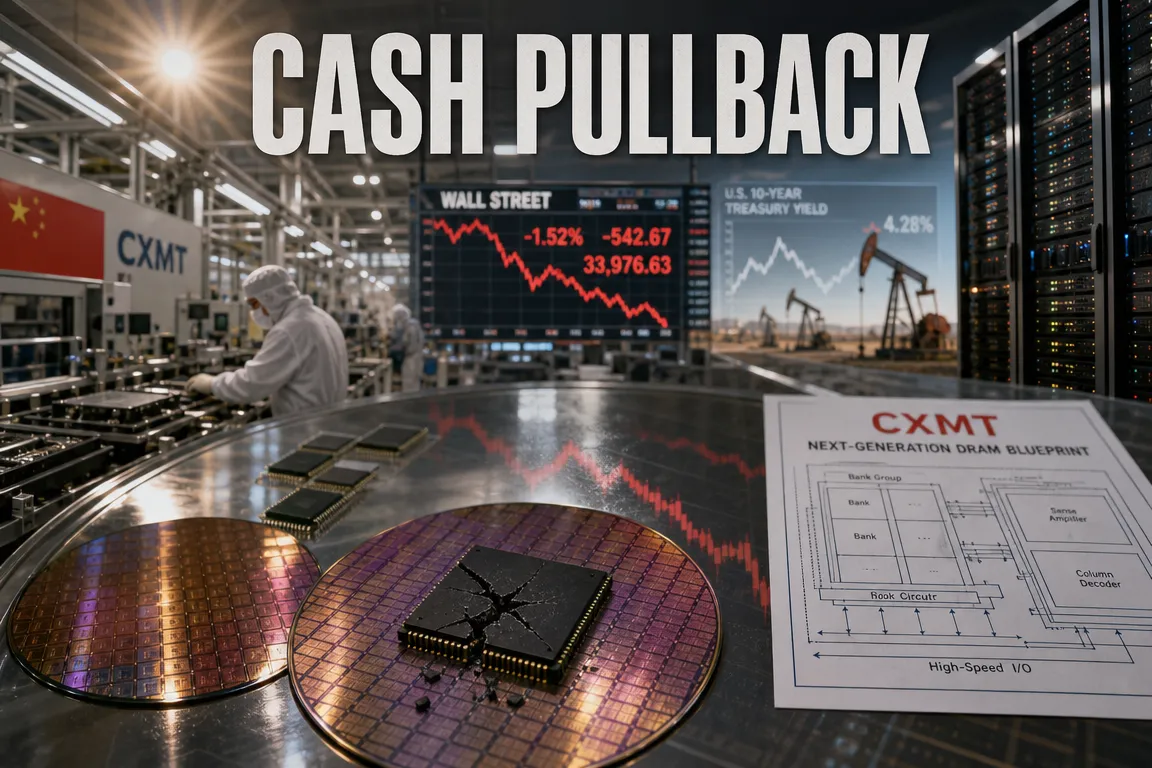
Rising geopolitical risk in the Middle East pushed crude oil higher, U.S. Treasury yields edged up again, and concerns also increased after CXMT announced next-generation DRAM progress, Broadcom’s CEO warned about AI investment, and Nvidia CDS widened.
In short, the market is now focusing less on the memory supply shortage narrative and more on whether AI infrastructure investment can be sustained.
1. U.S. equities were stable, but Kospi futures weakened sharply
U.S. equities were not under major pressure.
Nasdaq fell about 0.2%, while the Dow rose about 0.4%.
The S&P 500 was effectively flat.
In other words, this was not a broad-based selloff in the U.S. market.
The weakness was concentrated in semiconductors linked to Korea.
Kospi futures fell around 2%, raising investor concern.
The reason is clear.
Samsung Electronics and SK hynix are highly exposed to the memory semiconductor cycle.
When U.S. memory-related names such as Micron and Sandisk weaken, the Korean market is affected immediately.
This should be viewed as selective weakness in memory semiconductors rather than a broad U.S. equity decline.
2. Higher crude oil and Treasury yields pressured growth stocks
Another factor was the rise in crude oil and U.S. Treasury yields.
The U.S. 10-year Treasury yield moved slightly higher.
WTI crude rose by roughly 2%, while Brent increased by about 1.9%.
Higher oil prices can renew inflation concerns.
That, in turn, can weaken expectations for rate cuts and pressure valuations in growth and technology stocks.
AI semiconductors, memory chips, and data center infrastructure companies already trade on elevated future growth expectations.
As a result, even a small rise in rates can trigger sensitivity in the market.
This was not enough to break the market broadly, but it added pressure to already expensive semiconductor shares.
3. Middle East risk and the Russia-Ukraine conflict renewed market tension
The rise in crude oil was driven by geopolitical risk.
The original report cited a Houthi attack on Saudi Arabia.
Saudi Arabia said it was responding, but for the market, the fact that an attack occurred was more important.
Continued tension in the Middle East can raise concerns about oil supply.
That makes crude prices harder to stabilize.
The Russia-Ukraine war remains another source of risk.
While Trump’s side suggested both parties could halt attacks on energy facilities, reports also indicated that Russia again attacked Ukrainian energy infrastructure.
The market interpreted this as evidence that war risk remains persistent rather than fading.
In this environment, investors are less likely to add risk and more likely to reduce exposure to high-valuation growth names first.
4. First driver of the decline in memory semiconductors: CXMT’s next-generation DRAM announcement
One of the most direct factors behind the weakness in memory semiconductors was China’s CXMT.
CXMT announced technical progress related to a next-generation DRAM cell architecture.
It also indicated plans to introduce an upgraded DDR5 structure by the end of 2026.
The market reacted sharply to the announcement.
Some even interpreted it as evidence that CXMT is now about two years ahead of Samsung Electronics technologically.
However, an important point should be noted.
CXMT did not provide detailed product specifications, production schedules, yields, or scale.
In memory semiconductors, what matters is not a technology announcement alone, but stable mass production and yield.
Producing samples and manufacturing at scale with profitability are entirely different matters.
Samsung Electronics and SK hynix have already shown sample-level progress in similar technologies.
Micron was discussed less, but the global memory leaders still have a major advantage in mass-production experience and customer relationships.
Even so, the market reacted nervously because sentiment in memory semiconductors is already highly sensitive.
Since the stocks had risen significantly on supply shortage, HBM demand, and AI server investment expectations, even a Chinese technology update was enough to trigger selling.
5. Why the CXMT issue should not be overinterpreted
CXMT’s technical progress is meaningful.
China’s policy support for semiconductor self-sufficiency remains strong, and the long-term presence of its memory industry may increase.
However, whether it can disrupt the global market in the near term is a separate question.
Based on current information, CXMT’s capacity does not appear large enough to shock the global market.
Some observers even argue that by 2027, China may still struggle to fully cover domestic demand.
In other words, the CXMT news should be interpreted less as an immediate threat to Samsung Electronics and SK hynix, and more as a sign of rising long-term competition risk.
Still, equity markets react to fear and expectation before they react to fundamentals.
That is why sentiment weakened before the actual commercial impact became clear.
6. Second driver of the decline: Broadcom CEO’s warning
A more important factor was the statement by Broadcom’s CEO.
Speaking at an event in Singapore, he said the biggest bottleneck to AI-led technology growth is not memory, but capital.
This is an uncomfortable message for memory investors.
Until recently, the core market narrative was that AI server growth would create shortages in HBM and DRAM, benefiting memory companies.
Broadcom’s CEO effectively suggested that the issue is no longer memory scarcity, but funding constraints.
That can be interpreted as a sign that the main bottleneck in AI infrastructure investment is shifting.
He also said that wafer shortages and memory shortages are being overcome.
The market could read that as a signal that the memory shortage cycle may end sooner than expected.
Memory semiconductor stocks had risen on a supply shortage premium.
When that premium weakens, the share prices can fall quickly.
7. Why Broadcom’s CEO compared some AI investors to casino gamblers
Broadcom’s CEO compared some AI investors to casino gamblers.
He also suggested that some investors do not fully understand what they are investing in.
This was a pointed remark.
It matters because it came from a semiconductor CEO at the center of the AI infrastructure industry.
Industry insiders typically support the growth narrative.
That is the style often seen from Nvidia CEO Jensen Huang, who emphasizes AI demand and expanding computing infrastructure.
By contrast, Broadcom’s CEO questioned whether AI capital spending has become excessive.
He also raised concerns about the long-term profitability of loss-making AI labs such as OpenAI and Anthropic.
While acknowledging OpenAI’s strong annualized revenue growth, he argued that revenue growth alone does not guarantee long-term profitability.
In practical terms, the message was that sales growth is visible, but earnings durability is still unproven.
That kind of warning can weigh on sentiment across AI semiconductors and AI infrastructure stocks.
8. The next bottleneck in AI infrastructure may be capital, not memory
So far, the bottlenecks in the AI cycle have been described as GPUs, HBM, power, data center land, and cooling capacity.
Broadcom’s CEO offered a different view.
He suggested that the more important issue may now be whether the industry can secure funding.
AI data centers require massive capital.
Companies must buy GPUs, build servers, secure power contracts, and construct data centers, all of which require substantial spending.
When interest rates are high and corporate bond issuance becomes more expensive, AI companies also face higher funding costs.
In that case, even strong AI demand may not translate into planned infrastructure investment.
The original report also mentioned a case in which an AI data center company backed by Nvidia withdrew its Australian listing plan after failing to raise sufficient capital.
Such examples suggest that capital markets conditions are becoming increasingly important for the AI infrastructure sector.
The concern is not that AI growth is ending.
The real concern is whether capital deployment can keep pace with the valuations already embedded in the market.
9. Nvidia CDS widening also weakened semiconductor sentiment
Another negative factor was the rise in Nvidia CDS.
CDS reflects the market’s view of default risk.
The original report said Nvidia’s CDS had gradually risen toward an all-time high area.
This does not mean Nvidia is in immediate trouble.
Nvidia remains the core company in AI semiconductors, and its earnings growth is still strong.
However, in equity markets, direction matters more than absolute risk.
A widening CDS indicates that some investors are becoming more cautious on Nvidia than before.
Since Nvidia sits at the center of the AI semiconductor value chain, weakness in its sentiment can spread to Micron, SK hynix, Samsung Electronics, Broadcom, AMD, and others.
10. What Micron and Sandisk’s declines signal for Korean semiconductors
Micron fell about 2.9%, while Sandisk declined about 5.5%.
Micron is a key reference point for the global DRAM and HBM cycle.
Sandisk is a useful indicator for NAND flash and storage demand.
The fact that both names were weak suggests the market is turning more cautious on the broader memory sector.
For Korean investors, this directly affects Samsung Electronics and SK hynix.
SK hynix is especially sensitive because a large portion of its valuation reflects HBM and AI server demand expectations.
If the market begins to believe that the HBM shortage will not last as long as expected, or that AI data center investment could slow due to capital constraints, valuation pressure may increase.
That said, long-term demand for AI servers and high-performance memory is not disappearing.
This looks more like a repricing of expectations than a collapse in demand.
11. Why Meta was strong: Expectations for the AI agent “Muse”
While semiconductors weakened, Meta rose about 4% and showed relative strength among large-cap stocks.
The move was supported by expectations around its AI agent service, “Muse.”
According to data from Sensor Tower, Muse appeared to show better-than-expected retention.
Retention measures how long users stay engaged and how often they return.
In AI services, retention is as important as downloads.
Even if many users install the app initially, the service is difficult to sustain if they leave after a few days.
The original report noted that Muse had very strong first-day metrics, and while ChatGPT still led after two weeks, Muse was also showing respectable performance.
It also compared favorably with Threads, Elon Musk’s Grok, and the Google app in retention terms.
The market appears to have interpreted this as evidence that Meta may have another large-scale AI service on its hands.
12. Risk factors for Meta: Shopping site blocking and data access constraints
However, Muse is not without challenges.
The original report said that many shopping websites are blocking Meta’s AI agent Muse.
This is an important issue.
For an AI agent to handle shopping, search, booking, comparison, and purchase tasks, access to websites and platforms is essential.
If retailers begin blocking AI agents, service quality can be constrained.
In the future, AI agents may depend as much on data access, platform bargaining power, and commercial rules as on technical performance.
This is not just an app competition, but a struggle over control of internet traffic.
13. What Meta’s new AI model “Muse Wonder” suggests
Meta also introduced a new AI model called Muse Wonder.
In the original report, Muse Wonder was described as a higher-tier model than Muse Spark.
Based on benchmarking references, the full version of Muse Wonder was said to rank below Claude Opus 5.5, but ahead of some other recent models.
The key point is that Meta may be positioning itself as a contender in the top tier of AI model competition.
OpenAI and Anthropic are widely viewed as the current leaders.
However, Google, Meta, xAI, and Mistral are all competing for the next position.
If Meta combines its open-source AI ecosystem with its own application ecosystem, it could build a stronger position in the AI agent market than expected.
Meta’s share-price strength reflected not only a short-term rebound, but also a possible re-rating as an AI service company.
14. One-sentence summary of the market
This was not a Nasdaq selloff. It was a reassessment of AI infrastructure expectations.
Memory semiconductors weakened on the CXMT announcement and then again on Broadcom CEO comments.
Nvidia CDS widening further dampened semiconductor sentiment.
In contrast, Meta rose on Muse retention data and new model expectations.
The market is now differentiating more precisely between winners and vulnerable names within the broader AI theme.
The most important point that many media reports do not emphasize
The central issue is not CXMT itself.
The CXMT news was a catalyst, but the real issue is that the bottleneck in AI infrastructure investment is changing.
Until now, investors bought semiconductors on the logic that AI growth would create shortages in GPUs, HBM, and memory.
But Broadcom’s CEO said that the true bottleneck is now capital, not memory.
That has major implications for semiconductor investing.
When a component is scarce, prices rise and supplier margins improve.
But when capital is scarce, customers may delay investment and order growth may slow.
For memory companies, this means the supply shortage premium can shift into a demand slowdown concern.
That is the real driver behind the decline.
Going forward, investors should monitor not only HBM prices, DRAM prices, and NAND prices, but also the funding capacity of AI data center companies, the corporate bond market, U.S. Treasury yields, and the capital expenditure plans of major tech firms.
This does not mean the AI semiconductor cycle has ended.
But it does mean the market may no longer reward the idea that “AI automatically means higher prices.”
Key indicators investors should watch
First, the U.S. 10-year Treasury yield.
Higher yields increase valuation pressure on AI growth stocks and semiconductor names.
Second, crude oil prices.
If Middle East risk pushes oil higher, inflation concerns may reemerge and weaken expectations for rate cuts.
Third, Micron’s share price.
Micron is one of the fastest-moving indicators of the global memory cycle.
Fourth, Nvidia CDS and broader credit conditions.
If the credit risk premium on the AI leader rises, the entire semiconductor value chain may come under pressure.
Fifth, the AI capital expenditure plans of major tech companies.
Spending plans at Microsoft, Google, Meta, and Amazon are central to HBM and DRAM demand.
Sixth, funding conditions for AI startups and data center companies.
If these companies begin to struggle with listings, debt issuance, or equity financing, memory demand expectations may need to be revised.
Implications for Samsung Electronics and SK hynix from a Korean investor perspective
Samsung Electronics and SK hynix are directly exposed to these developments.
That is inevitable given the heavy weight of semiconductors in the Korean market.
However, the investment focus differs for each company.
SK hynix is primarily driven by HBM competitiveness and AI server demand.
As a result, it is more sensitive to AI data center spending and Nvidia-related trends.
Samsung Electronics needs to be evaluated across DRAM, NAND, foundry, mobile, and its progress in HBM competitiveness.
The CXMT issue is a long-term competitive risk for both companies.
However, until CXMT’s actual production yield and customer wins are confirmed, the news should not be treated as excessive panic.
What matters more in the near term is whether AI demand remains intact and whether memory prices continue to rise.
< Summary >
Nasdaq was only slightly lower, but memory semiconductor stocks fell sharply, dragging Kospi futures down.
Higher crude oil and a rebound in U.S. Treasury yields weighed on growth stocks.
CXMT’s next-generation DRAM announcement increased concerns about Chinese competition, but its production scale and yield remain unconfirmed.
Broadcom’s CEO said the main bottleneck in AI growth is capital rather than memory, raising concerns about investment intensity in AI infrastructure.
Nvidia CDS also widened, weakening sentiment across the semiconductor sector.
By contrast, Meta strengthened on Muse retention data and expectations for its new AI model.
The main message from this market is not that the AI semiconductor cycle has ended, but that investors are beginning to focus more on profitability and funding capacity within AI investment.
[Related Articles…]
Memory Semiconductors and the AI Server Demand Cycle
AI Infrastructure Investment and Global Market Drivers
*Source: [ 내일은 투자왕 – 김단테 ]
– 또 메모리만 패는 나스닥
● AI-Shift, Big-Tech-Rally, Security-Boost
AI investment leadership is shifting: while semiconductors pause, big tech, cybersecurity, and software are regaining control
The key issue in this market is not simply that AI is “good.”
In the first half of the year, AI infrastructure spending centered on Nvidia, memory semiconductors, and HBM drove the market. In the second half, capital is quietly rotating toward big tech, cybersecurity, software, power, and optical communications.
Palantir has broken to a new all-time high after roughly one year, Microsoft is approaching record levels, and cybersecurity ETFs and major security companies are rebounding strongly. These are important signals.
At the same time, AI data center power shortages, nuclear-based power contracts, surging optical communications demand at Marvell and Lumentum, and the possible Anthropic IPO are making the outlook for the U.S. equity market in Q4 2026 more complex.
This report summarizes where the AI investment cycle is shifting and what matters for understanding the continued strength in the Nasdaq and the S&P 500.
1. This week’s key market theme: semiconductors paused, while software and big tech advanced
Recent market action shows a temporary pause in the semiconductor sector.
Memory semiconductors and AI infrastructure-related stocks, which led the market in the first half, have moved sideways and lower since July, with elevated sensitivity to headlines.
News about OpenAI revenue deceleration, AI infrastructure spending pressure, and data center investment pacing has been enough to trigger corrections.
By contrast, software, cybersecurity, and big tech, which lagged in the first half, have recovered rapidly in the second half.
Cybersecurity and software names were previously viewed as potential losers from AI, but they are now being reassessed as beneficiaries of AI adoption.
This is best understood not as a simple rebound, but as sector rotation, with leadership moving across subsectors.
- First-half leaders: Nvidia, HBM, memory semiconductors, AI servers, and data center infrastructure.
- Second-half leaders: Palantir, Microsoft, CrowdStrike, Palo Alto Networks, Zscaler, and other software and security names.
- Newly emphasized areas: power utilities, nuclear energy, optical communications, and AI data center connectivity infrastructure.
The AI investment cycle is not ending; its center of gravity is moving.
2. What Palantir’s new high means: not just a rebound, but a re-rating of AI software
Palantir has reached a new all-time high after roughly one year.
In the first half, the software sector broadly came under pressure amid concerns that AI could replace software applications.
Palantir, despite its strong AI identity, also suffered a prolonged decline.
The tone changed materially after its August earnings release.
A strong earnings surprise restored the view that Palantir is not an AI casualty but a leading beneficiary of AI software adoption.
Its positioning across government, defense, enterprise analytics, security, and AI operations has been revalued by the market.
The key issue here is ownership turnover.
Investors who bought near prior highs and held through the drawdown appear to have sold near breakeven, while new investors absorbed the supply.
This type of handoff is typical of a turn where “when I sell, it rises” dynamics emerge.
Palantir’s new high is therefore more than a single-stock move.
It is a symbolic sign that AI software companies, which were under pressure in the first half, are returning to market leadership.
3. Why cybersecurity remains strong: a necessary layer in the AI agent era
The recent strength in cybersecurity is straightforward.
As AI agents expand, enterprise security requirements become materially more important.
AI agents are evolving beyond chatbots to systems that check email, open files, access business applications, and execute tasks.
That means more automated AI systems will have access to internal enterprise infrastructure.
For companies, that creates both efficiency gains and greater security risk.
Hacking, account takeover, privilege abuse, data leakage, and internal network intrusion become more complex challenges.
That is why CrowdStrike, Palo Alto Networks, and Zscaler are again drawing attention.
Zscaler recently said that enterprises are accelerating security software adoption as they prepare for AI agent deployment.
The market viewed that comment as an important signal.
Cybersecurity was weak in the first half, but stronger earnings and demand trends have pushed the group back into leadership in the second half.
4. Why Microsoft is strong again: software, security, and big tech are all recovering at once
Microsoft is now only about 3% to 4% below its all-time high.
In the first half, big tech, software, and security all underperformed, and Microsoft followed that pattern.
In the second half, three concerns have eased at the same time.
- Software concerns have moderated: fears that AI would replace software have eased.
- Security demand has improved: AI agent adoption is increasing enterprise security spending.
- Big tech cost concerns have eased: lower AI costs are improving cloud margin expectations.
Microsoft combines AI, cloud, security, and enterprise software.
If the market becomes more confident in AI monetization, Microsoft is one of the first large-cap names likely to be re-rated.
5. Concerns about big tech are easing again: the core issue is lower AI costs
In the first half, the main concern weighing on big tech was AI spending.
Data centers, GPUs, power, and cloud infrastructure required substantial capital.
There were also concerns about weaker cash flow, margin pressure, and AI not yet generating enough revenue.
In the second half, sentiment has improved because the cost of using AI, measured by token pricing, is falling rapidly.
Lower usage costs improve unit economics for enterprises.
In practical terms, it works like a decline in input costs that improves margins.
Anthropic has reportedly lowered model pricing meaningfully, and OpenAI has made its latest model available to free users.
This pricing competition may intensify near term, but over time it should support broader AI adoption.
As usage rises, data consumption increases, and AI content production expands, cloud and data center operators benefit.
AI-driven media production, applications, and automation services all increase underlying cloud demand.
That trend is constructive for Microsoft, Amazon, and Alphabet.
6. Is this similar to the early internet in 2003? The market is searching for AI killer apps
Venture investor Fred Wilson compared the current AI market with the early internet in 2003.
He is known for early investments in companies such as Twitter and Coinbase and for having experienced the post-dot-com internet expansion firsthand.
His core argument is that the internet infrastructure was built in the mid-1990s, while the first major wave of killer applications emerged around 2003.
At that time, Yahoo, Google, and Amazon were early internet leaders, and later companies such as Facebook, YouTube, and Twitter expanded the industry further.
The same pattern may be forming in AI.
AI infrastructure is being built quickly, and falling costs are allowing more users to create apps, video, websites, and automation tools with AI.
This could still produce AI killer applications that the market has not yet identified.
That said, this view may be somewhat ahead of current reality.
AI infrastructure is still under construction, and bottlenecks in GPUs, memory, power, and optical communications remain.
Investors should therefore consider both the long-term possibility of AI killer apps and the near-term reality that AI infrastructure spending is still ongoing.
7. AI infrastructure spending is not over: why power utilities and nuclear contracts are gaining attention again
Power is one of the main bottlenecks as AI data centers expand.
Power utilities have regained attention because large technology companies are actively securing long-term electricity contracts.
Constellation Energy and Vistra Energy are two of the most frequently mentioned names.
Both are major U.S. power generators, with particularly strong nuclear-related capabilities.
Alphabet and Amazon are reported to be pursuing or announcing long-dated power agreements.
Microsoft and Meta have also used long-term power contracts to secure electricity for AI data centers.
For big tech, electricity is a prerequisite for AI data center operations, so companies are willing to provide prepayments and support to secure supply quickly.
Building new nuclear plants takes too long.
As a result, upgrading existing nuclear capacity is becoming a more practical solution.
In some cases, that could support additional power supply within about two years.
8. What to watch in power utilities: insider buying and policy support
An interesting detail in power utilities is insider buying.
There were reports that executives at Constellation Energy and Vistra Energy bought shares during prior corrections.
The stocks later benefited from large contract announcements and government support headlines.
Vistra Energy needs capital to upgrade nuclear assets, and the possibility of low-cost government financing has been a positive factor.
When long-term contracts from big tech combine with government support, utilities can gain a meaningful catalyst.
Insider buying does not guarantee upside.
However, in a market where AI infrastructure bottlenecks are central, it is a useful signal to monitor.
9. Is optical communications the next major area after semiconductors? Marvell and Lumentum point to yes
Optical communications is becoming the next important AI infrastructure segment.
Semiconductors perform compute, HBM provides memory, and optical communications connects chips, servers, and data centers at high speed.
Marvell recently issued a very constructive outlook at an investor event.
The company emphasized that as AI data centers grow, connectivity becomes a critical requirement.
With more chips operating as one system, ultra-high-speed interconnect technology becomes essential, and optical communications sits at the center of that trend.
Management also reportedly suggested that related revenue could increase by as much as 10x over the next five years.
That implies growth expectations in the 50% to 60% range on an annualized basis.
Lumentum is showing a similar pattern.
The company, which supplies laser-based components linking semiconductors and data centers, has said that demand was effectively sold out through 2028, and that much of 2029 is also already allocated.
This is similar to the tone from memory semiconductor companies saying that even with new capacity, it will be difficult to meet demand within three years.
In other words, within AI infrastructure, leadership is rotating among semiconductors, memory, power, and optical communications.
10. Policy support from the Trump administration: backing the AI and compute leadership group
Policy remains supportive of AI development.
President Trump has emphasized the need to win the AI and superintelligence race and has increased engagement with large technology companies.
The administration reportedly recognized CEOs from Alphabet, Nvidia, SpaceX, AMD, Dell, and Microsoft with medals.
Attendees were said to include Elon Musk, Jensen Huang, Satya Nadella, Sergey Brin, Michael Dell, and Lisa Su.
This is more than a ceremonial event.
It signals that the U.S. government views AI, semiconductors, cloud, space, computing, and server infrastructure as core strategic assets.
Dell has been repeatedly associated with AI servers and infrastructure, while AMD remains a key alternative to Nvidia.
11. The broader market picture: the Nasdaq and S&P 500 remain structurally upward
Even when semiconductors pause, software rises, and when software pauses, power and optical communications move.
This type of rotation helps support the broader market.
Major index-linked funds and the leading benchmarks have regained strength in the second half.
In the first half, concerns about the end of big tech, excessive AI costs, and weaker cash flow were widespread. In the second half, the narrative has shifted toward lower AI costs, better monetization, and rising cloud usage.
For U.S. equity investors, buying strong companies on weakness is regaining relevance.
If selecting individual names is difficult, exposure through the Nasdaq or S&P 500 remains a practical approach.
These indexes already include AI infrastructure, semiconductors, big tech, software, and cybersecurity.
12. Macro variables: rates, inflation, oil, and geopolitical risk still matter
The market is not without risks.
Interest rate pressure remains, and equities can respond sharply to inflation data.
If September inflation comes in lower than expected, the rally could continue. If it is higher, rate concerns could trigger a pullback.
Oil is also an important variable.
Middle East conflict, the Russia-Ukraine war, restrictions on Russian oil, and diesel pricing can all increase market volatility.
Trump’s consideration of temporary diesel tax relief or easing restrictions on Russian oil is consistent with efforts to manage inflation and voter sentiment.
Political uncertainty typically rises ahead of midterm elections, which can keep investors defensive.
However, once election uncertainty clears, markets may regain direction.
13. Next catalysts: Anthropic IPO, earnings season, and the Apple event
One of the next major events is a potential Anthropic IPO.
Market commentary suggests the company could pursue an offering between November 23 and November 25.
The fact that it is holding private investor presentations before listing suggests serious intent.
However, a major AI startup IPO has two possible readings.
It could confirm the growth potential of the AI sector.
It could also be interpreted as a sign that sentiment is becoming overheated.
Anthropic’s IPO should therefore be viewed with both interest and caution.
Earnings season will also be important.
Financial, healthcare, and semiconductor companies are expected to report next week, while major big tech results are likely to begin in late October.
The Apple device event and inflation data could also increase volatility.
14. The key point often missed in other coverage: the AI cycle is not ending, it is fragmenting
Many reports interpret weakness in semiconductors as evidence that the AI trade is over.
Current market behavior suggests otherwise: AI investment is not ending, but fragmenting into multiple areas.
- Phase 1 was Nvidia-led AI compute spending.
- Phase 2 was HBM and memory semiconductor investment.
- Phase 3 is power, nuclear, and data center infrastructure.
- Phase 4 is optical communications and connectivity.
- Phase 5 is AI software investment, including Palantir, Microsoft, and cybersecurity names.
- Phase 6 is the next generation of AI killer applications, which have not yet fully emerged.
The key question is not whether AI is over.
The key question is where capital rotates next.
Palantir’s new high, the strength in cybersecurity, the rebound in power utilities, and the demand surge at optical communications companies are all evidence of this rotation.
The market continues to search for new bottlenecks and new beneficiaries within the AI theme.
15. Investment takeaway: what matters now
First, AI investing is no longer limited to semiconductors.
Nvidia and memory semiconductors remain important, but the market is now also focused on security, software, power, and optical communications.
Second, monitor whether concerns about big tech spending continue to ease.
The key indicators are lower token costs, higher cloud usage, and successful AI agent monetization.
Third, power and optical communications are central to resolving AI data center bottlenecks.
Areas where big tech signs long-term contracts are more likely to reflect structural demand than short-term themes.
Fourth, Palantir and cybersecurity names are key examples of an AI software re-rating.
The market is increasingly open to the view that AI may strengthen leading software companies rather than replace them.
Fifth, macro variables should not be ignored.
Rates, inflation, oil, election risk, and geopolitics can all trigger short-term corrections.
Over the longer term, however, a strategy centered on quality companies and index exposure through disciplined accumulation remains reasonable.
< Summary >
AI investment is expanding from semiconductors into big tech, software, cybersecurity, power, and optical communications.
Palantir’s new high is a sign of AI software re-rating.
AI agent adoption is increasing demand for cybersecurity, and Microsoft is approaching record levels.
Lower AI costs are easing concerns about big tech profitability.
Power shortages and data center expansion are drawing attention to nuclear-linked utilities and optical communications companies.
The possible Anthropic IPO, earnings season, inflation data, and election uncertainty may drive near-term volatility.
The main point is that the AI trade is not over; it is fragmenting and continuing to search for the next set of leaders.
[Related Articles…]
- AI Infrastructure Investment Cycle and the Next Leadership Names
- U.S. Equity Market Outlook During Big Tech Earnings Season
*Source: [ 소수몽키 ]
– AI투자 판도 조용히 바뀌는 중? 부진했던 빅테크, 팔란티어의 수상한 신고가