● Tesla Roadster Rocket Controversy
Tesla Roadster Controversy Explained: Is It Musk’s Hype, or the Start of a ‘Rocket Car’ That Could Shake Up the EV Market?
The core point of this issue is not simply that “the car flew.”
The claim that the Tesla Roadster uses fans to stick the body to the road surface and SpaceX-style cold gas thrusters to control its attitude in midair is touching everything at once, from the EV market, aerospace technology, AI control software, and automotive regulation to global economic outlooks.
To put it simply, physically, it is not “completely nonsense.”
But it is quite difficult for it to become a mass-market vehicle that ordinary consumers can drive on public roads.
In this article, we will summarize in a news format whether the Tesla Roadster is actually technically possible, why Elon Musk is attempting this, and what risks investors and consumers should really be watching.
1. Event Overview: Can the Tesla Roadster Really Spin in Midair and Land?
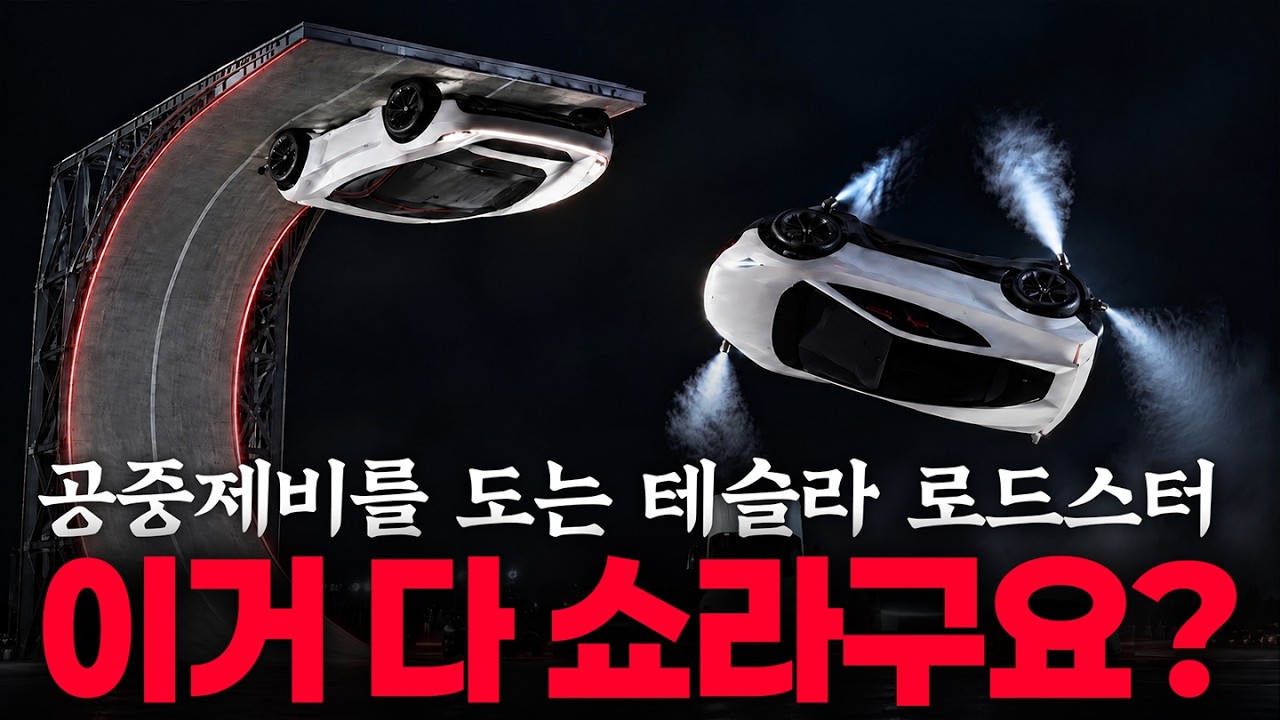
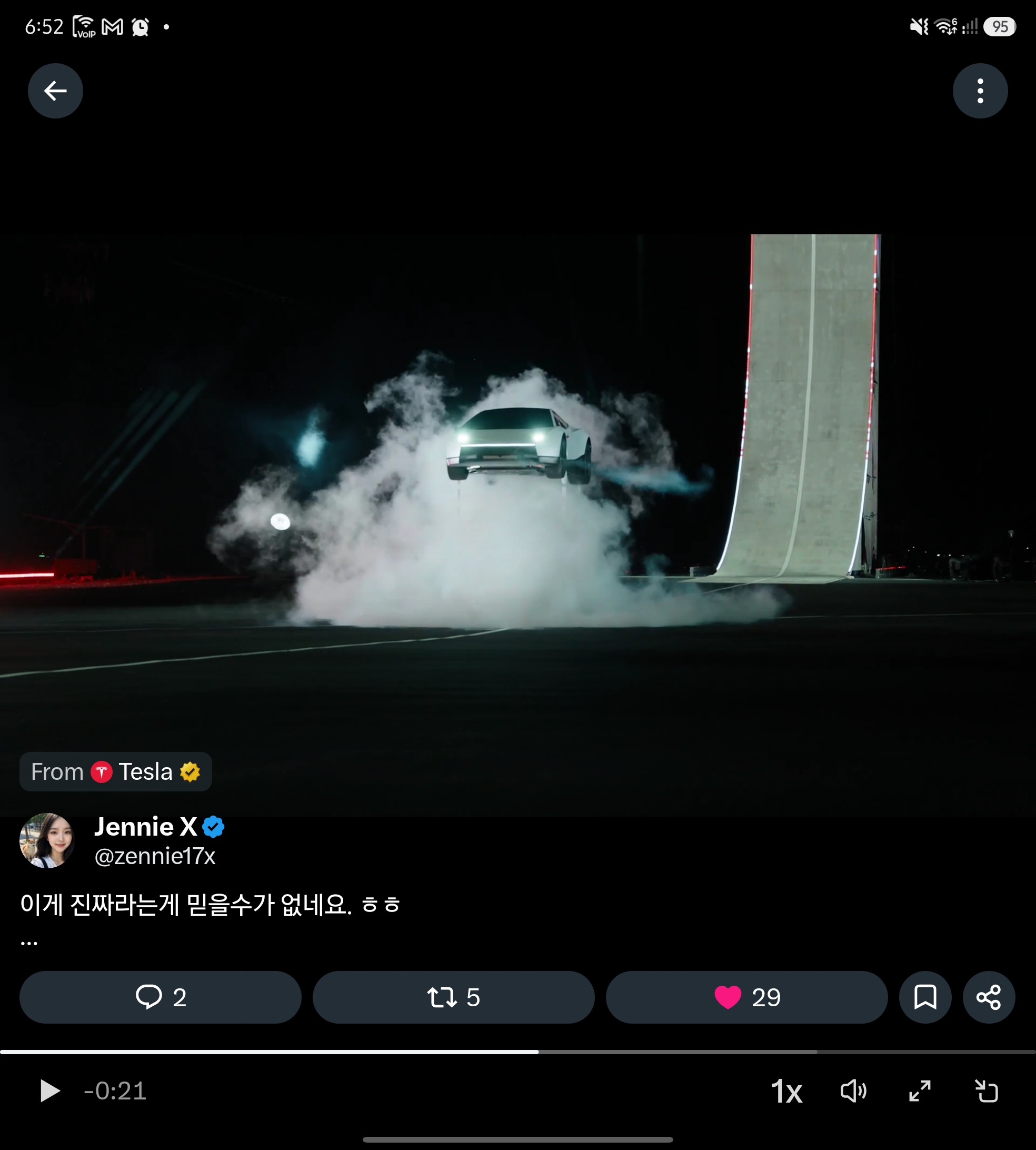
The most shocking scene in the original article is the Tesla Roadster driving up a ramp, then changing its attitude and landing even while upside down.
It also mentions jumping over parked Cybertrucks and a Tesla Semi, then spinning in midair and landing again.
By ordinary automotive common sense, the reaction can only be, “Is this even a car?”
But the principle Tesla describes has two major parts.
- First, it creates strong downforce by using fans and a ground-sealing system under the body.
- Second, it controls midair attitude with a cold gas propulsion system similar to what SpaceX uses.
In simple terms, it sucks the car down onto the ground while on the surface, and then uses compressed gas to change direction while airborne.
On that basis alone, the Tesla Roadster is no longer a traditional sports car, but closer to an experimental platform that combines EV and rocket technology.
2. Core Technology ①: The Fan-Based ‘Downforce’ System That Pins the Car to the Ground
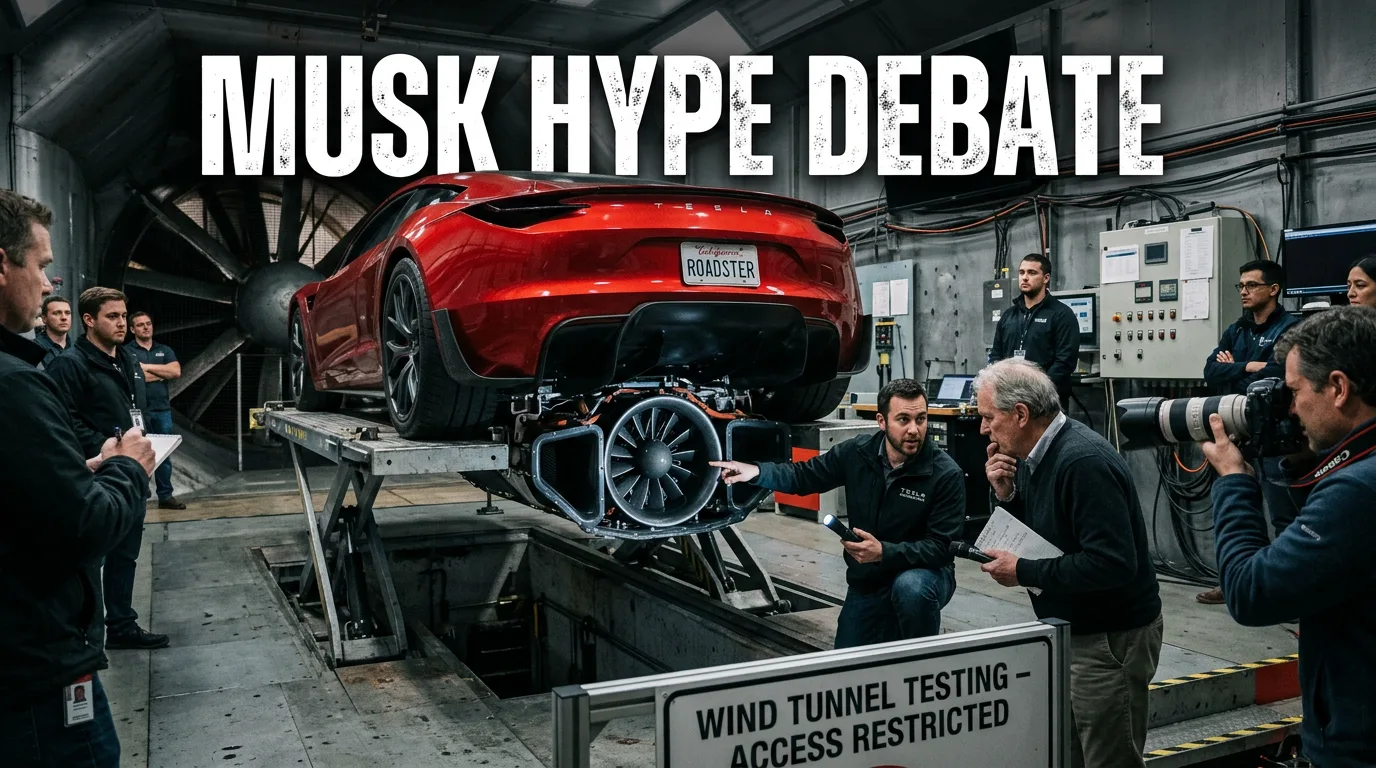
The first core technology of the Tesla Roadster is the fan system operating under the body.
According to the original text, floor fans and a ground-sealing device remove the air beneath the car, lowering the pressure under the body.
That creates a pressure difference between the top and bottom of the car, and that force pushes the vehicle strongly toward the road surface.
That is downforce.
Conventional high-performance cars also create downforce at high speed through spoilers and aerodynamic design.
But the method Tesla is talking about is far more aggressive.
It does not rely solely on the car’s speed; it actively creates a pressure difference using fans.
Theoretically, if the downforce is strong enough, the car could remain stuck to a surface under certain conditions even while upside down.
Of course, in reality, road conditions, vehicle weight, fan output, battery thermal management, tire grip, and sealing performance all have to align.
So the more realistic interpretation is that it may be possible on dedicated tracks or in special environments, but is close to impossible on ordinary roads.
3. Core Technology ②: SpaceX-Style Cold Gas Propulsion System
The second core technology is the cold gas propulsion system.
The original text explains that the Tesla Roadster uses SpaceX parts and ejects compressed gas through nozzles to gain force in the opposite direction.
It is a concept similar to what rockets or spacecraft use for attitude control.
For example, if a vehicle in midair ejects gas downward, it can receive an upward force.
If it ejects gas in only one direction, the body can rotate.
Conversely, if the rotation becomes too large, it can stabilize its attitude by ejecting gas in the opposite direction.
The reason this is not just a spectacle is that “stopping and stabilizing precisely” is much harder than simply “making it spin in midair.”
A vehicle has a center of gravity, a battery pack, and both the occupant and body structure affect inertia.
Therefore, controlling attitude in the air requires extremely fast sensor data processing and precise control algorithms.
This is where AI control software becomes important.
The original text also mentions using AI to semi-automatically control gas ejection.
In other words, the Tesla Roadster can be seen not simply as a high-performance EV, but as an experimental vehicle combining autonomous driving technology and aerospace control technology.
4. “Car or Plane?”: Why the Tesla Roadster Is Hard to Commercialize
This is the part many people are curious about.
“So will the Tesla Roadster actually become a car that can fly?”
To put it bluntly, it is difficult for it to become a vehicle that continuously flies through the sky.
Using compressed gas to lift the body or control its attitude may be possible momentarily.
But to keep supporting the vehicle’s weight, an enormous amount of gas and energy is required.
That increases tank size, adds vehicle weight, and creates a vicious cycle that requires even more thrust.
In other words, flying for long periods using only compressed gas is extremely inefficient.
Also, if the gas runs out in midair, the problem becomes much more serious.
Unlike a car accident on the road, an airborne accident can lead to a crash.
In that case, automotive safety regulations alone are not enough; aviation regulations must also be considered.
That is why the rocket version of the Tesla Roadster sits in a very ambiguous legal position.
It is too dangerous to be considered a car, the certification system is different to be considered an aircraft, and the intended use is different to be considered a spacecraft.
This is the biggest barrier to commercialization.
5. Model Differences: What’s the Difference Between the Performance, Thrust, and Rocket Versions?
According to the original text, the Tesla Roadster is likely to center around a performance version.
The model that ordinary consumers can reserve appears to be closer to this one.
Below that or as a separate lineup, the thrust version and the rocket version are mentioned.
- Performance version: Estimated to be a model close to a typical high-performance electric sports car.
- Thrust version: Mentioned as a limited edition that adds a cold gas propulsion device to the rear and raises 0-60 mph acceleration to about the 1-second range.
- Rocket version: Closer to a demonstration model or ultra-limited model capable of midair attitude control and flight-style performance, with road legality appearing very low.
In particular, the rocket version may be purchasable only by a few invited customers.
Also, if conditions are attached such as “it can fly, but it is not legal on public roads,” then in effect it is closer to a track-only experimental machine than a regular car.
6. Price and Launch Timing: Reservations from 70 Million Won to 300 Million Won?
The original text mentions that reservations are being accepted on the official website.
The base reservation deposit is $50,000, roughly 70 million won.
The deposit for the thrust version is $250,000, which is about 300 million won.
The important thing is that the reservation deposit is not the same as the vehicle’s full price.
If the deposit is this high, the actual car price is likely to be much higher.
Especially if it includes a carbon fiber pressure tank, high-pressure gas system, precision nozzles, AI control unit, and a special battery thermal management system, the manufacturing cost could become incomparable to a regular EV.
The launch schedule is mentioned as 2028, but given Elon Musk’s history of announcing timelines, it is hard to rule out a slip to around 2030.
Tesla has experienced delays before with the Cybertruck, Semi, and the original Roadster project.
Therefore, investors should pay more attention to “production certification” and “customer delivery” than to the “launch announcement.”
7. Elon Musk’s Way of Thinking: He Starts by Asking, “Is It Physically Impossible?”
To understand this Tesla Roadster controversy, you have to look at Elon Musk’s way of thinking.
Musk often emphasizes “first-principles thinking.”
Instead of starting from how people have done things before, he breaks it down by asking whether it is physically possible in the first place.
For example, in the past, there were questions like these.
- Battery packs for EVs are expensive, so how can they be popularized?
- Rockets are supposed to be used once and discarded, but can’t they be reused?
- Is it really necessary to assume that cars must only run on wheels?
Musk looks at these questions not as “industry common sense,” but as “physical laws.”
This Roadster is the same.
Rather than asking whether a car can fly, he first calculates whether it can momentarily generate enough force to support the car’s weight.
Rather than asking whether the body can change attitude, he first asks whether rotation can be generated through compressed gas and nozzle control.
That is why Musk is criticized as a showman while also being praised as an innovator.
He stands on the boundary between what is actually achievable and what is exaggerated marketing.
8. The Core Point Most Other News Miss: The Real Purpose May Be Technology Demonstration, Not Sales
Many reports focus on whether the Tesla Roadster can really fly, how much it costs, and when it will be released.
But there is another, more important point.
The vehicle’s true purpose is likely not mass sales.
The Tesla Roadster rocket version is closer to a symbolic product that showcases the technological capabilities of Tesla and SpaceX at the same time, rather than a mass-produced car meant to generate profit.
Tesla is already in strong competition in the EV market with Chinese EV makers, including BYD.
It is difficult to maintain premium brand value through price competition alone.
In that context, a product like the Roadster strengthens the image that “Tesla is still the company that actually builds the craziest technology.”
This can have a greater impact on Tesla’s stock price, brand premium, hiring, and investor sentiment than simple car sales.
In other words, the Tesla Roadster is a product where narrative matters more than volume.
As the global economic outlook remains uncertain and growth-stock valuations weaken in a high-interest-rate environment, Tesla needs once again to reinforce the frame of being a “future technology company.”
9. The Bigger Risks: Regulation, Insurance, and Liability Are Harder Than the Technology
Even if the Tesla Roadster is technically possible, actual sales are another matter.
The biggest barriers are regulation and insurance.
Regular cars must pass crash safety, pedestrian protection, battery safety, braking performance, noise, and emission standards.
But once a cold gas propulsion device is included, the story changes.
High-pressure tanks can create explosion risks in an accident, and depending on nozzle direction, nearby people or vehicles could be harmed.
From the moment it leaves the ground, there is also a possibility that aviation safety standards would apply.
Insurance companies would also be in a difficult position.
If this vehicle has an accident during a jump, should it be considered a car accident?
Or should it be considered an aviation accident?
It also becomes complicated to determine whether the responsibility lies with the manufacturer, the driver, or a software control error.
This is the core point that is less covered in other YouTube videos or general news.
The biggest enemy of the Tesla Roadster may not be physics, but law and insurance.
10. From the AI Trend Perspective: The Roadster Is a Test Bed for an ‘AI-Controlled Vehicle’
Another point to focus on in this Roadster is AI.
When a vehicle moving at high speed controls its attitude in midair, human reaction speed alone is not enough.
Sensors must read the body angle, rotation speed, altitude, velocity, road conditions, and pressure tank level in real time.
Then the AI control system must immediately determine which nozzle to fire and how much.
This technology may not be limited to a show car.
In the future, it could expand into high-performance EV body control, autonomous emergency avoidance, robotaxi safety control, and aerospace-based vehicle control technology.
In particular, Tesla is a company that sees vehicles as software platforms.
So the data and control technology obtained from the Roadster may also be indirectly used to advance autonomous driving technology in the future.
At this point, the Tesla Roadster is more deeply connected to AI industry trends than to the automotive industry.
11. Economic Meaning: Why Is Tesla Pulling Out This Card Now?
The background behind Tesla emphasizing an extreme product like the Roadster also includes market conditions.
Recently, the EV market has been dealing with a mix of slowing growth, price-cutting competition, pressure from Chinese companies, and battery cost strain.
There are also signs that EVs are no longer “the future itself,” but are increasingly becoming a normal manufacturing competition.
At times like this, Tesla needs to maintain the image that it is not just a company that sells cars cheaply, but a platform company connected to energy, AI, robots, and aerospace technology.
The Roadster is the product that can show this message most strongly.
From an investor’s perspective, it is more important what kind of technology narrative Tesla is building than Roadster sales volume.
In the U.S. stock market, Tesla’s valuation is hard to explain using the standards of a simple automobile manufacturer.
In the end, the market keeps evaluating whether Tesla should be seen as an EV company, an AI robotics company, or an energy platform company.
12. A Cool-Headed Judgment: Is the Tesla Roadster an Impossible Car?
In one sentence, the Tesla Roadster is “physically possible, but commercially very difficult.”
Downforce using fans is theoretically convincing.
Momentary acceleration and attitude control using cold gas thrusters are also physically possible.
If AI-based control systems are combined with high-performance sensors, it may be possible to demonstrate midair attitude control for a short time.
But there are too many obstacles before it can become a car that ordinary consumers can drive freely on public roads.
High-pressure tank safety, legal classification, insurance systems, battery and thermal management, maintenance costs, liability in accidents, and road infrastructure issues all have to be solved.
So if you think of this as a “mass-market electric car,” you may be disappointed.
On the other hand, if you see it as a technology demonstration platform combining Tesla and SpaceX, it is a very meaningful project.
13. Checkpoints for Investors and Consumers
- Whether a real prototype is revealed: Actual driving, jumping, and landing tests matter more than renderings or videos.
- Whether it gets regulatory approval: Road-legal models and track-only models must be distinguished.
- Refund terms for reservation deposits: Since a high deposit is involved, the contract terms must be checked carefully.
- Production timeline: We need to see whether the 2028 target leads to actual customer deliveries.
- AI control stability: More than raw performance, the core issue is whether it can be controlled safely in failure scenarios.
- Tesla brand strategy: We should watch how the Roadster affects Tesla’s stock and brand narrative more than its sales.
14. Core Conclusion: Is Musk a Blowhard or an Innovator?
Elon Musk clearly makes bold promises often.
And some of those promises are delayed or delivered to consumers in exaggerated form.
So the criticism that he is a “blowhard” is understandable.
But at the same time, Musk is someone who pushes what others only imagine in words into real hardware.
EV popularization, reusable rockets, satellite internet, humanoid robots, and AI autonomous driving were all initially dismissed as unrealistic.
The Tesla Roadster is in the same context.
The chance that it becomes a perfect mass-market vehicle is low, but as a symbolic project that breaks down the boundary between cars and aerospace technology, it is meaningful enough.
In the end, the real value of this car depends less on “how many units it sells” and more on “how far Tesla can push the standard for future mobility.”
< Summary >
The Tesla Roadster is an ultra-high-performance EV concept that combines fan-based downforce with a SpaceX-style cold gas propulsion system.
The technology for controlling attitude in midair is physically plausible, but regulations and safety issues make it very difficult to release as a mass-market road car.
It may be divided into performance, thrust, and rocket versions, and the rocket version appears to be closer to a track-only or ultra-limited technology demonstration model.
Reservation deposits are said to range from tens of millions to hundreds of millions of won, and the 2028 launch target may also be delayed.
The most important point is that this car is not a mass-sales product, but a symbolic project that showcases Tesla’s technological strength, AI control capabilities, and brand premium.
The biggest barriers to the Tesla Roadster are regulation, insurance, accident liability, and safety certification, not technology.
[Related Articles…]
- Tesla Electric Vehicle Market Outlook and AI Strategy Analysis
- Autonomous Driving Technology and Future Mobility Industry Trends
*Source: [ 월텍남 – 월스트리트 테크남 ]
– “머스크, 허풍쟁이에 사기꾼”… 실제로 로드스터는 불가능한 차?