● Tesla, SpaceX, explosive, showdown
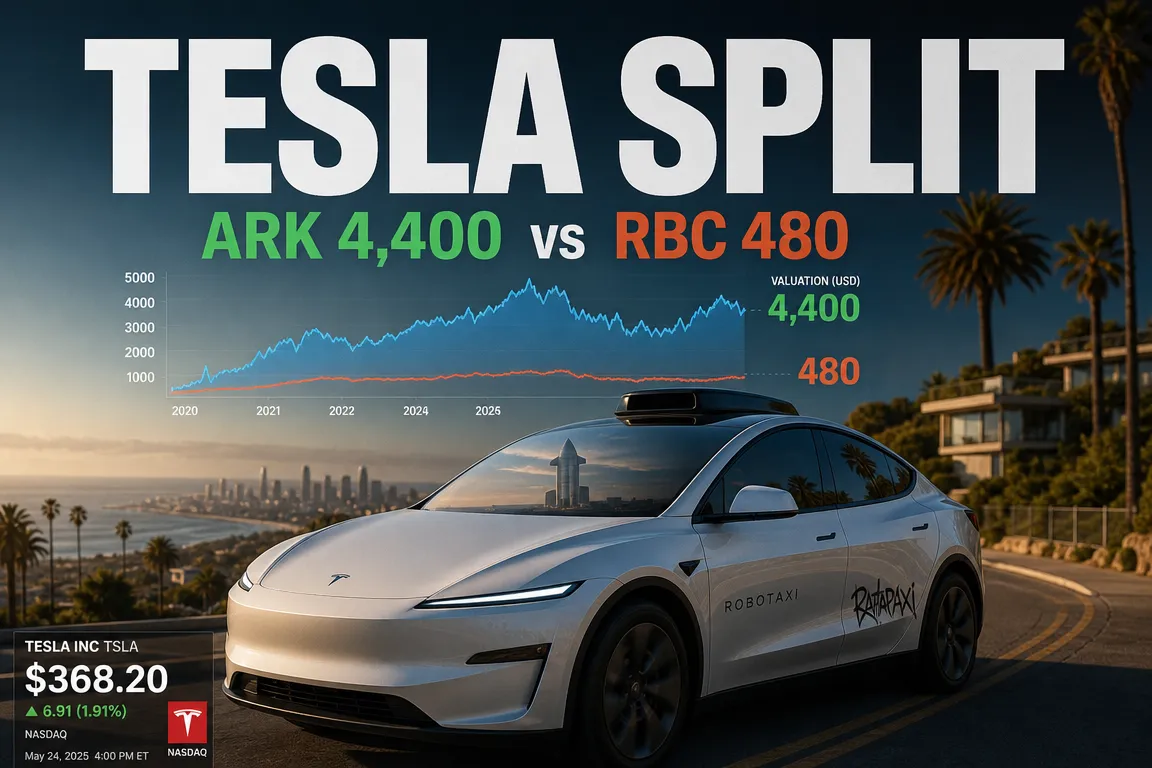
ARK: “Tesla Alone at $4,400” vs. A $480 Merger Scenario — What Tesla Shareholders at $368 Need to Know
The key issue is not simply whether Tesla and SpaceX will merge.
The real point is that the valuation benchmark for Tesla has now split into two very different paths.
One is ARK’s bullish scenario, in which Tesla alone could reach $4,400 per share by 2031 without SpaceX.
The other is RBC’s transaction scenario, in which SpaceX could acquire Tesla at around $480 per share.
Meanwhile, Tesla did not place a merger proposal on its official annual meeting proxy, making the market reaction more complex.
In effect, this news requires Tesla shareholders to reassess robotaxi value, merger probability, AI data center investment, Elon Musk compensation, and overseas equity strategy at the same time.
1. Tesla proxy statement: no merger proposal
Tesla filed its annual meeting proxy statement with the U.S. Securities and Exchange Commission.
The meeting is scheduled for December 3 in the U.S., or early morning December 4 at 6:00 a.m. in Korea.
The record date for voting is October 13 in the U.S.
Only shareholders of record as of that date are eligible to vote.
The proxy includes three main proposals.
- Re-election of Elon Musk, Chair Robin Denholm, and Director JB Straubel
- Advisory vote on executive compensation for 2025
- Approval of PwC as auditor
The most notable omission is any merger proposal involving SpaceX or xAI.
Denholm’s shareholder letter also makes no mention of SpaceX.
Instead, it emphasizes that experienced board oversight is particularly important during periods of rapid technological change.
Compared with last year’s annual meeting, which included a shareholder proposal related to xAI investment, this year’s proxy is notably shorter and more streamlined.
As a result, the prospect of a Tesla-SpaceX merger being approved at the December annual meeting now appears effectively off the table.
2. Elon Musk’s 2025 compensation: $158.4 billion on paper, $0 actually received
Another key item in the proxy is Elon Musk’s 2025 compensation.
The filing lists the potential compensation package at $158.4 billion.
However, this figure is contingent on full achievement of all performance targets.
The filing also states that Musk has received $0 in actual cash compensation to date.
This matters because it is directly linked to potential future dilution in Tesla shares.
ARK said its 2031 Tesla valuation model already incorporates the additional share count that could result from Musk compensation.
In other words, ARK’s $4,400 per-share target assumes dilution risk has already been taken into account.
3. Barclays’ forecast versus the actual proxy filing
Barclays had previously expected a Tesla-SpaceX merger announcement before the annual meeting.
It also said that if such an announcement were delayed until late October or early November, approval at the December meeting would become very difficult.
However, the actual proxy contains no merger item.
Based on the official filing, the chance of approving a merger at the December meeting is effectively closed.
That does not mean merger discussions are over.
Large transactions could still be put to a vote at a special meeting.
Barclays also suggested that if the December window is missed, a new merger announcement could still emerge within 6 to 12 months.
4. Market reaction: no merger item, but prediction markets still rise
One interesting point is that the market did not react negatively simply because the merger proposal was absent from the proxy.
In the original article, Tesla closed up 3.76% at $368.6.
The Nasdaq also rebounded 1.11%.
Prediction market activity was even more notable.
Kalshi’s implied probability of a Tesla-SpaceX merger before next February reportedly rose from the 30% range earlier this month to around 67%.
Even without an official proxy item, some investors appear to believe a special meeting remains a viable path.
In short, the market is not treating the absence of a merger proposal as a purely negative signal.
Instead, investors are now weighing Tesla’s standalone value against the potential exchange ratio in a future merger.
5. ARK’s new model: Tesla alone at $4,400 by 2031
Cathie Wood’s ARK now values Tesla at $4,400 per share in 2031.
That implies roughly 12 times the current share price in the $368 range.
In won terms, the article translates this to about 5.87 million won per share.
ARK estimates Tesla’s 2031 market capitalization at about $1.75 trillion.
Against an estimated current market cap of about $1.4 trillion, this implies roughly 12 times expansion.
Reaching that level would require an average annual return of nearly 62%.
ARK used thousands of simulations to produce a probability range.
- Expected value: $4,400 per share
- Top quartile scenario: $5,000 per share
- Bottom quartile scenario: $3,300 per share
Even the lower scenario is still about 9 times the current share price.
ARK is therefore treating Tesla not as a conventional EV manufacturer, but as a company spanning autonomous driving, robotaxis, humanoid robotics, energy storage, and AI infrastructure.
6. What changed in ARK’s model: Cybercab included, China robotaxi excluded
ARK previously set a 2029 Tesla target price of $2,600 per share.
This time, it shifted the base year to 2031 and revised several assumptions.
The new model includes Cybercab.
Tesla’s dedicated autonomous robotaxi vehicle is now part of the framework.
By contrast, China robotaxi is excluded.
China was likely omitted due to regulatory, data, competitive, and geopolitical uncertainties.
ARK also incorporated the share count impact from Elon Musk compensation.
That means dilution was already reflected in the per-share valuation.
7. Costs included in ARK’s model: AI data centers and the Terra project
ARK also added new cost assumptions.
The core items are AI data center investment and Terra-related spending.
ARK expects this investment base to rise from about $7 billion at the end of last year to as much as $225 billion by the end of 2031.
This reflects the scale of computing infrastructure required to support Optimus and autonomous-driving AI.
The implication is that Tesla is evolving beyond a car company into a platform that trains AI models, operates robots, and supports energy infrastructure.
For that reason, ARK’s valuation framework cannot be explained by traditional auto-sector multiples.
8. Businesses ARK excluded: Semi, FSD licensing, and SpaceX equity
ARK said its $4,400 valuation does not include several businesses.
These include the Semi truck business and FSD licensing to other automakers.
It also excludes Tesla’s stake in SpaceX.
In other words, ARK’s $4,400 target is based on Tesla as a standalone company.
This is the core of the article’s argument.
ARK is effectively saying Tesla can justify that valuation even without a merger.
9. ARK’s view: 80% of Tesla value comes from robotaxi
ARK expects about 80% of Tesla’s enterprise value in 2031 to come from robotaxi.
In earlier models, robotaxi accounted for about 90%, but the share has declined as Optimus and energy were given greater weight.
ARK’s key assumptions are as follows.
- 8.1 million Tesla robotaxis in operation by 2031
- $753 billion in net ride-hailing revenue
- More than 8 times Tesla’s roughly $95 billion in last year’s total revenue from a single robotaxi business line
ARK’s rationale is that robotaxi economics differ fundamentally from vehicle sales.
Traditional auto sales end once a car is sold.
Robotaxis generate recurring cash flow as the same vehicle is used repeatedly.
Removing driver labor could make margins resemble those of a software platform rather than a manufacturing business.
10. ARK’s view of Tesla’s robotaxi competitiveness
According to the article, Tesla launched robotaxi operations in Austin and has expanded to three states and seven cities.
It also reportedly reached 1 million driverless miles in about seven months.
That pace is described as roughly four times faster than Waymo’s first 1 million miles.
ARK estimates Cybercab operating cost per mile could be about 40% lower than Waymo’s robotaxi fleet.
The main reasons are vehicle cost, mass production, camera-based autonomy, and integrated software architecture.
The most important near-term variable is FSD version 15.
The year-end release of FSD v15 will be a key checkpoint for both regulators and consumers.
11. Optimus, automotive, and energy storage outlook
ARK remains relatively conservative on Optimus.
It assumes cumulative sales of about 1 million units by 2031 and revenue of $212 billion.
That is far below Elon Musk’s long-term vision of tens of millions to hundreds of millions of units by 2031.
ARK believes the humanoid robotics market could eventually become more than twice the size of the robotaxi market, but it sees a current shortage of real-world training data.
For the automotive business, ARK assumes annual sales of 11.2 million units.
That is more than 6 times last year’s level of roughly 1.6 million vehicles.
For energy storage, ARK forecasts 2,278 GWh of annual installations.
It estimates revenue of about $163 billion.
Given that Tesla installed 13.7 GWh in the third quarter, this is also a highly aggressive forecast.
12. ARK’s weakness: the numbers are large, but execution risk is also large
ARK’s forecast should be viewed critically.
If Tesla’s Austin Cybercab fleet is around 300 vehicles, then 8.1 million units would imply a scale-up of roughly 27,000 times.
Even the lower scenario assumes 4.8 million robotaxis.
ARK identifies regulatory delays and the risk of Elon Musk’s departure as major risks.
Tesla’s recent quarterly operating margin of 1.4% also highlights the near-term challenge.
That is far below ARK’s long-term assumption of operating margins in the 60% range.
Ultimately, ARK’s $4,400 forecast depends on robotaxi becoming a large-scale commercial business.
If that happens, the valuation could expand sharply.
If regulation or technology validation slows, the valuation could weaken significantly.
13. ARK’s separate Tesla-SpaceX combined scenario
ARK did not include SpaceX in its standalone $4,400 Tesla model.
However, the report separately presents a 2031 combined-company scenario for Tesla and SpaceX.
ARK says there is a possibility that Tesla and SpaceX could merge within the next five years.
It projects combined 2031 revenue of about $3.8 trillion.
The revenue mix is as follows.
- SpaceX AI business: $1.9 trillion, or about 50%
- Starlink: $450 billion, or about 12%
- Tesla robotaxi: $753 billion, or about 20%
- Automotive business: about 8%
- Optimus: about 6%
- Energy storage: about 4%
On a revenue basis, SpaceX would contribute about $2.35 trillion, while Tesla would contribute about $1.45 trillion.
That means roughly 62% of combined revenue would come from SpaceX.
14. On operating profit, SpaceX’s share is even larger
ARK estimates combined-company operating profit at about $2.74 trillion in 2031.
Of that, SpaceX’s AI business accounts for $1.62 trillion, or about 59%.
Starlink adds about 10%.
Tesla’s total operating profit across all businesses is about $845 billion.
That is about 31% of the total.
In other words, based on ARK’s model, the combined company’s profit mix would be roughly 69% SpaceX and 31% Tesla.
That ratio is important when evaluating any merger exchange terms.
15. Potential synergies if Tesla and SpaceX merge
ARK’s logic for combining the two companies is not limited to branding.
The core idea is the combination of cash flow and AI infrastructure.
Tesla robotaxi could generate stable cash flow, which could then support SpaceX’s space-based data center investment.
SpaceX’s AI infrastructure could become the intelligence layer for Optimus.
Tesla’s Megapack could be tied to large-scale data center power infrastructure.
ARK believes Terra-related work could give SpaceX the larger role, while Tesla could spend about $3 billion on early research facilities.
In that sense, a merger would not just be an equity exchange; it would combine AI data centers, energy storage, robotics, and space infrastructure into a single platform.
16. Tesla’s SpaceX stake is below 1%
The article says Tesla’s $2 billion investment in xAI was converted into SpaceX shares when SpaceX acquired xAI in February this year.
As a result, Tesla is now described as holding less than 1% of SpaceX.
That stake is not meaningless, but it is not large enough to determine Tesla’s overall valuation.
That is why ARK appears to have excluded it from the standalone Tesla valuation.
17. RBC scenario: SpaceX acquires Tesla at $480 per share
RBC, the Canadian investment bank, modeled a scenario in which SpaceX acquires Tesla at $480 per share.
Under that structure, Tesla shareholders would own about 48% of the combined company, while SpaceX shareholders would own about 52%.
There has been no official merger announcement from either company.
Accordingly, this is a hypothetical scenario rather than an actual offer.
One notable point is that RBC used the same $480 assumption in July.
At that time, Tesla shareholders were assigned a larger share of the combined entity, but the later increase in SpaceX’s valuation reduced Tesla’s relative share.
In other words, the same $480 valuation can imply a smaller Tesla ownership stake if SpaceX’s value rises.
18. Why $480 and $4,400 should not be compared directly
For Tesla shareholders, the obvious question is whether a $480 merger would undervalue the company relative to ARK’s $4,400 target.
However, the two figures are based on different time horizons.
$480 is a near-term transaction value.
$4,400 is a 2031 expected value if robotaxi, Optimus, energy, and AI infrastructure all develop as planned.
Also, if the merger is structured as a stock-for-stock exchange rather than a cash sale, the comparison changes.
Tesla shareholders would remain invested in the combined company rather than exit the robotaxi business entirely.
The real question is not whether the number is $480 or $4,400.
The question is whether giving up roughly half of Tesla’s robotaxi upside in exchange for nearly half of SpaceX’s AI, space, and Starlink exposure is attractive.
19. Using ARK’s numbers, a 48% Tesla stake may not be unfavorable
In ARK’s combined-company model, Tesla’s businesses account for about 31% of operating profit.
Yet in RBC’s scenario, Tesla shareholders receive about 48% of the combined company.
If one accepts ARK’s assumptions, Tesla shareholders would receive a larger ownership stake than the profit contribution might imply.
On that basis, a $480 merger is not necessarily unfavorable.
That said, there is also a strong counterargument.
Gary Black has argued that even if SpaceX paid a 15% to 20% premium in stock, Tesla shareholders might not see an increase in value.
For investors who believe Tesla’s robotaxi value could rise dramatically, a merger could instead be seen as dilution of upside.
20. Three scenarios Tesla shareholders at $368 should consider
If Tesla is trading around $368, shareholders should focus on three scenarios.
First, the standalone Tesla growth scenario.
If robotaxi scales quickly and FSD v15 satisfies both regulators and the market, ARK’s long-term $4,400 thesis could regain momentum.
In that case, Tesla’s standalone valuation case remains intact even without a merger.
Second, the SpaceX merger scenario.
If a $480-per-share transaction becomes real, the premium to the current price would be meaningful.
However, Tesla shareholders would become owners of a combined AI, space, and robotics platform rather than a pure Tesla investment.
Third, the execution-delay scenario.
If robotaxi expansion slows, regulation becomes a constraint, and AI data center spending rises, Tesla’s valuation could come under pressure.
That risk increases if heavy investment continues while automotive margins remain weak.
21. The real issue not always highlighted elsewhere
The first key point is that ARK’s $4,400 target could become a reference point in merger negotiations.
ARK values Tesla on a standalone basis without SpaceX.
If investors use that figure as a benchmark, Tesla’s board may find it harder to accept a low merger valuation.
The second key point is that ownership percentage may matter more than price.
If the transaction is stock-based, the critical issue is not the headline price but the combined-company ownership split.
If Tesla shareholders receive 48%, the question becomes how much confidence they have in SpaceX’s growth trajectory.
The third key point is that robotaxi progress could affect the merger premium.
If Tesla’s next earnings release shows faster Cybercab and robotaxi expansion, standalone valuation arguments will strengthen.
That could also improve Tesla’s bargaining position in any future merger discussion.
The fourth key point is that SpaceX operating performance could shape the merger case.
Stronger-than-expected results in AI, Starlink, and space infrastructure would strengthen the merger rationale.
Conversely, stronger robotaxi evidence from Tesla could support the view that a merger is unnecessary.
The fifth key point is that Tesla is increasingly being valued as an AI infrastructure company rather than a car company.
ARK’s thesis is not built around EV unit sales.
It is built around platform value from robotaxi networks, Optimus data, AI data centers, and energy storage.
22. Key items to watch
- Tesla earnings results, especially robotaxi fleet size and Cybercab expansion pace
- FSD v15 performance improvements and regulatory approval prospects
- SpaceX earnings and Starlink growth
- New SEC filings related to Tesla or SpaceX
- Any indication of a special meeting or merger-related documents
- AI data center and Terra project spending levels
- Share dilution from Elon Musk compensation
- Changes in prediction markets and institutional research on merger probability
23. Investor takeaway: the valuation benchmark matters more than the merger headline
The most important issue in this Tesla story is not simply that the merger item was absent from the proxy.
What matters more is that both Tesla’s standalone value and a potential merger value have now been placed in the market simultaneously.
ARK says Tesla alone could reach $4,400 per share by 2031.
RBC assumes a SpaceX acquisition of Tesla at $480 per share.
Tesla is currently trading in the $368 range.
These three numbers mean very different things.
$368 is the current market price.
$480 is a near-term merger-premium assumption.
$4,400 is the long-term expected value if robotaxi and AI platform growth materialize by 2031.
In the end, Tesla shareholders must decide whether to focus on a short-term premium, a long-term robotaxi platform, or a combined AI and space infrastructure company.
The same news can therefore be interpreted in very different ways.
< Summary >
Tesla’s December annual meeting proxy does not include a SpaceX merger proposal.
However, merger risk has not disappeared, and a special meeting remains possible.
ARK values Tesla at $4,400 per share in 2031 without including SpaceX.
About 80% of that value is attributed to robotaxi.
RBC, by contrast, assumes a SpaceX acquisition of Tesla at $480 per share.
$480 represents a near-term transaction assumption, while $4,400 is a long-term valuation target, so the two figures should not be compared directly.
For Tesla shareholders, the main variables are FSD v15, robotaxi expansion, SpaceX earnings, and any proposed exchange ratio.
The core issue is whether Tesla can be revalued as an AI platform spanning robotaxis, data centers, robotics, and energy infrastructure.
[Related Articles…]
- Tesla Robotaxi Expansion and Long-Term Valuation Framework
- AI Data Center Investment and Its Impact on Global Markets
*Source: [ 오늘의 테슬라 뉴스 ]
– ARK “테���라 혼자 주당 4,400달러” — 스페이스X를 빼고 계산한 날, 합치는 쪽은 480달러? $368 테슬라 주주는?
● Gold, Silver, Stocks, Shock
Where Capital May Flow as U.S. Treasury Yields Peak and Reverse: Gold, Silver, U.S. Equities, and Emerging Market Assets
The key issue is not simply that “stocks rise when rates fall.”
What matters is where capital moves first when U.S. Treasury yields peak and begin to decline.
This discussion connects gold, silver, U.S. equities, dollar trends, real interest rates, inflation, and policy uncertainty following the U.S. midterm elections.
Although the topic appears to center on Treasury yields, it is more relevant to portfolio allocation decisions for 2026–2027.
The base case is that if Treasury yields roll over, gold and silver are likely to react first, followed by emerging market equities and other non-U.S. assets that have remained under pressure.
U.S. equities, however, are a special case. They have already been supported by corporate earnings, and lower rates may provide an additional tailwind.
1. Why U.S. Treasury yields remain elevated
The market’s main question is straightforward.
If inflation is easing, why do U.S. Treasury yields remain elevated?
According to Park Jaehoon, the primary driver is inflation.
Price pressures have proved more persistent than expected.
The main components weighing on the U.S. Consumer Price Index are:
- Higher energy prices
- Housing and shelter costs
- Rising financial and financial services costs
More recently, expanded capital spending by hyperscalers linked to AI development has also added to inflation pressure.
Microsoft, Google, Amazon, and Meta continue to invest heavily in AI data centers and power infrastructure.
This is increasing demand for power equipment, semiconductors, cooling systems, real estate, and construction labor.
In that sense, the AI investment cycle is not only improving productivity; it is also generating near-term demand-side inflationary pressure.
If the Federal Reserve maintains a cautious stance on rate cuts at FOMC meetings, market rates are unlikely to decline quickly.
U.S. Treasury yields therefore reflect not only bond market conditions, but also inflation, AI spending, oil, housing, and monetary policy.
2. Which assets are being restrained by high Treasury yields
Elevated U.S. Treasury yields typically weigh on most risk assets.
The reason is simple.
When investors can earn a relatively high return from safe U.S. Treasuries, the incentive to hold riskier assets declines.
As a result, high-rate environments tend to pressure equities, commodities, emerging market assets, real estate, and growth stocks.
In this cycle, however, U.S. equities have behaved differently.
Despite higher rates, large-cap technology and AI-related earnings have supported the market.
By contrast, non-U.S. markets have been weaker.
Korea, China, emerging market equities, and some commodity-linked assets have been more directly affected by the rise in U.S. yields.
Park described this as a situation in which core markets hold up while peripheral markets weaken first.
In periods of stress, global capital tends to concentrate in the largest and most liquid U.S. markets.
Accordingly, a high-rate environment tends to reinforce U.S. market concentration while leaving non-U.S. assets relatively neglected.
3. The first assets likely to respond if Treasury yields decline: gold and silver
The most important investment signal in this discussion is gold and silver.
Park argued that if Treasury yields have peaked and begin to fall, gold and silver could benefit first.
The main variables behind gold pricing are:
- Real interest rates
- The U.S. dollar
- Central bank gold purchases
Kim Kwang-seok added one more factor:
- Geopolitical uncertainty
Gold does not generate yield.
When rates are high, the opportunity cost of holding gold increases.
When rates fall, that opportunity cost declines.
The key variable is not nominal yields, but real yields.
Real yields are nominal yields minus inflation.
When real yields decline, gold becomes relatively more attractive.
If inflation expectations ease gradually and market rates move lower, the environment becomes constructive for gold.
4. Why silver may be more sensitive than gold
Silver has characteristics similar to gold, but it also has stronger industrial exposure.
Demand comes from solar power, electric vehicles, semiconductors, electronics, and battery-related industries.
As a result, when rates fall and growth expectations improve, silver may respond more sharply than gold.
However, silver is more volatile.
It can rise faster, but it can also decline more sharply.
For that reason, silver should be viewed as a more aggressive asset than gold.
It should not be treated purely as a defensive store of value; it sits between a safe-haven asset and a cyclical commodity.
5. Why central bank gold purchases matter
Central bank buying provides structural support for gold prices.
In particular, China and several other central banks have been increasing gold holdings to reduce reliance on the U.S. dollar.
Park noted that China has purchased a significant amount of gold from January through August this year.
When central banks continue to buy gold, structural demand enters the market.
This demand differs from short-term investor flows.
Central banks buy gold for reserve diversification, geopolitical risk management, and dollar-risk hedging rather than short-term trading.
As a result, when gold prices correct, central bank demand can limit downside pressure.
6. Does a strong dollar prevent gold from rising
In general, a stronger dollar weighs on gold prices.
Gold is priced in dollars.
When the dollar strengthens, gold becomes more expensive for non-U.S. investors.
This can suppress demand.
However, the current setup is more complex.
If the U.S. economy remains strong and corporate earnings are resilient, the dollar may stay firm.
At the same time, lower rate expectations are supportive for gold.
In other words, the dollar is a headwind, while lower real yields and central bank demand are tailwinds.
Gold should therefore be assessed using real yields and central bank demand, not the dollar alone.
7. Why U.S. equities remain strong despite high rates
Park said U.S. equities remain constructive because earnings are holding up.
According to FactSet, third-quarter EPS growth expectations remain elevated, and earnings forecasts for S&P 500 companies continue to support the market.
U.S. equities are not being driven solely by liquidity.
AI, cloud services, semiconductors, software, healthcare, and financials are all contributing to earnings support.
This differentiates the U.S. market from Korea.
Korean equities are supported by strong earnings expectations for Samsung Electronics and SK hynix, but the broader market remains highly concentrated in semiconductors.
By contrast, the U.S. market can continue rising even if Nvidia pauses, because other sectors can take over leadership.
That is the main reason U.S. equities have remained resilient despite high rates.
8. Why Korean equities have lagged relative to earnings
Kim said the main issue in Korean equities is sentiment rather than earnings.
Samsung Electronics and SK hynix do not appear to be in weak fundamental positions.
In fact, the semiconductor earnings cycle could remain favorable through 2026 and 2027.
However, investors have already experienced a sharp downturn.
As a result, even modest price gains can trigger profit-taking or a desire to return to breakeven.
This sentiment keeps the market heavy.
In Korea, strong earnings alone are not enough.
Investors must first regain confidence that gains will be sustained.
9. Leadership rotation should also be considered
Kim emphasized the possibility of rotation in market leadership.
If Nvidia and GPUs defined the market in 2025, they may not dominate in the same way in 2026.
When a leading theme pauses, it does not necessarily indicate deterioration in the industry.
It may simply reflect capital rotation into other sectors.
U.S. equities can absorb such rotation.
Capital can move from AI semiconductors to power infrastructure, data centers, software, healthcare, financials, and industrials without undermining the overall market.
Korea has a more concentrated market structure, making leadership rotation more difficult.
That difference may widen the performance gap between U.S. and Korean equities.
10. Why the market may improve after the U.S. midterm elections
Another key variable is the U.S. midterm elections.
Park noted that historically, U.S. equities have often performed well in the year following midterm elections.
Markets dislike uncertainty.
Before elections, investors face uncertainty about winners, policy shifts, taxes, and regulation.
Once the election is over, at least one major source of uncertainty disappears.
Regardless of the outcome, reduced uncertainty can support risk assets.
Midterm elections can therefore serve as a near-term volatility event, followed by a potentially more constructive setup for markets.
11. Election disputes remain a key risk
Kim identified post-election disputes as a major risk.
If political conflict intensifies around the result, the market could face a new layer of uncertainty.
This is especially relevant given Donald Trump’s continued political influence.
The main scenarios are:
- Democratic advantage or a blue sweep
- Republican advantage or a red sweep
- A divided government
In the current discussion, a full Republican sweep is seen as less likely.
If a divided government or Democratic advantage emerges, Trump-style policy dominance may be constrained.
The market could interpret this as a reduction in policy uncertainty.
However, election disputes, broader domestic conflict, or an escalation of external conflict would require a reassessment of the outlook.
12. Geopolitical uncertainty and gold prices
Gold is a traditional safe-haven asset.
War, financial stress, and political instability tend to increase gold demand.
However, the reason gold has not surged more strongly despite rising geopolitical uncertainty is clear: rates remain high.
The Middle East conflict, U.S. political uncertainty, and election risk are supportive for gold.
But elevated real yields have been a headwind.
If geopolitical uncertainty persists while Treasury yields fall, gold could respond much more strongly.
That is the most important point in this discussion.
13. Key points that are often overlooked elsewhere
The following five points are particularly important and are often underemphasized.
First, the AI investment boom may be a short-term inflationary force rather than disinflationary
Many investors view AI only through the lens of productivity gains and cost reduction.
However, large-scale spending on data centers, power grids, semiconductor equipment, and cooling systems creates a surge in resource demand in the near term.
If that drives up power infrastructure and commodity prices, inflationary pressure can follow.
In other words, the AI revolution may improve efficiency in the long run, but it can also help keep inflation and rates elevated in the near term.
Second, real yields matter more than nominal yields for gold
This is one of the most commonly overlooked factors among gold investors.
The level of the policy rate matters less than the real yield after inflation.
When real yields decline, the opportunity cost of holding gold falls.
Gold should therefore be analyzed alongside U.S. 10-year yields, inflation expectations, and the dollar index.
Third, central bank buying creates a structural floor for gold
Individual investors trade gold, but central banks accumulate it strategically.
As skepticism about dollar dominance grows, central banks are likely to continue increasing gold reserves.
This creates structural demand rather than short-term speculative demand.
Fourth, sentiment is a greater constraint on Korean equities than earnings
Even if Samsung Electronics and SK hynix report strong earnings, index gains may remain limited if investors continue to take profits.
Korean equities need more than earnings improvement.
They also require foreign inflows, improved domestic sentiment, and broader leadership participation.
Fifth, after the midterm elections, the key issue is not the winner but the removal of uncertainty
The market is not focused only on which party wins.
What matters more is whether the policy path becomes more predictable.
Once the election is over and uncertainty fades, risk appetite can recover.
That said, a dispute over the result remains an important exception risk.
14. Asset-level strategy from an investor perspective
| Asset | Likely response if Treasury yields fall | Key variables to monitor |
|---|---|---|
| Gold | Likely immediate beneficiary | Real yields, dollar, central bank buying |
| Silver | Potentially higher volatility than gold | Industrial demand, growth expectations |
| U.S. equities | Supported by both earnings and lower rates | S&P 500 EPS, large-cap technology earnings, sector rotation |
| Korean equities | Possible rebound, but sentiment recovery is needed | Semiconductor earnings, foreign flows, profit-taking pressure |
| Emerging market assets | Potential rebound after prolonged weakness | Dollar weakness, global liquidity |
| Bonds | Prices may rise as yields fall | Long-duration volatility, renewed inflation risk |
15. Indicators to watch closely
Investors should monitor key data rather than rely on intuition.
The following indicators are particularly important:
- U.S. 10-year Treasury yield
- U.S. CPI
- Crude oil prices
- Inflation expectations
- Real interest rates
- Dollar index (DXY)
- Central bank gold purchases
- S&P 500 earnings outlook
- Policy direction after the U.S. midterm elections
- Geopolitical risk, including conflict in the Middle East
The most important combination is the U.S. Treasury yield, real yields, and the dollar index.
Together, these three variables are likely to determine the direction of gold and silver.
16. Core market conclusion
The market is currently constrained by high Treasury yields, but it is not breaking down completely.
U.S. equities remain supported by earnings, while gold and silver are waiting for lower rates.
Emerging market and non-U.S. assets have already been heavily discounted, so they could rebound more sharply if the rate cycle turns.
Because inflation is more likely to decline gradually than abruptly, yields may also fall only gradually.
In this environment, a phased allocation approach after confirmation of lower rates is more practical than an all-in strategy.
Gold and silver are likely to respond most strongly when Treasury yield peaking, lower real yields, a stable dollar, and central bank purchases converge.
< Summary >
U.S. Treasury yields remain elevated because of inflation, oil, housing, AI-related investment, and the Federal Reserve’s cautious stance.
High rates have weighed on gold, silver, emerging market equities, and non-U.S. assets.
If Treasury yields decline, gold and silver are likely to respond first.
Key drivers for gold include real yields, the dollar, central bank purchases, and geopolitical uncertainty.
U.S. equities remain resilient because earnings have offset higher rates and could benefit further if yields fall.
In Korea, sentiment recovery and broader leadership are more important than semiconductor earnings alone.
After the U.S. midterm elections, the removal of uncertainty may support markets.
Key risks include election disputes, escalation in the Middle East, and renewed inflation pressure.
Investors should monitor Treasury yields, real yields, the dollar index, central bank gold purchases, and U.S. corporate earnings when setting asset allocation.
[Related Articles…]
- U.S. Treasury Yield Outlook and Global Asset Allocation
- AI Investment Cycle and Power Infrastructure Outlook
*Source: [ 경제 읽어주는 남자(김광석TV) ]
– 국채금리 꺾이면 돈은 어디로 갈까…금·은이 먼저 움직일 수 있다 | 경읽남과 토론합시다 | 박재훈 전무님 [1편]