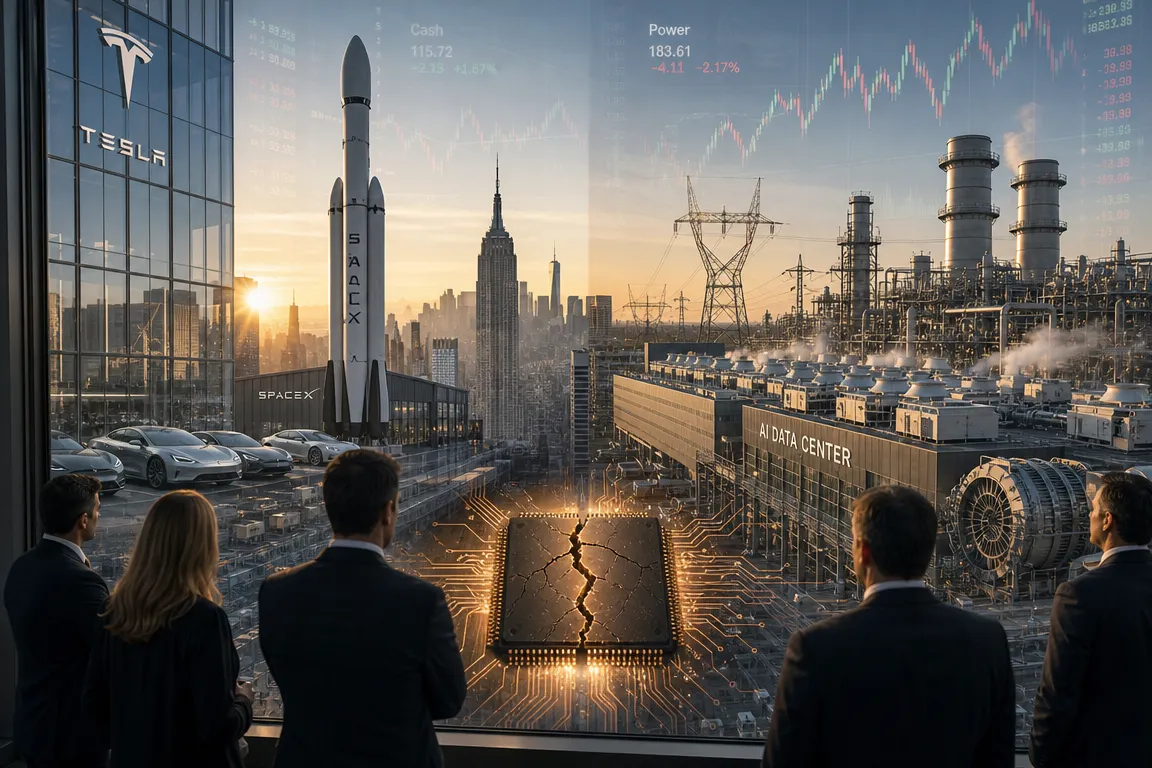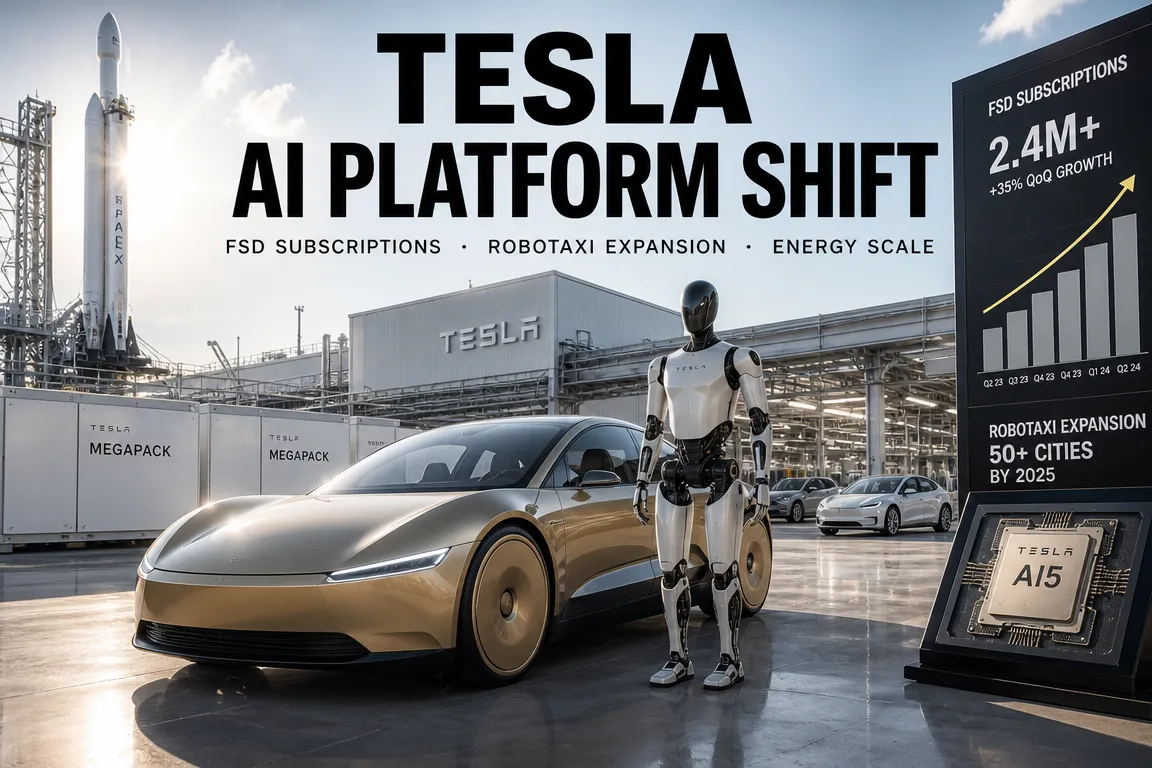
● Tesla AI Juggernaut, Robotaxi Surge, FSD Boom, Optimus Push, MegaPack Demand, SpaceX Merger Buzz
Tesla Q3 Earnings Highlights: Robotaxi, FSD, Optimus, Megapack, and SpaceX Merger in One View
The key takeaway from Tesla’s Q3 earnings call was not simply how many vehicles it sold.
The central message was that Tesla is clearly shifting from an EV manufacturer to a broader AI platform company spanning robotaxis, AI robotics, energy storage, AI semiconductors, and space-based connectivity infrastructure.
In particular, the call touched on Tesla earnings, robotaxi expansion, FSD subscription revenue, Optimus production plans, Megapack demand, TerraFab semiconductor strategy, and a possible SpaceX merger, covering nearly every long-term growth narrative in one session.
On the surface, auto margin recovery and energy strength were the main financial highlights. More importantly, Tesla appears to be shifting its monetization model from vehicle sales to autonomous network services and AI subscription revenue.
1. Q3 Vehicle Deliveries: 486,532 Units, with Production Constraints the Key Issue
Tesla reported Q3 vehicle deliveries of 486,532 units.
Management stated that deliveries exceeded 480,000 units for a second consecutive quarter.
The more important point was that deliveries were constrained by production rather than weak demand.
- Q3 vehicle deliveries: 486,532 units
- More than 480,000 deliveries for two consecutive quarters
- Auto backlog at the highest level in four years
- Main constraint: production capacity and supply chain, not demand weakness
Model Y remained the core volume driver.
Tesla said Model Y is estimated to rank first in Europe among BEVs and first in South Korea across the overall passenger vehicle market.
Record sales were also reported across key Asia-Pacific markets, including Australia, Japan, and Taiwan.
This matters for Tesla valuation.
Markets still view Tesla primarily through vehicle volume, while the company increasingly treats FSD as the main demand driver.
2. Automotive Margin: Excluding Credits, Gross Margin Rose to 18.1%
Automotive profitability improved meaningfully in the quarter.
Automotive gross margin excluding credits increased from 16.3% in the prior quarter to 18.1%.
- Auto gross margin excluding credits: 16.3% to 18.1%
- Improvement driven by a higher APAC sales mix
- Headwinds included higher raw material costs, interest rates, and financing program expenses
Tesla did not disclose an exact gross profit per vehicle figure.
Instead, it emphasized that auto margins are recovering and that FSD subscription revenue materially increases vehicle lifetime value.
The key point is that Tesla should not be evaluated solely with the margin framework of a traditional automaker.
Long-term software revenue from FSD subscriptions and potential robotaxi conversion may prove more important than vehicle-level profit at the point of sale.
3. FSD Subscription Penetration: More Than 75% of North American Deliveries
One of the most important metrics in the call was FSD subscription penetration.
Tesla said more than 75% of vehicles delivered in North America subscribed to paid FSD at delivery.
That is roughly 20 percentage points higher than the prior quarter.
- Paid FSD subscription penetration in North America deliveries: above 75%
- About 20 percentage points higher than the prior quarter
- Global paid FSD customers: more than 1.7 million
- Subscription-based customers: more than 50% of total paid users
This is not simply an option sale.
For Tesla, FSD is a recurring revenue software subscription business.
One analyst suggested that annual recurring FSD revenue may already be approaching $1 billion, and management indicated that the direction of that estimate was reasonable.
In practical terms, Tesla is moving from a one-time vehicle sale model to a model that collects monthly software revenue after delivery.
That is one of the most important structural changes for investors to track.
4. Robotaxi and Cybercab: Expansion from Austin to Dallas and Additional Cities
Robotaxi was the core focus of the call.
Tesla said it is expanding the Cybercab-based robotaxi service in Austin and that the fleet has grown roughly 10x since launch, about one month ago.
Cumulative full self-driving mileage increased 8x during the quarter, with weekly growth remaining in the double digits.
- Austin Cybercab fleet: about 10x larger since launch
- Cumulative FSD mileage: 8x increase during the quarter
- Weekly growth: double-digit pace
- Next expansion area: Dallas
- Additional city expansion planned before year-end
Tesla said Cybercab and Model Y robotaxi vehicles use the same software stack.
That implies the autonomous driving system validated in Austin can extend to other cities and existing vehicles.
Management also noted that not all remaining issues are regulatory.
Technical work is still needed for nighttime driving, highways, adverse weather, and 24-hour operations.
Service hours are being expanded gradually, with 24-hour operation and highway driving targeted by year-end.
5. Robotaxi Economics: Long-Term Target of $0.30 per Mile, with Meaningful Contribution from 2027
Tesla targets a long-term robotaxi operating cost of about $0.30 per mile.
The company said it has not reached that level yet, but expects it to be achievable as fleet scale increases.
- Long-term target cost: about $0.30 per mile
- Key variables: vehicle utilization, fleet management, cleaning, charging, and pickup/drop-off operations
- Near-term revenue impact: limited
- Visible contribution: possible from Q2 next year
- Large revenue contribution: more likely in Q3-Q4 next year
Elon Musk said robotaxi will not materially change this quarter’s results, but could become visible from Q2 next year and potentially a major business by Q3-Q4.
Tesla also stated that it intends to capture a significant share of ground transportation over time.
Musk said Tesla could eventually handle most passenger miles globally in countries that do not block the service.
That is a highly ambitious statement, but it shows that Tesla views robotaxi as a core business, not a side project.
6. Cybercab Production: 50% Fewer Parts and the Lowest Manufacturing Complexity Yet
Tesla said Cybercab is easier to manufacture than any previous vehicle it has produced.
The reason is that it uses about 50% fewer parts than a conventional vehicle.
- Cybercab parts count: about 50% lower than traditional vehicles
- Current production site: Gigafactory Texas
- Initial output: mostly for Tesla’s own robotaxi fleet
- Disclosed production capacity: more than 125,000 units annually
- Management view: actual potential capacity may be higher
Cybercab is less a consumer vehicle and more a Transport-as-a-Service product in which Tesla owns and operates the fleet.
In other words, the model is not customer ownership and individual driving, but Tesla-operated mobility services.
Longer term, customer ownership may also be possible, but the initial phase is likely to center on Tesla-owned fleet deployment.
7. Optimus Robot: Initial Production Has Started in Fremont, with Hands and AI Learning as Key Bottlenecks
Optimus was one of the longest-discussed topics in the call.
Musk reiterated that Optimus could become “the biggest product on Earth.”
Tesla has begun initial production on a high-volume line in Fremont.
- Initial Optimus production: started on a high-volume line in Fremont
- Target production pace: about 20,000 units per week, equivalent to a 1 million-unit annualized line
- Timeframe to reach that scale: at least one year
- Expected external customer deliveries: around the end of next year
- Initial use cases: industrial sites, hazardous tasks, repetitive work, and 24-hour operations
Tesla did not suggest that Optimus can be mass-produced immediately.
Musk said robot production requires roughly 10,000 variables to align, and the slowest component determines the overall pace.
The most difficult hardware component is the hand.
Human hands are soft, sensory, and recover from damage.
Robot hands must meet requirements for sensors, durability, precision, flexibility, and long-term repetitive use.
Tesla believes that hand design, AI5 chip integration, software improvement, and electromechanical durability must all converge before Optimus can scale commercially.
8. Optimus Training Strategy: Optimus Academy Is More Important Than Crowdsourcing
Optimus learning is not simply a data shortage problem.
Vehicles already generate large-scale driving data through Tesla’s global fleet.
However, because Optimus is not yet deployed at scale, Tesla must first build enough robots to generate robot training data.
- Required initial fleet size: about 10,000 to 20,000 robots
- Training approach: human demonstrations, simulation, and real-world self-play
- Key facility: Optimus Academy
- Goal: enable robots to learn a broad range of real-world tasks autonomously
Musk said Optimus should not be a robot that only performs pre-scripted demonstrations.
He added that any public Optimus videos released in the next one to two months should show real AI-based behavior, not staged motion.
This appears intended to differentiate Tesla from other humanoid robot companies.
Tesla also aims to integrate the AI5 chip into Optimus around next April.
AI5 was described as roughly 10x more capable than AI4, which could materially improve Optimus performance.
9. Energy Storage: 13.7 GWh Deployed, with Megapack Nearly Sold Out Through 2027
The energy business was a strong segment in the quarter.
Tesla deployed 13.7 GWh of energy storage in Q3.
That was the second-highest quarterly deployment in company history.
- Q3 energy storage deployment: 13.7 GWh
- Energy gross margin: 20.4% to 33.1%
- Key demand driver: data center power needs
- Megapack demand: nearly sold out through 2027
- New development: shipments of Tesla’s in-house LFP battery-based Megapack began
The 33.1% energy margin should not be treated as a normalized long-term rate.
This margin improvement included one-time factors such as tariff refunds and warranty expense adjustments related to suppliers.
Even so, structural demand from data centers is clearly supporting Megapack growth.
As AI infrastructure expands and power grid stability becomes more important, Tesla’s energy business could become a growth pillar comparable to automotive.
10. Capital Expenditure and Cash Flow: About $20 Billion for the Year, but a New Investment Cycle Is Beginning
Tesla lowered its full-year capex guidance to about $20 billion.
That is below earlier discussion of more than $25 billion in 2026, suggesting a more disciplined near-term capital allocation approach.
However, the company said capital spending will continue to increase over time.
- Expected capex for the year: about $20 billion
- Quarterly free cash flow: more than $1.5 billion
- Cash and investments: more than $45 billion
- Available new borrowing capacity: up to $30 billion
- No plans to draw on that facility this year
Tesla plans to invest heavily in robotaxi fleets, Optimus manufacturing, solar manufacturing, AI computing infrastructure, and semiconductor fabrication.
Near-term capex is lower than previously anticipated, but a much larger long-term investment cycle is being prepared.
That is an important interpretive point for Tesla investors.
Short-term expense pressure is real, but management views it as investment for the next growth phase.
11. TerraFab Semiconductor Strategy: Tesla Is Moving Toward AI Chip Vertical Integration
The most aggressive long-term project discussed in the call was TerraFab.
Musk said a research fab in Austin is progressing quickly and that equipment bring-up is expected to start in the first half of next year.
- Research fab equipment bring-up: first half of next year
- First test chips: targeted for May-June next year
- Meaningful chip production: around Q3 2028
- Initial investment scale: tens of billions of dollars
- Long-term investment scale: potentially more than $100 billion
Musk said TerraFab could ultimately become one of the most valuable buildings in the world.
That may sound exaggerated, but the rationale becomes clearer when viewed through Tesla’s AI strategy.
Optimus, robotaxi, FSD, AI data centers, and autonomous computing all depend on high-performance chips.
If semiconductor supply becomes a bottleneck, Tesla’s AI expansion could slow materially.
For that reason, Tesla appears to be preparing a long-term structure that can directly address bottlenecks in memory, packaging, and logic chips.
12. SpaceX Merger Possibility: Not Confirmed, but Special Committee Discussions Are Real
The most sensitive question in the call was the possibility of a Tesla-SpaceX merger.
Musk said it felt like “dancing in a minefield,” indicating that he was being extremely cautious.
The key point is that both companies formed special committees of independent directors in response to shareholder requests.
- Special committees established at both Tesla and SpaceX
- Musk is recused because of conflict-of-interest concerns
- Merger is not a confirmed outcome
- No agreed transaction terms yet
- Tesla would require approval from more than 50% of all outstanding shares
Musk personally sees advantages in combining the two businesses.
He cited superintelligence software, AI chip design, TerraFab, robotics, launch capabilities, and satellite connectivity.
However, he also emphasized that shareholder approval would be a high hurdle and that the special committee would need to agree on terms.
This could materially affect Tesla’s valuation, but it should still be treated as a scenario rather than a base case.
13. Non-Operating Items Affecting Net Income: SpaceX Fair-Value Loss and Bitcoin Gain
Several non-operating valuation items also affected quarterly net income.
- SpaceX equity fair-value loss: about $142 million
- Bitcoin fair-value gain: about $290 million
These items should be separated from core operating performance when assessing profitability.
The main structural changes at Tesla are not driven by fair-value gains or losses, but by FSD subscriptions, robotaxi commercialization, Megapack demand, and Optimus preparation.
14. The Most Important Points Often Missed by Other Coverage
First, Tesla’s real margin comes from the vehicle lifecycle, not just the initial sale.
Once FSD is attached, the long-term economics of a vehicle can be materially stronger than traditional automotive margin analysis suggests.
The fact that more than 75% of North American deliveries already subscribe to paid FSD indicates that Tesla is moving toward a software-like revenue model.
Second, the robotaxi bottleneck is not only the driving algorithm.
Many investors focus only on FSD technology, but commercialization also depends on fleet operations, cleaning, charging, insurance, pickup points, vehicle utilization, and city-level regulation.
Tesla’s $0.30 per mile target reflects not only technical confidence but also operational cost optimization.
Third, energy margins improved, but some one-time items were included.
The 33.1% energy margin is strong, but because it includes tariff refunds and warranty adjustments, it should not be treated as a normalized margin immediately.
Still, the structural trend from data center demand is clear.
Fourth, the real bottleneck for Optimus is not data alone, but embodied AI.
Unlike vehicles, humanoid robots do not already have a large deployment base generating data.
Tesla’s discussion of 10,000 to 20,000 robots and Optimus Academy is therefore highly important.
Fifth, TerraFab reflects Tesla’s attempt to control AI supply chain bottlenecks directly.
A car company building a semiconductor fab is ambitious, but if robotaxi and Optimus scale into the millions, chip supply becomes a strategic necessity.
Tesla is moving toward vertical integration not only in vehicles, but in the AI hardware supply chain as well.
15. Key Investor Watch Items
- Whether FSD subscription penetration rises outside North America
- When FSD approval expands in China and Europe
- Whether robotaxi expansion beyond Austin proceeds without incidents
- Whether Cybercab production can keep pace with service demand
- Whether Optimus is actually delivered to external customers next year
- Whether Megapack demand remains supported by the data center investment cycle
- Whether TerraFab test chip timing stays on schedule
- Whether SpaceX merger discussions progress into transaction terms
Tesla shares are likely to react more to FSD, robotaxi, Optimus, energy storage, and AI semiconductor milestones than to vehicle deliveries alone.
At the same time, the call outlined highly aggressive long-term plans, so investors should weigh execution speed and regulatory risk carefully.
This article is for informational purposes only and is not investment advice.
Investment decisions and responsibility remain with the individual investor.
< Summary >
The key theme from Tesla’s Q3 was AI platform transition rather than vehicle sales volume.
Vehicle deliveries were 486,532 units, and automotive gross margin excluding credits improved to 18.1%.
More than 75% of North American deliveries subscribed to paid FSD, and global paid FSD customers exceeded 1.7 million.
Robotaxi is expanding rapidly in Austin, with Dallas and additional city rollouts planned.
Optimus has entered initial production in Fremont, with external customer deliveries targeted for late next year.
Energy storage reached 13.7 GWh, and Megapack demand is nearly sold out through 2027 due to data center demand.
TerraFab is Tesla’s AI semiconductor vertical integration strategy and may require tens of billions of dollars in long-term investment.
The SpaceX merger remains under discussion but is not confirmed, and significant shareholder approval hurdles remain.
[Related Articles…]
- Tesla Earnings and AI Autonomous Driving Growth Strategy Analysis
- Robotaxi Market Expansion and Future Mobility Investment Trends
*Source: [ 오늘의 테슬라 뉴스 ]
– [라이브] 테슬라 3분기 실적 발표 — 머스크가 직접 답하는 Q&A, 한국어 자막으로 같이 봅니다
● Bulls Pause, Hawkish Hold
Bank of Korea Holds Base Rate at 3.00%; This Is a Pause, Not the End
The key point in this Bank of Korea rate hold is not a simple pause in tightening.
After two consecutive rate hikes in July and August, the Bank of Korea kept the base rate unchanged at 3.00%.
However, this is better understood as a hawkish hold rather than a dovish one, as it preserves the possibility of further rate increases.
There are five main points to watch in this decision.
- Why the Bank of Korea avoided a third consecutive rate hike
- Why it held rates even though inflation has not fully normalized
- How the decline in the won-dollar exchange rate and won strength affected the decision
- Why AI semiconductor momentum is lifting growth while consumer sentiment remains weak
- How Seoul apartment prices, household debt, and the equity market are shaping the next hike timing
In short, the Bank of Korea has not ended its tightening cycle. It is taking time to assess the effects of the two earlier hikes.
1. Bank of Korea Holds at 3.00%: Why This Is a Hawkish Hold
The Monetary Policy Board of the Bank of Korea decided to keep the base rate at 3.00%.
After raising the rate by 25 basis points in both July and August, the central bank opted to hold rather than tighten further.
At face value, this may appear to signal the end of the hiking cycle.
In practice, however, this decision does not indicate that rate hikes are over.
Instead, the Bank of Korea appears to be preserving policy flexibility while assessing the effect of previous tightening measures.
- The base rate has risen from 2.50% to 2.75%, and then to 3.00%.
- The Korea-U.S. policy rate gap remains near 1 percentage point.
- Two consecutive hikes already sent a strong tightening signal.
- A third consecutive increase could have added excessive pressure on growth and financial markets.
This means the hold should be read as: “further tightening remains possible, but the central bank wants to wait and observe first.”
In market terms, this is a hawkish hold.
The rate was unchanged, but the policy tone remains restrictive.
2. First Reason for the Hold: Preemptive Hikes Created Room to Pause
The main reason the Bank of Korea could hold rates this time is that it acted preemptively in July and August.
Interest rate policy does not affect the economy immediately.
It typically works with a lag, affecting household borrowing, property prices, consumption, investment, and inflation over several months.
This is known as the lag effect of monetary policy.
- Rate increases raise borrowing costs.
- Higher borrowing costs reduce consumption and investment momentum.
- They also affect housing demand and household debt growth.
- Over time, this helps ease inflationary pressure.
From the Bank of Korea’s perspective, it needed time to assess the economic impact of the two earlier hikes.
Continuing to raise rates too quickly could control inflation, but it would also increase pressure on small businesses, self-employed workers, and variable-rate borrowers.
The central bank is therefore maintaining a tightening bias while slowing the pace.
3. Inflation Assessment: Price Growth Has Slowed, but It Is Too Early to Relax
Inflation remains the most important factor in this rate decision.
The Bank of Korea’s inflation target is around 2%.
However, consumer price inflation remains above that level.
According to the original text, consumer inflation eased from a peak of 3.2% to 3.1%, and then to around 2.9%.
Core inflation also slowed from its peak to 2.8%.
- Inflation has moved down from its peak.
- However, it has not yet returned to the 2% target.
- Core inflation remains elevated.
- Higher global oil prices could reintroduce inflation pressure.
The Bank of Korea avoided a third consecutive hike because inflation is no longer accelerating sharply.
At the same time, it does not appear ready to declare victory over inflation.
If crude oil rises again, import prices and consumer prices could follow with a lag.
For that reason, October inflation data and the early-November release are likely to be key inputs for the next decision.
4. Import Prices and Exchange Rates: Won Strength Helped Limit Inflation Pressure
The exchange rate was another important factor in the decision.
Recently, the won-dollar exchange rate declined and the won strengthened.
This reduced the urgency for further rate hikes.
Import prices are a leading indicator of future inflation in Korea.
As noted in the original text, dollar-denominated import prices rose sharply, while won-denominated import price growth slowed from its peak.
In simple terms:
- Global commodity prices and dollar-based import costs increased.
- However, a stronger won reduced the transmission of those costs into domestic inflation.
- As a result, exchange rate stability eased inflation pressure.
If the won-dollar exchange rate had surged to 1,500 or 1,600 won, the policy response would likely have been different.
In that case, the Bank of Korea would have faced stronger pressure to tighten further in order to stabilize both inflation and the currency market.
With the exchange rate now more stable, the central bank had less need to raise rates immediately.
5. Financial Stability: Liquidity Trends Matter More Than the Korea-U.S. Rate Gap Alone
Many market commentaries focus only on the Korea-U.S. policy rate gap.
That gap is important.
A wider spread can trigger capital outflows, won weakness, and upward pressure on the exchange rate.
However, the more important issue in this cycle is the direction of liquidity.
The original text highlights changes in M2 growth in both Korea and the United States as a key exchange-rate variable.
M2 is a broad measure of money supply.
Korea’s M2 growth has slowed from its peak, while U.S. M2 growth has rebounded and moved above Korea’s pace.
- Korea’s liquidity growth has slowed as tightening takes effect.
- U.S. liquidity growth has strengthened relative to Korea.
- This may have helped ease dollar strength and support won appreciation.
- Exchange-rate stability, in turn, reduced pressure for additional Korean rate hikes.
This shows that the exchange rate cannot be explained by interest rate differentials alone.
Markets are also driven by liquidity conditions, risk appetite, election-related uncertainty, and equity market flows.
6. Growth Assessment: The AI Semiconductor Cycle Is Lifting Korea’s Growth Outlook
Korea’s growth outlook has improved significantly on the back of the AI semiconductor cycle.
According to the original text, the growth forecast rose from 1.9% to 2.6%, and the IMF later suggested potential growth of 3.3%.
This reflects stronger demand for AI-related semiconductors, a rebound in memory chip prices, large-scale capital spending, and higher exports.
- Data center investment is driving demand for high-performance chips.
- Semiconductor exports led by Samsung Electronics and SK hynix are supporting macroeconomic indicators.
- Capital expenditure in semiconductors is contributing to production, employment, and earnings.
- Export recovery is also supporting the current account and exchange-rate stability.
However, stronger headline growth does not necessarily translate into broad-based improvement in daily economic conditions.
Korea has about 29 million employed people in total.
By contrast, direct employment at Samsung Electronics and SK hynix is below 200,000.
Even after including suppliers and bonus effects, the direct beneficiaries of the semiconductor upswing remain a limited share of the total workforce.
As a result, headline growth may improve while households, small businesses, and many salaried workers continue to feel weak conditions.
7. Why Consumer Sentiment Remains Weak: The Double Burden of High Inflation and High Rates
The AI semiconductor-driven growth improvement is positive.
However, it also explains why the Bank of Korea cannot easily raise rates again.
The semiconductor and AI sectors can continue investing even in a higher-rate environment because their expected returns remain strong.
Most other sectors do not have that flexibility.
- Domestic demand businesses are highly sensitive to weaker consumption.
- Self-employed households face pressure from rents, wages, and input costs.
- Small and medium-sized firms face higher financing costs and tighter credit conditions.
- Households are dealing with both inflation and debt-service burdens.
In this environment, a third consecutive rate hike would likely place significant strain on vulnerable borrowers and sectors.
This is another reason the Bank of Korea chose to hold rates this time.
8. Housing and Household Debt: Seoul Apartment Prices Remain a Key Risk
From a financial-stability perspective, household debt remains one of the Bank of Korea’s main concerns.
And the main driver of household debt accumulation is housing prices.
Seoul apartment prices remain firm.
Regional apartment prices have not yet shown a broad-based recovery, but nationwide average apartment prices are still under upward pressure.
- Rising Seoul apartment prices can encourage more household borrowing.
- Higher household debt increases financial-stability risks.
- Improving property sentiment can weaken the transmission of rate hikes.
- At the same time, excessive tightening would add pressure on end users and vulnerable borrowers.
On housing alone, there is still a case for tighter policy.
However, the Bank of Korea cannot base its decision solely on Seoul housing prices.
It must balance inflation, growth, exchange-rate stability, financial volatility, and household debt.
That is why the housing market cannot be managed through interest rates alone.
Credit controls, lending limits, tax policy, supply measures, and broader housing policy all need to work together.
9. The 3.5 Billion Won Benchmark: High-End Housing May Face Adjustment Pressure
One notable point in the original text is the interpretation of the luxury housing market.
Properties above 3.5 billion won may face downward adjustment toward that level, while homes below 3.5 billion won could move upward toward it.
This is less a precise forecast than a signal of the market and policy boundary.
- High-end apartments are more sensitive to rate and regulatory pressure.
- Assets that have already appreciated sharply may face correction risk.
- By contrast, relatively less expensive high-end properties may attract capital and move higher.
- However, this does not necessarily translate into improved housing affordability for ordinary households.
The key point is that the housing market is not uniform.
It moves differently by price band, region, and buyer segment.
10. Equity Market Conditions: The Bank of Korea Cannot Ignore Capital Market Sentiment
Equity market conditions likely also influenced the hold decision indirectly.
The Bank of Korea does not target stock prices directly.
However, aggressive rate hikes can affect equities, bonds, and real estate simultaneously.
In particular, with Korean equities already under pressure, another hike could have drawn criticism if markets weakened further.
Central banks generally avoid decisions that could add unnecessary financial-market stress.
- Rate hikes pressure growth stocks and technology valuations.
- Higher bond yields raise corporate funding costs.
- Household appetite for risk assets can also weaken.
- Greater financial-market volatility can spill over into the real economy.
The hold decision should therefore be viewed as a balance between inflation control and broader financial-market conditions.
11. The Next Key Dates: November for Korea, December for the U.S.
The Bank of Korea has one policy meeting left this year, according to the original text.
Market expectations still leave room for another rate hike at the next meeting.
Before then, several data points will matter:
- October consumer inflation
- Core inflation trends
- Crude oil direction
- The won-dollar exchange rate
- Seoul apartment prices and household lending growth
- The Federal Reserve’s policy decision
- Volatility in Korean equities and bonds
The U.S. is expected to hold rates in late October, while a December hike remains possible.
If the Federal Reserve tightens again, Korea will have to consider the impact on the exchange rate and the policy gap.
Ultimately, the Bank of Korea’s next decision will depend not only on domestic inflation and housing conditions, but also on U.S. rates and dollar liquidity.
12. The Less-Scrutinized Variable: The Real Driver Is Money Flow, Not Just Rates
The most important and least discussed issue in this rate hold is the direction of M2 and broader liquidity.
Many reports focus on “rate hold,” “possibility of another hike,” and “the Korea-U.S. rate gap.”
But in practice, the broader trend in markets depends heavily on where money is flowing.
A closer look at the current situation suggests the following:
- Korea’s preemptive rate hikes slowed liquidity growth.
- U.S. M2 growth accelerated again.
- This helped stabilize the won-dollar exchange rate.
- Exchange-rate stability reduced import price pressure.
- Lower import price pressure created room for the Bank of Korea to hold rates this time.
In other words, the key variable is not simply whether rates are rising or falling.
What matters more is the speed and direction of money flow.
If liquidity shifts into U.S. equities, the Nasdaq and S&P 500 may strengthen further.
If election uncertainty rises, capital flows may become more volatile in the short term.
The same framework applies to Korea.
AI semiconductor exports and won strength are supportive, but weak domestic demand, household debt, and housing polarization remain constraints.
For 2026, the Korean economy should be assessed not through the policy rate alone, but through a combined view of the base rate, exchange rates, inflation, household debt, the AI semiconductor cycle, and global liquidity.
13. Key Points for Investors
This Bank of Korea hold is also an important signal for investors.
If the hiking cycle has not fully ended, excessive optimism in asset markets should be approached cautiously.
Equities
- AI semiconductor-related stocks still have structural growth potential.
- However, the possibility of further tightening means valuation risk should be monitored.
- Volatility may rise around U.S. election-related developments and Federal Reserve decisions.
- Semiconductor export momentum should be tracked closely.
Bonds
- Short-term yields may remain sensitive if another hike stays on the table.
- Slower inflation would support longer-duration bonds.
- If oil prices rise again, bond yields could move higher.
Property
- Seoul core apartment prices may remain more sensitive to supply and liquidity than to rates alone.
- High-end apartments may face greater correction risk.
- Debt controls and rate burdens are likely to remain in place simultaneously.
- End users should remain conservative when assessing borrowing capacity.
FX
- The won-dollar exchange rate remains highly sensitive to the policy paths of the Bank of Korea and the Federal Reserve.
- U.S. M2 growth and dollar liquidity trends should also be monitored.
- A stable exchange rate can ease import-cost pressure for firms and consumers.
14. Conclusion: The Bank of Korea Has Paused, Not Finished
This rate hold does not signal the end of tightening.
The Bank of Korea has chosen to assess the effects of the two earlier hikes before deciding on further action.
Inflation has eased from its peak, but it remains above target.
The exchange rate has stabilized, but risks remain from oil prices and U.S. policy.
AI semiconductor strength is improving headline growth, while domestic demand remains uneven.
Seoul apartment prices and household debt continue to pose financial-stability concerns.
In one sentence:
The Bank of Korea has not ended its hiking cycle; it is waiting for the right conditions and timing for the next move.
The next major variables are October inflation, the won-dollar exchange rate, oil prices, Seoul apartment prices, and the Federal Reserve’s policy decision.
< Summary >
- The Bank of Korea kept the base rate unchanged at 3.00%.
- This was a hawkish hold, not a signal that tightening has ended.
- The central bank appears to be waiting to assess the impact of the July and August hikes.
- Inflation has eased from its peak, but it remains above the 2% target.
- Won strength and a lower exchange rate helped ease import-price pressure.
- The AI semiconductor cycle is lifting Korea’s growth outlook, but consumer sentiment remains uneven.
- Seoul apartment prices and household debt remain reasons for caution on further tightening.
- The next policy decision will likely depend on inflation, exchange rates, oil prices, and the Federal Reserve’s stance.
[Related Articles…]
*Source: [ 경제 읽어주는 남자(김광석TV) ]
– [속보] 한국은행 ‘숨고르기’ 기준금리 동결. “금리인상 남아 있다” [즉시분석]