● Institutional Panic Selloff, Buy the Dip Signal
Are Forced Institutional Sales an Opportunity? Citadel’s Scott Rubner Identifies a Potential Turning Point in U.S. Equities
The key issue in the current market is identifying why stock prices are falling.
The appropriate response differs significantly depending on whether the decline reflects deteriorating earnings, valuation pressure, or mechanical selling triggered by institutional risk-management rules.
This analysis examines algorithmic institutional selling, unusually strong retail dip-buying, positioning gaps in AI infrastructure stocks, the potential deployment of sidelined capital after the 2026 U.S. midterm elections, and overlooked sectors that could benefit from lower interest rates.
A critical but underreported point is that institutions may not be selling solely because they are bearish. They may simply have suspended new purchases until key uncertainties are resolved.
This report focuses on short-term market positioning and potential inflection points, not the long-term outlook for the AI industry.
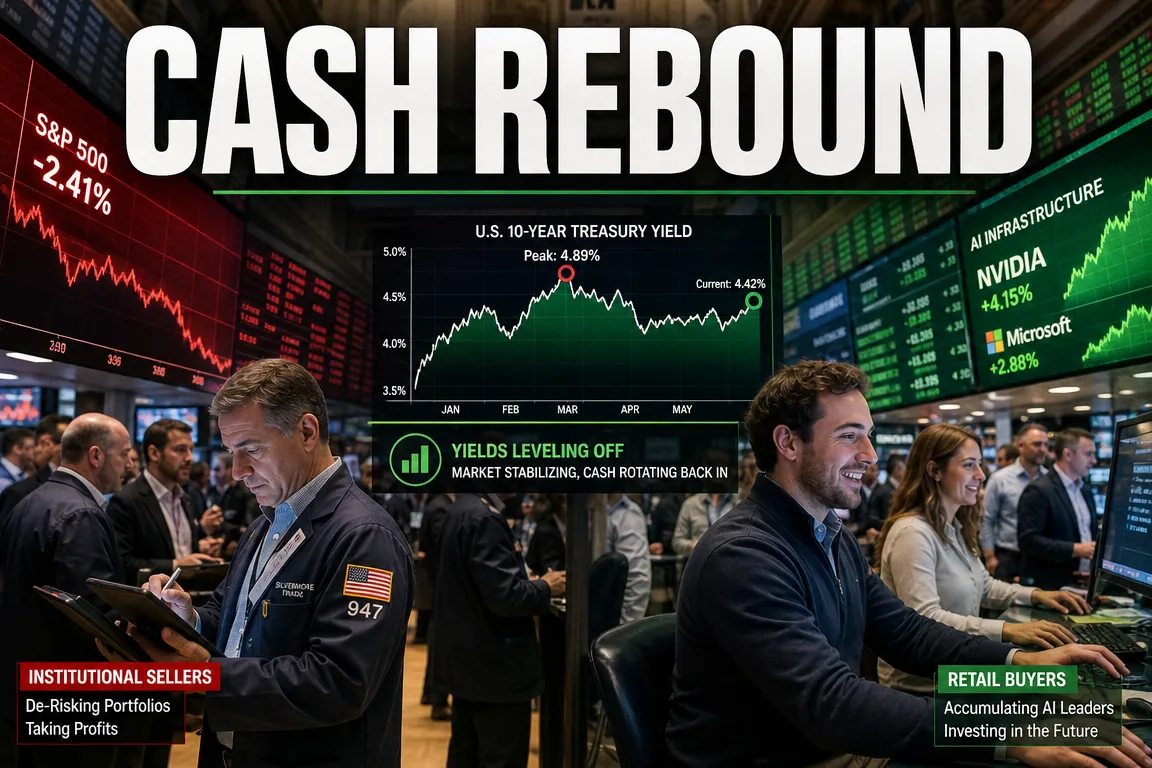
Key Development: Institutions Are Selling While Retail Investors Are Buying
Scott Rubner, an equity strategist at Citadel Securities, has attributed recent market weakness more to position unwinding and risk-management selling than to deteriorating corporate fundamentals.
Rubner previously spent many years at Goldman Sachs analyzing fund flows and positioning. He is known for assessing short-term turning points in equity markets.
His central argument is that institutional investors are reducing equity exposure under predetermined risk-management rules rather than selling based on a reassessment of long-term corporate value.
- Institutional investors: Reducing equity exposure because of political and geopolitical uncertainty
- Systematic strategies: Selling mechanically as price momentum and volatility signals deteriorate
- Retail investors: Buying declines in technology and AI-related stocks
- Sidelined capital: Remaining in cash pending greater policy and market clarity
Citadel Securities processes a substantial share of U.S. retail order flow, giving it relatively timely visibility into changes in retail buying and selling.
According to figures cited in the source material, retail investors recently recorded their most aggressive dip-buying activity in 16 weeks.
Robinhood-related data also indicated that retail buying intensity reached elevated levels over the latest 10 trading sessions.
These figures should not be treated as definitive market-bottom signals because their interpretation depends on the measurement period, net-purchase methodology, and whether options activity is included.
Why Institutions May Be Forced to Sell
Institutional and retail investors operate under different objectives and performance constraints.
Retail investors may tolerate losses if they believe an asset can recover over a longer investment horizon.
Funds, pension plans, hedge funds, and asset managers must control losses, volatility, and maximum drawdowns within defined limits because they manage client capital.
When stock prices fall below specified thresholds or volatility rises, these investors may be required to reduce equity exposure regardless of their discretionary views.
1. Automatic Unwinding by Momentum Strategies
Trend-following funds and commodity trading advisers reduce equity exposure when upward trends weaken or price momentum turns negative.
These decisions may not fully reflect corporate earnings, cash flow, or long-term growth prospects.
This helps explain indiscriminate selling in which both high-quality and weak companies decline together.
2. Lower Risk Budgets as Volatility Rises
Volatility-control funds automatically reduce risk-asset exposure as market volatility increases.
Falling prices can raise volatility, triggering further equity sales. Those sales can then push prices lower and amplify volatility, creating a negative feedback loop.
3. Political Events and Geopolitical Risk
The 2026 U.S. midterm elections are scheduled for November 3.
As uncertainty rises around policy direction, fiscal spending, regulation, and trade, institutions may reduce positions rather than attempt to predict the outcome.
This defensive positioning could intensify if geopolitical risks in the Middle East coincide with fiscal and interest-rate concerns in Europe.
How Far Have AI Infrastructure Positions Declined?
The source material cited an analysis indicating that institutional technology exposure had fallen to approximately the bottom 5% of its historical distribution.
This suggests that positioning in technology and AI infrastructure stocks is unusually low relative to periods ranging from one to five years.
However, it is necessary to determine whether the bottom-5% figure refers to the broader institutional market or to a specific client group or strategy portfolio.
Low institutional positioning can be constructive because it indicates that incremental selling capacity may be limited.
It does not, however, imply that new buying will begin immediately.
A prolonged positioning vacuum can leave prices highly sensitive to relatively minor negative developments.
Citadel’s Assessment: AI Investment Is Paused, Not Terminated
Rubner’s analysis does not suggest that the long-term AI growth thesis has ended.
Instead, the current environment may reflect a temporary suspension of institutional AI purchases because of political, interest-rate, and credit-market uncertainty.
Large asset managers, hedge funds, and pension funds may postpone new purchases until those risks become more manageable.
Once uncertainty declines, institutions could begin buying even after prices have already rebounded.
Institutional investors often prioritize explainable valuations and controllable risk over purchasing at the absolute lowest price.
This could recreate a familiar market structure in which retail investors buy first and institutions later enter through momentum-driven or catch-up purchases.
Why the Midterm Elections Could Become a Positioning Catalyst
The election outcome will matter, but the removal of uncertainty itself may be more important for the short-term direction of U.S. equities.
Markets generally respond more negatively to unpredictable conditions than to clearly defined adverse outcomes.
After the election, the range of potential policy scenarios should narrow, allowing institutions to formulate new allocation plans.
The period surrounding the election could therefore serve as a clearing event for accumulated positions and a catalyst for new fund flows.
However, the election will not automatically resolve interest-rate, earnings, or credit-spread concerns.
It should be viewed as a potential catalyst that removes one source of uncertainty, not as a sufficient condition for a market rebound.
Three Risks Commonly Highlighted by Wall Street Strategists
Wall Street strategists, including Morgan Stanley’s Mike Wilson and Bank of America’s Michael Hartnett, have suggested that the correction may be entering its later stages. However, they have generally emphasized confirmation rather than immediate aggressive buying.
Institutional investors are monitoring three primary risks:
- U.S. midterm elections and policy uncertainty
- Credit and financing pressure associated with expanding AI investment
- European fiscal and sovereign-yield instability, including risks in France
Geopolitical conflict and higher oil prices could further increase uncertainty around global growth, inflation, and interest rates.
Institutions generally prefer to reenter after these risks appear to have peaked.
Avoiding large losses is often more important for performance evaluation and client retention than purchasing assets at the lowest possible price.
The Cost of Waiting Until All Risks Have Cleared
The institutional approach is rational from a capital-preservation perspective, but it has clear disadvantages.
Equity markets often rebound before economic data and news flow visibly improve.
If investors wait until the election is completed, geopolitical risks recede, interest rates decline, and AI earnings are confirmed, stock prices may already have recovered substantially.
Greater certainty generally results in a higher purchase price.
Buying during periods of uncertainty may offer lower valuations, but it also requires investors to tolerate further declines and potentially extended periods of weak performance.
Excess returns can compensate investors for assuming uncertainty earlier, but risk-taking does not guarantee positive returns.
Three Potential Triggers for a Stronger Recovery
Brokerage and market analyses indicate that three conditions could reinforce a positioning-led recovery.
1. Macroeconomic Stabilization
Stable Treasury yields and oil prices would reduce the discount-rate pressure applied to future earnings from growth companies.
Lower long-term yields would be particularly supportive for highly valued semiconductor, data center, cloud, and power-infrastructure companies.
Credit spreads must also stabilize.
If Treasury yields decline while corporate borrowing costs continue to rise, overall financial conditions should not be considered materially improved.
2. Stronger Big Tech Earnings and Cash Flow
Sustained AI investment requires major technology companies to generate sufficient revenue and operating cash flow to support large capital-expenditure programs.
The critical issue is not simply whether AI spending increases, but whether that investment produces measurable revenue growth and improved profitability.
Investors should monitor cloud growth, data center utilization, depreciation expense, and free cash flow.
3. AI Private-Market and Financing Conditions
The source material identified a possible mid-November Anthropic listing as a potential sentiment indicator.
However, unconfirmed IPO schedules or listing plans should not be used as a basis for investment decisions.
More reliable indicators include AI startup funding activity, corporate bond issuance costs, and financing terms for data center projects.
Potential Rotation Beyond AI Stocks
If interest-rate and geopolitical risks moderate, capital may not return exclusively to large AI companies.
Market leadership could broaden toward previously overlooked cyclical, transportation, construction, industrial, and dividend-paying stocks.
AI infrastructure investment extends beyond the semiconductor industry.
It also supports capital spending in electrical grids, transformers, cooling systems, natural-gas generation, nuclear energy, copper, construction equipment, and data center real estate investment trusts.
However, if rates decline because of recession concerns, high-quality bonds and defensive equities may outperform cyclical sectors.
Investors should therefore assess why rates are falling rather than treating lower rates as uniformly positive.
Are Retail Investors Becoming More Sophisticated?
Rubner has argued that retail investors are becoming more institutional in their behavior and are moving beyond short-term thematic trading.
An increasing number of individuals are considering stock-bond allocation, investment horizons, taxation, and valuation together.
More investors are also using phased purchases during market declines and adjusting exposure during recoveries.
Strong retail buying alone does not confirm a market bottom.
If retail purchasing capacity becomes exhausted or leverage increases excessively, retail positioning could contribute to additional volatility.
Key Points Often Overlooked in Market Coverage
First, institutional investors are not a single homogeneous group.
Pension funds, hedge funds, commodity trading advisers, mutual funds, and volatility-based strategies operate under different mandates and rules.
Accurate flow analysis requires identifying which type of institution is selling and why.
Second, mechanical selling may be unrelated to corporate value but can still create substantial price pressure.
Strong fundamentals do not prevent additional short-term declines.
High-quality companies can remain undervalued for extended periods until positioning normalizes.
Third, low institutional positioning provides potential fuel for a rebound but does not indicate its timing.
Low exposure creates greater buying capacity after risks recede.
However, institutions may maintain low exposure for a prolonged period if uncertainty persists.
Fourth, the bond market’s reaction after the election may matter more than the result itself.
If the outcome increases expectations for larger fiscal deficits, rising Treasury yields could limit a technology-stock recovery.
If policy uncertainty declines and long-term yields stabilize, flows into AI infrastructure and growth stocks could recover more rapidly.
Fifth, retail investors can buy earlier than institutions partly because they operate under different constraints.
Retail investors are generally less exposed to short-term performance evaluations and redemption pressure, allowing them to adopt longer investment horizons.
Their primary advantage is not necessarily superior information, but greater flexibility and time.
Investor Monitoring Checklist
- Assess whether the U.S. 10-year Treasury yield is forming lower highs.
- Monitor whether high-yield credit spreads stop widening.
- Evaluate whether the VIX and the options-market volatility structure are stabilizing.
- Use market breadth to determine whether a rebound is expanding.
- Monitor whether gains extend beyond semiconductors and software into industrial and financial stocks.
- Assess whether Big Tech AI capital expenditure and free cash flow are improving simultaneously.
- Determine whether retail net purchases are concentrated in cash equities or in leveraged products and short-dated options.
- Monitor the direction of the U.S. dollar, Treasury yields, and oil prices after the midterm elections.
The Fear & Greed Index and the VIX are separate indicators and should not be treated as interchangeable.
A single-digit Fear & Greed reading and a specified VIX level measure different aspects of market stress and are calculated differently.
Practical Strategies for Individual Investors
A phased, conditional approach may be more practical than attempting to identify the exact market bottom.
Investors with sufficient risk tolerance may consider gradually purchasing high-quality assets when forced institutional selling intensifies.
Investors with lower tolerance for volatility may prefer to wait for stabilization in election uncertainty, interest rates, credit spreads, and Big Tech earnings.
Neither approach is universally appropriate.
Investors with unstable cash flow or leveraged exposure should prioritize risk reduction over dip-buying.
For long-term accounts, investors should establish their investment horizon and target allocation before adding exposure and avoid exceeding planned allocations solely because prices have declined.
Conditions That Could Invalidate This Outlook
If AI-related corporate earnings weaken faster than expected, the decline could represent a fundamental revaluation rather than a temporary positioning adjustment.
If U.S. long-term yields rise sharply again, new institutional technology purchases could remain delayed despite already-low positioning.
An escalation in geopolitical conflict or a sharp increase in oil prices could renew inflation concerns.
If credit-market stress develops into higher defaults and restricted financing access, the recovery in risk assets could remain limited even after the midterm elections.
The appropriate interpretation is not that markets will necessarily rise after the election, but that the probability of a flow reversal could increase if forced selling subsides.
< Summary >
Recent U.S. equity weakness may reflect institutional risk management and systematic selling more than deteriorating corporate earnings.
Retail investors, by contrast, appear to be buying declines in technology and AI infrastructure stocks aggressively.
With institutional technology positioning already low, capital could return after election-related and geopolitical uncertainty declines.
Low institutional exposure indicates potential rebound capacity but does not identify the market bottom.
Key indicators include Treasury yields, credit spreads, Big Tech cash flow, AI financing conditions, and the bond market’s response after the election.
Waiting until all risks have cleared may improve visibility but also result in higher entry prices.
Investors should balance phased buying against confirmation-based entry according to their risk tolerance, liquidity, and investment horizon.
This material is an informational analysis of market flows and structure based on the supplied source. It does not constitute a recommendation to buy or sell any security or financial product.
[Related Articles…]
*Source: [ 소수몽키 ]
– 큰 손들의 강제 주식 매도는 기회? 월가 변곡점 족집게 전망, 적중할까
● Goldilocks-Turn, Peak-Yields, Oil-Slowdown
Peak U.S. Treasury Yields and the 2027 Economic Outlook: How Interest Rates, Oil, and the Semiconductor Cycle Could Reshape Markets
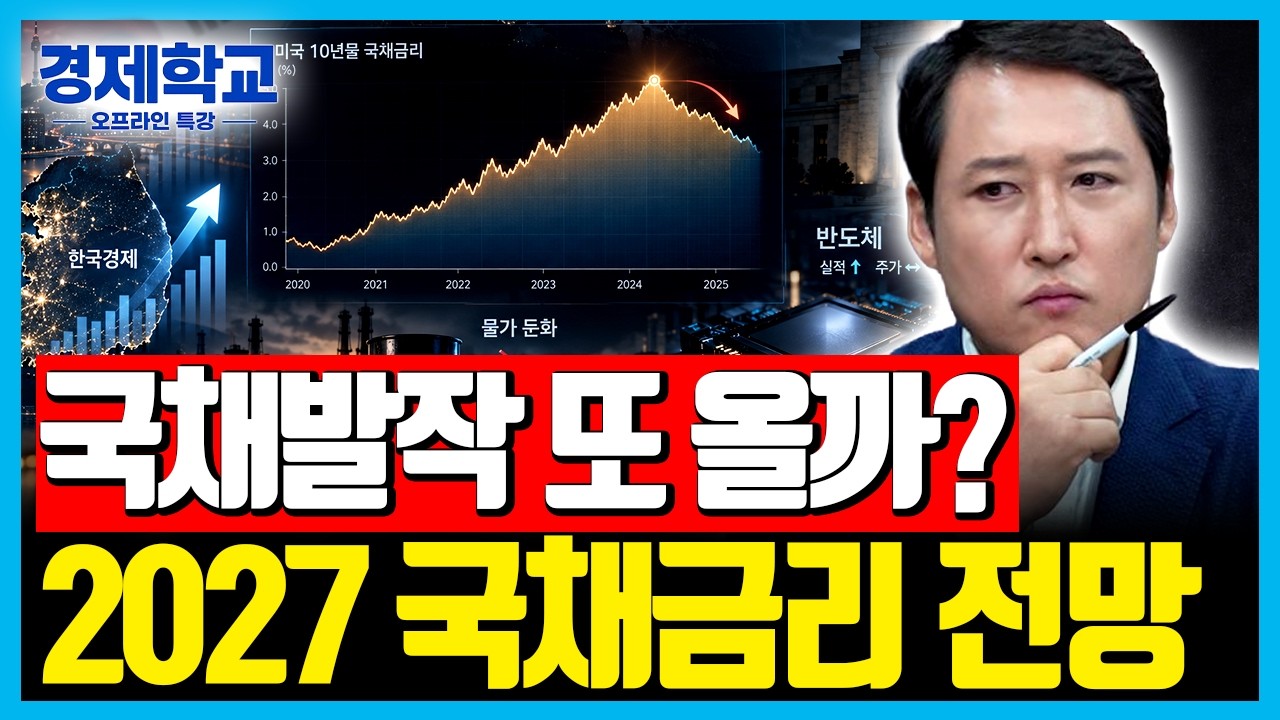
The central issue for markets in 2027 is not whether interest rates return to historically low levels, but whether U.S. Treasury yields reverse from an upward trend to a downward trajectory while remaining structurally elevated.
This shift could coincide with favorable oil-price base effects, moderating inflation, slower growth in data center capital expenditure, and a potential peak in semiconductor prices.
Rather than marking a return to the low-rate era, 2027 may represent a transition in which Treasury yields peak within a higher-for-longer interest-rate environment.
However, the projected peak in Treasury yields in the fourth quarter of 2026 and the expected moderation in 2027 inflation are conditional scenarios. They assume no renewed oil-price or geopolitical shock.
1. Key Conclusion: Treasury Yields May Decline Without Returning to Previous Lows
The central outlook is that U.S. Treasury yields may be approaching a peak, but are unlikely to return to the exceptionally low levels observed after the global financial crisis or during the COVID-19 period.
A decline from elevated levels would therefore indicate a directional reversal rather than a full normalization to the previous low-rate regime.
Instead of moving from 50 to 100 and then back to 50, yields may settle near 80 and establish a higher structural baseline.
From a market perspective, this would represent a higher-rate or moderate-rate new normal in which the direction of yields changes from sustained increases to a gradual decline.
- Large structural fiscal deficits and continued Treasury issuance could support long-term yields.
- Persistent core and services inflation may limit the speed of any yield decline.
- Favorable energy-price base effects and reduced expectations for additional rate increases could place downward pressure on yields.
- The 2027 policy-rate outlook therefore favors an extended pause followed by a gradual transition rather than aggressive cuts.
2. Rising Treasury Yields Reflect Policy Expectations Rather Than Automatically Triggering Rate Increases
It would be misleading to conclude that the central bank must raise its policy rate simply because Treasury yields have increased.
Higher Treasury yields generally reflect market expectations that policy rates may rise further or remain elevated for longer.
Policy rates and central-bank communications influence not only short-term rates but also bond yields, lending rates, and corporate borrowing costs.
If market rates rise substantially before an additional policy-rate increase, financial markets are already delivering part of the intended tightening.
John Williams, President of the Federal Reserve Bank of New York and Vice Chair of the FOMC, has indicated that persistently high Treasury yields can tighten broader financial conditions.
Under these conditions, the Federal Reserve may influence expectations through hawkish communication without implementing another rate increase.
This is the transmission mechanism connecting forward guidance, verbal intervention, and tighter financial conditions.
3. High Treasury Yields Act as an Automatic Brake on Corporate Investment
Higher Treasury yields increase financing costs for governments, businesses, and households.
Corporate bonds are priced at Treasury yields plus a credit-risk premium. As a result, rising government-bond yields directly increase corporate funding costs.
When borrowing rates reach double-digit levels, only companies expecting sufficiently high operating returns are likely to proceed with new investments.
Companies with weak profitability or limited cash flow may reduce capital expenditure and hiring.
When fiscal expansion and increased government-bond issuance raise market interest rates and displace private investment, the result is known as the crowding-out effect.
Government spending can support economic activity, but higher Treasury yields may offset part of that support by constraining private consumption and investment.
Slower aggregate demand and reduced corporate pricing power can subsequently create a disinflationary transmission channel.
4. The First Key Driver of 2027 Inflation Is the Rate of Change in Oil Prices, Not the Absolute Price
Oil analysis should focus on year-over-year changes as well as the current price per barrel.
For example, if oil rises to $100 per barrel in 2026 and remains at $100 in 2027, the absolute price remains high, but the year-over-year increase falls to 0%.
If oil falls below $100, the year-over-year energy inflation rate could turn negative.
This distinction is important because the Consumer Price Index measures changes over time rather than price levels alone.
As year-over-year energy inflation declines, its contribution to headline CPI can contract rapidly.
Under the assumption that oil prices surge in early 2026, base effects could become increasingly favorable in February and March 2027.
This could produce a larger-than-expected decline in U.S. headline inflation during the spring of 2027.
The outlook would weaken if conflict in the Middle East intensifies, major producers reduce output, or oil transportation routes are disrupted.
5. Why Higher Oil Prices May Not Reproduce a 1970s-Style Shock
The economy’s oil dependence, or energy intensity, has declined over time.
During the 1970s and 1980s, oil-price shocks raised manufacturing, transportation, and electricity costs across the economy.
Oil remains relevant to inflation and consumption, but the amount of oil required to produce one unit of GDP is lower than in previous decades.
The share of renewable and nuclear energy has increased, while the economic structure has shifted from energy-intensive manufacturing toward software and digital services.
Just as AI is changing labor-input requirements, the energy transition is gradually reducing the economy-wide impact of oil.
A renewed oil-price surge would therefore not necessarily generate the same economic impact as an equivalent increase in earlier periods.
6. How the Current Energy-Inflation Cycle Could Differ From 2022
The 2022 inflation cycle was characterized by broad transmission from energy prices into food, goods, transportation, housing, and services.
The key issue in the current cycle is the extent to which higher energy costs spread to other categories.
If price increases remain concentrated in energy while food, general merchandise, and services stabilize, the effect on overall CPI could remain limited.
If higher oil prices flow through transportation and production costs into wages and services, core inflation could accelerate again.
The 2027 outlook should therefore distinguish between headline and core CPI.
Headline inflation could decline rapidly because of favorable energy base effects, while core inflation may moderate more slowly due to housing and wage pressures.
7. Slower Wage Growth Reduces the Risk of Renewed Inflation
Immediately after the pandemic, labor shortages and rapid wage growth were major drivers of services inflation.
If wage growth returns toward its pre-pandemic range, the risk of a self-reinforcing wage-price cycle should diminish.
Moderate wage growth can preserve household purchasing power while reducing the need for companies to implement aggressive price increases to offset labor costs.
The Federal Reserve has a dual mandate of price stability and maximum employment.
If inflation continues to decline, the rationale for additional rate increases that could unnecessarily weaken employment becomes less compelling.
This supports a 2027 policy outlook centered on an extended pause rather than further tightening.
8. A Potential Peak in Semiconductor Prices and the Changing Chipflation Cycle
Inflation analysis should consider semiconductor inflation, or chipflation, alongside oil prices.
Smartphones, laptops, vehicles, household appliances, and data center equipment contain dozens or hundreds of semiconductors.
Higher memory and logic-chip prices increase manufacturers’ input costs and can eventually affect consumer-electronics and vehicle prices.
If semiconductor prices peak in the fourth quarter of 2026 or the first quarter of 2027, slower price growth could reduce upward pressure on finished-goods prices.
Semiconductor prices do not need to collapse for their inflation contribution to decline.
Even if prices remain high, a lower year-over-year growth rate would reduce the contribution from chipflation.
9. Strong Earnings at Samsung Electronics and SK Hynix May Not Translate Into Continued Share-Price Gains
Strong semiconductor operating profits do not necessarily imply that semiconductor equities will continue to appreciate.
Equity markets generally price future earnings growth and the direction of the cycle rather than current earnings alone.
Samsung Electronics and SK Hynix could maintain high profits in 2027, but their shares may correct if operating-profit growth or memory-price increases begin to slow.
Large operating-profit estimates for Samsung Electronics should be treated as projections based on semiconductor-cycle assumptions rather than confirmed results.
Comparisons between Saudi Aramco and Samsung Electronics also require caution because operating profit, net income, accounting standards, and exchange rates may differ.
10. Slower Data Center CAPEX Growth Is a Leading Indicator for Semiconductors
AI data center investment has been a major driver of U.S. economic growth and semiconductor demand.
For equity markets, however, the growth rate of capital expenditure may be more important than the absolute investment amount.
Even if companies continue increasing data center investment, a slowdown in CAPEX growth from 50% to 20% could trigger downward revisions to semiconductor and server-demand expectations.
Ahead of the U.S. midterm elections, policymakers and corporations may have incentives to sustain economic growth and AI infrastructure investment.
After the elections, policy moderation, power-grid constraints, data center regulation, and concerns about investment efficiency could receive greater attention.
If concerns over electricity consumption and local environmental costs intensify, particularly among Democratic policymakers, approval timelines for new projects could lengthen.
Investors assessing the 2027 semiconductor cycle should therefore monitor big technology companies’ CAPEX growth rates and investment guidance rather than data center construction totals alone.
11. Implications of a Potential Reversal in South Korea’s Growth Trend
The original analysis characterizes two consecutive years of improvement in South Korea’s potential growth rate, following a prolonged decline, as a reversal in the previous trend.
If AI semiconductor exports and large-scale capital investment materialize, estimates for South Korea’s actual and potential growth rates could be revised higher.
South Korea is directly exposed to the global AI investment cycle because semiconductors and electronic components represent a substantial share of exports and manufacturing investment.
Conversely, weaker semiconductor demand could affect economic growth, tax revenue, and KOSPI earnings expectations simultaneously.
Potential growth estimates of 2.1% and 2.2% should therefore be viewed as forecasts contingent on productivity gains and sustained AI investment.
12. The Korean Won May Appreciate While the Strong-Dollar New Normal Persists
The exchange-rate outlook follows a structure similar to that of Treasury yields.
A decline in the USD/KRW exchange rate from an extreme peak would not necessarily imply a rapid return to the previous KRW 1,100 range.
If U.S. interest rates remain elevated, economic growth remains resilient, and global demand for safe assets persists, the dollar could remain stronger than its historical average.
The exchange rate could move from an extreme high toward the KRW 1,300 range, although the actual path will depend on the U.S.-South Korea interest-rate differential and foreign capital flows.
Stronger semiconductor exports and an improving trade balance would support the won, while global risk aversion and rising U.S. Treasury yields would place downward pressure on it.
13. Why the KOSPI and U.S. Equities Move Before Interest-Rate Decisions
Equity markets price expected monetary-policy changes before they are implemented.
If Treasury yields and discount rates rise before a policy-rate increase is announced, valuations for growth and semiconductor stocks may decline in advance.
Conversely, markets may respond positively when the probability of additional tightening falls, even if the Federal Reserve does not immediately cut rates.
When Treasury yields decline, the present value of future cash flows rises, supporting equity valuations even when corporate earnings remain unchanged.
The direction of the U.S. 10-year Treasury yield and real yields may therefore matter more to 2027 equity markets than the number of policy-rate cuts.
However, if semiconductor CAPEX growth slows simultaneously, the positive effect of lower yields could conflict with weakening earnings momentum.
14. Key Points Often Overlooked in Market Coverage
First, declining rates and a return to the low-rate era are fundamentally different developments.
The principal investment opportunity in 2027 may emerge when the upward trend in yields ends, rather than when absolute rates fall substantially.
Second, even if oil remains expensive, its CPI contribution can decline sharply when year-over-year price growth reaches 0% or turns negative.
Focusing only on the absolute oil price can lead to an overstated assessment of renewed inflation risk.
Third, Samsung Electronics and SK Hynix shares could decline even if corporate profits reach record levels.
Equity prices reflect expectations for future earnings growth rather than the absolute level of current profits.
Fourth, the semiconductor cycle may peak even if AI data center investment continues to increase.
CAPEX growth rates and corporate guidance are more important leading indicators than absolute investment levels.
Fifth, high Treasury yields can reduce the probability of additional Federal Reserve rate increases.
If market rates already constrain consumption and investment, the central bank has less need to impose further pressure on growth and employment.
15. Key Indicators for Assessing Markets in 2027
- Determine whether the U.S. 10-year Treasury yield begins forming lower highs.
- Monitor whether the gap between headline and core CPI widens.
- Track the year-over-year change in oil prices rather than the absolute price alone.
- Assess whether average hourly earnings and the Employment Cost Index continue to moderate.
- Review the Federal Reserve’s decisions, dot plot, and FOMC communications.
- Monitor data center CAPEX growth and 2027 investment guidance from U.S. technology companies.
- Track whether DRAM and HBM price growth begins to slow.
- Assess South Korean semiconductor export growth together with the USD/KRW exchange rate.
- Monitor potential changes in U.S. AI infrastructure and energy policy after the midterm elections.
16. Base, Bull, and Risk Scenarios
Under the base scenario, slower oil-price growth and stabilizing headline CPI could allow U.S. Treasury yields to peak around the end of 2026.
The Federal Reserve would likely maintain an extended pause rather than implement rapid cuts, while equities price both reduced rate pressure and slower semiconductor growth.
Under the bull scenario, energy and wage inflation could decline faster than expected while AI investment maintains a high growth rate.
Bonds and growth equities could strengthen simultaneously, while South Korea’s economy could sustain a recovery supported by semiconductor exports.
Under the risk scenario, escalating conflict in the Middle East and oil-supply disruptions could trigger another energy-price surge.
If this coincides with tighter data center regulation and reduced CAPEX, the risk of stagflation would increase.
U.S. Treasury yields and the USD/KRW exchange rate could rise again, accompanied by greater volatility in the KOSPI and U.S. equity markets.
< Summary >
Rather than marking a return to exceptionally low interest rates, 2027 may be the year in which Treasury yields begin declining from structurally elevated levels.
Favorable oil-price base effects and slower wage growth would support disinflation.
Headline CPI could decline relatively quickly, while core inflation may moderate more gradually.
If semiconductor prices and data center CAPEX growth peak, Samsung Electronics and SK Hynix shares could correct even while corporate earnings remain strong.
Investors should assess U.S. Treasury yields, year-over-year oil-price changes, big technology CAPEX, and semiconductor price growth rather than focusing exclusively on policy-rate cuts.
[Related Articles…]
U.S. Treasury Yield Peak and the 2027 Global Asset Market Outlook
AI Data Center Investment and the Next Phase of the Semiconductor Supercycle
*Source: [ 경제 읽어주는 남자(김광석TV) ]
– 국채금리 정점 지나는가…2027년 시장이 바뀌는 이유 | 경제학교 월간특강 [1편]