● Hawkish Hold, Rate Cut Delay, Oil Shock
Warsh’s “Hawkish Hold,” the Proposal to Reduce FOMC Rate-Setting Meetings from Eight to Six, and the Variable Markets May Be Overlooking
The central issue is not the rate hold alone.
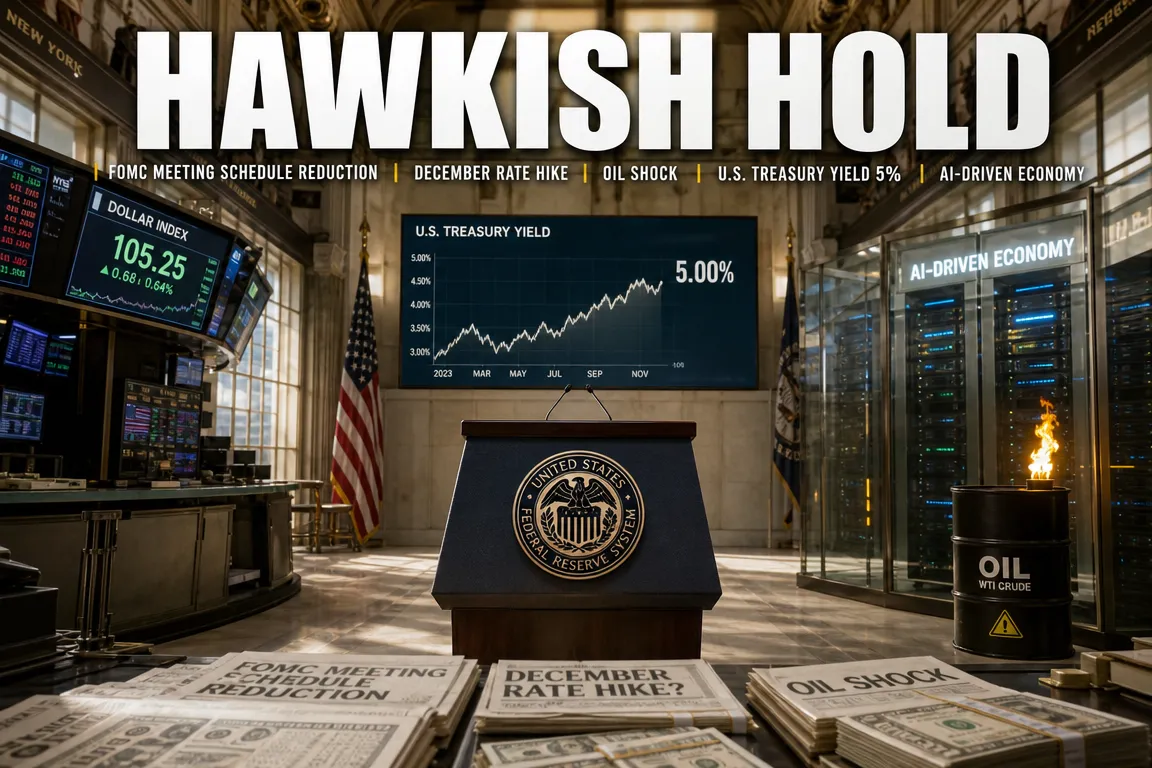
The outlook must also account for a potential December rate increase, Middle East risks, global oil prices, U.S. Treasury yields near 5%, the Korea-U.S. interest-rate differential, and an American economy supported by AI investment.
In particular, reports that the FOMC schedule could be reduced from eight meetings to six must distinguish between fewer FOMC meetings and fewer meetings designated for interest-rate decisions.
However, the source text assumes an announcement on October 29, 2026, Korea time. As the current date is October 28, 2026, the information cannot yet be treated as confirmed official news.
The policy rate, meeting schedule, voting result, and chair’s remarks cited in the source should be verified against the Federal Reserve’s official statement and press conference materials.
1. The FOMC Decision in One Sentence
The Federal Reserve held rates steady but retained the option of another increase in December if inflation accelerates, resulting in a “hawkish hold.”
According to the source, the Federal Reserve maintained the federal funds target range at 3.75%-4.00%.
Following a 25-basis-point increase at the previous meeting, policymakers reportedly chose to assess the effects of that move rather than tighten again immediately.
This does not indicate that the rate-increase cycle has ended.
Resilient U.S. economic activity and employment, combined with the risk of renewed inflation from higher oil prices, leave the possibility of further tightening open.
- Policy rate: 3.75%-4.00%, according to the source
- Policy stance: Hawkish rather than dovish hold
- Key indicators: CPI, PCE inflation, employment data, and global oil prices
- Market outlook: Increased probability of a December rate increase
- Implications for Korea: Depreciation pressure on the won and upward pressure on domestic market rates
2. What Would a Reduction from Eight to Six FOMC Meetings Mean?
The source suggests reducing the number of scheduled rate-setting meetings from eight to seven in 2027, followed by rate decisions at only six of the eight annual FOMC meetings from 2028.
The number of FOMC meetings and the number of meetings at which rates may change are not necessarily the same.
The Federal Reserve is not required to change rates at every scheduled meeting.
It can also respond between regular meetings through unscheduled meetings or emergency measures if a major financial shock occurs.
Even if the proposed reduction is confirmed, it would not mean that the Federal Reserve’s policy-response capacity had declined by 25%.
The more relevant change would concern the interval between formal policy communication events, not merely the number of rate decisions.
3. Potential Effects of Fewer Rate-Setting Meetings
Policy Predictability Could Improve
If rate decisions are limited to predetermined meetings, markets may align their analysis more closely with CPI, PCE, employment, and growth data released before those dates.
Companies and financial institutions may also find it easier to schedule borrowing, bond issuance, and currency hedging.
Each Meeting Would Carry More Weight
With fewer opportunities to adjust rates, each designated meeting could generate greater policy and market impact.
If inflation exceeds expectations shortly after one meeting, Treasury yields and the U.S. dollar could rise before the next rate-setting meeting occurs.
Economic Data Releases Could Become More Volatile
When formal rate-setting meetings are less frequent, CPI and employment reports may function as interim policy events.
Futures markets would continue to price the likely next decision even during periods without an FOMC rate announcement.
Emergency Action Would Remain Available
The Federal Reserve could respond outside the regular schedule to a financial crisis, war, or liquidity disruption.
A reduction in designated meetings should therefore not be interpreted automatically as a reduction in monetary-policy capacity.
4. Why the Decision Qualifies as a “Hawkish Hold”
A hawkish hold leaves the current policy rate unchanged while signaling that additional tightening remains possible.
The source identifies three principal reasons for this stance.
The U.S. Economy Remains Strong Enough to Absorb Higher Rates
Consumer spending, business investment, and overall economic activity have reportedly remained stronger than expected.
A sharp downturn would make additional tightening less likely.
However, if growth remains near 2% and employment conditions remain resilient, the Federal Reserve can place greater emphasis on price stability.
The Labor Market Has Not Deteriorated Significantly
Employment growth has slowed, but labor-force participation and job creation have reportedly continued to increase.
A moderate rise in unemployment may not prevent further tightening if employment remains close to the Federal Reserve’s maximum-employment objective.
Under those conditions, renewed inflation may represent a greater policy concern than labor-market weakness.
Inflation Remains Above the 2% Target
Although inflation has declined from its peak, higher oil prices could cause renewed acceleration.
The primary risk is not a temporary increase in energy prices, but its transmission to services inflation, wages, and inflation expectations.
5. Why the Federal Reserve Paused Instead of Increasing Rates Again
If the Federal Reserve raised rates at the previous meeting and held them steady at the current meeting, the decision may reflect the lagged effects of monetary policy.
Rate increases do not affect the entire economy immediately.
The impact moves through Treasury yields, corporate bonds, mortgages, business investment, and employment before reaching consumer prices, often with a delay of several months.
Consecutive increases could compound existing tightening and raise the risk of a future recession.
If the recent inflation increase is concentrated in energy, policymakers may prefer to assess whether it spreads to core inflation before tightening again.
The decision therefore appears closer to slower tightening than to the end of the tightening cycle.
6. Four Indicators That Could Determine a December Rate Increase
1. Consumer Price Index
A rebound in headline CPI driven by energy prices may be partly anticipated.
The more important issue is whether core CPI also accelerates.
Renewed increases in housing and services inflation could indicate that the energy shock is spreading across the broader economy.
2. Personal Consumption Expenditures Inflation
The Federal Reserve places greater weight on the PCE price index than on CPI when assessing progress toward its inflation objective.
If core PCE exceeds previous highs or rises for several consecutive months, rate expectations could shift quickly toward additional tightening.
3. Employment and Wage Data
Strong nonfarm payroll growth and elevated hourly wage gains would make services inflation more persistent.
Conversely, a sharp slowdown in employment and a rapid increase in unemployment would weaken the case for another rate increase.
4. Global Oil Prices and Middle East Developments
If West Texas Intermediate remains near $100 per barrel for an extended period, transportation and production costs could rise simultaneously.
If the impact spreads to airfares, logistics, food, and manufactured goods, the Federal Reserve may find it difficult to disregard the shock even if it originates on the supply side.
7. The Most Important Factor Often Overlooked
The central issue is not whether oil prices rise once, but how long they remain elevated.
Governments and companies can initially absorb an oil-price shock through strategic reserves and lower-cost inventories.
Once those inventories decline, replacing them with higher-priced crude can transmit the cost shock to consumer inflation with a delay.
The increase in oil prices and the resulting acceleration in inflation may therefore occur at different times.
Markets often focus on current oil prices, while the Federal Reserve must also consider the inflationary effect that may emerge after inventories are depleted.
If Middle East risks persist, a scenario in which rates remain elevated through 2027 could be more significant for financial markets than a single additional increase in December.
8. What a 5% U.S. Treasury Yield Would Mean
If the 10-year Treasury yield trades above the upper bound of the policy rate, market-based financial conditions may already be delivering substantial tightening.
Corporate bond yields, mortgage rates, and auto-loan rates would rise, while higher discount rates would weigh on equity valuations.
Elevated Treasury yields can therefore substitute for part of the tightening that would otherwise require another policy-rate increase.
However, the direction of causality should not be reversed.
Treasury yields often rise because markets first price higher inflation and additional Federal Reserve tightening, rather than because higher yields directly cause the Federal Reserve to raise rates.
If higher market rates subsequently slow economic activity, policymakers may gain a reason to pause further increases.
9. Implications for the Dollar and Equity Markets
U.S. Dollar
The prospect of additional tightening and elevated Treasury yields would generally support the U.S. dollar.
Higher relative returns on U.S. assets may attract additional global capital into dollar-denominated investments.
U.S. Equities
Higher long-term rates reduce the present value of future earnings and create valuation pressure for growth stocks.
Technology companies and unprofitable growth businesses with earnings concentrated further in the future may experience greater volatility.
Financial and Energy Stocks
Performance among financial companies may vary according to the yield curve and credit-loss risks.
Energy companies may benefit from higher oil prices, although investors should also consider possible government intervention and weaker demand from slower economic growth.
Bond Market
Short-term yields are particularly sensitive to expectations for additional policy tightening.
Long-term bonds reflect inflation expectations, fiscal deficits, and Treasury supply, potentially resulting in greater volatility.
10. The Connection Between AI Investment and the U.S. Economy
Strong U.S. capital expenditure should be evaluated in the context of expanding AI infrastructure.
Large technology companies are investing heavily in data centers, high-performance semiconductors, power grids, cooling systems, and cloud infrastructure to compete in generative AI.
This investment supports U.S. economic growth and business fixed investment.
However, if AI-related spending keeps the economy stronger than expected, the Federal Reserve may have less reason to reduce rates quickly.
This could create a mixed environment in which AI remains a structural growth driver while equity markets continue to face elevated discount rates.
AI companies should therefore be assessed not only on revenue growth, but also on capital expenditure, cash flow, depreciation, and borrowing costs.
11. Implications for the Korean Economy and the Won
According to the source, the Bank of Korea’s policy rate is 3.00%, while the upper bound of the U.S. target range is 4.00%, producing a 1.00-percentage-point differential.
However, another section of the source cites Korea’s policy rate as 3.75%, creating an internal inconsistency.
Any assessment should rely on the official rates published by the Bank of Korea and the Federal Reserve.
Won-Dollar Exchange Rate
A higher probability of additional U.S. tightening could strengthen the dollar and increase depreciation pressure on the won.
Higher oil prices could add further pressure by increasing Korea’s energy import bill.
Bank of Korea Policy Rate
Household debt and housing-market conditions could support higher rates, while weak domestic demand and risks to vulnerable borrowers make consecutive increases more difficult.
If the Federal Reserve keeps rates elevated for longer, the Bank of Korea may also delay the start of its easing cycle.
Korean Equity Market
A stronger dollar and higher U.S. long-term yields could weigh on foreign capital flows into Korean equities.
Highly valued growth companies and businesses with significant debt would be more sensitive to rising financing costs.
Semiconductor and AI-related companies should be evaluated on exchange-rate exposure, customer capital expenditure, power costs, and valuation, in addition to long-term industry growth.
12. Claims in the Source That Require Verification
The source contains a mismatch between its headline and its main discussion.
The headline emphasizes a reduction in FOMC meetings, while most of the text addresses the rate hold and the possibility of additional tightening.
It does not provide a specific official basis or implementation schedule for the proposed change in meeting frequency.
Several years translated as 1922 and 1926 appear, from context, to refer to 2022 and 2026.
The source also cites two different figures, 3.00% and 3.75%, for Korea’s policy rate.
The identities of the voting participants and the reported 10-2 decision should be checked against the Federal Reserve’s official documentation.
Remarks attributed to Chair Kevin Warsh should not be treated as confirmed quotations until an official video and transcript are available.
The analysis should therefore distinguish among confirmed facts, claims made by the source, and forward-looking scenarios.
13. Investor Checklist
- Monitor whether core CPI and core PCE accelerate on a monthly basis.
- Determine whether WTI is experiencing a temporary spike or remaining near $100 per barrel for an extended period.
- Assess whether the 2-year and 10-year Treasury yields are rising simultaneously.
- Track changes in market-based inflation expectations and consumer inflation expectations.
- Evaluate whether nonfarm payrolls and hourly wage growth remain strong enough to sustain inflation pressure.
- Monitor how a rising U.S. Dollar Index affects the won-dollar exchange rate and foreign investor flows.
- Evaluate AI companies based on the balance between revenue growth, capital expenditure, and free cash flow.
- Verify whether the Federal Reserve has published an official schedule or statement regarding any reduction in rate-setting meetings.
< Summary >
According to the source, the Federal Reserve held the policy rate at 3.75%-4.00% while leaving the possibility of additional tightening open.
The decision appears to be a hawkish hold intended to assess the effects of the previous increase rather than an end to the tightening cycle.
CPI, PCE inflation, employment data, and global oil prices are likely to shape the December policy decision.
Elevated Treasury yields both reflect expectations for further tightening and substitute for part of the Federal Reserve’s policy restraint.
The proposal to reduce the number of rate-setting meetings from eight to six must be distinguished from a reduction in the total number of FOMC meetings.
If Middle East risks persist, an extended period of high interest rates may represent a larger market risk than a single additional rate increase.
Because the assumed publication date and several figures in the source are inconsistent or unconfirmed, investors should verify the information against official Federal Reserve and Bank of Korea materials.
[Related Articles…]
- FOMC Policy Decisions and the Outlook for U.S. Equities
- How Higher Oil Prices Affect Inflation and Interest Rates
*Source: [ 경제 읽어주는 남자(김광석TV) ]
– [속보] 워시 “FOMC 연 8회→6회 축소” [즉시분석]
● Fed Shock, Market Jolt
October 2026 FOMC Outlook: Rate Decision, Kevin Warsh Press Conference, and U.S. Equity Strategy
The October FOMC meeting should be assessed on more than the interest-rate decision.
Key issues include whether the Federal Reserve assigns greater risk to inflation or the labor market, whether it adjusts quantitative tightening, and how financial markets interpret the press conference attributed to Kevin Warsh.
This report outlines the language to monitor in the FOMC statement, key press-conference questions, potential reactions in U.S. equities and the USD/KRW exchange rate, and implications for AI and semiconductor stocks.
The source material is not the full FOMC statement but a notice for a live broadcast scheduled for October 29, 2026.
Because the rate decision and statement have not yet been released, the analysis focuses on how to interpret the announcement rather than treating unconfirmed outcomes as facts.
1. October 2026 FOMC Schedule and Source Verification
The source lists the event for Thursday, October 29, 2026, at 2:30 a.m. Korea Standard Time.
Investors should distinguish between the official statement release and the start of a domestic pre-broadcast.
FOMC statements are typically released at 2:00 p.m. U.S. Eastern Time, followed by the press conference at 2:30 p.m.
Because U.S. daylight saving time remains in effect, these events would likely correspond to 3:00 a.m. and 3:30 a.m. Korea Standard Time, respectively.
Investors should verify the Federal Reserve’s official calendar rather than relying solely on the 2:30 a.m. time shown in the source.
Although the source identifies the Federal Reserve as the origin, the live coverage and simultaneous interpretation appear to be provided by a domestic media channel.
Policy analysis should prioritize the official FOMC statement and press-conference transcript over broadcast commentary.
2. Why Unreleased Information Should Not Be Treated as Confirmed
The October FOMC decision has not yet been released.
A rate cut, rate hold, dissenting votes, or changes to balance-sheet policy should not be presented as confirmed outcomes.
The source contains no official statement language or policy decision.
It is effectively a preview of an FOMC commentary broadcast.
The claim that Kevin Warsh will conduct the press conference also requires confirmation through official Federal Reserve communications and the identity of the presiding official.
Markets may price in an individual’s perceived policy stance, but the actual direction should be assessed through the FOMC’s collective statement and voting record.
3. Five Priorities in the October FOMC Statement
First, the federal funds rate decision.
Whether the Fed cuts or holds rates matters, but the gap between the decision and market expectations is more important for asset prices.
If markets have already priced in a cut, equities could decline even after the Fed lowers rates.
Conversely, a hold accompanied by a strong signal of a future cut could lower Treasury yields and support growth stocks.
Second, the inflation assessment.
Investors should determine whether the Fed continues to describe inflation as somewhat elevated or recognizes renewed progress toward its target.
Changes in expressions such as “sustainable progress,” “further progress,” and “remains elevated” may provide signals about the policy path.
Third, the labor-market assessment.
The key issue is not only payroll growth or the unemployment rate but also the extent to which the Fed emphasizes downside employment risks.
Stronger language on slowing job growth could indicate a shift in focus from inflation control toward protecting employment and economic activity.
Fourth, the balance-of-risks language.
Investors should assess whether the Fed views inflation and employment risks as broadly balanced or sees greater risk on one side.
This language may provide a clearer signal for the next meeting than the rate decision itself.
Fifth, quantitative tightening and balance-sheet policy.
A slowdown or termination of quantitative tightening would directly affect market liquidity and the U.S. Treasury market.
Even if policy rates remain unchanged, slower quantitative tightening could be interpreted as supportive of financial conditions.
4. The Most Important Overlooked Issue
The October meeting would generally not include a new Summary of Economic Projections or dot plot.
The Federal Reserve typically releases the Summary of Economic Projections and dot plot quarterly.
If the October meeting is a standard non-projection meeting, investors will not receive a new official rate-path forecast.
Markets may therefore react more strongly than usual to subtle changes in statement language and press-conference responses.
The size of the policy move may be less important than whether the Fed keeps future decisions open or signals a directional bias.
The reason for any rate cut is also critical.
A preventive cut supported by easing inflation may be constructive for equities, while a cut driven by recession risk could intensify concerns about corporate earnings.
The same rate cut can therefore produce materially different market outcomes.
5. Key Questions for the Kevin Warsh Press Conference
Investors should focus on repeated expressions rather than the opening statement alone.
Recurring language across multiple responses may provide a more reliable indication of the policy stance than initial remarks intended to stabilize markets.
First, the conditions for additional rate adjustments.
Investors should identify the inflation and employment conditions required for further cuts and whether the Fed maintains a meeting-by-meeting approach.
Second, the assessment of the neutral rate.
The scope for additional easing depends on whether the current policy rate is viewed as restrictive or already close to neutral.
Third, the risk of renewed inflation.
Key issues include services inflation, wages, housing costs, tariffs, and supply-chain expenses.
Fourth, the pace of labor-market deterioration.
Markets will assess whether the Fed sees an orderly normalization or a faster-than-expected weakening in employment.
Fifth, quantitative tightening.
Investors should monitor the Fed’s assessment of bank reserves, money-market liquidity, and the conditions for ending balance-sheet runoff.
6. Why Kevin Warsh’s Remarks May Matter More for Long-Term Yields and Technology Stocks
Kevin Warsh has historically been associated with criticism of prolonged monetary accommodation and excessive central-bank balance-sheet expansion.
Past views, however, should not be treated as definitive evidence of current policy.
The current policy environment requires consideration of inflation, fiscal deficits, Treasury supply, productivity, and financial-system liquidity.
Markets are likely to focus on views regarding the Fed’s balance sheet and long-term inflation expectations rather than short-term rates alone.
A strong emphasis on balance-sheet reduction could prevent long-term Treasury yields from declining materially.
In that case, even a rate cut may provide limited support to the Nasdaq and highly valued technology stocks.
7. U.S. Equity Scenarios Following the FOMC Decision
Scenario 1: Dovish rate cut
The Fed cuts rates, acknowledges progress on inflation, and leaves the door open to further easing.
The two-year Treasury yield would likely decline, while the U.S. dollar could weaken.
The Nasdaq, semiconductor stocks, software companies, and small-cap growth stocks could outperform.
Scenario 2: Hawkish rate cut
The Fed cuts rates but emphasizes that additional action will depend on incoming data and repeatedly highlights inflation risks.
Equities could rise immediately after the decision and surrender gains during the press conference.
A rebound in the dollar and Treasury yields could increase volatility in highly valued technology stocks.
Scenario 3: Dovish hold
The Fed holds rates but emphasizes downside employment risks and keeps a future cut under consideration.
If a hold is already expected, equity and bond markets could respond relatively calmly.
Scenario 4: Hawkish hold
The Fed holds rates while highlighting renewed inflation risks or the possibility of additional tightening.
Treasury yields and the dollar could rise, placing downward pressure on U.S. equities.
AI and software companies with valuations heavily dependent on long-term growth expectations could face greater pressure.
8. Implications for USD/KRW and South Korean Equities
Following the FOMC meeting, USD/KRW will likely respond more to U.S. Treasury yields and the Dollar Index than to the rate decision alone.
A dovish outcome that lowers U.S. yields could reduce dollar strength and support the South Korean won.
This environment could improve expectations for foreign capital inflows and support large-cap and growth stocks in the KOSPI.
Conversely, a hawkish message that raises long-term U.S. yields could weaken the won and weigh on foreign investor flows.
Even with a favorable semiconductor export outlook, rising global yields and currency volatility could compress domestic equity valuations.
Investors assessing Samsung Electronics and SK Hynix should monitor not only AI demand but also the U.S. 10-year Treasury yield and foreign investor positioning in index futures.
9. Why AI and Semiconductor Investors Should Monitor the FOMC
The AI industry is expanding rapidly, but data centers, advanced semiconductors, and power-grid infrastructure require substantial upfront investment.
Persistently high rates increase financing costs and reduce the present value of long-duration earnings.
AI-related stocks can therefore decline when long-term yields rise, even if operating results remain strong.
Lower rates can support both AI infrastructure investment and growth-stock valuations.
However, the benefits will not be uniform across the sector.
Large platforms with stable cash flows have materially different rate sensitivity from early-stage AI companies dependent on debt financing.
After the FOMC meeting, investors should differentiate companies by revenue growth, return on investment, depreciation burden, and free cash flow rather than relying solely on AI exposure.
10. Market Indicators to Monitor Immediately After the Announcement
First, the two-year U.S. Treasury yield.
The two-year yield is one of the most sensitive indicators of the expected near-term Fed policy path.
Second, the 10-year U.S. Treasury yield.
The 10-year yield reflects growth, long-term inflation, fiscal deficits, and Treasury supply pressures.
Third, the two-year/10-year yield spread.
The yield curve may steepen if expectations for rate cuts increase while long-term yields rise.
This may reflect higher fiscal and inflation risk premiums rather than stronger growth expectations alone.
Fourth, the Dollar Index and USD/KRW.
A sharp dollar reversal during the press conference could indicate that markets view the remarks as more hawkish than the statement.
Fifth, Nasdaq futures and the semiconductor index.
The direction after the press conference is more informative than the immediate response to the statement.
11. Three Mistakes Investors Should Avoid
The first mistake is trading immediately on the rate-decision headline.
Markets respond to the difference between the outcome, prior expectations, and the prospective policy path.
The second mistake is interpreting a single press-conference sentence in isolation.
The full context and recurring language are necessary to determine whether the message is hawkish or dovish.
The third mistake is monitoring equity prices alone.
If the initial equity response diverges from bond and currency markets, the first move may reverse.
Treasury yields, the dollar, and volatility indicators should be assessed together.
12. Practical Strategy After the Announcement
Before the FOMC decision, investors should prioritize position sizing and downside control rather than take excessive directional exposure.
Price movements during the first five minutes may be heavily influenced by algorithmic trading and position unwinding.
Investors should separately assess the initial response to the statement, the reaction during the press conference, and the direction into the U.S. market close.
Long-term investors should continue to prioritize earnings and cash flow while reviewing exposure to rate-sensitive stocks.
Short-term investors should respond to actual market pricing rather than whether the policy outcome matches their forecast.
< Summary >
The October 2026 FOMC result has not yet been released, and the source does not confirm the rate decision or statement language.
The most important issues are the Fed’s assessments of inflation, employment, the balance of risks, and quantitative tightening.
Without a new dot plot, markets may be more sensitive to changes in statement language and press-conference remarks.
The equity-market impact of a rate cut will depend on whether it reflects improving inflation or deteriorating economic conditions.
AI and semiconductor stocks remain sensitive to the U.S. 10-year Treasury yield and changes in liquidity, requiring close attention to earnings and valuations.
Investors should evaluate Treasury yields, the Dollar Index, USD/KRW, the Nasdaq, and the semiconductor index collectively.
[Related Articles…]
Latest FOMC Rate Outlook and U.S. Equity Strategy
Latest AI Semiconductor and Global Technology Outlook
*Source: [ Maeil Business Newspaper ]
– 10월 FOMC 성명서 해설 l 케빈 워시 기자회견 동시통역