● AI CAPEX Shock
The Real Reason Semiconductors Were Shaken by Fears of an AI Investment Slowdown: Google, Microsoft Earnings, FOMC, Interest Rates, and TPUs All at Once
The core point of this issue is not simply that “Google’s earnings were bad.”
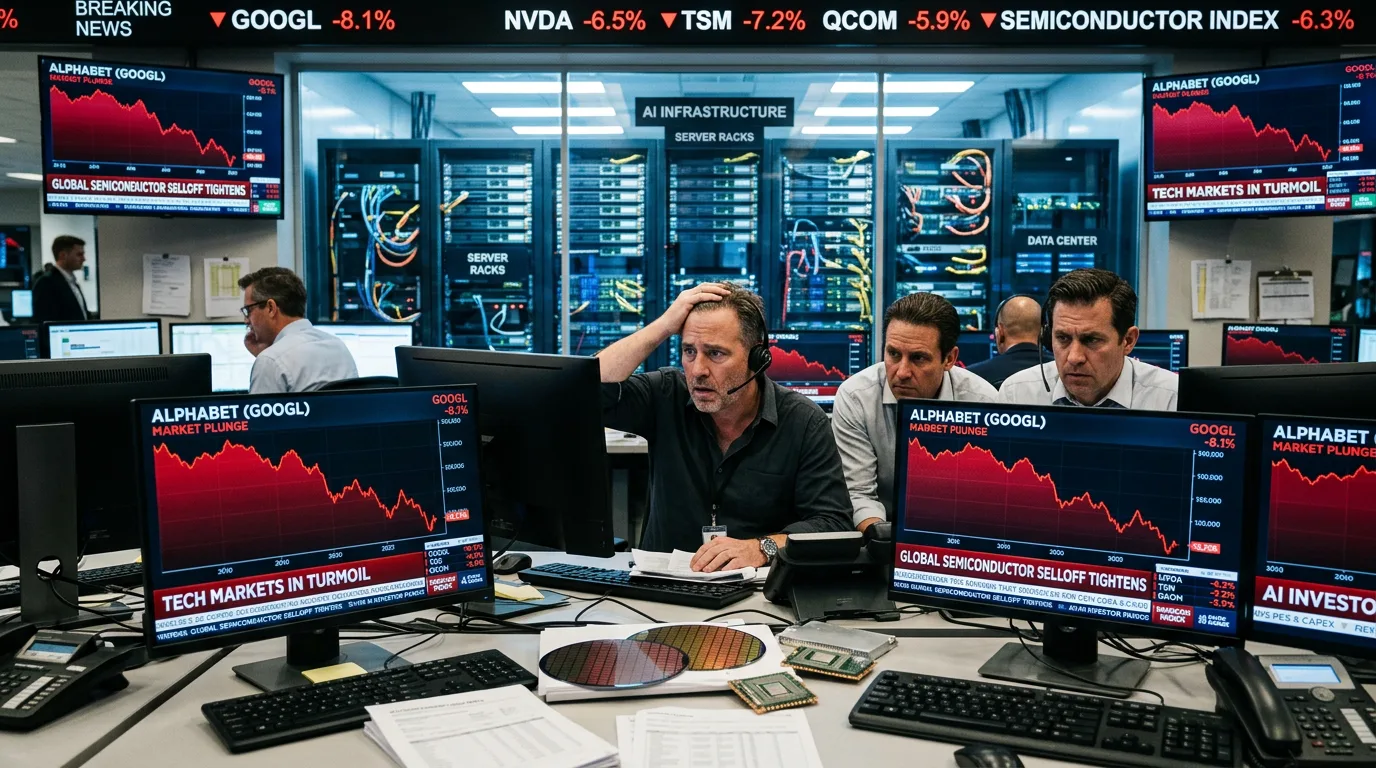
The market is now seeing Google and Microsoft post smaller-than-expected AI investment figures and starting to suspect that the “AI infrastructure investment cycle may be cooling.”
On top of that, the FOMC held rates steady but chose a hawkish pause that effectively left the door open to another rate hike, creating a simultaneous squeeze on U.S. stocks and the entire semiconductor market.
In particular, this article will also cover Google TPUs, the potential shift in Nvidia’s market share, Anthropic’s massive TPU demand, and the correlation between AI model performance and stock prices, which most headlines miss.
1. Market Reaction: Why the Nasdaq Held Up, but Semiconductors Wavered After Hours
Based on the original report, the U.S. Nasdaq rose about 0.3% intraday.
The Philadelphia Semiconductor Index also rose about 1.7%, so the mood during trading was not bad.
But after Google and Microsoft reported earnings, sentiment changed sharply in after-hours trading.
At first, stocks seemed to rebound on earnings optimism, but they then fell again as AI-related capital expenditures came in below market expectations.
Right now, the market is focusing more on the size of AI investment than on revenue or EPS.
That is because the semiconductor value chain, including Nvidia, can only be justified if AI data centers, cloud computing, and demand for high-performance chips keep exploding.
However, both Google and Microsoft posted AI CAPEX figures below expectations.
That is why investors began worrying that the excitement around AI investment might be fading.
2. FOMC Core Point: A Hold, but Effectively a Hawkish Skip
At this FOMC meeting, the benchmark rate was left unchanged.
But the market is interpreting it not as a normal hold, but as a hawkish skip.
In simple terms, they are pausing for now, but signaling that they could raise rates again at the next meeting.
Based on the original report, the current benchmark rate was described as being around 3.75% to 4%.
What matters in particular is that 2 out of 10 committee members supported a rate hike.
That means even within the decision to hold rates steady, there were internal voices calling for further tightening.
As a result, the U.S. 10-year Treasury yield climbed back to around 5.04%.
When the 10-year yield exceeds 5%, it becomes a significant burden for tech and growth stocks.
In the U.S. stock market, AI-related names are priced heavily on expectations of future growth, and higher rates reduce the present value of future cash flows.
In simple terms, the higher the rate, the stronger the gravity on growth stock valuations.
3. The Clash Between Rates and AI: Productivity Gains Are Good, but High Rates Cannot Be Avoided
In the long run, AI can raise productivity.
When productivity rises, companies can produce more output with lower costs, which can help ease inflationary pressure.
In theory, AI can sustain economic growth while also suppressing sharp price increases.
But the problem is the time lag.
It takes time for AI to translate into actual productivity gains.
Meanwhile, the pressure from high rates is reflected immediately in corporate valuations and investor sentiment.
So the market is basically saying, “We acknowledge the AI boom, but it is not automatically safe in the face of rate-hike risk.”
Goldman Sachs sees a rate hike in December as its base case, and based on the original report, the probability of a December hike was cited at about 83%.
Of course, inflation data such as CPI and PCE still need to be checked, but the market is already pricing in a fairly high chance of another 0.25 percentage point hike.
4. Oil as a Variable: WTI at $102 Reignites Inflation Risk
Based on the original report, WTI crude rose about 3% in a single day to around $102 per barrel.
Rising oil prices are one of the clearest variables that can rekindle inflation.
When energy prices rise, transportation costs, manufacturing costs, electricity bills, and consumer prices all come under pressure.
Ultimately, if oil stays high, it becomes harder for the Fed to rush into rate cuts.
That again weighs on the U.S. stock market, especially technology and semiconductor shares.
On the AI investment cycle alone, there are many positive factors, but macro variables like oil and rates continue to act as headwinds.
5. Google Earnings Analysis: Alphabet Rarely Missed Expectations
Alphabet’s latest results were somewhat disappointing relative to market expectations.
Revenue came in at $127.5 billion, below the market forecast of $127.9 billion.
The difference is only about 0.3%, so revenue alone was not a major problem.
The real issue is operating income.
Market expectations called for operating income of $43.16 billion, but the actual figure was only $40.5 billion.
That was about 6% below expectations, which is a meaningful miss by big-tech standards.
Because Alphabet had historically beaten expectations consistently in prior earnings reports, this weaker result was taken more seriously.
As a result, Alphabet shares fell about 7% to 8% in after-hours trading.
6. Google AI CAPEX: Why the Market Was Alarmed by Investment 7.9% Below Expectations
Google’s capital expenditures for the quarter were reported at $51.36 billion.
That is about 7.9% below market expectations.
With expectations high for AI data centers, servers, TPUs, and power infrastructure investment, the figure disappointed the market.
There are two main ways to interpret this.
First, Google may have adjusted spending out of concern over accusations of overinvesting in AI.
Internally, it may have become more cautious about how quickly AI investment can actually be recouped through revenue.
Second, Google may have wanted to invest more but been unable to execute as planned because of power constraints, land, data center construction, and supply chain bottlenecks.
Personally, the second possibility looks more important.
The main bottleneck in today’s AI infrastructure market is not simply money, but access to power, cooling systems, high-performance chip supply, and data center build speed.
In other words, interpreting this CAPEX weakness solely as “slowing AI demand” could cause you to miss the bigger picture.
7. Google Cloud: Google Should Now Be Seen as a Cloud AI Company, Not Just a Search Company
The bright spot in this earnings report was Google Cloud.
Google Cloud revenue came in about 5.5% above market expectations.
More importantly, operating margin improved significantly.
Google Cloud’s operating margin rose from 23.7% last year to 36.2% this year.
That is an improvement of nearly 13 percentage points in just about one year.
This means Google Cloud is moving beyond being merely a growth business and is becoming a genuine profit engine.
As AI workloads increase, demand for cloud computing has no choice but to rise.
From this perspective, Google’s long-term investment appeal may come more from cloud, TPUs, and AI infrastructure than from search advertising.
8. Google Search and YouTube: Legacy Ad Businesses Were Weaker Than Expected
On the other hand, Google’s existing core businesses, search and YouTube, fell short of expectations.
It was disappointing that the advertising business was not as strong as the market had expected.
In particular, users have recently been shifting from traditional search boxes to asking generative AI directly.
This change could become a long-term challenge to Google’s search advertising model.
If the structure for displaying ads on search results pages weakens, Google’s most stable source of cash flow could come under pressure.
Of course, Google is responding to this trend through Gemini, but how well it can defend the profitability of its search ads still needs to be watched.
9. Gemini Surpasses 1 Billion Users: A Signal of Google’s AI Counterattack?
Based on the original report, Gemini users at Google were said to have surpassed 1 billion.
Google recently unveiled the Gemini Argon and Carbon models, and although actual availability is a separate issue, they were said to have ranked first in benchmarks ahead of Claude Opus.
This is quite important.
In the current AI market, model performance increasingly translates directly into investor sentiment.
Whoever leads in the performance race among GPT, Claude, and Gemini can move related stock prices sharply.
Google’s stock rose significantly in the past on Gemini optimism for the same reason.
By contrast, recent criticism that it lags GPT and Claude in coding performance and user experience has weighed on the stock.
If the new Gemini models are also well received in real product use, Google stock could regain an innovation premium.
10. Google EPS Distortion: Why It Is Hard to See This as Just a Core Business Weakness
Google’s EPS was described in the original report as falling to around $5, down by $0.50.
That appears to reflect the impact of losses on equity securities.
As AI-related stocks and semiconductor stocks have corrected recently, the value of holdings has fallen, making EPS look weaker.
So you should not conclude that Google’s core business suddenly deteriorated just from the EPS figure.
What matters more in this earnings report is the operating income miss, the slowdown in search advertising, cloud growth, and the speed of AI CAPEX execution.
11. The Most Important Point: Google TPUs Could Disrupt Nvidia’s Monopoly Structure
The deeper point the market needs to examine in this earnings report is Google’s in-house AI chip, TPU.
Google is almost the only full-stack AI company that designs its own chips, runs its own data centers, builds its own AI models, and owns a YouTube and search ecosystem.
This structure is different from companies that rely only on Nvidia GPUs.
CEO Sundar Pichai said that TPU system demand is strong across a variety of customer groups.
In other words, TPU is moving beyond an internal chip and into the stage of expanding external customer demand.
Some forecasts say Google TPU could capture 30% of Nvidia’s market share by 2028.
More aggressive forecasts mention a 40% possibility.
Of course, this is a very optimistic scenario, but the important thing is that the market is now beginning to see the possibility that Nvidia’s dominance may not last forever.
12. Anthropic and TPUs: Hidden Beneficiaries Include Broadcom, Marvell, and MediaTek
Anthropic has reportedly been expanding rapidly and has not been able to secure enough Nvidia GPU supply.
Because of that, it is moving toward large-scale use of Google TPUs.
The original report mentioned an additional contract scale of up to 10 GW.
10 GW is not just a simple server expansion; it is closer to building a massive AI infrastructure complex.
The companies that can benefit from this trend are not limited to Google.
Key partners associated with Google TPU design include Broadcom, Marvell, and MediaTek.
Broadcom is strong in custom ASIC design.
Marvell is also gaining a larger presence in data center semiconductors and custom chips.
MediaTek was also mentioned as handling part of the role.
Ultimately, the AI semiconductor market is likely to increasingly diverge from a Nvidia-GPU-centric model toward custom ASICs, TPUs, and dedicated accelerators.
13. Microsoft Earnings: The Numbers Were Solid Overall
Microsoft’s earnings were generally strong.
Revenue came in at $92.2 billion, above the market expectation of $90.6 billion.
That is about 2% above expectations.
Adjusted EPS was $4.89, above the market expectation of $4.73.
That is about 3% above expectations.
Unlike Google, Microsoft beat expectations on both revenue and profit.
Based on the original report, after-hours stock price rose about 4%.
But the reason the market was not fully reassured was, once again, AI capital expenditure.
14. Azure Growth of 48%: The Core of Microsoft’s AI Strategy
Microsoft’s core is Azure.
Azure was said to account for about 74% of total revenue growth.
Azure grew about 48%, which is an extremely high rate even for such a large business.
This means companies are continuing to use Microsoft infrastructure for AI model training, inference, data analysis, and cloud migration.
Considering the partnership with OpenAI, the Copilot ecosystem, and enterprise cloud expansion, Microsoft is one of the big tech leaders most advanced in AI monetization.
From a global economic outlook perspective, if AI infrastructure spending does not slow, Azure is likely to remain a key growth engine.
15. Microsoft RPO of $677 Billion: A Figure Showing That AI Demand Is Real
Microsoft’s remaining performance obligations, or RPO, were reported at $677 billion.
That is roughly 850 trillion won.
RPO refers to the backlog of contracted revenue that will be recognized in the future.
If AI demand were just a bubble, it would be hard to build such a huge backlog of contracts.
This number signals that enterprise customers are still willing to spend enormous sums on cloud and AI infrastructure.
So based on Microsoft’s earnings alone, it is hard to conclude that AI demand has collapsed.
16. Microsoft CAPEX Was Also Below Expectations: Positives and Negatives Coexist
Microsoft’s cash-based capital expenditures were reported at $39 billion, below the market estimate of about $45 billion.
That is about 14.3% below expectations.
Like Google, Microsoft also failed to fully execute all of its planned AI spending.
On the negative side, that means the pace of AI data center investment is slower than the market expected.
On the positive side, reducing excessive spending could improve free cash flow, or FCF.
For investors, “less AI spending” is worrying, but “cash flow remains available” is positive.
That is why Microsoft’s lower CAPEX was viewed far less negatively than Google’s.
17. What the Market Is Really Worried About: Not AI Demand Slowdown, but AI Infrastructure Bottlenecks
After these earnings releases, the market is outwardly worried about slower AI investment.
But looking deeper, the issue is more likely supply and execution speed than demand.
Building AI data centers is not just about having GPUs or TPUs.
You also need the power grid, cooling equipment, land, substations, server racks, networking gear, construction labor, and long-term power contracts.
Even if big tech companies want to spend, there are physical limits to how quickly they can execute.
So it is premature to say the AI investment cycle is over just because CAPEX came in below expectations.
Going forward, “who can actually secure power and data centers” may matter more than “who spends the most money.”
18. The Most Important Things That Other Coverage Often Misses
First, the AI CAPEX miss is more likely a bottleneck issue than a demand slowdown.
The market was disappointed by the numbers alone, but in reality, power access and data center construction speed may have limited execution.
Second, Google TPUs are a key variable that could shake up Nvidia’s monopoly framework.
Nvidia is still the undisputed leader in AI semiconductors, but as Google TPUs and custom ASICs grow, the market structure could change.
Third, Anthropic’s TPU demand connects to Broadcom, Marvell, and MediaTek as well.
The view that Nvidia is the only AI beneficiary may become increasingly narrow.
Fourth, AI model performance and stock prices are becoming more tightly linked.
The performance race among Gemini, GPT, and Claude is not just a technical story; it is an investment variable that directly affects big tech valuations.
Fifth, in a 5% rate environment, even good earnings are not enough protection.
No matter how strong AI growth is, if the 10-year Treasury yield moves above 5%, tech valuations can remain under pressure.
19. Investment Takeaway: This Is Not the End of AI, but the Phase of Separating Winners and Losers
After these earnings, it is hard to say the AI investment cycle is over.
Microsoft’s Azure growth rate, the size of its RPO, Google Cloud’s margin improvement, and TPU demand all show that AI infrastructure demand remains strong.
However, expectations were so high that even a slight miss can trigger selling.
Going forward, it may become difficult for every stock tied to AI to rise just because of the AI label.
Companies that generate real revenue, can solve data center bottlenecks, have power-securement capability, or possess their own semiconductor strategy are more likely to be rewarded.
On the other hand, AI-related stocks that rose on hype alone could see deeper corrections in a higher-rate, tighter-liquidity environment.
In the end, this looks less like an AI bubble burst and more like a phase in which winners and losers within the AI industry are being sorted out.
< Summary >
Semiconductors were shaken because Google and Microsoft posted AI capital spending below expectations.
For Google, the bigger issue was the operating income miss rather than revenue, and search and YouTube advertising were also weaker than expected.
At the same time, Google Cloud was strong, and TPU demand expansion remains a key long-term variable.
Microsoft delivered solid earnings and Azure growth remained strong, but lower-than-expected CAPEX increased market concern.
The FOMC held rates steady, but it was a hawkish hold that left room for another hike.
A 10-year Treasury yield above 5% and WTI at $102 are burdensome for tech and AI-related stocks.
The core takeaway is that the real issue may be not slowing AI demand, but bottlenecks in power, data centers, and supply chains.
Going forward, AI investors should watch not only Nvidia, but also the custom semiconductor value chain including Google TPU, Broadcom, Marvell, and MediaTek.
[Related Articles…]
AI investment cycle and big tech earnings outlook
Analysis of rate hikes and U.S. stock market trends
*Source: [ 월텍남 – 월스트리트 테크남 ]
– 예상보다 적은 AI투자에 반도체까지 “와르르”