● Dutch Gen Z Riot Fears
Alert over Gen Z Protests and Unrest in the Netherlands: Why Markets and Cities Are on Edge at the Same Time This Weekend
View the Core Points First
This article covers
why the Dutch government is viewing the situation at a “warning level,”
what responses are emerging by city,
why shops and businesses have started putting up shutters first,
and why this incident should be understood not simply as a youth protest, but as a digitally amplified collective-action risk.
In particular,
when viewed together with trends such as
the possibility of protest contagion across Europe,
public-security risk,
weakening consumer sentiment,
defense of urban commercial districts,
and social unrest and preference for safe-haven assets,
it becomes much clearer how this issue may affect not only political news, but also the broader economy and society.
News-Style Summary: Dutch Interior Minister Says “Potential Gen Z Unrest This Weekend Is Being Closely Watched”
Dutch Interior Minister Pieter Heerma said
that “concerning reports” are circulating about the possibility of violent protests and unrest by young people in several Dutch cities this weekend.
However,
he did not disclose specific details
and redirected questions by saying that responsibility for maintaining and enforcing public order lies with local authorities.
Recently, several media outlets reported
that messages encouraging disruption of public order and vandalism
had been shared in Dutch Gen Z-related chat rooms.
The problem is
that it remains unclear whether this movement is an actually organized protest
or simply an atmosphere exaggerated online.
However,
one chat room is reportedly already gathering thousands of people,
and cities and businesses are not treating this as a “minor incident.”
Messages from the Government and the Prime Minister: Protest Is Allowed, but Violence Crosses the Line
The interior minister emphasized
that protest itself is an important democratic right.
However,
he strongly urged people to “show restraint and not get drawn into unrest.”
Prime Minister Rob Jetten also said
at his weekly press conference
that mayors and police would be sufficiently prepared to keep the weekend peaceful.
He stated,
“In the Netherlands, there are many ways to express opinions,
but people must not behave as we have seen in other countries.”
This statement is not merely a warning.
It can be read as a signal that the government views this issue as a matter of social stability and public-order management.
City-by-City Responses: Different Levels of Concern in The Hague, Amsterdam, and Maastricht
1) The Hague: The City Where the Alert Level Rose First
The city of The Hague
has entered a “state of alert”
in preparation for the possibility of a youth protest at Malieveld on Saturday.
Police are expected to be visibly deployed at the site,
and they may intervene immediately if public order is disrupted.
The important point is
that although no official assembly plan has yet been registered,
the police and the city are already continuously tracking messages spreading online.
In other words,
before any protest in physical space takes shape,
crowd psychology in digital space is already moving administrative responses.
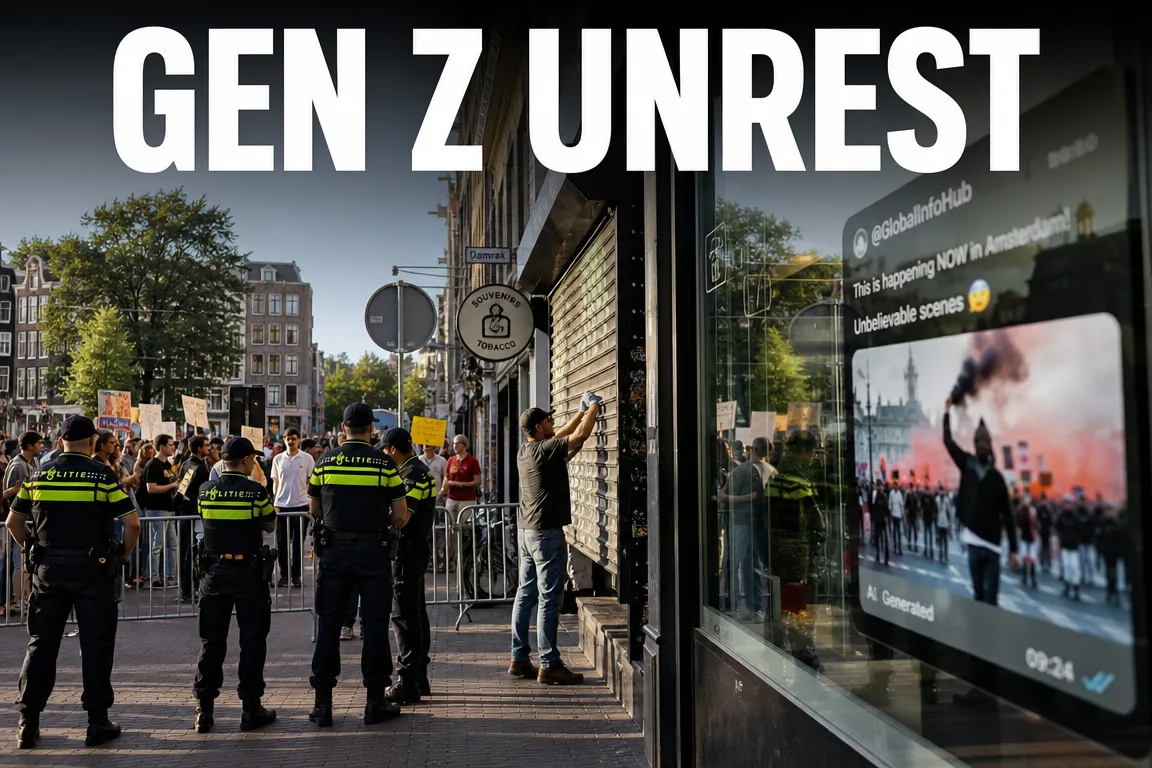
2) Amsterdam: Even AI-Generated Images Are Being Monitored
Amsterdam is also
closely monitoring online posts related to possible youth protests.
What is especially notable
is that the city is even examining AI-generated images circulating online.
This is extremely important.
That is because
these days, AI-created images, videos, and provocative phrases
often build momentum before any actual protest notice does,
regardless of whether they are true.
In other words,
this incident is not merely a protest warning.
It can be seen as a case showing how AI-based false or exaggerated content can disrupt public order.
3) Maastricht: The Possibility Has Been Confirmed, but Detailed Measures Are Not Being Disclosed
In Maastricht,
there are rumors that a protest may take place on Saturday,
but city authorities say they will not disclose preventive measures.
Local police
have confirmed related messages on social media
and are continuing to monitor the situation.
The city’s position can be summarized as
“manage quietly, but do not overlook it.”
Tension Spreading on the Ground: Parents, Students, and Merchants Are All Affected
Police have asked
parents to talk with teenagers.
This is not simply a notice.
It means this issue
has expanded beyond individual actions by teenagers
into a safety-management matter for families, schools, and local communities as a whole.
The Dutch vocational school ROC Mondriaan also
urged students to behave peacefully
and not get swept up in violence or provocation.
The school
emphasized cautious and responsible behavior
to students and parents
and is also directly monitoring online trends.
Student Organizations’ Response: “There Is No Organization and No One Responsible for Safety”
The Dutch Student Union LSVb
advised students not to participate in the protests.
The reason is clear.
There is no central organization,
no prior preparation,
no safety officer,
and the overall situation is too chaotic.
Another student organization, ISO, also said
it had received very little information about the protest.
In other words,
even student organizations
do not view this movement as an official social movement
but as a nonstandard form of online mobilization driven more by excitement than structure.
Business and Commercial District Response: Shutters Are Already Going Up
The Dutch business community
is taking this issue quite seriously.
VNO-NCW and MKB-Nederland
expressed concern that online calls for youth protests
could turn into disorder in several cities.
They mentioned recent cases in other European countries,
such as France and Spain,
where protests escalated into violence and looting.
In France in particular,
recent protests expanded to riot-level unrest in several cities,
and in Milan, shops even became direct targets of attacks.
What merchants now feel
is not a political slogan,
but the very real fear that
“this weekend’s business could be ruined.”
The sight of some shops in The Hague
boarding up their windows
is itself psychologically shocking.
Business groups emphasized
that regardless of the reason for any protest,
innocent merchants and small business owners must not be harmed.
Major Retailers Are Also Preparing: The Bigger Cost Is Security Spending
Department store chain De Bijenkorf
is taking additional security measures as a precaution.
However, its stores are expected to operate normally on Saturday.
The company said
it takes seriously the possibility of public-order disruption spreading on social media
and is in close contact with the city and police.
What must not be missed here
is that even before an incident actually turns violent,
businesses are already bearing higher security costs,
expanded operational risks,
and greater sales volatility.
In other words,
this news is both a public-security story
and an urban consumer-economy story.
Why This Incident Also Matters as Economic News
The tension in the Netherlands this weekend
is not simply a local incident.
It reflects broader trends in the global economy and society.
1) Consumer Sentiment and Commercial-District Defense
The moment shops start putting up shutters first,
consumers feel that “something must be dangerous.”
This psychology
can lead to lower weekend sales,
weaker tourist activity,
and reduced foot traffic in city centers.
In other words,
the possibility of local unrest immediately becomes
a question of trust in urban commercial districts.
2) Instability in Europe Could Grow Again
There is a clear reason why
examples from France, Spain, and Italy are being mentioned.
The pattern in which a spark in one city
spreads to another
has already occurred repeatedly in Europe.
In such a situation,
market participants also begin reassessing
political stability, public-security stability, and the pace of consumer recovery.
3) AI Can Become an Amplifier of Social Disorder
The most noteworthy point in this issue
is the fact that Amsterdam is monitoring AI-generated images.
Conflict no longer begins
only at the actual scene.
Images and messages created by AI
can first stimulate people’s anxiety and anger,
and only afterward spill over into real-world action.
This may be a typical example of
the AI-era social-stability risk that the whole world may face going forward.
The Core Point Other News Reports Often Miss: The Real Nature of This Incident
Many reports summarize the issue only as
“the possibility of youth protests,”
“police deployment,”
or “stronger shop security.”
But the more important point lies elsewhere.
1) “Online Crowd Psychology” Is Moving Before the Actual Protest
In this incident,
online chat rooms and social media moved first,
ahead of offline organizations,
and politics, administration, and businesses followed afterward.
In other words,
social order is no longer formed only in the streets.
2) The Fact That “No One Knows Who Is Leading It” Makes It Even More Dangerous
There is no central organization,
no person in charge,
and no clear objective,
yet people can still gather.
This is a very dangerous type of situation.
That is because
an organized protest can at least be negotiated with,
but in the case of unidentified collective action,
it is unclear who can stop it.
3) Cities Must Now Verify Information, Not Just Manage Public Security
When AI-generated images,
chat-room dissemination,
and social media rumors become mixed together,
a city becomes not just an administrative body
but also an institution for fact-checking and risk assessment.
Going forward,
policing alone will not be enough,
and digital information-response capability will become part of a city’s competitiveness.
4) Businesses Pay the Cost Before Politics Does
Merchants
board up windows,
increase security,
and worry about customers
even before anything has happened.
This is the first blow
that uncertainty delivers to the economy.
Even if a protest does not actually break out,
the mere possibility of one creates costs.
Final Summary: What the Netherlands Is Showing This Weekend
This case in the Netherlands
is not simply a warning of youth protests.
It is a complex risk in which
digital chat rooms,
AI images,
urban public security,
commercial-district defense,
and European-style instability contagion are all intertwined.
Ultimately, the core point is simple.
In the future, social disorder
is more likely to grow online first
rather than begin at the scene,
and governments and businesses must learn to read that flow
much faster.
Summary
The Dutch government is on alert for possible Gen Z-related unrest this weekend.
The Hague, Amsterdam, and Maastricht have strengthened police deployment and monitoring.
Student organizations and businesses have urged people to refrain from participating, while shops have increased security measures.
The core point is that online chat rooms and AI-generated images can amplify social unrest.
This incident is a case that shows not only public-security concerns, but also consumer sentiment, urban commercial districts, and the possibility of instability spreading across Europe.
[Related Articles…]
How AI Is Changing the Future of Urban Safety and Amplifying Social Unrest
How Spreading Protests in Europe Affect Consumer Markets and Business Risk
*Source: https://nltimes.nl/2026/10/30/interior-minister-alarming-messages-gen-z-riots-dutch-cities-weekend?utm_source=dlvr.it&utm_medium=facebook