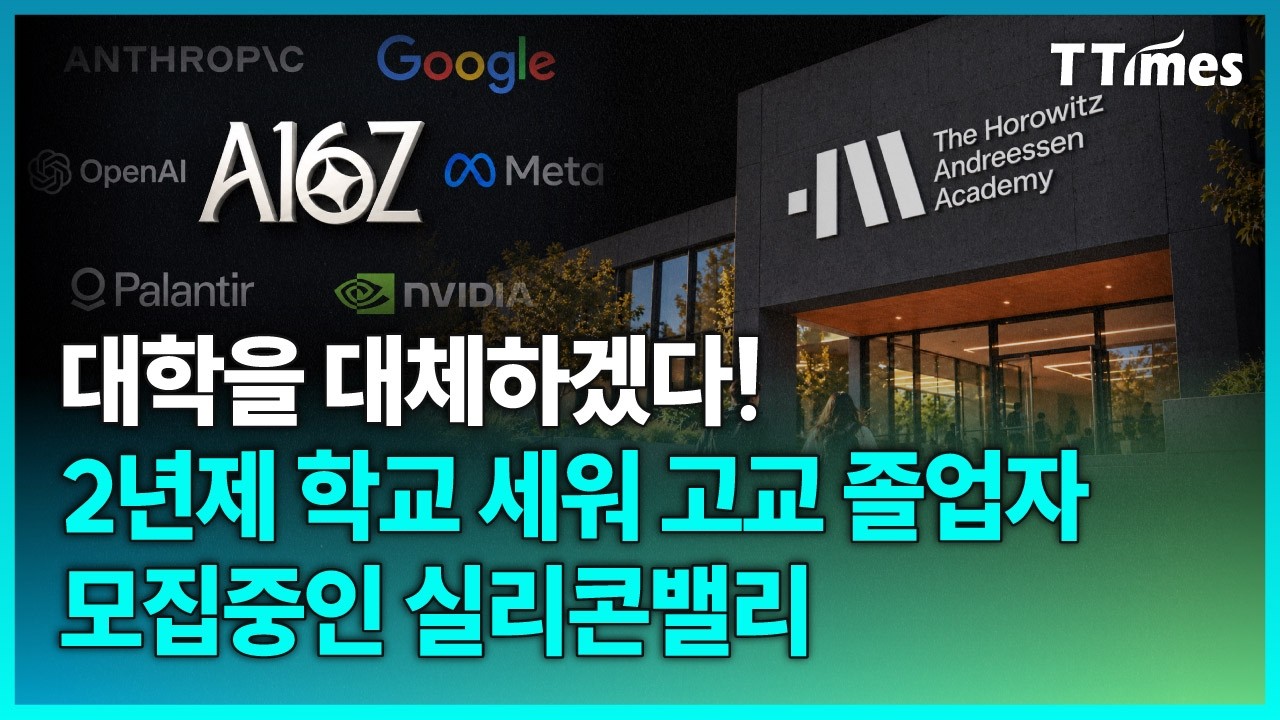
● VCs and Big Tech Skip College with AI Talent School
VC and Big Tech Are Starting to Skip College: Why the Landscape of Talent Development Is Changing in the AI Era
The core point of this issue is not simply that “a new school has opened in Silicon Valley.”
What matters is that a global venture capital firm like Andreessen Horowitz is directly funding it, while Big Tech companies such as Anthropic, Google, Meta, Nvidia, OpenAI, and Palantir are designing the curriculum and practical training.
In other words, in the AI era, the old structure in which universities produce talent and companies hire it is giving way to a new structure in which capital and companies directly secure the talent they need.
This change is a major trend that connects global economic outlooks, the labor market, startup investment, AI semiconductor demand, and the future education industry.
In particular, this case should be seen as more than “AI is replacing education”; it is a signal that “the way talent is validated in the AI era is shifting from degrees to execution.”
1. The New School Silicon Valley Built: What Is HAA?
Recently in San Francisco, the Horowitz Andreessen Academy, HAA, launched.
This school does not operate like a traditional university centered on exams, homework, and grades.
Students selected for the first cohort do not pay tuition.
It mainly targets young talent who are about to graduate from high school or are preparing to enter college.
HAA plans to select about 50 students for its first cohort and run a one-year program starting in September 2027.
Each student will also receive computing credits and travel and research budgets.
What is especially notable are the speakers and partner companies.
- Jensen Huang, CEO of Nvidia
- Sam Altman, CEO of OpenAI
- Satya Nadella, CEO of Microsoft
- Yann LeCun, Chief AI Scientist at Meta
- Fei-Fei Li, cofounder of World Labs
Just from the names alone, it is essentially a structure in which people at the forefront of the AI industry connect directly with students.
Gagan Biyani, known as the founder of the online education platform Udemy, was involved in establishing the school.
And the key entity providing capital and network support is the global venture capital firm Andreessen Horowitz, a16z.
HAA is said to have raised about $42 million, and Andreessen Horowitz backed a significant portion of it.
2. What Makes HAA Most Different from Traditional Universities
HAA’s core philosophy is not “how much knowledge did you memorize?” but “what have you actually built?”
In an era when AI quickly helps with search, summarization, coding, analysis, and document writing, the value of simply transmitting knowledge is bound to decline.
That is why HAA approaches student selection in a completely different way.
The most important evaluation criterion is not a transcript but a portfolio.
They look at software, robots, research projects, startup experience, community operations, and product launch experience that applicants have created themselves.
For example, a student who independently designed and donated an affordable prosthetic arm, or a student who built an AI-based service and generated real revenue, could be selected.
It is not simply “I want to start a company,” but rather “I have already identified this problem, tried building this, and encountered these limitations.”
3. The Keywords of Education in the AI Era: Execution Over Knowledge
The core capabilities HAA identifies for the AI era can be summarized into five areas.
- The ability to ask good questions
- The ability to use AI tools to create outputs
- The ability to judge the quality of results
- The ability to collaborate with outstanding people
- The ability to turn ideas into real products or services
What matters here is not simply the ability to use AI.
In the future, anyone will be able to talk with AI chatbots, generate code, and organize materials.
The real difference will come from “what problem will you solve with AI?”
That is why HAA was designed so that students first find the problems they want to solve themselves rather than being given a fixed curriculum.
This trend is likely to lead to important changes in the future labor market as well.
Companies may care less about “which school did you attend?” and more about “can you produce real results with AI?”
4. HAA’s Educational Structure: Pursuits, Courses, Co-op
HAA’s curriculum is broadly composed of three pillars.
Pursuits, Courses, Co-op.
4-1. Pursuits: Self-Directed Projects Chosen by Students
Pursuits are project-based activities in which students set and pursue their own goals.
The school does not assign tasks by saying, “This semester, do this assignment.”
Students choose the products they want to build, the social problems they want to solve, and the topics they want to research.
They can develop startup ideas, experiment with AI models, build robots, or focus on content or film production.
However, freedom comes with responsibility.
Students must meet weekly with peers and mentors to explain their progress.
They must directly describe what has advanced, where they are stuck, and what they will try next.
This process is very similar to the problem-solving methods actual startup founders go through.
4-2. Courses: Classes That Let Students Select the Knowledge They Need for Their Projects
Courses are intensive classes taught directly by founders and practitioners.
Students choose the classes they need for their projects.
Publicly announced courses include AI inference engineering, AI product development and evaluation, and modern software development.
In addition, world-class experts such as Fei-Fei Li and Yann LeCun are listed as instructors for AI research and model-related classes.
It is not only technical courses.
Business subjects such as sales strategy, brand building, visual identity development, and team building are also included.
This means the skills required of talent in the AI era do not end with just one technical skill.
Ultimately, the ability to build products, understand customers, persuade teams, and survive in the market is all needed together.
4-3. Co-op: Hands-On Training Working Directly at Big Tech and Startup Companies
Co-op is on-site corporate training.
Students join real company teams and experience product development and collaboration.
The first cohort is designed to work full-time for about three months from June to August 2028.
The partner companies involved are highly powerful.
- Anthropic
- Meta
- Nvidia
- OpenAI
- Palantir
- Coinbase
- Stripe
- Replit
- Anduril
These companies provide computing resources, hardware, curriculum development, and internship opportunities.
For students, this has significance beyond a simple internship.
It is an opportunity to learn, in a hands-on way, how companies at the forefront of the AI industry work.
5. Why Face-to-Face Education in San Francisco Instead of Online
In the AI era, it may seem like all education could simply be online.
But HAA brings students together in San Francisco.
This choice has an important reason.
AI may be able to replace knowledge transfer, but it is not easy to replace trust-building and collaborative experience among people.
You can only see who is responsible by actually working on projects together.
You can only know who will keep trying to solve a problem to the end by watching them directly.
Through meals, debates, and late-night problem solving, peers become colleagues, and those colleagues can become cofounders.
Silicon Valley is strong because people, capital, and ideas are concentrated in one place.
HAA is an attempt to directly connect the networking function once provided by universities with Silicon Valley’s startup ecosystem.
6. Why Did Venture Capital Build a School?
The most important question is this.
Why would a venture capital firm like Andreessen Horowitz enter the education business?
On the surface, the rationale is to cultivate talent suited for the AI era.
But at a deeper level, it is a strategy to meet future founders at a very early stage.
Competition among venture capital firms has changed a lot from the past.
In the past, the ability to find good startups was important.
Now, the ability to gain access to good startup investments is becoming even more important.
Popular founders attract many investors.
Founders choose investors who can connect them with talent, customers, and networks rather than simply those who provide money.
From this perspective, HAA is a powerful long-term investment for Andreessen Horowitz.
It allows them to build relationships before students start companies, observe projects, and provide mentoring.
When those students later found companies, the first investor they think of is likely to be the one connected through HAA.
This could become an enormous competitive advantage in the startup investment ecosystem.
7. HAA Is Not a Public-Interest Educational Institution but a For-Profit Education Company
There is also something that should not be overlooked.
HAA is not a nonprofit educational institution.
It is a separate for-profit education company invested in by Andreessen Horowitz.
The first cohort is tuition-free, but that does not mean it will remain free forever.
HAA aims to operate a separate two-year program starting in the fall of 2028.
If it obtains regulatory approval, tuition could potentially range from $60,000 to $90,000 per year.
That is on par with the cost of a prestigious private university.
In the end, HAA is a new education model, but at the same time it is a premium education business targeting the high-end talent market.
The future of education in the AI era may be open to everyone, but there is also the risk that it will be reorganized into even more expensive elite education.
8. The Real Core Point That Other News Does Not Emphasize
The real core point of this issue is not “the crisis of universities” but “the privatization of the talent pipeline.”
Until now, universities have been the center of talent development.
Companies hired the talent that universities produced, and investors met founders after they had already started companies.
But in the HAA model, that order changes.
Venture capital firms and Big Tech observe, educate, and bring students into their networks from the student stage itself.
In other words, they secure future founders and key developers before universities do.
If this shift grows, the alumni networks and trust certification functions that once were the strongest assets of elite universities could weaken.
In the future, not only Harvard, Stanford, and MIT, but also affiliation with the a16z, OpenAI, and Nvidia networks may function like a new form of identification.
This is not just educational innovation; it is a trend in which capital markets are redesigning the talent market.
9. Economic Ripple Effects to Watch
Models like HAA have important implications for the global economic outlook as well.
First, competition for AI talent is likely to intensify further.
AI semiconductors, cloud computing, data centers, software development, and robotics industries are all facing shortages of highly skilled talent.
The reason Big Tech is entering education directly is ultimately because waiting for the market to supply the talent it needs is not enough.
Second, hiring standards in the labor market may change.
Compared with degrees, project experience, portfolios, and real product launch experience may become more important.
Third, startup investment may move even earlier in the process.
Instead of investing after a company is founded, the approach shifts to finding talent and building relationships before the company exists.
Fourth, the pace of productivity innovation could accelerate.
That is because talented 18-year-olds who use AI tools well can accomplish alone or in small teams what previously required much larger groups.
Fifth, education may become increasingly premiumized.
A competitive landscape could emerge among traditional universities, online education, corporate academies, and VC-backed education platforms.
10. What Korean Education and Companies Should Pay Attention To
This trend offers important implications for Korea as well.
First, relying only on university admissions-based talent evaluation may make it difficult to properly identify talent suited for the AI era.
Second, companies should look more actively at real project execution ability rather than academic pedigree in entry-level hiring.
Third, rather than restricting AI tool use, the government and universities should shift toward education that uses AI to create outputs.
Fourth, the startup ecosystem needs to connect technical talent at the high school and university stages earlier.
Fifth, AI education should not end with coding education alone.
It must also teach problem definition, product planning, data interpretation, market validation, team collaboration, and ethical judgment.
11. Risks to Watch Going Forward
Of course, HAA’s model cannot be assumed to succeed unconditionally.
The first risk is degree recognition.
If students do not receive a traditional university degree after completing HAA, it could become a career risk for some.
The second risk is educational inequality.
If tuition later rises to $60,000 to $90,000 per year, it could end up being an education open only to a small elite.
The third risk is the conflict of interest between companies and investors.
There is also the possibility that education may tilt toward prioritizing corporate talent acquisition and investment returns over student growth.
The fourth risk is performance verification.
No exams and no grades offer freedom, but they also leave open the question of how to objectively evaluate student growth and ability.
The fifth risk is network concentration.
As alumni networks centered on specific VC firms and Big Tech become stronger, diversity in the talent market could actually decline.
12. Conclusion: Universities Are Not Disappearing, but Their Monopoly Is Breaking
The emergence of HAA does not mean universities will disappear.
But the era in which universities were the only path for talent certification and network formation is being shaken.
In the AI era, it is becoming more important than learning knowledge itself to know what you can create with what you have learned.
And who you can create it with is becoming another competitive advantage.
HAA is targeting exactly this point.
It provides students with a growth path outside university, and gives venture capital and Big Tech the opportunity to meet future talent early.
Going forward, when looking at AI education, future jobs, startup investment, and venture capital strategy, this model is likely to remain an important reference point.
< Summary >
HAA, backed by Andreessen Horowitz, is a Silicon Valley-style educational experiment aimed at directly developing talent for the AI era.
It emphasizes portfolios and execution over exams and grades, and students experience self-directed projects, practical classes, and Big Tech field training.
The core point is not replacing universities, but the structure in which venture capital and Big Tech secure future founders and key talent early.
This trend could have major effects across the labor market, startup investment, AI semiconductor demand, the global economic outlook, and the education industry as a whole.
The talent competition of the future is likely to be reorganized around not “where did you graduate from?” but “what have you actually built with AI?”
[Related Articles…]
- AI Education Revolution and the Future of Work
- How Venture Capital Is Driving AI Startup Investment Trends
*Source: [ 티타임즈TV ]
– VC와 빅테크가 학교 만들어 AI시대 인재 직접 배출한다