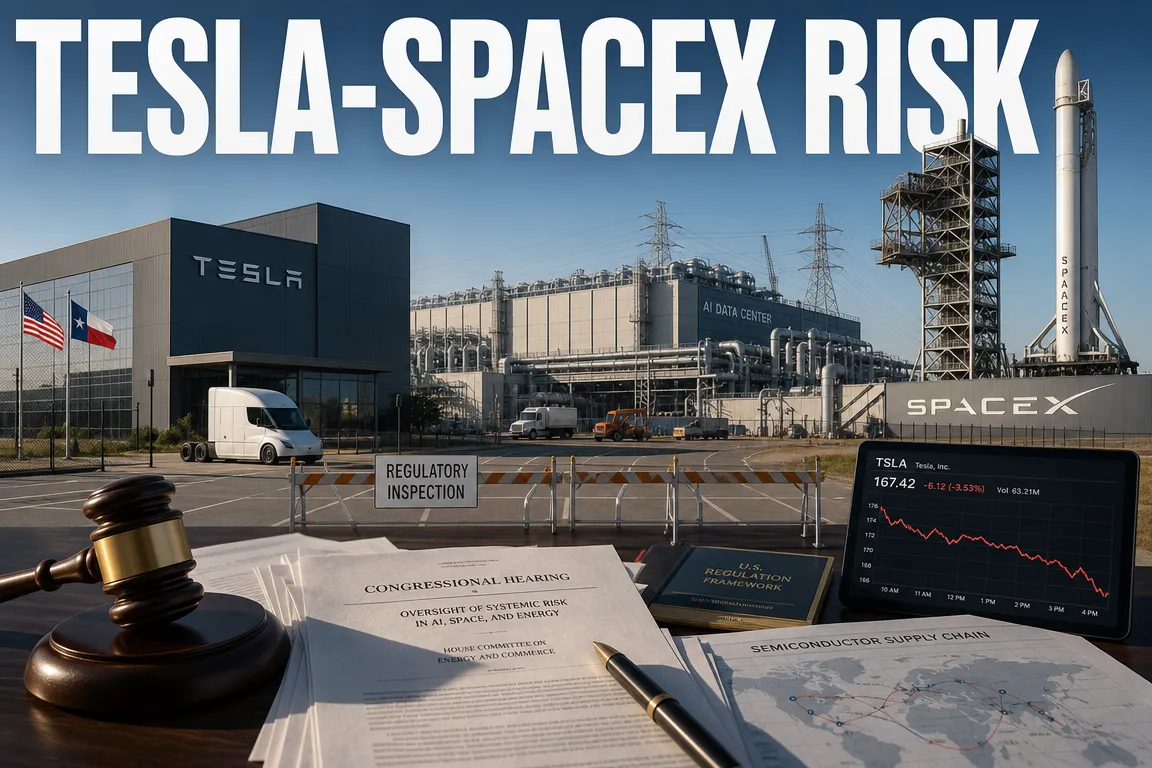
● AI Shock, Tesla-SpaceX Merger Risk, Market Frenzy
AI Risk Matters More Than SpaceX Earnings | Potential Tesla Merger and Key Variables for Investors
The more significant risk is that SpaceX’s valuation may increasingly be driven by AI expectations rather than the economics of the space industry.
The central issue is not merely the possibility of a merger between SpaceX and Tesla.
The merger ratio, shareholder approval, AI investment sentiment, large-scale capital expenditure, semiconductor supply chains, and market-share changes could all affect the valuation of a combined company.
However, the source includes claims regarding SpaceX’s financial performance, AI revenue, and quarterly capital expenditure that are difficult to verify publicly.
The analysis below therefore distinguishes verified facts from scenario-based projections while preserving the core investment thesis.
1. Facts to Verify First | SpaceX Financial Performance and Share Trading
SpaceX Is Not a Publicly Traded Company
SpaceX remains a privately held company and is not listed on a conventional U.S. stock exchange.
Unlike Tesla, its shares cannot be freely purchased through standard brokerage accounts.
Some investors may obtain indirect exposure through private-market platforms, special-purpose vehicles, funds, or employee share sales.
However, pricing, fees, liquidity, voting rights, and beneficial ownership structures can differ substantially from those of publicly traded shares.
References to a “SpaceX share price” or purchasing shares after a quarterly earnings announcement should not be interpreted in the same way as transactions in listed equities.
Verification of Private-Company Financial Data Is Limited
SpaceX is not required to file regular quarterly reports or disclose segment-level earnings with the U.S. Securities and Exchange Commission in the same manner as a public company.
Claims such as 70-80% Starlink revenue growth, a 45% operating margin, or 7,800% growth in AI revenue require verification through audited financial statements or regulatory filings.
The source does not establish that SpaceX separately reports revenue from an independent AI business segment.
Starlink may support AI-related data transmission and edge computing, but that does not necessarily qualify the associated revenue as AI revenue.
Capital-Expenditure Figures Also Require Cross-Verification
The source states that annual capital expenditure of approximately $20 billion increased to $19 billion in a single quarter and could double again in the following quarter.
Spending at that level would materially affect cash flow and financing requirements.
Investors should verify whether SpaceX officially disclosed these figures or whether they incorporate data from Tesla or other major technology companies.
Unverified figures should not form the basis of an investment decision solely because of their scale.
2. Core Investment Message | Strong Earnings Do Not Necessarily Imply an Attractive Entry Price
Financial Performance and Valuation Can Move in Opposite Directions
Improving financial results do not necessarily indicate that an investment is undervalued.
A share price may decline after better-than-expected results if the market has already priced in a higher growth rate.
Conversely, a stock may rise despite weak current performance if expectations already reflect sufficiently negative assumptions.
Capital markets increasingly discount revenue and cash flow expectations one to three years in advance.
As a result, investors may correctly forecast economic indicators and corporate earnings while misjudging the direction of asset prices.
AI Exposure Changes the Valuation Framework
If SpaceX is valued primarily as a launch-services and satellite-communications company, key metrics include launch frequency, subscriber growth, average revenue per user, and communications margins.
If it is reclassified as an AI infrastructure company, data-center investment, power availability, semiconductor procurement, GPU utilization, and AI revenue conversion become more important.
AI companies may command higher growth premiums, but their valuation multiples can contract rapidly when AI investment sentiment weakens.
AI expansion could therefore increase both SpaceX’s upside potential and its valuation volatility.
3. Potential SpaceX-Tesla Merger | Strategic Possibility Versus Transaction Feasibility
Strategic Links Across the Musk Ecosystem Are Evident
SpaceX and Tesla could share technology, capital, talent, and supply-chain resources through the broader ecosystem associated with Elon Musk.
- Tesla is expanding autonomous driving, robotics, energy storage, and AI data-center capabilities.
- SpaceX operates rocket-launch services and the Starlink satellite communications network.
- xAI could support generative AI models and data-center infrastructure.
- An integrated ecosystem could connect satellite communications, autonomous-driving data, humanoid robots, and energy supply.
In theory, data generated by vehicles and robots could be transmitted through Starlink, processed by AI models, and supported by Tesla’s energy infrastructure.
However, operating synergies do not necessarily require a legal merger.
Strategic partnerships, long-term contracts, joint investments, and technology licensing could deliver many of the same benefits.
Proposing a Merger and Completing One Are Separate Matters
A transaction would require support from the companies’ boards, shareholders, regulators, creditors, and other stakeholders.
The valuation of privately held SpaceX would likely be one of the most contentious issues.
The merger ratio could dilute existing Tesla shareholders, while an unfavorable valuation could prompt opposition from SpaceX investors and employees.
Required voting thresholds would depend on the transaction structure and applicable law. It is therefore not possible to state definitively that approval by a majority of all Tesla shareholders would always be required.
Until a transaction is formally announced, investors should prioritize board resolutions, regulatory filings, and independent valuation materials over speculation.
4. Why the Merger Ratio Represents a Major Risk
Determining Which Company Receives the Higher Valuation
A merger requires more than combining two enterprise values. The allocation of ownership in the combined entity is critical.
An excessive valuation for SpaceX could materially dilute existing Tesla shareholders.
Conversely, terms favoring Tesla could face resistance from early SpaceX investors and employees.
Elon Musk’s influence over both companies could facilitate execution but also increase conflict-of-interest concerns.
Shareholder Incentives May Be Required
Tesla shareholders may oppose the transaction if the expected benefits are not clearly demonstrated.
Management would need to explain the projected synergies, long-term strategy, dilution, cash-flow implications, and timetable for profitability.
Potential measures could include a special dividend, share repurchases, a favorable exchange ratio, or a long-term capital-return policy.
Until formally announced, such measures remain hypothetical.
5. Comparison With Tesla’s 2016 Acquisition of SolarCity
Controversies Surrounding the SolarCity Transaction
Tesla acquired solar-energy company SolarCity in 2016.
Critics argued that the transaction allowed Tesla to support a financially strained company.
Overlapping interests involving Elon Musk and other related parties intensified concerns.
Shareholder litigation continued for years and focused on transaction fairness and potential conflicts of interest.
A SpaceX Merger Would Differ in Scale and Strategic Profile
SpaceX holds reusable-rocket capabilities, a Starlink subscriber base, and government and commercial launch contracts.
It would therefore be difficult to characterize the transaction solely as Tesla rescuing a financially distressed company.
The debate would more likely focus on whether Tesla or SpaceX should serve as the principal growth engine of the combined entity.
Nevertheless, opaque private-company valuation and potential conflicts involving Musk could create legal risks similar to those raised in the SolarCity transaction.
6. Three Reasons Greater AI Exposure Could Increase SpaceX’s Risk
First, the AI Premium Could Expand Faster Than Financial Performance
If AI growth expectations become excessive, valuation may become more sensitive to market sentiment than to underlying cash flow.
Even with rising AI-related revenue, free cash flow could deteriorate if investment costs increase more rapidly.
Ultimately, investors will assess when revenue growth begins to generate sustainable cash flow.
Second, Large-Scale Capital Expenditure Increases Financing Risk
AI data centers, satellite networks, rockets, and ground stations all require substantial upfront investment.
If capital expenditure exceeds operating cash flow, additional debt or equity financing may be necessary.
Higher interest rates increase borrowing costs, while equity issuance dilutes existing shareholders.
Investors should therefore evaluate how quickly capital spending converts into revenue and cash flow.
Third, AI Sentiment Could Affect the Company’s Entire Valuation
Even if the core business remains stable, classification as an AI company could expose SpaceX to the same market sentiment affecting Nvidia, Microsoft, Meta, and data-center operators.
Disappointing listings or earnings reports from major AI companies could trigger valuation declines across related assets.
Such declines may result from lower earnings or revenue multiples rather than deterioration in the underlying business.
7. Potential Implications of a “Terra” Semiconductor Project
Potential Synergies From Semiconductor Vertical Integration
If the proposed “Terra” initiative refers to semiconductor manufacturing facilities or a large-scale internal supply-chain program, the potential synergies could be significant.
Tesla requires semiconductors for autonomous-driving computers, cameras, robotics, and data centers.
SpaceX uses a wide range of semiconductors in satellites, rockets, ground stations, and communications equipment.
Internal design capabilities and secure production capacity could reduce procurement costs and supply-chain risk.
Semiconductor Manufacturing Requires More Than Capital
Advanced semiconductor facilities may require tens of billions of dollars and extended construction periods.
Successful operation depends on lithography equipment, materials, process technology, skilled personnel, and stable production yields.
Semiconductor design and semiconductor manufacturing are fundamentally different capabilities.
Tesla’s ability to design AI chips would not imply an immediate ability to operate a leading-edge foundry.
Investors should assess site selection, equipment orders, technology partners, production nodes, mass-production schedules, and financing plans rather than relying on an initial construction announcement.
Until the official project name and execution plan are confirmed, the proposed “Terra” project should be treated as a long-term scenario.
8. Semiconductor Outlook | Why Market Share Matters More Than Absolute Earnings Growth
Market Growth and Company Competitiveness Are Not Equivalent
Rising demand for AI servers and high-bandwidth memory could support revenue growth at Samsung Electronics and SK hynix.
However, a company’s market share can decline if competitors grow faster than the overall market.
Investors assess not only absolute earnings growth but also market share, technology gaps, and the sustainability of margins.
Market-Share Claims Require Consistent Definitions
The source states that the market share of South Korean memory producers declined from 75% to 70% and then to 63%.
However, DRAM, NAND, and HBM have different market structures, and reported shares vary by research provider and measurement period.
The expansion of China’s ChangXin Memory Technologies and U.S.-based Micron is relevant, but comparisons must use the same product category and methodology.
In AI semiconductors, HBM capacity, customer certification, and advanced packaging capabilities may be more important than overall commodity-memory market share.
9. Changing Market Dynamics | Why Experts Can Forecast Events Correctly but Misjudge Share Prices
Share Prices Respond to Changes in Expectations
If strong earnings are already embedded in consensus expectations, the reported results may not provide an additional catalyst.
The relevant variables are the degree to which results exceed expectations and whether forward guidance improves.
Interest-rate cuts require similar interpretation.
Rate cuts driven by easing inflation may be constructive, while cuts caused by recession could signal weaker corporate earnings.
Lower oil prices may reduce production costs but could also indicate a sharp contraction in global demand.
Market-Share Loss Can Offset Earnings Growth
When an industry expands rapidly, most participants may report higher revenue.
However, slower growth than competitors can indicate a gradual loss of industry leadership.
Tesla analysis should therefore consider not only vehicle deliveries but also market share relative to Chinese electric-vehicle manufacturers, pricing competitiveness, and autonomous-driving monetization.
Semiconductor analysis should similarly extend beyond higher memory prices to HBM market share and customer composition.
10. Critical Issues Often Overlooked in News and Online Commentary
The Primary Issue Is Not the Merger Itself but the Concentration of Correlated Risks
A SpaceX-Tesla merger could appear to increase business diversification.
In practice, it could concentrate exposure to AI investment sentiment, semiconductor supply, power availability, interest rates, and capital-expenditure requirements within one company.
The transaction should therefore be assessed as a combination of highly correlated risks rather than conventional diversification.
The Sustainability of Starlink’s Margins Requires Further Assessment
As its subscriber base expands, Starlink may generate economies of scale by producing incremental revenue from its existing satellite network.
However, satellites have limited operating lives and require continuous replacement launches and maintenance.
Competing satellite networks, spectrum regulation, and lower service pricing could reduce long-term profitability.
Long-term free cash flow after satellite replacement costs is therefore more relevant than the operating margin reported for any single period.
Data Volume Does Not Automatically Confer Data-Usage Rights
The generation of large datasets by Tesla vehicles and the Starlink network does not mean all such data can be used freely for AI training.
National privacy regulations, telecommunications laws, defense restrictions, and cross-border data-transfer rules may apply.
Assessments of AI synergies should prioritize the amount of legally usable data rather than total data volume.
The Musk Premium Can Also Create a Corporate-Governance Discount
Elon Musk’s strategic vision and execution record support investor expectations for growth.
At the same time, resource allocation, employee transfers, related-party transactions, and conflicts of interest across affiliated companies may increase governance risk.
If a merger proceeds, an independent special committee, external valuation, and transparent disclosure could materially affect the combined company’s valuation.
11. Investor Due-Diligence Checklist
- Official confirmation: Verify whether board resolutions and regulatory filings related to a merger exist.
- Valuation: Assess the revenue multiples and cash-flow methodologies used to value SpaceX and Tesla.
- Dilution: Calculate the reduction in existing Tesla shareholders’ ownership after a potential merger.
- Cash flow: Review free cash flow after AI and space-infrastructure capital expenditure.
- Financing: Determine whether investment is funded through operating cash flow, debt, or equity issuance.
- Market share: Compare revenue growth and market-share trends with those of competitors.
- AI monetization: Verify the definition of AI-related revenue, customer base, contract duration, and recurring-revenue characteristics.
- Governance: Assess whether independent procedures are in place to control related-party transactions and conflicts of interest.
- Valuation discipline: Distinguish a high-quality company from an attractive purchase price.
- Volatility: Reassess position size and loss tolerance if the valuation framework changes before or after a merger.
< Summary >
SpaceX and Tesla have potential strategic links, but any merger should remain a hypothetical scenario until formal procedures and transaction terms are announced.
Claims regarding SpaceX’s AI revenue, operating margins, and capital expenditure require verification through publicly available disclosures.
Key transaction risks include shareholder dilution from the merger ratio, conflicts of interest, litigation, large-scale capital expenditure, and AI-driven valuation volatility.
AI exposure could increase the company’s valuation, but weaker AI investment sentiment could also reduce valuation multiples regardless of operating performance in the space business.
Semiconductor and Tesla analysis should consider cash flow and market share relative to competitors rather than revenue growth alone.
Investors should distinguish strong financial performance from an attractive valuation and base decisions on official disclosures and verifiable data.
This material restructures the investment issues and verification requirements presented in the source. It is provided for informational purposes and does not constitute a recommendation to buy or sell any security.
[Related Articles…]
*Source: [ 경제 읽어주는 남자(김광석TV) ]
– 스페이스X 실적 폭발했는데 안 샀다…AI가 커질수록 위험해지는 이유 | 경읽남과 토론합시다 | 정의훈 연구원님 [2편]
● CPI Shock, Stocks Sink
How CPI Affects Bank Accounts and Stocks: The Link Between Consumer Prices, Interest Rates, and Equity Markets
Why can a higher-than-expected CPI increase borrowing costs, pressure technology stocks, and reduce household purchasing power?
This report explains the CPI, how to interpret inflation releases, how central banks and equity markets respond, and which variables investors should monitor.
A high CPI does not automatically lead to lower stock prices. Financial markets often react more strongly to the difference between the reported figure and consensus expectations than to the absolute level of inflation.
1. What Is the CPI?
CPI stands for Consumer Price Index.
It is a widely used inflation indicator that measures changes in the prices households pay for goods and services over a specified period.
In practical terms, it tracks changes in the cost of food, clothing, transportation, housing, and other essential consumption categories.
- Food and beverages
- Housing costs and utilities
- Transportation and fuel
- Clothing and footwear
- Healthcare
- Education
- Telecommunications
- Dining and other services
The CPI is calculated by surveying prices and assigning weights based on each category’s share of household expenditure.
Not all goods and services have the same influence on the index.
Categories representing a larger share of consumer spending receive greater weight.
2. What Does a 2% CPI Increase Mean?
The Bank of Korea targets consumer price inflation of approximately 2% over the medium term.
A 2% inflation rate generally means that the average price level of goods and services is approximately 2% higher than one year earlier.
Moderate and stable inflation can be consistent with normal economic growth.
However, excessively rapid inflation reduces real household purchasing power and increases economic uncertainty.
For example, if wages rise by 3% while living costs increase by 5%, nominal income rises but real purchasing power declines.
Inflation therefore represents a direct increase in the real cost of living, rather than merely a statistical change.
3. Three CPI Measures Investors Should Distinguish
1. Year-over-Year Inflation
This measure compares the current price level with the same month one year earlier.
It is the most commonly cited figure in reports stating that consumer prices increased by a specified percentage.
It is useful for assessing longer-term inflation trends, but base effects can distort the result when the prior-year comparison was unusually high or low.
2. Month-over-Month Inflation
This measure compares the current price level with the immediately preceding month.
It provides a more timely indication of whether inflationary pressure is accelerating or moderating.
Even if year-over-year inflation declines, persistent month-over-month increases may prevent central banks from concluding that inflation is under control.
3. Core CPI
Core CPI excludes selected categories with high short-term price volatility to identify the underlying inflation trend.
Definitions vary by country and institution, but the measure generally reduces the influence of categories such as agricultural products and energy.
Headline CPI may moderate when oil prices decline, while core inflation remains elevated because of continued increases in dining, rent, healthcare, and other service costs.
Central banks therefore evaluate headline CPI together with core and services inflation.
4. What Happens When CPI Exceeds Expectations?
Financial markets assess more than the absolute CPI level.
The difference between the reported figure and the market consensus is often more important.
If the consensus forecast is 2.8% and the reported figure is 3.1%, investors may conclude that disinflation is progressing more slowly than expected.
The following sequence may then occur:
- Investors conclude that inflation remains stronger than expected.
- Expectations for central bank rate cuts are deferred.
- Government bond yields rise, and market interest rates remain elevated.
- Financing costs increase for businesses and households.
- Forecasts for corporate earnings and consumer spending may be revised downward.
- Volatility increases across equities, bonds, and other asset classes.
The CPI is therefore a key transmission point connecting inflation, interest rates, borrowing, consumption, investment, and corporate earnings.
5. How CPI Affects Policy Rates
Price stability is one of the primary responsibilities of a central bank.
If inflation remains materially above target and shows limited signs of moderation, monetary policy is likely to remain restrictive.
Central banks may respond by raising policy rates or maintaining elevated rates for longer than previously expected.
Higher interest rates increase the relative attractiveness of deposits and bonds while raising the cost of borrowing.
Households may reduce consumption as mortgage and consumer loan payments increase.
Companies may also become less willing to finance new factories, research and development, or acquisitions at higher borrowing costs.
Lower aggregate demand can reduce inflationary pressure, but it can also increase the risk of an economic slowdown.
6. How CPI Directly Affects Household Finances
1. Borrowing Costs
Persistent inflation can delay policy rate cuts.
As a result, market rates and lending rates may remain elevated.
Households with significant variable-rate debt may face higher monthly interest payments or a prolonged period of elevated borrowing costs.
2. Higher Living Costs
As food, dining, transportation, and utility costs increase, the quantity of goods and services that can be purchased with the same income declines.
A decline in the inflation rate does not mean that prices have returned to previous levels.
If inflation falls from 5% to 2%, prices are still rising, but at a slower rate.
3. The Real Value of Deposits and Cash
If a deposit yields 3% while inflation exceeds the after-tax return, the nominal balance may increase even as real purchasing power declines.
Investors should therefore evaluate inflation-adjusted real returns rather than nominal yields alone.
4. Employment and Wages
If financing and operating costs rise simultaneously, companies may have less capacity to expand hiring or increase wages.
Elevated inflation can therefore affect not only consumer prices but also labor markets and household income.
7. Why Does High CPI Increase Equity Market Volatility?
Equity prices reflect the present value of expected future corporate cash flows.
The discount rate used to convert future cash flows into present value generally rises with interest rates.
A higher discount rate reduces the present value of earnings expected further in the future.
Consequently, a higher-than-expected CPI can place downward pressure on equity valuations.
Markets may also price in weaker corporate earnings due to lower consumption and higher interest expenses.
However, rising CPI does not always cause a major equity market decline.
If economic growth and corporate earnings remain strong, or if persistent inflation is already reflected in asset prices, the market response may be limited.
8. Why Technology and AI Stocks Are Particularly Sensitive to CPI
Technology and AI companies are often valued more heavily on future growth than on current earnings.
When interest rates rise, the present value of long-duration earnings declines more sharply, making growth stocks relatively sensitive to changes in inflation expectations.
Companies funding substantial investment in data centers, semiconductors, cloud infrastructure, and AI model development while operating at a loss are particularly exposed to financing costs.
Despite strong long-term growth potential, the AI industry remains sensitive to short-term interest rate and liquidity conditions.
By contrast, large technology companies with stable cash flow may be better positioned to withstand a high-rate environment.
After a CPI release, investors should distinguish among companies based on cash flow, leverage, and capital expenditure requirements rather than treating the technology sector as a single category.
9. CPI Effects Vary by Sector
- Growth stocks: May be particularly sensitive to higher rates and valuation adjustments.
- Banks: Net interest margins may improve, but delinquency and credit risks can also increase.
- Consumer staples: Demand may remain relatively stable during an economic slowdown.
- Energy companies: Earnings may improve when higher oil prices are a major driver of inflation.
- Retail and restaurant companies: Performance depends on their ability to pass higher input costs on to customers.
- Real estate and REITs: Higher borrowing costs and government bond yields can create valuation and refinancing pressure.
In the same inflationary environment, earnings performance can differ significantly between companies with pricing power and those without it.
10. Critical Factors Often Missing from CPI Coverage
1. Markets Trade the CPI Surprise
Equity prices can rise when CPI remains high but is lower than expected.
Conversely, markets can decline even when inflation moderates if it does not fall as quickly as anticipated.
Investors should evaluate the reported figure, consensus forecast, previous reading, and revisions together.
2. Lower CPI Does Not Necessarily Mean Lower Living Costs
Slower inflation is disinflation, not necessarily deflation.
Prices may continue to rise at a slower pace while remaining well above previous levels.
This distinction is a major reason for the gap between official inflation data and household perceptions of living costs.
3. Central Banks Do Not Base Decisions on CPI Alone
Central banks also assess employment, wages, economic growth, inflation expectations, financial stability, and exchange rates.
A single favorable CPI report is rarely sufficient to justify an immediate rate cut because policymakers must evaluate whether the trend is sustainable.
4. Housing and Services Inflation May Remain Persistent
Goods inflation can moderate quickly as supply chains normalize, but wage-sensitive services inflation generally declines more slowly.
Rent and housing-related components may also reflect market changes with a delay because of lease renewal cycles.
Even if headline CPI declines, persistent services inflation can limit expectations for rate cuts.
5. Investors in South Korea Should Monitor US CPI and Exchange Rates
If US CPI exceeds expectations, expectations for Federal Reserve rate cuts may weaken.
US Treasury yields and the dollar may then rise, placing depreciation pressure on the South Korean won.
A weaker won can increase the domestic cost of imported energy and raw materials, adding renewed inflationary pressure.
Investors in South Korean equities should therefore monitor the interaction among US inflation, US interest rates, and the USD/KRW exchange rate.
11. CPI Release-Day Investment Checklist
- Determine whether year-over-year CPI exceeded the market consensus.
- Assess whether month-over-month inflation is accelerating.
- Review the direction of core CPI and services inflation.
- Check whether the previous month’s figures were revised upward or downward.
- Monitor government bond yields and interest rate futures.
- Review movements in the US dollar and the USD/KRW exchange rate.
- Compare sector performance across technology, financial, and energy stocks.
- Evaluate trends over at least three months rather than relying on a single release.
Immediately after a CPI release, algorithmic trading and short-term position adjustments can cause disproportionate price movements.
Rather than pursuing the initial move, investors should assess whether interest rates, exchange rates, and sector performance confirm the same direction.
12. Practical Applications of CPI Data
Highly leveraged households can use CPI trends to assess the potential timing of rate cuts and the likely direction of interest expenses.
Deposit investors should compare nominal yields with inflation to estimate real returns.
Equity investors should distinguish between the effects of high interest rates on corporate earnings and valuation multiples.
For AI and semiconductor companies with substantial long-term growth potential, cash flow and capital expenditure requirements should be assessed alongside revenue growth.
CPI is more useful as an indicator of broader funding conditions across households, businesses, and financial markets than as a standalone short-term trading signal.
< Summary >
- CPI measures changes in the prices households pay for goods and services.
- A higher-than-expected CPI can delay policy rate cuts and increase financing costs for households and companies.
- Higher rates reduce the present value of future earnings, creating greater valuation pressure on technology and AI growth stocks.
- Lower inflation means prices are rising more slowly, not necessarily declining.
- Markets often react more strongly to the gap between CPI and expectations, as well as to core and services inflation, than to the headline figure alone.
- Investors in South Korea should monitor US CPI, Treasury yields, and the USD/KRW exchange rate.
[Related Articles…]
*Source: [ Jun’s economy lab ]
– CPI가 뭐길래 내 통장까지 털어갈까?