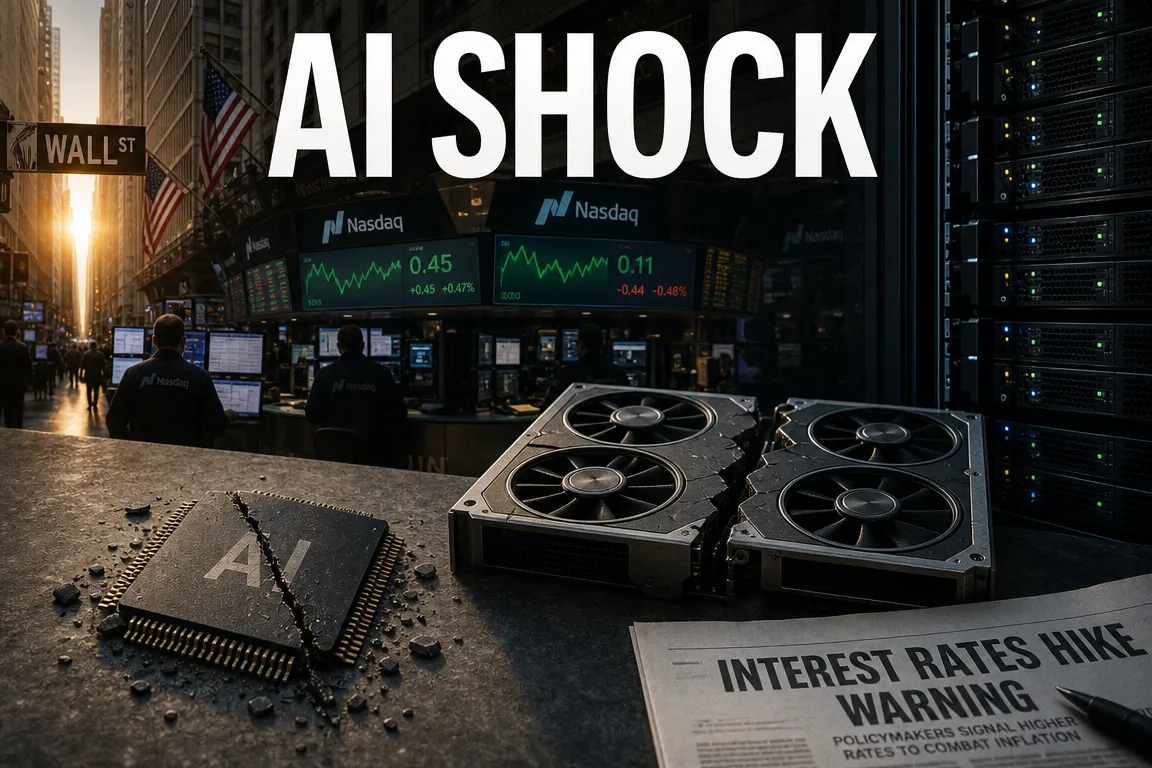
● Nasdaq Rebound Fake, AI Chip Risk Surges
Why Mark Minervini Viewed the Nasdaq Rebound as a False Signal and the Real Risks in the AI Semiconductor Market
The key issue in the latest Nasdaq rebound is not the index gain itself, but whether trading volume and price momentum were strong enough to confirm a trend reversal.
Investors must also assess U.S. employment data, the Federal Reserve’s rate path, Microsoft’s reduction of Oracle AI computing contracts, the economic life of older GPUs, data center investment regulations, and downward revisions to AI-sector earnings forecasts.
This issue extends beyond a routine Nasdaq correction. It may challenge the market’s assumption that AI computing capacity will remain structurally scarce.
However, the source does not clearly identify the relevant dates, and several names and terms appear to have been mistranslated. Employment data, interest-rate probabilities, and related claims should therefore be verified against official releases for the applicable period.
1. Why Investors Remained Cautious Despite the Nasdaq Gain
According to the source, the Nasdaq rose nearly 2% early in the session but surrendered much of the advance and closed approximately 0.91% higher.
Several AI semiconductor stocks, including Nvidia and Micron, rebounded, while the recent heavy selling across the semiconductor sector temporarily eased.
Although this was positive on the surface, a gain of less than 1% is insufficient to confirm a trend reversal after a substantial prior decline.
If the Nasdaq had fallen more than 5% in the previous session, as stated in the source, the subsequent modest gain would be more consistent with an oversold technical rebound than a sustained recovery.
The Nasdaq outlook should therefore be evaluated using trading volume, market breadth, and the index’s ability to retain intraday gains rather than a single session’s percentage change.
2. What Mark Minervini Meant by a Dead-Cat Bounce
The names rendered in the source as “Mark Megnobny” or “Mark Mee Nubni” appear to refer to prominent U.S. momentum investor Mark Minervini.
A dead-cat bounce is a temporary recovery within a broader downtrend.
A price rebound does not necessarily indicate that the downtrend has ended. It may simply reflect a temporary pause in selling pressure.
Minervini focuses on the strength and quality of the market response rather than the existence of a rebound alone.
- Major indexes should post a meaningful advance.
- The advance should be supported by strong trading volume.
- Buying should broaden beyond a limited number of large-cap stocks.
- Early gains should be maintained through the close.
- Follow-up buying and trend confirmation should continue over subsequent sessions.
Because the rebound described in the source was limited and lacked sufficient volume, it did not meet the threshold for a confirmed trend reversal under this framework.
3. Why a Follow-Through Day Matters
A follow-through day occurs when a major market index posts a significant gain on increased volume after establishing a potential low.
It is generally interpreted as a sign that institutional capital is returning to the market.
However, a single follow-through day does not guarantee the start of a new bull market.
If the index subsequently falls below its recent low or leading stocks break down, the signal should be considered unsuccessful.
When the VIX is elevated, the quality of a rebound matters more than its headline percentage gain.
If the Nasdaq rises on declining volume and gives back much of its intraday advance, the move does not indicate strong risk-asset demand.
4. Why Strong U.S. Employment Data May Not Be Positive for Equities
The source states that nonfarm payrolls increased by 165,000, compared with an estimate of 65,000.
It also reports an unemployment rate of 4.1%, below the 4.2% forecast.
These figures would indicate a stronger-than-expected U.S. labor market.
Resilient employment can support consumption and corporate earnings while reducing recession risk.
However, the implications differ when inflation remains above the Federal Reserve’s target.
Strong employment may sustain wage and services inflation, giving the Federal Reserve grounds to keep interest rates elevated for longer.
If markets had been pricing in slower growth and rate cuts, stronger employment data could therefore pressure equity valuations.
The source states that markets assigned an approximately 80% probability to a rate increase at the next meeting. Because no reference date is provided, this should not be treated as a current market probability.
U.S. interest-rate increase and hold probabilities change continuously and should be verified through CME FedWatch and federal funds futures.
5. The Federal Reserve May Place Greater Weight on Inflation Than Employment
The name “Nick Timmy Routh” in the source appears to refer to Nick Timiraos, The Wall Street Journal’s Federal Reserve correspondent.
The central argument is that one employment report is insufficient to determine the Federal Reserve’s next policy decision.
Unless the labor market deteriorates sharply, inflation is likely to remain the central policy consideration.
Key indicators include core personal consumption expenditures inflation, core consumer price inflation, housing and services inflation, and wage growth.
The rate path is therefore more likely to depend on whether inflation is moving sustainably toward target than on employment strength alone.
Conversely, a sharp decline in AI and growth stocks combined with wider corporate credit spreads could create a degree of market-driven tightening.
Lower equity values weaken household wealth effects, while higher financing costs can constrain corporate investment. This could reduce the need for additional aggressive monetary tightening.
However, an equity-market decline alone is unlikely to trigger an immediate policy reversal.
The more important issue is whether financial-market stress develops into tighter credit conditions and weaker real economic activity.
6. Why Microsoft’s Reduction of Oracle Contracts Matters
One of the most significant points in the source is that Microsoft is reportedly allowing some leases for Oracle-provided AI computing capacity to expire without renewal.
If accurate, this would represent a selective reduction of existing capacity rather than an abrupt termination of the broader relationship.
The stated reason is that some Nvidia GPUs installed in Oracle servers were older models that no longer met Microsoft’s performance and efficiency requirements.
Oracle reportedly disputed this interpretation, arguing that demand remains strong for AI infrastructure, including systems using older GPUs.
Both positions may be valid.
Aggregate GPU demand can remain strong while individual customers discontinue specific GPU generations based on power efficiency, networking architecture, memory capacity, and software compatibility.
7. Three Questions Raised by the Contract Reduction
The first question is whether AI computing capacity is scarce across all categories.
If every type of GPU were equally scarce, maintaining existing contracts would appear economically rational.
In practice, scarcity may be concentrated in the latest high-performance GPUs and systems with superior power efficiency.
The second question is how quickly the economic value of older GPUs declines.
As AI models expand and newer GPUs deliver rapid improvements in performance and energy efficiency, older hardware may lose economic value significantly faster than its accounting depreciation schedule implies.
The third question is whether major technology companies are entering a more disciplined phase of computing investment.
If Microsoft is selectively reducing higher-risk data center projects and inefficient computing contracts, this would indicate tighter capital discipline rather than an end to AI investment.
Future data center investment is likely to depend less on the number of GPUs deployed and more on power availability, cooling efficiency, network design, utilization rates, and measurable revenue generation.
8. GPU Depreciation Is an Underappreciated Risk
The reported profitability of AI infrastructure companies can vary substantially depending on the assumed useful life of GPU assets.
A longer useful-life assumption reduces near-term depreciation expense and can increase reported earnings.
However, if rental rates and utilization for older GPUs decline faster than expected, a gap may emerge between carrying value and economic value.
This could result in impairment charges, accelerated depreciation, and weaker rental profitability.
Analysis of AI infrastructure companies should therefore include the following factors:
- GPU holdings by generation and average equipment age
- Customer contract duration and early termination provisions
- GPU utilization rates and hourly rental prices
- Operating expenses, including power and cooling costs
- Depreciation periods and residual-value assumptions
- Interest expenses associated with debt-financed data centers
These factors receive less attention than revenue growth but may be decisive for profitability and valuation.
9. Why High GPU Rental Prices Do Not Eliminate Demand Concerns
Third-party data may show that GPU rental prices at neocloud providers remain elevated.
This indicates that demand for AI computing capacity remains strong.
However, high rental prices do not necessarily confirm a long-term structural shortage.
Delays in grid connections, permitting, transformers, and cooling systems may restrict near-term supply and force customers with immediate needs to pay premium prices for existing capacity.
Current prices may therefore reflect short-term supply bottlenecks rather than certainty regarding long-term demand.
The durability of rental prices after new supply enters the market will be a more reliable measure of underlying AI computing demand.
10. Downward AI Semiconductor Earnings Revisions Are an Early Warning Signal
The source indicates that consensus earnings forecasts for AI and semiconductor growth companies have declined.
Falling consensus estimates imply downward revisions to expected revenue, operating income, or earnings per share.
Equities often react more strongly when estimates begin to decline than after weaker results are formally reported.
If AI semiconductor stocks fall while earnings estimates are also being reduced, investors should consider whether the move reflects deteriorating fundamentals rather than valuation compression alone.
Order expectations, inventory levels, and average selling prices at memory-sensitive companies such as Kioxia and Micron may provide useful leading indicators.
Conversely, if share prices decline while earnings estimates remain stable or rise, lower valuations may create a more attractive entry point.
11. Potential Market Impact of TSMC’s Review of 3D DRAM
The source also states that TSMC is evaluating production of 3D DRAM, a next-generation memory technology.
TSMC is primarily known for foundry services and advanced logic manufacturing rather than conventional memory production.
A confirmed entry into next-generation DRAM could eventually affect an industry currently dominated by Samsung Electronics, SK Hynix, and Micron.
3D DRAM uses vertically stacked memory cells to address the scaling limitations of conventional planar structures.
However, technical evaluation and commercial production are materially different stages.
The development should not be treated as a near-term earnings catalyst until yield, cost, customer commitments, and mass-production schedules are confirmed.
12. The Positive Case for Data Center Investment
Investor Chris Camillo has argued that Democratic-leaning states may ultimately support additional data center development.
The rationale is that data centers can generate substantial investment, tax revenue, local employment, and power-infrastructure upgrades, encouraging regional governments to compete for projects regardless of political alignment.
However, Democratic-leaning states may impose stricter requirements related to environmental standards, electricity consumption, water use, and carbon emissions.
The likely outcome is not unrestricted approval or prohibition, but broader use of conditional approvals tied to renewable energy, dedicated generation, and regional grid investment.
Camillo’s investments in Amazon and energy infrastructure companies should also be considered.
Even well-supported investment views may be influenced by existing portfolio exposure.
13. What OpenAI’s Continued Data Center Investment Means
According to the source, OpenAI’s chief financial officer stated that customer demand remains intact and that the company intends to continue raising capital and investing in AI data centers.
This supports the view that long-term AI service demand and infrastructure investment remain active.
However, large investment plans do not guarantee profitability.
OpenAI and other major AI companies must demonstrate that usage growth can be converted into sustainable revenue and cash flow.
As data center investment expands, financing costs, depreciation, and electricity expenses also increase.
Markets are therefore likely to focus increasingly on the proportion of paying customers, revenue per customer, inference costs, and gross-margin improvement rather than user growth alone.
14. Interpreting Michael Burry’s Reduction of Semiconductor ETF Put Options
The source states that Michael Burry sold approximately 25% of a put-option position that benefited from declines in a semiconductor ETF.
A reduction in put exposure may indicate that the bearish view has moderated.
However, it should not automatically be interpreted as a strong buy signal.
The transaction could reflect profit-taking, expiration management, portfolio risk adjustment, or positioning linked to other derivatives.
If Burry reduced rather than fully closed the position, he may still consider downside risk elevated.
15. The Most Important Issue Receiving Limited Attention
The central issue is not whether AI demand has disappeared, but whether the value of AI computing assets is becoming increasingly polarized by hardware generation.
The value of the latest GPUs and power-efficient data centers may continue to rise.
Older GPUs and facilities with high electricity costs may lose competitiveness faster than expected even if aggregate market demand remains strong.
AI infrastructure companies should therefore not be evaluated under a single generalized assumption of GPU scarcity.
Companies with newer GPUs and long-term customer contracts may have significantly different economics from those dependent on older hardware and short-term rentals.
Microsoft’s reported contract adjustment is more likely to indicate a preference for cost-efficient computing capacity than a withdrawal from AI investment.
This suggests that the AI industry may be shifting from indiscriminate capacity expansion toward greater scrutiny of investment efficiency and return on capital.
16. Market Indicators Investors Should Monitor
- Whether Nasdaq rebounds are accompanied by higher volume than in the previous session
- Whether gains broaden beyond Nvidia and Micron to software, cloud, and power-infrastructure companies
- Whether the VIX declines sustainably and corporate credit spreads stabilize
- Whether U.S. consumer price and personal consumption expenditures inflation continue to moderate
- Whether revenue and earnings-per-share estimates for AI companies are revised further downward
- Whether capital expenditure guidance from Microsoft, Amazon, Alphabet, and Meta remains intact
- Whether neocloud GPU utilization and rental prices remain resilient after new capacity enters the market
- Whether data center power agreements and permits result in actual construction and operations
A sustained improvement across these indicators would be required to classify the rebound as a trend recovery rather than a dead-cat bounce.
17. Final Assessment of the Nasdaq Rebound
Based on the information presented in the source, the Nasdaq gain appears more consistent with a technical rebound than a confirmed trend reversal.
Volume and price momentum were limited, while downward earnings revisions for AI growth companies and the declining economic value of older GPUs remain significant risks.
However, the available evidence does not yet indicate a broad collapse in data center demand.
Long-term investment plans from OpenAI and major technology companies, elevated GPU rental prices, and potential state-level support for data center development remain constructive factors.
The direction of the global economic outlook and technology equities will depend on the interaction among inflation, corporate earnings, and AI infrastructure profitability rather than on a single Federal Reserve decision.
Investors may consider maintaining a cautious allocation until stronger trading volume and improved earnings estimates confirm the rebound. Increased exposure would be more defensible if both earnings expectations and market flows recover.
< Summary >
The Nasdaq rebounded, but limited gains and weak volume leave open the possibility of a dead-cat bounce under Mark Minervini’s framework.
Strong employment supports the economy but may reinforce inflation concerns and extend the period of restrictive interest rates.
Microsoft’s reduction of some Oracle contracts appears to reflect the efficiency and economic-life limitations of older GPUs rather than a collapse in AI demand.
The central market issue is no longer GPU scarcity alone, but the widening value gap between newer and older hardware, depreciation risk, and the actual profitability of AI data centers.
A sustained Nasdaq advance supported by higher volume and a recovery in AI-sector earnings estimates would be necessary to confirm a durable trend reversal.
[Related Articles…]
*Source: [ 내일은 투자왕 – 김단테 ]
– 마크 미너비니 “나스닥 반등은 가짜”
● Jobs-Surge,Rate-Shock,AI-Risk
U.S. Employment Surprise: Implications for Interest Rates, AI Data Centers, and Semiconductor Investment
The key takeaway from the latest U.S. employment data is not simply that job creation exceeded expectations.
Stronger employment could increase the likelihood of additional Federal Reserve tightening, lift U.S. Treasury yields and the dollar, and raise discount rates across equities, bonds, gold, and Bitcoin.
Local opposition to data center construction following the U.S. midterm elections could also shift AI investment leadership from semiconductors and power infrastructure toward AI software and services.
Because the source connected newly released figures with political interpretations in real time, investors should verify the data through the U.S. Bureau of Labor Statistics, the Federal Reserve, and CME FedWatch before making investment decisions.
1. U.S. Employment Data Significantly Exceeded Expectations
- Employment growth: The source reported that private-sector employment increased by 165,000 in October.
- Market estimate: The reported increase was substantially above the consensus estimate of approximately 65,000.
- Previous figure: Employment growth accelerated from 60,000 in the prior month.
- Unemployment rate: The rate reportedly declined from 4.2% to 4.1%.
- Wage growth: Wage growth was reported at 3.1%, above the 2.9% market estimate.
Taken together, these figures do not indicate a rapidly weakening U.S. labor market.
Job creation exceeded expectations, unemployment declined, and wage growth remained above forecasts.
An unemployment rate of 4.1% also remains low by historical standards.
Continued hiring and relatively strong wage growth suggest that household spending capacity remains resilient.
However, the source appears to use private-sector employment and nonfarm payrolls interchangeably.
The official employment report separately presents nonfarm payrolls, private-sector employment, and government employment. Each figure should therefore be verified independently.
2. Why Strong Employment Data Can Be Negative for U.S. Equities
Under normal conditions, strong employment supports consumer spending and corporate revenue, making it positive for equities.
The implications differ when inflation has not fully stabilized.
An excessively strong labor market can sustain consumer demand, service inflation, and wage pressures.
This reduces the Federal Reserve’s incentive to cut rates quickly in response to recession or unemployment risks.
If inflation reaccelerates, the Federal Reserve may instead consider additional rate increases or maintain restrictive rates for longer.
This is the market environment commonly described as “Good News is Bad News.”
Positive economic data can become negative for financial markets that depend on lower rates and greater liquidity.
3. How an Employment Surprise Affects Asset Markets
- Employment exceeds market expectations.
- Rate-cut expectations decline, or concerns about further tightening increase.
- U.S. Treasury yields rise.
- The relative appeal of dollar-denominated assets increases, potentially strengthening the U.S. Dollar Index.
- Valuation pressure increases for equities, Bitcoin, and other risk assets.
- Gold may face short-term pressure because it does not generate interest income.
The source stated that the probability of an additional rate increase rose from 66.1% before the employment release to 72.8% afterward.
FedWatch probabilities vary according to the selected Federal Open Market Committee meeting and target-rate range and change continuously.
The directional increase in tightening expectations is therefore more important than the specific 72.8% reading.
4. Why the U.S. Economy Is Withstanding High Interest Rates
The source cited annualized third-quarter U.S. GDP growth of 3.2% and described the fourth-quarter outlook as relatively strong.
The Atlanta Federal Reserve’s GDPNow estimate was cited at 3.4%, while the New York Federal Reserve’s forecast was reported at approximately 2.9%.
If sustained, these figures would indicate that consumption and investment remain resilient despite elevated interest rates.
Employment is generally a lagging economic indicator.
Strong third-quarter growth could therefore support employment through October and November.
The latest employment data may represent a continuation of earlier economic strength rather than an isolated surprise.
However, stronger growth allows the Federal Reserve to maintain restrictive rates for longer.
5. Key Variables for Future Federal Reserve Decisions
The source suggested that the probability of an additional rate increase at the next Federal Open Market Committee meeting had increased.
However, one employment report is insufficient to determine monetary policy.
Investors should monitor the following indicators:
- Consumer Price Index: Whether housing and service inflation continue to moderate.
- Producer Price Index: Whether corporate input costs could be passed on to consumers.
- Personal Consumption Expenditures Price Index: The Federal Reserve’s preferred inflation measure.
- Average hourly earnings: Whether wage growth could renew service-sector inflation.
- Crude oil prices: Geopolitical escalation could increase energy prices and inflation expectations.
- Treasury yields: Higher market rates can tighten financial conditions without an additional policy-rate increase.
If employment remains strong while inflation declines rapidly, the Federal Reserve could refrain from further tightening.
If both employment and inflation remain strong, the probability of another rate increase would rise.
During periods dominated by oil prices and geopolitical conflict, the monetary policy outlook can change rapidly.
6. U.S. Equity Outlook: Further Downside Versus Bottom Formation
Strong employment data increase short-term downside pressure on U.S. equities.
Higher Treasury yields raise the discount rate applied to future earnings.
Technology and high-valuation growth stocks are particularly sensitive because much of their valuation depends on future earnings expectations.
However, if equities stabilize or rebound despite negative news, the market may already have priced in a substantial portion of the risk.
Investors should assess both the news and the subsequent price reaction.
Market resilience following negative developments may indicate weakening selling pressure.
Continued declines without material new negative information may indicate that deleveraging and risk reduction remain incomplete.
7. The Connection Between Midterm Elections and AI Data Centers
The source characterized Democratic strength in the U.S. midterm elections as a “blue wave.”
It argued that this political shift could slow AI data center construction.
Residents may support national AI competitiveness while opposing large data centers in their own communities.
Data centers consume substantial electricity and water, require transmission and substation upgrades, and can create noise and land-use concerns.
This reflects the emergence of NIMBY opposition within AI infrastructure development.
Policymakers must balance long-term U.S.-China AI competition with local voter concerns.
Candidates supporting stricter permitting, electricity-rate protections, and environmental reviews may gain electoral support in affected regions.
However, individual regional election results should not be interpreted as an immediate halt to nationwide data center investment.
Stricter policies are more likely to relocate projects, delay construction schedules, or encourage efficiency improvements at existing facilities.
8. Effects of Slower Data Center Construction on Semiconductors
The source cited 13,118 data centers globally and 5,069 in the United States.
These figures vary substantially depending on how each data provider defines a data center and should be verified using current, consistently defined data.
The broader point is that the United States remains the center of global AI data center investment.
Slower U.S. construction could reduce demand expectations for server GPUs, high-bandwidth memory, DRAM, networking equipment, cooling systems, and electrical infrastructure.
This could weaken short-term investor sentiment toward memory manufacturers such as Samsung Electronics and SK Hynix.
However, permitting delays do not automatically cancel existing GPU and high-bandwidth memory contracts.
AI server memory faces greater supply constraints and technological barriers than commodity DRAM, so its demand may not move directly with the number of data centers.
Semiconductor investors should monitor AI server shipments, high-bandwidth memory content per server, product pricing, and customer contract duration in addition to total capital expenditure.
9. Potential Rotation Within the AI Value Chain
The AI value chain can be divided into the following segments:
- Power generation, transmission, cooling, and other core infrastructure
- Data center construction and operation
- GPUs, high-bandwidth memory, servers, and networking semiconductors
- Foundation models and cloud platforms
- Enterprise AI software and consumer services
- Physical AI, including robotics and autonomous driving
Investors have assigned substantial valuation premiums to AI infrastructure suppliers, including GPU, high-bandwidth memory, electrical equipment, and data center companies.
If AI capital expenditure growth among hyperscalers slows, investor attention may shift toward monetization of the installed infrastructure base.
Companies with proprietary AI models, cloud platforms, advertising businesses, subscription services, and enterprise software could benefit.
Market leadership may shift from companies selling AI equipment to companies generating recurring revenue from AI applications.
More stable memory prices resulting from slower data center investment could also reduce operating costs for AI service providers.
This could constrain semiconductor revenue growth while supporting margins for AI software companies.
10. Key Issues Often Overlooked in Market Coverage
First, lower AI capital expenditure does not mean the end of the AI industry.
Even if data center construction slows, higher utilization of existing facilities and GPUs could continue to support AI service revenue.
Second, data center regulation is more likely to relocate investment than stop it nationwide.
Investment could shift toward regions with sufficient electricity and water, less community opposition, access to on-site generation, or reusable industrial sites.
Third, strong employment and stable wage pressures can coexist.
Productivity gains from AI and automation could allow companies to maintain employment while limiting unit-cost increases.
Strong employment would not necessarily generate higher inflation under this scenario.
Fourth, Treasury yields can perform part of the Federal Reserve’s tightening function.
Higher 10-year Treasury yields, mortgage rates, and corporate borrowing costs can reduce consumption and investment without another policy-rate increase.
Fifth, rotation among AI market leaders can occur before an industry downturn.
Capital may rotate from GPUs to high-bandwidth memory, from memory to power infrastructure, and subsequently toward AI models and services.
A correction in AI data center stocks should not automatically be interpreted as the end of the broader AI growth cycle.
11. Outlook for Bonds, Gold, and Bitcoin
U.S. Treasuries may decline in price immediately after strong employment data as yields rise.
If recession concerns return, demand for long-duration Treasuries could increase and yields could decline.
Gold is generally pressured by high real yields and a strong dollar but supported by geopolitical risk and fiscal uncertainty.
Its outlook should therefore be assessed alongside dollar movements and geopolitical conditions.
Bitcoin remains sensitive to global liquidity and real interest rates in the short term.
Higher rate expectations and dollar strength are negative factors, while regulatory developments, institutional adoption, and legislative policy remain separate drivers.
The source argued that changes in the U.S. political environment could reduce the probability of cryptocurrency legislation passing.
Actual legislative prospects depend on the composition of the Senate and House, committee leadership, and the possibility of an executive veto.
12. Investor Checklist
- Verify nonfarm payroll and private-sector employment figures separately.
- Review upward or downward revisions to the previous two months.
- Distinguish between monthly and annual average hourly earnings growth.
- Assess the labor force participation rate alongside unemployment.
- Monitor 2-year and 10-year U.S. Treasury yields after the employment release.
- Confirm the relevant Federal Open Market Committee meeting and target range in FedWatch.
- Track housing and service inflation in the Consumer Price Index and Personal Consumption Expenditures Price Index.
- Determine whether hyperscalers are reducing AI capital expenditure guidance.
- Compare high-bandwidth memory shipments and memory pricing with data center demand concerns.
- Monitor institutional capital rotation from AI infrastructure toward AI software.
< Summary >
The source reported October private-sector employment growth of 165,000, an unemployment rate of 4.1%, and wage growth of 3.1%.
Strong employment could increase the probability of tighter Federal Reserve policy and higher Treasury yields, creating short-term pressure on U.S. equities, Bitcoin, and gold.
Greater community opposition following the midterm elections could slow U.S. data center construction and weaken sentiment toward semiconductor investment.
However, slower data center investment would not indicate the end of the AI industry.
Market leadership could shift from GPUs, high-bandwidth memory, and power infrastructure toward AI models, software, and recurring-revenue services.
Investment decisions should be based on verified employment and inflation data, Treasury yields, Federal Reserve guidance, and major technology companies’ AI capital expenditure plans.
[Related Articles…]
*Source: [ 경제 읽어주는 남자(김광석TV) ]
– [생방송] 미국 고용지표 심층분석 : 증시에 추가 충격 가져올까? [즉시분석]