● Nervous Market Awaiting CPI And AI Profits
Two Core Variables That Could Send the Market Soaring Again Tomorrow: CPI and AI Earnings, Plus the Semiconductor Cycle Shift More Important Than Nvidia
The real point to watch in the market right now is not simply that “the Nasdaq rebounded.”
The core takeaway to confirm tomorrow comes down to exactly two things.
First, whether CPI comes in more stable than the market expects.
Second, whether AI-related companies show margin improvement rather than just revenue growth in earnings.
If those two line up at the same time, U.S. stocks, semiconductor shares, and the AI investment theme could surge strongly again.
On the other hand, if CPI comes in hot and monetization wavers in AI company earnings, this rebound is likely to end as a short-term technical bounce.
What is especially unusual in this move is that the Philadelphia Semiconductor Index jumped more than 7%, while Nvidia alone fell about 5%.
This is not just a simple stock-price move; it can be seen as a signal that the market has begun separating Nvidia risk from AI semiconductor demand.
1. Today’s key U.S. market summary: semiconductors surged, while Nvidia alone fell
Based on the original text, the U.S. market showed a fairly strong rebound.
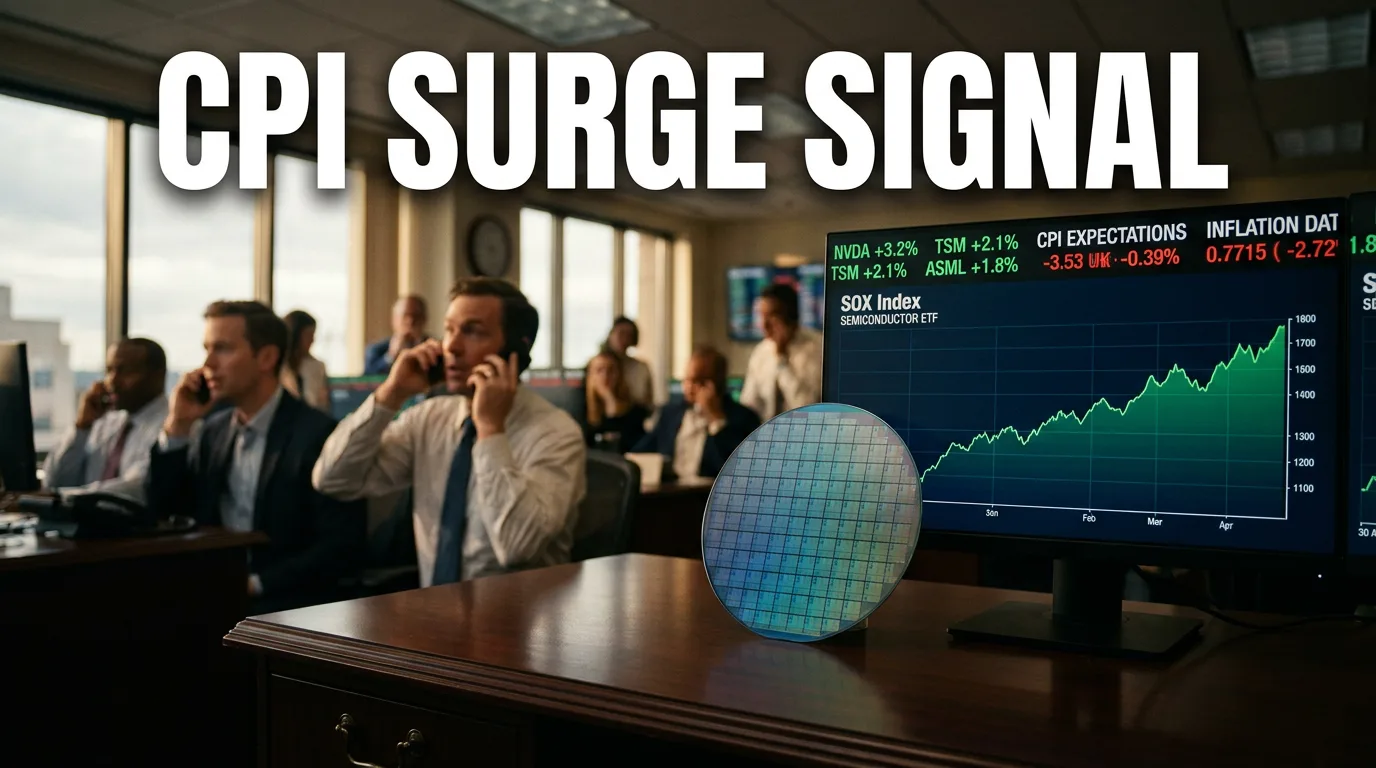
The Nasdaq rose about 3%, and the Philadelphia Semiconductor Index jumped more than 7%.
Given that the semiconductor index had recently fallen about 13%, today’s rebound means more than just a routine bounce.
The market is shifting back to the view that “AI is not over,” but rather “it sold off too far.”
Still, while the broader semiconductor sector rose, Nvidia alone fell about 5%.
That is the most important divergence in today’s market.
AMD, Broadcom, Marvell, optical communications stocks, and AI server infrastructure names mostly rebounded strongly, while Nvidia stood out on the weak side.
In other words, the market was not rejecting AI demand itself; it was pricing in Nvidia-specific risk.
2. The essence of Nvidia’s decline: not a personal issue, but key-man risk and export-control risk
The original text mentioned rumors involving CEO Jensen Huang and an alleged board investigation.
However, because this is sensitive and unverified material, the investment question is not the rumor itself, but how the market is interpreting the risk.
What Wall Street is focusing on is key-man risk.
Nvidia is not just a company that sells GPUs; it sits at the center of the current global AI infrastructure expansion.
Jensen Huang is not simply a CEO; he has functioned like a kind of “central banker of AI,” linking governments, big tech, data centers, and cloud companies around the world.
So if his external activities are restricted or board-level uncertainty grows, the pace of AI ecosystem expansion could face short-term pressure.
What the market is worried about is not the CEO’s personal issue itself, but the possibility that Nvidia’s coordinating role in the AI supply chain could be disrupted.
Another major risk is China export controls.
In the original text, Nvidia’s China revenue share was mentioned as roughly 8%.
On the surface, that does not look large.
But the more important piece is Southeast Asia revenue.
If U.S. lawmakers intensify scrutiny over possible rerouted exports through Southeast Asia, including Singapore, Nvidia could face delayed revenue recognition or order cancellations.
That matters far more than the direct China revenue share.
Going forward, in semiconductor stock trends, “revenue to China” may become less important than “revenue routed through Southeast Asia.”
3. Why the market sold Nvidia and bought AMD, Broadcom, and Marvell
In today’s session, AMD jumped about 14%, Broadcom rose about 9%, and Marvell climbed about 10%.
This means investors still see AI semiconductor demand as very strong.
At the same time, money rotated into substitute beneficiaries while avoiding the concentrated risk in Nvidia.
In AMD’s case, Oppenheimer raised its rating, and news that it will supply EPYC CPUs for Google’s TPU 8 was a positive catalyst.
This is a fairly important shift.
The AI semiconductor market is no longer running on GPUs alone; it is expanding across CPUs, ASICs, network chips, optical communications, and power and cooling infrastructure.
Broadcom has strengths in custom AI chips and network chips.
Marvell is benefiting from data-center connectivity and optical communications.
Ultimately, the AI investment cycle is not a one-company story for Nvidia alone; it is increasingly spreading across a broader supply chain.
4. The truly important signal in memory semiconductors: three months have passed, and there is still no order decline
In this original text, the most important content is not actually the Nvidia rumor, but the order flow in memory semiconductors.
In the past, when memory stocks fell sharply, a decline in orders would typically appear about three months later.
SK Hynix and Samsung Electronics have both gone through this cycle many times.
Stocks fall first, and then customer orders shrink, confirming an actual downturn in the industry.
But this time is different.
Three months have passed since memory stocks fell, and there is still no sign of reduced orders.
Instead, talk of DRAM and NAND shortages continues.
Morgan Stanley also sees the DRAM and NAND market as still tight, and related stocks such as SanDisk, Micron, and hard-drive names have risen sharply.
This is a different pattern from the traditional memory cycle.
It increasingly looks like this may not be a classic downcycle of “stock drop → order decline → earnings deterioration.”
AI servers require massive amounts of not only HBM, but also DDR5, high-capacity SSDs, enterprise storage, and high-performance NAND.
As a result, memory demand is more closely tied to the AI data-center investment cycle than to the smartphone or PC cycle.
That is the most important change to keep in mind when looking at Samsung Electronics and SK Hynix.
5. The core of AI model competition: chip quantity and performance create the gap
The original text noted that Anthropic’s new model improved significantly on major benchmarks versus the previous version.
What matters here is not the specific score, but the direction.
Recently, AI model competition has been reshaped into a structure where OpenAI and Anthropic are pulling ahead, with Meta and Google following behind.
The reason is not just model ideas.
The core is the computing moat.
AI model performance ultimately depends on how many high-performance chips can be secured stably and how efficiently they can be deployed for training and inference.
Chinese AI models once tried to compete on cost-effectiveness, but in the highest-performance tier, a gap still remains.
The original text also explained that there is a wide difference in inference efficiency and training efficiency between Huawei chips and Nvidia’s latest chips.
That means U.S. export controls on Chinese semiconductors are not just political sanctions; they are translating into real AI performance gaps.
From an AI investment perspective, GPUs, HBM, networking, power, cooling, and optical communications infrastructure are likely to remain the key beneficiaries.
6. An even more important AI trend: AI has entered the stage of making AI
One of the most interesting parts of the original text was the mention of internal hidden models and RSI.
RSI stands for Recursive Self-Improvement, meaning a structure in which AI improves AI.
Right now, leading companies like OpenAI and Anthropic likely have even more powerful internal models beyond their public releases.
These internal models serve as teacher models that train smaller models.
In other words, a stronger model creates cheaper and faster models.
Once this stage is reached, the gap between leaders and latecomers can widen over time.
In the past, if you built one strong model, others could catch up, but now companies need computing infrastructure, data, internal models, and deployment capabilities all at once.
That is the key factor reinforcing a winner-takes-all structure in the AI industry.
That is why it was also important for OpenAI’s CFO to say that AI investment will continue regardless of the midterm election outcome.
It means real customer demand exists regardless of the political calendar.
7. What to watch in AI earnings is not revenue, but operating margin
The most important point in tomorrow’s and this week’s earnings season is whether AI companies are actually making money.
The original text mentioned Coiv and Nevis earnings, and in particular explained that Coiv’s operating margin is the key takeaway.
There is also a point that in a previous earnings release, the operating margin moved from around 1% to 5%, and the stock reacted strongly.
If it rises to around 10% this time, the market could substantially reduce its skepticism about AI monetization.
Most skepticism about the AI industry begins with the question: “When will profits actually show up, given all this investment?”
So in this earnings round, margin matters more than revenue growth.
AI data centers, cloud companies, software firms, optical communications companies, and power and cooling names need to show margin improvement, not just top-line growth.
If that is confirmed, AI-related stocks can once again command higher valuations.
On the other hand, if revenue grows but margins deteriorate, doubts that “AI is a money-burning industry” could return.
8. The optical communications rebound: why Coherent, Ciena, and Lumentum matter
Optical communications stocks also rebounded strongly today.
Coherent was mentioned as rising about 18%, Ciena about 11%, and Lumentum about 12%.
Optical communications are becoming increasingly important in AI data centers.
As the number of GPUs rises, GPUs need to be connected faster to each other, and data movement both inside and outside the data center surges.
AI performance depends not just on the power of a single chip, but on how quickly chips can be linked together.
That is why optical switches, optical modules, and network equipment companies are being watched as beneficiaries of AI infrastructure.
In Lumentum’s case, there had been merger-related issues with Marvell, and the original text mentioned the possibility of a bidder emerging with a higher offer.
In particular, Lumentum has strong revenue growth potential, yet its stock fell sharply in a short period, bringing the undervaluation argument back into focus.
Because Nvidia has also invested in Lumentum in the past, the market is even imagining the possibility of an additional acquisition.
Of course, this is not confirmed and is more of a scenario than a fact, but the importance of the optical communications sector in the AI supply chain is clear.
9. Why the sharp drop in oil prices helped semiconductor stocks rebound
Another reason semiconductors rebounded strongly today was the drop in oil prices.
The original text said Brent crude fell about 7%, and WTI also declined sharply from its highs.
When oil prices fall, inflation pressure eases.
When inflation pressure eases, the rate outlook can become more relaxed.
Lower rate pressure is positive for growth stocks and technology valuations.
In other words, AI semiconductor stocks are driven not only by earnings, but also by oil, CPI, and the rate outlook.
In particular, Middle East risk and tensions around the Strait of Hormuz are key variables that increase oil volatility.
If tensions tied to Iran ease, oil can stabilize, which would be positive for U.S. stocks and Nasdaq growth names.
But if nuclear issues or geopolitical negotiations drag on, oil could spike again.
So when looking at CPI tomorrow, you need to watch oil trends as well, not just the number itself.
10. The first variable to watch tomorrow: CPI
The first turning point for the market tomorrow is CPI.
Because PPI came in hot, there is concern that CPI could also come in higher than expected.
If CPI comes in below expectations or in line with the market, today’s rebound is likely to continue.
Especially if oil stays stable and CPI is also acceptable, the rate outlook should ease, and strong buying could return to Nasdaq and semiconductor stocks.
On the other hand, if CPI comes in hotter than expected, there is a problem.
The market could shift back to the view that “the Fed will have a hard time cutting rates easily.”
In that case, AI and semiconductor stocks could give back part of today’s gains.
In other words, tomorrow’s CPI is not just an inflation release; it is the first test of whether this rebound is real or fake.
11. The second variable to watch tomorrow: Q3 earnings and AI monetization
The second variable is Q3 earnings.
What matters especially is whether AI-related companies can show actual monetization.
The market already knows that AI infrastructure investment is expanding to some extent.
What is needed now is the answer to: “So how much money are they actually making?”
If data-center companies, optical communications firms, power and cooling names, and semiconductor companies show margin improvement in earnings, the AI investment cycle can once again be strongly validated.
By contrast, if revenue rises but costs also rise and margins stagnate, the market can once again apply a discount to the AI theme.
The most important word in this earnings season is not growth rate, but operating margin.
12. Key points other news does not explain well
First, the real Nvidia risk is not the CEO rumor, but the weakening of its ecosystem-coordination function.
Jensen Huang is not just an executive; he is a symbolic figure connecting the global AI infrastructure investment flow.
That is why the market is pricing in key-man risk rather than the personal issue itself.
Second, Southeast Asia rerouting scrutiny is more important than Nvidia’s 8% China revenue share.
If U.S. lawmakers begin scrutinizing shipments routed through Southeast Asia, including Singapore, more aggressively, revenue delays could become a risk.
Third, memory semiconductors are showing a different pattern from the traditional cycle.
The fact that no order decline has appeared even three months after the stock drop is very important.
AI data-center demand may be overwhelming the traditional PC and smartphone memory cycle.
Fourth, AI competition has shifted from a battle of model ideas to a battle of computing moats.
The companies that secure more chips can build better models, and better models in turn create even more efficient models.
Fifth, the core of this earnings season is not revenue, but margin.
For the AI industry to remain sustainable, margin improvement must be confirmed alongside revenue growth.
13. Investment perspective summary: conditions for a surge tomorrow and conditions for a decline
The conditions that increase the chances of a surge are as follows.
CPI should come in below expectations or at least remain stable.
Oil should stabilize further and reduce inflation pressure.
AI-related company earnings should confirm operating margin improvement.
The trend showing no order decline in memory semiconductors must continue.
Nvidia-specific risk should not spread to the broader semiconductor sector, including AMD, Broadcom, Marvell, SK Hynix, and Samsung Electronics.
On the other hand, the conditions that increase downside risk are as follows.
CPI comes in hotter than expected, making the rate outlook uneasy again.
AI company earnings show rising cost pressure and weakening margins.
Nvidia’s export-control risk expands into Southeast Asia revenue.
Middle East risk flares up again and oil surges.
A delayed signal of order decline is finally confirmed in the memory industry.
14. Conclusion: even if Nvidia falls, that does not mean the AI cycle is over
Today’s market message is clear.
Nvidia fell, but the entire AI semiconductor sector did not collapse.
In fact, the market is separating Nvidia-specific risk and reallocating money into AMD, Broadcom, Marvell, optical communications, power and cooling, and memory semiconductors.
This may not be a sign that the AI investment cycle is over; it may instead be the process of the beneficiary base broadening.
Still, tomorrow’s CPI and Q3 earnings must be checked.
If inflation stays calm and AI monetization is proven in the numbers, today’s rebound can continue.
Conversely, if CPI is hot and earnings margins disappoint, the market could swing back quickly again.
Right now, this is not a phase for making a firm directional call, but a phase for waiting for the two confirmation buttons, CPI and earnings, before moving.
< Summary >
The key variables for tomorrow’s market are CPI and Q3 AI earnings.
If CPI is stable and operating margin improvement is confirmed for AI companies, U.S. stocks and semiconductor shares could extend their rebound.
Nvidia’s decline is closer to an individual issue driven by key-man risk and export-control concerns than to a collapse in AI demand.
Memory semiconductors are showing a different pattern from the traditional cycle, with no order decline even three months after the stock drop.
The essence of AI competition is not the model itself, but computing power and chip supply capability.
In this earnings season, margin improvement rather than revenue is the key criterion for judging whether AI investment can continue.
[Related Articles…]
AI Semiconductor Supercycle and the Shift in the Global Supply Chain
Generative AI Investment Trends and the Outlook for Data Center Infrastructure
*Source: [ 월텍남 – 월스트리트 테크남 ]
– 내일 “두 가지” 확인하면 폭등 할 수 있습니다.