● Tesla Cybercab Cost Bombshell
Tesla Cybercab Launch Debate: Pricing, Customer Deliveries, and Monthly Costs Matter More Than the Head-Shaving Wager
The central issues in the Tesla Cybercab head-shaving wager are how a “launch” is defined and what users will actually pay, rather than who may have changed their position.
The dispute over the wager’s conditions, the significance of retail customer deliveries, the monthly costs attributed to Elon Musk, and the implications for Tesla’s business and valuation require separate assessment.
1. From Cybercab Launch Feasibility to a Dispute Over Wager Conditions
The excerpt alleges that a YouTuber who pledged to shave his head if Tesla met specified launch conditions subsequently added requirements.
The individual appears to be technology reviewer Marques Brownlee, known as MKBHD, although his identity and statements require verification against the original material.
- Claim presented in the excerpt: As previously cited obstacles are addressed, the opposing party is allegedly adding requirements.
- Reported online response: Some users on X reportedly characterize this as “moving the goalposts.”
- Counterargument: The vehicle is not yet available for unrestricted public purchase.
- The commentator’s outlook: Deliveries to retail customers in December could support a ruling in Tesla’s favor.
Establishing whether the conditions changed requires comparing the initial and subsequent statements against consistent criteria.
If price, launch timing, and retail availability were included from the outset, reiterating them would not establish a change in conditions.
If new requirements were introduced later, the criticism could have merit.
2. The First Issue to Resolve: A “Launch” Is Not a Single Event
The debate is complicated by differing definitions of a launch.
A prototype unveiling, a limited service rollout, and retail vehicle sales represent distinct milestones.
| Stage | Meaning | What Remains Unproven |
|---|---|---|
| Vehicle unveiling | Presentation of the product’s design and development direction. | Manufacturing feasibility, actual pricing, and customer delivery timing. |
| Test operations | Validation of the vehicle or system under specified conditions. | Unrestricted access for general consumers. |
| Invitation-only or limited operations | Access for selected users within a defined operating scope. | Broad accessibility and service scalability. |
| Retail customer deliveries | Transfer of vehicles to external purchasers. | High-volume production capacity and sustainable profitability. |
| Broad commercialization | Recurring sales or service provision across an expanding user base. | Long-term operating costs and margins. |
The excerpt appears to refer to invitation-only operations, although the wording requires verification against the original audio.
If so, this should be distinguished from retail vehicle sales.
The launch of the Cybercab vehicle and the launch of Tesla’s robotaxi service should not be treated as the same event.
Operating a service with existing vehicles and delivering Cybercab vehicles have different implications for both the wager and the business.
3. Interpreting “48 Days Later, December 31”
The excerpt states that the YouTuber asked Grok, the AI service on X, for a reminder in 48 days, reportedly corresponding to December 31.
The excerpt does not provide the post’s date or year.
- Confirm the year: Establish which December 31 is referenced.
- Confirm the reference date: The posting time and date-counting method may affect interpretation.
- Clarify the deadline: Distinguish the wager’s cutoff date from a company-announced delivery schedule.
The excerpt does not establish December customer deliveries as an official schedule.
It discusses deliveries conditionally and should not be presented as confirmation of a launch.
4. What Monthly Cost Was Elon Musk Reportedly Addressing?
The video ends before identifying the recurring monthly expense attributed to Musk.
It is therefore unclear whether the reference concerns a subscription, insurance, financing payments, or service charges.
Claims that Musk identified an autonomous-driving subscription fee or disclosed a monthly usage charge would go beyond the available material.
From an economic perspective, recurring expenses should be assessed alongside the vehicle’s purchase price.
The following are general cost-assessment criteria, not verified components of Musk’s remarks.
- Vehicle financing: Loan or lease payments can cause monthly affordability to differ from the headline purchase price.
- Software costs: Separately priced required features may create additional post-purchase expenses.
- Insurance and liability: Costs depend on ownership structure, commercial use, and coverage terms.
- Charging and maintenance: Electricity, tires, parts, cleaning, and vehicle care must be included.
- Service operating costs: Commercial operations may require customer support, vehicle recovery, and remote assistance.
Consumers should compare total cost of ownership rather than the vehicle’s advertised price alone.
For robotaxi users who do not purchase a vehicle, total transportation spending based on monthly trip frequency and distance is the more relevant benchmark.
5. Implications for Tesla Shares: Validation Milestones Matter More Than the Wager
A dispute involving a prominent reviewer and a corporate executive can attract attention, but does not independently determine Tesla’s earnings or valuation.
Equity analysis should focus on which uncertainties have materially declined.
- Product validation: Whether vehicles are manufactured and delivered to customers.
- Technical validation: The road, weather, and operating conditions under which vehicles function without human intervention.
- Regulatory validation: The forms of operation permitted in each jurisdiction.
- Business-model validation: Whether fares or vehicle sales generate profits after costs.
- Scalability validation: Whether service quality and unit economics remain viable as geographic coverage and fleet size increase.
Progress in one area does not automatically resolve the others.
Customer deliveries are an important product milestone, but do not immediately demonstrate the profitability of a large-scale robotaxi business.
Positive developments may also produce a muted or adverse share-price response if investors had anticipated faster expansion.
Investment assessment should therefore consider the gap between market expectations and actual results, not merely whether a headline appears positive or negative.
6. Autonomous Driving and AI Investment: The Operating System Matters Beyond the Vehicle
Autonomous-driving competitiveness cannot be assessed solely through demonstrations of self-driving vehicles.
Commercial services require systems that handle exceptions, manage fleets, and support passengers throughout their journeys.
- Exception handling: Responses to construction, temporary road restrictions, and changes in pickup or drop-off locations.
- Support-staff efficiency: The rate at which staffing requirements and costs increase with fleet size.
- Charging and maintenance: Vehicle downtime reduces revenue-generating availability.
- Geographic expansion: An operating model validated in one region may not transfer directly to another.
AI investment analysis must therefore consider service-delivery costs alongside model performance.
Technical functionality and sustainable profitability remain separate requirements.
7. Four Issues That Require Separate Assessment
The excerpt does not adequately address the following distinctions.
① Delivery to one retail customer is not equivalent to unrestricted retail availability.
External customer deliveries represent progress, but eligibility requirements, waiting periods, and geographic restrictions may limit access.
Such restrictions do not, however, negate the significance of completed deliveries.
② A driverless vehicle is not necessarily a business without human support.
Customer service and field-response personnel may still be required even when no driver is present.
Remote assistance and remote driving are also distinct; human involvement should be assessed by function and frequency.
③ A lower vehicle price does not guarantee lower fares.
High insurance, maintenance, and support costs, or insufficient revenue-generating operating hours, can offset lower acquisition costs.
Conversely, a more expensive vehicle with consistently high utilization may spread its costs across more trips.
④ Winning a wager and delivering investment returns require different conditions.
A wager can be settled by whether specified conditions are met by a deadline.
Investment outcomes also depend on production growth, cash flow, competitive responses, and expectations already reflected in valuation.
The central question is which customers can access the product, under what conditions, and at what cost.
8. Checklist for Future Developments
- Original wager: Verify the specified vehicle, price, timing, and eligible customers.
- Product scope: Distinguish Cybercab deliveries from robotaxi services using other vehicles.
- Official schedule: Separate announcement dates from actual customer deliveries.
- Purchase and access conditions: Check invitation requirements, geographic restrictions, and public availability.
- Pricing structure: Identify mandatory costs excluded from advertised pricing.
- Operating scope: Verify permitted locations, operating conditions, and required human support.
- Business performance: Assess paid trips, utilization, costs, and profits alongside fleet size.
< Summary >
- The excerpt alleges changes to the Cybercab wager’s conditions, but the initial and subsequent statements require comparison.
- Vehicle unveiling, invitation-only operations, retail deliveries, and broad commercialization are distinct milestones.
- The year and official basis for December deliveries and the December 31 deadline remain unverified.
- The truncated excerpt does not identify the monthly expense attributed to Musk.
- Tesla’s business prospects and valuation should be assessed through total ownership costs, operating scope, utilization, and scalability, not vehicle pricing alone.
[Related Articles…]
*Source: [ 오늘의 테슬라 뉴스 ]
– 삭발 건 유튜버, 조건 또 바꿨다?
● Nvidia Meltdown, Anthropic IPO Trap
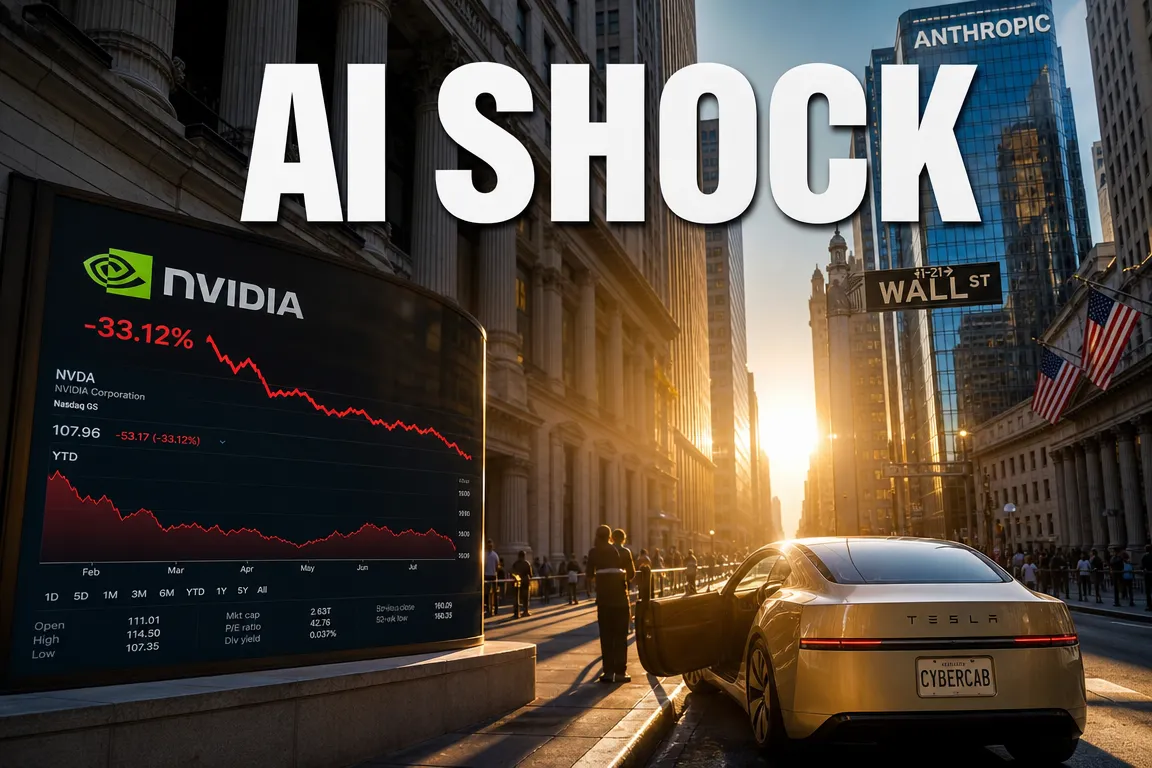
Is a 33% Decline in NVIDIA an Opportunity? Differences from 2018 and Key Risks in an Anthropic IPO
A sharp decline in NVIDIA shares does not necessarily indicate undervaluation, and strong demand for an Anthropic IPO would not guarantee attractive investment returns.
Three factors are central to the assessment.
Investors should assess whether earnings expectations are deteriorating faster than share prices, whether financial conditions are tightening as they did in 2018, and who ultimately funds AI companies’ growth.
Additional considerations include the return required to recover from a 33% decline, the distinction between AI investment growth and shareholder returns, and the offering terms of a potential Anthropic IPO.
1. Interpreting NVIDIA’s 33% Decline: Earnings Expectations Matter More Than the Drawdown
Key assessment: A substantial price decline does not necessarily make a stock inexpensive.
- Drawdown reference: A decline from an all-time high, a recent peak, or the start of the year has different implications.
- Price consistency: Comparisons should use prices adjusted on a consistent basis, including for stock splits.
- Cause of the decline: Distinguish a market-wide correction driven by higher interest rates from deterioration in NVIDIA’s earnings outlook.
- Benchmark comparison: Compare performance with the Nasdaq and semiconductor sector over the same period to assess company-specific risks.
The primary question is not how far NVIDIA trades below its previous high.
It is whether the future earnings implied by the current price are realistic.
A decline from 100 to 67 represents a 33% loss.
A recovery from 67 to 100 requires a gain of approximately 49.3%.
Drawdowns and the returns required to recover are not symmetrical.
Valuation requires a separate assessment of price and earnings.
The following hypothetical example illustrates the principle; it does not represent NVIDIA’s actual financial data.
| Metric | Before the Decline | Earnings Outlook Unchanged | Earnings Outlook Deteriorates |
|---|---|---|---|
| Share price | 100 | 67 | 67 |
| Expected earnings per share | 2 | 2 | 1.2 |
| Forward price-to-earnings ratio | 50x | 33.5x | Approximately 55.8x |
If the share price declines while earnings expectations remain unchanged, valuation pressure eases.
If expected earnings fall more sharply than the share price, the stock can become more expensive relative to earnings despite a 33% decline.
A valuation-based purchase should be supported by future earnings and cash flows, not a previous price peak.
2. A Repeat of the Late-2018 Selloff? Compare Financial Conditions, Not Chart Patterns
Key assessment: Similar price patterns do not establish similar economic conditions.
U.S. equities experienced substantial volatility in the fourth quarter of 2018 amid Federal Reserve rate increases, balance-sheet reduction, U.S.-China trade tensions, and concerns about slowing global growth.
The S&P 500 declined approximately 20% from its September 2018 peak through the December 24 close.
NVIDIA also faced company-specific pressures from weakening cryptocurrency-mining demand and associated inventory exposure.
A comparison with 2018 should therefore focus on the following conditions rather than the timing of the selloff.
| Indicator | Higher-Risk Conditions | Relatively Stable Conditions |
|---|---|---|
| Interest rates and financial conditions | Rising real yields and funding costs | Moderating inflation and easing real-rate pressure |
| Corporate earnings | Falling share prices accompanied by earnings downgrades | Stable earnings expectations despite a price correction |
| Credit markets | Widening corporate credit spreads | Relatively stable corporate funding conditions |
| Industry demand | Rising inventories alongside order cancellations | Resilient end demand and limited inventory pressure |
| Policy environment | Escalating trade disputes and export restrictions | Declining policy uncertainty |
For interest rates, the relevant question is not only whether cuts occur, but why they occur.
Rate cuts supported by moderating inflation and resilient economic activity can ease valuation pressure on growth stocks.
Urgent cuts prompted by recession or credit stress may coincide with declining corporate earnings.
Investment analysis should evaluate interest rates, economic activity, and earnings together.
3. AI Investment Indicators That Define NVIDIA’s Opportunities and Risks
Key assessment: Demand durability, profitability, and cash conversion matter more than the existence of AI demand alone.
① Big Tech capital expenditure: Assess composition and deployment pace, not just total spending.
Higher cloud-provider investment in data centers does not translate entirely into NVIDIA revenue.
Capital expenditure includes buildings, power infrastructure, cooling, and networking equipment, as well as servers.
The use of internally developed AI chips and competing suppliers also matters.
Announced investment plans may differ from actual ordering, installation, and operational timelines.
② Inference: Distinguish usage growth from GPU spending growth.
Inference, which generates outputs from trained models, is an important source of compute demand alongside model training.
AI agents, coding tools, search, and workflow automation could expand inference usage.
However, smaller models, quantization, caching, and inference optimization can reduce the compute required per task.
Aggregate demand depends on whether usage growth outpaces reductions in compute requirements per task.
③ Competitive position: Evaluate customer switching costs alongside chip performance.
NVIDIA’s competitive position extends beyond the performance of individual GPUs.
Its software ecosystem, including CUDA, development tools, networking, and systems integration affects customers’ implementation costs and development timelines.
For certain workloads, proprietary chips or alternative accelerators may be more economical. Overall market growth and NVIDIA’s market share should therefore be assessed separately.
④ Earnings quality: Determine whether revenue growth converts into cash.
- Gross margin: Assess the effects of competition, product transitions, and changes in system configurations.
- Inventory: Distinguish preparation for product launches from accumulation caused by slowing sales.
- Accounts receivable: If receivables grow faster than revenue, examine payment terms and collection periods.
- Cash flow: Verify whether reported earnings translate into operating cash flow.
- Customer concentration: Assess exposure to changes in investment plans among a small number of large customers.
Deterioration in one indicator does not establish a broader problem.
Simultaneous weakness across several indicators, however, may signal a change in business prospects rather than a price correction alone.
4. Anthropic IPO Demand: Listing Prospects and Investment Merit Are Separate Issues
Key assessment: Brand recognition, offering demand, and post-listing returns are distinct considerations.
Anthropic is the AI company behind Claude.
The supplied material does not establish an official listing timetable, offering price range, exchange, or offering size.
Claims of strong prospective IPO demand should therefore be treated as expectations rather than confirmed outcomes.
If a listing proceeds, investors should prioritize official registration filings and offering terms over promotional coverage.
① Valuation: Do not treat the previous funding round as a definitive benchmark.
Private investments may include preferred shares, liquidation preferences, and other rights unavailable to ordinary public shareholders.
A private funding valuation therefore cannot be applied directly as fair value for IPO investors.
② Revenue: Assess recurrence and concentration alongside growth.
Revenue stability and profitability vary across enterprise subscriptions, API usage fees, and cloud distribution channels.
Assess dependence on major customers and retention after discounts or free-usage incentives are reduced.
③ Costs: Evaluate inference expenses alongside research and development.
Unlike traditional software, generative AI services can incur higher inference costs as usage increases.
Model training, research personnel, and next-generation model development add further expenses.
Rapid revenue growth may still require additional financing if cash consumption grows faster.
④ Share supply: Assess price increases driven by a limited public float.
A small tradable share base can amplify price increases when buying demand is concentrated.
Subsequent lockup expirations, employee share sales, and additional equity issuance can increase supply.
These factors do not necessarily cause price declines, but their timing and scale warrant review.
⑤ Dilution: Corporate growth and per-share value growth can diverge.
Substantial stock-based compensation and new share issuance can limit per-share value growth even as total equity value increases.
Where possible, valuation should use a fully diluted share count that accounts for options and convertible securities.
A useful valuation test is whether strong operating results would still leave sufficient return potential at the proposed purchase price.
A strong business can deliver weak investment returns if the entry price incorporates excessive expectations.
5. Beyond the Headlines: AI Industry Growth Does Not Necessarily Translate Into Shareholder Returns
First, investment capital received by AI companies is not equivalent to revenue from end customers.
Within the AI ecosystem, investors provide funding, model developers purchase cloud and compute resources, and infrastructure providers order equipment.
This financing structure is not inherently problematic.
Its sustainability depends on whether external customers receive sufficient economic value from AI services to continue paying for them.
Funding rounds and major contract announcements alone do not validate end demand.
Second, improvements for users can pressure suppliers’ profitability.
Lower AI service prices benefit businesses and consumers.
Intensifying competition among model developers, however, can pressure unit revenue and margins.
Compute efficiency improvements can support adoption while reducing semiconductor spending for certain workloads.
A successful AI industry does not imply rising prices for every AI-related stock.
Third, semiconductor availability alone does not make a data center operational.
Power connections, transformers, cooling, land, and networking infrastructure are also required.
Delayed grid connections can postpone installation and commissioning even when equipment supply is adequate.
AI investment analysis should therefore incorporate power-grid constraints and infrastructure bottlenecks.
Fourth, physical hardware longevity differs from economic competitiveness.
New accelerators that materially improve throughput per unit of power and cost per task can weaken the economics of existing equipment.
Differences between depreciation assumptions and actual replacement cycles can create a gap between accounting earnings and cash requirements.
Equipment suppliers and equipment owners or operators face different risks.
Fifth, a larger number of holdings does not necessarily reduce exposure to common risks.
A portfolio combining NVIDIA, cloud providers, semiconductor ETFs, and AI software companies may appear diversified.
If all depend on expanding AI capital expenditure and elevated growth expectations, they may decline together.
Diversification should be assessed by differences in underlying earnings drivers, not simply the number of holdings.
6. Three Scenarios for Distinguishing Opportunity From Downside Risk
| Scenario | Signals to Monitor | Interpretation |
|---|---|---|
| Expectations reset | Earnings expectations and cash flow remain resilient despite falling share prices; credit markets remain stable | Valuation pressure may ease, but fair value still requires assessment |
| Slower growth | AI spending continues to rise at a slower rate while profitability gradually weakens | Revenue growth alone may not support historically high valuation multiples |
| Investment-cycle deterioration | Customer spending cuts, order delays, earnings downgrades, and tightening credit conditions occur together | Buying solely on a large drawdown may expose investors to further losses and an extended recovery period |
These scenarios provide a framework for updating assessments as new information becomes available; they do not classify current conditions.
A price rebound does not establish a recovery in business prospects, just as a price decline does not establish a loss of competitiveness.
7. Pre-Investment Checklist: Define the Framework Before the Entry Price
- Document the investment thesis.
Specify assumptions for revenue growth, profitability, and cash flow. - Define conditions that would invalidate the thesis.
Identify fundamental changes such as customer investment cuts or structural margin deterioration. - Assess capacity to absorb further losses.
Separate living expenses and near-term funding needs from volatile investments. - Do not overestimate the protection offered by staged purchases.
Phased buying can spread entry-timing risk but does not eliminate the risk of declining business value. - Evaluate returns in Korean won.
For investors based in South Korea, U.S. equity returns reflect both share-price movements and exchange-rate changes. - Reassess an IPO after offering terms become available.
Separate confidence in the company from the attractiveness of its offering price.
Investment assessments should prioritize NVIDIA’s official earnings releases and filings, major customers’ capital expenditure disclosures, and Anthropic’s official announcements and publicly available listing documents.
Unverified video headlines and online expectations may identify topics for investigation, but they cannot substitute for evidence-based conclusions.
< Summary >
- NVIDIA’s 33% decline: The supplied material does not establish the measurement basis. Changes in earnings expectations matter more than the drawdown alone.
- Comparison with 2018: Assess real yields, credit markets, corporate earnings, and inventories rather than chart patterns.
- AI investment: Examine end-customer demand, inference economics, and cash conversion alongside capital expenditure.
- Anthropic IPO: The official listing status requires verification. Offering price, cost structure, dilution, and tradable share supply matter more than demand for the offering.
- Less visible risks: Monitor financing dependence, power constraints, hardware’s economic life, and portfolio concentration in AI-related drivers.
- Conclusion: Evaluate the price paid relative to future earnings and cash flows, rather than previous price peaks or listing expectations.
[Related Articles…]
*Source: [ 소수몽키 ]
– 엔비디아 -33% 폭락, 기회일까 vs 후폭풍올까/2018 연말 급락 데자뷰? 불길한 신호일까/앤트로픽 IPO 대흥행 예정? FOMO 조심할 이유