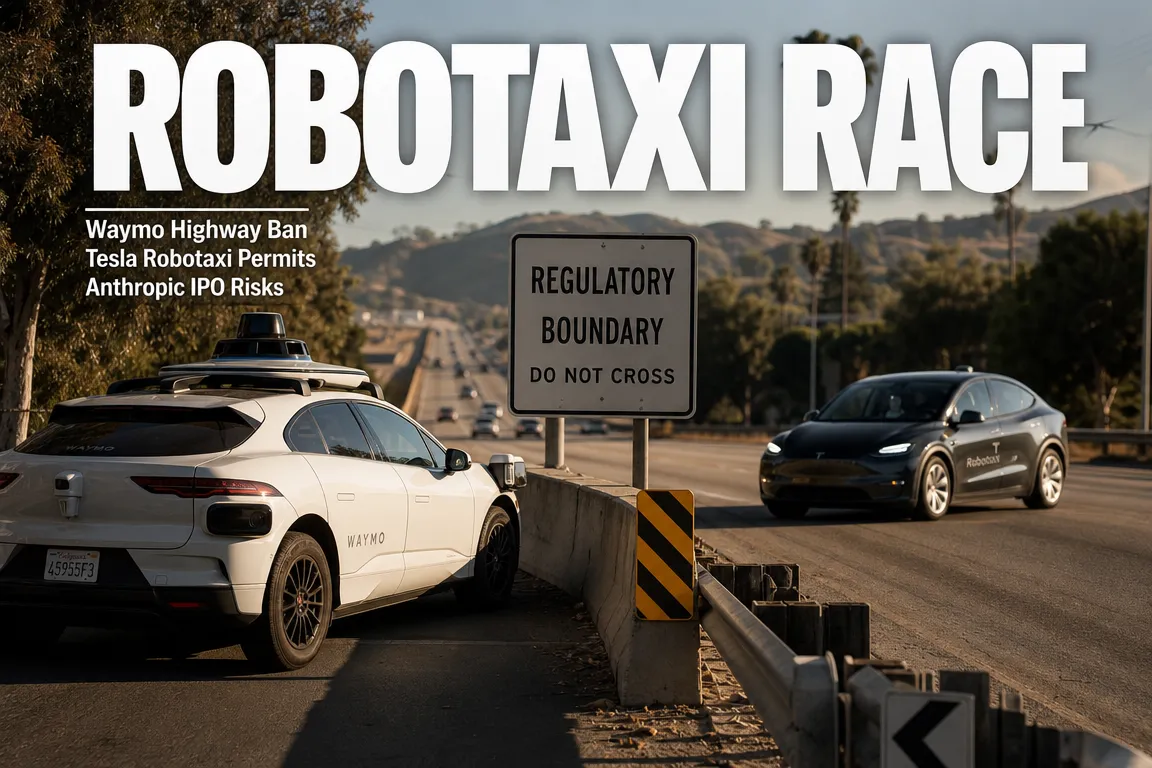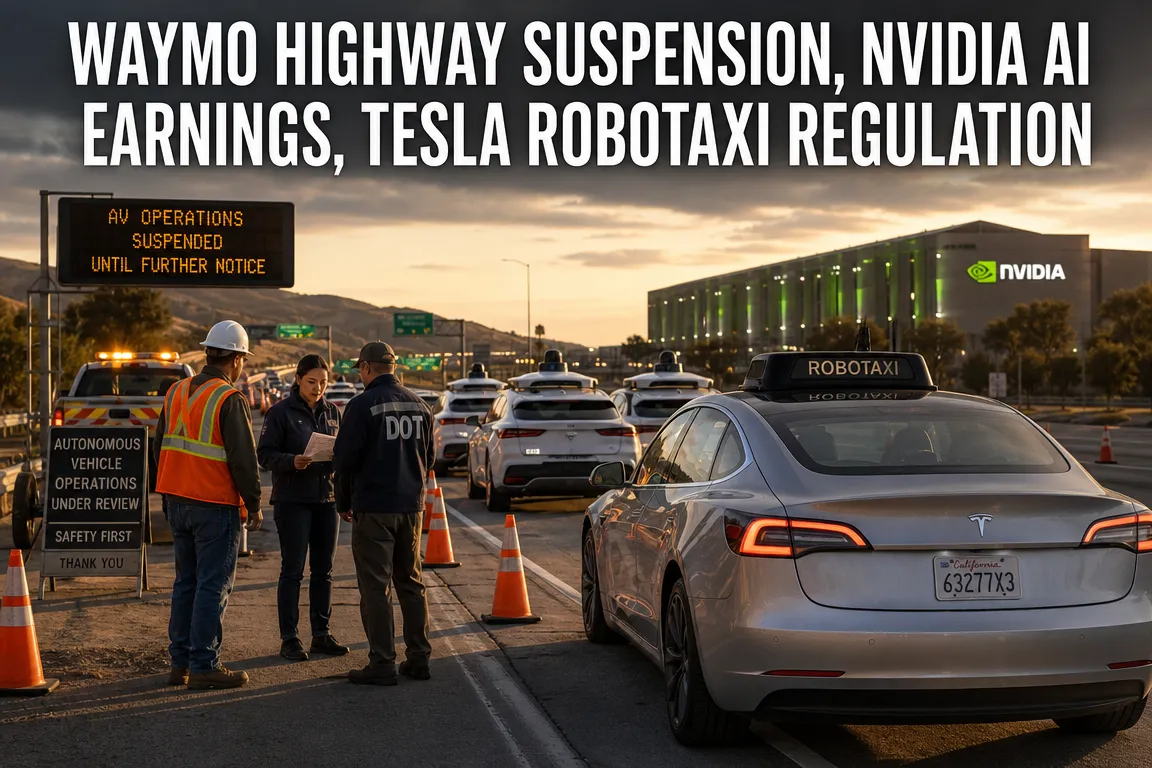
● Waymo Highway Freeze, Tesla Robotaxi Gold Rush
Claims of Waymo Highway Suspension: Implications for Tesla, Robotaxi Regulation, and AI Investment
For Tesla investors, the key issue is not a competitor’s service suspension itself, but how safety is demonstrated after corrective action.
This report examines the regulatory issues described in the source transcript, approval requirements for Tesla’s robotaxi operations, Cybercab charging economics, and opportunities in energy infrastructure.
It also assesses the impact of highway restrictions on robotaxi profitability and the hidden costs of adding privately owned vehicles to a robotaxi network.
1. Fact-Checking: Claims Requiring Verification
The transcript addresses significant autonomous-driving issues, but its statements vary in reliability.
Reported events, numerical accuracy, and investment interpretations must be assessed separately.
| Item | Source Claim | Verification Required |
|---|---|---|
| Waymo highway operations | Highway operations suspended across all service areas following restrictions imposed by the California Department of Motor Vehicles | Existence of an official order, geographic scope, affected vehicles, and whether broader restrictions were voluntary |
| Recurring safety issues | Problems involving construction zones and emergency vehicles recurred after corrective updates | Incident reports, recall documents, deployment of updated software, and causes of recurrence |
| Tesla and other share prices | Company names and prices were transcribed ambiguously | Correct ticker, trading date, closing price, and percentage change |
| NVIDIA earnings | Revenue, previous guidance, and Korean won equivalents were cited | Inconsistencies between dollar amounts and won conversions, and the relevant fiscal quarter |
| NVIDIA leadership | Jensen Huang’s departure and inability to return were mentioned | Official company announcements and regulatory filings |
| Cybercab | Customer deliveries next month and no onboard charger | Production specifications, delivery recipients, charging methods, and regional operating requirements |
| Tesla Powercore | 7.4 MW power equipment and a planned 2027 operational launch | Official specifications, announcement source, and production and delivery schedules |
| Interest rates and oil prices | 95% probability of a December rate increase and a 21% monthly decline in Brent crude | Observation time, futures-market methodology, price reference dates, and original statements |
The cited NVIDIA revenue of $15.8 billion is inconsistent with the stated equivalent of approximately KRW 155 trillion.
Conclusions about earnings strength or a technology-stock recovery based on inconsistent figures would be unreliable.
The $380 figure referenced in the source headline has not been verified as Tesla’s current share price or an investor’s actual purchase price and is not used here as a trading benchmark.
2. Waymo: Recurrence After Corrective Action Is the Central Issue
Source claim: California’s Department of Motor Vehicles restricted Waymo’s driverless highway operations over problems involving construction-zone entry and responses to highway patrol vehicles.
The transcript states that similar incidents had occurred previously and that comparable problems reappeared after software updates.
If official records confirm these claims, the issue extends beyond an isolated autonomous-driving error.
The central question is whether the company’s corrective measures sufficiently reduced the identified risks in actual operations.
- Problem identification: Vehicles behave unexpectedly in construction zones or situations controlled by emergency vehicles.
- Corrective action: The company modifies software and operating policies.
- Validation: Changes are evaluated to determine whether they resolve the original problem without introducing additional risks.
- Recurrence: Similar incidents prompt renewed scrutiny of both the corrective measures and the validation process.
A recurring incident type does not necessarily indicate that the same software defect remains unresolved.
Potential causes include new road conditions, incomplete update deployment, and failures between perception and decision-making.
Investors should therefore examine validation results covering reproduction tests, recurrence-prevention measures, and changes to operating conditions, rather than relying solely on announcements that an update is complete.
The scope of regulatory action also matters.
A California administrative action and service suspensions in other states may represent separate decisions.
Business implications and resumption requirements depend on whether Waymo voluntarily extended restrictions or other regulators imposed separate measures.
3. Does a Waymo Suspension Benefit Tesla? Competition and Authorization Are Separate
Restrictions on a competitor may give Tesla additional time to close the operational gap.
However, a competitor’s withdrawal does not automatically authorize Tesla to enter the affected market.
In California, autonomous-vehicle testing and deployment are regulated separately from passenger transportation services.
Investors should distinguish between relevant approvals from the DMV and the California Public Utilities Commission, which oversees passenger transportation.
- General transportation authorization: May permit ride-hailing services with human drivers.
- Autonomous-vehicle testing permits: Allow technology testing under specified conditions.
- Driverless deployment and passenger-service approvals: Operations carrying passengers without a driver require authorizations appropriate to that service model.
The transcript claims that Tesla lacks authorization to operate paid driverless passenger services in California.
Its current status requires verification against official permit lists. The key principle remains that general transportation authorization is not equivalent to approval for driverless robotaxi service.
A single Waymo incident also does not establish that new industry-wide regulations have been introduced.
Investors should determine whether regulators are enforcing existing standards against a specific operator or imposing additional requirements.
4. Cameras Versus Lidar: This Incident Cannot Establish a Winner
The transcript interprets Waymo’s reported problems as favorable to Tesla’s camera-centered approach.
However, an incident involving one company does not establish that another company’s sensor configuration is safer.
Describing Waymo as relying only on maps and Tesla as responding to real-world conditions is an oversimplification.
Waymo also processes real-time sensor data, while camera-centered systems depend on training data, routing information, and software decision-making.
| Comparison Area | Key Assessment Question |
|---|---|
| Construction-zone recognition | Which signals take priority when existing lane markings conflict with temporary traffic cones? |
| Emergency-vehicle response | Can the system interpret instructions to slow down or stop, rather than merely detect flashing lights? |
| Uncertainty management | Does the vehicle safely slow down, stop, or reroute when conditions are ambiguous? |
| Safety comparison | Are results compared under similar road, weather, speed, and mileage conditions? |
| Operational support | How frequently are remote assistance, on-site intervention, and service interruptions required? |
Highway-driving footage or demonstrations at particular speeds can indicate technical progress.
Such footage alone does not establish competence in construction zones, emergency-vehicle interactions, or adverse weather.
AI investment analysis must distinguish compelling demonstrations from repeatable commercial performance.
5. Highway Restrictions Affect Both Safety and Profitability
The transcript gives limited attention to an important economic consideration.
Highway access can materially affect revenue per vehicle-hour.
More paid trips create revenue opportunities, but profitability also depends on travel time, empty mileage, charging downtime, and operational support costs.
- Longer journey times: Using local roads instead of highways may lengthen certain longer-distance trips.
- Lower trip turnover: Longer journeys can reduce the number of bookings served within a given period.
- Weaker customer appeal: Less competitive arrival times may reduce demand for airport and intercity trips.
- Reduced dispatch efficiency: Empty travel between demand centers may take longer.
- Higher operating requirements: Maintaining the same revenue may require more vehicles and support staff.
The impact may be smaller for services concentrated on short urban trips.
Exposure may be greater where airport and suburban routes account for a substantial share of activity.
Continued operation on local roads therefore does not imply unchanged revenue or profitability.
The time required to resume highway operations is another key variable.
Delays may reflect documentation requirements, administrative review, and phased reopening conditions, not only technical difficulty.
Investors should assess the routes and operating conditions permitted at resumption, as well as the restart date.
6. Privately Owned Teslas in a Robotaxi Network: Operating Structure Matters More Than Fleet Size
The transcript reports that Elon Musk conditionally discussed the possibility of testing privately owned vehicles in Tesla’s robotaxi network in December.
The relevant post and earnings materials require verification. A conditional management statement is not a confirmed launch schedule.
Participation by privately owned vehicles does not, by itself, indicate driverless operation, human-driven service, or a limited trial.
The commercial significance depends on disclosure of the following:
- Eligible vehicles: Which models and hardware configurations can participate?
- Operating conditions: In which locations, at what times, and under what supervision requirements can vehicles operate?
- Liability and insurance: How is accident liability allocated among the manufacturer, operator, and owner?
- Operational responsibilities: Who handles charging, cleaning, maintenance, lost property, and passenger complaints?
- Economic allocation: What remains for owners after platform fees, operating costs, and vehicle depreciation?
Privately owned vehicles can reduce the platform’s vehicle-acquisition requirements, but they do not eliminate system-wide costs.
Some costs and risks may instead be transferred to vehicle owners.
If owner returns are insufficient, a large initial fleet may not translate into sustainable long-term supply.
7. Cybercab Charging: Evaluate the Full System, Not Just the Onboard Charger
The transcript claims that Cybercab lacks an onboard charger and cannot use conventional residential AC charging.
This requires confirmation against production specifications. Until supported charging methods are verified, it would be premature to conclude that only fast charging is available.
In conventional EV AC charging, an onboard charger converts alternating current into the direct current required by the battery.
During DC fast charging, external equipment performs the power conversion.
Wireless charging requires separate transmission, reception, and power-conversion components. Compatibility cannot be determined solely by the presence or absence of a conventional onboard AC charger.
Evaluation criteria also differ between privately owned and commercial vehicles.
- Private ownership: Home-charging availability, installation costs, and travel to nearby charging stations are important.
- Commercial fleets: Empty travel to charging hubs, charging time, peak-power costs, and infrastructure utilization are central considerations.
- Fully driverless operations: Whether charging requires manual connection or can be automated may materially affect operating costs.
Cybercab’s competitiveness cannot be assessed from its purchase price alone.
Total cost of ownership must include charging infrastructure, insurance, maintenance, and downtime.
8. Tesla Energy and Power Equipment: Electricity Supply Is a Constraint on AI Growth
The transcript states that Tesla unveiled power equipment called Powercore, citing a 7.4 MW rating and a planned 2027 operational launch.
The product name, rating, configuration, and production schedule require official verification. The following analysis addresses the industrial implications without confirming the product or its performance.
AI data centers and large EV charging sites both require reliable grid connections and power-conversion infrastructure.
Potential beneficiaries of AI investment therefore extend beyond semiconductors and software.
Transformers, power semiconductors, distribution equipment, and energy storage systems are also linked to expanding power-infrastructure investment.
The solid-state transformer approach described in the transcript uses power electronics to convert and control electricity.
It should not automatically be interpreted as eliminating copper windings entirely; magnetic components and circuit configurations depend on the design.
Dividing 7.4 MW by 500 kW produces 14.8.
This does not establish that approximately 15 chargers can operate simultaneously at a full 500 kW each.
The rating basis, conversion losses, auxiliary loads, and grid-connection capacity must also be considered.
The proposed comparison with Heron Power likewise requires verified product specifications and production plans.
For investors, certification, orders, deliveries, revenue recognition, and maintenance costs matter more than announcements.
Future product plans should not be treated as contributions to current earnings when assessing valuation.
9. Tesla Shares: Assess Robotaxi Developments Alongside Interest-Rate Expectations
Tesla’s share price reflects expectations for robotaxis, robotics, and energy, as well as its automotive results.
Even when business prospects improve, investment outcomes depend on how much of that progress is already reflected in the valuation.
Companies whose valuations depend heavily on future earnings can be sensitive to changes in interest-rate expectations.
All else equal, a higher discount rate reduces the present value of distant cash flows.
Macroeconomic assessment should therefore consider inflation, policy rates, government bond yields, and risk appetite alongside robotaxi commercialization schedules.
Strong NVIDIA earnings may support sentiment toward AI-related investments.
However, robust demand for data-center chips does not establish Tesla’s regulatory readiness or autonomous-driving profitability.
| Scenario | Developments to Monitor |
|---|---|
| Commercial progress | Expansion of paid driverless operations, required approvals, and fewer recurring safety issues |
| Lag between announcements and results | More pilot operations, but limited fleet scale, revenue contribution, and operating profitability |
| Expectations reset | Approval delays, recurring safety problems, higher support costs, and delayed charging-infrastructure deployment |
If $380 is an investor’s purchase price, the priority is to assess whether verified business progress remains consistent with the original investment thesis, rather than focusing on that price alone.
A competitor’s setback does not provide a sufficient basis for quantifying an increase in Tesla’s future cash flows.
Approval scope, operating costs, and the pace of paid-service expansion are more useful indicators than short-term price direction.
10. Additional Issues for Overseas Equity Investors: Tax Petitions and Shareholder Meetings
Corporate Actions and Taxation of Overseas Equities
The transcript discusses a public petition seeking to defer taxation arising from mergers or share exchanges until the shares are sold.
However, overseas mergers and share exchanges do not all receive identical tax treatment.
Treatment depends on transaction structure, cash consideration, and applicable law. Investors should consult brokerage guidance and qualified tax professionals.
Petition participation figures and deadlines require verification on the official petition page. Meeting the signature threshold does not itself result in legislative change.
Tesla Shareholder Meeting and Voting Rights
The meeting date, director nominees, proposals, and voting deadlines cited in the transcript should be checked against Tesla’s investor-relations materials and official proxy statement.
For investors holding shares through Korean brokerages, intermediary submission deadlines may precede the company’s final deadline.
Claims about returns since listing also require verification of reference dates and stock-split adjustments. The term “dividend-reinvested return” does not itself establish that dividends were paid.
11. Official Sources and Investor Checklist
- California DMV: Official Waymo restrictions, permit status, and scope of application
- California CPUC: Autonomous passenger-service approvals for each operator
- National Highway Traffic Safety Administration: Relevant recalls, investigations, and software remedies
- Waymo announcements: Affected service areas, reasons for restrictions, and resumption conditions
- Tesla investor-relations materials: Cybercab specifications, network participation plans, energy products, and shareholder-meeting documents
- NVIDIA official materials: Earnings, guidance, and leadership disclosures
- Federal Reserve and market data: Original policy statements and time-specific interest-rate expectations
The central investment principle is that technical demonstrations must be followed by validated safety and commercially viable operations.
The relevant comparison is which operator can repeatedly demonstrate safety and economic viability across a broader authorized operating scope.
This framework applies to Waymo, Tesla, robotics, and other physical AI businesses.
< Summary >
- Verification first: Many recent events and figures in the transcript require official confirmation.
- Waymo: If the claims are accurate, recurrence after corrective action and safety validation are the central issues.
- Tesla: Competitor restrictions do not automatically translate into approvals, revenue, or profit.
- Technology comparison: Camera and lidar approaches should be assessed using safety data under comparable conditions, not demonstration footage.
- Operating economics: Highway access, empty mileage, charging, insurance, cleaning, and remote support influence robotaxi profitability.
- Investment criteria: Monitor actual approvals, paid operations, costs, and cash flows alongside interest-rate expectations.
[Related Articles…]
*Source: [ 오늘의 테슬라 뉴스 ]
– 고쳤다던 문제가 또 나왔다, 캘리포니아 차량국이 웨이모를 고속도로에서 내려놓은 이유 — $380 테슬라 주주는?
● Nvidia AI Boom, China Crackdown, HBM Shock
NVIDIA Earnings Analysis: Linking AI Capital Expenditure, China Export Controls, and HBM Demand
NVIDIA earnings above market expectations do not eliminate AI investment risks.
This analysis examines the reported financial figures, the limitations of guidance excluding China revenue, major technology companies’ cash flows, and implications for Samsung Electronics and SK hynix HBM demand.
The central question is not simply how many GPUs were sold, but who purchased them, how the purchases were financed, and when the equipment can begin generating revenue.
1. Verification Priorities: Distinguishing Source Claims from Confirmed Facts
This is a conditional analysis based on the supplied source, not a news report independently verified against the latest official earnings release.
Claims concerning management changes, corporate listing schedules, new export controls, and the composition of the U.S. Congress have not been verified against official sources.
Unverified claims concerning individuals’ private lives are excluded and are not used as a basis for investment analysis.
Financial figures should be treated as source-reported figures until verified against NVIDIA investor relations materials and U.S. Securities and Exchange Commission filings.
- Announcement date: The source specifies the 17th, but the year, fiscal year, and quarter require confirmation.
- Reporting period: NVIDIA’s fiscal quarters do not align with calendar quarters. Its fourth quarter should not automatically be interpreted as October through December.
- Inconsistent figures: Adjusted gross margin is reported as both 74.8% and 74.9%, while EPS growth rates also vary.
- Net income verification: Adjusted EPS exceeding expectations does not establish that total GAAP net income also exceeded expectations.
Relevant official sources include NVIDIA Investor Relations, SEC Corporate Filings, and U.S. Bureau of Industry and Security Announcements.
2. Earnings Overview: How Large Is the Beat If the Source Figures Are Accurate?
The following calculations apply a consistent basis to the figures provided in the source.
| Metric | Source-Reported Result | Source-Reported Benchmark | Calculation and Interpretation |
|---|---|---|---|
| Quarterly revenue | $115.8 billion | Market estimate of $109.11 billion | Approximately 6.1% above expectations |
| Adjusted EPS | $2.68 | Market estimate of $2.48 | Approximately 8.1% above expectations |
| Adjusted EPS, year over year | $2.68 | $1.30 in the prior-year quarter | Approximately 106.2% growth |
| Data center revenue | $107.6 billion | Market estimate of $101.9 billion | Approximately 5.6% above expectations |
| Next-quarter revenue guidance | $130.0 billion | Current-quarter revenue of $115.8 billion | Approximately 12.3% sequential growth |
| Next-quarter revenue guidance | $130.0 billion | Source-reported upper-end market estimate of $125.0 billion | 4.0% above that benchmark |
The figures indicate that both revenue and adjusted EPS exceeded expectations.
Consensus estimates vary by provider and collection date. Estimates from different periods should not be combined.
The upper end of market estimates differs from the mean or median and should not be treated as equivalent to consensus.
① Data centers account for approximately 93% of revenue.
Based on the source figures, data center revenue represents approximately 92.9% of total revenue.
This makes NVIDIA a direct beneficiary of AI infrastructure investment, while increasing its exposure to customers’ data center spending schedules.
② EPS reflects both earnings and share-count changes.
Diluted EPS generally divides earnings attributable to common shareholders by the diluted weighted-average share count.
Share repurchases and equity compensation can affect the denominator. Adjusted EPS may exclude certain expenses as a non-GAAP measure.
Assessing earnings quality therefore requires reviewing total net income, operating cash flow, and adjustments.
3. Guidance: Revenue Growth May Coincide with Margin Compression
The source reports a current-quarter adjusted gross margin of 74.9% and next-quarter guidance of 71–72%.
If measured on the same accounting basis, this implies a decline of 2.9–3.9 percentage points.
Revenue and profit growth may therefore diverge.
- Estimated current-quarter gross profit: $115.8 billion × 74.9% = approximately $86.73 billion.
- Estimated next-quarter gross profit: $130.0 billion × 71–72% = approximately $92.3–93.6 billion.
- Growth differential: Revenue would increase approximately 12.3%, while gross profit would rise approximately 6.4–7.9%.
These are simplified calculations based on source figures, not net income forecasts incorporating operating expenses and taxes.
They illustrate that rapid revenue growth can coexist with slower profit growth.
The source-reported company margin guidance of 71–72% partially overlaps with the market estimate range of 70.2–71.5%.
The guidance range is higher overall, but does not exceed every market estimate.
The drivers of margin changes require separate verification.
- Assess initial production costs and yields for next-generation products.
- Review cost increases in HBM, advanced packaging, and networking components.
- Examine changes in the sales mix between standalone GPUs and rack-scale systems.
- Distinguish one-time costs from structural changes in product mix.
4. Excluding China Revenue Does Not Eliminate China-Related Risk
Excluding China revenue from guidance is not equivalent to eliminating China-related risk.
First establish whether the exclusion covers all China revenue, specific data center products, or products requiring export licenses.
Excluding China revenue for specific products may reduce the risk that further direct export declines in those products weaken guidance.
However, indirect risks remain.
- Third-country data center demand: Tighter end-user and end-use screening could delay overseas operators’ orders or equipment imports.
- Customer investment schedules: Regulatory uncertainty could delay data center capital expenditure.
- Product development costs: Country-specific compliance requirements may increase product design and inventory management costs.
- Long-term competition: Chinese customers’ adoption of domestic semiconductor and software ecosystems could reduce long-term market opportunities.
However, remote access to GPUs through overseas cloud services is not necessarily illegal or universally prohibited.
Applicability depends on effective dates, covered technologies, transaction parties, end users, intended uses, and licensing requirements.
New restrictions described in the source should not be presented as established policy before official documentation is verified.
Implications for Korean Companies
Overseas AI data center projects may increasingly require customer due diligence, end-user verification, remote-access controls, and export licensing capabilities alongside equipment supply capacity.
Korean corporate participation alone does not establish exposure to sanctions.
5. AI Capital Expenditure: Funding Sources and Payback Matter More Than Spending Alone
AI capital expenditure is an important variable in the global economic outlook, linking semiconductors with power infrastructure, construction, and financial markets.
Higher capital expenditure by major technology companies does not imply proportionate growth in AI semiconductor demand.
Capital expenditure also includes land, buildings, power infrastructure, networking, and conventional servers.
① Free cash flow requires company-specific analysis.
Free cash flow is generally understood as operating cash flow less capital expenditure.
The source’s claim that all major technology companies have moved into negative free cash flow requires verification using company filings, consistent periods, and comparable definitions.
Finance leases and equipment payment arrangements can cause investment obligations to appear in different financial statement categories.
- Operating cash flow: Assess how much investment funding the core business generates.
- Cash holdings and net debt: Evaluate financial capacity to sustain investment.
- Leases and purchase commitments: Identify future obligations not yet reflected in cash outflows.
- AI service revenue: Determine whether equipment investment generates customer revenue and profit.
② Debt financing can support investment, but funding costs matter.
Companies can continue investing through bond issuance or loans even as cash flow declines.
Higher interest rates and credit spreads raise the required return on investment.
Assessing the sustainability of AI infrastructure spending therefore requires examining paying customer demand, utilization, pricing, and investment payback periods, not spending alone.
6. Circular Financing: Identify Where Risk Remains
Semiconductor companies investing in AI companies that subsequently purchase cloud services or GPUs warrants scrutiny of demand independence.
However, equity investments, loans, payment guarantees, purchase commitments, and cloud contracts are distinct transactions.
Commercial relationships among multiple companies do not, by themselves, establish financial distress or improper revenue recognition.
Four questions are central.
- Is there demand from independent end customers? Determine whether customers outside the investment relationships are paying for AI services.
- Are receivables being collected? Review receivables growth, collection periods, and operating cash flow.
- Are contracts sufficiently binding? Examine cancellation rights, minimum purchase obligations, and payment guarantees in long-term contracts.
- Is collateral value being overstated? New product launches and lower rental rates can reduce the collateral value of GPUs used in financing arrangements.
A finance-oriented management background alone does not justify predicting reductions in particular investments or financial support.
Policy changes should be verified through board decisions, capital allocation policies, investment commitments, and disclosed risk management practices.
7. Competition: Does NVIDIA Uncertainty Translate Directly into Competitor Revenue?
Competitors may gain opportunities, but revenue depends on customers’ ability to switch platforms.
Market share varies depending on whether the market is defined as data center GPUs, all GPUs, or AI accelerators overall.
The source’s market-share figures require confirmation of market scope and measurement date.
① Competing Semiconductor Companies, Including AMD and Intel
Potential gains depend on product performance, supply capacity, software compatibility, customer qualification, and operating costs.
Export restrictions based on technical performance and end users rather than individual companies may impose similar constraints on competitors.
② Custom AI Chips Developed by Major Technology Companies
Custom accelerators may reduce GPU dependence where they improve cost efficiency for specific workloads.
However, training, inference, general-purpose workloads, and model-specific optimization have different requirements, limiting broad substitution assumptions.
③ The CUDA Ecosystem
CUDA’s competitive strength extends beyond software designed for particular GPUs.
Development tools, libraries, accumulated optimization expertise, developer capabilities, and operational reliability increase switching costs.
Competing products must therefore demonstrate compelling total cost of ownership across performance, power, development, and operations, not merely a lower purchase price.
AI model developers are not necessarily direct competitors of GPU manufacturers.
Adopting multiple computing platforms can influence competition, but does not automatically constitute a business that replaces CUDA.
8. Samsung Electronics, SK hynix, and HBM: Does Demand Growth Translate into Equivalent Profit Growth?
The key relationship for Korean semiconductor companies is AI accelerator shipments × HBM content per accelerator × each supplier’s actual supply share.
Selling prices, yields, and manufacturing costs determine the resulting profit.
NVIDIA revenue growth alone is therefore insufficient to estimate profit growth at Samsung Electronics or SK hynix.
- Customer qualification: Verify which products have been adopted for specific platforms.
- Production yields: Higher production volumes may still carry elevated costs if yields remain low.
- Product mix: Next-generation HBM supply share and pricing influence profitability.
- Advanced packaging: Packaging or system assembly bottlenecks can persist even when memory is available.
- Conventional memory: Resource allocation toward HBM expansion can affect conventional DRAM supply.
- Customer diversification: Demand shifting to other GPUs or custom accelerators does not necessarily produce a proportionate decline in HBM demand.
The shipment status of Vera Rubin described in the source also requires verification against official announcements.
Product announcements, sampling, volume production, customer deliveries, and revenue recognition represent different stages.
9. Power and Policy: Securing GPUs Does Not Ensure Immediate Data Center Operations
AI data center bottlenecks may shift from semiconductor supply to grid connections and operating costs.
Delays in power connections, transformers, cooling facilities, or permits can postpone service availability even after GPUs are secured.
Equipment and financing costs may therefore arise before customer revenue begins.
The source’s assumptions about the composition of the U.S. Congress and the prospects for specific electricity cost legislation require separate verification.
Campaign commitments, bill introductions, legislative passage, and implementation should be distinguished.
- Tariff structures: Identify charges imposed on large electricity consumers.
- Grid connections: Assess the feasibility of grid expansion and connection schedules.
- Cost allocation: Review how transmission and distribution expansion costs are divided between operators and other users.
- Location competitiveness: Compare regulation, telecommunications infrastructure, and customer proximity alongside electricity prices.
These factors do not necessarily indicate an end to AI investment. They may instead change its geographic distribution, deployment pace, and profitability.
10. Additional Analysis: Five Issues Often Underemphasized in Earnings Headlines
Revenue- and EPS-focused coverage can underemphasize the following issues, although they are not necessarily absent from other reporting.
First, NVIDIA revenue and customer monetization occur on different timelines.
Strong equipment sales do not establish that purchasers’ AI service businesses are profitable at the same time.
Current equipment demand should be assessed separately from the sustainability of the next investment cycle.
Second, customers’ overall regulatory exposure may matter more than direct China revenue.
The geography of reported sales may differ from the location of end users.
Regulatory effects can appear in customer contracts and investment schedules, not only in export revenue.
Third, lower-cost competing chips may struggle to gain adoption if delivery schedules are unreliable.
Large cloud operators consider development delays and service disruption risks alongside chip prices.
This helps explain NVIDIA’s competitive position and provides a framework for assessing alternative platform adoption.
Fourth, improved inference efficiency can both reduce and expand demand.
Lower computing requirements per task can reduce GPU demand per unit of work.
Conversely, lower prices may stimulate enough AI usage to increase aggregate computing demand.
The balance depends on the relative pace of efficiency gains and usage growth.
Fifth, high supplier margins do not imply high customer investment returns.
Even if NVIDIA sustains high margins, weak customer returns could pressure future pricing negotiations and investment decisions.
The sustainability of the AI industry must be assessed through service revenue paid by end customers, not chip sales alone.
11. Indicators to Monitor: A Checklist for Assessing Upside and Downside Risks
| Indicator | Positive Signals | Warning Signals |
|---|---|---|
| NVIDIA earnings quality | Revenue growth accompanied by stronger cash collection | Receivables and inventory growing faster than revenue |
| AI investment by major technology companies | AI revenue and utilization supporting investment growth | Delayed monetization and rising funding costs |
| New product transitions | Production and delivery schedules met with stable profitability | Yield problems and delayed customer deliveries |
| HBM supply chain | Broader customer qualification and stable production yields | Rising inventories and customer order adjustments |
| Regulation and power | Improved visibility on approvals and power availability | End-user screening and grid connection delays |
Strong earnings and share-price appreciation should also be evaluated separately.
If valuations already reflect substantial growth expectations, an earnings beat alone may not support further gains.
The central conclusion is not that AI investment concerns have been resolved, but that strong equipment demand must translate into sustainable cash flow.
< Summary >
- The source’s claims concerning earnings, management, and regulation require official verification.
- Based on the supplied figures, revenue exceeded expectations by approximately 6.1% and adjusted EPS by approximately 8.1%.
- Next-quarter margin compression could slow profit growth despite higher revenue.
- Excluding China revenue from guidance does not eliminate indirect regulatory risks.
- AI capital expenditure sustainability depends on cash flow, service revenue, utilization, and power availability.
- HBM benefits depend on shipments, memory content, customer qualification, supply share, and production yields.
[Related Articles…]
*Source: [ 경제 읽어주는 남자(김광석TV) ]
– [속보] 엔비디아 매출·순익 예상치 상회. 실적·가이던스 ‘압도적’, AI우려 일축 [즉시분석]