● Nvidia Shock, Huang Exit Rumor, Musk Warning
Jensen Huang Resignation Claims and Musk’s Remarks: Verification Priorities and Key NVIDIA Investment Variables
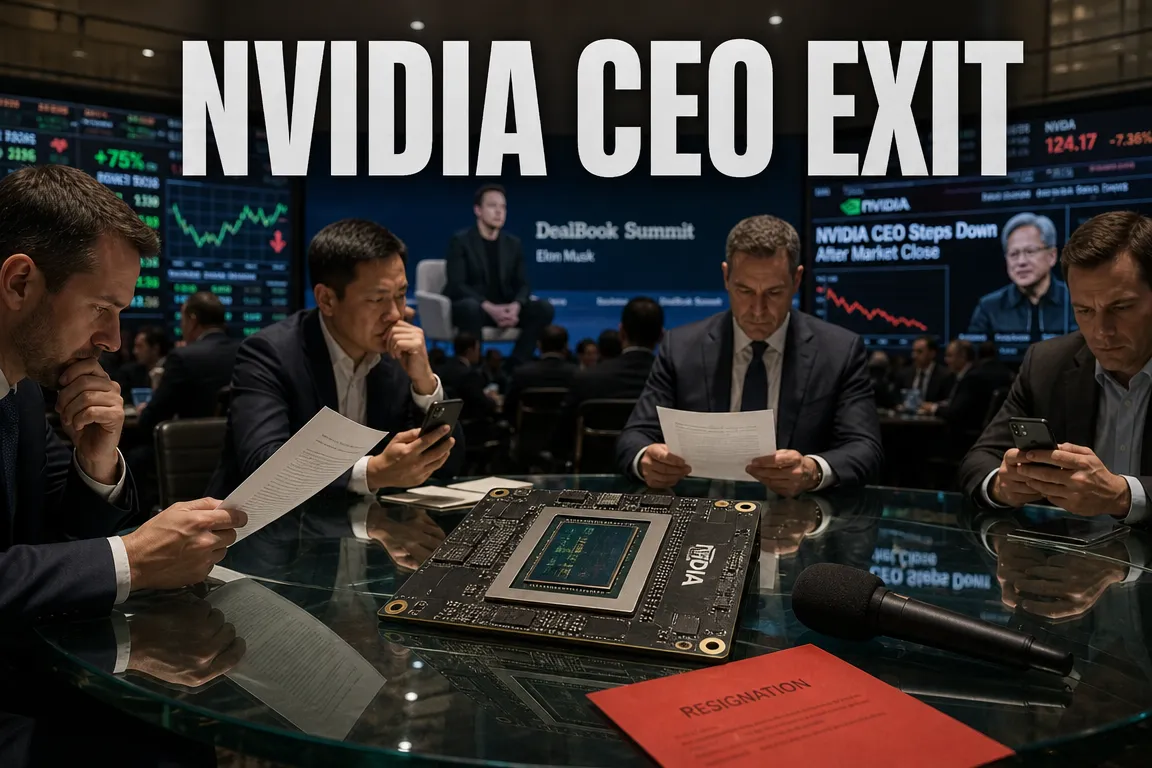
Claims that Jensen Huang has stepped down as NVIDIA CEO should not be treated as fact without official confirmation.
The key issues are the validity of the resignation claim, the context of Elon Musk’s remarks, and the potential implications of leadership changes for NVIDIA’s AI semiconductor competitiveness and valuation.
Conflicting references to resignation and dismissal, incomplete announcement dates, and unverified quotations require scrutiny before investment decisions.
1. Fact Check: Insufficient Evidence to Confirm Jensen Huang’s Resignation
The supplied material contains three claims: Huang resigned as CEO, Colette Kress assumed interim leadership, and Musk publicly commented on the decision.
No official announcement or complete event recording was provided to substantiate these claims. The underlying sources were not independently verified in real time for this report.
These claims should therefore be classified as information requiring verification, not confirmed current news.
| Key Claim | Verification Limitations | Required Sources |
|---|---|---|
| Huang stepped down as CEO on the “12th of this month” | No month, year, or official announcement was provided. | NVIDIA’s official newsroom, investor announcements, and relevant SEC filings |
| Kress assumed interim leadership | Her CFO position does not establish an appointment as interim CEO. | Board statement and interim CEO appointment announcement |
| Musk criticized the decision at a DealBook event | The event year, question, and subject of the remarks remain unverified. | Full New York Times DealBook recording and official transcript |
Verification should begin with NVIDIA’s official newsroom and NVIDIA’s investor relations website.
Material executive changes at U.S.-listed companies can generally also be verified through regulatory filings. Official documents should take precedence over captions in short video clips.
2. The “Michael Jordan in His Prime” Comparison Requires Context
The supplied account claims that Musk compared Huang to Michael Jordan in his prime and characterized a decision to let him leave as unwise.
However, the remarks should not be presented as Musk’s established position until their authenticity, intended subject, and preceding question are verified.
- Event date: An older interview cannot be interpreted as a response to current management developments.
- Subject: The references to individuals and companies must be accurately established.
- Question framing: Distinguish between responses to actual events and hypothetical scenarios.
- Editing: Omitted context can materially alter the meaning of a statement.
Even if verified, praise for an executive is distinct from a forecast of share-price appreciation.
Positive comments about management should not automatically be interpreted as a buy signal.
3. Why CEO Changes Matter to NVIDIA Investors
If a leadership change is confirmed, investors should assess its operational implications.
The central issue is not the prominence of the CEO, but continuity in product strategy, customer relationships, and execution.
① Product Roadmap and Supply Chain
The AI semiconductor business extends beyond chip design.
Revenue realization depends on coordinated supplies of advanced packaging, high-bandwidth memory, server manufacturing capacity, and networking equipment.
A leadership transition should therefore prompt a review of next-generation product schedules and capacity expansion plans.
② Software Ecosystem and Customer Switching Costs
NVIDIA’s competitive position rests on GPU performance and the development tools and software ecosystem built around CUDA.
Switching to alternative processors may require additional spending and time for code optimization, workforce training, and operational validation.
These structural advantages would not disappear immediately following one executive’s departure. Their durability nevertheless depends on organizational execution.
③ Major Customers’ AI Infrastructure Spending
Higher data center spending by major technology companies does not translate entirely into NVIDIA revenue.
Budgets also cover power, cooling, buildings, networks, and internally developed semiconductors.
Investors should assess allocations to GPUs and related systems, delivery timing, and profitability rather than aggregate spending alone.
4. A Critical Distinction: Resignation Is Not Dismissal
The supplied account combines a description of a voluntary departure with an analogy suggesting removal from a team.
These scenarios have different implications for corporate governance and investment risk.
- Planned succession: A designated successor and established handover schedule can reduce management disruption.
- Unexpected voluntary resignation: Uncertainty depends on the reason for departure and the succession structure.
- Board dismissal: Potential strategic disagreements or governance issues require further examination.
- Transfer of the CEO role only: Business implications depend partly on whether the executive retains board or technology strategy responsibilities.
The transition process, retained responsibilities, and allocation of authority may matter more than the departing executive’s identity.
Drawing share-price conclusions before establishing the nature of the event risks undermining the investment thesis.
5. Implications for the Global Economic Outlook and AI Trends
Developments involving NVIDIA can influence expectations for U.S. equities and the broader AI industry.
However, executive developments, semiconductor demand, and the global economic outlook remain distinct variables requiring separate verification.
Interest Rates and Valuation
Companies with substantial expected future growth can be sensitive to interest rates and changes in investor risk appetite.
Additional management uncertainty could compress valuation multiples even if earnings expectations remain unchanged.
AI Investment and Monetization
Assessing the sustainability of AI investment requires evidence that customers are generating revenue or reducing costs through AI services, not merely expanding data center capacity.
If monetization fails to keep pace with investment, capital expenditure growth could slow.
Power Availability and Operational Timing
GPU purchases do not immediately generate AI service revenue.
Delays in power connections, cooling infrastructure, or system installation can postpone operations and investment recovery.
AI investment analysis should consider both order volumes and the timing and financial performance of operational deployments.
6. Pre-Investment Verification Checklist
- Confirm whether official announcements and filings establish a CEO change.
- Distinguish among resignation, dismissal, and reassignment of responsibilities.
- Review the successor’s authority and the handover schedule.
- Check for changes to product launches, revenue forecasts, and profitability guidance.
- Interpret Musk’s remarks only after verifying the event date and full context.
The supplied material does not support a conclusion that Huang has resigned.
With insufficient evidence to verify either the resignation claim or the quoted remarks, unconfirmed information should not form the basis of an investment decision.
< Summary >
- The supplied material does not establish Huang’s resignation, Kress’s interim leadership, or Musk’s reported remarks.
- Announcement dates, official filings, and the complete DealBook recording require verification.
- If a leadership change is confirmed, assess the succession structure and continuity of product and customer strategies.
- NVIDIA’s long-term value should be evaluated alongside AI infrastructure demand, ecosystem competitiveness, and customers’ ability to monetize investment.
[Related Articles…]
*Source: [ 오늘의 테슬라 뉴스 ]
– 젠슨 황 사임, 머스크 반응은 ?
● Debt Shock, AI Bubble, Korea IMF Warning
France’s Economic Strains and Korea’s Risk of Another IMF Crisis: Warning Signals from U.S. Debt, AI Investment, and Semiconductors
Korea’s principal economic vulnerability is not a lack of semiconductor capacity, but the risk that semiconductor earnings fail to support domestic demand while access to dollar funding deteriorates.
France’s fiscal disputes, U.S. Treasury yields, and funding pressures at AI companies share a common issue: who can secure financing and who bears its costs.
Key considerations include Korea’s foreign exchange vulnerabilities, the strategic importance of Samsung Electronics and SK hynix, and whether gold or Bitcoin can substitute for foreign exchange reserves.
1. France’s Economic Strains: Agreement on Burden Sharing Is Harder Than Debt Management
Key assessment: The need to restore fiscal sustainability can conflict with demands to maintain living standards, turning economic pressures into political gridlock.
- Government: Rising debt-service costs and pension, healthcare, and defense spending reduce resources available for other priorities.
- Households: Slower inflation does not reverse previous increases in food, housing, and energy prices.
- Businesses: Weakening demand and higher costs constrain investment and hiring.
- Policymakers: Both tax increases and spending cuts are likely to face opposition.
A critical distinction is necessary.
Disinflation means prices are rising more slowly, not returning to their previous levels.
This helps explain why improving economic indicators may not translate into better household living conditions.
U.S. monetary expansion alone cannot explain social tensions.
Energy shocks, domestic pension and tax policies, housing costs, labor-market structures, and changes in real wages also matter.
Monetary policy in France and Germany is set within the European Central Bank framework; neither country independently controls monetary issuance as the United States does.
2. U.S. Debt and Dollar Dominance: Focus on Funding Costs Rather Than Imminent Collapse
Key assessment: The risks associated with U.S. debt may emerge through persistently high borrowing costs for businesses and households rather than a sudden collapse of the dollar.
U.S. Treasury issuance and Federal Reserve monetary expansion are related but distinct processes.
A fiscal deficit does not necessarily require an equivalent increase in central bank money creation.
Several factors can drive Treasury yields higher.
- Inflation expectations: Investors may anticipate higher future inflation.
- Policy-rate expectations: Yields may reflect expectations that the Federal Reserve will maintain restrictive rates for longer.
- Treasury supply and term premiums: Investors may demand greater compensation for holding long-duration government debt.
- Fiscal credibility: Concerns about medium- and long-term debt management can affect yields.
Accordingly, rising Treasury yields do not, by themselves, indicate the collapse of dollar dominance.
Higher yields can increase the appeal of dollar-denominated assets, while global uncertainty can strengthen demand for dollars.
For Korea, the more relevant transmission mechanism is:
Higher U.S. long-term yields → Higher global funding costs → Weaker corporate investment → Reduced risk appetite → Greater pressure on the won and domestic financial markets
Increased government borrowing can also crowd out private-sector financing.
However, the magnitude depends on economic conditions, capital inflows, and monetary policy.
3. AI Investment Outlook: Technology Adoption and Investment Returns Can Diverge
Key assessment: Rising AI usage does not imply that all AI companies will experience higher share prices or valuations.
AI development requires substantial upfront investment in data centers, semiconductors, electricity, and networks before returns materialize.
Higher interest rates increase the cost of waiting for future earnings.
- Cash-rich large platforms: Cash generated by established businesses provides relatively greater capacity to sustain investment.
- AI companies dependent on external financing: Funding constraints can force retrenchment despite strong technology.
- Highly leveraged infrastructure operators: Interest expenses and capacity utilization are major determinants of profitability.
- Enterprise AI adopters: Continued spending requires demonstrable cost savings or revenue gains.
Corporate bond yields generally comprise a benchmark government bond yield plus a spread reflecting issuer-specific credit risk.
AI companies therefore do not face uniformly high borrowing costs.
A downgrade below investment grade can require some institutions to sell bonds under investment mandates or index eligibility rules.
However, not all pension funds must automatically liquidate every security issued by the affected company.
The following indicators are more informative than announced investment budgets:
- Whether revenue growth translates into cash receipts.
- Whether free cash flow remains available after capital expenditure.
- Whether loan and bond maturities are concentrated within a narrow period.
- Whether data center utilization and power procurement costs align with business plans.
During industry consolidation, the financial capacity to operate until the next funding round can be as important as technological capabilities.
4. France and Germany Face Different Economic Challenges
Key assessment: European economic risks should be assessed by country rather than grouped into a single collapse scenario.
| Economy | Principal Pressures | Indicators to Monitor |
|---|---|---|
| France | Fiscal deficit management and political disputes over spending reform | Sovereign borrowing costs, budget implementation, economic growth |
| Germany | Energy costs, manufacturing competitiveness, changing competition involving China | Industrial production, manufacturing orders, business investment, industrial energy prices |
| Europe-wide | Population aging, security spending, productivity improvement | Real wages, private investment, fiscal capacity |
German manufacturing has faced multiple pressures, including reduced Russian energy supplies, energy-price shocks, and stronger Chinese competition.
Attributing these challenges solely to a single pipeline incident overlooks broader supply reductions and policy changes.
France benefits from a substantial existing nuclear generation base, but nuclear capacity does not resolve fiscal imbalances.
Claims that German automakers do not produce electric vehicles or that Europe’s industrial base has disappeared are inaccurate.
Declining industrial competitiveness is distinct from the disappearance of an industry.
5. Korea’s Economic Outlook: Semiconductors Provide a Buffer, Not a Comprehensive Solution
Key assessment: Samsung Electronics and SK hynix strengthen Korea’s position in global supply chains, but robust exports do not immediately raise incomes across all households.
AI chips and high-performance memory are important components of global data center investment.
Competitiveness in these areas supports export receipts, domestic investment, and supply-chain bargaining power.
Broader economic spillovers require separate assessment.
- Employment: Output growth in advanced manufacturing may not generate proportional employment gains.
- Investment: Significant spending on overseas factories and imported equipment can limit domestic spillovers.
- Income distribution: The extent to which large-company profits translate into supplier pricing and employee wages matters.
- Consumption: Households may use additional income to repay debt, slowing the recovery in consumption.
Semiconductor benefits are not limited to employees of the leading manufacturers.
Indirect gains extend to suppliers, tax revenues, pension funds, shareholders, and local service businesses.
The issue is whether the speed and breadth of these spillovers are sufficient.
Semiconductors, automobiles, and defense equipment are strategic industrial assets, not legal currency or foreign exchange reserves.
Servicing dollar liabilities during a crisis depends less on the products themselves than on when sales proceeds arrive and in which currency.
6. How Should the Risk of Another IMF Crisis Be Assessed?
Key assessment: A foreign exchange crisis arises when required foreign currency cannot be secured on time, not simply because growth weakens or public debt increases.
The 1997 crisis reflected excessive reliance on short-term external debt, maturity mismatches at financial institutions, corporate distress, weak financial supervision, and foreign creditors’ refusal to roll over loans.
It cannot be explained solely by U.S. monetary policy or the failure of a single company.
| Indicator | Significance |
|---|---|
| Short-term external debt relative to foreign exchange reserves | Indicates the capacity to meet near-term foreign-currency obligations. |
| Banks’ foreign-currency liquidity and refinancing conditions | Measures resilience if existing dollar borrowing cannot be rolled over. |
| Current account balance and export receipts | Shows the underlying capacity to generate recurring foreign-currency inflows. |
| Liquidity and availability of foreign exchange reserves | Determines whether reserves can actually be deployed when needed, beyond their headline value. |
| Exchange rates, foreign-currency funding costs, and CDS premiums | Provides complementary market assessments of currency and credit risk. |
A rise in the won-dollar exchange rate alone does not establish that a foreign exchange crisis is underway.
A more concerning combination is sharp currency depreciation, restricted foreign-currency borrowing, bank refinancing difficulties, and deteriorating foreign-currency liquidity.
Conversely, export growth does not eliminate risk if financial institutions have vulnerable foreign-currency maturity profiles.
Assessing the current level of risk requires up-to-date indicators.
The information presented does not establish that another IMF crisis is inevitable for Korea.
7. Gold and Bitcoin: National Reserve Management and Personal Investment Serve Different Objectives
Key assessment: Foreign exchange reserve management prioritizes safety, liquidity, and crisis-response capacity over high returns.
- Gold: Offers diversification without reliance on an issuer’s creditworthiness, but its price fluctuates and it generates no interest income.
- Dollar cash and liquid bonds: Can be readily used to service dollar-denominated liabilities and settle international payments.
- Bitcoin: Carries substantial price volatility and custody and operational risks; its suitability as a foreign exchange crisis buffer requires separate evaluation.
- Semiconductor inventories: Are valuable industrial assets but cannot replace foreign exchange reserves because of price volatility and technological obsolescence.
A country holding gold or Bitcoin generally needs to sell or pledge those assets to obtain dollars for dollar-denominated debt payments.
Owning substantial assets is not equivalent to having dollars available for settlement on the day of a crisis.
There is insufficient evidence to treat predictions of mandatory U.S. international settlement in gold, Bitcoin, or semiconductors as established policy.
Korea’s failure to hold a specified quantity of gold or Bitcoin does not make a foreign exchange crisis inevitable.
Individual gold investors should distinguish portfolio diversification objectives from expectations of price appreciation.
Bitcoin should not be assumed to be a safe-haven asset that necessarily appreciates during a crisis.
8. An Overlooked Risk: Growth Transmission Can Weaken Before a Financial Crisis Emerges
First, real household disposable income affects social stability more directly than headline economic growth.
Even when exports and corporate profits increase, households may experience weaker conditions if income remaining after taxes, interest, and housing costs declines.
Korea’s outlook should therefore be assessed using real wages, household interest burdens, and self-employed business revenues alongside exports.
Second, semiconductor exports provide foreign-currency inflows while creating sector concentration risk.
A larger-than-expected slowdown in global AI investment could simultaneously affect exports, capital expenditure, tax revenues, and equities.
Maintaining competitiveness should be accompanied by diversification across products, customers, and markets.
Third, AI bottlenecks can arise from power infrastructure and financing structures, not only model performance.
Even with sufficient demand, delayed grid connections or higher interest costs can postpone data center monetization.
AI investment analysis should cover power availability, utilization, and contractual structures alongside semiconductor orders.
Fourth, fiscal expansion does not invariably increase inequality, and austerity does not invariably benefit future generations.
Education, healthcare, and support for vulnerable households can reduce opportunity gaps, while inefficient subsidies can increase fiscal burdens without commensurate benefits.
Sharp reductions in productive investment during a downturn can weaken long-term growth capacity.
The key questions are not only how much is spent, but also where funds are allocated, how spending is financed, and what outcomes it delivers.
Fifth, Korea’s supply-chain bargaining power derives from difficult-to-replace technology rather than a confrontational stance.
Sustained bargaining power requires core research and development, production capacity, skilled labor, and a strong domestic supplier ecosystem.
Effective crisis management requires coordinated attention to industrial competitiveness, foreign-currency liquidity, and the distribution of growth benefits.
< Summary >
- France’s fiscal disputes and Germany’s manufacturing pressures require distinct assessments of causes and policy responses.
- U.S. debt risks are transmitted primarily through higher interest rates and funding costs rather than an immediate collapse of the dollar.
- Rising AI demand does not ensure profitability across all companies; cash flow and debt maturities remain critical.
- Korea’s semiconductor industry is a major strength, but domestic spillovers and sector concentration risk require scrutiny.
- The risk of another IMF crisis should be assessed through short-term external debt, foreign exchange reserves, and banks’ foreign-currency liquidity, not exchange rates alone.
- Gold and Bitcoin holdings alone cannot prevent a foreign exchange crisis; timely access to the required settlement currency is essential.
[Related Articles…]
*Source: [ 경제 읽어주는 남자(김광석TV) ]
– 프랑스 사태는 시작일 뿐이다…한국도 ‘제2의 IMF’ 피할 수 없나 | 경읽남과 토론합시다 | 김창익 작가 [3편]