● Jensen Huang Comeback Drama Sends Nasdaq Into Turmoil
Jensen Huang Return Possibility and the Nasdaq Rebound Scenario: The Real Reason the Nvidia Incident Is Shaking U.S. Stocks
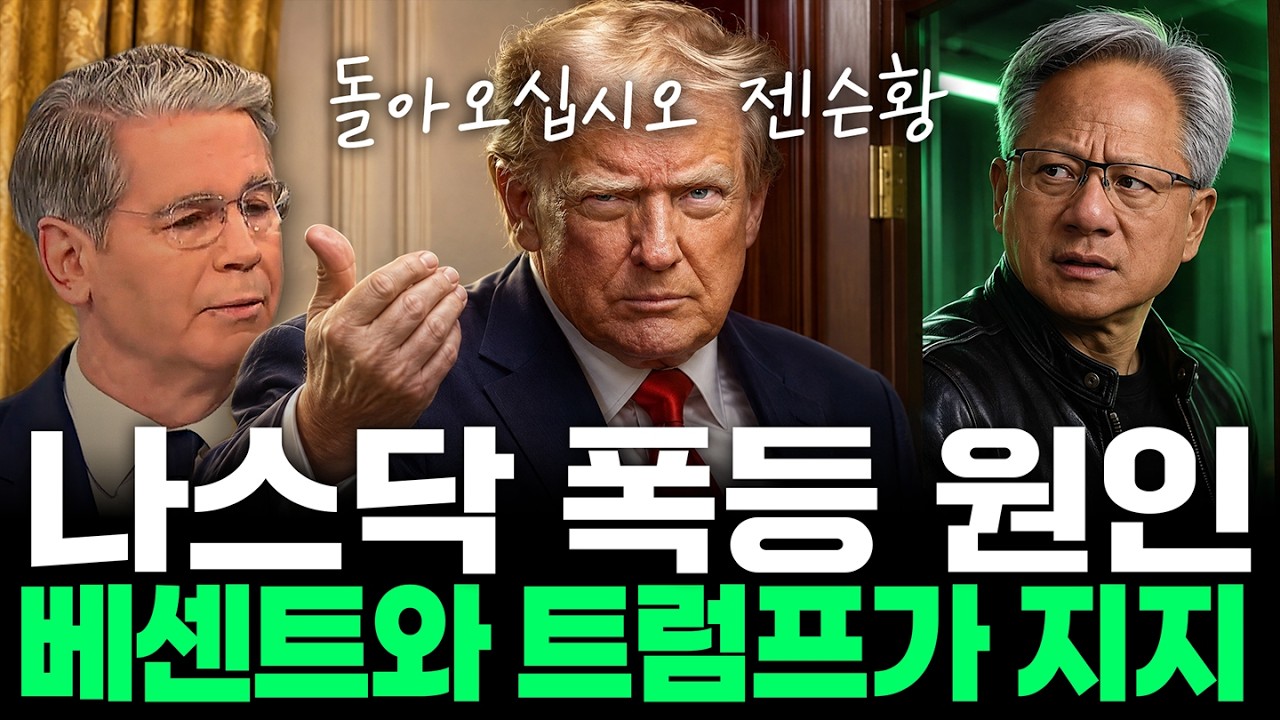
The core point of this issue is not simply whether Jensen Huang will return.
It is an event that connects Nvidia’s sharp stock decline, the Nasdaq correction, pressure from the U.S. government, SEC accounting investigations, and AI semiconductor investment sentiment all at once.
What the market should especially focus on is “who will take responsibility.”
If responsibility is concentrated on Jensen Huang personally, Nvidia’s leadership vacuum could last longer; on the other hand, if it is resolved as a violation of regulations by a lower-level unit, a basis for his return emerges.
Right now, U.S. stocks are moving more sensitively to political signals and regulatory risks than to earnings.
1. Starting Point of the Incident: Jensen Huang’s Resignation and Nvidia’s Leadership Vacuum
Based on the provided information, Jensen Huang stepped down from his positions as Nvidia CEO and board member on November 12.
The surface reason was a personal scandal, but the bigger market reaction came from national security suspicions related to the other party.
The person in question was described as a former executive of Singaporean company Mega Speed, which is known as an Nvidia customer.
U.S. authorities suspect that high-performance AI semiconductors may have entered China through this company.
- Jensen Huang is described as having stepped down as CEO and from the board.
- CFO Colette Kress is summarized as serving as interim CEO.
- Harvey Jones is said to have stepped forward as board chair.
- The core issue is Nvidia’s customer verification system and compliance with export regulations.
In other words, this is not just an internal corporate issue, but a matter linked to U.S.-China technology controls, the AI semiconductor supply chain, and national security concerns.
2. Why Treasury Secretary Bessent’s Change in Tone Matters
The most interesting part is the change in stance by U.S. Treasury Secretary Bessent.
Initially, he put strong pressure on Nvidia.
He even said there was a culture inside Nvidia of disregarding regulations and implied that a new CEO should be found from outside the company.
This statement was taken as a direct attack aimed at Jensen Huang, increasing downward pressure on Nvidia’s stock.
But a few days later, the 분위기가 changed.
As former President Trump sent a message that Jensen Huang should be given another chance, Bessent also began shifting the direction of responsibility.
He now says claims that Jensen Huang knowingly acted with intent lack solid basis.
He also referred to the party that violated the rules as a “malicious actor” within the company’s lower-level organization.
This change is extremely important from the market’s perspective.
That is because it can be interpreted as the U.S. government moving in a direction that creates a basis for Jensen Huang’s return.
3. The Real Cause of Nvidia’s Sharp Stock Drop: Uncertainty, Not Earnings
Nvidia’s earnings themselves were very strong.
Based on the provided information, third-quarter revenue increased 103% year over year.
Revenue is said to have reached $115.8 billion, beating the expected $108.7 billion.
This means AI infrastructure investment and data center demand remain strong.
However, the stock moved in the opposite direction of the earnings.
With news of the SEC accounting investigation, Jensen Huang’s absence, and pressure from the U.S. government all hitting at once, Nvidia’s stock is summarized as having dropped 14% in a single day.
The Nasdaq also fell more than 5%, with analysis saying it gave back most of this year’s gains.
- Earnings are strong, but leadership risk has increased.
- The SEC investigation cooled investor sentiment.
- The change in messaging from the U.S. government is increasing stock volatility.
- Nvidia’s stock is now more sensitive to political statements than to earnings.
At present, Nvidia’s stock cannot be explained by corporate fundamentals alone.
AI semiconductor demand is still alive, but regulatory and management-control risks are suppressing valuation.
4. Why the Board Is Being Cautious About Jensen Huang’s Return
The market is hoping for the possibility of Jensen Huang’s return, but the board is still summarized as being opposed.
Chairman Harvey Jones is said to have unanimously accepted the resignation and stated that there were no return plans.
It is also said that an outside search firm was hired to look for a successor CEO.
From the board’s perspective, Jensen Huang’s return could be positive for the stock in the short term.
But considering regulators, politicians, and the possibility of shareholder lawsuits, it is difficult to decide on a return hastily.
- If a return is allowed, the board’s responsibility could become a bigger issue.
- Until the SEC investigation results are out, the board is likely to act defensively.
- Even if the U.S. government creates a basis for his return, corporate governance procedures will proceed separately.
- In the end, the board, the SEC, and Treasury reports are the key variables.
In other words, Jensen Huang’s return is not a matter of “if we want it, it happens immediately.”
It becomes possible only when political support, easing of regulatory risks, and a basis from the board all align at the same time.
5. The Most Important Point Others Overlook: Reassigning Responsibility
The most important point in this case is not Jensen Huang’s moral controversy itself.
The core point is where the responsibility is being shifted.
The initial frame was “Jensen Huang must take responsibility.”
But the recent frame is changing to “a malicious actor in the company’s lower-level organization may have violated the rules.”
This difference is enormous.
- If the blame on Jensen Huang is maintained, the possibility of his return is low.
- If the narrative shifts to responsibility at the lower level, a basis for his return is created.
- What names appear in the accident report submitted to the Treasury is crucial.
- Separate from the SEC investigation, the executive branch’s political judgment can change the market direction.
Ultimately, Nvidia’s short-term stock direction is likely to move based on the wording of the report, designation of responsibility, and government statements rather than earnings announcements.
That is the most important hidden variable in the market right now.
6. Nasdaq Rebound Potential: How the Market Moved After the 5% Drop
The trend after the Nasdaq’s drop of more than 5% in a single day is also worth attention.
According to the provided statistics, since 1971 there have been 49 days when the Nasdaq fell more than 5% in one day.
The probability of a rise one week later was about 55%, meaning the short-term rebound probability is just over half.
But the story changes when looking one year ahead.
The 20 cases from 2000 to 2002 during the dot-com bubble mostly led to further declines.
By contrast, the other 28 cases rose after one year, with an average gain of 41%.
- If this correction is a dot-com-style collapse, further downside is likely.
- On the other hand, if it is an event-driven drop while earnings remain intact, it could become a medium- to long-term buying opportunity.
- For now, Nvidia’s earnings remain strong and the AI investment cycle is still intact.
- So the market seems to view this decline more as a reassessment of risk than a structural collapse.
In U.S. stocks, a 20% Nasdaq correction does not happen often.
It appeared during major fear periods such as the 2018 trade war, the 2020 pandemic, and the 2022 tightening cycle.
Each time, investors who bought amid fear later experienced a strong recovery market.
7. Has the AI Investment Cycle Peaked, or Was It Only Temporarily Shaken?
The biggest question right now is whether the AI investment cycle has peaked.
The market views Nvidia as a symbol of the AI bubble.
So if something goes wrong with Nvidia, the entire AI-related stock group immediately wobbles.
But based on the provided information, the actual data and earnings are still strong.
Investment in AI infrastructure by cloud companies, data center expansion, and demand for high-performance GPUs are still interpreted as solid trends.
The issue is not demand, but valuation and regulatory risk.
- AI semiconductor demand is still strong.
- Nvidia’s earnings are summarized as beating market expectations.
- However, because the stock had already risen so much, it reacted sensitively to bad news.
- With rate expectations and government regulation added in, volatility across growth stocks increased.
Therefore, the current situation is less about a collapse in AI industry demand and more like an event where leadership risk at the flagship AI company spread across the market.
8. Three Variables the Market Needs to Watch Going Forward
First, the Nvidia incident report submitted to the Treasury Department.
Whether Jensen Huang’s direct responsibility is specified in the report, or whether it is resolved as a violation of rules by a lower-level unit, is important.
Second, the direction of the SEC accounting investigation.
Whether it remains a simple confirmation or becomes a full-scale investigation into accounting treatment and revenue recognition could greatly change the stock impact.
Third, any change in the board’s stance.
Even if the U.S. government and shareholders want Jensen Huang to return, his return could be delayed if the board continues to oppose it.
- Government statements are a short-term rebound catalyst.
- The SEC investigation is a medium-term risk.
- The board’s decision is the final gate that determines whether he returns.
- Nvidia’s stock and the Nasdaq trend are likely to be tied to these three variables.
9. Market Reactions by Scenario from an Investor’s Perspective
Scenario 1: Jensen Huang’s return becomes official
Nvidia’s stock is likely to attempt a strong short-term rebound.
AI-related stocks and Nasdaq futures could also rebound together.
However, because SEC investigation risk remains, the size of the rise may depend on how intense the investigation is.
Scenario 2: The board continues to refuse his return
Concerns about the leadership vacuum could continue, increasing stock volatility.
Even if Nvidia’s technology and earnings are maintained, the market may lower the premium valuation.
Scenario 3: The SEC investigation expands
This is the most burdensome scenario.
If the accounting issue becomes a full-blown problem, investor sentiment could weaken regardless of whether Jensen Huang returns.
In that case, a Nasdaq rebound could also be limited.
Scenario 4: The issue is resolved as a lower-level organizational responsibility
This is the most favorable conclusion for the market.
A basis for Jensen Huang’s return emerges, and Nvidia’s stock could quickly begin to restore confidence.
10. Conclusion: Right Now, It Is the Stage Where “Politics, Regulation, and Leadership” Move the Stock More Than Earnings
Nvidia remains a core company in the AI semiconductor market.
Its earnings are strong, and AI infrastructure demand still cannot be said to have weakened.
Even so, the reason the stock plunged is not that the company’s profit engine weakened, but that uncertainty suddenly increased.
The market is currently reacting sensitively to the possibility of Jensen Huang’s return.
The fact that Trump and Bessent have begun moving in the same direction is clearly a rebound catalyst.
But two gates remain: the board and the SEC.
If Nvidia risk eases at a time when the Nasdaq has already corrected sharply from its highs, a rebound centered on technology stocks could emerge.
Conversely, if regulatory risks expand, the revaluation of AI-related stocks could take longer.
Right now, instead of being swept up by fear, this is the stage to calmly confirm where responsibility is being assigned and what the U.S. government says next.
In particular, Nvidia’s stock, the Nasdaq, AI semiconductors, U.S. stocks, and rate outlook are all likely to remain strongly interconnected going forward.
< Summary >
As the possibility of Jensen Huang’s return grows, expectations for a rebound in Nvidia and the Nasdaq are coming back.
The core point is that the narrative of Jensen Huang’s personal responsibility is shifting toward responsibility at the lower-level organization.
Nvidia’s earnings are strong, but the SEC investigation and board opposition remain risks.
The Nasdaq has corrected sharply, and it is still too early to say the AI investment cycle itself has peaked.
Going forward, the Treasury report, SEC investigation intensity, and the board’s stance are likely to determine market direction.
[Related Articles…]
*Source: [ 월텍남 – 월스트리트 테크남 ]
– “젠슨황 복귀”