● Nasdaq Shock Fuels AI Stock Bargain Hopes as Rates May Ease
Will Technology Stocks, Which Returned From Hell, and Nasdaq and Semiconductor Stocks Send a Real Bottom Signal?
The core point of this market is not simply that “technology stocks have become cheap.”
You need to connect in one view the Nasdaq’s sharp intraday plunge and strong rebound, the collapse in semiconductor valuations, the structure in which AI data center investment is propping up U.S. GDP, and the impact that falling oil prices may have on the future interest-rate outlook.
In particular, the market is now in a very unusual phase where fear has reached an extreme while AI infrastructure demand remains strong.
On the surface it looks like a correction in technology stocks, but underneath it may be an important inflection point that will determine the next direction of the U.S. stock market.
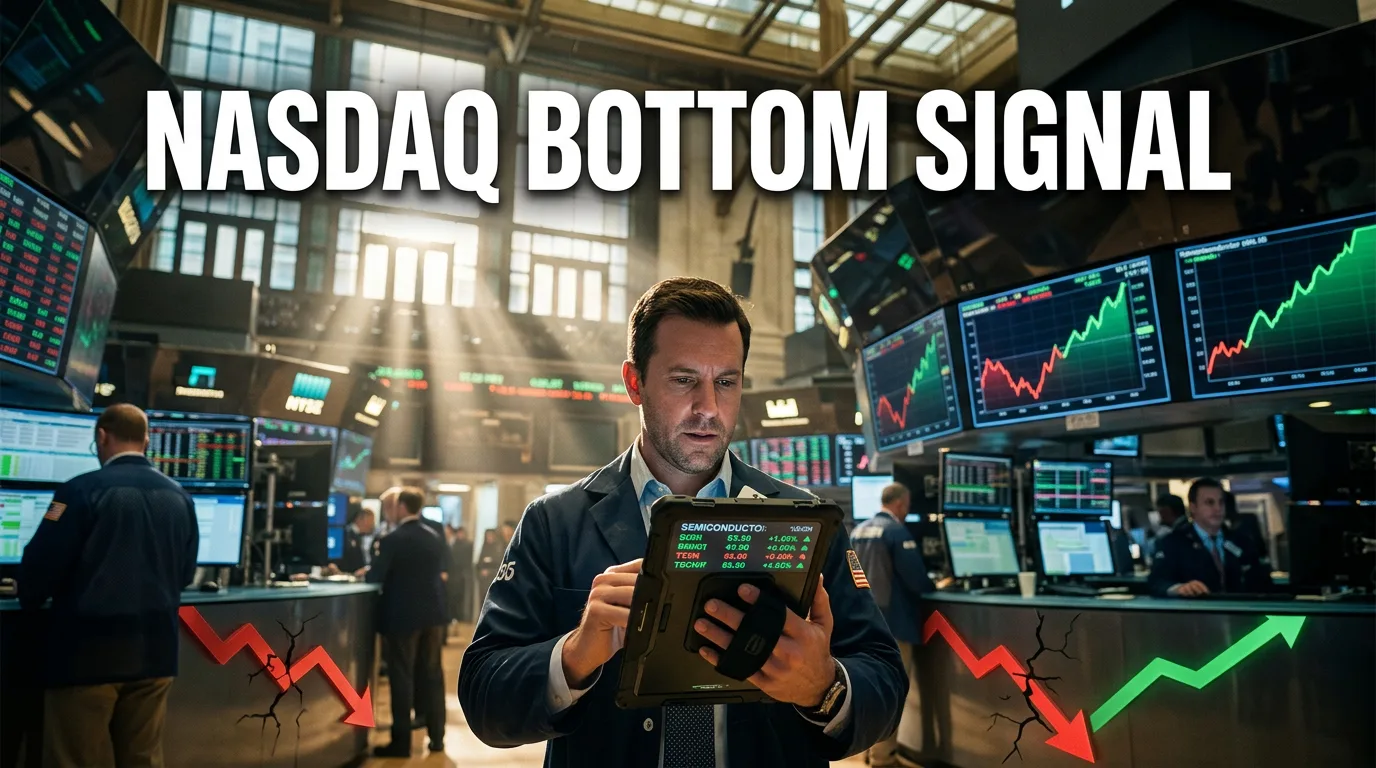
1. Why is the rebound after the Nasdaq plunge being interpreted as a bottom signal?
The Nasdaq at one point fell as much as about -4.5% intraday, but later rebounded strongly and significantly narrowed its losses.
This kind of move can be seen not as a simple technical bounce, but as a moment when the market confirmed buying interest near the bottom.
- Recovery after an intraday plunge
What matters is that buying came in when fear was at its peak.
In particular, if dip buying was strong even on a day when technology stocks were collapsing, you can consider the possibility of a short-term bottom forming.
- Possible double bottom
The current index range is being viewed as a position similar to past lows.
If it rebounds again from here, a double bottom pattern could form on the chart.
- No one knows the perfect bottom
That said, you cannot definitively say this is the exact lowest point.
There is still room for an additional 5% to 6% decline.
So rather than going all in at once, a staged buying strategy is more realistic.
In short, the current range is less “a certain bottom” and more “a bottom zone where the risk-reward profile has improved.”
2. Semiconductor stock valuations: numerically, already in an extreme undervaluation zone
The sector hit hardest in this correction is semiconductor stocks.
But from a valuation standpoint alone, the market has already priced in a great deal of bad news.
- Low forward P/E ratios for memory semiconductor companies
Sandisk’s forward P/E was mentioned at around 1.87x.
Micron was also valued at around 2.68x.
SK Hynix and Samsung Electronics were likewise cited in the high-2x range.
At this level, it is not just “cheap”; it suggests the market has almost fully priced in a peak-out in the memory cycle.
- The meaning of being near 1x P/B
For memory semiconductor companies, the P/B ratio, which measures stock price relative to book value, is also important.
A P/B near 1x means the market has discounted the company to a level where it barely acknowledges future growth potential.
- AI semiconductor companies have also seen valuation compression
NVIDIA’s forward P/E was mentioned at around 8.5x.
Broadcom, Lam Research, Marvell, and others have also fallen to much lower valuations than before.
It is not common for the core companies in the AI trend to be discounted this heavily.
What the market is worried about is that EPS, or earnings per share, forecasts for next year and beyond may weaken.
However, given current AI data center demand and companies’ capital spending trends, there is still not enough evidence to conclude that earnings in 2027 and 2028 will actually fall sharply.
3. Has AI demand weakened? The key is not GPU prices, but useful life and infrastructure demand
Recently, some in the market have interpreted falling GPU rental prices as a sign of weakening AI demand.
But this needs a more multidimensional view.
- Falling H100 prices are hard to view as a sign of demand collapse
There are claims that the future rental price of H100 GPUs will be lower than today’s price.
But the H100 is already a product that has been on the market for quite some time.
By 2028, it will essentially be an old-generation GPU asset.
Even so, if a certain level of rental pricing is maintained, it could actually indicate that AI infrastructure demand remains quite strong.
- The increase in Blackwell supply could be temporary
There are also stories that Blackwell chip rental prices have declined somewhat.
This may reflect a short-term increase in supply as demand routed through China was blocked.
But considering AI infrastructure demand from the U.S., Korea, global big tech, and government agencies, this supply could be absorbed quickly.
- Short-term adjustments in DRAM and HBM prices are natural
Short-term fluctuations in spot prices for DRAM or HBM are common in the industry cycle.
What matters is not day-to-day price changes, but whether the overall trend is still upward.
Ultimately, when assessing whether AI demand is weakening, you should not look at just one short-term price data point.
You need to look at data center investment, GPU utilization, cloud companies’ CapEx, and comments from corporate CEOs about demand.
4. U.S. GDP at 4.3%: on the surface strong, but underneath highly dependent on AI investment
One of the most important macro indicators this time is U.S. third-quarter GDP.
The fact that growth came in at 4.3%, above the initial estimate, means the U.S. economy is still strong.
But even more important is the composition of that GDP growth.
- Private investment made up most of the growth rate
Of the 4.3% GDP growth rate, private investment was said to have contributed about 3.7%.
The core of that private investment is AI data centers, power infrastructure, and semiconductor capital spending.
- AI investment is propping up the U.S. economy
This means U.S. economic growth is not being sustained by consumption alone, but is heavily dependent on AI infrastructure investment.
On the positive side, the AI investment boom is lifting the U.S. economy.
On the other hand, if AI investment slows, GDP growth could also weaken.
- Why it is hard to stop AI investment from a policy perspective
From the U.S. perspective, it is difficult to suddenly reduce AI investment.
That is because if AI infrastructure investment stops, growth could immediately slow.
This structure is effectively a sign that AI investment has become an industry that is “too large to stop.”
This is the core point that many investors easily miss.
AI is no longer just a thematic stock story; it has now become a macro variable that directly affects U.S. economic growth and the interest-rate outlook.
5. Inflation and interest-rate outlook: short-term pressure, but the mood could change early next year
October core PCE inflation was mentioned at 3.3% annualized.
That was slightly above the market’s expectation of 3.2%.
The monthly increase was 0.3%, in line with expectations.
- Inflation is still a burden
It is hard to say inflation is fully under control.
So in the short term, the Fed’s hawkish stance may continue.
- Concerns about a December rate hike or continued tightening are pressuring the market
The market is still pricing in interest-rate burdens heavily.
Technology and growth stocks are especially vulnerable to valuation pressure when rates rise.
- Falling oil and gasoline prices could ease inflation early next year
Gasoline prices and refining margins have recently fallen significantly.
If refining margins decline, the energy-price burden passed on to consumer prices could also ease.
This effect is more likely to show up in inflation data early next year rather than immediately.
In other words, the market is being weighed down right now by inflation and rate concerns, but once falling energy prices begin to feed through, the interest-rate outlook could ease.
This movement may also be interpreted as a pattern similar to late 2018.
6. What is similar to 2018: when fear is extreme, rebounds come the fastest
Some analysis suggests current investor sentiment and positioning have fallen to levels seen in December 2018.
In 2018 as well, the Nasdaq fell sharply and then rebounded strongly after the Fed signaled a pause in rate hikes.
- Even then, corporate earnings did not collapse seriously
The 2018 correction was more about rates and sentiment than an earnings collapse.
Today, too, the earnings outlook for AI-related companies has not completely fallen apart.
- Market prices have already reflected EPS weakening
Current stock prices appear to have already priced in much of the possibility of a slowdown in 2027 EPS growth.
But actual forecasts still point to positive growth.
- What is easy to miss in a fear zone
Historically, the strongest up days in the stock market have often occurred near the worst down days.
There is also a statistic that if you miss the 10 best up days while investing in the S&P 500 over 20 years, long-term returns fall sharply.
So rather than trying to time the market perfectly, a strategy of gradually entering with a set allocation during fear-driven periods may be more rational.
7. Key checkpoints investors should watch now
- Nasdaq 100 valuation
You need to check how much the Nasdaq 100’s P/E has fallen relative to its long-term average.
If valuation compression has progressed sufficiently, rebound potential may outweigh further downside.
- U.S. 10-year Treasury yield
The key variable for a technology-stock rebound is interest rates.
If the 10-year yield stabilizes again, that is positive for growth stocks and semiconductors.
- AI data center investment trend
You need to check whether big tech’s capital expenditure plans are being reduced or maintained.
If AI infrastructure investment is maintained, the downside for semiconductor demand could be limited.
- Oil prices and refining margins
Lower energy prices could lead to weaker inflation later on.
This is directly linked to the possibility of a change in the Fed’s interest-rate policy.
- Investor sentiment and short-position covering
If even heavily short-positioned investors reduce exposure or flip long, that could be an early sign of a trend reversal.
8. The most important point that is not well captured elsewhere
The real core point of this market is not “Have AI stocks gotten cheap?” but “Has AI investment become a safety net for the U.S. economy?”
If a significant portion of GDP growth comes from AI data centers and private investment, the U.S. government and companies cannot easily stop AI investment.
This means a massive investment cycle linking semiconductors, power infrastructure, cloud, servers, cooling systems, and data center REITs.
In other words, short-term debates about an AI bubble may continue.
But from the perspective of policy and economic growth, AI infrastructure investment has already become a systemically important industry.
Another important point is that falling GPU rental prices should not automatically be interpreted as weakening demand.
The price decline of older GPUs and the structural demand for the latest AI chips need to be viewed separately.
It is too simplistic to conclude that because the future rental price of the H100 may fall somewhat, the NVIDIA and AI semiconductor cycle has ended.
Finally, falling oil prices and shrinking refining margins are a bigger variable than many realize.
If energy prices fall, inflation data early next year could ease, and that could change the interest-rate outlook.
The real trigger for a rebound in technology stocks is more likely to be a shift in the Fed’s stance than corporate earnings.
9. Conclusion: fear has grown, but for long-term investors it is becoming an opportunity zone
Nasdaq and semiconductor stocks are clearly in an uneasy zone right now.
There is still room for additional downside.
But if you look at valuations, sentiment, AI infrastructure demand, falling oil prices, and the interest-rate outlook together, it seems that a great deal of bad news has already been reflected in stock prices.
From a short-term trading perspective, volatility can be large.
But from a long-term investment perspective, conditions are forming in which staged buying can be considered during fear-driven periods like this.
In particular, bull markets in the U.S. stock market have often lasted a long time, while bear markets have tended to end quickly and deeply.
So what is needed now is not the greed to pick the exact bottom, but the strategy of buying good companies in stages at good prices.
< Summary >
The Nasdaq rebounded strongly after an intraday plunge, signaling a potential bottom zone.
Semiconductor stocks have approached a historically undervalued zone based on forward P/E and P/B metrics.
AI data center investment has emerged as a core driver of U.S. GDP growth.
Falling GPU prices are better interpreted as product aging and temporary supply shifts than as a collapse in AI demand.
Lower oil prices and refining margins could lead to easing inflation early next year and changes in the interest-rate outlook.
In conclusion, the current market still has additional volatility ahead, but for long-term investors it may be an attractive zone from a staged buying perspective.
[Related Articles…]
- AI Infrastructure Investment and the Core Trend in the Global Economic Outlook
- Semiconductor Cycle and U.S. Stock Market Valuation Analysis
*Source: [ 월텍남 – 월스트리트 테크남 ]
– 지옥에서 돌아온 기술주.. 진짜 저점신호일까?