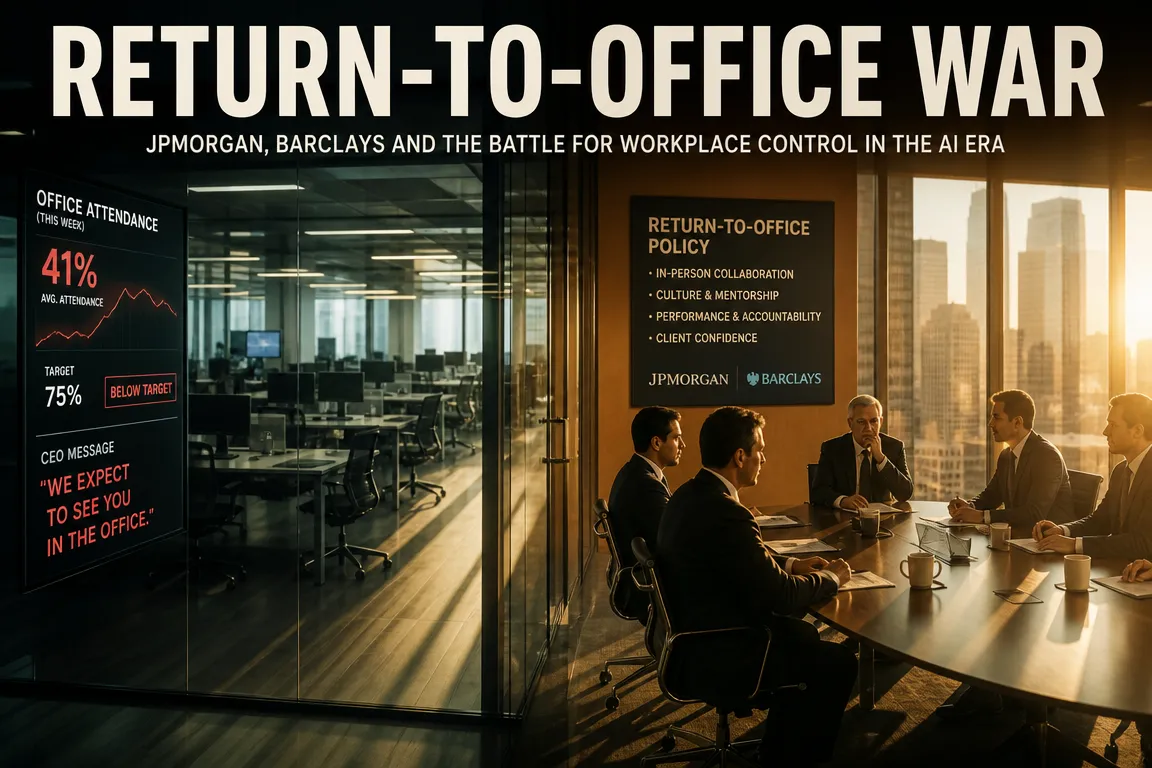
● Office Return War
The Return-to-Office Battle Reignites in Global Finance… Reduced Remote Work, Labor-Management Conflict, and the Reshaping of Office Strategy in the AI Era
Expanded Office Attendance Has Once Again Become a Core Corporate Issue
As major global banks reduce remote work and push strongly for employees to return to the office, demands for commuting allowances and labor-management conflicts are growing at the same time.
JPMorgan Chase has effectively mandated five days a week in the office, while Barclays has decided to increase office attendance from two days to three days a week.
On the surface, this may look like a simple adjustment to work policies, but in reality, it is a structural issue where productivity, organizational culture, talent management, commuting costs, and work efficiency are all colliding at once.
In particular, this issue is not merely a financial industry news story. It is also a signal that must be read together with the global economic outlook, labor market, global stock markets, remote work, and AI transformation.
Key Takeaway News Summary
Starting next month, Barclays will increase the minimum number of office attendance days for employees from the current two days a week to at least three days a week.
Senior executives will be required to come into the office at least four days a week.
The labor union Unite has strongly opposed the plan and demanded that it be halted.
The union represents about 80% of Barclays’ roughly 45,000 employees in the United Kingdom, giving it considerable influence.
The union argues that employees with caregiving responsibilities, such as childcare and eldercare, should be allowed more flexible working arrangements.
It has also demanded permission to commute during off-peak hours to ease commuting costs, a one-time office attendance allowance in response to the expanded return-to-office requirement, and clear exemption criteria for long-distance commuters.
The company maintains its position that “both flexibility and the benefits of in-person collaboration are important.”
Why the Return-to-Office Battle Is Reemerging Now
After the pandemic, remote work became almost a standard way of working, but major financial firms are increasingly shifting back toward the view that “in-person work is better.”
There are four main reasons.
1. Collaboration and Decision-Making Speed
The larger the organization, the more important fast decision-making becomes.
From management’s perspective, in-person meetings are seen as more effective for immediate feedback and coordination.
Especially in finance, where risk management, internal controls, and sales collaboration are tightly interconnected, the argument is that dense office-based work is more efficient.
2. New Employee Training and Mentoring
This is exactly the point emphasized by JPMorgan CEO Jamie Dimon.
The argument is that employees need to work together in the office to learn how senior colleagues handle tasks firsthand and to absorb organizational culture naturally.
The longer remote work continues, the slower new employees may be in developing a real sense of the organization.
3. Greater Clarity in Performance Management
From a company’s perspective, office attendance makes visible management easier.
Especially in roles where performance measurement is ambiguous, “how visible someone is” can sometimes affect evaluations more than “how much work they actually do.”
For this reason, strengthening office attendance is not merely a work policy. It also carries the meaning of restoring organizational control.
4. Use of Office Assets
The real estate and office operations perspective cannot be ignored either.
Major financial firms often own large headquarters or hold long-term leases in prime downtown locations.
As remote work continues for longer, the utilization rate of offices falls compared with the cost of maintaining them. Therefore, mandatory office attendance also has the character of improving asset efficiency.
Why Labor Unions Are Strongly Opposing the Move
Employees are not pushing back simply because they “do not want to go in.”
It is because actual living costs and time costs increase significantly.
1. Increased Commuting Costs and Time Burden
When office attendance days increase, transportation costs, meal expenses, and childcare costs rise together.
For long-distance commuters in particular, the perceived burden is much greater.
This is also why the union has demanded exemptions for employees whose one-way commute exceeds 40 minutes or 35 miles.
2. Conflict with Caregiving Responsibilities
Childcare, eldercare, and family care remain real variables for many employees.
Remote work has functioned not merely as a convenience, but as a safety net that allows people to maintain both their livelihood and caregiving responsibilities.
That is why expanded office attendance may feel to some employees not like a “strengthening of work discipline,” but like a “collapse of daily life.”
3. Resistance to Unilateral Decision-Making
Employees believe the company has not sufficiently proven the need for expanded office attendance with objective evidence.
In other words, the problem with the policy is less about office attendance itself and more about “why now, why in this way, and why unilaterally.”
What the JPMorgan Case Shows About the Market Direction
Since March of last year, JPMorgan Chase has required hybrid employees to come into the office five days a week.
In effect, it has returned to a full office-based work model.
At the time, employee opposition was also strong.
Hundreds of protest posts appeared on the company’s internal message board, and about 1,200 people signed an online petition.
Even so, CEO Jamie Dimon did not reverse the policy.
This should not be read simply as management stubbornness. Rather, it is a signal that America’s largest financial firms may place greater emphasis on in-person-centered organizational operations than on talent management flexibility going forward.
Points to Watch from a Global Economic Perspective
This news may look like a labor issue, but it is actually a clue for reading the direction of the global economy.
1. The Bargaining Power of the Labor Market Is Being Tested Again
Immediately after the pandemic, employees had significant power to demand “flexible work.”
Now, however, as economic slowdown, cost pressure, and organizational restructuring overlap, companies are showing signs of regaining the upper hand.
2. Major Financial Firms Are Pursuing Cost Reduction and Stronger Control at the Same Time
In a situation where labor costs, office costs, and performance management costs are all rising, companies want stronger control.
Expanded office attendance carries more significance as a tool for strengthening control than as a tool for reducing costs.
3. In a High-Interest-Rate, Low-Growth Environment, Companies Focus on “Removing Excess”
When global economic slowdown and interest-rate burdens continue, companies tend to reduce non-core elements and focus on core productivity.
In that process, flexible work is reinterpreted as both a cost and a risk.
4. There Are Also Ripple Effects on the Office Market and Urban Economy
When more office workers commute, downtown commercial districts, transportation, food and beverage businesses, and office-related industries also change.
Conversely, when remote work increases, suburban consumption grows while downtown demand weakens.
In other words, office attendance policy is not merely an internal bank policy. It is also connected to the structure of the urban economy.
Why This Trend Matters Even More in the AI Era
Many people may think, “If AI is changing how we work, shouldn’t remote work increase even more?”
In reality, however, many companies are moving in the opposite direction.
1. AI Can Replace Collaboration Tasks, but It Cannot Replace Organizational Cohesion
Even if AI quickly handles document writing, summarization, analysis, and repetitive tasks, trust-building between people is still necessary.
Especially in conservative and risk-sensitive industries such as finance, companies tend to strengthen management intensity while adopting AI.
2. During AI Adoption, On-Site Coordination Often Becomes Stronger
When new systems are introduced, training, supervision, and verification become important.
At such times, companies more frequently use the logic that “we can align faster if we are together.”
3. The Core Point in the AI Era Is Not Whether People Work Remotely, but How Roles Are Redesigned
Going forward, the issue will not simply be whether people work from home or come into the office.
What matters more is reorganizing which tasks should be automated with AI and which tasks should be strengthened through in-person collaboration.
In other words, this news shows that office strategy in the AI era is not simply a matter of employee benefits, but part of corporate strategy.
The Most Important Point Often Missed by Other News Coverage
There is a core point that is easy to overlook when looking at this issue.
Expanded Office Attendance Is More About “Power Structure” Than “Work Style”
This debate is not a fight over the convenience of work flexibility.
In reality, it is a rebalancing of power over how directly companies can control the way employees work.
Remote work gave employees autonomy, while expanded office attendance reduces that autonomy again.
In other words, this conflict is less about “whether people can work from home” and more about “who sets the rules of work.”
Demands for Office Attendance Allowances Are Not Just About Compensation, but Resistance to Cost Shifting
The union’s demand for office attendance allowances carries strong symbolic meaning.
From employees’ perspective, the company should bear at least part of the transportation costs, caregiving costs, and time costs associated with returning to the office.
This is ultimately a question of whom the company shifts the cost of changes in work policy onto.
Demands for Exceptions for Long-Distance Commuters Are Likely to Grow
Applying the same office attendance rules to all employees may become increasingly difficult.
This is because caregiving responsibilities, residential locations, and transportation conditions differ from person to person.
Going forward, customized office attendance policies that reflect individual circumstances, not just job categories, may become a source of competitiveness.
The Common Message from Barclays and JPMorgan
Both banks are ultimately pointing in the same direction.
Office return is no longer merely a recommendation; it is becoming the default setting for organizational operations.
And this trend is not limited to the financial sector.
Large corporations, consulting firms, and some IT organizations are also likely to face similar concerns.
Key Points to Watch Going Forward
1. Whether the Union Can Actually Secure Additional Negotiation Results
It will be important to watch whether office attendance allowances or exemption criteria are actually accepted.
2. Whether Stronger Office Attendance Spreads to Other Financial Firms
One bank’s decision can spread like an industry standard.
3. How Turnover and Productivity Change
It is also important to see whether employee resistance actually leads to talent outflows.
4. How Much Office Return Changes Office Demand and Downtown Consumption
There may also be an impact on urban economies and commercial district trends.
5. How AI Adoption and Office Attendance Policies Become Connected
In the future, companies will need to design more carefully how to divide AI automation and in-person collaboration.
In Summary
The office attendance expansion issue at Barclays and JPMorgan is not simply a story about reducing remote work.
As global finance returns to an office-centered organization, employees are directly pushing back based on living costs and time costs.
This conflict is likely to become an important standard for reading the future of the labor market, global economic outlook, remote work, return to office, and AI trends.
< Summary >
Global financial firms are reducing remote work and strengthening return-to-office policies.The moves by JPMorgan and Barclays point to a reshaping of in-person collaboration, organizational control, and talent management.Employees are pushing back over commuting costs and caregiving burdens, demanding office attendance allowances and exemption criteria.This issue is not merely a debate over work policies, but a signal showing the direction of the global economy and office strategy in the AI era.
[Related Articles…]
How Remote Work Cuts Are Reshaping the Global Labor Market Outlook
How AI Is Redefining Workplace Culture and the Future of Office Strategy
*Source: https://www.hankyung.com/article/202609221648i