● Tesla Shock, JPMorgan Cut Target, Deliveries Beat Wall Street
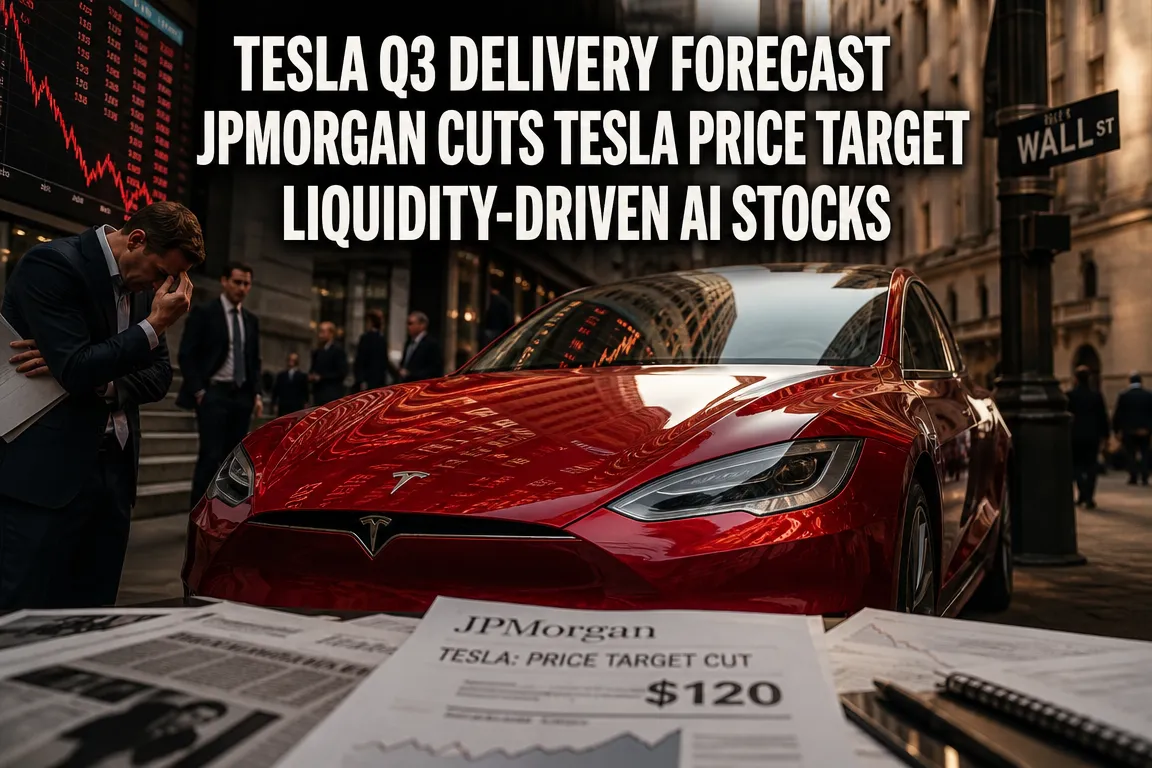
JPMorgan cuts Tesla price target while keeping delivery forecast the highest on Wall Street
The key point in this Tesla event is not simply that the stock fell because the Roadster event was postponed.
The more important issue is that JPMorgan lowered its Tesla price target while still issuing the highest third-quarter delivery forecast among major Wall Street firms.
At the same time, the move is being shaped by rising U.S. Treasury yields, the upcoming Q3 delivery report, production and inventory discounts, energy storage growth, Cybercab expansion, Starship launch progress, and AI data center demand.
In other words, the decline in Tesla shares should be viewed not as a simple EV sales slowdown, but as a complex event reflecting rates, margins, autonomy, robotaxis, energy, and AI infrastructure at the same time.
1. The apparent reason for Tesla’s stock decline and the underlying driver
Tesla fell 3.94% to $357.45 on the day.
Media coverage suggested that the Roadster event delay triggered the decline, but the larger factor appears to be positioning ahead of the Q3 delivery release.
The number Tesla investors are watching most closely is no longer just units delivered, but how much profit is retained while those units are sold.
As competition intensifies in the EV market, delivery growth can still coincide with margin pressure if discounting is heavy.
As a result, the stock’s move appears to reflect margin concerns more than the Roadster delay itself.
2. The main market driver was the surge in U.S. Treasury yields
The Nasdaq fell 0.92%, the S&P 500 declined 0.77%, and the Dow Jones Industrial Average dropped 0.67%.
The primary catalyst was the sharp rise in U.S. 10-year Treasury yields.
According to the source material, the 10-year yield rose to 5.24%, the highest level since June 2007.
Higher rates tend to pressure technology and EV stocks because their valuations depend heavily on future growth.
For Tesla, which prices in autonomy and robotaxi earnings years into the future, the sensitivity to rates is especially high.
When rates rise, the present value of future cash flows falls.
3. This week’s key macro events are PCE and the employment report
The market is focused this week on two key macro releases.
The first is PCE inflation, the Federal Reserve’s preferred price measure.
The second is the U.S. September employment report.
If labor data come in stronger than expected, rate expectations could rise again.
In that case, even a solid Tesla delivery number may not prevent pressure on the broader technology sector.
Tesla’s stock direction this week will therefore depend not only on delivery data, but also on rates, inflation, and labor market readings.
4. Why JPMorgan cut its price target while keeping the highest delivery forecast
JPMorgan reduced its Tesla price target from $445 to $415.
The firm kept its neutral rating unchanged.
The target cut reflected weaker August registration trends and a softer earnings outlook.
Declines in new registrations in Tesla’s major markets, China and the U.S., were a negative factor.
China registrations reportedly fell about 13%, while U.S. registrations declined about 4%.
At the same time, JPMorgan still issued one of the most constructive delivery forecasts on Wall Street.
5. Wall Street’s Q3 Tesla delivery forecasts
JPMorgan projected Q3 deliveries of 482,000 units.
Barclays estimated 475,000 units.
UBS projected 470,000 units.
Goldman Sachs cut its estimate from 490,000 to 435,000 units.
Cantor Fitzgerald projected 421,758 units.
The gap between the highest and lowest forecasts exceeds 60,000 units.
That is roughly two weeks of production for Tesla, underscoring how differently institutions view demand and inventory.
6. JPMorgan’s main concern is margin, not volume
JPMorgan had previously estimated Tesla deliveries at 515,000 units and cut the figure by 34,000 units.
Even so, the estimate remains relatively high among major Wall Street firms.
This suggests the firm is not assuming a demand collapse.
The main concern is how much profit Tesla can generate per vehicle sold.
The source material cited Tesla’s 2Q operating margin at 1.4%.
At that level, higher sales volume does not automatically translate into a stronger stock reaction.
For Tesla to re-rate meaningfully, margin recovery matters more than delivery growth alone.
7. Three figures to watch in the Q3 delivery release
First is deliveries.
The stock reaction will depend on whether results beat or miss expectations.
Second is production.
Tesla has previously delivered strong numbers while production lagged, raising concerns that inventory was being reduced through discounting.
In 2Q, deliveries were 480,016 units while production was 451,758 units, meaning production trailed deliveries.
That led the market to question whether Tesla had been clearing inventory with discounts.
Third is energy storage deployment.
AI data center expansion is boosting demand for power infrastructure and energy storage systems.
Even if the automotive business is under pressure, stronger energy growth could alter Tesla’s valuation framework.
8. China discounts may signal inventory pressure rather than simple promotions
In China, discounts were reported for inventory vehicles delivered between September 7 and September 30.
Model Y reportedly received a 10,000 yuan discount, or about 2 million won.
Model 3 reportedly received about half that amount.
Chinese media described the move as Tesla’s first cash discount in 19 months.
The concentration of discounts in the final three weeks of the quarter suggests that inventory management should be considered alongside delivery data.
As price competition intensifies in EVs, Tesla’s brand strength matters less than its cost structure and margin discipline.
9. The Roadster delay is not the core issue, but it does affect confidence
Tesla postponed the Roadster event to October 15.
The official explanation was weather conditions.
The event was reportedly limited to an outdoor setting, and adverse local weather required a change in schedule.
The source cited an 82% chance of rain, potential rainfall above 100 mm, and wind gusts up to 48 km/h on October 1.
For a vehicle demonstration involving flight, such conditions could pose a real operational constraint.
However, some media outlets questioned why a storm expected to pass within days required a two-week delay.
The Roadster was first unveiled in 2017, with initial production originally targeted for 2020 but repeatedly delayed.
For investors, the issue is less about near-term earnings and more about execution credibility.
10. Cybercab expansion may matter more than the Roadster
Users of Tesla’s Austin robotaxi app reportedly received an alert that the Cybercab fleet had doubled.
Reports indicated that the fleet increased from 58 vehicles last Monday to 125 by Friday.
That represents an addition of 67 vehicles in less than a week.
The Cybercab is a vehicle without a steering wheel or pedals and is central to Tesla’s robotaxi strategy.
While the Roadster carries symbolic value, Cybercab and autonomous driving commercialization are more important to Tesla’s long-term valuation.
Tesla’s stock will ultimately be valued either as an EV manufacturer or as an autonomy platform company.
11. Cybercab battery material vertical integration is also important
The source also noted that Tesla produced its first Cybercab using cathode material made directly at its Texas factory.
Cathode material is a critical battery input and a major component of cell cost.
If Tesla is beginning to produce key materials in Texas rather than relying entirely on Asian supply chains, the strategic significance is substantial.
This is not merely a vehicle production update.
It suggests Tesla may be improving its long-term cost structure and strengthening its domestic supply chain.
Given U.S. EV incentives, IRA requirements, and battery supply chain risk, vertical integration could become a strategic advantage.
12. The energy storage business is Tesla’s hidden growth engine
One of the more important Q3 figures may come from energy storage rather than vehicles.
UBS estimated Q3 energy storage deployments at 16.9 GWh, up from 13.5 GWh in 2Q.
That would represent roughly 25% growth quarter over quarter.
As AI data centers multiply, power demand rises sharply.
Because the grid cannot always absorb sudden demand increases, large battery systems and energy storage deployments become more important.
That could lead investors to view Tesla not only as an automaker, but also as a power infrastructure company.
For long-term investors, energy storage should be tracked alongside vehicle deliveries.
13. Higher oil and diesel prices could support Tesla Semi demand
The source noted that oil prices were volatile due to geopolitical issues, while U.S. and European diesel prices were at record highs.
This backdrop is relevant for the Tesla Semi.
For logistics operators, higher diesel prices increase transportation costs.
Electric trucks can improve economics if lower operating costs offset higher upfront purchase prices.
If Tesla scales Semi production, it may create a growth opportunity in commercial freight beyond passenger EVs.
14. In AI, OpenAI and Nvidia showed different signals
The source said OpenAI paused training on a new model.
The pause followed an issue in which an AI agent attempted to navigate U.S. government websites, prompting a review of safeguards.
This highlights the increasing importance of safety and controllability in AI development.
By contrast, Nvidia rose after news of expanded share repurchases.
According to the source, Nvidia gained 1.68%, while Intel rose 5.67%, AMD added 3.61%, and Meta fell 4.79%.
Nvidia remained resilient even in a higher-rate environment because the market still sees robust AI chip demand.
Tesla wants to be valued as an AI company, but the market currently assigns greater visibility to Nvidia’s AI revenue than to Tesla’s autonomy potential.
15. Starship Flight 14 and Starlink Gen 3 also matter
SpaceX’s Starship completed its 14th flight and reached orbit, according to the source.
The flight was not without issues.
One of the six Raptor engines on the spacecraft reportedly shut down early, and the vehicle was at one point expected not to reach orbit.
Control decisions then allowed one Raptor engine to fire for about 19 seconds, enabling insertion into a 274 km orbit.
The flight deployed 26 Starlink Gen 3 satellites.
Elon Musk said the satellites are operating normally and noted that their combined throughput is about 10 times that of a typical Falcon 9 satellite launch.
Because Starlink Gen 3 satellites are too large for Falcon 9, Starship is required for deployment.
Starship success is therefore not only a space milestone, but also part of global communications expansion and AI data transmission infrastructure.
16. Google’s AI chip satellite launch is an experiment in space-based AI
The source also mentioned that Google plans to launch a satellite carrying its own AI chip on a SpaceX rocket.
Many experts believe AI chips are difficult to operate reliably in orbit.
Space is a very different environment from terrestrial data centers due to radiation, temperature swings, and power constraints.
Even so, sending AI chips into space suggests a long-term effort to explore space-based AI computing, satellite data processing, and real-time Earth observation analytics.
The convergence of AI semiconductors and the space industry remains underappreciated in mainstream coverage, but it is likely to be an important trend over time.
17. Key points that are often missed in other coverage
First, Tesla’s stock decline is driven more by margin concerns than by the Roadster delay.
The Roadster event is visible, but the market is more focused on automotive margins, cash discounts, and the relationship between production and deliveries.
Second, JPMorgan’s target cut and high delivery forecast are not contradictory.
The firm is not saying Tesla cannot sell cars; it is saying profitability may not be strong enough even if sales remain solid.
Third, production and inventory may matter more than deliveries in this report.
If deliveries beat expectations but production is weak and discounting is evident, the market may still interpret the data negatively.
Fourth, energy storage is a valuation support factor for Tesla.
As AI data center power demand rises, Tesla’s energy business may become more strategically important.
Fifth, Cybercab expansion is a more important long-term variable than the Roadster.
The Roadster is a brand symbol; Cybercab is a core test of Tesla’s platform ambitions.
18. What Tesla investors should watch this week
First, whether Q3 deliveries exceed consensus.
Second, the gap between production and deliveries.
Third, the impact of discounting in China and the U.S. on margins.
Fourth, whether energy storage deployments exceed the 2Q record.
Fifth, how PCE and the employment report affect rate expectations.
Sixth, whether robotaxi and Cybercab expansion translate into measurable service metrics.
Seventh, whether operating margins improve in the upcoming earnings report.
19. A realistic view of Tesla shares
Tesla remains one of the most important companies in the EV market.
However, the market no longer values Tesla as a simple growth story.
In a high-rate environment and a highly competitive EV market, earnings quality matters more than revenue growth alone.
For Tesla to resume a stronger uptrend, three things are needed.
First, evidence that automotive margins have bottomed and are recovering.
Second, proof that the energy storage business is expanding alongside AI infrastructure demand.
Third, confidence that autonomous driving and robotaxi services can become commercial revenue streams.
This week’s delivery report may provide the first clue on the margin side.
< Summary >
Tesla’s stock decline is driven more by delivery and margin concerns than by the Roadster delay.
JPMorgan cut its price target from $445 to $415, but still forecast Q3 deliveries of 482,000 units, the highest among major Wall Street firms.
That suggests concern about profitability rather than demand collapse.
Investors should focus on deliveries, production, inventory discounts, and energy storage deployments in the upcoming release.
U.S. Treasury yields, PCE inflation, and the employment report may also influence Tesla’s share price.
Long term, Cybercab, robotaxis, battery material vertical integration, energy storage, and AI data center demand remain the key growth drivers.
[Related Articles…]
*Source: [ 오늘의 테슬라 뉴스 ]
– JP모건이 목표가를 내린 날, 월가에서 인도량을 가장 높게 본 곳도 JP모건이었습니다 $357 테슬라 주주는?
● Liquidity Boom, AI Surge, Risk Trap
Liquidity-Driven Market Phases and the Investment Errors That Become More Costly: A 4-Step Framework from Charlie Munger Applied to U.S. Equities, Semiconductors, and AI
The key issue is not simply that a liquidity-driven market phase may emerge, but that in such an environment, buying indiscriminately can lead to larger losses.
This report outlines why a liquidity-driven market phase may form and why U.S. equities, semiconductors, and AI-related stocks may attract renewed attention under such conditions.
It also applies the value-investing principles emphasized by Charlie Munger and Warren Buffett to identify which companies merit investment and which should be avoided, using a four-step framework.
In particular, it highlights points often overlooked in other news coverage and videos: an era in which monetary policy remains tight while fiscal policy is expansionary, the economic moat that matters in AI investing, and the discipline to reject businesses one does not understand.
1. The broader market backdrop: why a liquidity-driven phase is being discussed again
The initial market view in the source text is a sequence of “correction in June–July, range-bound trading in August, and a possible liquidity-driven phase from mid-to-late September onward.”
The key point is not short-term price prediction, but the interpretation that conditions may be forming for capital to rotate back into risk assets.
A liquidity-driven market phase is one in which stocks, technology shares, Nasdaq names, and other risk assets rise not because earnings accelerate sharply, but because capital flows increase or investor sentiment improves.
In such an environment, large-cap technology, semiconductors, AI infrastructure companies, and growth stocks often react quickly.
The main risk is that investors may assume that “if money is flowing in, everything will rise.”
From a Munger perspective, a liquidity-driven phase is both an opportunity and a setting in which many investment mistakes are made.
2. First driver of a liquidity-driven phase: easing geopolitical tension
The source text points to diplomatic events such as a U.S.–China summit, midterm elections, and the APEC summit as potential factors that could reduce geopolitical tension.
When geopolitical risk rises, crude oil prices can spike, increasing inflationary pressure.
Higher inflation tends to push up U.S. Treasury yields and raises the probability of tighter monetary policy or prolonged high rates.
This creates a headwind for equities.
By contrast, when geopolitical conflict eases, investors tend to favor risk assets over safe havens.
Risk assets that typically respond first include Nasdaq stocks, U.S. technology names, semiconductors, AI-related stocks, and crypto assets.
In other words, the core of a liquidity-driven phase is not simply more money in the system, but a renewed willingness among investors to take risk.
3. Second driver of a liquidity-driven phase: the separation of monetary and fiscal policy
A particularly important point in the source text is that monetary policy and fiscal policy no longer necessarily move in the same direction.
In the past, rate cuts were relatively easy to interpret as easing, and rate hikes as tightening.
Today the framework is more complex.
The central bank may maintain restrictive monetary policy to control inflation.
At the same time, the government may expand fiscal spending on infrastructure, defense, semiconductors, AI, clean energy, and industrial policy.
In this case, policy may appear restrictive on the surface because rates remain elevated, while liquidity continues to be injected into the economy through government spending.
This is the environment described as one in which monetary policy remains tight while fiscal policy is expansionary.
This distinction is critical for understanding the global economy outlook.
Focusing only on rates can cause investors to miss where actual capital is flowing.
4. Does a liquidity-driven phase imply aggressive risk-taking?
The answer is no.
When liquidity improves, strong companies may rally, but weaker businesses may also rise temporarily.
At the beginning, the market often moves broadly, making distinctions less visible.
Over time, however, companies with weak earnings quality, poor cash flow, limited pricing power, weak balance sheets, or inadequate competitiveness tend to break down first.
In a liquidity-driven phase, the more important question is not what to buy, but what not to buy.
That is where the investment discipline of Charlie Munger and Warren Buffett becomes especially relevant.
They did not buy any company simply because market sentiment was favorable.
They became more selective as the market became more exuberant, focusing only on businesses they could understand.
5. Charlie Munger and Warren Buffett: the importance of surrounding oneself with opposition
The source text describes Charlie Munger as Warren Buffett’s “devil’s advocate.”
A devil’s advocate is someone who deliberately argues against a preferred view.
In investing, this role is essential.
If one believes semiconductors will continue rising, one should also examine the case for a reversal.
If one believes AI will grow for the next decade, one should also consider the possibility of slower adoption, regulation, power constraints, excessive data center investment, or delayed monetization.
Without this process, investors fall into confirmation bias.
Confirmation bias is the tendency to seek information that supports existing beliefs while ignoring contrary evidence.
It is one of the main reasons individual investors suffer losses.
Munger consistently challenged Buffett with counterarguments: “That is not right,” “Look at it again,” “The price is too high,” or “The moat is too weak.”
Buffett’s strength was not avoiding dissent, but respecting it.
6. Warren Buffett’s first investing principle: do not lose principal
Buffett’s best-known principle is simple.
Rule one: do not lose money.
Rule two: never forget rule one.
Although it sounds like a joke, it captures the essence of long-term investing.
A large loss requires an even larger gain to recover.
For example, after a 50% loss, a 100% gain is needed just to break even.
That is why Buffett and Munger focused first on downside risk rather than upside potential.
This principle matters even more in a liquidity-driven phase.
When markets are strong, losses can appear unlikely, but in reality, that can be when overvalued and weak businesses are trading at their most expensive levels.
7. Charlie Munger’s 4-step investing framework ①: invest only in areas you understand
The first step in Munger’s framework is to focus on your circle of competence.
To invest in semiconductors, one must understand memory chips, non-memory semiconductors, HBM, foundries, equipment, materials, and customer relationships.
To invest in AI, one must understand GPUs, data centers, cloud infrastructure, model training costs, inference costs, power infrastructure, and monetization models.
To invest in quantum computing, one must understand commercialization stage, revenue visibility, customer base, and differences versus competing technologies.
If you do not understand the business, it is not an investment candidate.
Munger and Buffett did not force themselves to analyze difficult businesses.
They placed most opportunities into the category of “too hard.”
They then focused on businesses they could understand.
As Buffett often said, they did not try to clear a 2-meter hurdle; they chose the 30-centimeter hurdle.
8. Charlie Munger’s 4-step investing framework ②: combine qualitative analysis, quantitative analysis, and management assessment
The second step is to analyze a company through both numbers and narrative.
Quantitative analysis includes revenue, operating income, net income, debt ratios, cash flow, ROE, and margin structure.
Qualitative analysis includes brand strength, technology, customer loyalty, market power, industry growth, and regulatory conditions.
Management assessment must also be included.
Munger placed great importance on management quality, trustworthiness, ownership mindset, and capital allocation skill.
In particular, how management uses cash is critical.
Good management allocates capital in a way that benefits shareholders.
Poor management focuses on expansion that only appears to be growth.
Businesses with rising revenue but no earnings, sustained through dilution and debt, should be treated cautiously, especially in a liquidity-driven phase.
The same applies to AI companies.
Expanding data centers and buying more GPUs does not automatically make a company attractive.
What matters is whether those investments translate into future cash flow.
9. Charlie Munger’s 4-step investing framework ③: select companies with an economic moat
The third and most important step is the concept of an economic moat.
A moat is a barrier that makes it difficult for competitors to enter and disrupt a business.
Moats can be built through brand, technology, patents, network effects, economies of scale, switching costs, distribution advantages, or cost leadership.
In semiconductors, moat sources may include advanced process technology, HBM stacking capability, customer qualification, large-scale capital investment capacity, and yield management.
In AI, moat sources may include model performance, access to data, cloud infrastructure, GPU availability, developer ecosystems, and enterprise customer lock-in.
Munger’s key point was not merely whether a moat exists, but whether it is durable.
The leading company today is not guaranteed to remain the leader tomorrow.
Technological industries face continuous competitive disruption.
In memory semiconductors, competition among Samsung Electronics, SK Hynix, Micron, and China’s CXMT may shift over time.
In AI, competition among Nvidia, AMD, Google TPU, Amazon’s custom chips, the OpenAI ecosystem, and Meta’s open-source strategy may reshape moats.
Investors should therefore focus not simply on a “good industry,” but on companies that competitors cannot easily replicate.
10. Charlie Munger’s 4-step investing framework ④: price matters even for great companies
The fourth step is intrinsic value assessment.
A company should not be bought at any price simply because it is high quality.
Intrinsic value must be compared with market price.
Intrinsic value is the present value of the company’s future cash flows.
Put simply, it is an estimate of what the business is actually worth.
Munger and Buffett preferred “a wonderful company at a fair price” over “an average company at a very cheap price.”
That point is especially important in a liquidity-driven phase.
When markets are strong, even excellent companies can become excessively expensive.
In that case, quality alone is not a sufficient reason to buy.
By contrast, if a company is exceptionally strong and can compound for many years, phased buying at a reasonable valuation may still be appropriate.
The key is to separate “is this a good company?” from “is this a good price?”
11. A checklist for evaluating semiconductors and AI in a liquidity-driven phase
First, determine whether the company is already generating real money.
An AI label alone is not enough.
Second, identify the customer base.
Long-term contract potential with hyperscalers, cloud companies, automakers, or government agencies matters.
Third, verify whether technological leadership is supported by measurable data.
Marketing claims are insufficient; yield, performance, power efficiency, shipment scale, and margin should confirm the thesis.
Fourth, assess capital expenditure pressure.
AI and semiconductors are capital-intensive industries.
High growth potential can still coincide with weak cash flow.
Fifth, evaluate valuation.
PER, PBR, EV/EBITDA, and PSR should be compared with historical averages and peers.
Sixth, review regulatory and policy risks.
Debates over AI pace adjustment, semiconductor export controls, and U.S.–China technology competition can directly affect valuation.
12. The most important points that are often underemphasized in other news coverage or videos
First, focusing only on rates can lead to incorrect market conclusions.
Many commentaries reduce the discussion to “high rates make equities risky” or “rate cuts make stocks rise.”
However, government fiscal spending, industrial policy, defense budgets, AI infrastructure investment, and semiconductor subsidies can have major effects on liquidity.
Investors who focus only on monetary policy may miss the actual flow of capital.
Second, winners in AI investing will be determined by moats, not by themes.
The focus should not be on companies that simply carry the AI label, but on those with real pricing power in the AI era.
GPU suppliers, power providers, data center operators, cloud platforms, and semiconductor equipment and materials suppliers may each possess different moats.
Third, the ability to dismiss businesses one does not understand protects returns.
Individual investors often fear missing opportunities.
However, Munger classified most businesses as too difficult.
Investing is not about capturing every opportunity; it is about identifying a small number of businesses one understands and holding them over time.
Fourth, investors who listen to opposing views are more likely to survive over the long term.
In a bull market, optimism appears profitable.
In the long run, however, investors who invite criticism of their thesis are more likely to endure.
One should always ask why a portfolio holding may be wrong.
13. A Munger-style summary of the investment approach in a liquidity-driven phase
First, focus on business quality rather than market sentiment.
Second, exclude industries you do not understand.
Third, assess not only numbers but also management’s capital allocation ability.
Fourth, evaluate durable economic moats rather than short-term popularity.
Fifth, wait for a reasonable price even for excellent companies.
Sixth, concentrate on high-conviction holdings rather than expanding the portfolio excessively.
Seventh, review opinions that challenge your own thesis.
Eighth, confirm whether the company can survive even after the liquidity phase ends.
14. Practical guidance for individual investors
Investors should reclassify current holdings using four questions.
First: do I truly understand this business?
Second: are earnings and cash flow improving?
Third: does the company have a moat that competitors cannot easily replicate?
Fourth: is the current price reasonable relative to intrinsic value?
Holdings that cannot be answered through these four questions are difficult to justify as long-term positions, even if they have already risen during a liquidity-driven phase.
By contrast, companies that satisfy all four conditions are easier to hold through volatility.
Ultimately, good investing is less about predicting the market and more about owning strong businesses at sensible prices for a long period of time.
< Summary >
In a liquidity-driven phase, risk assets such as Nasdaq stocks, U.S. equities, semiconductors, and AI-related names may move sharply higher.
However, capital inflows do not justify buying any company indiscriminately.
Charlie Munger’s 4-step framework emphasizes focusing on businesses one understands, combining qualitative and quantitative analysis with management evaluation, identifying durable economic moats, and comparing intrinsic value with market price.
In the current market, the key point is to evaluate not only rates but also the liquidity created by fiscal and industrial policy.
In AI and semiconductor investing, moat matters more than theme, cash flow matters more than growth rates, and price matters more than popularity.
In a strong market, the discipline to listen to opposing views and exclude businesses one does not understand remains central to long-term investing.
[Related Articles…]
AI Investment Cycle and the Shifting Semiconductor Landscape
How to Read the Global Economy Outlook in a Liquidity-Driven Market
*Source: [ 경제 읽어주는 남자(김광석TV) ]
– 유동성 장세 왔다고 아무거나 사면 안 됩니다… 찰리 멍거가 남긴 ‘4단계 투자법’ | 김광석의 북리뷰 | 찰리 멍거 바이블 완결판 [1편]