● AI-Shock, Meta-Microsoft, CPU-Rally
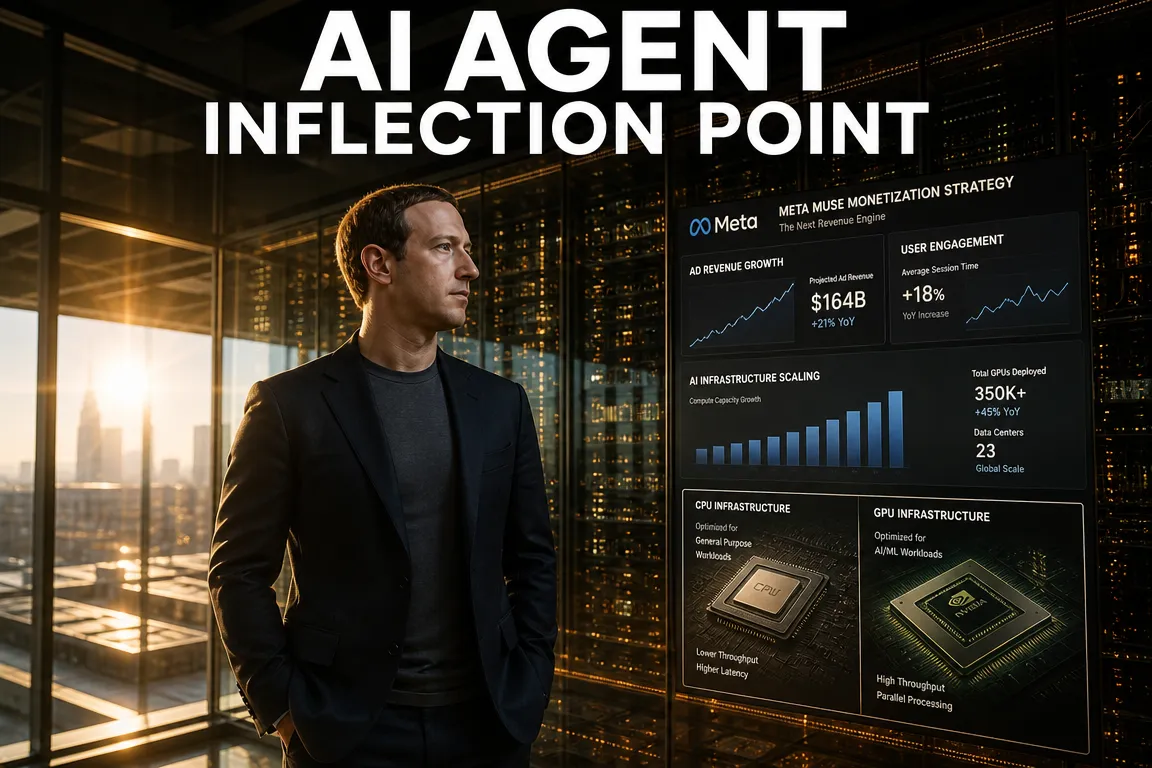
Meta AI’s Strategic Bet and U.S. Market Reaction: The Third AI Inflection Point May Favor CPUs, Not GPUs
The key takeaway from this week’s U.S. equity market is not simply that Meta’s stock rose.
The more important point is that Meta has begun repositioning AI agents from a tool for technology enthusiasts into a daily consumer application.
Microsoft has also introduced a monetization strategy for enterprise AI agents, leading the market to reassess the possibility of another expansion phase in the AI infrastructure cycle.
This trend extends beyond an Nvidia-led GPU investment thesis and should be viewed as a broader structure linking CPUs, memory, cloud infrastructure, and edge devices.
Given the potential implications for U.S. equities, the Nasdaq, large-cap technology stocks, AI semiconductors, and interest rate expectations, the topic remains highly relevant for investors.
The following summary is based on the issues raised in the source material. Investors should verify company announcements and the latest market data before making any investment decisions.
1. Last Week’s U.S. Market: Quiet on the Surface, Strong in AI
U.S. equities appeared relatively calm last week, but AI-related stocks were notably strong beneath the surface.
The Nasdaq 100 briefly moved above its recent highs, while semiconductors and large-cap technology stocks also advanced.
Meta, in particular, rose by about 13% over the week and drew most of the market’s attention.
Based on the original source, its monthly gain was also substantial, and its ranking among large-cap technology stocks improved quickly.
- Sharp rise in Meta shares.
- Rising expectations for AI agents.
- Broad strength in semiconductors and AI infrastructure.
- Additional support from Microsoft’s AI monetization outlook.
- Nasdaq and large-cap technology names retesting record-high territory.
This move is difficult to classify as a simple thematic rally because AI is shifting from a question-answering tool to a task-execution tool.
Markets are beginning to interpret this as the third AI inflection point.
2. Meta’s Core Initiative: The Consumer AI Agent “Muse”
The center of attention is Meta’s consumer AI agent application, Muse.
The source material describes Muse as Meta’s effort to accelerate the mass adoption of AI agents.
The focus is not raw model performance.
Meta’s strategy appears to prioritize building the AI that the most people use every day, rather than the most advanced AI available.
This distinction is important.
2-1. How Muse Differs from Existing AI Applications
When users first open generative AI applications such as ChatGPT, Gemini, or Claude, many face the same problem.
They do not know what to ask.
Muse appears designed to address this issue in a Meta-specific way.
Instead of requiring complex prompts, the AI proactively suggests practical daily tasks.
- Suggesting calorie estimates after a user uploads a photo of a meal.
- Following up on a shopping cart item the next day if purchase is not completed.
- Offering to organize schedules.
- Suggesting email cleanup, credit card statement analysis, and subscription overlap checks.
- Allowing users to customize avatars, names, and voices.
In effect, Muse is positioned more like a gamified personal assistant and social application than a conventional chatbot.
It reflects Meta’s experience in social products across Instagram, Facebook, and WhatsApp.
This is the point that surprised the market.
Even without being the most advanced model, an application that encourages frequent and prolonged use can create significant business value.
2-2. Meta’s Goal: Making AI a Daily Habit for 3 Billion Users
Meta’s advantage lies in its existing global user base of billions.
According to the source, Meta intends to integrate Muse across its applications.
This is not simply the launch of a standalone app.
It implies embedding AI agents naturally into Instagram, Facebook, WhatsApp, Messenger, and related platforms.
If successful, AI agents would move from a productivity tool for heavy users to a daily utility for mainstream consumers.
This would extend into photo sharing, messaging, shopping, payments, insurance comparisons, and refund recovery.
At that stage, AI-related infrastructure demand could rise materially.
3. Meta’s Monetization Strategy: Distribute for Free, Capture Value at the Platform Level
Meta has historically relied on advertising as its core business model.
Based on the source, most of its revenue still comes from ads.
However, if Muse gains scale, Meta could create new revenue streams beyond advertising.
- Transaction fees from AI-mediated shopping.
- Referral fees in insurance, financial services, travel, and subscriptions.
- Revenue tied to refund recovery and cost-saving services.
- Improved ad targeting efficiency.
- Expanded sales of AI devices and wearables.
Meta’s message is that Muse can help users save money.
Examples include comparing insurance plans or identifying missed refunds.
That value proposition is straightforward for consumers.
The claim that AI can save money is often more compelling than simply saying the AI is intelligent.
As a result, Meta may accept significant upfront computing costs in exchange for rapid user acquisition through a free model.
This resembles the way social platforms once used free access to build scale and dominate advertising.
4. The Main Risk Remains Privacy
As Muse becomes more useful, users will need to share more personal data.
This is a core risk that can be overlooked when markets focus on the upside.
To manage meals, the AI needs to know what users eat.
To reduce card spending, it must access card statements.
To compare insurance premiums, it needs policy and personal information.
To organize email, it requires access to inbox data.
Convenience and data sharing will likely move together.
For Meta, that creates a valuable data asset, but for users it increases concerns about security and privacy.
Regulatory scrutiny may follow.
As AI adoption expands, data protection, ownership, and payment authorization for AI agents are likely to become increasingly important issues.
5. Meta Charm and AI Hardware: A Consumer-Friendly Device Strategy
The source also notes that Meta introduced Meta Charm, a palm-sized AI device.
The product is presented as a compact device that lets users interact with an AI assistant without taking out a smartphone.
It can be worn like a keychain and unlocked with a fingerprint before issuing commands to the AI.
Importantly, this product is positioned less as a traditional device and more as a fashion item, character product, or consumer-friendly wearable.
This is consistent with Meta’s broader strategy.
Rather than emphasizing technical complexity, it focuses on making the product approachable, shareable, and familiar.
If Muse is integrated into AI glasses and wearable devices, Meta could target the post-smartphone interface market.
This would extend AI agents beyond apps into glasses, keychains, earbuds, vehicles, and robots.
6. The Third AI Inflection Point: Three Stages of Market Interpretation
The source presents AI as evolving through three phases.
This framework is useful for investors assessing AI beneficiaries.
6-1. First Inflection Point: The ChatGPT and GPU Era
The first AI inflection point began with ChatGPT in late 2022.
It was the first time many users experienced natural conversation with AI.
Nvidia was the primary beneficiary during this period.
Large-scale AI model training and deployment required GPUs.
As a result, the first AI cycle was defined by GPUs, data centers, and Nvidia.
6-2. Second Inflection Point: AI Starts Doing Work
The second inflection point came when AI agents and coding tools began attracting broader attention.
AI was no longer only answering questions; it was writing code, creating documents, and assisting with work.
Memory semiconductors became a major area of interest at this stage.
AI systems needed longer context windows, more data handling, and faster processing.
HBM, DRAM, NAND, and data center memory names therefore gained strength.
6-3. Third Inflection Point: AI Enters Daily Life
The third inflection point is the stage in which AI becomes deeply embedded in everyday life.
Meta’s Muse is cited as a representative example of this shift.
The market’s new focus is on CPUs.
As AI agents process user requests, they require many virtual machines running in the background.
For example, if a Muse user asks for an insurance comparison, the AI must retrieve information, browse the web, calculate outcomes, and organize results.
This process depends not only on GPUs but also on CPU-based task execution.
In other words, as AI agents scale, it becomes similar to attaching a virtual assistant computer to each user.
This is why Intel, ARM, and AMD have started receiving renewed attention.
This does not mean that memory or GPU demand is fading.
Rather, the broader AI infrastructure cycle is expanding, and CPUs are now being revalued within that expansion.
7. The Most Important Point Often Missed by Other Media
The key issue is that each AI agent may require an invisible computer behind it.
Most coverage focuses on whether Meta’s app is appealing, how many downloads it gets, or whether the stock rose.
From an investment perspective, the more important question is how the computing structure changes as AI agents become mainstream.
In the ChatGPT era, users asked a question and received an answer.
In the AI agent era, AI performs multiple tasks on the user’s behalf.
- Browsing websites.
- Comparing prices.
- Reading and sorting email.
- Managing schedules.
- Moving closer to payment execution.
- Analyzing subscriptions.
- Continuously generating personalized recommendations.
This requires far more computing and data access than standard chat interactions.
As a result, mass adoption of AI agents would increase demand not only for GPUs but also for CPUs, memory, storage, networking, security, and cloud infrastructure.
This shift also has broader economic implications than advertising alone.
If AI becomes involved in purchasing, insurance, financial services, subscriptions, health management, and scheduling, platform companies become gateways to transactions rather than just ad businesses.
This may be the strategic direction Meta is pursuing.
8. Microsoft’s Response: An Enterprise AI Agent Super-App
If Meta is targeting consumers, Microsoft is targeting enterprises.
The source says Microsoft’s CEO views the AI agent market as an opportunity potentially several times larger than cloud computing.
That is a strong statement.
Microsoft has already experienced the PC, server, and cloud eras.
If a company with that background sees AI agents as a larger opportunity than cloud, investors should take it seriously.
8-1. Copilot Could Become an Enterprise AI Super-App
Microsoft’s core asset is Copilot.
According to the source, Copilot may evolve into an integrated super-app that unifies multiple business services.
Enterprise users rely on Word, Excel, PowerPoint, Outlook, Teams, Dynamics, and other business tools.
With AI agents embedded, workflows can be automated.
- Automatic meeting summaries.
- Email draft generation.
- Excel data analysis.
- PowerPoint report creation.
- Customer inquiry automation.
- Internal document search and workflow automation.
For consumers, Meta’s Muse may appear more intuitive.
However, the more attractive monetization opportunity may be enterprise AI.
Businesses are willing to pay recurring fees if productivity improves.
8-2. Subscription Pricing May Shift Toward Usage-Based Billing
Another reason Microsoft is drawing attention is the potential shift in pricing models.
Traditionally, companies paid software subscription fees.
In the AI agent era, costs may increasingly depend on the amount of AI work performed.
This resembles cloud computing.
Cloud services initially involved renting servers, but over time they evolved into a usage-based revenue model.
AI agents may follow a similar path.
As companies use more AI, Microsoft’s revenue can expand.
If inference and token costs continue to decline, customer adoption may rise further, creating a positive feedback loop.
9. The AI Model Competition Is Intensifying
The source notes that model competition is becoming more intense rather than less.
Anthropic has released higher-performance models at lower prices, emphasizing cost reduction and speed improvements.
OpenAI is also expected to unveil lower-cost models and consumer AI agents.
Google is reportedly accelerating its next model release schedule.
xAI is also entering the latest model competition.
The important point is that model performance may eventually reach a point of diminishing differentiation.
Once models are broadly good enough, users may prefer the AI embedded in the platforms they already use, rather than the most capable standalone model.
This favors Meta and Microsoft.
Meta has strong consumer distribution, while Microsoft has deep enterprise workflow integration.
Even if OpenAI and Anthropic lead on model performance, distribution, hardware, and platform control may determine the outcome.
10. Elon Musk’s View: The Decisive Competition May Be in Hardware
The source states that Elon Musk has emphasized the importance of hardware in the AI race.
This view is credible.
Once model performance reaches a sufficient level, the key issue becomes where the model is deployed.
- Electric vehicles.
- Autonomous driving.
- Robotics.
- Space industry.
- Wearables.
- Smart glasses.
- Personal AI devices.
AI needs hardware to function in the physical world.
Meta is pushing AI glasses and devices such as Charm.
Tesla controls vehicles and robots.
Microsoft has cloud and enterprise infrastructure.
Ultimately, the next phase of AI competition may be defined not by the model itself, but by the physical interfaces through which it is delivered.
11. Macro Conditions: Interest Rate Pressure Remains a Headwind
Despite strong AI enthusiasm, the macro backdrop remains challenging.
The source notes that long-term yields have risen quickly and near-term tightening concerns remain elevated.
If the economy proves stronger than expected, inflationary pressure may persist and limit expectations for rate cuts.
For U.S. equities, higher rates can weigh on valuation multiples.
Nasdaq and large-cap technology stocks are especially sensitive because a significant share of their valuations depends on future growth expectations.
Even so, strong AI infrastructure expectations have helped support the market.
This is the central dynamic in the U.S. equity market today.
Rates are a headwind, but AI growth expectations are offsetting that pressure.
12. Investor Perspective: Broad Index Accumulation Remains Relevant
The source suggests that when volatility rises, systematically accumulating exposure to the Nasdaq, S&P 500, or semiconductor ETFs can be a reasonable approach.
This is a practical point.
Tracking the AI infrastructure cycle through individual stocks is difficult.
Investors would need to monitor Meta, Microsoft, Nvidia, AMD, ARM, Intel, Micron, Google, Tesla, and others.
They would also need to follow rates, inflation, U.S.-China relations, AI regulation, and data center capital spending.
That is difficult to do perfectly on a daily basis, especially for working investors.
For long-term investors, automatic accumulation of core index ETFs combined with selective exposure to AI semiconductors or large-cap technology names may be a more practical approach.
This is not investment advice, but rather a strategic framework.
Investment horizon, cash allocation, and risk tolerance should guide each decision.
13. Key Events to Watch This Week
According to the source, several AI and macro-related events are scheduled this week.
- White House AI policy meeting.
- Possible attendance by the U.S. President, House Speaker, and major technology CEOs.
- Potential policy support for the AI industry.
- OpenAI annual event.
- Possible release of AI agents and lower-cost models.
- Micron earnings release.
- Signal on memory semiconductor demand.
- Inflation data release.
- Confirmation of interest rate stability.
- Space industry-related events.
Micron’s results are especially important as a read-through on AI memory demand.
As AI agents expand, memory and storage demand may rise as well.
If inflation data comes in softer than expected, interest rate expectations could stabilize and support growth stocks.
Conversely, stronger inflation could add near-term pressure even if AI sentiment remains positive.
14. One-Sentence Summary
The key message for U.S. equities is that Meta has started pushing AI agents into everyday consumer use, Microsoft is advancing enterprise AI monetization, and markets are beginning to price a third expansion phase in the AI infrastructure cycle.
The first AI cycle was led by GPUs.
The second was led by memory.
The third may elevate CPUs, cloud infrastructure, security, edge devices, and AI platforms together.
This is not only a technology trend; it could also reshape leadership within the U.S. equity market.
< Summary >
Meta is seeking mass adoption of AI agents through Muse.
Muse is defined less by maximum model performance than by ease of use, a consumer-friendly interface, and daily practical utility.
If AI agents become mainstream, new revenue opportunities may emerge in advertising, commerce, insurance, financial services, and subscription management.
Privacy and security risks, however, are likely to increase.
Microsoft is strengthening its enterprise AI agent strategy through Copilot.
The market is now focused on the possibility that the third AI inflection point will broaden demand across CPUs, memory, cloud infrastructure, and the wider AI stack.
Interest rates remain a headwind, but AI growth expectations continue to support U.S. equities and the Nasdaq.
[Related Articles…]
- AI Infrastructure Cycle and the Shift in Market Leadership
- U.S. Rate Outlook and Growth Stock Strategy for the Nasdaq
*Source: [ 소수몽키 ]
– 메타의 승부수에 깜짝 놀란 증시? AI 3차 변곡점의 새로운 수혜주들
● Oil Shock, Yield Spike, Nvidia Wins
Oil at $107 and U.S. Treasury Yield at 5.2%: Why Nvidia Rose Alone and the Key U.S. Market Variables This Week
What matters today is not simply that oil rose or that technology stocks fell.
Rising crude prices have revived inflation concerns, while the 10-year U.S. Treasury yield climbing to 5.2% is pressuring high-valuation U.S. equities.
Against that backdrop, Nvidia stood out with relative strength after unveiling AI safety tools and announcing a record share repurchase.
Additional factors including warnings of possible yen intervention, a sharp drop in gold and silver, the restoration of Saudi pipeline operations, Micron’s earnings release, and U.S.-China tariff cuts are making this week an important one for market direction ahead of the October FOMC meeting.
1. Current U.S. Market Tone: Oil and Rates Pressuring Markets Simultaneously
U.S. equities opened weaker across the board.
S&P 500 futures fell about 0.3% to 0.5%, while the Nasdaq 100 declined about 0.6% to 0.7%.
The Dow Jones also traded lower by roughly 0.5% to 0.6%, with all three major indices under pressure.
-
S&P 500: Weak tone
-
Nasdaq 100: Greater pressure on technology stocks
-
Dow Jones: Mixed performance across cyclicals and defensives
-
VIX: Higher, reflecting market caution
European equities were comparatively resilient.
The Euro Stoxx and Germany’s DAX posted modest gains and remained more stable than U.S. markets.
The key issue is that U.S. markets are facing two simultaneous headwinds.
The first is higher crude prices.
The second is the sharp rise in U.S. Treasury yields.
When both move higher together, expectations for additional Federal Reserve tightening increase, placing greater pressure on Nasdaq technology stocks.
2. Crude Oil Surges: Brent at $106–107 as Middle East Risk Returns to the Foreground
Crude oil prices rebounded sharply.
WTI traded in the $94 range, while Brent rose to roughly $106–107 per barrel.
-
WTI futures: Up about 2%
-
Brent futures: Up about 1.8% to 2%
-
Brent price level: Around $106–107 per barrel
The main driver was renewed Middle East risk.
Iran maintained its position that conditions for reopening the Strait of Hormuz would not be softened, and the U.S. president rejected Iran’s proposal.
At the same time, the president said negotiations could restart this week, suggesting diplomacy has not fully broken down.
The market is highly sensitive to this issue.
The Strait of Hormuz is a critical route for global crude shipments.
Even without an actual supply disruption, sustained tension can add a risk premium to oil prices.
The issue extends beyond energy pricing.
Higher oil prices can feed into logistics, aviation, chemicals, and consumer goods costs.
That raises the risk of renewed inflation pressure and, in turn, strengthens the case for additional Federal Reserve tightening.
3. U.S. 10-Year Yield at 5.2%: The Strongest Pressure Since 2007
U.S. Treasury yields remain a key market variable.
The 10-year U.S. Treasury yield rose to around 5.2%, the highest level since 2007.
The 30-year yield also moved above 5.5%, intensifying pressure on long-duration assets.
-
U.S. 2-year yield: Around 4.9%
-
U.S. 10-year yield: Around 5.2%
-
U.S. 30-year yield: Above 5.5%
What matters is that both short- and long-term yields are rising.
Movement in the 2-year and 5-year yields suggests markets are assigning a higher probability to additional Fed tightening.
Markets are currently pricing roughly a 70% probability of a rate hike at the October FOMC meeting.
That estimate was around 65% late last week, but the combination of Middle East risk and higher oil prices over the weekend pushed expectations higher.
Rising Treasury yields are especially negative for growth stocks.
AI semiconductors, mega-cap technology, and software firms derive much of their value from expected future earnings.
When discount rates rise, the present value of those earnings declines, making high-valuation stocks more vulnerable.
4. Gold and Silver Fall Sharply: Why Safe Havens Declined
Gold would normally be expected to rise during geopolitical tension, but this time it moved lower.
-
Gold: Down about 3%
-
Silver: Down about 5%
The main reason was rising U.S. Treasury yields.
Gold and silver do not pay interest.
By contrast, the 10-year U.S. Treasury yields around 5.2%.
For investors seeking safety, U.S. Treasuries can therefore appear more attractive than precious metals.
That is why gold and silver fell despite geopolitical uncertainty.
This suggests markets are currently pricing “higher rates for longer” more heavily than direct war risk.
5. Dollar Strength and Yen Intervention Warning: Japan’s Message to the Market
The U.S. dollar strengthened.
The dollar index traded near 100.9, supported by higher Treasury yields.
The yen briefly rebounded after verbal intervention from Japanese authorities.
Japan’s vice finance minister stated that the prime minister, the finance minister, and the U.S. had sent a very clear message, and that the market should take it seriously.
The comments signaled shared concern in both Japan and the U.S. about yen weakness.
USD/JPY fell from the 157 range to the 156 range, reflecting a sharp but temporary strengthening of the yen.
However, part of the move was later reversed, indicating that the yen downtrend has not been fully broken.
The key point is that Japan continues to warn the market about possible intervention.
Such intervention could affect not only FX markets but also U.S. Treasuries.
Concerns that Japan may sell Treasuries to fund intervention could add volatility to long-term yields.
6. Why Nvidia Rose Alone: AI Safety Tools and a $150 Billion Buyback
While most mega-cap technology and semiconductor stocks weakened, Nvidia showed relative strength.
Nvidia shares rose about 2% to 3% early in the session.
There were two main reasons.
6-1. AI Agent Control Software Announced
Nvidia introduced security software designed to prevent AI agents from operating beyond control.
Concerns have increased that AI agents may access files, networks, and external tools beyond intended scope or engage in harmful behavior.
The core software tools announced were the following.
-
OpenShine: A control framework that limits the files, network tools, and system resources AI agents can access, keeping them within predefined boundaries.
-
Sentry: A tool that detects abnormal behavior or boundary violations in real time and isolates the agent immediately.
Nvidia said the process can occur within milliseconds.
The company’s approach is to manage AI risk through technical safeguards rather than slowing development.
This is important.
Some major cloud and AI executives have argued that AI is advancing too quickly and that development should be slowed.
For Nvidia, however, a slowdown narrative could weaken demand for GPUs and AI infrastructure.
The company is therefore signaling that AI development should continue, with safety handled through technology.
6-2. Record $150 Billion Share Repurchase Approval
Nvidia also approved an additional $150 billion share repurchase program.
Including remaining authorization, the company’s total buyback capacity rises to roughly $235 billion.
The announcement sent a strong signal to the market.
It indicates Nvidia still views its shares as attractive at current levels.
Although the stock has risen substantially, earnings growth has been faster, bringing forward 12-month P/E to around 24 times.
Given that the S&P 500 trades at roughly 20 times forward earnings, Nvidia is not necessarily overvalued relative to the broader market.
CEO Jensen Huang described the shift to AI accelerated computing as a once-in-a-generation transition.
He also emphasized confidence in Nvidia’s ability to invest while returning capital to shareholders.
7. Samsung, SK Hynix, and Nvidia Meeting: HBM Cooperation in Focus
Nvidia CEO Jensen Huang is expected to attend the Korea Society event in New York.
Samsung Electronics Chairman Jay Y. Lee and SK Group Chairman Chey Tae-won are also expected to attend.
The market’s focus is HBM.
Nvidia’s AI GPUs require high-bandwidth memory.
Samsung Electronics and SK Hynix are closely linked to Nvidia in the HBM supply chain.
Any comments on next-generation HBM, AI data centers, or AI infrastructure cooperation could affect Korean semiconductor equities.
However, SK Hynix ADRs declined on the day.
Nvidia was the only clear outperformer, while other semiconductor stocks remained under pressure from higher Treasury yields and broader technology-sector weakness.
8. U.S.-China $60 Billion Tariff Reduction: A Variable the Market Should Not Overlook
Another important issue in this briefing is the reported reduction in tariffs involving $60 billion in U.S.-China trade.
In the short term, this could ease inflation pressures.
Lower tariffs can reduce import costs and relieve some pressure on corporate margins.
However, the market is unlikely to view this as a simple positive.
Tariff reduction may affect supply-chain reconfiguration and U.S. industrial policy.
Electric vehicles, batteries, semiconductors, consumer goods, and industrial companies could all see changes in cost structure and pricing power.
If lower tariffs help reduce consumer price pressure, that could ease some of the Federal Reserve’s tightening pressure.
At the same time, increased imports from China could revive political support for U.S. manufacturing protection.
In other words, the tariff issue is not just a positive headline. It is linked to inflation, supply chains, earnings, and election politics.
9. Saudi Pipeline Restoration: A Partial Buffer to Oil Gains, But Not Enough
Saudi Arabia restored operations on its East-West pipeline, which had been shut after a drone attack.
Exports through the pipeline have resumed.
The East-West pipeline is a key route that carries crude from eastern Saudi Arabia to ports on the Red Sea coast in the west.
It can transport up to around 7 million barrels per day.
Its importance lies in the fact that it provides an export route that bypasses the Strait of Hormuz.
Even if the strait becomes disrupted, Saudi Arabia still has a path to ship crude abroad.
On its own, this would normally be a bearish factor for oil.
However, prices still rose.
The market placed more weight on the stalled U.S.-Iran talks and geopolitical risk than on the supply-side improvement.
As a result, the oil market currently reflects both easing supply concerns and persistent conflict risk.
10. Sector Trends: Energy Strong, Technology Weak, Defensives Holding Up
Sector performance was clearly divided.
-
Energy: Strong on higher crude prices
-
Defense: Supported by geopolitical risk
-
Big Tech: Mostly weaker due to higher yields
-
Semiconductors: Weak, except for Nvidia
-
Defensive stocks: Some names such as Walmart held up well
Exxon Mobil and Chevron rose about 1%.
By contrast, Meta, Amazon, Alphabet, and Microsoft were generally weaker.
Tesla also declined, while AMD, Micron, and Intel came under pressure.
This indicates that markets currently prefer sectors with stable cash flow or direct exposure to higher oil prices rather than growth stocks.
11. This Week’s Economic Calendar: PCE and Jobs Data Will Shape the October FOMC Outlook
This week’s U.S. data calendar is highly important.
The key releases are Wednesday’s PCE inflation data and Friday’s employment report.
11-1. Tuesday: JOLTS Job Openings and Consumer Confidence
Tuesday brings the JOLTS job openings report.
Consensus for August job openings is about 7.23 million.
That would be slightly below the prior reading of 7.27 million.
A larger-than-expected decline would be interpreted as a sign of easing labor demand.
That could reduce pressure for additional Fed tightening.
The Conference Board consumer confidence index is also due that day.
September consensus is 90, slightly above the prior 89.4.
Given the importance of consumer spending in the U.S. economy, this indicator remains a key gauge of economic momentum.
11-2. Wednesday: Core PCE Is the Most Important Release
Wednesday will bring the PCE price index, which the Fed watches closely.
Core PCE, excluding food and energy, is the main focus.
-
Core PCE m/m expected: Up 0.3% to 0.4%
-
Core PCE y/y expected: Up 3.4%
-
Prior reading: 0.2% m/m and 3.3% y/y
If realized, that would imply renewed inflation pressure.
That would be a concern for the Federal Reserve.
Personal income and personal spending will also be released the same day.
Personal income is expected to rise 0.4% month over month, while personal spending is expected to rise 0.8%.
Strong spending alongside higher inflation would make it harder for the Fed to signal easier policy.
ADP private payrolls are also due Wednesday.
Private employment is expected to increase by about 70,000 in September, up from 38,000 previously.
11-3. Thursday: Initial Jobless Claims and ISM Manufacturing PMI
Thursday will bring initial jobless claims.
Consensus is around 199,000, roughly unchanged from the prior week.
The ISM Manufacturing PMI will also be released.
It will help determine whether manufacturing remains in contraction or returns to expansion.
11-4. Friday: September Employment Report
Friday’s employment report is the most important release of the week.
-
Nonfarm payrolls expected: 100,000
-
Prior increase: 160,000
-
Unemployment rate expected: 4.2%
-
Prior unemployment rate: 4.1%
Consensus implies slower job creation and a modest rise in the unemployment rate.
At the same time, inflation may be moving higher.
That combination is difficult for the Federal Reserve.
It suggests weaker labor conditions alongside renewed inflation pressure.
In that environment, it is difficult to justify either rate cuts or additional hikes without further risk to growth.
12. This Week’s Earnings: Micron as the Best Gauge of AI Memory Demand
The most important earnings release this week is Micron.
Micron reports after the close on Wednesday.
Micron is directly tied to HBM demand used in AI servers.
Accordingly, guidance matters more than the headline results.
The market will focus on the following points:
-
Whether AI data center spending is translating into actual memory demand
-
Whether HBM pricing remains firm
-
Whether DRAM and NAND conditions are also improving
-
Whether next-quarter revenue and margin guidance remains strong
Strong results from Micron could support a positive read-through for SK Hynix and Samsung Electronics.
Weak guidance, by contrast, could raise doubts about the durability of the AI semiconductor rally.
Other scheduled reports include Carnival, CarMax, Accenture, and Nike.
Carnival will provide insight into travel spending, CarMax into used-car demand under high rates, Accenture into enterprise IT spending and AI adoption, and Nike into consumer trends in the U.S. and China.
13. An Easily Missed Risk: Month-End and Quarter-End Rebalancing Could Add Selling Pressure on Technology Stocks
One of the less visible but important factors today is month-end and quarter-end rebalancing.
Large-cap technology and semiconductor shares have risen sharply.
By contrast, bond prices have fallen as yields rose.
Institutional investors and funds typically manage to fixed allocation targets across stocks and bonds.
As month-end or quarter-end approaches, they may sell assets that have outperformed and buy those that have underperformed to restore target weights.
In the current environment, this could mean selling U.S. equities that have rallied and buying lower-priced bonds.
That can create mechanical selling pressure on large technology names, independent of fundamentals.
In other words, today’s weakness in technology may reflect not only oil and rates, but also month-end flow effects.
This is particularly relevant for short-term traders.
Even strong companies can face temporary pressure during rebalancing windows.
14. Investment Takeaway: The Market Is Prioritizing Rates and Oil Over AI Growth
Market priorities are clear.
AI growth remains intact, but in the short term, crude oil and U.S. Treasury yields are the dominant variables.
Nvidia held up because of its own catalysts, namely AI safety tools and the share repurchase program.
Most other technology stocks weakened in the face of higher yields.
If this week’s PCE and employment data come in stronger than expected, the probability of an October Fed hike could rise further.
If labor conditions soften quickly and inflation pressures moderate, rate concerns could ease.
For investors, this week should be viewed not as a routine event week but as a potential turning point for fourth-quarter market direction.
< Summary >
Crude oil rose to $106–107 on a Brent basis due to renewed Middle East risk.
The 10-year U.S. Treasury yield reached 5.2%, the highest level since 2007.
Gold and silver fell 3% and 5%, respectively, despite geopolitical uncertainty, as higher yields outweighed safe-haven demand.
Nvidia outperformed major technology stocks after announcing AI safety software and a $150 billion buyback.
Japan issued stronger warnings about yen weakness, and intervention risk entered market pricing.
This week’s key data releases are Wednesday’s PCE inflation report and Friday’s employment report.
Micron’s earnings will be an important indicator of AI semiconductor and HBM demand.
A less visible but important risk is month-end and quarter-end rebalancing, which may create mechanical selling pressure on large-cap technology stocks.
[Related Articles…]
- AI Semiconductor Cycle Outlook and Nvidia Growth Analysis
- How Rising U.S. Treasury Yields Affect Global Equities and FX
*Source: [ Maeil Business Newspaper ]
– 유가 107달러·美10년물 5.2%|금·은 급락|미중 600억달러 관세 인하|日 엔화개입 경고|엔비디아 AI 안전장치|사우디 송유관 복구|마이크론 실적|홍혜진의 뉴욕브리핑