● Superbudget, growth-bet, policy-clash
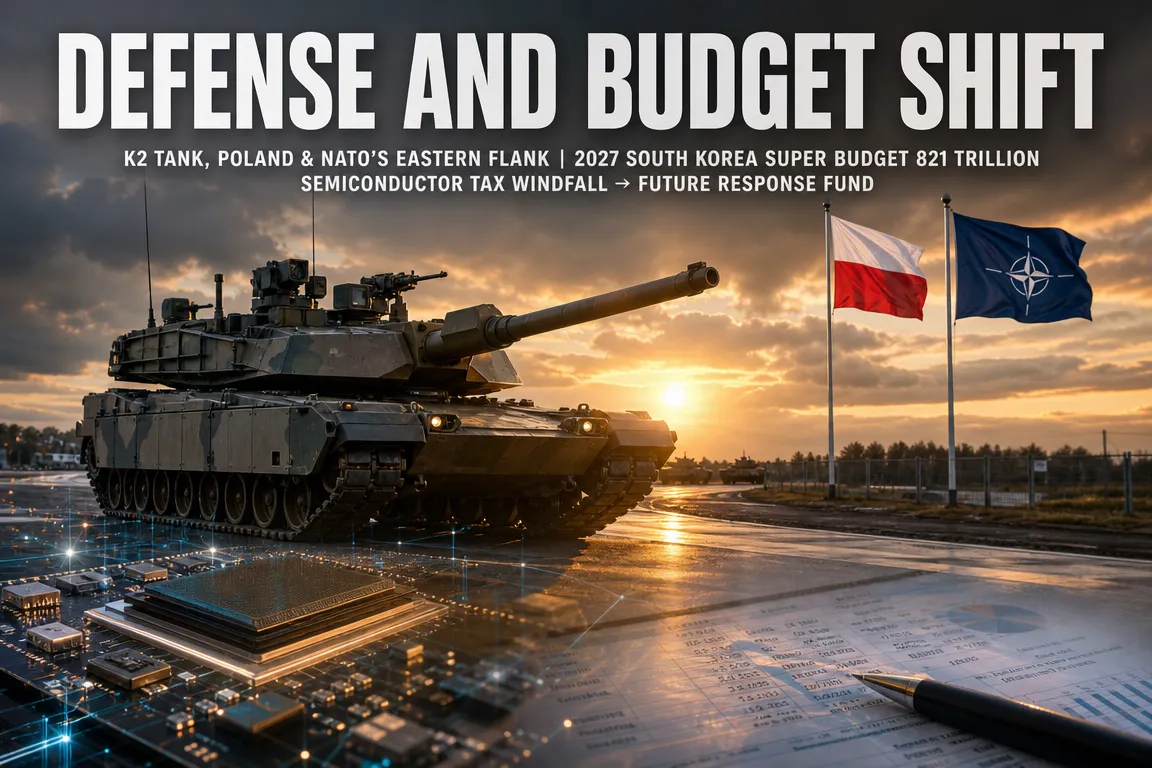
2027 Budget Proposal of KRW 821 Trillion: Growth Investment or a Policy Mismatch with Monetary Tightening?
The most important point in the 2027 budget proposal is not simply that spending reaches KRW 821 trillion.
The key issues are where the government concentrates spending, how much fiscal resilience is supported by semiconductor-related tax revenue windfalls, and whether the budget may conflict with the Bank of Korea’s monetary policy.
In particular, the extent to which ultra-innovation projects linked to industry, SMEs, energy, semiconductors, SMRs, K-content, and AI infrastructure reshape Korea’s future growth engines is the main focus.
Although the budget is expansionary on the surface, it is also connected to growth-rate defense, potential growth recovery, fiscal rule debates, housing market stability, and KRW management.
1. 2027 Budget Size: KRW 821 Trillion, Why Is It a “Super Budget”?
The government’s 2027 budget proposal totals KRW 821 trillion.
This is about 12.8% higher than the 2026 main budget of KRW 728 trillion.
In Korea’s budget history, a double-digit increase is highly unusual.
Even in 2019, when the budget rose 9.5%, the term “super budget” was used; this proposal exceeds that level.
- 2026 main budget: KRW 728 trillion
- 2027 budget proposal: KRW 821 trillion
- Year-on-year increase: 12.8%
- Core character: expansionary fiscal policy, growth investment, future industry support
A budget of KRW 821 trillion implies substantial liquidity injection into the economy.
Greater liquidity can affect inflation, housing markets, exchange rates, and interest-rate policy.
Accordingly, the key issue is not how much is being spent, but where the money is allocated.
2. Fiscal Revenue at KRW 880 Trillion: Semiconductor Tax Windfalls Provide a Buffer
An important feature is that 2027 fiscal spending is projected at KRW 821 trillion, while fiscal revenue is forecast at KRW 880 trillion.
This suggests the budget is not relying solely on debt-financed spending.
Stronger semiconductor-cycle conditions in 2026 and improved export-sector earnings are likely to translate into higher corporate tax revenue in 2027.
- 2027 fiscal spending plan: KRW 821 trillion
- 2027 fiscal revenue forecast: KRW 880 trillion
- Main drivers: semiconductor cycle strength, export-sector earnings improvement, higher corporate tax revenue
- Key implication: expansionary fiscal stance with partial revenue support
This is positive from a fiscal sustainability perspective.
If spending increases are matched by higher revenue, the fiscal burden is reduced.
In particular, semiconductor-related tax windfalls are the central variable enabling this budget proposal.
3. Possibility of Ending Eight Consecutive Years of Deficit Budgeting: Positive, but Not a Reason for Complacency
Korea has maintained a deficit-oriented fiscal structure for several years.
The original text indicates that deficit budgets have continued for about eight consecutive years.
Persistent deficits increase national debt and may weigh on KRW valuation from the perspective of global investors.
A positive aspect of the 2027 budget proposal is that stronger revenue may allow the government to move away from a persistent deficit trend.
More precisely, the managed fiscal balance may remain in deficit, but the deficit gap could narrow materially.
- Positive factor: narrower deficit gap due to revenue growth
- Positive factor: improved national debt ratio management
- Risk factor: deficits may widen again after 2028, 2029, and 2030
- Core view: 2027 shows improvement, but medium-term fiscal planning remains uncertain
What matters more than the absolute level of national debt is the debt-to-GDP ratio.
Debt can be absorbed to a certain extent if the economy expands.
However, with slower growth and population decline, debt ratio management becomes increasingly important.
The original text notes a possible decline in the debt-to-GDP ratio from 50.6% to 48.3%.
If realized, this would be a favorable signal for fiscal sustainability.
4. The Main Issue: Expansionary Fiscal Policy May Move in the Opposite Direction from Monetary Policy
The largest debate surrounding the budget is that the government’s expansionary fiscal stance may conflict with the Bank of Korea’s monetary policy.
The government will inject funds through the KRW 821 trillion budget.
By contrast, the Bank of Korea may choose tighter monetary policy or interest-rate increases to stabilize inflation.
In simple terms, the government may turn the heater on strongly while the central bank opens the window to release heat.
When policy directions diverge, the effectiveness of fiscal stimulus declines and the burden on monetary policy increases.
- Government stance: expansionary fiscal policy to support growth and defend growth rates
- Bank of Korea stance: interest-rate tightening or restrictive policy to stabilize inflation
- Conflict risk: liquidity expansion versus price-stability objectives
- Market impact: housing, exchange rates, household debt, and consumer sentiment
This issue is especially sensitive in the housing market.
Even if the government seeks housing-market stability, a large-scale budget can increase liquidity and re-ignite asset prices.
When the value of money declines, the cost of purchasing the same apartment rises.
This can create upward pressure on housing prices.
5. The Less Discussed Core Issue: How Semiconductor Tax Windfalls Are Allocated Matters More
Other media and video commentary tend to focus on “a KRW 821 trillion super budget,” “more liquidity,” or “expanded growth investment.”
However, the more important question is how semiconductor-related tax windfalls and surplus revenues are processed.
Under Korea’s National Finance Act, excess tax revenue must be handled in a specific order.
Local transfer settlements come first.
Then settlements related to local education grants and other transfer funds follow.
After that, allocations such as contributions to the public funds repayment mechanism become relevant.
- Step 1: Settlement of local transfer grants
- Step 2: Settlement of local education financial grants
- Step 3: Contributions related to public debt repayment and fiscal obligations
- Issue: whether remaining funds can be used flexibly through a future response fund
The future response fund is the key issue.
Its policy purpose is reasonable.
It allows responses to unexpected shocks such as pandemics, wars, global supply-chain disruptions, and energy crises.
However, if it can be used flexibly without supplementary budget approval by the National Assembly, it may function like a de facto permanent supplementary budget mechanism.
Fiscal flexibility is an advantage, but it may weaken democratic oversight and legal discipline.
This is one of the least discussed but most important issues in the 2027 budget proposal.
6. Where the Budget Is Concentrated: Industry, SMEs, and Energy Are the Main Areas
The 2027 budget proposal is divided into 12 sectors, but the fastest-growing areas are industry, SMEs, and energy.
This indicates that the government is placing greater weight on growth foundations than on simple welfare expansion.
- Industrial sector: advanced manufacturing and future strategic industries
- SME sector: scaling up, financial support, and overseas expansion
- Energy sector: power infrastructure, nuclear power, SMRs, and energy security
- Technology sector: R&D, semiconductors, AI, content, and digital transformation
Korea’s economy faces structural problems, including long-term low growth and declining potential growth.
Accordingly, the direction of the budget is not only to support short-term growth, but also to improve potential growth.
7. Ultra-Innovation Projects: The Growth Engine of the 2027 Budget
The key term in the budget proposal is the ultra-innovation project.
This is not simply a subsidy program for selected industries.
It is a strategy that links R&D, talent development, financial support, overseas expansion, and deregulation to build a growth ecosystem.
- R&D investment: development of future technologies
- Talent development: securing skilled workers for advanced industries
- Financial support: backing startups, SMEs, and scaling companies
- Overseas expansion: export market growth and global supply-chain participation
- Deregulation: lowering barriers to entry for new industries
Examples include SiC semiconductors, SMRs, AI infrastructure, and the content industry.
SiC semiconductors are linked to electric vehicles, power semiconductors, and energy efficiency.
SMRs are viewed as next-generation nuclear technology and a potential solution for rising power demand in the AI data-center era.
AI competitiveness is also closely tied to this budget.
AI strength is not determined by software models alone.
It requires semiconductors, power grids, data centers, cloud infrastructure, talent, and content IP to move together.
The reason the 2027 budget emphasizes industry and energy is ultimately tied to infrastructure competition in the AI era.
8. K-Content Budget: Targeting Growth in the Global Content Market
One notable example in the original text is K-content.
Even as global GDP growth remains below 3%, the global content market is growing at roughly 5% to 6% annually.
This suggests that the content industry has relatively strong growth potential in a low-growth environment.
- High-growth areas: music, gaming, film, and video content
- More challenged area: print-based industries such as publishing
- Core strategy: expand K-content in global markets
- Policy tools: R&D, production support, financial support, talent development, and overseas expansion
The K-content value chain is centered on planning, development, production, distribution, consumption, and IP expansion.
The government intends to improve global competitiveness by investing across this entire chain.
- Ministry of Culture, Sports and Tourism: production support, talent development, overseas expansion
- Ministry of Science and ICT: technology R&D support for content
- Ministry of Trade, Industry and Energy: industrialization and export linkage
- Ministry of SMEs and Startups: support for content startups and SMEs
- Financial Services Commission: financing support mechanisms for content companies
The content industry is also linked to AI trends.
Generative AI is reshaping video production, music generation, game development, translation, dubbing, and global distribution.
Accordingly, the K-content budget should be viewed not only as a cultural allocation, but also as a digital export-industries budget built around AI.
9. Positive Factors: The Budget Is Growth-Oriented
A positive aspect of the 2027 budget proposal is its focus on growth.
Korea faces structural challenges such as population decline, slowing productivity, weak domestic demand, and lower potential growth.
In this context, concentrating spending on future industries, advanced technologies, energy infrastructure, and export industries is necessary.
- Positive factor 1: partial fiscal relief from semiconductor tax windfalls
- Positive factor 2: expanded growth investment centered on industry and energy
- Positive factor 3: possible improvement in debt ratio management
- Positive factor 4: support for future industries such as K-content, AI, and SMRs
- Positive factor 5: policy design aimed at restoring potential growth
In particular, Korea needs industrial restructuring more than short-term stimulus in order to escape a prolonged low-growth phase.
The budget appears to be designed with that objective in mind, which is a constructive sign.
10. Risks: Inflation, Housing, Exchange Rates, and Fiscal Procedure Remain Key Variables
At the same time, there are clear risks.
First, expansionary fiscal policy may create pressure on inflation.
Second, liquidity expansion may conflict with housing-market stabilization.
Third, if monetary and fiscal policy move in opposite directions, policy effectiveness may weaken.
Fourth, the process of using tax windfalls may weaken procedural discipline and National Assembly oversight.
- Risk 1: conflict between expansionary fiscal policy and interest-rate policy
- Risk 2: possible re-ignition of housing prices
- Risk 3: increased volatility in KRW and exchange rates
- Risk 4: possible weakening of fiscal discipline through flexible use of the future response fund
- Risk 5: renewed fiscal deficit risk after 2028
Ultimately, this budget cannot be judged simply as good or bad.
The policy direction is growth-oriented, but it requires coordination and fiscal discipline.
11. Key Points for Investors and Companies
The 2027 budget proposal also sends important signals to investors and corporations.
Sectors that receive budget support are likely to see related industrial policy, deregulation, financial support, and tax incentives.
- Semiconductors: SiC semiconductors, power semiconductors, and AI semiconductor ecosystems
- Energy: SMRs, power grids, and data-center power infrastructure
- AI: cloud, data centers, AI services, and generative AI content
- Content: gaming, music, video, and IP expansion companies
- SMEs: export-oriented companies, technology-specialized firms, and scaling companies
However, relying solely on the budget to make investment decisions is risky.
The budget is only a directional signal, while actual beneficiaries depend on implementation speed, regulatory changes, corporate earnings, and global demand.
12. Conclusion: The Core of the KRW 821 Trillion Budget Is Growth-Rate Defense, Not Simple Spending Expansion
The 2027 budget proposal of KRW 821 trillion is clearly a super budget.
However, the core issue is not simple fiscal expansion.
Its main purpose is to defend Korea’s growth rate and address long-term low growth and declining potential growth.
Semiconductor-related tax windfalls have partially eased fiscal concerns.
Budget allocations to industry, SMEs, energy, K-content, and AI infrastructure are also constructive.
At the same time, if monetary policy moves in the opposite direction, inflation and housing-market stability may face pressure.
In addition, the handling of tax windfalls and the future response fund must comply with fiscal rules and legal procedures.
During the National Assembly’s budget review, policy coordination matters more than political confrontation.
For the KRW 821 trillion budget to support Korea’s future growth rate, not only spending priorities but also policy coordination and oversight will be decisive.
< Summary >
The 2027 budget proposal totals KRW 821 trillion, up 12.8% from the previous year, making it a super budget.
Fiscal revenue is projected at KRW 880 trillion, supported by semiconductor-related tax windfalls, which partially ease fiscal pressure.
The budget is concentrated in growth areas such as industry, SMEs, energy, semiconductors, SMRs, K-content, and AI infrastructure.
On the positive side, it may support potential growth recovery and future industry development.
The main risk is that expansionary fiscal policy could conflict with the Bank of Korea’s monetary stance, inflation control, and housing-market stability.
The least visible but most important issue is whether semiconductor tax windfalls and the future response fund are managed transparently and in line with the National Finance Act.
[Related Articles…]
- 2027 Economic Outlook and Global Cycle Shift
- Semiconductor Supercycle and AI Infrastructure Investment Trends
*Source: [ 경제 읽어주는 남자(김광석TV) ]
– 2027년 예산안 821조원. 어디에 쓰일까? 통화정책과 엇박자인가? [경읽남 264화]
● Europe on Edge, Russia Cornered, K-Defense Soars
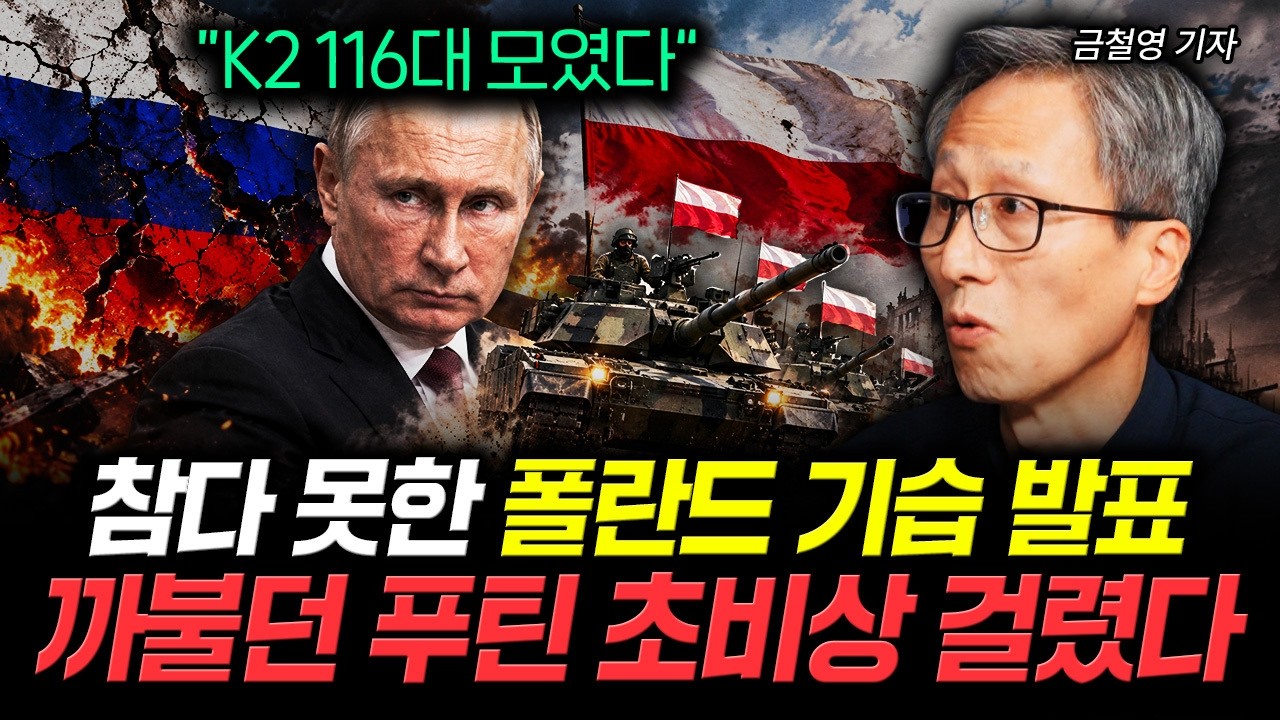
Poland’s Deployment of 116 K2 Tanks and the Escalating Russia Risk: Why European Security, K-Defense, and the Global Outlook Are Being Repriced Simultaneously
The key issue is not simply that Poland has concentrated a large number of K2 tanks.
Poland’s rapid operational deployment of K2 tanks indicates that NATO’s eastern flank is moving from planning to actual force posture.
This is occurring alongside allegations that a drone carrying explosives was used in an incident involving a Ukrainian aircraft at a German airport, Russia’s moves around the Kuril Islands, and heightened security concerns in Japan, creating a dual-front geopolitical risk environment spanning Europe and Asia.
This article summarizes why Poland’s 116 K2 tanks are a burden for Putin, how realistic NATO intervention risks are, and how this trend may affect defense stocks, energy prices, supply-chain restructuring, and the AI sector.
1. The K2 Tank Issue in Poland: The Critical Point Is Speed, Not Scale
The most notable point in the original report is that 116 K2 tanks have been concentrated in Poland.
The significance lies not in the number alone, but in the fact that Poland is rapidly completing force deployment on NATO’s eastern flank.
-
Poland is NATO’s front-line state.
Its location near Russia, Belarus, and Kaliningrad makes it a central buffer in European security.
-
The K2 tank is not merely an imported weapon but a capability to close a force gap quickly.
While deliveries of German and U.S. platforms have faced delays, South Korea’s K2 has benefited from faster delivery and stable production capacity.
-
For Russia, the post-war NATO environment is materially different.
NATO has shifted from a primarily political alliance to one that is actively reallocating weapons, personnel, ammunition, and air defense assets.
In that sense, Poland’s K2 deployment signals to Russia that NATO’s eastern line is fully occupied.
As a result, K-defense exports are increasingly influencing both the global security landscape and macroeconomic expectations.
2. Why Putin Faces a Growing Burden: Poland Has Shifted from Buffer Zone to Forward Base
Russia has historically preferred buffer zones around its borders.
That strategic environment has changed after the war in Ukraine.
Poland, Finland, and the Baltic states are arming more aggressively despite their proximity to Russia.
Poland’s K2 procurement symbolically reflects this shift.
Russia now faces pressure not only from the war in Ukraine, but also from Poland’s rearmament to the west, Finland’s NATO membership to the north, and territorial friction with Japan in the east.
-
First, Russia’s coercive military effect is weakened.
A heavily armed Poland makes it harder for Russia to threaten NATO’s eastern flank.
-
Second, Ukraine support lines become more resilient.
Poland remains a critical transit hub for weapons, logistics, and humanitarian assistance to Ukraine.
-
Third, Europe’s defense-industrial ecosystem is being reorganized.
South Korean weapons are now embedded in Europe’s security structure, raising the profile of K-defense.
Poland’s K2 deployment is therefore both an economic story about Korean exports and a security story about shrinking Russian strategic space.
3. Why the German Airport Drone Incident Matters: A Gray-Zone Path to NATO Involvement
The original text refers to a drone carrying explosives being found at a German airport and allegedly targeting a Ukrainian aircraft.
This claim would require further verification, but if an attack attempt on a Ukraine-related aircraft or facility inside NATO territory were confirmed, it would be highly sensitive.
The key issue is not whether Article 5 of the NATO treaty is automatically triggered.
More important is that if Russia or pro-Russian actors expand hybrid warfare inside NATO territory through drones, cyberattacks, or sabotage, the threshold for military response becomes less clear.
-
Drone attacks are difficult to attribute.
It is often unclear whether such actions are state-directed or carried out by proxy groups, complicating escalation decisions.
-
Airports, ports, railways, and logistics hubs are strategic targets even if they are not military facilities.
Infrastructure supporting Ukraine can be exposed to disruption.
-
NATO will likely weigh intermediate responses between direct intervention and non-intervention.
Possible measures include stronger air defense, expanded intelligence operations, cyber countermeasures, and greater support for Ukraine.
Accordingly, while “world war” rhetoric may be excessive, the accumulation of gray-zone incidents is increasing the risk of escalation.
4. Russia’s Kuril Islands Moves and Japan’s Dilemma: The European War Is Affecting Asian Security
The original text also notes Russian moves involving the Kuril Islands, which are politically sensitive for Japan.
The islands are linked to Japan’s Northern Territories claim.
Any effort by Russia to reinforce its presence there increases diplomatic and security pressure on Japan.
The important point is that Russia is not operating only in Europe.
Even while fighting in Ukraine and confronting the West, Moscow retains tools to pressure Japan in Northeast Asia.
-
Japan is participating in sanctions against Russia.
As a result, bilateral relations are more strained than before the war.
-
The Kuril issue is politically sensitive inside Japan.
If the government underreacts, it risks criticism for weak security posture; if it overreacts, tensions could deepen further.
-
Northeast Asian security dynamics also affect South Korea.
Greater Russia-China-North Korea alignment would likely raise South Korea’s security burden and support demand for defense procurement.
The Kuril issue is therefore not only a bilateral dispute, but also a linkage between the European war and Northeast Asian security.
5. The More Important Economic Point: Defense Is Now a Strategic Sector, Not Just a Cyclical One
From an economic perspective, the main shift is the rising strategic importance of defense.
Defense was once viewed as a government-dependent, limited sector.
It is now increasingly tied to energy, semiconductors, AI, shipbuilding, and aerospace as a national strategic industry.
Europe’s rearmament is creating direct opportunities for the Korean economy.
Platforms such as the K2 tank, K9 self-propelled howitzer, Chunmoo, and FA-50 are not limited to one-time sales.
They can generate recurring revenue through maintenance, parts, ammunition, training, local production, and software upgrades.
-
For defense stocks, order backlog and delivery capacity are the key metrics.
Actual production and delivery timelines matter more than headline contract values.
-
In supply-chain terms, Korea’s manufacturing reliability is increasingly relevant.
Europe now wants not only advanced systems but also timely delivery.
-
Higher defense spending also affects fiscal and rate expectations.
Rising military budgets may widen deficits and increase pressure on bond issuance and inflation.
Poland’s K2 deployment should therefore be seen as a structural shift, not merely a short-term defense trade theme.
6. AI Trend Implications: Modern Warfare Depends on Intelligent Networks, Not Just Tanks
The K2 tank itself matters, but the larger issue is the network in which it operates.
The war in Ukraine has shown that modern battlefields are built around tanks, drones, satellites, electronic warfare, and AI-enabled analytics.
Military competitiveness is no longer determined only by hardware performance.
It now also depends on AI-based target identification, battlefield data analysis, drone defense, predictive maintenance, and cybersecurity.
-
Demand is increasing for AI-based drone detection and electronic warfare systems.
Low-cost drones can threaten expensive systems, making air defense and electronic countermeasures more important.
-
Tanks are becoming data platforms.
They now need to operate as part of a real-time network with drones, artillery, infantry, and satellites.
-
AI is gaining a new growth channel through defense demand.
While civilian AI drives productivity, defense AI is becoming central to survivability and response speed.
As a result, the competitive edge of K-defense is likely to depend not only on steel and engines, but also on software, sensors, AI, and communications systems.
7. The Key Point Often Missed in Coverage: The Real Contest Is Sustained Production Capacity
The most important but often overlooked issue is production capacity.
In a prolonged war, the deciding factor is not a small number of advanced systems, but the ability to replace lost equipment and ammunition quickly.
Russia has expanded wartime weapons production despite Western sanctions.
By contrast, Europe sharply reduced defense manufacturing capacity after the Cold War, making rapid expansion difficult.
This explains why Korea is drawing attention.
Korea has maintained a meaningful defense production base due to its security environment on the Korean Peninsula, along with a strong manufacturing foundation.
For Europe, Korea can serve not only as a seller but also as a partner that helps fill production gaps.
-
Europe is short on time.
In the face of Russian pressure, forces that can be deployed within 2–3 years matter more than systems planned for 10 years later.
-
Korea’s delivery reliability is a key advantage.
Its industrial base supports faster production and supply.
-
Over the long term, local production and technology transfer will be critical.
Poland wants not only finished products but also stronger domestic defense capabilities.
This is why defense exports should be viewed as an industrial restructuring trend, not just a short-term headline.
8. Key Points for Investors and Industry Participants
This trend has important implications for both investors and companies.
However, defense themes are highly sensitive to politics, diplomacy, contracts, delivery schedules, and exchange rates, so simple momentum trading should be approached cautiously.
-
First, monitor Europe’s defense-spending trend.
Whether NATO members actually meet the 2% of GDP target remains a central issue.
-
Second, review Korean defense companies’ order backlogs and delivery schedules.
Revenue recognition timing matters more than contract announcements.
-
Third, watch exchange rates and raw-material prices.
Higher input and logistics costs can affect profitability even when exports rise.
-
Fourth, track AI and drone-defense technologies together.
Future defense competitiveness is shifting toward software- and network-centric systems.
-
Fifth, geopolitical risk could re-accelerate energy prices.
Rising tensions between Europe and Russia may increase volatility in gas, oil, and power markets.
9. Likely Scenario: Prolonged Tension Is More Plausible Than Immediate Escalation
It is premature to link the current situation directly to a global war scenario.
However, elevated tension in both Europe and Northeast Asia is clearly a risk factor.
The most plausible outcome is not full-scale war, but a prolonged period of military tension and gray-zone conflict.
Drone incursions, cyberattacks, threats to undersea cables, logistics disruption, election interference, and information warfare are likely to continue.
-
Base case: Poland and NATO reinforce defenses while Russia avoids direct confrontation and continues pressure.
-
Risk case: Repeated drone attacks or sabotage inside NATO territory raise the likelihood of a stronger military response.
-
Economic case: Defense, energy, cybersecurity, and AI-related military technologies continue to see structural demand, while fiscal pressure in Europe rises.
In conclusion, Poland’s 116 K2 tanks represent both a military signal to Russia and a demonstration of Korea’s rising defense profile.
They also illustrate how geopolitical risk is feeding into global economic expectations, defense stocks, AI demand, and supply-chain restructuring.
The most important factor is not total weapons inventory, but sustained production capacity and delivery reliability over a prolonged conflict.
< Summary >
Poland’s operational deployment of K2 tanks indicates that NATO’s eastern flank is being materially strengthened.
Russia now faces pressure not only in Ukraine, but also around Poland, Japan, and the Kuril Islands.
Gray-zone incidents such as the German airport drone case are increasing the risk of escalation.
Economically, K-defense, defense stocks, energy prices, supply-chain restructuring, and AI-enabled defense technologies are all gaining attention.
The key issue is not the number of weapons, but the long-term production capacity and delivery reliability needed to sustain a conflict.
[Related Articles…]
-
European Rearmament and K-Defense Exports: How Global Defense Stocks Are Being Repriced
-
AI Warfare, Drone Detection, and Cybersecurity: The Next Growth Cycle in Defense Technology
*Source: [ 달란트투자 ]
– “K2 116대 모였다” 참다 못한 폴란드 기습 발표 까불던 푸틴 초비상 걸렸다 | 금철영 기자 2부