● Tesla Shock, Trump Eases Rules, EU FSD Delay, Musk Growth Bet
Trump’s Fuel Economy Rollback and Delayed EU FSD Vote: The Real Variables for Tesla Stock
The core of this issue is not simply that Trump has loosened EV rules.
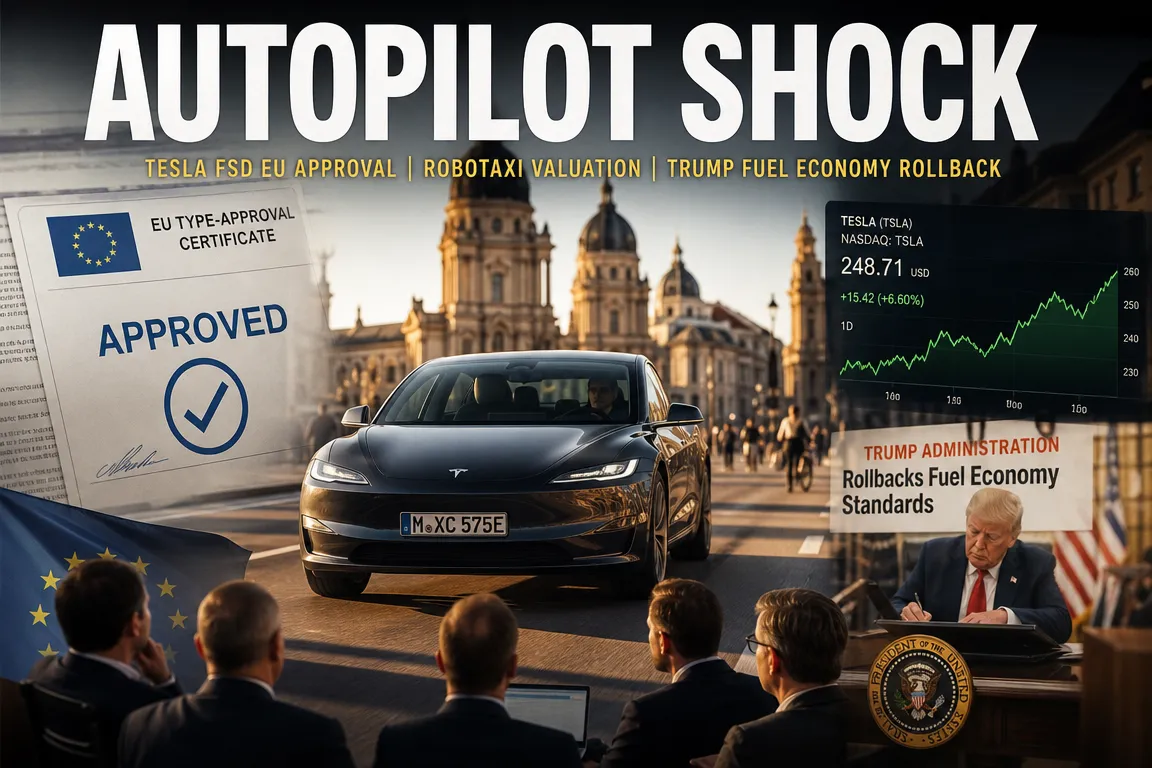
Tesla’s legacy earnings model tied to regulatory credits is effectively fading, while a full EU approval for FSD may be pushed back to December.
At the same time, higher U.S. gasoline prices, elevated interest rates, robotaxi valuation, SpaceX Starship’s commercial flight progress, and Google’s AI satellite test are all intersecting.
For investors viewing Tesla around $372, the key question is no longer how many cars it sells, but whether the market values Tesla as an automaker or as an AI robotaxi platform.
1. Trump’s New Fuel Economy Standards: Negative for Tesla?
President Trump said he approved new fuel economy standards that end the Biden administration’s EV mandate approach.
The rules must still be formally initiated by the U.S. Department of Transportation and NHTSA to take effect.
The prior Biden target was 50.4 miles per gallon for 2031 model-year vehicles.
The new standard would lower that to around 34.5 miles per gallon.
In Korean units, that is roughly a shift from over 21 km per liter to about 15 km per liter.
- The direct beneficiaries of looser fuel economy rules are GM, Ford, and Stellantis.
- Companies with high exposure to pickup trucks and large SUVs would face less penalty risk.
- Tesla sells only EVs, so it does not need to adjust its fleet to meet fuel economy requirements.
- Accordingly, Tesla being absent from Trump’s list of beneficiaries is not unusual.
At face value, this may appear negative for Tesla.
However, it is better understood as the formalization of a long-running decline in regulatory credit economics rather than a new shock.
2. Regulatory Credits Were a Key Driver of Tesla’s First Profits
Tesla earned substantial profits for years through regulatory credits.
Regulatory credits are sold by companies that exceed emissions or fuel economy standards to firms that fall short of those requirements.
Because Tesla sold only EVs, it generated excess credits, while legacy automakers paid Tesla for them.
- Tesla’s net income in 2020 was about $721 million.
- Regulatory credit revenue in the same year was about $1.58 billion.
- Tesla’s first annual profit was therefore heavily supported by credit sales.
- Because credits carry minimal cost, they flow directly into operating profit.
Tesla management has long said it does not view regulatory credits as a core long-term business.
The company understood that this was always going to be a temporary revenue source.
That structure has recently weakened more quickly.
As penalty pressure declines, competitors have less incentive to buy Tesla’s credits.
Companies such as Stellantis are shifting toward U.S. manufacturing investment rather than credit purchases.
3. The More Important Issue Is Tesla’s Profit Resilience
Tesla reportedly generated about KRW 370 billion from regulatory credits in 2024, based on the source material.
However, credit revenue appears to have fallen sharply in recent quarters.
In the second quarter, it reportedly declined to around KRW 200 billion, only a fraction of the prior-year level.
The key point is this.
The decline in credit revenue is a burden for Tesla.
But the market has already understood that this is not a permanent earnings stream.
Trump’s fuel economy rollback is therefore less a sudden loss than the formal closure of a weakening source of income.
Even so, relative to Tesla’s operating income, the amount remains meaningful.
When EV subsidies are reduced, regulatory credits decline, and rates remain high, automotive margins remain under pressure.
4. Delayed EU FSD Vote Is a More Material Variable
More important than U.S. regulatory easing is the delay in EU FSD approval.
A full EU-level vote had been expected, but the published agenda appears to have shifted from voting to continued discussion.
As a result, broader approval may be delayed until the December meeting.
According to the source text, FSD is currently permitted in seven countries:
- Netherlands
- Lithuania
- Estonia
- Denmark
- Belgium
- Slovenia
- Czech Republic
The combined population of these countries is about 53 million.
That represents roughly 12% of the EU population.
For Tesla to scale FSD across Europe, it needs much broader market access.
France is currently viewed as skeptical of the system.
Sweden is also taking a cautious stance due to speed-limit-related concerns.
Accordingly, Tesla appears to be pursuing country-by-country approvals in parallel with waiting for EU-wide authorization.
Reported discussions with Irish authorities are consistent with that strategy.
5. Why the EU Delay Matters for Tesla Stock
There are two valuation frameworks for Tesla stock.
The first is the automaker framework.
That model focuses on deliveries, average selling price, margin, regulatory credits, and production cost.
The second is the AI robotaxi platform framework.
That model focuses on FSD approval markets, cities with real driverless operation, robotaxi fleet size, and potential software revenue.
This is also why Wall Street’s price targets diverge so widely.
If Tesla is valued as an EV manufacturer, the multiple is harder to justify.
If it is valued as a robotaxi and autonomous-driving AI platform, a much higher multiple becomes possible.
For that reason, the EU FSD delay is not just an administrative issue.
It can slow the pace at which Tesla is re-rated from an automaker into an AI mobility platform.
6. Rising U.S. Gasoline Prices Could Support EV Demand
The source cites average U.S. gasoline prices at $4.48 per gallon.
That is about 43% higher than $3.14 a year earlier.
On a liter basis, that is roughly KRW 1,600.
From a household budget perspective, the impact is significant.
A family spending KRW 200,000 per month on fuel could now face KRW 280,000 to KRW 300,000.
That implies an additional burden of roughly KRW 80,000 to KRW 90,000 per month.
The Trump administration argues that looser fuel economy standards could lower new vehicle prices by about $1,000.
However, consumers consider not only sticker price but also fuel costs, insurance, financing rates, and maintenance.
If oil rises above $100 per barrel and energy prices remain elevated, the case for EV adoption could strengthen again.
At the same time, high interest rates increase auto-loan costs, which can delay purchases.
7. Tesla U.S. Sales Decline, Yet Market Share Improved
According to the source, Tesla U.S. sales fell by more than 16% year over year.
That is clearly not a trivial number.
However, if the overall U.S. EV market declined by about 30% in the same period, the interpretation changes.
Tesla fell less than the market, while competitors declined more sharply.
As a result, Tesla’s U.S. EV market share reportedly rose back to around 52%.
- Ford’s F-150 Lightning is under sales pressure.
- Volkswagen’s ID.4 is also struggling in the U.S. market.
- Honda’s Prologue faces questions about long-term competitiveness.
- When EV subsidies disappear, the losses of late-entry automakers can become more severe.
This is one reason Elon Musk has previously argued for removing subsidies.
Without subsidies, Tesla is affected, but competitors may be hit harder.
8. SpaceX Starship Moves Closer to a Commercial Flight Model
The 14th Starship launch is another issue that Tesla ecosystem investors should watch.
The first 13 flights were largely test flights that returned within about an hour after reaching space.
This time, the vehicle is expected to complete its first orbital flight.
- Planned altitude is about 275 km.
- The vehicle may orbit Earth about six times.
- Flight duration is expected to approach 10 hours.
- It will carry 26 Starlink V3 satellites.
- The 26 satellites are described as having roughly 10 times the communication capacity of a single Falcon 9 launch.
This is significant.
Starship could be moving from a test rocket to a commercial transport vehicle.
Lower launch costs at SpaceX would support Starlink, space-based data centers, and broader AI infrastructure expansion over time.
9. Google’s AI Satellite Test Points to the Next Stage of Infrastructure Competition
Google is expected to launch a satellite carrying its own AI chips aboard a SpaceX rocket.
The satellite is described as refrigerator-sized and contains four Google AI chips.
This is not simply a space headline.
It is an early test of extending AI compute and data infrastructure into orbit.
Ground-based data centers face pressure from power, cooling, land, and regulation.
That is why long-term expansion into space-based compute or communications infrastructure remains under discussion.
Google is also reported to hold about a 6% stake in SpaceX.
Collaboration between Google and SpaceX may become more important in the AI infrastructure race.
10. Roadster: The Real Story Is Technology Demonstration, Not Price
Ahead of the Roadster reveal, one Tesla patent has drawn attention.
It concerns an active rear spoiler mounted at the back of the vehicle.
- In normal driving, it remains hidden and aligned with the trunk lid.
- During cornering or hard braking, it rises to increase downforce.
- At high-speed cruising, it lies flat to reduce drag.
- If collision avoidance is deemed difficult, it folds away to reduce secondary damage.
There is no guarantee this patent will be used in the final production Roadster.
However, Tesla is likely to use the Roadster as a technology showcase rather than just a high-performance sports car.
Investors will be watching three items in the presentation:
- Roadster pricing
- Final performance specifications
- Production schedule and volume targets
For customers who reserved in 2017, this would be the first substantive update in nearly nine years.
The structure of the SpaceX package will also be an important point of interest.
11. In-House Cathode Cybercab: Tesla’s Key Cost-Reduction Tool
Tesla reportedly unveiled its first Cybercab using in-house cathode material.
The cathode material was produced at a plant near Giga Texas.
The cathode is one of the most expensive components in a battery cell.
It often accounts for more than one-third of cell cost.
If Tesla succeeds in internalizing cathode production, the long-term cost savings could be material.
This receives less attention than some other headlines, but it is highly important for Tesla’s auto margins.
As regulatory credits decline and EV subsidies disappear, cost competitiveness becomes the main determinant of profitability.
12. Key Points That Are Easy to Miss in the Broader News Flow
First, Trump’s rollback is not a new existential blow to Tesla, but rather the formalization of a pre-existing decline in credit revenue.
The market already understood that regulatory credits were not a permanent earnings source.
Second, the EU FSD approval delay is the more important obstacle for Tesla.
For the market to value Tesla more as a robotaxi platform than as a car company, broader FSD approval is essential.
Third, rising U.S. gasoline prices could re-support EV demand.
However, high rates are simultaneously increasing financing burdens, making consumer behavior less straightforward.
Fourth, competing EV pullbacks may support Tesla’s relative market position.
Even if the market shrinks, Tesla can strengthen its position if competitors exit faster.
Fifth, Google’s AI satellite test and Starship progress suggest the next phase of AI infrastructure competition may move into space.
That is also why Tesla, SpaceX, xAI, and Starlink are increasingly viewed as part of a single technology ecosystem.
13. What Tesla Shareholders Around $372 Should Watch
- Whether Q3 deliveries exceed Street expectations
- Whether automotive gross margin can absorb lower regulatory credit income
- Whether the EU FSD vote makes progress in December
- Whether higher U.S. gasoline prices translate into stronger EV demand
- How often robotaxi questions arise during the earnings call
- Whether Cybercab and in-house cathode production support the cost-reduction narrative
- Whether Starship and Google’s AI satellite test expand the valuation case for AI infrastructure
Tesla stock should not be judged solely on vehicle sales in the current environment.
If the market starts to value robotaxis, FSD, AI infrastructure, and energy storage together, a different framework will apply.
The central issue is whether Wall Street continues to view Tesla as a carmaker or begins to treat it as an AI-enabled mobility platform.
< Summary >
Trump’s fuel economy rollback benefits GM, Ford, and Stellantis, while Tesla faces a decline in regulatory credit economics.
However, credit revenue was already falling, so this is more an extension of an existing trend than a new shock.
The more important variable for Tesla is the delay in EU FSD approval, with broader authorization likely deferred until December.
Higher U.S. gasoline prices could support EV demand, but elevated interest rates remain a counterweight.
SpaceX Starship, Google’s AI satellite, the Roadster, and in-house cathode Cybercab all strengthen Tesla’s long-term ecosystem narrative.
At around $372, Tesla shareholders should focus more on FSD approval, robotaxi expansion, and AI infrastructure re-rating than on automotive margins alone.
[Related Articles…]
*Source: [ 오늘의 테슬라 뉴스 ]
– 트럼프는 규제를 풀고 EU는 표결을 미뤘다 — 같은 주말 테슬라가 맞은 두 개의 벽, $372 주주는?● White-Collar Shock
The End of the Ordinary White-Collar Worker, Not the End of Office Work
The central argument of this discussion is direct.
In the AI era, the workforce appears to be narrowing into two viable groups.
One group consists of leader-type talent that can direct AI agents and generate measurable outcomes.
The other consists of blue-collar specialists with manual skills and field-based judgment that AI cannot easily absorb as data.
The most exposed segment is the ordinary office worker whose role is limited to document preparation, reporting, and coordination.
This connects to AI-driven labor market change, the restructuring of future jobs, the decline and redesign of vocational education, AI infrastructure investment, and labor-market polarization in the broader economic outlook.
1. The Four-Year College Model Is Weakening
The first major issue raised in the discussion was the education system.
Historically, attending a strong university for four years and then entering a major company was an effective pathway.
That model is losing relevance in the AI era.
- The value of theory-heavy university education is declining.
- Companies now prefer candidates who can perform work immediately, rather than those with only credentials.
- Large technology firms and AI companies are increasingly training talent internally rather than relying on universities.
A representative example is Palantir’s Meritocracy Fellowship.
The program selects top U.S. high school students, trains them at the company for four months, and then connects them to employment.
This is closer to apprenticeship training than to a standard internship.
It is structured around practical learning beside experienced professionals on real projects.
This trend is also linked to Peter Thiel’s Thiel Fellowship.
The fellowship supports talented students at or near elite universities with funding to leave school and start companies.
The discussion noted that many participants later founded unicorn companies and that innovations such as Ethereum emerged from this environment.
The key message is clear.
The assumption that talented people must spend four years in university is now being openly questioned.
2. Companies Are Becoming the Primary Developers of Talent
U.S. companies are absorbing the practical training that universities often do not provide.
From a corporate perspective, it is difficult to find externally trained candidates who fit specific roles.
As a result, firms are increasingly hiring directly, training directly, and developing talent internally.
This is not only an education issue.
It is a structural shift linked to labor markets, corporate competitiveness, and national competitiveness.
- Companies want work-ready talent.
- Students are increasingly sensitive to high tuition and long timelines.
- AI is reducing the value of memorization-based talent.
- Vocational and apprenticeship-based education is regaining importance.
South Korea is not insulated from this trend.
However, regulatory constraints, credential-focused culture, and hiring practices may slow the pace of change relative to the U.S.
The risk is that slower adjustment could widen the gap further.
3. The Korean Success Model May Become a Liability in the AI Era
South Korea has historically advanced through concentration, speed, memorization, and diligence.
It is also often cited as a rare case of a country that moved from developing to developed status.
In the AI era, however, these strengths may lose their edge.
Late-night work, memorization, repetitive tasks, and rapid compilation are functions AI can perform more efficiently.
The discussion did not attribute the U.S. lead in new industries to intelligence alone.
It emphasized human traits such as tolerance for failure, repeated experimentation, and broader experience.
This is a critical point.
In the AI era, people who can set direction and connect people with technology will be more valuable than those who simply score well on tests.
4. The Issue Is Not Total Job Loss, but the Decline of Good Jobs
The question of whether AI will eliminate all jobs remains central.
The discussion suggested that total employment may not collapse sharply.
However, the number of jobs people consider desirable may decline.
These desirable jobs typically share the following features:
- They are desk-based.
- They are not physically demanding.
- They carry social status.
- They offer high compensation.
- They are stable and relatively low risk.
These are exactly the office, administrative, and white-collar roles most exposed to AI disruption.
By contrast, physically demanding, field-based, or highly manual work is less likely to disappear quickly.
Even with advances in robotics and AI, human tactile sensitivity, field judgment, and fine adjustment remain difficult to replicate fully.
5. Middle Management Is Giving Way to Management Reduction
In the past, larger organizations required more managers.
As headcount increased, reporting structures became necessary, and middle managers coordinated operations.
AI agents change this structure.
One person can manage multiple AI agents and effectively function as a team of one.
The discussion noted that U.S. technology firms are moving beyond middle-management cuts toward reducing management functions more broadly.
For example, a person operating 10 AI agents may be evaluated like a small team leader rather than a standard employee.
This improves productivity from the employer’s perspective.
For workers, it means the same output can be produced with fewer people.
In the AI era, the core competitive advantage is no longer simply working more.
It is the ability to direct AI and produce greater outcomes through it.
6. Another AI Shock: Commercial Real Estate Vacancy
Another important point is that AI-related labor change is affecting real estate markets.
The discussion explained why JLL, one of the largest commercial real estate firms in the U.S., began studying labor markets in greater depth.
During the pandemic, remote work reduced office demand.
That problem did not end after the pandemic.
AI adoption has continued to drive efficiency and restructuring, putting further pressure on office demand.
According to the figures cited in the discussion, the U.S. commercial office vacancy rate is around 21%, while San Francisco is around 30%.
San Francisco is especially notable because it is a major concentration of technology firms.
Given that vacancy was around 3% in 2019, the magnitude of change is substantial.
This is not only a U.S. real estate issue.
It signals that AI can reshape office employment, office demand, and urban economies.
7. Why Blue-Collar Work Is Being Reassessed
One of the strongest messages in the discussion was the reassessment of blue-collar work.
In the past, academic success and white-collar employment were treated as the standard path to success.
In the AI era, that assumption is no longer absolute.
Blue-collar work matters because of tacit knowledge.
Tacit knowledge refers to experiential expertise that is difficult to fully express in words or data.
This includes tactile sensitivity, field judgment, hands-on skill, and fine motor adjustment.
AI learns quickly from text, images, numbers, and code.
However, it still has limits in areas that are difficult to digitize, such as a skilled worker’s hand sensitivity or a surgeon’s tactile feedback during an operation.
As a result, professions such as plumbers, electricians, construction technicians, mechanics, surgical assistants, care workers, and field engineers are becoming more important again.
8. AI Infrastructure Investment Is Raising Blue-Collar Wages
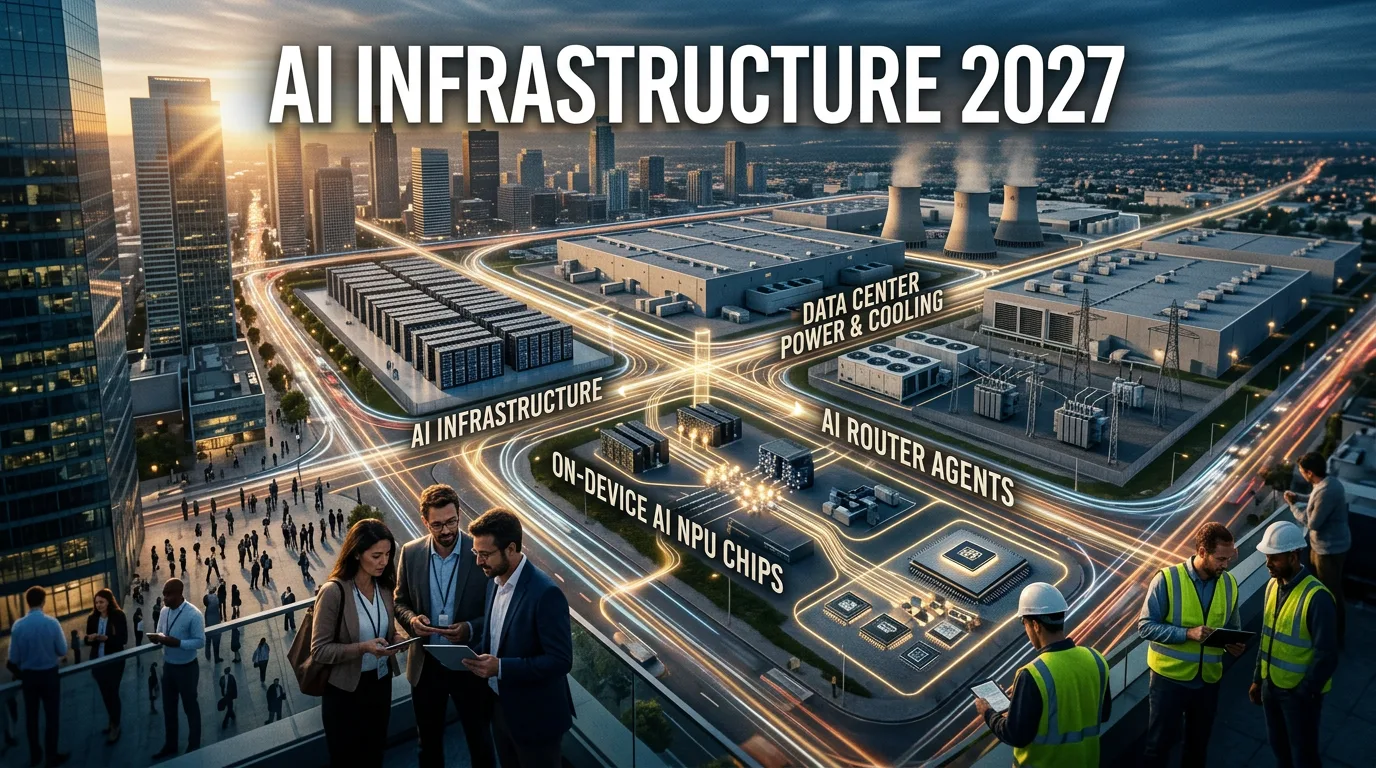
As AI scales, data centers become necessary.
More data centers require power grids, cooling systems, piping, electrical equipment, and construction labor.
This is the link between AI infrastructure investment and blue-collar employment.
The discussion noted that Jensen Huang, speaking at Davos, pointed to a shortage of plumbers and electricians as AI infrastructure investment expands, with wages rising materially.
It also noted that in the U.S., the income of highly skilled plumbers has at times exceeded that of office workers with master’s degrees.
In the discussion, median income for a highly skilled plumber was cited at around $160,000, versus around $90,000 for some master’s-degree office roles.
The exact figures vary by region, experience, certification, and union coverage.
However, the direction is clear.
As AI pressures white-collar roles, AI infrastructure buildout is increasing the value of skilled blue-collar labor.
9. Blue-Collar Aesthetics Are Entering Fashion
Blue-collar rehabilitation is also visible in fashion.
Luxury brands and youth-oriented labels are increasingly incorporating workwear aesthetics.
In the past, children imitated adult professionalism through suits, ties, and high heels.
More recently, work pants, cargo styles, work jackets, and safety-boot-inspired designs have become part of mainstream fashion.
This is not merely a style cycle.
It reflects a shift in what society considers an attractive or desirable occupation.
10. In the AI Era, the Winners Fall Into Two Broad Groups
The conclusion of the discussion is straightforward.
People who are positioned to benefit in the AI era generally fall into two groups.
- First, leader-type talent that can direct AI.
- Second, skilled professionals with manual expertise and field judgment that AI cannot easily replicate.
Top-tier AI researchers and developers remain important.
However, they represent a small share of the overall labor market.
For most people, the more realistic path is either to become highly effective at using AI or to develop field-based specialization that AI cannot easily replace.
This is not simply about using ChatGPT well.
Over time, AI usage itself is likely to become a basic competency, much like computer use is no longer treated as a separate skill.
The differentiator will be human capability.
Problem-solving, leadership, persuasion, resilience, creativity, collaboration, and judgment will become more important.
11. Who Is Most Exposed
The most exposed person in the AI era is not only the repetitive office worker.
The truly vulnerable worker is the person who uses AI only superficially, lacks collaboration skills, and has no field expertise.
Such workers are likely to occupy increasingly ambiguous roles inside organizations.
Document drafting is faster with AI.
Data organization can be automated.
Scheduling and first-draft reporting can be handled by AI agents.
Without leadership or judgment as a differentiator, replacement risk rises sharply.
Accordingly, individual survival strategies should become more explicit.
- Either move toward leadership and AI orchestration.
- Or build professional specialization rooted in field skills and manual expertise.
12. The Core Point Most News Coverage Misses
Most coverage frames the issue as AI eliminating jobs or creating new ones.
What matters more is not total employment, but the redistribution of status and income.
In the AI era, not everyone becomes equally worse off.
A minority will use AI as leverage to gain more wealth and authority.
Meanwhile, many ordinary white-collar workers may lose the stability and income they expected.
Another key point is that the rise of blue-collar work is not merely about recommending technical trades.
As the AI economy expands, data centers, power grids, semiconductor plants, robotic automation systems, cooling systems, and construction infrastructure all expand with it.
In other words, AI growth raises the value not only of digital talent but also of skilled workers who maintain the physical infrastructure behind the digital economy.
This is the central point.
AI may appear to operate in software alone, but in practice it depends on large amounts of electricity, land, buildings, cooling systems, cables, semiconductors, and maintenance labor.
Therefore, an economic outlook for the AI era must extend beyond software companies.
It must also include power, construction, facilities, cooling, semiconductors, data centers, and vocational training.
13. What Individuals Should Prepare Now
First, AI should be treated not merely as a tool but as a working partner.
A likely future structure is one in which a single person manages multiple AI agents.
Planning, research, drafting, analysis, marketing, and customer response can be delegated to different AI systems, while the human manages direction and judgment.
Second, leadership skills should be developed.
This does not only mean becoming a manager.
It means defining the direction of one’s work, validating AI outputs, persuading others, and carrying projects through to completion.
Third, manual skill and field competence should not be undervalued.
Electricity, plumbing, maintenance, machinery, robot servicing, smart-factory equipment, and energy infrastructure skills may become more valuable.
Fourth, the criteria for children’s education should change.
Relying solely on elite universities and major companies may be risky.
If a child shows strong leadership and interpersonal skills, they may be suited to a knowledge-industry leadership track.
If they have strong dexterity, spatial ability, mechanical understanding, and field adaptability, a technical profession can be an equally strong path.
14. What Companies and Governments Need to Do
Companies can no longer hire new employees and expect them to learn everything on their own.
Like U.S. firms, they need apprenticeship-style training, practical reskilling, and AI-based redesign of workflows.
Governments need to change how vocational education is perceived.
Treating technical work as a fallback for weaker students is outdated.
In the AI infrastructure era, skilled technicians can become core national assets.
Universities also need to adapt.
Classroom theory disconnected from the workplace will not adequately protect students.
They need to be reorganized around corporate projects, apprenticeship training, practical AI use, and problem-solving education.
15. Why This Matters for Investors
This is not only a career topic but also an investment topic.
As the AI industry expands, capital is likely to concentrate in different areas.
- AI software and AI agent companies
- Semiconductors and high-performance computing infrastructure
- Data centers and power grids
- Cooling systems and energy-efficiency technologies
- Construction, electrical, plumbing, and facilities industries
- Vocational education and corporate training platforms
In other words, AI is not only a technology-sector theme.
It is a structural change affecting labor, education, real estate, energy, manufacturing, and services simultaneously.
To understand the future of jobs and the economic outlook, the key question is not only which jobs AI removes, but which bottlenecks AI creates.
At present, power, data centers, skilled labor, and AI-agent operations are major bottlenecks.
< Summary >
The most exposed segment in the AI era is the ordinary white-collar office worker.
Routine document drafting, reporting, coordination, and administrative work can be replaced quickly by AI agents.
The winners are leader-type talent that can direct AI and skilled blue-collar specialists with capabilities that AI cannot easily replace.
The four-year university model is weakening, while company-led apprenticeship and practical vocational education are expanding.
AI infrastructure investment is likely to increase the value of skilled labor in data centers, power, plumbing, electrical, and construction.
The key issue ahead is not speed, but direction.
Individuals must decide whether to raise their value through AI or build field expertise that AI cannot easily substitute.
[Related Articles…]
*Source: [ 경제 읽어주는 남자(김광석TV) ]
– “사무직의 종말이 온다” AI 시대 살아남는 사람은 결국 ‘두 부류’입니다 | 경읽남과 토론합시다 | 김용섭 소장님 [3편]