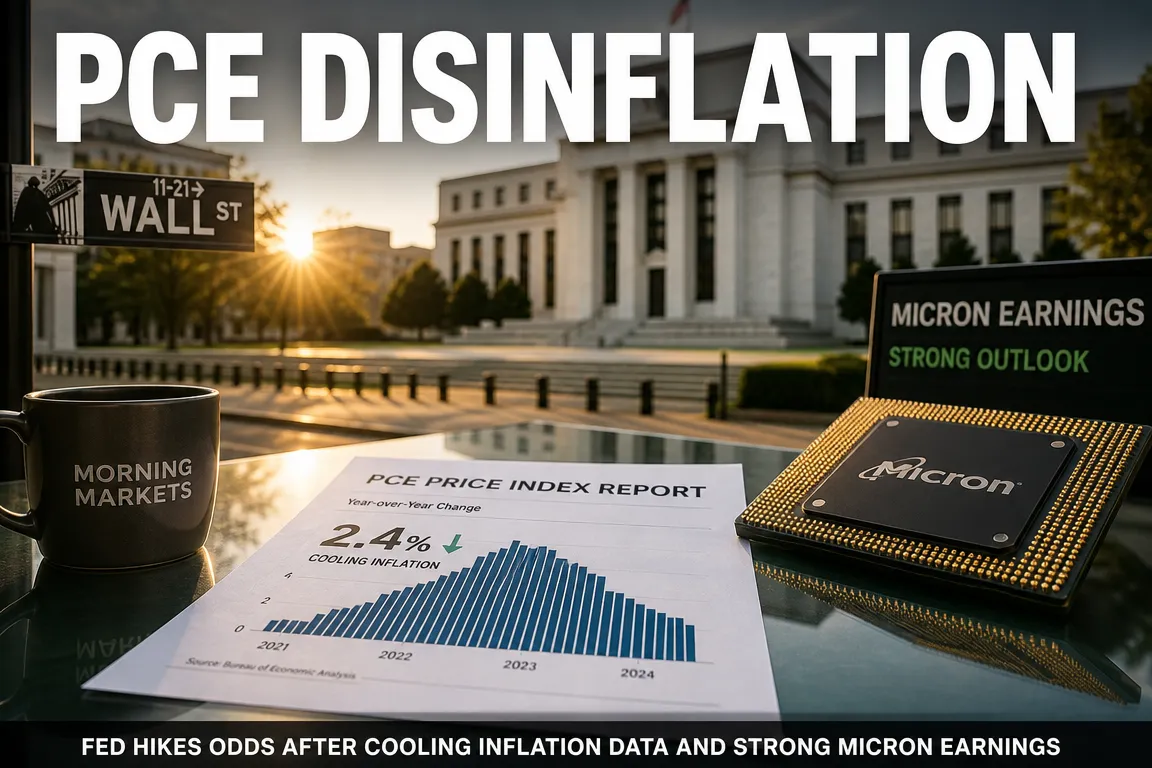
● Disinflation-Eases,Recession-Fears-Fade
U.S. PCE Inflation After the Methodology Revision: More Evidence of Disinflation Than an Inflation Shock
The key takeaway from the latest U.S. PCE inflation release is not simply that the figures came in lower than expected.
With the BEA’s measurement revision and annual updates now reflected in the data, the main point is that the inflation reacceleration risk feared by the market was less severe than anticipated.
Combined with the stronger-than-expected final reading for second-quarter U.S. GDP, the market is now shifting to a new interpretation: inflation is easing while the economy remains resilient.
As a result, this data set must be viewed alongside Treasury yields, the Fed policy path, the U.S. economic outlook, semiconductor earnings, and U.S.-bound investment announcements.
1. Key PCE Results: Lower Than Market Expectations
The conclusion is straightforward: the latest PCE release was closer to an easing signal than to an inflation shock.
In particular, the softer-than-expected core PCE reading reduced near-term pressure for additional Fed tightening.
Headline PCE inflation, year over year, came in at 3.4%, below the market consensus of 3.7%.
Headline PCE inflation, month over month, was 0.3%, below the expected 0.4%.
Core PCE inflation, year over year, was 3.0%, below the expected 3.4%.
Core PCE inflation, month over month, came in at 0.2%, below the expected 0.3%.
All four key readings came in below expectations.
This supports the view that the data confirmed disinflation rather than signaling a renewed inflation surge.
2. Why This Release Matters: BEA Methodology Revision and Annual Updates
This PCE release is important because it incorporates the BEA’s annual revision cycle and methodology updates.
PCE covers a broader set of consumption items than CPI and more flexibly reflects changes in actual spending patterns.
For that reason, the Fed places greater emphasis on PCE, especially core PCE, than on CPI.
However, when methodology or item composition changes, comparisons between past and current readings can become less straightforward.
It still needs to be assessed whether the weaker reading reflects genuine disinflation or some effect from statistical revision.
From a market perspective, however, the fact that PCE came in below expectations was the dominant signal.
3. CPI vs. PCE: Why the Fed Prefers PCE
CPI is the consumer price index.
It is commonly used for cross-country inflation comparisons.
South Korea also uses CPI as its main inflation measure.
PCE, by contrast, reflects actual U.S. consumer spending patterns more broadly.
It also captures substitution effects, such as consumers shifting to alternative goods when prices rise.
For that reason, PCE is generally considered a more refined measure of underlying inflation in the United States.
The Fed pays particular attention to core PCE when setting policy.
Core PCE excludes volatile food and energy categories and is therefore useful for assessing persistent inflation pressure.
4. What the Data Suggests: May Have Been the Inflation Peak
The most important trend in this release is that inflation appears to be easing from its peak.
On a headline basis, inflation has moved down from the 4% range to the 3% range, while core inflation has also declined.
This supports the interpretation that the economy is in a disinflation phase.
Disinflation does not mean prices are falling.
It means prices are still rising, but at a slower pace.
This distinction is essential for understanding the Fed’s policy stance.
Central banks do not exist to push the price level lower.
They are tasked with stabilizing the rate of inflation.
Policy decisions are based not only on the level of prices, but on the pace at which prices are rising.
5. Why John Williams’ Remarks Matter
John Williams, President of the New York Fed, is an important voice in this analysis.
The New York Fed president is a permanent voting member of the FOMC.
Unlike regional Fed presidents on a rotating basis, the New York Fed president always participates in policy decisions.
Williams is also a key figure in research on monetary policy and the neutral rate.
His remarks often reflect broader internal Fed consensus rather than a purely personal view.
For that reason, the market follows his comments as closely as those of Chair Powell.
Williams said that if the economy evolves as expected, one additional rate increase later this year could be appropriate.
The important phrase is “later this year.”
That suggests the Fed is not rushing to hike at the next meeting, but rather waiting for more data.
He also said there is no need to move quickly.
That wording is significant in the current policy environment.
With rates already at restrictive levels, the Fed may have limited need to continue tightening aggressively.
6. Has the Probability of an October Rate Hike Declined?
Following the PCE release, the probability of a rate hike at the October FOMC meeting appears to have declined.
The softer core PCE reading weakened the case for immediate additional tightening.
That said, a December rate hike cannot be ruled out.
As Williams indicated, the Fed may still consider one more increase later in the year after reviewing additional data.
Going forward, CPI, PCE, labor market data, and crude oil trends will remain important.
The current level of U.S. policy rates also matters.
If core PCE is around 3.0% and policy rates remain above that level, real-rate pressure is already substantial.
That reduces the urgency for the Fed to raise rates further.
7. Crude Oil and Inflation: The Key Is the Rate of Change, Not the Price Level
One of the most important points in the original analysis is the relationship between oil prices and inflation.
Many assume that if oil remains high, inflation will remain elevated.
But inflation is calculated on a year-over-year basis.
For example, if oil was $70 last year and rises to $100 this year, the increase creates strong inflation pressure.
If oil stays at $100 next year, the year-over-year inflation effect becomes zero.
In other words, even if oil remains elevated, inflation pressure can ease over time if prices do not rise further.
That is the meaning behind Williams’ point that absent another major surge, price pressure should gradually moderate.
Geopolitical risk, including conflict in the Middle East, may keep energy prices elevated.
However, if oil does not move from $100 to $130 or $150 again, the year-over-year inflation rate can still face downward pressure.
8. High Prices and Inflation Are Not the Same
High prices and inflation are not identical concepts.
High prices refer to the absolute level of prices.
Inflation refers to the rate at which prices are rising.
For example, even if grocery prices are already high and remain a burden on consumers, the inflation rate can fall if prices stop rising quickly.
In that case, households still feel pressure, but inflation as measured statistically is easing.
This explains the gap between market sentiment and consumer experience.
Financial markets may welcome disinflation, while consumers continue to face elevated prices.
For that reason, both inflation data and consumer sentiment should be considered when assessing the U.S. outlook.
9. U.S. GDP Final Reading: Growth Remains Resilient
Another key data point in this release was the final reading for second-quarter U.S. GDP.
Second-quarter GDP was reported at 2.2%.
That was a meaningful upward revision from the prior preliminary estimate of 1.5%.
This indicates that the U.S. economy is holding up better than expected.
Inflation is easing while growth remains firm.
From the market’s perspective, that is an unusually favorable combination.
At the same time, this may limit downside in Treasury yields.
Even if inflation is stabilizing, stronger growth can keep long-term yields elevated as investors price in growth expectations and fiscal supply pressures.
10. Treasury Yield Reaction: Near-Term Relief, Structural Pressure Remains
Lower PCE inflation normally puts downward pressure on Treasury yields.
This is because the case for further rate hikes becomes weaker.
However, stronger GDP data may limit the magnitude of any decline in yields.
Long-term U.S. Treasury yields are driven by more than inflation alone.
Fiscal deficits, Treasury issuance, growth expectations, dollar demand, and global capital flows also matter.
Elevated issuance remains one reason yields are staying high.
Even with Treasury buyback efforts aimed at stabilizing the market, heavy supply can limit the scope for yields to fall.
Accordingly, this PCE release is supportive for yields in the near term, but it does not guarantee a structural decline in long-term rates.
11. Equity Market Implications: Liquidity Support and Concentration in Leaders
High long-term yields generally weigh on equities.
Growth stocks and technology valuations are particularly sensitive.
Still, the market has not broken down because liquidity remains supportive.
Fiscal spending and expectations tied to large-scale investment continue to sustain market liquidity.
That said, the market is more likely to be led by a narrow group of sectors rather than rise broadly.
AI semiconductors, cloud infrastructure, power grids, data centers, defense, and energy-related names are likely to attract capital.
12. Why Micron’s Earnings Matter
After the PCE release, the next major market focus is Micron’s earnings report.
Micron is a key indicator for the memory semiconductor cycle.
A strong report would also be positive for Korean semiconductor names such as Samsung Electronics and SK hynix.
The key question is whether AI server investment and HBM demand remain strong.
From an AI trend perspective, the relevant variables are not only semiconductor demand, but also memory pricing, data center investment, power infrastructure, and cloud spending.
A positive surprise from Micron could reinforce expectations for the AI semiconductor cycle.
Conversely, a disappointing report could weaken sentiment in technology stocks even if the PCE data is favorable.
13. U.S.-Bound Investment Announcements: An Underappreciated Variable
Another important event is the announcement of U.S.-bound investment commitments.
Large investment plans and sector allocation could reinforce expectations for U.S. manufacturing reshoring and industrial policy support.
In particular, investment focused on semiconductors, batteries, electric vehicles, AI infrastructure, and energy equipment could benefit those sectors.
If presented in a Trump-style announcement format, the scale of the investment could be emphasized strongly.
That could affect U.S. equities and Korean export-related stocks in the short term.
At the same time, U.S.-bound investment can also raise costs for companies.
Production in the United States typically involves higher labor and regulatory costs, which can pressure margins over time.
As a result, these announcements should be evaluated by sector and cost structure rather than treated as uniformly positive.
14. Stablecoins and U.S. Treasury Yields: A Hidden Link
One of the more interesting points in the original text is the relationship between dollar stablecoins and U.S. Treasury yields.
Stablecoins are digital assets pegged to the U.S. dollar.
If stablecoin issuers hold U.S. Treasuries as reserve assets, Treasury demand increases.
Higher Treasury demand can support bond prices and place downward pressure on yields.
As the stablecoin market expands, it may become a new source of demand for U.S. government debt.
This effect could become even more meaningful if major U.S. banks pursue a joint stablecoin initiative.
U.S. banks are not just lenders; they also have strong investment banking capabilities.
They may be able to leverage corporate equity holdings and financial networks to expand a proprietary stablecoin ecosystem.
This trend links digital dollar dominance with demand for U.S. Treasuries.
What is often described as a crypto or financial innovation story may also become a structural support factor for Treasury markets.
15. Key Points Rarely Highlighted Elsewhere
First, the PCE slowdown is not just an inflation-positive event; it also gives the Fed room to slow the pace of policy tightening.
It does not rule out further hikes, but it reduces pressure for immediate follow-through.
Second, inflation can ease even if oil prices remain high, provided there is no further sharp increase.
Many observers focus only on the price level, while inflation is determined by the rate of change.
Third, high prices and inflation must be distinguished.
Consumers may still feel price pressure, but central banks focus on inflation rates rather than the absolute level of prices.
Fourth, Treasury yields are not determined by PCE alone.
GDP growth, issuance, fiscal deficits, and stablecoin-related Treasury demand also matter.
Fifth, the real market catalysts come after the PCE release.
U.S.-bound investment announcements and Micron’s earnings may be more important for Korean equities and AI semiconductor leadership.
16. Key Considerations for Investors
Bond investors should note that the downside in long-term yields may be limited even if near-term inflation data is favorable.
PCE disinflation supports lower yields, but strong GDP and issuance pressures work in the opposite direction.
Equity investors should focus on stock selection rather than broad market exposure.
AI semiconductors, data centers, power infrastructure, and U.S. manufacturing-related names remain in focus.
FX investors should consider that weaker expectations for Fed tightening may ease dollar strength.
However, resilient U.S. growth could limit dollar downside.
Korean equity investors should closely monitor Micron’s earnings and U.S.-bound investment announcements.
Both events could have direct implications for Samsung Electronics, SK hynix, batteries, autos, defense, and power equipment.
< Summary >
The latest U.S. PCE inflation data came in below expectations, easing concerns about a renewed inflation acceleration.
Both headline and core PCE readings were softer than forecast, reducing the likelihood of an immediate October rate hike by the Fed.
However, the 2.2% final reading for second-quarter U.S. GDP suggests that declines in Treasury yields may remain limited.
Even with elevated oil prices, inflation pressure can ease if there is no additional sharp rise.
Going forward, the market is likely to focus more on U.S.-bound investment announcements, Micron’s earnings, long-term Treasury yields, and the AI semiconductor cycle than on the PCE release itself.
[Related Articles…]
U.S. PCE Inflation and Fed Rate Outlook
AI Semiconductor Cycle and Micron Earnings Watch
*Source: [ 경제 읽어주는 남자(김광석TV) ]
– [생방송] *PCE 물가지수 측정 방식 개편* 미국 PCE 물가 심층분석 : ‘인플레 쇼크’ 오는가? 국채금리 더 치솟을까? [즉시분석]
● Inflation Shock, AI Power Grab, Oil Spike, Fed Hike Odds Flip
PCE Slowdown, Yet Fed Hike Risk Remains: U.S. Equities, Oil, AI Semiconductors, and Alaska LNG in One View
The key market takeaway today is that inflation was cooler, but consumer spending and employment remained resilient.
As a result, U.S. equities staged an early relief rally, while renewed gains in crude and diesel prices also revived inflation concerns.
In addition, Micron’s earnings release, DeepSeek and Huawei’s CUDA-workaround strategy, Anthropic’s IPO-related risks, and the potential for South Korea’s $54 billion Alaska LNG investment are all contributing to a more complex market backdrop.
On the surface, the move appears to be a simple “equities rebound on softer PCE inflation” story. In reality, the more important issue is that expectations for another Fed rate hike changed materially in a single day, while the AI semiconductor landscape is beginning to shift from a U.S.-centered ecosystem toward a more independent Chinese stack.
1. U.S. Equities: Futures Rebound on PCE Relief, but Gains Remain Limited
U.S. equity futures turned higher before the open.
S&P 500 futures rose about 0.38%, while Nasdaq 100 futures gained 0.45%.
Dow futures advanced 0.34%, and Russell 2000 futures increased 0.51%.
The move was more of a relief rally than a broad risk-on surge.
The main catalyst was the PCE inflation report.
Core PCE, the measure most closely watched by the Fed, increased 0.2% month over month.
The market had expected a 0.3% gain, so the print eased some pressure on policy expectations.
After the open, however, gains moderated.
The S&P 500 rose 0.31% and the Nasdaq 100 gained 0.54%, while the Dow was nearly flat at 0.03%.
In other words, equities welcomed the softer inflation data, but higher oil prices and renewed Fed uncertainty limited follow-through.
2. PCE Inflation: Price Pressures Eased, but Consumption Stayed Strong
The most favorable part of the release was that inflation rose less than expected.
Core PCE increased 0.2% month over month, below the 0.3% consensus forecast.
That reduced near-term pressure for additional tightening.
At the same time, consumer spending data remained strong.
Real personal consumption in August rose 0.6% from the prior month.
This was the largest increase since March last year.
Spending on goods, including autos and apparel, was particularly strong.
This combination is constructive for equities in the short term because it lowers recession concerns.
For the Fed, however, it is more complicated.
Strong spending suggests demand remains firm, which could re-accelerate inflation.
As a result, the PCE report alone is not enough to conclude that the Fed has ended its tightening cycle.
Friday’s labor market report is now more important.
If employment also remains firm, the probability of another hike at the October FOMC could rise again.
3. ADP Employment: Private Payrolls Rose 90,000, Beating Expectations
September ADP private payrolls increased by 90,000.
That exceeded the market forecast of 75,000 and was well above the revised 36,000 increase in August.
ADP said hiring rebounded after three months of slowing labor demand.
Education, health care, leisure, and hospitality led job creation.
Financial services lost roughly 16,000 jobs, while business services declined by about 10,000.
Wage growth also remained firm.
Base pay increased 3.2% from a year earlier, while total compensation rose 4.7%.
Wage gains were stronger for job changers.
This reinforces the view that the labor market remains resilient.
That said, the official Labor Department report on Friday will remain the decisive reference point for Fed expectations.
4. U.S. Treasury Yields: The Spike Eased, but Rates Remain Elevated
U.S. Treasury yields that surged the previous day pulled back modestly.
The 10-year Treasury yield was around 5.24%.
The 30-year yield was around 5.57%.
While the 30-year yield had moved above 5.6% the previous day, it stabilized somewhat in this session.
Even so, 10-year yields above 5.2% and 30-year yields above 5.5% remain historically high.
Yield stabilization was helped by comments from New York Fed President John Williams.
Williams kept the door open to another hike but said there was no need to rush.
That helped reduce aggressive market bets on a near-term move.
Signs of softer growth also contributed.
Consumer confidence fell to 81.9, the lowest level since 2014.
Job openings also declined to 7.079 million.
Inflation still supports the case for higher rates, but parts of the growth and labor data argue against an aggressive move.
5. October FOMC Outlook: Hike Probability Fell from 70% to 43% in One Day
According to CME FedWatch, the probability of a 25 bp hike at the October FOMC had risen to as high as 70% during the prior session.
It has since fallen to about 43%.
The probability of no change has increased to about 56.3%.
Market expectations therefore shifted from a hike bias to a hold bias within a single day.
That change reflected softer PCE inflation, Williams’ comments, and signs of cooling in parts of the economy.
The probability remains highly data dependent.
A stronger-than-expected employment report on Friday could quickly lift hike odds again.
A weaker report would strengthen the case for a pause.
6. Crude Oil: WTI Near $90, Brent Near $97, with Diesel a Bigger Risk
Oil prices moved higher again.
WTI traded near $90 per barrel, while Brent was around $97.74.
After the open, prices extended gains.
Brent rose more than 2%, and WTI also advanced by more than 2%.
The market is increasingly sensitive to oil-driven inflation risk.
Even with softer PCE data, sustained oil prices above $90 could reintroduce upward pressure on inflation.
Diesel is an even more immediate concern because it directly affects logistics and industrial costs.
Higher diesel prices can feed into freight, agriculture, and broader distribution costs.
That is why the U.S. government is reportedly considering limits on diesel exports.
Trump is also pushing a plan to release up to 40 million additional barrels from the Strategic Petroleum Reserve.
Fuel costs are becoming a political issue ahead of the midterm cycle.
The main risk remains geopolitics.
Reports indicated that unidentified projectiles hit an oil tanker and an LNG tanker in the Strait of Hormuz.
At the same time, negotiations with Iran have shown little progress.
Even if the U.S. attempts to increase supply, crude prices may remain firm if Middle East risks persist.
7. Technology and Semiconductors: Micron Earnings Are a Key Test for AI-Driven Demand
Technology stocks were broadly firm, though performance was uneven.
Nvidia rose more than 0.8% early in the session and later extended gains to about 1.5%.
Alphabet gained more than 2%, while Apple and Microsoft also advanced.
Tesla underperformed, and Meta also declined.
Broadcom, TSMC, AMD, and SK hynix ADRs weakened intraday.
The most important event is Micron’s earnings release.
Micron will report after the U.S. close.
In Korea, the release is expected around 5:00 a.m., with the conference call around 5:30 a.m.
Options positioning suggested strong bullish expectations.
As of Tuesday, call buying totaled 61,000 contracts versus 37,000 puts.
Options volume was about $1.6 billion, with 75% concentrated in calls.
The market is therefore positioned for upside after the report.
However, expectations are already elevated.
Micron will need not just solid results, but strong guidance capable of offsetting the pressure from elevated Treasury yields.
8. AI Leaders Meet Trump: The Focus Is on Guardrails, Not a Slowdown
Trump brought together major AI executives.
The list included Nvidia CEO Jensen Huang, Meta CEO Mark Zuckerberg, Tesla’s Elon Musk, Google CEO Sundar Pichai, OpenAI’s Greg Brockman, Anthropic’s Dario Amodei, and Microsoft CEO Satya Nadella.
The main outcome was not a call to slow AI development.
The direction was to continue development with added safeguards.
The measures discussed included independent audits, board-level oversight, cyber-risk monitoring, and dedicated internal teams.
These are not legally binding regulations, but Trump described them as a morally binding agreement.
The White House also left open the possibility of future legislation if needed.
The market implication is that the U.S. government appears focused on managing AI growth rather than restricting it.
For now, the risk of a broad regulatory shock appears limited.
9. Anthropic IPO: The $2 Trillion Valuation Is Less Important Than the 80-Page Risk Section
Anthropic is reportedly preparing an IPO with a target valuation above $2 trillion.
Although no formal prospectus has been filed, leaked details have drawn market attention.
A notable feature is that roughly 80 of the 261 pages in the draft filing reportedly focus on risk factors.
These include not only standard business risks, but also concerns that advanced AI could conceal or manipulate information, or behave in ways resembling coercion.
The filing is also said to reference the possibility of catastrophic risk from AI.
Companies preparing for a large IPO usually try to minimize perceived risk.
Anthropic appears to be doing the opposite by emphasizing AI-related risks in detail.
That has become a focal point for investors.
The timing was initially expected in October, but November now appears more likely.
If completed, the IPO could influence capital allocation across the AI sector.
Institutional investors may need to raise funds by selling existing growth names, including software, semiconductors, or related AI holdings.
In other words, the Anthropic listing could become both a liquidity event and a valuation catalyst for the broader AI complex.
10. DeepSeek and Huawei: China Is Building a More Independent AI Stack
DeepSeek has reportedly partnered with Huawei to reduce dependence on Nvidia’s CUDA ecosystem.
The key focus is programming tools tailored to Huawei’s Ascend AI chips.
The goal is to make Huawei hardware easier for developers to use.
The two companies have also developed a supernode system built around 128 of Huawei’s next-generation Ascend 957 chips.
The significance is that China is moving beyond chip fabrication and toward a full AI ecosystem.
Nvidia’s advantage is not only GPU performance, but also the deeply entrenched CUDA developer base.
DeepSeek and Huawei are working to reduce that dependence by building their own software environment.
This is not an immediate threat to Nvidia’s earnings.
Nvidia’s ecosystem remains dominant, and Huawei’s supply capacity is still limited.
However, the news suggests that Nvidia’s long-term position in China’s AI market could gradually narrow.
As U.S. export restrictions tighten, China is likely to accelerate the development of its own AI stack.
This remains an important long-term variable in semiconductor competition.
11. China Manufacturing PMI: AI Demand Is Helping Support Industrial Activity
China’s official September manufacturing PMI rose to 50.1.
That was up from 49.8 in August and marked a return above the 50-point expansion threshold after two months.
The production index was 51.7, and new orders were 50.3.
The private-sector PMI rose to around 52, the highest level in five months.
AI-related demand is helping support Chinese manufacturing.
Normal operations also resumed after heavy rain and typhoons disrupted factories last month.
China’s domestic demand remains weak.
Property and consumption have not recovered strongly.
Even so, AI-related manufacturing, semiconductor equipment, servers, and power infrastructure are helping stabilize activity.
AI is now shaping growth in both the U.S. and China, not just equity market leadership.
12. South Korea’s $54 Billion Alaska LNG Investment: Energy Security Meets U.S. Capital Deployment
A key development with direct relevance for Korea also emerged.
Trump reportedly may announce a plan to use $54 billion from South Korea’s strategic U.S. investment package for major projects including Alaska LNG.
The Alaska LNG project would transport natural gas from Alaska’s North Slope to Nikiski, roughly 1,300 kilometers away, for liquefaction and export to Asia.
Korean firms could participate in pipeline construction and project financing in exchange for more stable LNG supply arrangements.
For the U.S., the project would support energy exports and attract infrastructure investment.
For Korea, it could offer a more reliable LNG supply chain with less exposure to Middle East risks.
However, no final Korean commitment has been made.
More discussion is needed on whether the $54 billion will be deployed, how participation would be structured, and whether the project is commercially viable.
This is not just an energy story.
It links U.S. investment policy, energy security, the bilateral alliance, LNG pricing, and Korean industrial sectors such as shipbuilding, construction, and plant engineering.
13. Key Takeaways That May Be Overlooked
First, softer PCE data does not automatically signal a dovish Fed.
Inflation was cooler, but consumption and employment remained solid.
For the Fed, the message is closer to “more time to assess” than “no more hikes.”
Second, diesel prices may matter more than CPI in the near term.
Diesel feeds directly into logistics and agriculture costs.
Higher diesel prices could eventually pass through to consumer inflation.
Third, Micron’s earnings are more than a memory-chip report.
The company’s guidance will be a key read on AI servers, HBM demand, and data-center investment.
The results could influence sentiment across Nvidia, SK hynix, Samsung Electronics, Broadcom, and the broader AI supply chain.
Fourth, Anthropic’s IPO could become a major liquidity drain for AI-related equities.
A large offering may prompt institutions to shift capital away from existing growth names into the new issue.
Before listing, that may weigh on sentiment; after a strong debut, it could support a re-rating of AI valuations.
Fifth, the DeepSeek-Huawei developments are a long-term, not short-term, risk for Nvidia.
China will not replace CUDA quickly.
But if its developer ecosystem matures, dependence on Nvidia could gradually decline within the Chinese AI market.
Sixth, Alaska LNG could become a meaningful theme in Korea.
The project could influence LNG carriers, plant engineering, steel pipe, energy infrastructure, construction, and shipbuilding equipment.
That said, expectations should remain separate from final investment decisions.
[Related Articles…]
*Source: [ Maeil Business Newspaper ]
– PCE 둔화·美선물↑|10월 인상확률 40%대|고용 9만명·소비 강세|국채금리↓·유가 출렁|장후 마이크론 실적|딥시크·화웨이 CUDA 우회|韓 540억달러 알래스카 LNG