● AI-Surging,Micron-Quiet,KOSPI-Rips
Why Micron’s Earnings Were Quiet but the KOSPI Rallied: The Key Was Not Earnings, but Semiconductor Exports and the AI Investment Cycle
Micron’s earnings release was broadly in line with expectations and materially solid.
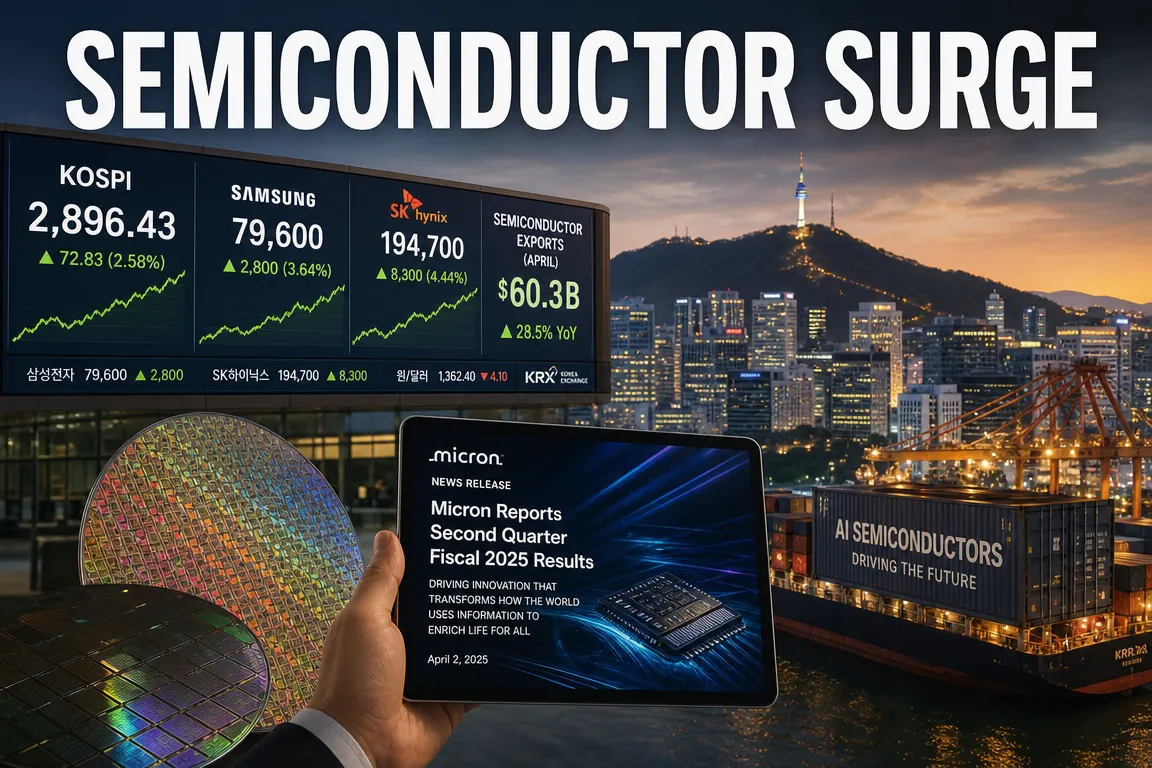
However, Micron’s share price did not move significantly. Instead, the Korean equity market reacted strongly, with the KOSPI, KOSDAQ, Samsung Electronics, SK hynix, and semiconductor equipment stocks all advancing.
The key point in this move was not simply that “Micron reported strong results.”
The market had already priced in strong results from Micron, and the real catalyst was the Korean semiconductor export data released at 9:00 a.m.
In particular, AI semiconductor demand, memory price recovery, higher HBM investment, and expectations for semiconductor equipment stocks were all linked together, leading to a reassessment of the KOSPI outlook.
1. Micron’s Earnings Were Strong, but the Stock Was Quiet
Micron’s quarterly revenue was described as being at a very strong level, roughly equivalent to 73 trillion won in the original context.
This confirmed that the memory semiconductor industry has moved past the bottom and entered a recovery phase.
AI server demand and growing demand for high-value-added HBM products were the main drivers of the improvement.
Still, Micron’s stock did not react sharply after earnings.
The reason is straightforward.
The market had already expected Micron to report strong results.
Equity markets respond not to strong earnings alone, but to how much better results are than expectations.
In other words, even a strong report can leave the stock relatively unchanged if the upside surprise is limited.
This earnings report was not just good; it was very strong.
However, because investors had already priced in a recovery in AI semiconductors and memory demand, Micron’s shares did not respond dramatically.
2. Why Samsung Electronics and SK hynix Rallied Sharply
At first, Micron’s muted share reaction suggested that Samsung Electronics and SK hynix might also trade flat.
However, the market moved differently.
South Korean equities saw strong buying in major semiconductor names from the start of trading, driving the KOSPI higher.
The key inflection point was the semiconductor export data released at 9:00 a.m.
The data indicated strong semiconductor export growth, prompting institutional investors to respond.
The original text refers to semiconductor exports at around 60.3 billion dollars, with a year-on-year increase of 26.2%.
Some captions or transmitted figures may suggest 60.3 billion dollars and 262%, but the market-relevant point is that semiconductor export momentum was clearly strong.
This data point was more than a single number.
In the Korean economy, semiconductor exports are directly linked to KOSPI earnings expectations.
If earnings expectations for Samsung Electronics and SK hynix rise, broader KOSPI earnings estimates also increase.
For foreign and institutional investors, this created a fresh rationale to re-enter Korean equities.
3. The Real Trigger for the KOSPI Rally Was the Export Data, Not Micron
Many investors may attribute the rally to Micron’s earnings.
However, a closer reading suggests that Micron’s results were background context, while the actual market-moving catalyst was the Korean semiconductor export data.
Micron’s earnings confirmed that the memory cycle is recovering.
By contrast, Korea’s export data showed that this recovery is already being reflected in the actual results of Korean companies.
This distinction matters.
Expectations that corporate results will improve can already be reflected in share prices.
Actual data, however, provides a new reason to buy.
The KOSPI advance should be understood as a response to this data-driven buying.
4. Why the KOSDAQ Also Rose: Expectations for Semiconductor Equipment Stocks
The KOSDAQ also moved higher, not just the KOSPI.
The reason was rising expectations for semiconductor equipment stocks.
Micron’s earnings not only confirmed strong performance but also reinforced expectations for future capital expenditure.
As AI semiconductor demand continues to grow, memory supply capacity must also expand.
HBM, DDR5, high-performance NAND, and AI server memory demand create a different investment cycle from traditional memory products.
The beneficiaries of this cycle are semiconductor equipment, materials, and component companies.
Many of these firms are listed on the KOSDAQ.
As a result, expectations for Micron’s capital spending were quickly translated into a positive catalyst for Korean semiconductor equipment stocks.
Today’s KOSDAQ rally was not simple rotation; it reflected expectations that the AI investment cycle could extend into the equipment sector.
5. The Most Important Number in the Market: Semiconductor Export Growth
The most important figure in this session was not Micron’s revenue.
It was the growth rate of Korea’s semiconductor exports.
Rising semiconductor exports have three implications.
- First, they indicate a recovery in global IT demand.
- Second, they suggest that inventory pressure for Korean companies is easing.
- Third, they raise the likelihood of upward revisions to Samsung Electronics and SK hynix earnings estimates.
Equity markets often respond most strongly when earnings are moving up from a bottom.
The semiconductor sector appears to be entering that phase now.
In particular, AI semiconductor demand is creating a structure different from the traditional smartphone- and PC-driven memory cycle, which may allow this recovery to last longer than in previous cycles.
6. Why Institutional Investors Acted
One notable feature of the rally was institutional buying.
Institutional investors generally do not react strongly to a single headline; they evaluate earnings revisions and supply-demand structure together.
When semiconductor export data comes in strong, institutional investors can draw the following conclusions:
- Next-quarter earnings for Samsung Electronics and SK hynix may be better than expected.
- KOSPI earnings forecasts may be revised upward.
- Portfolio exposure to the semiconductor sector should be increased again.
- Buying may extend to the broader AI semiconductor value chain.
In other words, today’s move was not just a rebound in individual stocks. It was closer to a broader re-rating of the Korean market.
Stronger semiconductor exports also affect the won, trade balance, corporate earnings, and foreign investor flows, making the impact positive across the market.
7. Why Samsung Electronics and SK hynix Should Be Viewed Differently
Samsung Electronics and SK hynix are both leading semiconductor names, but the market evaluates them differently.
SK hynix is viewed more directly as an AI semiconductor beneficiary because of its HBM competitiveness.
As demand for high-bandwidth memory used in NVIDIA AI GPUs continues to expand, SK hynix’s earnings outlook has improved quickly.
Samsung Electronics, by contrast, is viewed as a diversified semiconductor company with exposure to memory recovery, foundry, smartphones, and consumer electronics.
For Samsung, the key variable is whether it can regain competitiveness in the HBM market.
If Samsung Electronics quickly recovers share in HBM, the upside for the KOSPI could become larger.
In short, SK hynix is currently viewed as the leading name in the AI memory cycle, while Samsung Electronics remains a recovery story with room for catch-up.
8. Can the KOSPI Break Out of Its Trading Range?
As noted in the original text, one of the main frustrations for investors has been the KOSPI’s range-bound pattern.
Even when positive news has emerged, gains have often been temporary.
For the KOSPI to break out of its range, three conditions are needed.
- First, the increase in semiconductor exports must be confirmed as a trend, not a one-off event.
- Second, earnings expectations for Samsung Electronics and SK hynix must continue to rise.
- Third, foreign investors must begin to raise their allocation to Korean equities more meaningfully.
Today’s rally strengthened expectations on the first two conditions.
However, it is still too early to confirm a full breakout from the range.
Further confirmation will be needed from the next export data release, memory price trends, AI server investment outlook, and guidance from major semiconductor companies.
9. The Most Important Point Often Missed in Other Coverage
The key point is not simply that “Micron reported strong earnings, so Korean semiconductor stocks rose.”
That explanation is only partly correct.
The more important point is that the Korean market is once again reacting to its own export data.
This is a meaningful shift.
For a period, the Korean market often appeared driven mainly by U.S. interest rates, exchange rates, the S&P 500, and NVIDIA’s stock price.
Today, however, domestic semiconductor export data shaped market direction.
That is a significant signal for the KOSPI outlook.
For Korean equities to strengthen sustainably, corporate earnings must improve.
And the core driver of Korean corporate earnings remains semiconductor exports.
Today’s rally suggests that the AI semiconductor cycle is now being reflected in Korea’s export numbers.
10. Key Indicators Investors Should Monitor Going Forward
Going forward, investors should not focus only on Micron’s earnings, but also on the following indicators:
- Growth rate of Korean semiconductor exports
- DRAM and NAND contract prices
- HBM supply agreements and capacity expansion plans
- Samsung Electronics’ HBM certification and supply updates
- SK hynix earnings guidance
- Micron’s capital expenditure plans
- NVIDIA AI GPU shipment outlook
- USD/KRW exchange rate trends
- Foreign and institutional net buying in the KOSPI
Semiconductor equipment stocks often move ahead of reported earnings, driven by expectations.
For that reason, investors should place greater weight on order outlook and customer investment plans than on near-term quarterly results.
11. One-Sentence Summary of Today’s Market
Micron reported results that were strong but largely expected, leaving its share price relatively stable.
By contrast, strong Korean semiconductor export data triggered buying in Samsung Electronics, SK hynix, and semiconductor equipment stocks.
Ultimately, today’s KOSPI and KOSDAQ gains reflected the market’s view that the AI semiconductor cycle is beginning to show up in actual export data.
< Summary >
Micron posted very strong earnings, but the market had already anticipated the result, so the stock did not move much.
In contrast, South Korean equities rallied after the 9:00 a.m. release of strong semiconductor export data.
Samsung Electronics and SK hynix rose on expectations of stronger earnings, while KOSDAQ-listed semiconductor equipment stocks benefited from expectations of higher capital expenditure at Micron.
The key driver of the move was not Micron itself, but Korea’s semiconductor export data.
For the KOSPI to break out of its trading range, investors will need to see continued export growth, memory price recovery, and sustained foreign inflows.
[Related Articles…]
*Source: [ 내일은 투자왕 – 김단테 ]
– 마이크론 실적 보고는 별일 없었는데 코스피 오른 이유 #마이크론 #코스피 #하이닉스
● High-Rates, AI-Boom, Fiscal-Driven-Market, Uneasy-Stability
The End of the Low-Rate Era, and Why Equities Have Not Collapsed
The key issue is not simply that policy rates have risen.
The market is currently in an unusual phase in which monetary policy is restrictive, while fiscal policy remains expansionary.
As a result, Treasury yields remain elevated, yet U.S. equities and AI-related stocks have not broken down easily.
The most important themes in this discussion are the end of the low-rate era, fiscal dominance, the AI investment cycle, crude oil and inflation, and the impact on the middle class.
Although the environment appears to be one of rate hikes and tightening, market support is increasingly being provided by government spending and AI infrastructure investment.
1. What “The End of the Low-Rate Era” Really Means
Following the 2008 global financial crisis, the world economy became accustomed to an environment of ultra-low interest rates for roughly 10 to 15 years.
The cost of money, as reflected by interest rates, was close to 0%, and Japan and parts of Europe even experienced negative rates.
However, there is now a growing view that a return to that period is unlikely.
- Ultra-low rates were a policy response to crisis, not a normal condition.
- Massive liquidity injected after the pandemic has fed back into inflation.
- AI, data centers, power grids, and semiconductors have created new areas of capital demand.
- Geopolitical conflict and supply-chain reconfiguration have made it difficult to reduce inflation structurally.
In simple terms, the economy previously needed lower rates because it was weak. Today, a large AI-driven industrial cycle is creating substantial capital requirements.
That is why maintaining very low rates is becoming increasingly difficult.
2. Why Has the Stock Market Not Collapsed?
Normally, higher policy rates weigh on equities.
Discount rates rise, corporate funding costs increase, and investors tend to favor bonds over risk assets.
This time, however, the structure is different.
The reason is that central banks are tightening while governments continue to spend.
In other words, monetary policy and fiscal policy are moving in opposite directions.
| Category | Past Crisis Period | Current Market Structure |
|---|---|---|
| Monetary Policy | Rate cuts, liquidity injection | Rate hikes or high-rate maintenance |
| Fiscal Policy | Expanded spending for stimulus | Expanded spending on AI, defense, and industrial policy |
| Market Impact | Conventional liquidity-driven rally | Liquidity-supported rally under high rates |
This explains why U.S. equities continue to hold up despite high rates.
Private liquidity is tightening, but government spending and AI capital expenditure continue to support financial markets.
That is the key difference from a traditional tightening cycle.
3. Fiscal Dominance as the Core Market Theme
The most important concept in this discussion is fiscal dominance.
Fiscal dominance refers to a situation in which government fiscal policy has a greater impact on markets than central bank monetary policy.
In the past, interest rates alone were often sufficient to assess market direction.
Rate cuts meant easing, and rate hikes meant tightening.
Today, however, even if policy rates rise, large-scale fiscal spending can prevent overall liquidity from declining.
- Central banks tighten to contain inflation.
- Governments find it difficult to reduce spending because of slowdown risks, defense needs, industrial competition, and the AI race.
- As a result, Treasury issuance increases and yields remain elevated.
- At the same time, fiscal spending injects liquidity into the market.
The current environment is therefore not simply one of tightening, but one in which high rates and fiscal expansion coexist.
That is the source of the current market confusion.
4. The 2022 Tightening Cycle Is Not the Same as Today
In 2022, inflation surged and both central banks and governments moved in the same direction.
U.S. CPI at one point exceeded 9%, and the Federal Reserve raised rates rapidly.
That was a clear tightening cycle.
Today, inflationary pressure is not as extreme as it was then.
Prices remain a concern, but they are no longer at the uncontrollable levels seen in 2022.
Nevertheless, Treasury yields remain high because the drivers are not only inflation, but also fiscal deficits, Treasury supply, AI investment, and geopolitical risk.
- 2022 was a rate-hike cycle driven by inflation.
- The current cycle is more influenced by fiscal spending and Treasury supply pressure than by rate hikes alone.
- That is why Treasury yields have been slow to decline.
- At the same time, fiscal spending continues to support growth and financial markets.
5. AI Investment Is Ending the Low-Rate Era
AI investment is not simply a growth story for a few software companies.
Hyperscale firms are committing large amounts of capital to data centers, semiconductors, power grids, cooling systems, and cloud infrastructure.
This is increasing demand for capital.
Companies are issuing bonds, and governments are deploying fiscal resources in pursuit of AI leadership.
This money competes with Treasury markets and broader funding markets.
AI may improve productivity and reduce inflation over the long term, but in its early phase it can create inflationary and rate pressure.
- Rising data center construction costs
- Surging electricity demand
- Expanded semiconductor supply-chain investment
- Higher corporate bond issuance by large technology firms
- Greater government industrial-policy spending on AI
In the current phase, the dominant effect is not lower rates from productivity gains, but higher capital requirements to build the AI ecosystem.
6. The Gap Between Countries Inside and Outside the AI Value Chain
One critical point is that only a small number of countries are meaningfully integrated into the AI value chain.
Even when including semiconductors, cloud services, AI models, data centers, advanced equipment, and power infrastructure, the number of core countries is limited.
This means the global economy is not broadly strong. Instead, only a subset of countries and companies participating in the AI value chain are experiencing strong momentum.
- The United States has major technology platforms and AI leaders.
- Korea is benefiting through semiconductors, memory, and parts of the AI infrastructure supply chain.
- Taiwan holds a strategic position through advanced foundry capacity.
- Some countries are benefiting through power, equipment, materials, and cloud infrastructure.
- By contrast, many countries remain outside the AI investment cycle.
For global economic analysis, average growth rates alone are insufficient.
Whether a country is inside or outside the AI value chain is becoming a key determinant of economic and corporate outcomes.
7. Why Crude Oil Is More About Demand Than Supply
Crude oil remains a key variable for inflation and Treasury yields.
Geopolitical risk in the Middle East, tensions involving Iran, and internal OPEC disputes can lift oil prices at any time.
However, weaker long-term demand is also important.
If many countries outside the AI value chain experience slower growth, oil demand may decline.
In that case, if geopolitical tensions ease, crude prices could face renewed downside pressure.
| Oil Upward Drivers | Oil Downward Drivers |
|---|---|
| Prolonged conflict in the Middle East | Global economic slowdown |
| Iran-related risk | Lower oil demand |
| OPEC internal conflict | Weakness in non-AI economies |
| Reduced U.S. strategic reserves | Potential supply normalization |
The United States released large volumes from its strategic petroleum reserves during the pandemic and the Russia-Ukraine war.
As a result, its buffer is now considered weaker than before.
By contrast, China is believed to have substantial crude stockpiling capacity, although official data are not fully transparent.
Therefore, China’s crude import strategy may become more important than the U.S. in shaping oil prices in the coming year.
8. Why Are Treasury Yields Staying High?
Treasury yields are elevated for several reasons.
Inflation concerns, government debt, large-scale issuance, geopolitical risk, and AI investment competition are all acting at once.
When governments continue spending, Treasury issuance rises.
The market must absorb that supply.
At the same time, large technology companies are issuing corporate debt to fund AI investment.
As a result, Treasury and high-grade corporate bonds compete for investor capital.
- Governments issue Treasuries to finance fiscal spending.
- Large technology firms issue corporate bonds to finance AI data center investment.
- Investors face more allocation choices.
- If demand for Treasuries is insufficient, yields rise further.
- This keeps Treasury yields elevated.
If geopolitical risks ease and crude oil stabilizes, yields could face some downward pressure.
However, as long as fiscal spending and AI-related capital demand remain strong, a rapid return to the low-rate environment is unlikely.
9. European Sovereigns May Be More Vulnerable Than U.S. Treasuries
U.S. Treasuries remain the deepest and most liquid government bond market in the world.
Although the United States also faces a large fiscal deficit and debt burden, its market absorption capacity is relatively strong.
The greater concern is Europe.
Countries such as France, where sovereign yields have risen quickly, may be more vulnerable.
Countries with limited AI value-chain exposure, high defense and welfare obligations, and weak growth are likely to be under the greatest pressure.
- AI-related growth benefits are limited.
- Defense spending is rising.
- Social welfare costs are difficult to reduce.
- Borrowing needs continue to increase.
- If market confidence weakens, yields could rise sharply.
Looking ahead, the key sovereign risk is not only U.S. Treasuries but also European bond markets.
Fiscal stress in advanced economies outside the AI core may become the next major risk.
10. A Tightening Cycle or a Liquidity Rally?
This is the central question.
The answer is that the environment is restrictive from a monetary-policy perspective.
However, from a broader market perspective, it still has the characteristics of a liquidity-supported rally.
Central banks are keeping rates high to control inflation.
At the same time, governments are unable to reduce spending because of AI competition, defense needs, stimulus, and social support obligations.
This is therefore not voluntary tightening, but rather a form of forced tightening.
Central banks are tightening because inflation requires it, while governments continue spending because social and political pressures require it.
| Perspective | Assessment |
|---|---|
| Central Bank View | Tightening cycle |
| Fiscal View | Expansionary cycle |
| Equity Market View | Selectively liquidity-supported |
| Bond Market View | Persistent high-rate pressure |
The simple rule that rate hikes equal equity selling no longer fully applies.
What matters is where capital is flowing.
At present, capital is concentrating in AI, defense, energy, semiconductors, and data centers.
11. The Middle Class Is at the Center of the AI Shock
The most important social variable ahead is the middle class.
AI may affect not only lower-income workers, but also parts of the white-collar and professional workforce.
In the past, the middle class benefited from stable jobs, wage growth, and rising asset prices.
That environment is changing.
- Wage growth is slowing.
- AI automation is replacing some white-collar tasks.
- The gap between asset owners and non-owners is widening.
- Housing and education costs remain high.
- Political dissatisfaction may intensify among middle-income households.
For governments, it is difficult to cut support for vulnerable groups, and equally difficult to ignore middle-class frustration.
That creates a continued incentive for fiscal expansion.
This, in turn, can add pressure on Treasury issuance and yields.
12. The Most Important Point Missing From Most News Coverage
Most headlines treat rate hikes, AI stock gains, and oil volatility as separate events.
The key point is that these developments are structurally connected.
First, AI investment is one of the forces ending the low-rate era.
Although AI may lift productivity over time, large capital spending on data centers and power grids is occurring now.
That increases capital demand and limits how quickly rates can fall.
Second, fiscal policy is the hidden source of liquidity in equity markets.
Even if central banks tighten, government spending can keep total liquidity from contracting sharply.
That helps explain why equities remain resilient under high rates.
Third, countries outside the AI value chain are a major source of global growth weakness.
While U.S. technology firms and selected semiconductor leaders remain strong, many economies are not participating in the AI cycle.
This gap can weigh on oil demand, global growth, and political stability.
Fourth, the key risk ahead is not only inflation, but the market’s capacity to absorb fiscal supply.
If Treasury issuance rises faster than investor demand, yields can move higher again.
Fifth, middle-class dissatisfaction will shape economic policy.
As AI changes labor markets and wealth gaps widen, policymakers will find it difficult to reduce fiscal support.
As a result, fiscal policy is likely to remain expansionary.
13. Key Monitoring Points for Investors
In the current market, investors should not focus only on the direction of rates.
The following five factors should be monitored together.
- Policy rates: Whether central banks will hike further or maintain high rates for longer.
- Treasury yields: Whether the market can absorb fiscal deficits and issuance without strain.
- AI investment: Whether hyperscale data center spending and semiconductor demand remain intact.
- Crude oil: Whether Middle East risk and China’s import strategy re-ignite inflation pressure.
- Fiscal policy: Whether governments can restrain spending or will continue expanding it.
From an equity perspective, the market is unlikely to reward all sectors equally.
Capital is likely to remain concentrated in AI infrastructure, power, semiconductors, cloud services, defense, and energy security.
14. Conclusion: Not a Tightening Market, but a High-Rate Liquidity Rally
The current environment can be summarized as a high-rate liquidity rally.
Rates are high and the cost of capital is elevated, but governments and large technology firms continue to deploy substantial capital.
As a result, equities have not collapsed, and capital continues to concentrate in selected sectors.
This structure is not stable.
If Treasury yields rise too quickly, if crude oil spikes again, or if AI investment expectations weaken, markets could become significantly more volatile.
The central question for the macro outlook is therefore:
Can government and corporate spending remain stronger than central bank tightening?
The answer to that question is likely to shape U.S. equities, Treasury yields, inflation, and the AI investment cycle.
< Summary >
The low-rate era has effectively ended, and markets have entered a new phase led by AI investment and fiscal spending.
Central banks are tightening to contain inflation, while governments continue to spend on AI leadership, defense, and economic support.
As a result, the market now resembles a high-rate environment with liquidity support rather than a conventional tightening cycle.
Countries inside the AI value chain are benefiting, while those outside it face greater growth pressure.
Crude oil, Treasury yields, AI-related shocks to the middle class, and fiscal dominance are the key variables ahead.
Investors need to monitor not only rates, but also fiscal policy, AI capital spending, and Treasury market absorption capacity.
[Related Articles…]
- AI Investment Cycle and the Global Economic Outlook
- High-Rate Era: Treasury Yields and Equity Market Outlook
*Source: [ 경제 읽어주는 남자(김광석TV) ]
– “저금리 시대는 끝났습니다” 그런데 주식시장은 왜 무너지지 않을까 | 경읽남과 토론합시다 | 3자토론 김효진x김열매x김광석 [3편]