● ASICS Upsets Nike By Overhauling Its Organization
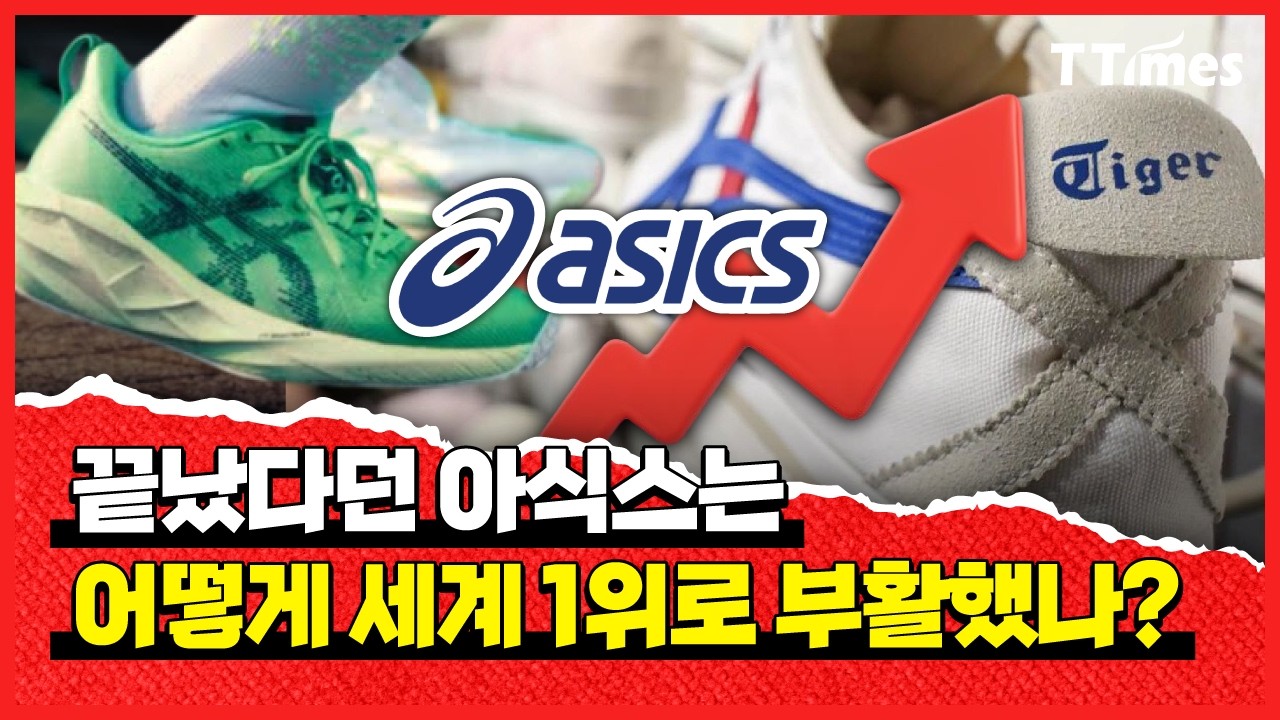
The Real Reason Asics Overtook Nike: It Rebuilt Its Organization Before It Innovated Running Shoes
This story is not simply a brand success tale of “Asics shoes got better.”
The key takeaway is that there are important clues behind Nike’s stumble in the running shoe market and Asics’s resurgence, connecting technological innovation, organizational innovation, D2C strategy, premium consumption trends, and the way companies will operate in the 2027 AI agent era.
Many reports explain it only as “Metaspeed sold well” or “Onitsuka Tiger is popular,” but the truly important point is elsewhere.
Before changing its shoes, Asics changed its decision-making structure, and it redefined customers not as “consumers” but as “partners who need to deliver results.”
This shift is now aligning with revenue growth, stock market revaluation, the global running boom, and the expansion of the premium sportswear market, pulling Asics back into the ranks of global sports companies.
1. The core point: Nike and Asics diverged in the running shoe market
As the global running boom continues, competition in the running shoe market is becoming more intense.
Since COVID-19, rising interest in health management, self-improvement, community sports, and marathon participation culture has transformed running shoes from simple exercise gear into lifestyle consumer goods.
The two companies most sharply contrasted in this market are Nike and Asics.
According to the source, Nike’s revenue growth slowed, and net profit also declined.
Its stock price fell from around $167, the peak in November 2021, to the $36 range, dropping by nearly 80%.
It was also removed from the S&P 100 index, where it had held symbolic significance since joining in 2008, weakening its standing as a representative global sports stock.
In contrast, Asics has been moving in the opposite direction.
According to the source, Asics’s revenue for the first half of 2026 was 534.4 billion yen, up 32.7% year over year.
It is noted that this was the first time since the company’s founding in 1949 that first-half sales exceeded 500 billion yen.
Its full-year revenue forecast was also set at 1.05 trillion yen, up 29.5% from the previous year.
If achieved, this would be the first time in Asics’s history that annual sales exceeded 1 trillion yen.
Even amid uncertain global economic forecasts and concerns about slowing consumption, the premium running shoe market is still growing.
This is the important part.
Consumers are not buying just any shoes; they are willing to pay more for products that improve performance and have a brand story.
2. Why Asics rose to No. 1 in the premium running shoe market
The especially important segment in the running shoe market is the premium running shoe market.
The source defines premium running shoes as those priced from $90 per pair, or roughly 120,000 won in Korean currency, and above.
This segment is not simply a high-price market.
It is a highly involved market where runners carefully evaluate cushioning, rebound, weight, stability, and the potential to improve their times.
In other words, a strong brand image alone is not enough; real performance must back it up.
Yet Asics is said to have reached first place in the premium running shoe market across the U.S., Europe, and Japan in 2025, with a 17.4% share, surpassing Nike and Adidas.
It ranked third in 2022 and 2023.
It rose to second place in 2024 and recorded first place for the first time in 2025.
This change is not a short-term marketing result; it signals that the rules of competition in the running shoe industry are changing.
In the past, advertising, celebrity marketing, and brand emotion mattered most, but now performance proven in real runner communities and data-driven product development carry much greater force.
3. Asics’s roots: from Onitsuka Tiger to a global sports company
To understand Asics, you first need to look at Onitsuka Tiger.
Onitsuka Tiger is the root of Asics.
The yellow sneakers worn by Uma Thurman with the yellow tracksuit in the 2003 film Kill Bill are the iconic Mexico 66 model from Onitsuka Tiger.
Founder Kihachiro Onitsuka established a company under his own name in Kobe, Japan, in 1949 and began making shoes.
The starting point was a philosophy of making young people, devastated after the war, healthier through sports.
The company then grew significantly with the 1964 Tokyo Olympics.
It expanded into many sports, including soccer shoes, fencing shoes, gymnastic shoes, and volleyball shoes, and grew into a comprehensive sports footwear brand.
In 1977, Onitsuka Tiger merged with two other companies and changed its name to Asics.
After that, Asics focused on technological development centered on running shoes.
In 1993, it launched the Gel Kayano series, featuring gel, an impact-absorbing material, and established itself as a global performance running shoe brand.
During this period, Asics was a brand with clear strengths in functionality and durability.
But that very strength later became the source of its crisis.
4. Asics’s crisis: its own success experience became a drag
By the 2010s, Asics had begun to wobble.
While Nike and Adidas strengthened their brand images through celebrity marketing, global campaigns, and fashion collaborations, Asics focused only on functionality and durability.
As a result, Asics gradually became perceived by consumers as “durable but not stylish.”
In Korea too, Asics was once strongly associated with value-for-money sneakers worn by marathon enthusiasts or students.
The problem intensified in 2017.
Nike introduced running shoes with carbon plates that dramatically boosted rebound, opening the so-called carbon plate era.
Until then, the running shoe market had centered on thin midsoles and lightweight shoes.
But after Nike, the market rapidly shifted toward thicker midsoles, carbon plates, and high-rebound materials to shorten race times.
Among runners, it was such a major shift that they called it “technological doping.”
Although other brands quickly followed this trend, Asics’s internal executives and middle managers viewed it as a temporary fad.
“Not many ordinary people are wearing them.”
“Thick midsoles won’t last as a trend.”
As these judgments continued, Asics fell behind in the core competition.
This is where an important economic lesson emerges.
During a technological transition, an organization’s speed of learning matters more than its existing market share.
Asics did not fail because it lacked technology; it failed because it lacked the organizational ability to acknowledge market change.
5. The shock of the Hakone Ekiden: the 0% Asics-wearing incident
The moment that symbolically showed Asics’s decline came from Hakone Ekiden, Japan’s premier university relay marathon.
Hakone Ekiden is a popular Japanese sports event held every New Year.
With average TV ratings reaching 30%, it is highly symbolic in Japan’s running culture.
For Japanese running shoe brands, it is a stage of pride.
Up until 2017, Asics had the No. 1 wearing rate among 210 participating athletes at 31.9%.
But after that, Nike quickly took over market share.
In 2020, Nike’s wearing rate surged to 84.3%, while Asics fell to 3.3%.
In 2021, Nike’s wearing rate reached 95.7%, and it is said that not a single athlete wore Asics.
There was even a story of an athlete under contract with Asics who said it was hard to win in Asics shoes, so he blacked out the logo of another company’s shoes and wore them instead.
This was not just a marketing failure.
It meant that the most demanding customers, the athletes, no longer trusted Asics products.
Ultimately, sales also collapsed.
Revenue, which stood at 428.5 billion yen in 2015, fell to 328.8 billion yen in 2020.
The company recorded five consecutive years of negative growth, and in 2018 it turned unprofitable.
When trust among athletes collapses in a sports brand, trust among general consumers collapses as well.
This is a representative example of how quickly consumer trends spread.
6. The beginning of the comeback: Project C and a 12-person team directly under the president
The card Asics played in the middle of the crisis was Project C.
It was a new shoe development project announced in November 2019 by then-president Yasuhito Hirota.
The goal was clear.
It was to create shoes that athletes could win in at the World Athletics Championships scheduled for early 2021.
But the first thing Asics innovated was not the shoe.
It was the organization.
Inside Asics, which had dominated the thin-sole long-distance running shoe market for decades, there were many middle managers trapped in past success.
They dismissed the new carbon plate trend and viewed the thick midsole and carbon plate competition as just a fad.
From President Hirota’s perspective, as someone brought in from outside, the wall of the existing organization was too high.
So he selected 12 young employees from R&D, design, production, marketing, legal, and other departments to create a project team reporting directly to the president.
The team minimized middle-management layers and made decisions quickly through direct communication with the president.
This is the real core point.
Asics’s turnaround was not a product development project; it was a decision-making structure reform project.
Corporate innovation is not completed simply by introducing technology.
Who makes decisions, on what criteria they judge, and how quickly customer feedback is reflected in products matter even more.
7. A change in development method: it went from the lab to the track
Asics’s new product development cycle was usually about two and a half to three years.
But President Hirota demanded that results be produced within one year.
There was no time to bring athletes into the lab, measure and analyze data, and develop slowly as before.
So the development team completely changed its approach.
Instead of staying in the laboratory, they took prototypes into the field.
They went to tracks, had athletes training there wear them directly, made them run immediately, and got feedback on the spot.
Then they revised again, had them wear them again, and received more feedback.
In normal new product development, one prototype is often tested at a time.
But in this project, more than 100 athletes were given between two and four prototype patterns each to try on.
The criterion was just one thing.
“Does this shoe actually help the athlete?”
This may sound simple, but it is extremely powerful.
Many companies make products based on the criterion of “Can we make it?”
Asics changed it to “Can the customer do better with it?”
This change was the starting point of the Metaspeed series.
8. The Metaspeed difference: it did not view runners as a single type
The result of Project C was the Metaspeed series.
Asics did not release its top-tier running shoe as just one line.
It introduced two lines depending on the runner’s style.
Metaspeed Sky is designed for stride-type athletes who take longer steps.
Metaspeed Edge is designed for cadence-type athletes who take quicker turnover rates.
In sports branding, top-tier running shoes are often managed as just one flagship model.
The reason is to reduce development costs and inventory burden.
But Asics kept both lines so athletes could run as fast as possible.
Development costs doubled and inventory burdens doubled too, but the company chose performance-based judgment.
This strategy is not just product segmentation.
It is a case of designing products not around an average customer, but around customer behavior data and performance patterns.
As AI agents and data analytics become more deeply integrated into corporate operations, this approach is likely to become even more important.
Companies that can quickly create and verify optimized products for different customer types, rather than a single mass-market product, will have the advantage.
9. Asics’s technical recovery proven by the Olympics and records
The first Metaspeed series was launched in March 2021, slightly past the deadline.
Coincidentally, the Tokyo Olympics, delayed by a year because of COVID-19, were held that same year.
In the Tokyo Olympic triathlon, athletes wearing Metaspeed won gold medals in both the men’s and women’s events.
From that point on, the reputation that “you can win if you wear Asics” began to return.
The source says that over one year after launch, Asics-sponsored athletes worldwide recorded 195 personal best improvements.
At the 2024 Paris Olympics men’s marathon, Belgium’s Bashir Abdi won a silver medal wearing Metaspeed.
It was the first time in 16 years, since the 2008 Beijing Olympics, that Asics running shoes returned to the Olympic marathon podium.
Changes also appeared at Hakone Ekiden.
The Asics wearing rate, which had once fallen to zero, is said to have recovered to 24.8% in 2024, 25.7% in 2025, and 28.5% in 2026.
Meanwhile, Nike’s wearing rate, which had once surged to 95.7%, fell to 16.7% and dropped to third place.
At the 2025 Tokyo Marathon, 40.7% of all runners, including general participants, chose Asics.
This trend is the strongest evidence of brand recovery.
It is trust created not by advertising, but by the choices of real athletes and runners.
10. The real turning point: it was not a good shoe that saved the company
On the surface, it may look as though Asics turned around by making a great shoe called Metaspeed.
But the order is the opposite.
It was not a good shoe that saved the company; because the company changed its organization, the good shoe emerged.
Asics was not a company that lacked technology in the first place.
It was a company that had dominated the long-distance running shoe market for decades.
The problem was not a lack of technology, but an attachment to its old success formula.
It believed the thin, lightweight running shoe strategy that worked in the past would continue to work in the new market.
But the market had already moved toward carbon plates, high-rebound foam, and thick midsoles.
Asics eventually acknowledged that reality, changed its organizational structure, changed its customer criteria, and changed its development method.
As a result, Metaspeed was born.
This section also carries important implications for the global economy and corporate management.
In an environment where high interest rates, consumer polarization, and technological transitions are happening simultaneously, it is difficult to survive on past brand power alone.
The speed with which an organization learns, admits failure, and reflects customer feedback in products becomes the core of corporate value.
11. Onitsuka Tiger: another growth engine for Asics
Asics’s success is not limited to running shoes.
The fashion shoe brand Onitsuka Tiger is another key growth pillar for Asics.
The current Onitsuka Tiger is not directly the same brand as the company founded in 1949, but a sub-brand launched by Asics in 2002 under the old name.
It is a lifestyle brand centered on fashion shoes rather than functional athletic shoes.
According to the source, Onitsuka Tiger’s revenue for the first half of 2026 was 89.5 billion yen, up 36% year over year.
Its profit margin is said to have reached 39.7%.
Achieving profitability close to 40% in a sports brand is quite impressive.
The secret lies partly in the products themselves, but even more importantly in the sales method.
12. Onitsuka Tiger’s D2C strategy: sell more expensively and more selectively, not more widely
The core strategy of Onitsuka Tiger is D2C.
D2C stands for Direct to Consumer and means a direct-to-consumer sales strategy.
Instead of sending goods in bulk to distributors, the brand sells directly through company-owned stores or official online malls.
This approach has the advantages of reducing intermediary margins, preventing discount wars, and securing customer data.
A few years ago, Nike also pushed its D2C strategy hard and saw results.
But Onitsuka Tiger’s approach is more extreme and more refined.
First, it operates globally, but it does not scatter products indiscriminately through distribution channels.
It sells mainly through directly operated stores.
Second, it limits the number of stores.
The number of directly operated stores worldwide is said to be about 160 to 190.
By country, some markets have only one or two.
It is even said that there is no standalone Onitsuka Tiger store in the United States.
Third, it maintains full-price sales without discounts.
Because openings are limited, distribution is controlled, and discounts are avoided, scarcity naturally emerges.
As a result, for tourists visiting Tokyo, stopping by an Onitsuka Tiger store has become part of the travel itinerary.
There are long lines in front of the stores, and they even hand out waiting tickets.
The Wall Street Journal reported on this phenomenon separately, showing that it has become a global consumer trend.
The important point here is that the experience of lining up to buy itself becomes marketing.
Visiting the store, waiting, purchasing, and posting on social media all connect into the brand experience.
This is the structure behind Asics’s high profitability through Onitsuka Tiger.
13. Why Asics is smart: it sells running shoes and fashion shoes in completely different ways
What is interesting is that Asics does not apply the same D2C strategy to all products.
Onitsuka Tiger uses directly operated stores, limited locations, full-price sales, and a scarcity strategy.
By contrast, running shoes are still said to rely on wholesale channels for more than half of sales.
The reason is simple.
For running shoes, the process of having staff at specialty stores look at foot shape, running style, and training purpose before recommending a model is important.
For runners, the experience of trying on shoes directly, hearing expert advice, and choosing the model that fits their feet is necessary.
If you remove specialty store shelf space from such products, the brand touchpoint weakens.
In fact, Nike once strengthened D2C, withdrew from some specialty distribution channels, and brands like Hoka and On Running filled that gap.
Asics did not repeat that mistake.
It sells fashion shoes through scarcity and brand experience, while selling running shoes based on specialty-store access and athlete trust.
It is running two completely opposite sales strategies within the same company.
This is not just a distribution strategy; it is a portfolio strategy.
Asics is managing performance, sports style, and lifestyle in different ways while capturing both profitability and growth.
14. The key point most reports miss: Asics’s real strength is an “ambidextrous organization”
Many reports explain Asics’s success as due to Metaspeed and the popularity of Onitsuka Tiger.
But there is something even more important.
Asics is running two completely different operating systems inside one company at the same time.
In the running shoe business, athlete data, field testing, technical verification, and specialty-store distribution matter.
In the Onitsuka Tiger business, scarcity, full-price sales, directly operated store experiences, and social media diffusion matter.
One is a product driven by performance, and the other is a product driven by desire.
One needs to be worn widely to build trust, while the other must be sold sparingly to increase value.
These two strategies can conflict with each other.
But Asics separates them operationally and connects them into a single corporate portfolio.
In management terms, such an organization is often called an ambidextrous organization.
It improves the core business with one hand and grows a new growth business with the other.
This is very likely to become a core model of future corporate innovation.
Especially around 2027, when AI agents begin operating in corporate workflows in earnest, this structure becomes even more important.
The gap is likely to widen between companies that simply use AI as an assistant tool and companies that restructure their organizations so AI agents can actually work within them.
15. The connection between the 2027 AI agent era and the Asics case
The source also mentions that AI agents will change corporate operations in 2027.
This part connects naturally with the Asics case.
In the future, companies may be broadly divided into three types.
First, organizations where people work with people.
Second, organizations where people use chatbots or AI tools as auxiliary support.
Third, organizations where AI agents move at the level of actual work units, and people design and manage them.
Asics’s Project C was not an AI agent organization, but it did show some features of a future model.
It reduced intermediate reporting steps.
It gathered field feedback quickly.
It narrowed the distance between decision-makers and execution teams.
It shortened product development cycles.
It revised products based on customer data.
If AI agents are combined with this structure, it could become even more powerful.
For example, a running shoe company could use AI agents to analyze athlete feedback, landing data, injury history, record changes, social media reactions, inventory data, and regional sales trends in real time.
Then the product development team, marketing team, production team, and distribution team could all move based on the same data.
This is what makes it different from simple digital transformation.
In the AI agent era, competitiveness will come not from “Did we adopt AI?” but from “Did we change the organization so AI can actually work?”
Just as Asics changed its organization before innovating shoes, companies in the future will need to change their workflow structure and decision-making structure before adopting AI.
16. The investment perspective: the difference between Asics and Nike
The stock market ultimately prices in future growth and profitability.
Nike’s struggles are not simply because one or two products sold less.
Its brand power remains strong, but it lost market share in the specialty running market to competitors like Hoka, On Running, and Asics.
Its push into D2C also weakened relationships with specialty distribution channels.
Consumers became more segmented, and the running community became more specialized, but Nike’s strategic shift was not as fast as expected.
In contrast, Asics secured multiple growth engines at once: restored technical trust, a rising share of the premium running shoe market, the highly profitable Onitsuka Tiger structure, and the global running boom.
Of course, Asics also has risks.
Competition in premium running shoes will remain intense.
Nike and Adidas could accelerate technological innovation again.
Hoka and On Running are also strong competitors.
As Onitsuka Tiger’s scarcity strategy becomes more popular, the temptation to increase supply will grow.
If supply increases too much, scarcity will be lost; if it is too tightly limited, growth may be constrained.
Therefore, Asics’s next challenge is balancing growth and scarcity.
If it maintains that balance well, corporate value revaluation in the global sportswear market could continue.
17. Five strategic points companies should learn
First, technological change can be a structural shift, not a fad.
Asics initially saw the carbon plate trend as a temporary fad.
But the market had already moved to a new technological standard.
The same thing happens in AI, electric vehicles, robotics, semiconductors, and biotech.
What first looks like a fad may actually be a turning point that changes the industry standard.
Second, you should look at customer results, not just customer opinions.
Asics looked at whether athletes actually ran faster, rather than whether they simply liked the shoes.
This is the core of product innovation.
Third, organizational structure determines the limits of the product.
Rapid innovation is difficult under traditional reporting systems and manager-centered structures.
Asics increased decision speed with a 12-person team reporting directly to the president.
Fourth, D2C is not the right answer for every product.
D2C worked for Onitsuka Tiger, but running shoes needed specialty distribution channels.
As Nike’s case shows, a forced D2C shift can instead create opportunities for competitors.
Fifth, brands must distinguish between selling widely and selling at a premium.
Onitsuka Tiger created a luxury image by limiting stores and avoiding discounts.
By contrast, running shoes had to be broadly validated by athletes and serious runners.
Even within the same company, completely different strategies are needed depending on the product line.
18. What the Asics case means for Korean companies
Korean companies also have a lot to learn from Asics.
In particular, there are messages that apply to manufacturing, consumer goods, platforms, and AI startups alike.
First, companies with strong past success are more likely to deny new market changes.
Second, product innovation is hard to sustain without organizational innovation.
Third, customers should not be viewed as averages.
Fourth, in premium markets, performance, story, and experience move together.
Fifth, in the AI agent era, organizations with fast feedback loops will become stronger.
In the end, Asics’s revival is not just a sports brand story.
It is a management case showing how a company can turn around even amid an uncertain global economic outlook.
It is also a market analysis case showing that consumer trends are shifting toward functionality, experience, scarcity, and community.
And for companies preparing for the 2027 AI agent era, it can also serve as a future strategy case highlighting the importance of organizational design.
< Summary >
Asics was once pushed back by Nike in the running shoe market and suffered the shock of a 0% athlete wearing rate.
But it succeeded in turning around by changing its organization before changing its shoes.
It created Project C directly under the president, changed its development method to field testing, and launched Metaspeed Sky and Edge according to runner type.
As a result, it proved its performance in the Olympics and marathon races and rose to No. 1 in the premium running shoe market.
At the same time, Onitsuka Tiger created high profitability through limited stores, full-price sales, and a D2C strategy.
Asics’s real strength lies in its ambidextrous organization, which operates technology, brand, and distribution differently from one another.
This case offers important insight connecting corporate innovation, consumer trends, the stock market, the global economic outlook, and organizational strategy for the AI agent era.
[Related Articles…]
How AI Agents Will Reshape Corporate Operations in 2027
An Analysis of the Global Running Shoe Market and Premium Consumption Trends
*Source: [ 티타임즈TV ]
– 신발 혁신하기 전에 조직부터 갈아엎었다