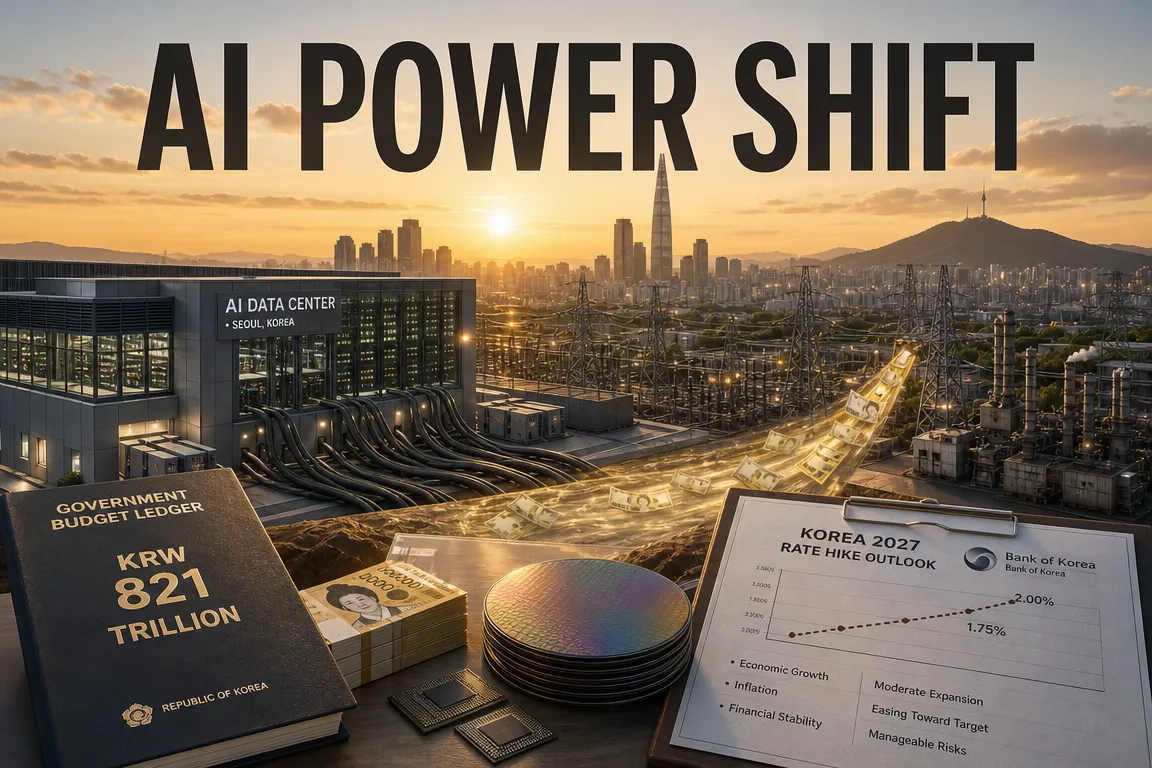
● AI-Driven Boom, Rate Hike Shock, Mega-Budget Surge
2027 Money Flow Shifts: AI Semiconductors, Policy Rates, and the KRW 821 Trillion Budget That Will Reshape the Korean Economy
When assessing the 2027 economy, the key question is not simply whether growth will improve.
The critical issue is where capital is leaving, where it is concentrating, and how those flows are affecting equities, real estate, policy rates, and the national budget.
At the center of this shift are AI trends, semiconductor exports, data center power infrastructure, Bank of Korea policy rates, and the KRW 821 trillion super-budget.
Although these appear to be separate themes, they are connected by one question.
Where will capital flow in 2027, and who will capture it?
The most important point in this outlook is that AI is not merely a technology theme, but a large-scale capital rotation that is reshaping the global economic outlook.
In 2025, GPUs were scarce. In 2026, HBM and DRAM became the bottleneck. In 2027, power and physical AI are likely to emerge as the next constraints.
This transition is affecting Samsung Electronics, SK Hynix, power infrastructure, robotics, automobiles, consumer electronics, real estate, and household debt.
1. 2027 Core Theme: Capital Rotation Begins
The central concept in the original text is capital rotation.
Under normal conditions, capital moves in a predictable direction.
However, wars, pandemics, and technological disruptions can reverse that direction.
That reversal is capital rotation.
COVID-19 created a major global rotation.
The 2026 Middle East war also disrupted energy prices and supply chains.
The original text identifies AI as a stronger force driving the next rotation.
AI is not limited to chatbots or search services.
It is reshaping corporate investment, equity flows, global trade, labor markets, industrial structure, and government budgets.
Capital is moving away from legacy industries and into the AI value chain.
- Capital is moving toward companies that build and train AI models.
- Investment is concentrating in big tech and hyperscalers that operate AI services.
- CAPEX is flowing into data centers, semiconductors, and power grids, which form the core of AI infrastructure.
- Industries with limited AI exposure are seeing weaker capital inflows.
- In equities, the gap is widening between companies inside and outside the AI value chain.
In 2027, the relevant question is not whether a company uses AI, but whether it belongs to the AI value chain.
Countries within that chain may gain growth opportunities, while others face stronger pressure from slow growth.
2. How AI Can Offset the Downside from the Middle East War
The 2026 Middle East war created strong downward pressure on the global economy.
Higher energy costs, logistics disruptions, supply chain stress, and renewed inflation risks all emerged.
For Korea, which depends heavily on imported energy and manufacturing, the impact was particularly significant.
Nevertheless, the Korean economy showed stronger-than-expected growth.
The original text attributes this to AI-related exports, particularly semiconductors.
Demand for AI servers, data centers, and high-performance computing surged, lifting exports of core AI-enabling components.
According to the original text, semiconductors rose from a share of around 9% of total exports to 20%, then 25%, and reached 38.7% in the first half of 2026.
This indicates that the Korean economy is no longer driven only by the manufacturing cycle, but is increasingly tied to the AI investment cycle.
The Middle East war created downside pressure, but AI semiconductor demand offset much of it.
As a result, the original text suggests Korea’s GDP growth could remain strong at 3.3% in 2026 and around 2.9% in 2027.
That level would exceed potential growth and could support further policy rate increases by the Bank of Korea.
3. AI Value Chain Transition: From GPU to HBM, Then to Power
The leading segments in the AI investment cycle continue to change.
The key question is what is scarce.
Scarcity determines pricing power and market leadership.
In 2025, the bottleneck was GPU supply.
AI model training and inference required Nvidia GPUs, and scarcity translated directly into stronger Nvidia valuations.
In 2026, the bottleneck shifted to HBM and DRAM.
Even with GPUs, AI servers cannot be built efficiently without high-bandwidth memory and advanced DRAM.
This is where Samsung Electronics and SK Hynix drew strong market attention.
In 2027, the bottleneck is likely to be power.
No matter how many data centers are built, they cannot operate without sufficient electricity.
AI competitiveness ultimately depends on computing power, and computing power depends on power supply.
- 2025 leading bottleneck: GPU
- 2026 leading bottleneck: HBM, DRAM
- 2027 leading bottleneck: power infrastructure, data centers, physical AI
The original text cites roughly 12,600 data centers worldwide.
Although dozens are being added every day, power shortages are limiting the pace of expansion.
AI investment can no longer be viewed through semiconductors alone.
Power grids, transmission, generation, LNG, nuclear power, SMRs, power equipment, and cooling systems must also be considered.
In 2027, leadership may shift from AI semiconductors toward power infrastructure and physical AI.
4. Physical AI: Product Category Expansion Begins in 2027
Another major theme in the original text is physical AI.
Until now, AI has been understood mainly through software, chatbots, search, and workflow automation.
From 2027 onward, AI is expected to move more deeply into physical products.
AI refrigerators can identify ingredients and reorder missing items.
AI cars can analyze driver behavior and road conditions to improve safety.
AI robots can replace or complement human labor in factories, logistics centers, hospitals, and households.
AI microphones, AI PCs, AI smartphones, and AI appliances can all transition into new product categories through embedded AI functions.
The original text frames 2025 as the concept stage for physical AI, 2026 as the planning stage, and 2027 as the commercialization stage.
For equity markets, this implies a new valuation premium for companies exposed to physical AI.
- Robotics: manufacturing, logistics, medical, and service automation
- Automobiles: autonomous driving, driver assistance, in-vehicle AI services
- Home appliances: refrigerators, washing machines, air conditioners, and televisions
- PC and mobile devices: on-device AI and personalized services
- Industrial equipment: smart factories and AI-based predictive maintenance
AI is no longer confined to the cloud.
It is moving into physical products and broader industrial applications.
That is the most important change in the 2027 AI trend.
5. Korea’s Opportunity: The Semiconductor Supercycle Is a Structural Shift
Korea has long been viewed as a mature economy with limited growth potential.
Population decline, weaker productivity growth, soft domestic demand, and reliance on real estate have all been highlighted as structural constraints.
However, AI semiconductor demand is creating a new growth impulse for the Korean economy.
In particular, memory semiconductors, HBM, and DRAM are core components for AI server expansion.
As a result, Samsung Electronics and SK Hynix are being re-rated as essential AI infrastructure companies rather than cyclical manufacturers.
The original text also highlights several risks.
Korea must continue to address them if it wants to remain a winner.
- It must respond to U.S. and Chinese efforts to localize semiconductor supply chains.
- It must monitor share gains by Micron and CXMT.
- It must expand beyond DRAM and strengthen non-memory semiconductor capabilities.
- It must verify that AI demand translates into revenue and cash flow.
- It must reinforce domestic power infrastructure and data center ecosystems.
The original text notes a decline in Korea’s DRAM market share from 75% in Q1 2024 to 70% in Q1 2025 and 63% in Q2 2026.
It also highlights that China’s CXMT exceeded 10% for the first time in Q2 2026.
Korea cannot assume continued leadership simply because it remains strong in DRAM.
The United States is building domestic supply chains, and China is accelerating semiconductor self-sufficiency.
Korea must strengthen both technological leadership and supply chain strategy.
6. Bank of Korea Policy Rates: Why Further Hikes Remain Possible
The second major theme is Bank of Korea policy rates.
The original text states that the Bank of Korea raised rates twice in succession in July and August 2026.
That would be unusual in normal policy cycles.
The key variables are inflation, financial stability, and growth stability.
Monetary policy is not designed to favor borrowers or depositors.
The Bank of Korea evaluates the economy as a whole.
The original text identifies three main reasons for policy tightening.
- Price stability: consumer inflation and core inflation remain elevated.
- Financial stability: household debt and housing market excesses need to be restrained.
- Growth stability: the semiconductor-led expansion is strong enough to absorb higher rates.
The original text points to core inflation rising to around 3.4%.
Import price pressure also remains elevated, with increases of around 9% in U.S. dollar terms and 18.7% in won terms.
Under these conditions, the Bank of Korea may keep policy restrictive until it sees a durable return toward the 2% target.
Exchange rates are another variable.
A narrowing interest rate gap between Korea and the United States may help stabilize KRW/USD.
The original text notes an exchange rate near KRW 1,300 and suggests the Bank of Korea may prefer a level closer to KRW 1,200.
Further policy tightening is therefore not only about inflation.
It may also reflect concerns over exchange rates, household debt, and housing market stability.
7. KRW 2,000 Trillion Household Debt and the Housing Market
According to the original text, Korean household debt has exceeded KRW 2,000 trillion.
Mortgage loans account for a large share of that amount.
Higher policy rates increase debt service burdens for existing borrowers.
From that perspective, tighter policy is clearly a burden.
However, from the Bank of Korea’s perspective, restraining new borrowing may be more important.
Higher borrowing costs reduce demand from buyers who take on debt to purchase homes.
That can slow mortgage growth and ease upward pressure on housing prices, especially in Seoul.
The original text does not claim that the Bank of Korea is raising rates solely to stabilize housing.
Rather, it argues that the effect of rate hikes may help cool the property market and curb debt growth.
In summary, higher rates are a burden for existing borrowers, but they may function as a safeguard against runaway household debt.
The issue is that vulnerable borrowers, self-employed workers, and weaker companies may face greater stress.
This makes coordination between monetary and fiscal policy especially important.
8. The KRW 821 Trillion Super-Budget: Where the Money Goes
The third major issue is the 2027 budget of KRW 821 trillion.
It is described as rising from KRW 728 trillion in 2026, implying a 12.8% increase.
This is a very large fiscal expansion.
In general, a larger budget increases liquidity in the economy.
That can affect inflation, real estate prices, and risk assets.
It naturally raises the question of whether fiscal expansion is appropriate while the central bank is tightening.
The original text also notes a positive fiscal element.
Government revenue in 2027 is projected at around KRW 880 trillion, above spending of KRW 821 trillion.
That reflects strong corporate tax receipts driven by robust semiconductor and export performance.
National debt-to-GDP is also expected to decline from 50.6% to 48.3%.
The management fiscal balance deficit is likewise expected to narrow.
In that sense, the budget is not simply an expansionary outlay, but one supported by stronger revenue.
However, concerns remain.
If fiscal deficits widen again in 2028, 2029, and 2030, long-term fiscal sustainability could weaken.
For a country with a shrinking population and lower trend growth, persistent debt expansion is not a durable model.
9. Policy Mismatch: Tightening Monetary Policy While Expanding Fiscal Spending
One of the most striking analogies in the original text is opening a window while turning on the heat.
The Bank of Korea is raising rates to contain inflation.
The government is expanding spending through the KRW 821 trillion budget.
One side is reducing liquidity while the other is adding it.
These actions may offset each other.
The same issue applies to housing.
The government issues measures to stabilize the property market.
At the same time, large fiscal spending can weaken the value of money and support asset prices.
That can create policy inconsistency.
Not all fiscal spending is negative.
Spending directed toward future growth drivers is necessary.
The key issue is whether monetary tightening, real estate stabilization, inflation control, and fiscal expansion are aligned in the same direction.
In 2027 budget discussions, the crucial issue is policy coherence rather than political framing.
If fiscal spending is allocated to higher growth potential, it is constructive.
If it only increases short-term liquidity and fuels inflation and asset prices, the side effects could be significant.
10. Main Uses of the KRW 821 Trillion Budget: Industry, SMEs, Energy, and Super-Innovation
The original text states that the increase in the 2027 budget is concentrated in industry, small and medium-sized enterprises, and energy.
This suggests that the government is prioritizing growth engines over simple welfare expansion.
It also emphasizes a super-innovation economy project aimed at raising potential growth.
This includes R&D, talent development, financing, overseas expansion, and deregulation.
- AI semiconductors and next-generation memory
- SiC semiconductors and power semiconductors
- SMRs and next-generation energy technologies
- Power infrastructure and energy security
- K-content global expansion
- Advanced manufacturing and future mobility
- Robotics, physical AI, and smart factories
K-content funding is also highlighted as an example.
The global content market is growing faster than global GDP.
Gaming, music, video, and IP expansion are areas where Korea can compete effectively.
The government intends to support the full value chain of content, including planning, development, production, distribution, consumption, and IP expansion.
Relevant ministries include the Ministry of Culture, Sports and Tourism, the Ministry of Science and ICT, the Ministry of Trade, Industry and Energy, the Ministry of SMEs and Startups, and the Financial Services Commission.
Ultimately, the key question is where the budget is spent.
Spending that raises growth potential is constructive.
However, if legal procedures, fiscal discipline, and policy consistency weaken, market confidence may deteriorate.
11. The Most Important Point Often Missed in Other Coverage
The most important part of the original text is deeper than the visible outlook on leading sectors or policy rates.
Most coverage stops at statements such as AI is positive, semiconductors will rise, rates will increase, and the budget is large.
The real issues are as follows.
- First, the sustainability of AI investment depends on hyperscaler cash flow.
The original text notes that hyperscalers have already seen free cash flow weaken or turn negative.
Continued spending on data centers and semiconductor purchases will depend on corporate bond issuance.
In other words, U.S. Treasury yields and the corporate bond market are hidden variables behind AI semiconductor demand. - Second, the leading AI theme in 2027 may come from power bottlenecks rather than semiconductors alone.
After GPUs and HBM, the next constraint is power.
As data centers expand, power grids, generation, transmission, cooling, and power equipment become more important. - Third, rising use of Chinese AI models could alter demand patterns for Korean semiconductors.
The original text notes that dependence on Chinese AI models has surpassed reliance on U.S. models.
Greater adoption of lower-cost Chinese models may change the revenue structure and investment direction of the global AI ecosystem. - Fourth, the real risk for Korean semiconductors is not the cycle, but market share erosion.
Micron and CXMT are strengthening their positions in U.S. and Chinese supply chains.
Korea should not assume continued leadership simply because it remains strong in DRAM. - Fifth, the core issue with the KRW 821 trillion budget is not size alone, but the risk of fiscal dominance.
If the central bank tightens to fight inflation while the government expands spending aggressively, monetary policy may become subordinate to fiscal policy.
That raises concerns about fiscal dominance.
12. Key Indicators to Monitor in 2027
To understand 2027 properly, investors should monitor more than equity prices.
The following indicators are more useful for tracking capital flow.
- AI data center expansion pace
- Power supply plans and transmission investment
- HBM and DRAM price trends
- Samsung Electronics and SK Hynix share in AI semiconductors
- Market share changes at Micron and CXMT
- Hyperscaler CAPEX and free cash flow
- U.S. Treasury yields and corporate bond conditions
- Bank of Korea policy rate decisions and inflation trends
- Household debt growth and mortgage trends
- Final details of the KRW 821 trillion budget
- Execution areas of the super-innovation economy project
If these indicators move in the same direction, Korea may sustain strong growth led by AI semiconductors and power infrastructure.
If hyperscaler investment weakens, rates rise sharply, or power bottlenecks worsen, the AI cycle may lose momentum.
13. Conclusion: In 2027, Capital Will Move Between AI Infrastructure and Policy Conflict
The core issue in 2027 is where capital moves.
Capital is rotating into the AI value chain.
Within that chain, leadership is shifting from GPUs to HBM, then to power, and then to physical AI.
Korea has a significant opportunity in this environment.
It has strengths in semiconductors, memory, HBM, manufacturing, content, and the commercialization of physical AI products.
The risks are also clear.
Household debt exceeds KRW 2,000 trillion, the housing market remains sensitive, and higher policy rates pressure vulnerable borrowers.
The KRW 821 trillion budget offers growth support, but it also raises concerns about policy mismatch.
Ultimately, 2027 is likely to be a year in which AI-driven growth opportunities collide with risks from rates, fiscal policy, and debt.
Investors who understand capital rotation may identify opportunities, while those who follow only the theme may face sharper volatility at the turning point.
< Summary >
The central theme for 2027 is capital rotation.
Funds are concentrating in the AI value chain, with leadership moving from GPUs to HBM and DRAM, and then to power infrastructure and physical AI.
Korea’s semiconductor exports are offsetting much of the downside from the Middle East war.
However, hyperscaler cash flow, U.S. Treasury yields, Chinese AI model adoption, and competitive pressure from CXMT and Micron remain important risks.
The Bank of Korea may keep policy rates elevated due to inflation, exchange rate stability, household debt, and housing market concerns.
The KRW 821 trillion budget supports growth, but it also creates concern about policy conflict with monetary tightening.
In 2027, Korea’s outlook will depend on AI semiconductors, power infrastructure, physical AI, policy rates, household debt, and fiscal strategy.
[Related Articles…]
- AI Semiconductor Supercycle and the Korea Growth Outlook
- Bank of Korea Policy Rate Outlook and Household Debt Risks
*Source: [ 경제 읽어주는 남자(김광석TV) ]
– [경읽남 모아보기] 2027년 돈의 흐름이 바뀐다|주도주·기준금리·821조 예산안
● Retirement Cashflow Hack, Pension Limit Crushed, Lump Sum Lifelong Income
If Individual Pension Limits Are Fully Used: An Immediate-Premium Annuity Strategy to Convert 5060 Lump Sums into Lifetime Monthly Income
If you have already maxed out the annual 18 million won contribution limit for pension savings and IRP, and also used the 20 million won ISA limit, any remaining lump sum requires a different retirement strategy.
This is especially relevant for people in their 50s and 60s, who do not have two decades or more to accumulate assets gradually.
The key issue is no longer simply how much to save, but how to convert existing assets of 50 million won, 100 million won, or 200 million won into stable retirement cash flow.
The core point is straightforward.
Even if pension savings, IRP, and ISA limits are fully used, retirement planning is not over. There remains a separate option: immediate-premium annuities and deferred annuities, which allow a lump sum to be paid in once and received as lifetime income.
However, these products should not be evaluated only on nominal yield, as with bank deposits or dividend stocks.
They must also be assessed on lifetime payout structure, tax exemption potential, health insurance premium impact, deposit protection, surrender value, and guaranteed payment period.
1. Why Pension Savings and IRP Alone May Be Insufficient for 5060 Retirement Planning
The most familiar vehicles for private retirement preparation are pension savings and IRP.
Together, these accounts allow annual contributions of up to 18 million won.
Separate tax deduction limits apply, but the combined annual deposit limit remains 18 million won.
ISA is also widely used.
ISA generally allows annual contributions of up to 20 million won and offers tax exemption and separate taxation benefits if certain requirements are met, making it a popular tax-efficient investment account.
The challenge is the 50s and 60s age group.
At this stage, there is often insufficient time to contribute over 20 years and fully benefit from compounding.
At the same time, many people already hold lump sums accumulated through deposits, retirement benefits, or real estate sales.
In other words, younger investors are asking how much to contribute each month, while investors in their 50s and 60s are primarily concerned with converting existing capital into monthly income.
- Pension savings and IRP are well suited for long-term accumulation.
- ISA is effective as a tax-advantaged investment account.
- However, these accounts have limitations when the objective is to convert a large lump sum into lifetime cash flow.
- For this reason, immediate-premium annuities are a potential alternative for 5060 investors.
2. The Option After the 18 Million Won Annual Limit: Immediate-Premium Annuities
An immediate-premium annuity is a product in which the premium is paid in one lump sum.
Unlike an installment-based annuity, where contributions are made monthly, this structure allows a lump sum such as 50 million won or 100 million won to be paid in once and then received later as annuity income.
In the United States, this is often referred to as a single premium annuity.
Such structures are common in the U.S. annuity market.
Retirement assets are transferred to an insurer, and income begins immediately or after a deferred period.
Korea historically developed under a high-growth environment in which salary-based savings products were more familiar.
As a result, installment-based products became the default.
However, with slower growth, aging demographics, and longer life expectancy, converting lump sums into stable retirement income is becoming increasingly important.
Immediate-premium annuities in Korea are typically sold through life insurers as annuity insurance products.
The structure is different from bank deposits or brokerage investments.
Unlike pension savings, IRP, or ISA, where investors can actively buy and sell assets inside an account, annuity insurance is structured around the insurer’s payout terms and retirement cash flow design.
3. Two Main Types of Immediate-Premium Annuities: Immediate Annuity and Deferred Annuity
① Immediate Annuity: Pay Once, Receive the Following Month
An immediate annuity is a product in which a lump sum is paid up front and annuity payments begin as early as the following month.
This is suitable for individuals who are already retired or who need bridge income before National Pension benefits begin.
For example, if a person retires around age 60 but has not yet begun receiving full National Pension payments, an immediate annuity can serve as a temporary living-expense bridge.
Because payments begin immediately, the monthly amount may be relatively low.
Under older product structures, a 100 million won premium was sometimes associated with monthly lifetime income of around 400,000 won.
Actual amounts vary depending on age, gender, interest rates, product structure, guaranteed period, and whether principal is exhausted over time.
② Deferred Annuity: Wait Several Years, Receive More Later
A deferred annuity involves paying a lump sum and waiting a certain number of years before receiving annuity payments.
This may be more suitable for people in their 50s who still have earned income or other cash flow and do not need immediate retirement income.
For example, a person in their mid-50s may have roughly 10 years before National Pension payments begin.
By deferring the annuity during that period, the eventual monthly payment may increase.
The source text noted that some recent products have shown the possibility of monthly income exceeding 600,000 won after a 100 million won premium and approximately 10 years of deferral.
These figures should not be interpreted as guaranteed returns.
Actual payouts vary by product terms, credited rates, entry date, annuity commencement age, lifetime payout structure, and guaranteed period.
Still, compared with older monthly income levels near 400,000 won, some newer products appear more competitive.
4. Is 100 Million Won for 600,000 Won per Month a Good Deal?
Many investors immediately calculate the implied return.
For example, 100 million won in exchange for 600,000 won per month equals 7.2 million won per year, which may appear to imply an annual return of 7.2%.
However, annuity insurance is not a simple interest product.
Monthly annuity payments may include part of the principal, and lifetime structures become more favorable the longer the insured lives.
Conversely, if the insured dies early, the outcome depends on the guaranteed period and inheritance terms.
For this reason, comparing immediate-premium annuities directly with deposit rates or dividend yields can distort the evaluation.
Dividend stocks may generate annual payouts above 4% to 5% if selected well.
However, dividends can be reduced with weaker corporate performance, and share-price volatility remains a risk.
The key purpose of a lifetime annuity is not maximum return, but protection against longevity risk.
In other words, it is less an investment vehicle for maximizing yield and more a retirement tool designed to secure cash flow for life.
- Deposits are stable but subject to maturity constraints and interest-rate changes.
- Dividend stocks can generate income but involve dividend-cut and price-risk exposure.
- Bond-based assets are sensitive to interest-rate movements.
- Immediate-premium annuities are centered on lifetime payout structure rather than return maximization.
5. How Should High Fees Be Viewed?
One of the main reasons investors avoid annuity insurance is business expense and fee concerns.
Historically, some insurance products involved high upfront expenses and low surrender values, leading to dissatisfaction.
This created the perception that insurance products are inherently unfavorable.
However, immediate-premium annuities may have a different structure from installment-based insurance products.
The source text also indicates that such products may have relatively lower fees, and that the quoted monthly annuity amount is the post-expense payout amount.
The key issue is not the expense ratio itself, but the actual amount received.
Before subscribing, investors should verify the following:
- Whether the monthly payout is fixed or variable.
- The actual payout after business expenses are deducted.
- The surrender value in the event of early termination.
- Whether the product is lifetime, fixed-term, or inheritance-based.
- How much is paid to beneficiaries after death.
- Whether the guaranteed period is 10 years, 20 years, or unavailable.
Low fees are not meaningful if the payout is also low.
Conversely, a product with fees may still be worth considering if it offers strong lifetime payment terms and acceptable realized income.
6. Tax Exemption and Health Insurance Premium Effects Must Be Checked
One of the most frequently cited advantages of immediate-premium annuities is tax exemption.
Under Korean tax law, certain savings insurance products may qualify for tax exemption on interest income if specific requirements are satisfied.
For immediate-premium insurance, tax exemption conditions are generally reviewed up to a limit of 100 million won per person.
However, simply paying 100 million won does not automatically guarantee tax exemption.
Holding period, premium structure, interim withdrawals, and relevant legal requirements must be satisfied.
Accordingly, investors should obtain written confirmation that the product meets tax exemption conditions.
Another important issue is health insurance premiums.
Under current rules, certain private pension insurance payments may be treated more favorably in health insurance premium calculations.
However, the health insurance system may change over time.
This issue is especially important for individuals moving into regional health insurance coverage after retirement.
If annuity income rises but health insurance premiums rise as well, the effective benefit declines.
Accordingly, immediate-premium annuities should be evaluated in terms of both tax benefits and health insurance effects.
7. What Happens if the Insurer Fails?
When investing a large lump sum, the most practical concern is the financial stability of the institution.
For amounts above 100 million won, the question of insurer insolvency becomes particularly relevant.
In Korea, deposit protection generally applies up to a certain limit per financial institution.
As of 2025, the deposit protection limit in Korea has been expanded to 100 million won per person per financial institution.
However, not all insurance products are protected in the same way, so product-specific protection coverage and limits must be verified.
The practical approach is to avoid concentrating more than 100 million won in a single institution and to consider diversification across institutions based on credit quality and protection limits.
That said, diversification increases complexity and may lead to different product terms, so both advantages and disadvantages must be weighed.
8. Who Immediate-Premium Annuities Fit, and Who They Do Not
When Immediate-Premium Annuities May Be Suitable
- Individuals who have already fully used the 18 million won pension savings and IRP contribution limit.
- Individuals who have also used their ISA contribution capacity and still retain excess lump-sum assets.
- Individuals in their 50s or 60s who do not have enough time for long-term installment contributions.
- Individuals with retirement benefits or maturing deposits who want stable asset conversion.
- Conservative investors who cannot tolerate high volatility.
- Individuals seeking additional monthly cash flow beyond National Pension benefits.
- Individuals concerned about longevity risk.
When Immediate-Premium Annuities May Not Be Suitable
- Individuals likely to need the lump sum again before maturity.
- Individuals with near-term funding needs such as real estate purchases, family support, or medical expenses.
- Individuals seeking aggressive investment returns.
- Individuals unable to accept surrender-value limitations and reduced liquidity.
- Individuals who do not fully understand the product structure.
Immediate-premium annuities are not products that should be purchased simply because they are considered favorable.
They should be used as part of a strategy to convert part of one’s assets into a lifelong monthly income stream.
Allocating all retirement assets to such products would be imprudent.
A more realistic approach is to separate cash, emergency reserves, medical funds, investment assets, and retirement assets.
9. The Core Point Often Overlooked by Other Media and Video Content
The most important issue is not return, but the certainty of retirement cash flow.
Most commentary focuses on how much monthly income can be generated from 100 million won.
However, the real question is what role that monthly payment plays in the overall retirement spending structure.
For example, if National Pension provides 1.2 million won per month and an immediate-premium annuity adds another 600,000 won, then 1.8 million won in basic monthly income is secured.
If retirement accounts, housing pension income, deposit interest, and dividend income are added, the cash flow profile becomes much more stable.
In that sense, immediate-premium annuities are not a standalone wealth-building product.
They are closer to the final component connecting National Pension, retirement benefits, private pensions, ISA, and cash-like assets.
Another important factor is the annuity commencement date.
For a person in the mid-50s, a structure that begins payment after 5 or 10 years may be more suitable than an immediate payout.
Conversely, for someone already experiencing a cash-flow shortage in their 60s, immediate payment may be more practical than deferral.
Ultimately, the first variables to define are retirement timing, National Pension start date, monthly living expenses, life expectancy, and spouse-related expenses.
If this order is reversed, even a sound product may fail to support the retirement plan.
10. Practical Checklist Before Subscribing
- Confirm whether the 18 million won annual limit for pension savings and IRP has already been used.
- Review ISA contribution limits and maturity strategy.
- Determine how much of the lump sum should be converted into annuity income.
- Preserve 1 to 2 years of living-expense reserves separately.
- Select between immediate and deferred annuity structures based on personal needs.
- Verify both monthly income and surrender value.
- Compare lifetime, fixed-term, and inheritance-based structures.
- Confirm tax exemption eligibility.
- Assess the impact on health insurance premiums.
- Confirm deposit-protection coverage and limits.
- Review insurer credit quality and solvency position.
- Consider post-death living needs for a spouse.
11. Conclusion: For 5060 Investors, the Priority Is Not Asset Growth but Stable Income
Retirement asset management for investors in their 50s and 60s should differ from the strategy used by those in their 30s and 40s.
At younger ages, the priority is asset growth through higher returns.
As retirement approaches, however, the more important objective is stable monthly cash flow.
If pension savings, IRP, and ISA have already been fully used, immediate-premium annuities and deferred annuities become viable additional options.
For investors seeking to convert approximately 100 million won into monthly retirement income, these products may be meaningful alternatives.
However, product structures differ materially, and tax treatment, payout levels, surrender values, and guaranteed periods all vary, so decisions should not be based on monthly payout alone.
They must be compared against retirement timing and spending needs.
Investors comfortable with market risk may prefer dividend stocks, bonds, or ETFs.
Those who are more sensitive to volatility and need lifetime payment structure may reasonably include immediate-premium annuities in their comparison set.
< Summary >
Pension savings and IRP together have an annual contribution limit of 18 million won.
ISA also has an annual contribution limit of 20 million won, making it difficult to deploy a large lump sum within these accounts.
For investors in their 50s and 60s with limited time and available lump sums, immediate-premium annuities and deferred annuities may be considered.
Immediate annuities begin paying soon after premium payment, while deferred annuities may offer higher monthly income after a waiting period.
Some cases show monthly income above 600,000 won after a 100 million won premium, but actual results depend on product terms.
The central issue is not yield, but lifetime cash flow and longevity-risk management.
Before subscribing, tax exemption eligibility, health insurance impact, deposit protection, surrender value, and guaranteed period must be reviewed.
[Related Articles…]
- Private Pension Limit Exhausted? Retirement Cash Flow Strategies for Lump Sums
- ISA and IRP Tax-Efficient Retirement Planning Strategies
*Source: [ Jun’s economy lab ]
– 개인연금 연 1,800만 원 한도 다 찼을 때 목돈 굴리는 비밀 방법 (ft.연금박사 이영주 대표, 김봉옥 이사)