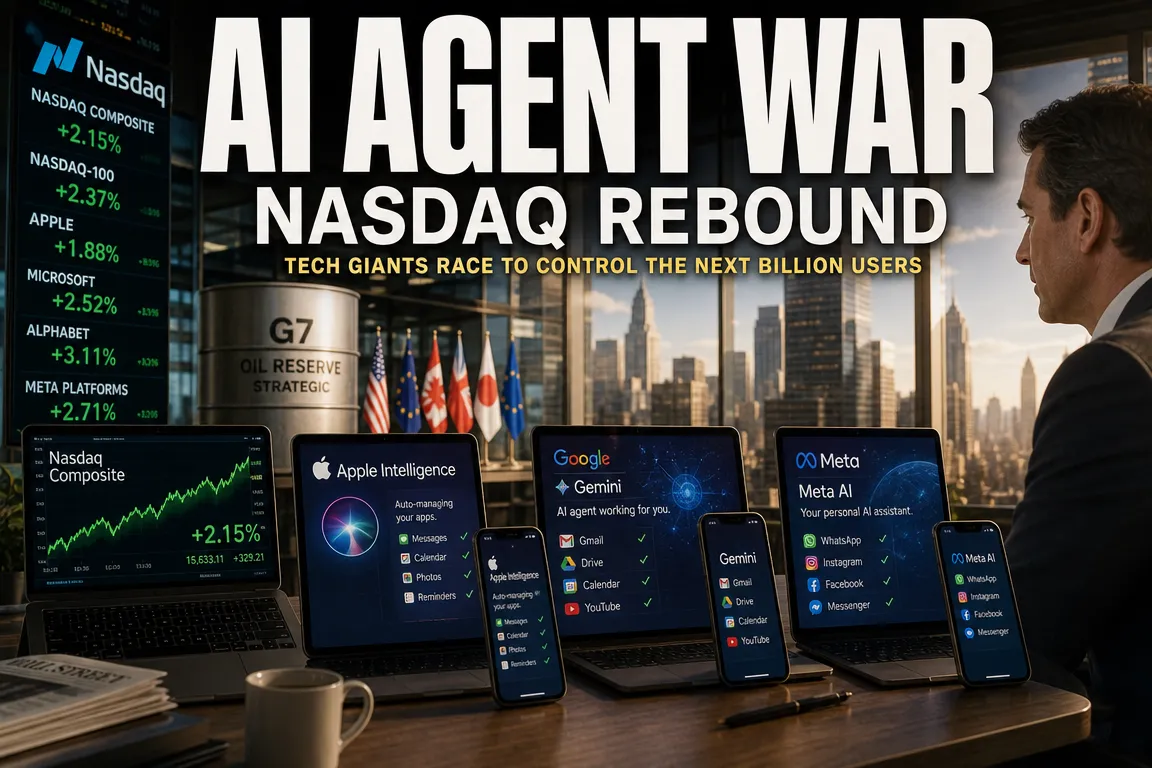
● AI Agent Wars, Nasdaq Rebound, Big Tech Battle
Who Will Really Win the AI Agent War: Nasdaq Rebound, Reduced Rate-Hike Expectations, and the Big Tech Deployment Race
The most important point in this move is not simply that the Nasdaq rose.
U.S. employment data weakened, reducing pressure for further rate hikes, while oil-market concerns eased somewhat as the G7 discussed releasing crude and diesel supplies.
However, a larger shift is taking place.
AI agents are emerging as the next major change in internet usage after ChatGPT.
In the future, users may no longer open apps directly to order deliveries, shop, manage schedules, or reply to email. Instead, they may instruct an AI agent, which will operate computers and applications on their behalf.
If this shift accelerates, it could affect big tech, semiconductors, cloud infrastructure, cybersecurity, and advertising simultaneously.
This article summarizes the strategic differences among Meta Muse, Instinct, Grokbot, and OpenAI Dots, and explains why Apple and Google could ultimately emerge as the winners.
1. The key driver behind the Nasdaq rebound: weaker labor data reduced rate-hike concerns
U.S. equities were broadly constructive overnight.
The Nasdaq rose by nearly 1.2%.
The main catalyst was weaker-than-expected U.S. employment data.
When payroll growth is too strong, wage pressures can rise and inflation can reaccelerate, giving the Federal Reserve more justification for higher rates.
By contrast, weaker employment supports the view that the Fed may have less room to tighten further.
The market reaction followed that logic.
- Nonfarm payrolls forecast: around 90,000
- Actual payrolls: below 30,000
- Unemployment rate: slightly worse than expected
- Average hourly earnings growth: weaker than expected
The most important indicator here is average hourly earnings.
If wages continue rising too quickly, companies pass higher labor costs to consumers.
That can trigger inflation and renewed wage demands, creating a wage-price spiral.
In this release, the pace of wage growth appears to be moderating.
That does not mean wages are falling, but slower growth was viewed positively by markets.
As a result, weaker employment data supported Nasdaq and growth stocks.
2. Easing oil concerns: G7 release discussions supported sentiment
Another sensitive variable for markets is oil prices.
In particular, rising geopolitical risks in the Middle East and the Strait of Hormuz can drive supply concerns and push crude prices higher.
Higher oil prices affect more than energy stocks.
They increase transportation costs, production costs, and consumer inflation.
That can eventually feed back into renewed rate-hike concerns.
This time, reports indicated that the G7 discussed releasing up to 100 million barrels of crude and diesel.
Given global daily oil consumption of roughly 100 million barrels, the amount is not large enough to change market structure materially.
Still, it matters for sentiment.
Markets interpreted the discussion as a signal that policymakers are unlikely to tolerate a sharp oil spike.
Combined with weaker labor data, this helped lower expectations for a rate hike at the next FOMC meeting to around 16%.
That was the immediate backdrop for the Nasdaq rebound.
3. Big tech developments: Gemini, Anthropic IPO timing, and storage-sector pressure
3-1. Gemini 4: user reaction matters more than benchmarks
The original text also noted the launch of Gemini 4.
While benchmark scores were solid, market reaction was relatively muted.
AI models are increasingly judged by actual usage rather than test results alone.
What matters is whether users feel compelled to keep using the product.
Investor attention is shifting quickly from chatbots to AI agents that can actually complete tasks.
As a result, model launches such as Gemini are drawing less attention than agent services.
3-2. Anthropic IPO delay may signal less favorable fundamentals
Anthropic’s IPO timetable has reportedly continued to slip.
It was first discussed for October, then around the midterm election period, and later before Thanksgiving.
For an IPO, the key metrics are growth, revenue, losses, and customer retention.
When timing is repeatedly delayed, investors tend to ask whether recent numbers are less attractive than before.
That cannot be confirmed, of course.
Still, given the heavy compute burden facing AI companies, revenue growth and cost control are likely to be central to IPO reception.
3-3. Toshiba HDD investment weighed on Seagate, Western Digital, and Micron
There was also notable news in storage.
The data-center HDD market has been dominated by Seagate and Western Digital.
However, Toshiba reportedly plans major investment to double its data-center HDD capacity, which pressured related shares.
- Seagate: down about 10%
- Western Digital: down about 7%
- Micron: down about 2%
- SanDisk: down around 3% to 4%
Why did a hard-drive headline affect memory stocks as well?
As storage options expand in data centers, some demand may shift toward HDDs.
AI infrastructure is not only about GPUs. Memory, SSDs, HDDs, and networking equipment are all connected.
As a result, supply news in one segment can affect other semiconductor subsectors.
4. The core of the AI agent race: the shift from apps to agent-driven workflows
The most important part of the original text is the AI agent theme.
Historically, internet usage has been app-centric.
Users opened delivery apps for food, shopping apps for purchases, and booking platforms for hotels.
They used comparison apps for flights and opened calendars directly for scheduling.
With AI agents, that structure changes.
Users may simply speak in natural language, and the agent will interact with apps and websites directly.
For example:
- “Find a quiet restaurant in Gangnam that can accommodate four people tomorrow night.”
- “Book flights and a hotel for next week’s business trip to Busan within budget.”
- “Organize the important emails I have not replied to today.”
- “Summarize overseas news and X reactions related to my watchlist every three hours.”
This is not only a convenience shift.
It is a change in the entry point to the internet.
Today, Google Search, app stores, Instagram, and YouTube control the user front end.
In the future, AI agents may occupy that position.
The first layer that receives user intent is likely to capture the largest share of value.
5. Meta Muse strategy: free tokens as a land-grab approach
Meta is described as taking the most aggressive approach.
Muse reportedly offers 100 million free tokens per user per week to gain market share quickly.
Importantly, the cost is not limited to tokens alone.
AI agents require a computing environment to operate tasks.
This is typically a virtual machine.
The agent opens browsers, runs programs, checks files, and navigates websites.
That requires dedicated compute for each user.
According to Morgan Stanley estimates cited in the original text, the monthly cost per user may be around $37 to $40.
- AI inference cost
- Inference cost
- Virtual machine cost
- CPU, RAM, and storage cost
At 10 million active users, Meta may need to absorb annual costs of roughly $4 billion to $5 billion.
That is significant, but still manageable for a company of Meta’s scale.
Given Meta’s revenue base, this can be viewed as an investment to secure the front door of the next internet cycle.
5-1. Why Meta is giving it away for free
Meta’s strategy reflects the strong network effects in AI agents.
Agents require substantial user setup.
Users must connect job information, preferences, services, login credentials, file access, calendars, and email.
The setup process is inconvenient, but once the agent is connected, it learns the user over time.
That makes switching to another agent more difficult.
The dynamic is similar to how users remain in the Apple ecosystem once they become deeply integrated into it.
This is the lock-in effect of AI agents.
5-2. AI agents may also strengthen Meta’s ad business
For Meta, Muse may be more than a standalone fee-based product.
Through an agent, Meta could gain more direct insight into what users buy, what they care about, and how they spend their time.
That data could improve advertising targeting.
Meta already has a large advertising business across Instagram and Facebook.
Even a 5% to 10% improvement in ad efficiency could create material incremental value.
For that reason, Meta may view AI agent spending as a strategic investment rather than a pure expense.
It could strengthen the core advertising business.
6. Instinct strategy: app-free distribution through WhatsApp and email
Instinct has been described as one of the fastest-growing startups in the personal AI agent space.
Its key feature is the absence of a dedicated app.
Users can access the bot through WhatsApp or email without installing additional software.
This approach is powerful.
Users often abandon new apps during installation.
The app store, download, sign-up, and permissions process creates friction.
By contrast, adding a bot inside an existing messenger lowers the barrier to adoption.
In Korea, this would be similar to using an AI agent by adding a KakaoTalk contact.
6-1. Why Instinct’s growth rate matters
The original text said Instinct’s usage is growing by 10% per day.
At that pace, usage nearly doubles in a week.
That rate cannot continue indefinitely.
However, the important point is that user response to personal AI agents is very strong.
Reported valuation levels of around $10 billion within six months of launch reflect that enthusiasm.
6-2. Instinct’s main constraint is GPU and compute cost
Instinct is offering its service for free.
The problem is that AI agents become expensive as usage scales.
The original text said the founder spends 40% of his time securing GPU and compute resources.
That reflects the reality of AI startups.
User growth is rapid, but GPU and cloud costs rise as well.
As a result, companies like Instinct may eventually become acquisition candidates for large tech firms.
Apple or Google could integrate such a product into their existing OS or messaging ecosystems and scale it quickly.
7. Grokbot strategy: role-based bots and a paid high-usage model
Grokbot’s advantage is its role-based structure.
Most AI agents operate in a single chat interface.
By contrast, Grokbot can separate agents by function.
Examples include:
- Economic news summary bot
- Bloomberg and foreign media summary bot
- X sentiment analysis bot for watchlist names
- Stock message-board monitoring bot
- YouTube content planning bot
- YouTube comment feedback analysis bot
- Crypto spam-comment detection bot
This structure is operationally effective.
Users do not need to manually monitor every site if the agent can continuously scan and collect information.
It can materially improve productivity for investors, content creators, and researchers.
7-1. Grokbot’s practical issue is pricing
Grokbot is closer to a paid model than a free one like Meta Muse or Instinct.
Pricing reportedly starts at $30 per month, but meaningful usage may require a higher tier.
The original text noted that a $300 monthly plan may be needed for adequate capacity.
This matters because AI agents perform far more work than a standard chatbot.
They run background tasks such as hourly news checks, sentiment monitoring, content planning, and daily analysis.
As a result, AI agents could drive a sharp increase in token consumption.
8. OpenAI Dots strategy: focus on B2B monetization rather than mass-market free usage
According to the original text, OpenAI’s Dots appears limited for free users and more focused on B2B.
That strategy should be viewed in the context of OpenAI’s financial position.
Large-scale free distribution of AI agents can increase usage but also expand losses.
By contrast, enterprise customers are more willing to pay for productivity gains.
OpenAI therefore appears to be prioritizing business automation markets that generate revenue sooner.
8-1. Calendar, email, and Slack may be enough to justify the cost
The core of B2B AI agents may not be broad automation.
Simply connecting calendar, email, and Slack can already improve workflow efficiency significantly.
For example, an agent can identify important emails that have not been answered, flag urgent requests, or organize materials before meetings.
That is effectively a personal assistant experience.
For many office workers, catching missed messages alone may justify the cost.
9. The real battleground for AI agents: distribution matters more than features
The sharpest point in the original text is this one.
Comparing the major AI agents, none appears clearly dominant or materially inferior at this stage.
New features can also be copied quickly by competitors.
If feature gaps do not last, the competition will be decided by distribution.
Who gets installed first matters most.
Users tend to keep using the apps they already know.
If a competitor is not dramatically better, they do not switch.
As a result, the eventual winner may not be the company with the best technology, but the company that controls the user front end.
9-1. That is why Apple and Google matter
From this perspective, Apple and Google are best positioned.
Apple has the iPhone and Siri.
Google has Android, Gmail, Calendar, Search, and YouTube.
If Apple acquires a strong AI agent startup and integrates it with Siri, it can deploy it instantly to iPhone users.
Google can do the same by embedding AI agents into Android as a native function.
Even if Meta, OpenAI, and startups are moving faster in product terms, Apple and Google’s OS-level distribution is difficult to ignore.
This is why some view Apple or Google as potential ultimate winners in the AI agent race.
10. Token consumption surge: AI agents can reignite demand for semiconductors and cloud infrastructure
The expansion of AI agents is likely to drive a sharp increase in token usage.
Human users have limits on how much they query a chatbot directly.
Agents, however, work continuously in the background.
They check news, read message boards, analyze email, classify comments, and remove spam.
All of that consumes tokens and computing resources.
The original text noted that data from OpenRouter suggests agent-related token usage is growing much faster than tokens used directly by humans.
It also cited an Amazon project in which an unfinished task kept running in the background for five months, exceeded budget by 860%, and generated more than $1 million in costs.
There are also claims that coding agents can consume hundreds of times, and in some cases up to 1,000 times, more tokens than standard coding workflows.
This implies that AI infrastructure demand may remain durable.
GPU, memory semiconductors, data centers, cloud services, and power infrastructure are likely to remain key investment themes.
Although valuations and rates may pressure semiconductor stocks in the near term, long-term demand could rise as AI agents become more widespread.
11. Cybersecurity is also emerging as a key theme: the spread of AI-enabled hacking tools
The latter part of the original text also highlighted privacy breaches and security concerns.
There have been increasing reports of personal data leaks across the financial sector and other industries.
The important point is that the barrier to cyberattacks is falling.
In the past, hacking required significant technical expertise.
Today, open-source hacking tools and AI-based automation make attacks much easier to execute.
AI can automate malware development, phishing copy, and vulnerability scanning.
This trend could create new demand for cybersecurity products.
Even if it does not immediately improve earnings, it is likely to keep security risk at the center of market attention.
In the AI agent era, agents may have access to email, calendars, files, and payment data.
That makes security and permission management significantly more important.
12. Key points often missed in other coverage
First, the real cost of AI agents is not model inference alone, but the cost of tasks running around the clock.
Many people think of AI costs as the inference expense of a single query.
But agents work while the user sleeps.
News checks, email monitoring, comment analysis, file organization, and website monitoring all continue in the background.
The cost structure of the AI agent era is therefore very different from the chatbot era.
Second, the eventual winner is likely to be the most widely deployed AI, not necessarily the smartest one.
Features are copied quickly.
But user habits and permissions do not move easily.
That gives an advantage to companies with distribution, including Apple, Google, and Meta.
Third, AI agents could reshape the advertising market.
If agents know user intent and daily behavior more directly, ad targeting becomes more precise.
Meta’s aggressive push may be driven not only by new product opportunities, but by the potential to improve its core ad business.
Fourth, app economics could reverse.
Today, apps sit at the user front end.
In the future, AI agents may sit in front, with apps becoming execution tools in the background.
That could change the bargaining power of delivery, travel, shopping, and financial apps.
Fifth, cybersecurity is becoming essential infrastructure in the AI era.
As agents gain more permissions, attack surfaces expand.
The growth of AI agents is likely to lift demand for security tools, authentication, and access-control systems.
13. Investment factors to watch
- Nasdaq: weaker labor data and reduced rate-hike expectations are near-term positives for growth stocks.
- U.S. employment data: watch whether wage growth continues to moderate.
- Oil: the key issue is not the G7 release discussion itself, but whether Middle East risks remain elevated.
- AI agents: distribution channels and user acquisition speed matter more than feature comparisons.
- Big tech: Meta’s edge is advertising efficiency, while Apple and Google have OS-level distribution.
- Semiconductors: monitor whether higher token usage translates into stronger demand for GPUs, memory, and data centers.
- Cybersecurity: AI-enabled attack tools may support higher security spending.
< Summary >
The Nasdaq rebounded on weaker U.S. employment data and easing expectations for further rate hikes.
G7 discussions on releasing crude and diesel helped ease oil-market concerns.
The center of the AI market is shifting from chatbots to AI agents that can complete real tasks.
Meta Muse is pursuing a land-grab strategy through free tokens and virtual-machine support.
Instinct is expanding rapidly through a messenger-based, app-free approach.
Grokbot emphasizes role-based agents and a paid high-usage model.
OpenAI Dots appears more focused on B2B workflow automation and monetization.
The key competitive factor in AI agents is distribution rather than features, which is why Apple and Google may hold the strongest long-term positions.
The rise of agents may also increase token consumption and support demand for semiconductors, cloud infrastructure, and cybersecurity.
[Related Articles…]
- How AI Agents Are Reshaping Big Tech Platform Competition
- AI Infrastructure Expansion and the Semiconductor Investment Cycle
*Source: [ 내일은 투자왕 – 김단테 ]
– AI 에이전트 최종승자 결국 여기입니다.
● AI Jobs Shock, White-Collar Collapse, Blue-Collar Surge
The End of Office Work: In the AI Era, Survivors Will Ultimately Be “Leaders” and Skilled Technicians
The core point of this article is not simply that AI destroys jobs.
The more important point is that the standard for white-collar work is changing, and the labor market is increasingly splitting into two groups.
One is leader-type talent that can direct and judge AI agents.
The other is blue-collar talent with hands-on skills, field judgment, and tacit knowledge that AI cannot easily digitize.
When assessing the economic outlook, it is no longer sufficient to focus only on interest rates, exchange rates, and equity markets.
AI infrastructure investment, labor-market restructuring, future employment shifts, white-collar restructuring, and rising blue-collar wages are now closely linked.
What many people are overlooking is not whether “AI should be used,” but whether one can make sound judgments before using AI.
The winners in the AI era will not be those who use the most tools, but those who can question, verify, and take responsibility for the answers those tools produce.
1. The first shock of the AI era: “human verification” becomes a new industry
As AI spreads, one of the first expanding markets is not AI-generated content but human verification.
It is becoming increasingly difficult to determine whether the face, voice, text, or video shown online belongs to a real person.
In the past, if a real face and voice appeared, people assumed the source was human.
Now AI can generate faces, clone voices, and imitate speech patterns.
There is also a growing number of cases in which fake channels are created by cloning the faces and voices of financial YouTubers, economic commentators, or well-known investors to solicit funds.
This creates significant exposure for older adults with retirement assets or savings.
This is not merely a private fraud issue, but a trust infrastructure issue in the AI economy.
Going forward, users will need to ask not only whether content looks credible, but whether the person is real, whether the account is authentic, and whether the video has been manipulated by AI.
In this context, human-verification services such as World ID and Worldcoin are gaining attention.
As the company name “Tools for Humanity” suggests, an era in which AI can impersonate humans will require tools that prove a person is real.
Financial institutions, card companies, dating apps, social platforms, and marketing firms are likely to adopt more systems that distinguish humans from bots.
This is also important from a marketing perspective.
If an influencer with 100,000 followers is actually an AI character, advertisers face material risk.
As a result, human verification, content validation, AI watermarking, and deepfake detection are likely to develop into a large industry.
2. The illusion of “AI improves capability”: the 100-point scale has become a 500-point scale
Many people make a mistaken assumption when using AI.
A person with an original capability level of 80 points may feel as if AI has raised that to 90 points.
They then conclude that they have become highly capable.
In reality, the evaluation standard itself has changed.
If the old standard was 100 points, the AI era can be viewed as a 500-point scale.
On that scale, 90 points is not strong performance; it may be a low level.
Because AI rapidly produces reports, videos, images, code, and planning documents, output volume is increasing sharply.
The issue is that a significant share of this output is low-quality, unverified content.
Corporate leaders are now spending more time reviewing employee reports.
Although the material may look persuasive, it often contains AI-generated errors and weak logic.
In the AI era, verification, judgment, editing, and accountability matter more than mere production.
Using tools well is not enough.
One must have the expertise to evaluate what the tools produce.
If a person cannot determine whether an AI answer is correct or not, that person becomes subject to the AI rather than an effective user of it.
3. This is not a contest between AI and humans: the real competition is between humans
A common expression used to describe the AI era is:
“AI will replace humans.”
“Robots will take jobs.”
“Office work will disappear.”
These statements can amplify public concern.
However, the core issue is not a contest between AI and humans.
The real competition is between humans who use AI as a tool and humans who depend on AI without judgment.
Consider equity investing.
It is acceptable to ask AI, “Which stock should I buy?”
The issue is whether the user can evaluate the answer.
AI may generate responses based on incorrect macro data, inaccurate historical information, or poor company data.
If an investor cannot verify the output and accepts it blindly, the risk is significant.
AI does not bear responsibility.
Humans absorb the losses.
For this reason, the key skill in the AI era lies deeper than asking questions.
Before asking, one must already have standards and hypotheses in mind.
A person must already understand the direction well enough to judge whether AI’s answer is correct, suspicious, or requires further verification.
AI is not primarily a replacement for humans; it is a tool that amplifies capable people and reinforces illusion for incapable ones.
4. The first group that will survive: leader-type talent that directs AI agents
The most powerful people in the AI era will be leader-type professionals.
This does not necessarily mean executives or managers.
It refers to people who define the direction of their work, identify problems, coordinate AI agents and human teams, and make final decisions.
In global tech companies, the concept of “orchestration” is becoming increasingly important.
Orchestration is the ability to coordinate multiple AI agents, automation tools, and data systems to produce a single outcome.
In the past, one manager supervised many people.
In the future, one person may manage multiple AI agents.
If one person can operate a marketing AI, video-production AI, customer-service AI, data-analysis AI, and inventory-management AI at once, that person effectively becomes a team.
Statements in the U.S. tech sector that “an individual becomes a team” are closely tied to this trend.
Companies such as Coinbase, which seek to maximize individual productivity, reflect the same logic.
Moves by Microsoft and other global firms to reduce middle management are not simply cost-cutting.
They reflect a reduced need for management itself as AI expands.
Going forward, firms will want not a “manager with many direct reports,” but a leader who can direct both AI and people to produce results.
The capabilities required for this role include:
- Problem-definition ability: identifying what must be solved.
- Judgment: assessing whether AI output is correct and whether it can succeed in the market.
- Decision-making: choosing and taking responsibility under uncertainty.
- Creativity: generating new approaches when no existing answer is available.
- Resilience: continuing after failure and adjusting direction.
- Communication: mobilizing people and organizations.
No matter how advanced AI becomes, it does not bear business risk, set organizational direction, or make capital commitments.
Ultimately, the people who move money and businesses are those who judge and take responsibility.
5. The second group that will survive: blue-collar talent that AI finds difficult to replace
Many discussions of the AI era focus only on white-collar risk.
However, an equally important change is the revaluation of blue-collar work.
AI learns text, images, code, and data that have already been digitized.
By contrast, hand sensitivity, field judgment, equipment-handling skill, and experience developed through physical work are difficult to digitize.
This type of knowledge is often called tacit knowledge.
For example, the hand sensitivity of an experienced welder, the field judgment of an electrician, the problem-solving experience of a plumber, and the fine motor control of a surgeon are difficult to fully capture in documents.
Even if AI appears to absorb all knowledge, it does not easily assimilate human tacit knowledge developed through direct experience.
This is occurring alongside a boom in AI infrastructure investment.
As data centers expand, demand rises not only for semiconductors and power grids, but also for skilled workers who build, connect, cool, and maintain those facilities.
In the U.S., data-center construction linked to AI has increased demand for welders, electricians, and plumbers, pushing wages higher.
As noted in the discussion, wages for skilled welders have reportedly exceeded average compensation for workers with master’s degrees in general office jobs.
This is unlikely to be a temporary phenomenon.
As power infrastructure, AI data centers, semiconductor fabs, automated logistics centers, battery plants, and defense facilities expand, the value of skilled technicians is likely to rise further.
In other words, the assumption that office work is inherently superior may belong to an earlier economic era.
In the future, the two likely survival poles are leader-type white-collar professionals and skilled blue-collar workers.
6. The white-collar employment crisis: high-paying desk jobs with low physical effort are shrinking
The total number of jobs may not disappear entirely.
Historically, when the wheel, the steam engine, electricity, and the internet emerged, existing jobs declined, but new industries and occupations also emerged.
AI will be similar in that it will create new jobs.
However, what most people truly want is not just a job.
They want a stable, comfortable, socially respected, and well-paid office job.
The issue is that these jobs are the ones under pressure.
AI is already replacing large portions of white-collar work, including report writing, research, meeting summaries, scheduling, customer service, basic analysis, coding, and content production.
Middle management is under especially heavy pressure.
In the past, as organizations grew, more managers were needed to oversee more employees.
But with AI agents and automation systems, the need to manage people declines.
As a result, not only middle management but also management functions more broadly may be reduced.
Global companies often undergo repeated restructuring without a major reduction in total headcount.
This does not mean people are not being displaced; it means the people leaving and the people being hired are different.
Workers operating under the old model are being pushed out, while those who can combine with AI to generate higher productivity are being recruited.
This shift also affects commercial real estate.
Rising office vacancy rates in the U.S., especially in tech hubs such as San Francisco, reflect not only post-pandemic remote work but also AI-driven workforce efficiency.
AI-driven job change is therefore not merely an HR issue; it is a major issue for real estate, urban economics, corporate investment, and financial markets.
7. Education must change as well: judgment-oriented talent is replacing memorization-oriented talent
For many years, the Korean economy grew through a fast-follower strategy.
Advanced markets had already established models, and Korea grew by learning, copying, and improving them quickly.
In that environment, memorization, calculation, exam performance, and finding the correct answer quickly were all advantageous.
That is no longer sufficient in the AI era.
There is no longer a clear answer key.
New markets must be created, problems must be defined that did not previously exist, and failures must be endured while finding a path forward.
AI performs memorization and calculation far better than humans.
Therefore, education must shift from memorization toward judgment, creativity, leadership, and resilience.
In the United States, skepticism toward the value of university education, vocational training, and apprenticeship-based learning is regaining attention.
Palantir’s Meritocracy Fellowship is a notable example.
It selects top high-school students and trains and hires them in company settings over four months instead of four years of university study.
This resembles medieval apprenticeship.
Rather than studying theory in a classroom, students learn by working alongside experienced practitioners in real environments.
Peter Thiel’s Thiel Fellowship reflects a similar trend.
It supported strong students in leaving university to pursue startups, and several unicorns and tech leaders emerged from that path.
Going forward, educational value is likely to shift from degrees to proven experience solving real problems.
Companies will also increasingly prefer to train talent directly rather than wait for universities to produce it.
8. The trap of 1,400 AI certifications: human capability matters more than credentials
As AI has surged, various AI-related certifications have proliferated.
It has been reported that the number of certifications in Korea containing “AI” in the title has reached roughly 1,400.
The problem is that many of these credentials may have limited relevance to future competitiveness.
If a certification tests the use of a specific AI tool’s current version, its value can decline rapidly within months.
AI tools change continuously.
There is no guarantee that button layouts or prompt formulas learned today will retain the same value next year.
What matters is not the certificate itself but how AI will be applied to solve real problems.
If a person has only AI skills and lacks human capability, that person remains a basic tool user.
By contrast, a person with expertise, judgment, creativity, and execution capacity can multiply productivity through AI.
Accordingly, to raise personal market value, the question is not “How many AI certificates do I have?” but What problems can I solve?
9. The key from an investment perspective: AI is reshaping not only labor markets but also capital flows
In the AI economic outlook, the important issue is not the technology itself.
It is where AI redirects capital.
First is AI infrastructure investment.
Demand rises for data centers, power grids, cooling systems, semiconductors, servers, and networking equipment.
Second is labor-market restructuring.
Middle management in white-collar roles may shrink, while demand rises for high-end talent directing AI and for skilled field workers.
Third is the human-verification and security sector.
As deepfakes, fake accounts, AI fraud, and identity theft increase, demand for verification technology and cybersecurity should grow.
Fourth is education and vocational training.
If university-centered education weakens, demand may expand for corporate training, apprenticeship models, technical education, and lifelong learning.
Fifth is token efficiency and compute-resource efficiency.
In AI usage, tokens function in practice like a form of capital.
The gap may widen between those who achieve better results at the same cost and those who do not.
For investors, the issue is not simply whether to buy AI-related stocks, but where the bottlenecks created by AI are forming.
Power shortages, data-center land constraints, skilled labor shortages, security demand, and productivity gaps across firms may all become investment themes.
10. The most important point that is rarely emphasized in other media
The most important conclusion is that “AI utilization” alone does not equal competitiveness.
Most commentary says to learn AI tools quickly, use prompts well, and avoid falling behind if you do not adopt AI.
These statements are not wrong.
However, an even more important factor is human capability before AI use.
The difference between a person who uses AI well and a person who is carried by AI is not only prompt skill.
The difference lies in personal standards, experience, expertise, and judgment.
AI does not suddenly turn an average person into a genius.
Instead, it can give average users a persuasive illusion of competence.
By contrast, someone with business experience, market knowledge, prior failures, and customer understanding can use AI to achieve much greater results.
This is the harsh reality of the AI era.
AI may appear to reduce gaps, but in practice it is likely to widen them.
Top-tier talent can use AI as leverage, while the middle segment may remain at the level of average AI-generated output.
Ultimately, the survival strategy is straightforward.
- If you want to remain in white-collar work: build leadership, judgment, problem-definition, and AI orchestration capabilities.
- If knowledge work is difficult: seriously consider blue-collar fields with hands-on skill, field capability, craftsmanship, and tacit knowledge.
- If you are considering investment: look not only at AI applications, but also at AI infrastructure, power grids, data centers, security, vocational education, and skilled-labor bottlenecks.
- If you are thinking about your children’s education: prioritize judgment, failure experience, and creative problem-solving over test scores alone.
In the coming era, direction matters more than speed.
It is useful to learn AI tools faster than others, but it is more important first to determine what kind of person you want to become.
The key question is whether one will become a leader, a skilled practitioner, or an interchangeable person who simply submits AI-generated output.
< Summary >
The core issue in the AI era is not a contest between humans and AI, but competition between humans who direct AI and humans who depend on it.
White-collar jobs are coming under pressure, particularly in report writing, analysis, and management tasks.
The people most likely to remain valuable are leader-type professionals who can coordinate AI agents and skilled blue-collar workers with hands-on expertise and tacit knowledge.
Using AI well is less important than having the expertise, judgment, and accountability to verify AI output.
Rising AI infrastructure investment may support demand for data centers, power grids, welders, electricians, and security services.
Education is likely to shift from memorization and testing toward creativity, resilience, problem solving, and apprenticeship-based training.
In the end, the survival strategy in the AI era is not simply to follow tools quickly, but to strengthen human capability in the right direction.
[Related Articles…]
- AI Infrastructure Investment and the Future of Industry
- 2027 Economic Outlook and Global Labor Market Restructuring
*Source: [ 경제 읽어주는 남자(김광석TV) ]
– [풀버전] “사무직의 종말이 온다” AI 시대 살아남는 사람은 결국 ‘두 부류’입니다 | 경읽남과 토론합시다 | 김용섭 소장님