● Rate Shock
Is It the Opportunity of a Lifetime or a Trap? A Key Summary of U.S. Treasury Yields, Labor Slowdown, and AI Semiconductors Behind Nasdaq’s All-Time High
The key point in the market right now is not simply that “the Nasdaq went up.”
The real point is that AI semiconductors and some big tech names are driving the market higher even though U.S. Treasury yields have surged to their highest levels in 20 years.
In this article, we will cover the U.S. employment report shock, the sharp drop in the odds of Fed rate hikes, the energy-price variable, and Nvidia, AMD, TSMC, Micron, Tesla, and Lumentum all at once.
In particular, we will separately address two things that other news outlets rarely cover well: “Why are indexes at all-time highs while my account is barely moving?” and “What structure could allow Nasdaq to explode when rates fall?”
1. The biggest variable in the market right now is U.S. Treasury yields
The variable putting the strongest pressure on the market recently is U.S. Treasury yields.
Based on the original article, the U.S. 10-year Treasury yield climbed to around 5.3%, and the 30-year Treasury yield rose to around 5.6%.
That is close to the highest level in nearly 20 years.
When Treasury yields rise to this level, they act like a strong gravity force on the stock market.
That is because if safe-haven U.S. Treasuries are offering nearly 6% returns, investors have less reason to assign high valuations to volatile stocks.
For example, even if you expect a 10% return from investing in the S&P 500, stocks become less attractive if there are assets that can generate 5% to 6% returns without loss risk.
That is why rising U.S. Treasury yields weigh on the valuations of the Nasdaq, the S&P 500, growth stocks, and AI semiconductor stocks as a whole.
But something strange happened.
Even with yields this high, the Nasdaq hit an all-time high, and the semiconductor sector rose strongly.
This is the key to interpreting the market right now.
2. The employment report shock crushed expectations for a Fed rate hike
This employment report was much weaker than the market expected.
Nonfarm payroll growth came in at around 29,000, far below the market’s expectation of 90,000.
In addition, payroll gains for the prior two months were revised downward.
In other words, the U.S. economy may not be as strong as previously thought.
If employment slows, wage growth is also more likely to slow.
If wage growth slows, inflationary pressure is also likely to weaken.
In particular, among the PCE inflation components closely watched by the Fed, the stickiest are housing and wages.
Oil and commodity prices can move quickly, but wages and rents do not come down easily once they rise.
That was the main reason the Fed had to raise rates aggressively in 2022 and 2023: sticky inflation.
But average hourly earnings growth slowed to around 3% year over year.
That is similar to the pace of PCE inflation.
From the Fed’s perspective, that means: “If wages are slowing and rents are cooling, is another rate hike really necessary?”
In fact, based on the original article, just one week earlier, the probability of a November rate hike was close to 70%.
But after the employment report, it plunged to around 14%.
The market has effectively started to view a November hold as much more likely.
3. Then why did market rates rise again?
This raises an important question.
If the Fed is becoming less able to raise rates further, market yields should normally fall.
Yet the U.S. 10-year yield, which had intraday dropped to 5.17%, climbed back toward 5.3%.
This is the most uncomfortable variable for the stock market right now.
The original article notes that the Wall Street Journal explained the move as profit-taking and concerns over energy prices.
Ultimately, the issue is energy again.
If crude oil and refining margins rekindle inflation expectations, market yields will not easily fall.
The G7 discussed releasing 100 million barrels of diesel and crude oil in a strategic reserve-style move, but Brent briefly fell and then rebounded near $100 intraday.
Recently, refining margins have become an even bigger issue than crude oil itself.
When actual consumer fuel prices such as diesel and gasoline rise rapidly, they directly affect consumer prices and corporate costs.
WTI has fallen to around the low $90s, but it is still too early to say energy prices have fully stabilized.
Geopolitical risks related to the Strait of Hormuz also need to be monitored.
There have been reports that the U.S. is controlling the region to some extent, but energy markets can swing sharply on even small variables.
4. Short covering in the bond market created the stock rebound
Bond-market positioning also played an important role in this market rebound.
The original article explains that there was excessive positioning concentration in U.S. Treasury yields.
In simple terms, hedge funds were heavily betting on Treasury prices falling, meaning yields rising.
But when the employment data came in weak, the odds of another rate hike collapsed.
That prompted investors who had shorted Treasuries to reverse their positions.
This is called short covering.
When short covering occurs, Treasury prices rise and yields fall.
That is why yields dropped sharply intraday.
However, the fact that yields failed to keep falling through the close and rebounded again suggests the market is still not fully reassured.
Whether the yield decline becomes a trend or merely a temporary short-covering move is the key issue ahead.
5. The Nasdaq is at an all-time high, but market breadth is extremely narrow
The Nasdaq hit an all-time high.
However, based on the original article, only about 6% of all stocks actually hit new highs.
That means only about 6 out of 100 stocks reached new highs.
This means the market is not rising broadly.
It is a very narrow rally led by just a few strong names.
That is why many investors feel, “The index is at an all-time high, so why is my account not going up?”
In fact, in an environment like this, beating the index is extremely difficult.
If you are not holding the few stocks that are actually rising, it is hard to keep pace with the market return.
In this environment, index investing, especially Nasdaq or S&P 500 ETFs, may look relatively strong.
The difficulty of individual stock picking has actually become higher.
6. A summary of the W7 core stocks mentioned in the original article
The original article mentions W7 stocks from a WallTech perspective.
This is a structure that selects one representative stock from each AI infrastructure theme.
-
AMD: A core name in the competition around CPUs and AI accelerators.
-
Micron: A representative beneficiary of AI memory demand, especially HBM and server memory.
-
TSMC: The undisputed leader in the global foundry market.
-
Nvidia: The central company in the AI semiconductor ecosystem.
-
Coherent: An infrastructure company related to optical communications and lasers.
-
Lumentum: Mentioned as a key company that can solve AI data center optical communication bottlenecks.
-
Bloom Energy: Classified as a beneficiary of AI data center power infrastructure.
Among these, AMD, TSMC, Nvidia, and Lumentum either hit new highs or moved close to them.
This shows that the AI semiconductor investment cycle is not ending with GPUs alone, but is expanding into memory, foundry, optical communications, and power infrastructure.
7. Nvidia is still the best, but its market-cap burden has grown
Nvidia’s core competitive edge is no longer just GPU performance.
Power efficiency, or how many tokens can be processed per gigawatt, has become important.
That is because power is one of the biggest bottlenecks in AI data centers.
Even based on recent benchmarks, Nvidia is still rated among the best in power efficiency and price-performance.
That is because next-generation products like Blackwell and Rubin are showing overwhelming competitiveness.
Alternatives such as Google TPU and “Jalapeno,” mentioned as OpenAI’s in-house chip, are getting attention, but as of now Nvidia remains at the top of the AI semiconductor market.
Morgan Stanley set Nvidia’s target price near $300, and Wall Street’s average target is mentioned at around $330.
However, based on the original article, Nvidia’s market capitalization is around $5.5 trillion, or roughly 7,000 trillion won.
At that scale, the Nasdaq as a whole probably needs to move significantly for the stock to rise much further.
There is little doubt about the technology, but one also needs to recognize that near-term upside may be limited by the company’s size.
8. Michael Burry’s AI short bet is, so far, working against him
The original article also mentions Michael Burry’s recent positioning.
As AI-related names, especially Micron, surged, his short position is being interpreted as increasingly painful.
As Micron and Nvidia rose to near all-time highs, investors betting against AI stocks have come under pressure.
In particular, the article introduced the view that the market would need to fall sharply for AI development to truly slow down.
However, based on the current trend alone, the AI investment cycle does not seem to be breaking easily.
If you add the possibility of an Anthropic IPO and expectations for OpenAI-related listings, the AI theme is likely to remain at the center of the market.
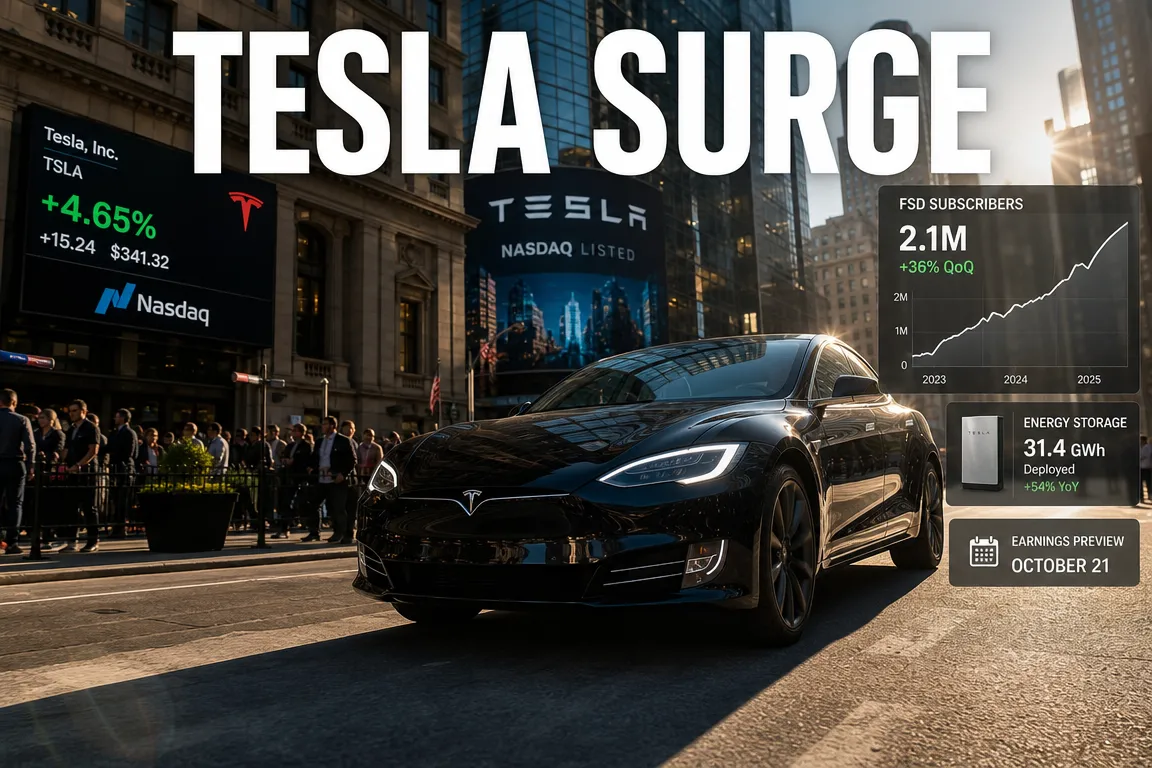
9. Tesla delivered something more important than vehicle volume: it beat expectations
Tesla’s vehicle deliveries were lower than a year ago or the prior period, but they still beat market expectations.
Based on the original article, Wall Street expected 460,000 units, while actual deliveries were around 480,000.
What matters is that Tesla beat expectations for the second consecutive quarter.
Recently, Wall Street sentiment toward Tesla had been quite cold.
But when results repeatedly come in not as bad as expected, consensus can change.
Higher oil prices can be positive for EV demand.
The more expensive gasoline gets, the more seriously consumers consider switching to electric vehicles.
If this is combined with rising expectations for self-driving improvements, it could create a favorable environment for Tesla demand.
10. Tesla’s real essence is not EVs, but Physical AI
Looking at Tesla only as an EV company misses the point.
The original article views Tesla as a leading Physical AI company, meaning artificial intelligence that operates in the physical world.
The first key catalyst is the global expansion of FSD.
Expansion in the U.S. is underway, but meaningful progress in China and North American robotaxis is needed for a strong revaluation of the stock.
The original article sees global FSD expansion happening sometime between the first half and second half of 2027.
The second key catalyst is Optimus.
Humanoid robots are still at a stage where hand dexterity is difficult to implement.
Chinese companies are catching up quickly, but the original article still sees Tesla Optimus as having the edge.
There are three reasons for that.
First, Tesla has the most real-world driving data.
Second, it has strong AI talent and engineering capabilities.
Third, it has Dojo, its own data centers, and actual factory deployment environments.
There are not many companies that can build a humanoid robot and then immediately deploy it in factories for training.
In that sense, Tesla can be seen as a core company in the Physical AI era.
However, whether the stock can rise sharply right now is a separate question.
Stronger buying conviction may emerge only when concrete progress in FSD and Optimus becomes visible.
11. Even within AI semiconductors, winners and losers are diverging
The semiconductor sector as a whole looks strong, but the internal picture is different.
AI semiconductors, HBM memory, foundries, and optical communications are strong, while hard-disk-related names weakened.
Hard-disk companies Seagate and Western Digital came under pressure after news that Toshiba would increase production.
Concerns about rising supply emerged after Toshiba announced it would double production.
The problem is that this also had some impact on Sandisk and Micron.
Sandisk and Micron are not directly tied to hard drives, but because they are grouped in the same storage sector, they were sold off together.
The original article interprets this as a broad decline caused by sector classification.
There is weak evidence for saying that Micron’s AI memory demand itself has weakened.
Micron has already risen to around $100 and is now near its prior highs.
By contrast, Samsung Electronics and SK Hynix are said to be moving less quickly than Micron because domestic capital flows are not keeping up.
12. Lumentum and optical communications are the hidden bottlenecks in AI infrastructure
Lumentum is highlighted as an especially important name in this move.
As AI data centers grow larger, they need more than just GPUs.
Optical communications infrastructure is essential for rapidly transferring data within and between data centers.
Lumentum’s CEO said he expects to supply only about 30% of the laser volume requested for 2027.
In simple terms, if customers want 100, current supply capacity is only about 30.
This is not just demand growth; it is a serious supply shortage.
If AI infrastructure investment continues, optical-communications companies could receive structural tailwinds through 2027.
Many investors only look at Nvidia and HBM, but the real bottlenecks are spreading into optical communications, power, cooling, and data center sites.
This could become a very important differentiator in AI investing going forward.
13. Software and cybersecurity names were strong, but short-term corrections are possible
The software sector has recently shown strength, but on this day the stocks moved unevenly.
Palantir and Salesforce were weak, and ServiceNow also declined.
Given how much they had already risen recently, some correction is natural.
By contrast, cybersecurity names are still maintaining a solid trend.
As AI adoption increases, cybersecurity demand also rises.
Therefore, cybersecurity names should continue to be watched as indirect beneficiaries of AI infrastructure expansion.
14. Rocket Lab strengthened on NASA launch expansion and an Electron contract
In the aerospace sector, there was news related to Rocket Lab.
News of NASA launch expansion and a 20-launch Electron contract supported the stock.
Rocket Lab is classified as a high-growth space industry company, but it also has the characteristics of a rate-sensitive growth stock.
Therefore, even with company-specific positives, valuation pressure can remain if market yields stay high.
15. The real core point that other news does not clearly say
The most important thing in this market is not simply that “AI is good.”
Everyone already knows that.
The real core point comes down to three things.
-
First, if rate declines begin, the Nasdaq could spring upward like a compressed coil.
-
Second, because this rally is very narrow, picking the wrong stocks makes it hard to feel the index’s gains.
-
Third, the next bottleneck in the AI investment cycle is not GPUs, but power, optical communications, and refined data center infrastructure.
U.S. Treasury yields are currently weighing heavily on the stock market.
Even so, the fact that the Nasdaq hit an all-time high means expectations for AI-related companies’ earnings are that strong.
The original article mentions the possibility that earnings growth rates for AI-related companies could reach 80%, 90%, or even more than 100% annually.
If that kind of earnings growth is actually confirmed and rates also come down, the Nasdaq could produce a very strong rally.
On the other hand, if energy prices jump again and market yields rise further, growth-stock valuations could come under pressure once more.
So right now, it is important not to look only at stock prices, but also at U.S. Treasury yields, global oil prices, employment data, and wage growth.
16. Key indicators to watch going forward
-
U.S. 10-year Treasury yield: Check whether it breaks down around the 5.2% to 5.3% range.
-
U.S. 30-year Treasury yield: Reflects long-term inflation expectations and fiscal risk.
-
Nonfarm payrolls: If employment continues to slow, the odds of a Fed hike may fall further.
-
Average hourly earnings: Slower wage growth is important for PCE inflation to decline.
-
Brent crude and WTI: If energy prices spike again, inflation concerns could reignite.
-
AI semiconductor earnings: Earnings outlooks for Nvidia, AMD, TSMC, and Micron could drive the Nasdaq’s direction.
-
Optical communications demand: Stocks like Lumentum and Coherent are key to easing AI data center bottlenecks.
-
Tesla FSD and Optimus progress: These are key variables for Tesla’s long-term revaluation.
17. Investment interpretation
The current market is a very difficult one.
The Nasdaq is at an all-time high, but only a small number of stocks are hitting new highs.
AI semiconductors are strong, but not all semiconductors are rising together.
Rate-cut expectations have grown, but market yields are still high.
So right now, it is hard to make a simple judgment like “buy aggressively no matter what” or “sell no matter what.”
That said, if yields begin a clear downtrend, the upside momentum in AI-related growth stocks could become much stronger.
As the original article says, the market right now is like a spring being held down by rates.
The force compressing the spring is U.S. Treasury yields.
The force that makes the spring jump is earnings growth at AI companies.
In the end, the key question is just one thing.
Will rates come down, or will they rise again because of energy and inflation concerns?
Investment decisions require each person’s own standards, but in the current market it is important to look at five pillars together: AI semiconductors, U.S. Treasury yields, the Nasdaq trend, easing inflation, and Tesla’s Physical AI story.
< Summary >
U.S. Treasury yields have climbed to their highest levels in 20 years, putting heavy pressure on the stock market.
However, the employment data slowed far more than expected, causing the likelihood of further Fed rate hikes to plunge.
The Nasdaq hit an all-time high, but the share of stocks actually making new highs remains low, so the rally is very narrow.
AI semiconductor and infrastructure names such as Nvidia, AMD, TSMC, Micron, and Lumentum are leading the market.
For Tesla, it is important to view the company not just through short-term EV sales, but as a Physical AI company centered on FSD and Optimus.
The key point for the market ahead is whether rates fall; if they do, AI growth stocks and the Nasdaq could stage a strong rally.
[Related Articles…]
*Source: [ 월텍남 – 월스트리트 테크남 ]
– “일생 일대의 기회”