● Tesla-SpaceX Shock, 2.2 Up, 7.6 Surge
After Tesla’s Delivery Surprise, Why Was the Stock +2.2% on the First Monday While SpaceX Jumped +7.6%?
The key issue here is not simply that Tesla sold more cars.
Tesla significantly beat Wall Street expectations on third-quarter deliveries, yet analysts’ price targets moved far less than expected.
By contrast, SpaceX posted a much stronger gain on a private-market trading basis than Tesla.
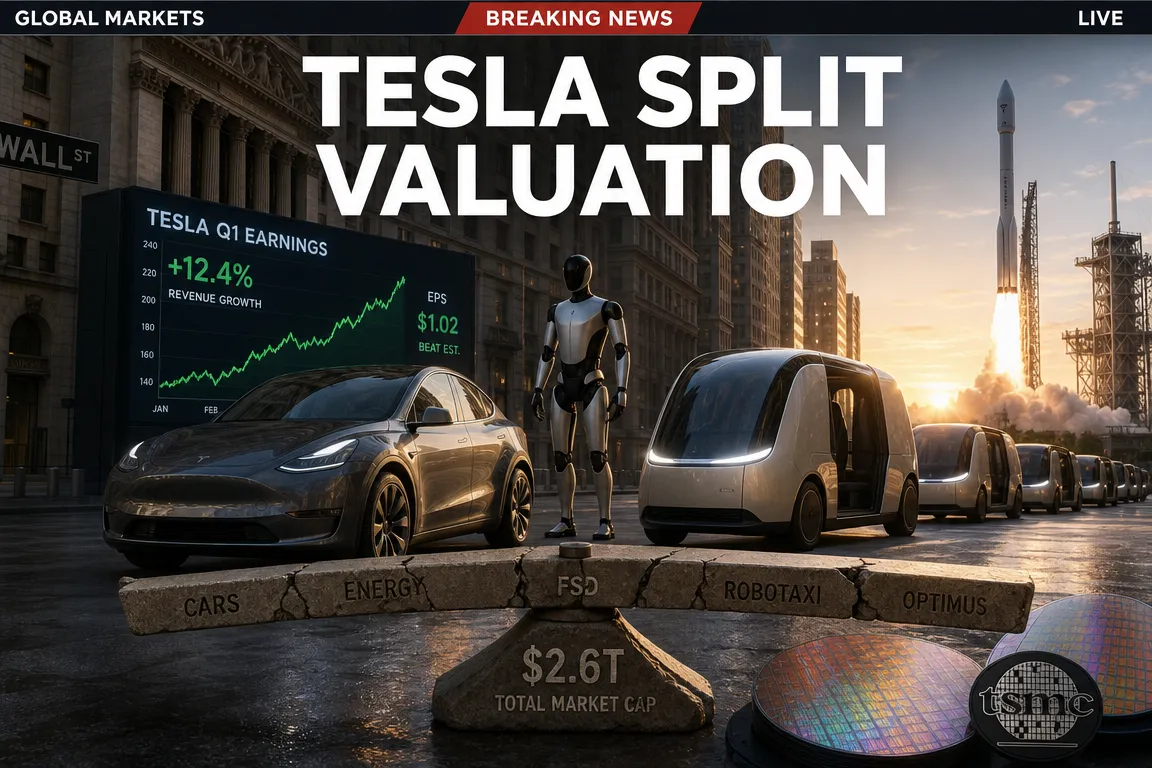
The real question is how much of Tesla’s $379 share price is being attributed to the auto business, energy storage, FSD autonomous driving, robotaxi, and Optimus humanoid robot businesses.
In particular, whether robotaxi revenue is reported as a separate line item in the upcoming third-quarter earnings release may become a key catalyst for Tesla’s re-rating.
Below is a consolidated view of why Wall Street has been reluctant to raise price targets materially, why HSBC still maintains a sell rating, what TSMC’s potential link to Tesla and SpaceX chip facilities could mean, and why SpaceX is being valued more highly than Tesla in the current structure.
1. Market backdrop: Rates are higher, but Nasdaq is at record highs on AI and liquidity expectations
In the source material, Tesla closed at $378.73, up 2.2%.
SpaceX was cited at $171.09 on private-market trading terms, up 7.63%.
In other words, among Elon Musk-related companies, SpaceX advanced much more sharply than Tesla despite Tesla’s delivery surprise.
Broader U.S. equity markets were also notable.
Although the U.S. 10-year Treasury yield rose to 5.31%, the Nasdaq closed at a record high.
Normally, higher U.S. rates pressure growth and technology stocks because future earnings are discounted at a higher rate.
Even so, the Nasdaq remained firm for two main reasons.
- First, weaker-than-expected labor data reduced the likelihood of additional rate hikes.
- Second, the G7’s decision to release emergency crude and diesel supplies eased concerns about a further surge in oil prices.
Inflation concerns, however, have not fully disappeared.
Service-sector data showed input prices at their highest level since July 2022.
This indicates that service providers’ costs are rising faster than the prices they receive.
That trend supports the view that the Federal Reserve may not be able to cut rates easily.
The market is therefore operating under a framework in which “rates remain high, but AI growth expectations are stronger.”
2. A new argument linking AI data center investment and higher rates
One of the most important points in this market interpretation is the link between AI data center spending and the bond market.
Large technology companies are spending heavily to build AI infrastructure.
Spending on AI data centers, GPU servers, power grids, cooling systems, and semiconductor supply chains has become enormous.
The problem is that this spending cannot be funded entirely through internal cash flow.
If companies issue corporate debt or increase borrowing, bond supply rises in the market.
When bond supply rises, prices can fall and yields can come under upward pressure.
The source material also referenced approximately $60 billion in debt demand tied to a Broadcom-Anthropic transaction.
In effect, AI is supporting growth-stock valuations while also helping keep U.S. interest rates elevated.
This dynamic is highly relevant for Tesla, whose valuation depends heavily on future robotaxi, FSD, and Optimus expectations rather than just current auto sales.
Higher rates can further compress the present value of those future businesses.
3. Tesla’s third-quarter delivery surprise: acknowledged by Wall Street, but only limited target price changes
Tesla reported third-quarter deliveries that exceeded market expectations.
HSBC acknowledged that Tesla’s third-quarter deliveries were about 7% above consensus estimates and nearly 80,000 units above public registration-based estimates.
Even so, HSBC maintained its underweight rating on Tesla.
Its target price was raised from $125 to $157, an increase of more than 25%, but that remains far below the current share price of $378.
Wall Street’s major Tesla price targets were mixed:
- HSBC: Underweight maintained, target price $157
- UBS: Neutral, target price $385
- Truist: Hold, target price $370
- Baird: Target price $475, implying more than 25% additional upside
- Wall Street average target: approximately $405, implying about 7% upside from current levels
In many cases, when a company reports a material delivery beat, target prices rise meaningfully as well.
Here, however, Tesla’s target prices remained clustered near the current share price.
That is the most important point in this release.
4. Why Wall Street cannot raise targets materially: the market is pricing more than vehicle deliveries
UBS estimates Tesla’s price-to-earnings ratio at approximately 345x.
Put simply, if current earnings were unchanged, it would take 345 years to justify the share price through earnings alone.
Of course, growth stocks cannot be valued by simple P/E alone.
But the number still makes one point clear.
The contribution of this quarter’s vehicle deliveries to Tesla’s current valuation may be smaller than many investors assume.
UBS estimated that lower-than-expected energy storage sales would affect earnings per share by about $0.03.
On a $378 stock, $0.03 is economically immaterial for valuation purposes.
By the same logic, even a stronger-than-expected delivery number is unlikely to change Tesla’s overall valuation profile materially.
The core valuation drivers remain FSD autonomous driving, robotaxi, and Optimus, not auto deliveries alone.
5. Why HSBC remains cautious on Tesla: slower energy storage growth
HSBC maintained a negative view on Tesla even while raising its target price because of the energy business.
Tesla is not only an automaker; it is also an energy storage company.
Megapack and Powerwall have long been viewed as an important growth pillar.
However, HSBC argued that growth in Tesla’s energy segment is falling short of expectations.
The report indicated that HSBC had previously expected roughly 40% growth in the energy business, but actual nine-month cumulative growth was only around 11%.
The issue is that the overall energy storage market is expanding, but Tesla is not capturing that growth as quickly as expected.
That could also weaken Tesla’s 2026 earnings outlook.
Even with stronger vehicle deliveries, slower energy storage growth remains a drag on the broader valuation case.
6. The bullish case: Tesla is being valued as a robotics and autonomy platform, not just a car company
By contrast, Canaccord maintained a buy rating on Tesla.
Its core thesis is straightforward.
Tesla’s share price is being driven less by vehicle deliveries and more by expectations for other businesses.
Those businesses are Optimus humanoid robots and the FSD-based robotaxi platform.
This also explains why Tesla’s target prices range so widely, from HSBC at $157 to Baird at $475.
The divergence does not come from different views on vehicle sales.
It comes from different assumptions about the value assigned to robotaxi and Optimus.
Vehicle sales help define the floor for Tesla’s stock.
FSD, robotaxi, and Optimus define the upside ceiling.
7. Gene Munster’s bullish view: FSD could help reaccelerate EV demand
Gene Munster said Tesla could outperform legacy automakers.
He highlighted that Ford and GM saw a sharp decline in September EV deliveries, while Tesla remained relatively resilient.
The source material noted that Ford and GM’s September EV deliveries fell by nearly 75%.
Tesla deliveries were down 2% year over year, but excluding last year’s tax credit pull-forward effect, they could be interpreted as up 8%.
Munster expects Tesla deliveries to grow 15% next year, above the Street consensus of 9%.
His constructive view is based on FSD.
As more users experience FSD, adoption can spread through word of mouth and eventually support demand for Tesla vehicles.
He also argued that Ford and GM could lose long-term competitiveness if they do not adopt FSD-like capabilities.
There are, however, risks.
If recent EV demand has been supported partly by high gasoline prices, a decline in oil prices could weaken EV purchasing demand.
8. Tesla, SpaceX, and xAI chip facility issue: why TSMC’s name matters
Another important weekend development involved Tesla’s chip facility plans.
Reports indicated that TSMC could become involved in the TerraFab project in Texas, which is linked to Tesla and SpaceX.
The semiconductor press reported that TSMC is reviewing a role in operating the TerraFab facility, and Elon Musk reportedly acknowledged on X that discussions are underway.
The chips produced there are expected to be used exclusively by Tesla, SpaceX, and xAI.
The structure could resemble a model in which TSMC operates the plant while TerraFab remains the major customer purchasing chips.
This is similar to how TSMC has operated in Japan and Germany.
The importance of this issue is that it directly affects the cost and speed of Tesla’s AI semiconductor supply chain.
FSD, robotaxi, and Optimus all require substantial AI compute capacity and dedicated chips.
If TSMC becomes an operating partner, Tesla may benefit from more stable chip production and improved cost structure.
By contrast, Intel could face headwinds.
According to the source material, Intel had been mentioned as the existing fabrication partner for the TerraFab project, and following the TSMC report, Intel fell 2.63% while TSMC rose 2.75%.
The capital commitment is also significant:
- Initial investment: approximately $16.8 billion, or about KRW 22 trillion
- Long-term investment intention: up to $119 billion, or about KRW 160 trillion
- This is roughly five times Tesla’s previously discussed long-term capex plan of about $25 billion
Ultimately, who operates this facility will affect how much Tesla pays for AI chips and how reliably it can secure supply.
9. Why SpaceX moved more than Tesla: its business value is more clearly separated
SpaceX rose much more sharply than Tesla on a private-market basis.
The source material cited Tesla as up about 7% over two sessions, while SpaceX rose about 15.5%.
This cannot be explained simply by saying that SpaceX is more popular.
The key is how clearly the business value can be separated.
Morgan Stanley’s Adam Jonas assigned SpaceX an overweight rating and a target price of $300.
He valued the rocket and communications businesses at $127 per share when SpaceX stock was at $159.
The remaining $32 was attributed to AI-related optionality.
In other words, roughly 80% of SpaceX’s value is supported by existing rocket launch and Starlink businesses, while about 20% is tied to AI expectations.
That makes the investment case easier to understand.
Even if AI does not scale as quickly as expected, the rocket and Starlink businesses provide a valuation floor.
Tesla, by contrast, does not yet have a clear separate valuation for robotaxi or Optimus.
Automotive, energy, autonomy, and robotics are still valued together.
That is one of the main reasons Wall Street has not materially raised Tesla’s target prices.
10. Elon Musk’s shift from “AI” to “SI”
Over the weekend, Elon Musk said on X that the industry should increasingly use SI, or Super Intelligence, instead of AI.
There were also references to renaming SpaceX’s AI-related division from SpaceXAI to SpaceXSI.
The source material suggested that this tracks with recent naming changes in the White House’s AI-related terminology.
No formal announcement has been confirmed, but if adopted, the change could help reposition the company as an infrastructure platform for superintelligence rather than a conventional AI company.
At first glance this may appear cosmetic.
However, in capital markets, naming conventions can influence the valuation framework.
A superintelligence infrastructure label may lead investors to envision a larger addressable market and a longer growth runway.
11. The most important point in third-quarter earnings: whether robotaxi revenue appears separately
Tesla’s third-quarter earnings release was cited as scheduled for October 21 in U.S. time and October 22 at 6:30 a.m. in Korea.
The most important issue in that release is not vehicle deliveries.
Delivery data has already been disclosed and is largely reflected in the market.
The real question is whether robotaxi revenue will appear as a separate line item.
If Tesla presents robotaxi revenue separately, Wall Street may begin assigning a revenue multiple to that figure.
That would push Tesla further toward being valued as an autonomous driving platform rather than just an EV manufacturer.
Optimus would also matter if Tesla provides concrete details on production schedule, sales targets, pricing, customer adoption, and internal deployment.
If Tesla does not provide clear numbers for FSD, robotaxi, and Optimus, Wall Street’s target prices are likely to remain near current levels.
12. Key checklist for Tesla shareholders at around $379
With Tesla trading near $379, the more important issue is business-line valuation rather than short-term price moves.
Investors should separate the following four areas:
- Auto business: whether Model 3 and Model Y sales can remain resilient
- Energy business: whether Megapack and storage growth reaccelerate
- FSD and robotaxi: whether revenue is reported separately and whether service areas and user counts are disclosed
- Optimus: whether Tesla provides a commercialization timeline and customer pipeline rather than just a prototype update
Because Tesla is already trading at a level that is difficult to justify using auto-industry valuation metrics alone, the company needs AI-platform revenue that can be demonstrated with numbers.
In particular, once robotaxi revenue is recognized, the market may begin to value Tesla less as an automaker and more as a software-platform company.
13. The most important point often missed elsewhere
First, Tesla’s target price is not rising because deliveries were weak; it is rising slowly because the valuation is not neatly separable by segment.
SpaceX is easier to break into rocket, Starlink, and AI components.
Tesla, by contrast, is still valued as one combined block that includes auto, energy, FSD, robotaxi, and Optimus.
Because the market cannot assign clean numbers, target prices have not moved sharply.
Second, AI data center investment is a double-edged sword for Tesla.
It strengthens expectations for Tesla’s future businesses, but it also increases corporate borrowing and bond issuance, which can keep U.S. rates elevated.
Higher rates weigh on the valuation of long-duration growth stocks like Tesla.
Third, TSMC’s potential participation in TerraFab is not just a semiconductor story.
This issue directly affects the cost and supply reliability of the AI chips needed for FSD, robotaxi, and Optimus.
Long term, Tesla’s ability to control its AI chip supply chain may become a core competitive factor.
Fourth, weakness in Tesla’s energy business is a more important risk than many investors assume.
Many investors focus on vehicles and robotics, but energy storage is another major growth pillar.
If that segment underperforms, Tesla’s long-term earnings outlook may weaken as well.
Fifth, the real earnings-release battleground is not EPS but robotaxi revenue recognition.
Once that revenue appears as a reported line item, Wall Street is likely to assign a valuation multiple to it.
That could be the starting point for a Tesla re-rating.
< Summary >
Tesla beat third-quarter delivery expectations, but Wall Street price targets did not rise meaningfully.
The reason is that Tesla’s current valuation relies more heavily on expectations for FSD, robotaxi, and Optimus than on vehicle sales alone.
HSBC remained negative, citing slower energy storage growth.
By contrast, Canaccord and other bullish analysts continue to view Tesla as a robotics and autonomy platform rather than just an automaker.
SpaceX rose more sharply than Tesla because its rocket, Starlink, and AI value components are more clearly separated.
Tesla’s next major event is its third-quarter earnings release, with separate robotaxi revenue being the key variable.
The potential involvement of TSMC in TerraFab could have a meaningful impact on Tesla’s AI chip supply chain and long-term cost competitiveness.
Ultimately, the key question for Tesla at around $379 is not how many cars it sold, but whether robotaxi and Optimus are beginning to show up in reported numbers.
[Related Articles…]
- Tesla Robotaxi Revenue and Valuation Outlook
- AI Semiconductor Supply Chain and Market Rates Analysis
*Source: [ 오늘의 테슬라 뉴스 ]
– 인도량 서프라이즈 뒤 첫 월요일, 테슬라 +2.2% 오를 때 스페이스X는 +7.6% — 월가가 고쳐 쓴 목표가, $379 주주는?● China semiconductor surge, Samsung SK Hynix alarm
Why China’s Semiconductor Catch-Up Is Proceeding Faster Than Expected: The Real Pressure Points for Samsung Electronics and SK hynix
The key issue is not simply that “China is catching up in semiconductors.”
CXMT, China’s ChangXin Memory Technologies, has secured a meaningful share of the DRAM market, and China’s AI talent base combined with its large domestic test market is forcing a reassessment of Korea’s semiconductor outlook.
Even if Samsung Electronics and SK hynix remain ahead in HBM, DRAM, and AI semiconductors, China is building a structure in which domestic firms continue to adopt local products despite low yields.
The concern is not short-term profitability, but the pace of learning.
At the same time, viewing the Chinese economy only through the lens of a weakening property sector overlooks important dynamics.
Traditional manufacturing, property, and local government debt remain under pressure, but new-economy sectors such as AI, semiconductors, electric vehicles, and aerospace are reshaping global supply chains.
1. News Summary: China’s semiconductor catch-up is no longer a possibility, but an ongoing process
The most notable point in the discussion was CXMT’s DRAM market share.
According to the original discussion, CXMT moved from near-zero presence in DRAM just a few years ago to a double-digit share.
The trend from 2%, to 5%, and then to around 12% is a signal that Korea’s memory semiconductor leaders cannot ignore.
The DRAM market has long been dominated by Samsung Electronics, SK hynix, and Micron.
That a Chinese vendor is gaining share despite lower yields and a technology gap suggests more than simple price competition.
It indicates that domestic demand is being created intentionally, production experience is accumulating, and a feedback loop for technical improvement has begun.
The critical point is that China does not need to produce perfect products from the outset.
If major Chinese technology firms and manufacturers continue to use domestic semiconductors, CXMT can accumulate failure data and accelerate improvement.
In semiconductors, yield is a core technical barrier, yet China’s strength lies in large-scale repetitive production and rapid iteration.
2. Why Samsung Electronics and SK hynix should be concerned
Korea remains strong in memory semiconductors.
Samsung Electronics has substantial manufacturing capabilities in DRAM and NAND, while SK hynix is a key global supplier in HBM for AI demand.
The issue is that current leadership does not guarantee future dominance.
The core message was that Korea should prepare on the assumption that China can overtake it.
This matters because Korean discourse still often assumes that China produces lower quality goods and will ultimately fail to catch up.
China is unlikely to fully replace Samsung Electronics and SK hynix in high-end HBM or leading-edge DRAM in the near term.
However, if it begins taking share in mainstream DRAM, mid-range memory, and certain domestic AI server chips, the situation changes materially.
China’s pattern of capturing lower-end segments first, then using that cash flow and production data to move up the value chain, has already been observed in electric vehicles, solar, and batteries.
That scenario cannot be ruled out in semiconductors.
3. A China collapse narrative misses semiconductor risk
An important analytical frame is to separate China into old China and new China.
Old China refers to property, local government finances, state-owned enterprise debt, and traditional manufacturing.
This segment is clearly under strain.
Some local governments are under fiscal pressure even in meeting public payrolls, the property market remains weak, and deflationary pressure persists.
By contrast, new China consists of AI, semiconductors, electric vehicles, batteries, aerospace, robotics, and digital platforms.
This segment is gaining global relevance rapidly.
In other words, both statements can be true: China faces structural weakness, and its advanced industries are still expanding aggressively.
The risk for Korea is that focusing only on the old-China downturn may lead to underestimating competition from the new-China industrial base.
Investors should examine not only property stress, but also the industrial ecosystem being built by CXMT, BYD, Huawei, Alibaba, Tencent, and Xiaomi.
4. Why China is not collapsing: talent and domestic scale remain key
The strongest argument in the discussion was the scale of China’s talent pipeline.
China continues to produce a very large number of science and engineering graduates each year, with emphasis placed on the size of its top-tier engineering talent pool.
The discussion also noted the high presence of Chinese-born researchers in global AI rankings.
It was further noted that many AI scientists in the United States received undergraduate education in China before moving abroad.
This is also relevant to AI semiconductor competition.
If talent in AI model development, semiconductor design, manufacturing process engineering, and equipment localization continues to accumulate, bottlenecks may gradually ease over time.
Semiconductors are not an industry that can be built on capital alone.
However, if capital, talent, market access, policy support, and manufacturing repetition are all present, catch-up can accelerate.
China has that combination.
5. Why CXMT matters: a market that keeps buying despite low yields
In most global markets, weak quality and limited price competitiveness would prevent adoption.
China’s semiconductor ecosystem is different.
The government treats semiconductor self-sufficiency as a national strategy, and Chinese firms are pushed or encouraged to adopt domestic chips and equipment.
If large platforms and manufacturing ecosystems such as Alibaba, Xiaomi, Tencent, JD, and Temu continue testing local components, what follows?
Initial performance may be inadequate and yields may be low.
But continued use helps identify defects, adjust production conditions, optimize equipment, and revise designs, creating cumulative improvement.
For Korean firms, this is a serious challenge.
Chinese firms can absorb short-term losses by providing a testing ground.
Korean firms must deliver high-completion products to global customers, while Chinese firms can absorb trial-and-error costs in the domestic market.
Over time, this difference can narrow the technology gap.
6. HBM competition: next-generation speed matters more than current leadership
HBM is one of the most important semiconductors in the AI server market.
As NVIDIA GPUs, AI data centers, and large language model infrastructure expand, HBM demand has surged, and SK hynix has established a strong position.
Samsung Electronics is also focusing on regaining competitiveness in HBM and securing customer qualifications.
However, the discussion suggested that Samsung’s involvement in HBM is largely a question of timing.
SK hynix also faces risk if it fails to move faster from its current position.
This is not only about China.
The AI semiconductor market moves quickly, and customer requirements change rapidly.
HBM3E, HBM4, custom memory, packaging, power efficiency, thermal management, and integration with AI accelerators are all competitive factors.
To remain ahead, Korean firms need more than manufacturing strength; they need closer co-development with customers, advanced packaging, equipment ecosystems, and stronger materials localization.
7. A variable often overlooked in Korea: labor, compensation, and governance
One important but less-discussed issue is incentive structure.
The original discussion highlighted differences in how engineers are rewarded in Korea and China.
In China’s advanced firms, key employees are often given stock options or equity-based compensation, linking personal rewards directly to corporate growth.
In Korea, cash compensation tends to be preferred over equity, and labor relations do not always align fully with long-term corporate growth.
This is sensitive, but highly relevant.
Advanced industries are ultimately built by people.
When top engineers directly benefit from rising company value, work behavior changes.
When management, employees, and shareholders are pulling in different directions, long-term competitiveness can weaken.
If Korea wants to outperform China in semiconductors, it needs not only capital expenditure and R&D, but also a compensation structure and organizational culture that supports deep technical commitment.
8. What Korea should do in the U.S.-China power competition: survival strategy, not ideological alignment
The recurring message was to move beyond the pro-China, anti-China, pro-U.S., and anti-U.S. framing.
Korea is highly dependent on exports, imports most energy and raw materials, and is very sensitive to supply chain shifts.
For a country with that structure, emotional alignment with or against any single nation is not a viable strategy.
The United States remains the leading global power in technology, finance, and security.
China is also the world’s second-largest economy, with manufacturing scale, domestic demand, talent, and policy mobilization capacity.
Korea should strengthen technology and security cooperation with the United States while maintaining a disciplined analysis of the Chinese market and industrial transition.
Ignoring China is not strategy.
Overestimating China is not strategy either.
Strategy requires distinguishing areas of cooperation from areas of competition.
9. China data credibility: direction matters more than exact numbers
Whenever China’s economy is discussed, one common objection appears.
That is the claim that Chinese data cannot be trusted.
The discussion addressed this point directly.
Local governments in China have inflated figures in the past, and the central government has responded by strengthening accountability for statistical manipulation.
It is true that not all Chinese data should be viewed as fully reliable given the country’s scale.
Population, local finance, and property-related data may contain errors and uncertainty.
However, the broader trend is what matters.
A slowdown from 10% growth to 4-5% does not imply collapse.
For the world’s second-largest economy, 4-5% growth still represents a very large absolute increase.
Given Korea’s own growth rate of around 2%, it would be risky to treat China’s slowdown as evidence of systemic failure.
10. The most important point missing from many reports and videos
The real issue is not China’s technical level, but its ability to absorb failure.
Many reports evaluate China’s semiconductor industry mainly through nodes, HBM capability, or dependence on ASML equipment.
These factors matter.
But more important is China’s ability to sustain its industrial ecosystem despite lower quality and lower yields.
If domestic firms continue buying Chinese semiconductors, and if the government continues providing funding and policy support, while engineers are deployed at scale, the technology gap can narrow over time.
Korean firms, by contrast, must maintain high profitability and customer satisfaction, limiting their tolerance for failure.
China can afford to sustain losses for a period if the sector is deemed strategically important.
That may appear inefficient from a market perspective, but it can be a powerful advantage in a technology catch-up race.
The relevant question for Korea is not whether China is weaker today.
The relevant question is whether China will still be structurally weaker in five years.
If that question cannot be answered confidently, Samsung Electronics and SK hynix need a significantly more aggressive strategy.
11. Strategic response for Korea’s semiconductor industry
First, Korea must widen the technology gap in HBM and next-generation memory.
If China catches up in mainstream DRAM, Korea needs to increase the share of high-value products.
That means shifting further toward HBM, CXL memory, PIM, low-power memory, and server-grade high-performance memory.
Second, advanced packaging and system-semiconductor integration must be strengthened.
In AI semiconductors, memory alone is not enough.
GPUs, NPUs, ASICs, HBM, interposers, packaging, and cooling systems are increasingly sold as a combined solution.
Korea should expand its position from a memory leader to a leader in AI infrastructure semiconductors.
Third, the materials, components, and equipment ecosystem must become more resilient.
China is strongly pushing localization of equipment and components.
Korea must also manage dependence on Japan, the United States, and Europe while strengthening domestic suppliers.
Fourth, key talent compensation must be upgraded to global standards.
To retain semiconductor engineers, AI researchers, process specialists, and packaging experts, salary competition alone is not sufficient.
A structure that links performance to company value is needed.
Fifth, China should be assessed through data, not sentiment.
Disliking China does not slow down its semiconductor industry.
Ignoring China does not make Korean semiconductors safer.
Korea must analyze China’s economy, global supply chains, U.S.-China competition, and its own national interests in a single framework.
12. Key indicators to watch
-
Whether CXMT’s DRAM market share continues to rise.
-
How widely Chinese AI servers and data centers adopt domestic memory.
-
Samsung Electronics’ customer qualification progress and ramp-up speed in HBM.
-
Whether SK hynix can extend its HBM lead into HBM4.
-
How quickly China increases localization of semiconductor equipment.
-
Whether U.S. export controls slow China’s self-sufficiency or accelerate it.
-
Whether Korea’s semiconductor tax incentives, power infrastructure, water infrastructure, and talent policy translate into actual investment.
13. Why the crypto and tokenized stock issue should be viewed in parallel
The original discussion also raised questions about the U.S. SEC, tokenized stock trading, and changes in the crypto market.
While this may appear separate from semiconductors, it is connected.
AI, semiconductors, data centers, power infrastructure, and digital assets are all tied to large-scale capital allocation.
If tokenized equities and digital asset regulation advance, global capital flows may become faster and more fluid.
Ultimately, capital shifts occur where technological leadership and financial regime changes intersect.
When assessing the semiconductor outlook, investors should therefore consider not only corporate earnings, but also regulatory developments in the United States, China’s industrial policy, global liquidity, and the AI investment cycle.
< Summary >
China’s semiconductor catch-up is progressing faster than many expected.
CXMT is gaining relevance in DRAM, and China is building a structure in which domestic firms continue to adopt local products despite low yields.
China’s economy should be viewed as a split between old China, pressured by property and local government debt, and new China, driven by AI, semiconductors, and electric vehicles.
Samsung Electronics and SK hynix need to widen their technology gap in HBM and next-generation memory.
Korea’s priority should be a survival strategy within global supply chains, not a political framing of pro- or anti-China, or pro- or anti-U.S.
The central question is not whether China is behind today, but whether its industrial structure still ensures it will be behind five years from now.
[Related Articles…]
*Source: [ 경제 읽어주는 남자(김광석TV) ]
– 중국 반도체 추격, 생각보다 빠릅니다… 삼성·하이닉스가 긴장해야 하는 이유 | 경읽남과 토론합시다 | 안유화 교수 [2편]