● Germany Shocks Tesla FSD Vote, Europe Turns Tesla-Friendly
Germany Shifts the EU FSD Vote: Key Points Tesla $380 Investors Should Watch
The central issue is not simply that Tesla changed the name of FSD in Europe.
More important is that Germany has effectively moved in Tesla’s direction ahead of the December EU FSD vote.
This comes alongside Houston robotaxi preparations, Cybercab sightings, SpaceX’s AI satellite plan, and Tesla software updates.
In other words, this news should be viewed as an event linking Tesla stock, autonomous driving regulation, the European EV market, AI infrastructure investment, and interest-rate expectations.
1. Market backdrop: Tesla at $380, equities supported by easing rate expectations
According to the source, Tesla closed up 0.51% at $380.68.
SpaceX-related indicators were cited at around $171.92, up 0.49%.
U.S. equities were broadly firm on the day.
The S&P 500 closed at 7,820, moving above 7,800 for the first time, while the Nasdaq also set a new record high.
-
September employment data came in weaker than expected, reducing the likelihood of further rate hikes.
-
The source said the probability of a rate hike this month fell from 70% a week earlier to around 20%.
-
Markets still see some possibility of a pause in October followed by renewed tightening in December.
Tesla’s ability to hold the $380 level is supported not only by company-specific news but also by shifting rate expectations.
Growth stocks are sensitive to interest rates.
That is especially true for Tesla, where valuation reflects expectations for autonomous driving, robotaxis, AI robots, and energy growth.
2. Oil and geopolitical risk: Brent at $101, but market impact remains contained
Brent crude rose again to $101 per barrel.
The source said Iran has increased tanker attacks in the Strait of Hormuz, with 9 incidents already recorded this month.
That means roughly half of the September monthly total was reached quickly.
However, oil has not surged sharply because Gulf-region crude exports have recovered to about 80% of prewar levels.
For the EV market, higher oil prices may support longer-term demand for electric vehicles.
In the near term, though, they could add inflation pressure and complicate the rate outlook.
3. Media deal: Paramount-Skydance and the Warner Bros. Discovery angle
The source also mentioned Skydance under Paramount acquiring Warner Bros. Discovery for $110 billion, or about KRW 147 trillion.
The deal was described as bringing CBS News and CNN under one corporate umbrella.
Related shares fell 2.7% on the first day, but the event was framed as politically and industrially significant.
This may not appear directly linked to Tesla.
However, AI, autonomous driving, political regulation, and public opinion are all connected to media environments.
In particular, major social debates around Tesla’s FSD approval can be influenced by media framing.
4. Key Tesla dates: October and December are the main windows
Tesla investors should closely monitor the dates cited in the source.
-
The Roadster unveiling was delayed due to wind and is now scheduled for October 15.
-
Third-quarter earnings are scheduled for after the U.S. close on October 21.
-
In Korean time, the key check-in point is around 6:30 a.m. on October 22.
-
The FSD refund lawsuit ruling was cited for October 29.
-
The EU FSD approval vote is expected in December.
The most important event is the December EU FSD vote.
If Tesla secures approval in Europe, the impact would go beyond a single feature.
It could affect software revenue, subscription revenue, brand premium, and the pace of autonomous-driving data collection across the European EV market.
5. Germany’s transport ministry: Tesla drops the FSD name in Europe
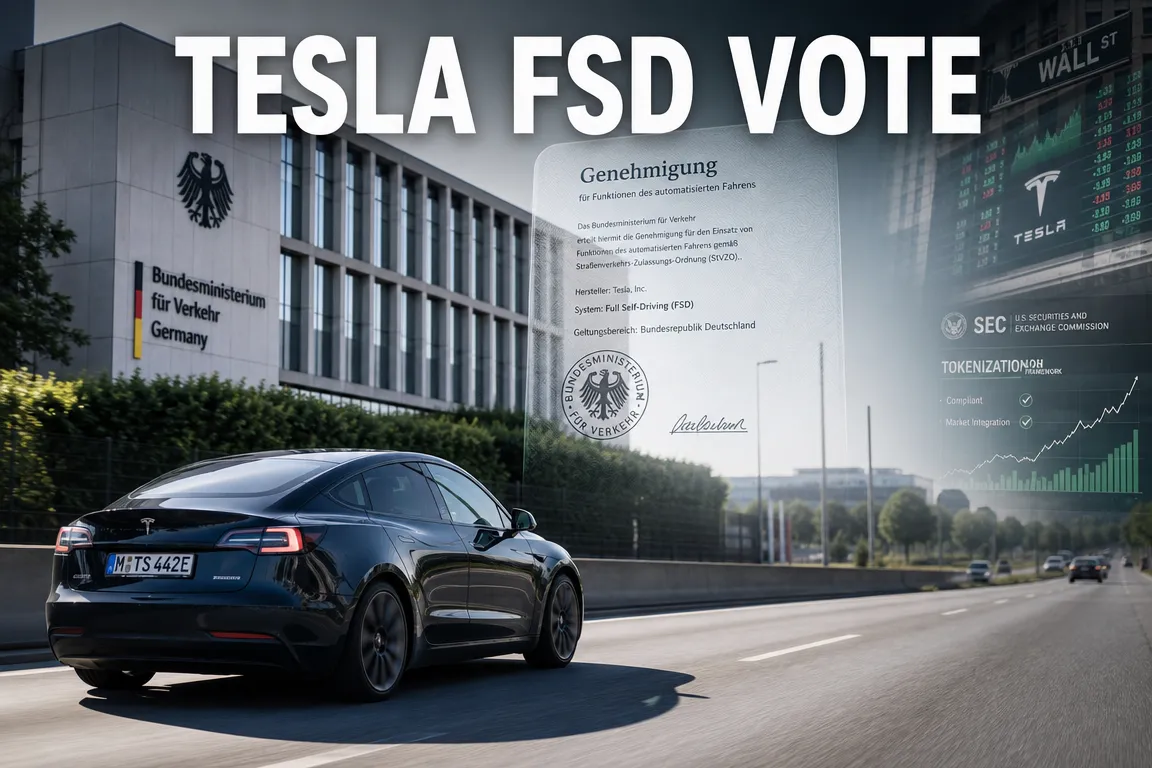
On October 6, Germany’s Federal Ministry of Transport published a statement regarding Tesla’s driver-assistance approval status.
The key point was that Transport Minister Stefan Wilke had consulted with Tesla in September and reached agreement on two areas.
-
First, a name change.
Tesla proposed using “Tesla Assist Driving” instead of the FSD label in Europe.
-
Second, a speed limitation.
The system would be limited to a maximum of 10% above the posted speed limit.
The important point is that this was not a case of Germany forcing the change first.
Tesla appears to have proposed the adjustment itself.
The company had already used a similar “Tesla Assist Driving” formulation on its China website in May.
In that sense, the German move appears to be an application of a strategy Tesla has already tested in China.
6. The real meaning of the German statement: support for the EU vote, not immediate domestic approval
This statement should not be misunderstood.
It does not mean Germany has immediately approved FSD for use on domestic roads.
Rather, it suggests Germany may move in a favorable direction during the EU approval process expected in December.
That is still significant.
Germany has the largest population in Europe.
It is also the center of the traditional automotive industry, including Volkswagen, BMW, and Mercedes-Benz.
Many expected Germany to take a cautious stance toward Tesla’s FSD approval, but the statement challenged that assumption.
7. Why speed matters more than the name
At face value, the name change appears to be the bigger headline.
In practice, the speed issue is more important.
FSD currently includes a speed-offset setting.
In simple terms, this determines how much faster the system may drive relative to the speed limit.
According to the source, under certain conditions the offset can be set as high as 50% above the limit.
-
On a 50 km/h road, a 50% offset would allow up to 75 km/h.
-
Under Germany’s 10% standard, the same road would be limited to around 55 km/h.
The difference is material.
From a European regulatory standpoint, a driver-assistance system that can exceed the posted limit by a wide margin is a safety concern.
This is especially sensitive in school zones, urban areas, and pedestrian-heavy locations.
8. Sweden and France still have speed-related concerns
If Germany is accepting of a 10% margin, Sweden and France remain more restrictive.
The source said Sweden had already argued in June that FSD should not receive full approval until it strictly complies with speed limits.
France reportedly raised similar concerns.
The European transport safety committee also questioned whether the setting could conflict with UN rules.
In the end, the European criticism converges on one point.
The issue is not the name; it is whether the system follows the rules precisely.
9. Is Germany’s 10% standard a negative for Tesla?
In the short term, some Tesla owners may find the restriction frustrating.
One reason FSD is popular is that it can feel more natural and less rigid than traditional driver-assistance systems.
Tesla FSD tends to adjust speed based on traffic flow.
As a result, it can feel more fluid than systems that strictly match the posted limit.
However, in the long term, the 10% cap is not necessarily a disadvantage.
Legal compliance is a required step for robotaxis and unsupervised autonomous driving.
A robotaxi that cannot reliably reduce speed in school zones is unlikely to receive approval in any market.
Germany’s requirement is less a burden than a necessary step toward true autonomous deployment.
10. EU voting structure: why one country matters so much
EU votes are not determined simply by counting supporting countries.
Under Council rules, at least 15 of 27 member states must support a measure, and those supporting countries must represent at least 65% of the EU population.
To block approval, at least four countries are needed, representing more than 35% of the EU population.
-
Germany’s population share was cited at about 18.5%.
-
France’s share was cited at about 15.2%.
-
Sweden’s share was cited at about 2.3%.
If Germany had aligned with the opposition, Germany, France, and Sweden alone would have represented roughly 36% of the population.
One more country could then have created a blocking minority against EU FSD approval.
With Germany moving toward support, the picture changes materially.
France and Sweden together account for only about 17.5%.
The opposition would need to gather significantly more support to block the vote.
Germany’s shift does not guarantee approval, but it makes it much harder for the opposition to stop the process.
11. Eight countries have already approved; the December vote is still open
The source said 8 countries have already granted approval.
Tesla still needs 15 countries for EU-level passage.
Germany’s more favorable stance does not mean December approval is assured.
Still, Germany appears to be choosing a conditional-pragmatic position.
The name changes to driver assistance, the speed overage is capped at 10%, and the underlying urban-driving capability is still viewed positively.
This position could influence other member states.
12. Houston robotaxi: 190 to 200 Cybercabs reportedly spotted
While Germany is moving on regulatory paperwork, vehicles are moving in Texas.
A drone video of Tesla’s robotaxi lot in Houston showed a parking area nearly full of Cybercabs without steering wheels.
The videographer estimated that Houston may have around 190 to 200 Cybercabs.
About 15 were reportedly charging, and some vehicles were seen leaving the lot and driving on public roads.
However, this figure is an individual estimate and has not been officially confirmed by Tesla.
There had previously been a report that 169 Cybercabs were registered in Austin, so if the Houston estimate is accurate, Houston could now appear to have a larger fleet than Austin.
That said, Austin remains the only city where Cybercab service is described as available to the public.
13. Houston robotaxi service area: about 22 times the size of Yeouido
The Houston robotaxi service area was cited at approximately 65 square kilometers.
That is about 22 times the size of Yeouido.
It is a substantial operating zone.
The source said a driverless Model Y is already serving as a robotaxi in the area.
Vehicles are present, the service zone exists, and unsupervised operation has reportedly begun.
What is still missing is Tesla’s formal announcement.
When Tesla chooses to disclose the Houston expansion, and in what form, remains a key catalyst to watch.
This could be a direct stock catalyst.
14. SpaceX AI satellite plan: 100,000 Starlink satellites and 1 million Starmind satellites
Another major point in the source is SpaceX’s AI satellite plan.
SpaceX reportedly included, for the first time in an official analysis, a target of up to 100,000 Starlink communications satellites.
Even more notable is the plan to operate up to 1 million AI-compute satellites under the Starmind concept.
The current number of Starlink satellites in orbit was cited at about 11,000.
That implies nearly a ninefold increase in communications satellites alone.
Starmind goes further by aiming to build a space-based AI computing infrastructure.
Starmind satellites are described as working in groups of about 10, connected to function like a single computer.
Each satellite could weigh as much as 4 tons, roughly seven times heavier than current Starlink satellites.
Production would take place at the Bastrop, Texas factory, with launches potentially starting as early as late next year.
15. AI infrastructure competition is moving from Earth to orbit
The main bottlenecks in AI today are semiconductors, power, and data centers.
Securing Nvidia GPUs is difficult, and building large data centers requires substantial power infrastructure.
Against that backdrop, SpaceX’s Starmind concept represents an attempt to extend AI infrastructure into space.
This is not just a space story.
Over the long term, it points to the possibility of linking Tesla autonomous-driving training, Optimus robots, xAI model training, and the Starlink network into a broader AI ecosystem.
That connection is easy to overlook in daily news flow, but it is highly relevant for long-term investors.
16. The biggest risk for a 1 million-satellite system: collisions and orbital data sharing
Once satellites are deployed at very high density, collision risk becomes the main issue.
According to the source, Starlink faced potential collisions this year involving roughly 650 satellites operated by other companies.
The problem is that only about half of them are sharing orbital data.
SpaceX is publicly urging other satellite operators to share orbital information.
As the space industry expands, information opacity becomes a larger risk.
A million-satellite AI era would require not only launch capability but also a robust system for space traffic management.
17. SpaceX record: Crew Dragon reaches ISS in the shortest U.S. mission time
SpaceX also set a record.
Crew-13 Dragon reached the International Space Station in 7 hours and 55 minutes after launch.
NASA reportedly confirmed this as the shortest mission time ever for a U.S. spacecraft.
The previous record was 14 hours and 43 minutes.
That is a reduction of nearly seven hours.
The result underscores the improving maturity of SpaceX’s launch cadence and orbital operations.
18. Tesla software update: Halloween mode and emergency Supercharger disconnect
Tesla software update 2026.38.3 included two new features.
-
First, Halloween mode.
The vehicle is displayed as a ghost covered with a white sheet, and pedestrians appear as skeletons.
A trick-or-treat mode was also added, in which the car flashes its lights and emits a spooky sound when someone approaches after the driver exits.
-
Second, a feature that allows immediate unplugging from a Supercharger in an emergency.
This was framed as a safety update, following incidents in which vehicles could not move away from charging stalls during shootings.
Tesla software updates are not just cosmetic.
They reinforce the company’s core advantage in OTA-based product improvement.
19. The most important point that is often missed in coverage
The most important issue here is not simply that Tesla changed the FSD name.
The real point is that Tesla is beginning to accept the language of European regulators.
Tesla has long pushed the “Full Self-Driving” label.
But in Europe, that wording can create consumer misunderstanding and legal liability concerns.
By moving to driver-assistance language and reducing the speed-overage allowance to 10%, Tesla is adapting its market-entry strategy.
This is less a retreat than a regulatory positioning move.
Tesla is adjusting presentation to secure access to the European market.
The company is not abandoning hardware or AI capability, but rather modifying the framework to improve approval odds.
Another important point is the change in Germany’s stance.
Because Germany is a leading automotive power, many expected it to oppose Tesla FSD more strongly.
Instead, the statement suggests a move toward conditional acceptance.
That could alter the competitive landscape in the European EV market.
20. What Tesla $380 investors should monitor
If Tesla is trading around $380, investors should focus on catalysts and risks rather than short-term price action alone.
-
First, watch third-quarter earnings for automotive margin trends and energy growth.
-
Second, monitor whether management comments on the EU FSD approval timeline during the call.
-
Third, check whether Tesla releases a Europe-specific FSD update reflecting the 10% speed rule before the December vote.
-
Fourth, watch for a formal announcement on Houston robotaxi expansion.
-
Fifth, track whether the rate outlook remains supportive for growth-stock valuations.
Tesla’s current valuation already reflects expectations for robotaxis, FSD approval, Optimus, and AI-related optionality.
As a result, even strong news can disappoint if it falls short of expectations.
Conversely, EU FSD approval and a Houston robotaxi announcement could add a new premium.
21. Conclusion: Germany’s statement improves Tesla’s EU FSD approval prospects
Tesla gave up two things in Europe.
One was the FSD label.
The other was the speed-overage allowance.
In return, Tesla gained support from Germany, Europe’s largest population center.
That is a meaningful trade.
Had Germany aligned against Tesla, the EU FSD vote would likely have become much more difficult.
With Germany moving toward conditional support, it is now far harder for the opposition to block approval.
The key question now is whether Tesla will release a Europe-specific FSD update before the December vote.
If a version reflecting the 10% speed rule is introduced, approval odds could improve further.
Tesla investors should view the October 21 third-quarter earnings release and the December EU vote as linked events.
< Summary >
Germany’s transport ministry said Tesla agreed to change the FSD name to “Tesla Assist Driving” in Europe and to limit speed overshoot to a maximum of 10%.
This increases the likelihood that Germany will support Tesla in the December EU FSD approval vote.
Germany accounts for about 18.5% of EU population, making it a critical factor in the voting structure.
Tesla’s adjustment to naming and speed settings appears to be a pragmatic market-entry strategy rather than a strategic retreat.
Cybercabs were reportedly spotted in Houston in quantities of 190 to 200, supporting the case for robotaxi expansion.
SpaceX also highlighted plans for up to 100,000 Starlink satellites and 1 million Starmind AI satellites, extending AI infrastructure competition into orbit.
Tesla $380 investors should track third-quarter earnings, EU FSD approval, Houston robotaxi developments, and interest-rate trends together.
[Related Articles…]
- Tesla Robotaxi Strategy and Autonomous Driving Outlook
- Autonomous Driving Regulation and AI Mobility Market Shifts
*Source: [ 오늘의 테슬라 뉴스 ]
– 독일의 발표 12월 유럽 표결 판을 바꾸나? 테슬라 $380 주주는?
● SEC Tokenization Shatters Markets, Bitcoin Stablecoins Altcoins Split
How SEC-Driven Stock Tokenization Could Reshape Global Capital Markets: Distinct Roles for Bitcoin, Stablecoins, and Altcoins
The key issue is not simply whether crypto prices rise or fall.
If the SEC moves toward stock tokenization, the boundaries between equities, bonds, and crypto could weaken materially.
More importantly, this shift could connect brokerage apps, bank transfers, stablecoin payments, Bitcoin collateral use, and AI-agent transactions within a single financial infrastructure.
Although it appears to be a blockchain topic, the deeper implication is a transition in global capital markets infrastructure from paper certificates to electronic securities and then to blockchain-based finance.
The more relevant question is not “which coin is promising,” but which assets generate cash flow, which blockchains function as payment rails, and which digital assets are accepted as collateral.
1. Why SEC Support for Stock Tokenization Could Force Global Adoption
The SEC’s movement toward stock tokenization, tokenized securities, and broader digital asset integration is largely driven by practical considerations.
The United States remains the center of global capital markets, and when it establishes new rules, other countries cannot easily ignore them.
Capital tends to move toward markets with clear regulation, lower transaction costs, and stronger liquidity.
If the United States enables trading of equities, Treasuries, and ETFs on blockchain-based infrastructure, other jurisdictions may have to follow to avoid capital outflows.
This is not only a technology race; it is a financial power competition.
- If the United States establishes the first clear framework, global capital may align with U.S.-style rules.
- Other countries may have to review comparable frameworks to avoid falling behind.
- As tokenized equities and bonds expand, trading hours, settlement methods, and intermediary roles will change simultaneously.
- Ultimately, the line between traditional equity markets and crypto markets may narrow into a single digital financial market.
In short, if the SEC begins regulatory experimentation, other financial authorities will find it difficult to dismiss the model.
Many will instead seek to observe the U.S. framework and adapt accordingly.
2. Stock Tokenization Is an Evolution in Securities Recording, Not a New Coin Issuance
When people hear stock tokenization, they often assume it means creating another coin.
That is not the core issue.
Stock ownership is, at its foundation, a legal claim.
It represents the right to dividends, voting rights, and recognition of ownership.
Historically, this claim was recorded on paper certificates.
It later moved into electronic recordkeeping systems.
Now the same record is being moved onto blockchain infrastructure.
- Paper certificate era: Physical share and bond certificates were stored and transferred.
- Electronic securities era: Ownership rights were recorded in central depository and brokerage systems.
- Blockchain securities era: Rights are recorded on distributed ledgers with the potential for real-time transfer.
Accordingly, genuine stock tokenization is different from price-tracking tokens.
Real stock tokenization must connect to legal rights such as dividends, voting, and ownership.
This distinction is critical because it separates legitimate tokenized securities from speculative or fraudulent products.
3. Price-Tracking Tokens and Real Stock Tokenization Are Not the Same
In the past, some exchanges listed token products that tracked the price of stocks such as Tesla or Nvidia.
These products may appear similar to stocks from an investor’s perspective, but their legal structures can be fundamentally different.
The key question is whether holding the token confers actual shareholder rights.
- Price-tracking tokens: They may follow stock prices but may not provide dividend or voting rights.
- Backed tokens: They may be linked to actual shares held elsewhere, but the investor’s rights structure can be complex.
- True stock tokenization: The token represents actual equity rights, including dividends, voting rights, and legal ownership.
For a regulated tokenized securities market to be viable, this distinction must be precise.
Regulators will likely focus heavily on whether the token is a true security, who holds custody, and who bears responsibility.
4. The First Major Change from Blockchain in Capital Markets: Faster Settlement at Lower Cost
When blockchain enters financial markets, the earliest major change is likely to be in post-trade settlement.
When investors buy stock, the transaction may appear instantaneous on a screen, but actual settlement and ownership transfer often occur later.
Market structures vary, but the core issue is the same.
Traditional securities trading frequently separates trade execution from settlement.
That separation creates the need for collateral, custody, clearing, settlement institutions, and intermediary fees.
By contrast, blockchain-based systems can improve DVP, or Delivery versus Payment.
DVP means that assets and cash are exchanged simultaneously.
It works like paying for an item in a store and receiving it at the same time.
- Settlement delays may decline.
- Counterparty risk may decrease.
- Excess collateral requirements may be reduced.
- Intermediary costs may fall.
- Liquidity may improve as capital is released.
The most important point is not merely lower fees.
Capital and collateral that were previously locked up in settlement processes may be released across global financial markets.
That would materially improve capital efficiency.
5. Why 24-Hour Stock Trading Could Become Possible
If tokenized equities enter regulated markets, one of the most visible changes will be trading hours.
Today, equity markets operate within defined sessions such as regular trading, pre-market, and after-hours.
Blockchain-based assets can technically be traded 24/7.
Of course, extending stock trading to a 24-hour format would require additional rules on pricing limits, disclosures, liquidity provision, and investor protection.
Even so, the direction is clear.
As equities become tokenized, stock markets may begin to resemble crypto markets in their real-time global trading structure.
- U.S. equities may become more naturally tradable across Asian time zones.
- Global investor access may expand.
- Operating models for brokers and exchanges may change.
- Liquidity concentration around specific trading sessions may ease.
This improves convenience for investors, but it also increases the importance of risk management.
A market that never closes makes it harder for investors to disconnect.
6. Stablecoins Could Become Core Payment Infrastructure in the AI Era
One of the most important themes in the discussion is the link between stablecoins and AI agents.
Current banking, card, insurance, and brokerage systems are largely designed around human users.
Humans open accounts, click payment buttons, and complete authentication steps.
That structure becomes less efficient when AI agents begin handling tasks independently.
AI may need to purchase data, use cloud resources, hire other AI systems, and settle costs automatically.
Traditional fiat payment systems have limitations in automation and programmability.
That is why stablecoins are gaining attention as a payment rail for AI-to-AI transactions.
- Stablecoins can be settled automatically on blockchain networks.
- They can be linked to smart contracts for conditional payments.
- They can reduce time and cost in cross-border transactions.
- They are suitable for repeated micro-payments by AI agents.
- They support real-time settlement in digital commerce.
In future market analysis, stablecoins should be viewed not only as dollar-pegged assets, but as the payment rail for the AI economy.
7. Bitcoin Is Increasingly Likely to Function as Digital Gold and Collateral
Bitcoin’s role is also likely to evolve.
Historically, Bitcoin has been viewed mainly as a volatile speculative asset.
Going forward, it may be valued more as digital gold or a collateral asset.
Bitcoin has a fixed supply and cannot be arbitrarily created by governments or corporations.
That scarcity is central to its long-term investment case.
As AI agents and stablecoin payments expand, demand for reliable collateral may also increase.
Bitcoin could become one of the assets considered for that role.
- Stablecoins function as payment instruments.
- Bitcoin may strengthen its role as a store of value and collateral asset.
- Ethereum, Solana, and Tron may serve as payment and application infrastructure.
- Altcoins without cash flow may face declining relevance.
The digital asset market is therefore likely to become more segmented by function.
Bitcoin, stablecoins, and major blockchains may each be valued according to their own role.
8. Most Altcoins May Fade, While Networks With Real Utility Survive
One of the strongest statements in the discussion is that most coins may disappear over time.
That may sound extreme, but it is consistent with market structure.
Many altcoins have relied more on narratives and white papers than on actual services.
However, once institutional finance moves further onto blockchain, narrative alone will not be enough.
The key criteria will become more concrete.
- Does the asset have real users?
- Is developer activity sustained?
- Is it used in stablecoin issuance or payments?
- Can institutional investors trust its stability?
- Can it withstand regulatory scrutiny?
- Is it connected to cash flow or real-world assets?
Altcoins that fail these tests may struggle to survive in the long term.
Especially as tokenized securities and RWA markets expand, coins with high market caps but limited use cases may become less attractive.
9. Why Ethereum, Solana, and Tron Are Drawing Attention: Network Effects
If the stablecoin era expands, which blockchains are most likely to benefit?
The answer is not only about technology.
Network effects are the more important factor.
For example, a company issuing a stablecoin will likely choose a blockchain with broad usage, strong wallet and exchange connectivity, and a large developer ecosystem.
Ethereum resembles a major financial center.
It already has a large base of developers, applications, institutions, wallets, exchanges, and stablecoin liquidity.
Tron has been strong in stablecoin transfers, while Solana is recognized for high throughput and low fees.
The networks that support the largest volume of stablecoin issuance and transfers may strengthen further.
- Ethereum: The largest smart contract ecosystem with strong institutional credibility.
- Tron: A network with demonstrated strength in stablecoin transfer demand.
- Solana: A network favored for speed and low transaction costs in payments and consumer applications.
- Other major chains: Those with verified usage and liquidity may also remain relevant.
By contrast, blockchains with limited users and insufficient liquidity may struggle regardless of narrative quality.
10. Why RWA Matters: Cash Flow Now Matters More Than Narrative
RWA stands for Real World Assets, meaning assets from the real economy that are tokenized.
Examples include Treasuries, real estate, receivables, private credit, commodities, and fund interests.
The significance of RWA is straightforward.
These assets are linked to real underlying value and can generate cash flow.
Many earlier crypto projects were based on promises of future ecosystems.
RWA takes a different approach by digitizing assets that already exist.
For investors, that makes evaluation more concrete.
- What is the underlying asset?
- Does it generate actual cash flow?
- Are the legal rights and collateral structure clear?
- Who provides custody and audit oversight?
- What rights does the token holder receive?
In the future, the digital asset market may be evaluated less by token name and more by the source of cash flow.
11. The Likely Disappearance of Boundaries Across Investment Apps
Today, equities are viewed in brokerage apps, crypto in exchange apps, bonds in separate menus, and deposits in banking apps.
As tokenization expands, those divisions may weaken.
Investors may no longer need to ask whether an asset exists on blockchain infrastructure.
This would be similar to using the internet without needing to understand TCP/IP.
One platform may eventually present stocks, bonds, ETFs, tokenized securities, RWA, stablecoins, and Bitcoin together.
At that point, investors should focus on fundamentals rather than technical labels.
- What rights does the asset provide?
- Where does cash flow originate?
- What is the collateral?
- Who issued it and who supervises it?
- Is liquidity sufficient?
- What is the regulatory risk?
This would also reshape competition among brokers, banks, and crypto exchanges.
The strongest players may be those that safely connect traditional finance and digital assets within a single interface.
12. Why the SEC-CFTC Divide Matters
A recurring issue in U.S. digital asset regulation is the jurisdictional boundary between the SEC and the CFTC.
The SEC oversees securities, while the CFTC supervises commodities and derivatives.
The challenge arises when a token is not clearly classified as one or the other.
For issuers, this uncertainty is a major risk.
After substantial investment in technology and ecosystem development, a later SEC determination that an asset is a security could create significant compliance costs.
That is why U.S. policy discussions continue around issuance, distribution, trading, and regulatory authority for digital assets.
Key questions include who may issue stablecoins, how post-issuance trading should be regulated, and how security status should be determined.
- Clear regulation may make institutional entry easier.
- Issuers may reduce business risk.
- Investors may find it easier to identify fraudulent projects.
- Large blockchains and verified assets may benefit.
Regulation can appear to constrain markets, but over time it may also be the condition required for serious capital to enter.
13. The Most Important Points Rarely Emphasized in Other Coverage
The first key point is collateral release.
The real power of stock tokenization is not only lower transaction costs, but also the potential release of capital and collateral tied up in settlement processes.
Financial markets lock up very large amounts of collateral.
If blockchain enables simultaneous settlement, capital efficiency could improve materially.
The second key point is the AI-agent economy.
If AI systems begin paying and settling transactions autonomously, stablecoins could become the basic infrastructure for machine-to-machine commerce.
This theme is rarely addressed in standard crypto commentary.
The third key point is the changing standard for altcoin valuation.
Going forward, users, revenue models, developer ecosystems, and regulatory fit may matter more than community size or price performance.
Major blockchains and RWA assets may remain relevant, while narrative-only tokens face structural disadvantages.
The fourth key point is the changing role of brokers and exchanges.
Intermediaries will not disappear, but simple order routing may no longer be enough to sustain profitability.
Custody, compliance, risk management, identity verification, and global liquidity connectivity may become more important revenue drivers.
The fifth key point is that investors should focus on rights rather than technology.
Whether an asset sits on blockchain or not, investors ultimately need to examine dividend rights, voting rights, collateral rights, redemption rights, and cash flow.
Technology changes, but the core of investing remains rights and cash flow.
14. Investor Checklist
From an investment perspective, this is not a recommendation to buy crypto broadly.
It is, instead, a call for more selective analysis.
- Bitcoin: Monitor whether its role as digital gold, scarce asset, and collateral asset strengthens.
- Stablecoins: Assess whether adoption increases in payments, AI-agent transactions, and cross-border transfers.
- Major blockchains: Focus on networks such as Ethereum, Solana, and Tron where real usage and liquidity exist.
- RWA: Verify the underlying asset, cash flow, legal rights, and custody structure.
- Tokenized securities: Distinguish true security rights from price-tracking products.
- Altcoins: Evaluate actual users, revenue models, and developer ecosystems rather than marketing or white papers.
Digital assets should not be treated as one uniform category.
Bitcoin, stablecoins, tokenized securities, RWA, and altcoins should be assessed as distinct asset classes.
15. What Companies and Financial Institutions Need to Prepare For
For companies, this shift is significant.
If equities and bonds become tokenized, capital-raising methods may change.
In particular, direct access to global investors may broaden.
Financial institutions will need to move beyond a business model centered only on intermediary fees.
In a blockchain-based payment and tokenized securities environment, institutions that provide trust infrastructure will become increasingly important.
- Brokerages should prepare platforms for tokenized issuance and distribution.
- Banks should evaluate stablecoins, deposit tokens, and digital payment networks.
- Exchanges should consider structures that combine traditional and digital assets.
- Asset managers may design RWA and tokenized fund products.
- Companies should examine the potential tokenization of equities, bonds, and receivables.
This is not a short-term theme; it is a long-term transition in financial infrastructure.
16. The Financial Market That May Emerge
Future markets may move away from a structure in which equity markets and crypto markets exist separately.
One platform may eventually allow trading and management of stocks, bonds, ETFs, RWA, Bitcoin, and stablecoins together.
Investors may focus less on whether an asset is a coin or a stock and more on the rights and cash flow it provides.
Bitcoin may continue to develop as a form of digital gold with scarcity and collateral value.
Stablecoins may become core infrastructure for global payments and the AI-agent economy.
Ethereum, Solana, and Tron may serve as the transport layer for digital assets.
RWA and tokenized securities may bridge traditional finance and blockchain-based markets.
By contrast, crypto assets without clear utility may become increasingly difficult to sustain.
The digital asset market is gradually shifting from speculation toward infrastructure.
Investors who understand that transition may be better positioned in the next cycle.
< Summary >
The SEC’s move toward stock tokenization could weaken the boundary between equities and crypto in global capital markets.
Stock tokenization is not about creating a new coin; it is about moving securities rights onto blockchain infrastructure.
Blockchain-based settlement may reduce intermediary costs, lower collateral burdens, and improve liquidity.
Stablecoins may become key payment infrastructure for the AI-agent economy.
Bitcoin may increasingly function as digital gold and collateral.
Most altcoins may struggle without real usage, cash flow, or network effects.
Investors should evaluate digital assets based on rights, collateral, cash flow, and regulatory fit rather than technology labels alone.
[Related Articles…]
- Stock Tokenization Outlook and Market Structure Shifts
- Stablecoins as the Next Global Payments Infrastructure
*Source: [ 경제 읽어주는 남자(김광석TV) ]
– SEC가 판을 뒤엎는다… 주식·코인 경계가 사라지는 순간 | 경읽남과 토론합시다 | 안유화 교수 [3편]