● Nasdaq, Soars, on, AI, Boom, Oil, Calm
The Real Drivers Behind the Nasdaq’s Record Highs: Stable Crude Oil, Sustained AI Investment, and the Strong Signals from Nvidia and Google
The key issue in the current record-high rally in the Nasdaq is not simply that “AI is strong.”
The market is assessing whether AI companies can sustain profitability through 2028 and 2029, not just whether they are generating earnings today.
Today’s focus is on three main factors.
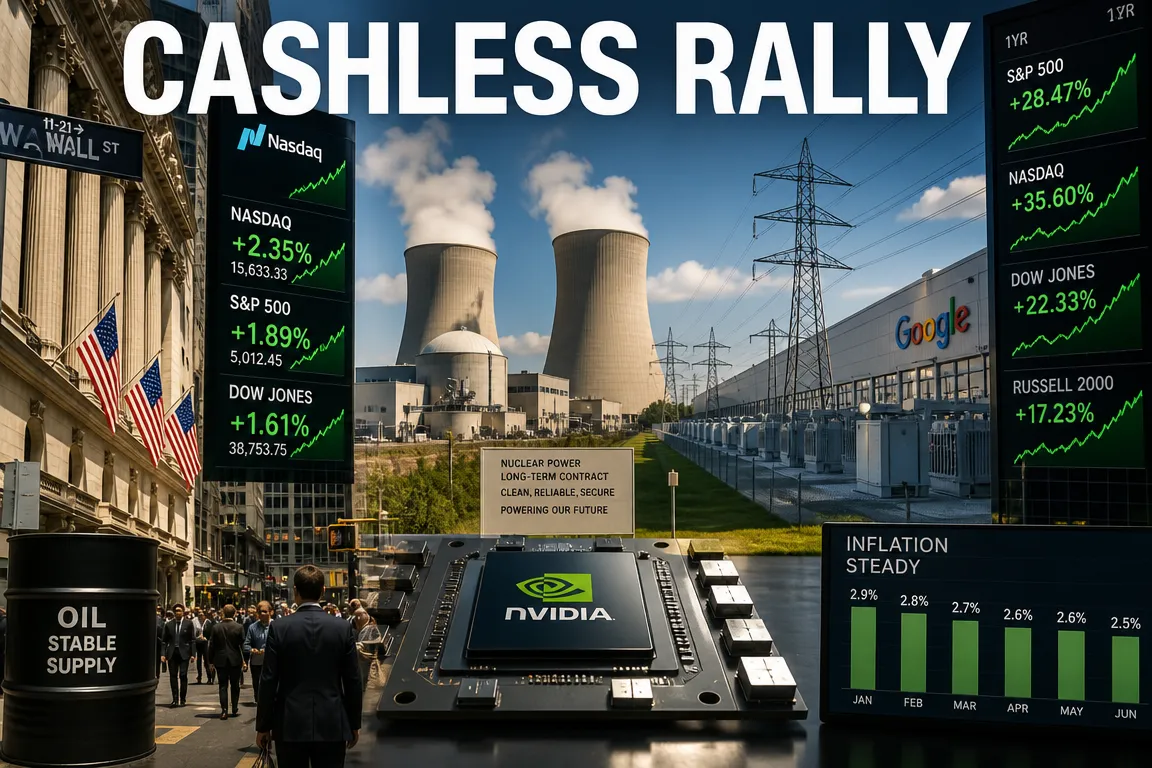
First, stable crude oil prices are easing concerns about a reacceleration in inflation.
Second, Google’s 20-year power purchase agreement and Nvidia’s large-scale share buyback plan have reinforced the market’s view of sustained AI investment.
Third, major capital-raising efforts and IPO plans among Chinese AI companies suggest that global AI competition is still in its early stages.
1. U.S. Market Overview: Nasdaq, S&P 500, and Dow All Advance
U.S. equities moved higher again.
The Nasdaq rose intraday by about 0.6%, extending its record-high trend.
The Dow Jones Industrial Average gained about 0.57%, while the S&P 500 rose about 0.73%.
If these levels hold into the close, both the Nasdaq and the S&P 500 will likely set fresh records.
- Nasdaq: Continued strength led by AI growth stocks
- S&P 500: Broad participation from large-cap technology and cyclical stocks
- Dow Jones: Improved sentiment extending into traditional industrial names
What matters most is not simply that indices are rising, but that the market is increasingly absorbing negative news in a different way.
Interest-rate pressure, valuation concerns, and geopolitical risks remain, yet equities are moving higher because the market is assigning greater value to “visible growth.”
2. First Driver of the Rally: Stable Crude Oil Prices Have Reduced Inflation Pressure
One of the most direct reasons for the market’s recent relief is the stabilization of crude oil prices.
WTI and Brent have both moved within a relatively narrow range, and pressure from recent highs has eased somewhat.
When oil prices stabilize, concerns about renewed inflation ease as well, which supports expectations for Federal Reserve policy.
The stabilization in oil prices has been supported by several factors.
- Discussions or measures involving G7 strategic petroleum reserve releases have reduced supply concerns in the oil market.
- Middle East supply disruption risks have been present, but actual export flows have remained stronger than expected.
- Energy trader Vitol said that over the past 7 to 10 days, roughly 12 million barrels per day of crude and 2 million barrels per day of refined products were exported from the Middle East.
- News related to alternative transportation routes in Saudi Arabia also helped ease market concerns.
The significance is straightforward.
If crude oil rises sharply again, inflation will become more volatile, and that would weaken expectations for U.S. rate cuts.
By contrast, stable oil prices lead equity markets to interpret the outlook as one in which monetary-policy pressure may not intensify further.
3. Second Driver of the Rally: Confidence in Continued AI Investment Has Improved
The deeper basis for the Nasdaq’s move is sustained AI investment.
The market already knows that AI companies are generating earnings today.
It also broadly expects AI infrastructure spending to continue through 2026 and 2027.
However, the market’s real concern has been different.
Can AI investment continue through 2028 and 2029?
Positive signals from Google, Nvidia, and Marvell have helped improve investor sentiment on that question.
4. Google’s 20-Year Nuclear Power Agreement: AI Data Center Demand Is Not a Short-Term Theme
Google signed a long-term power agreement with Constellation Energy to secure electricity for AI infrastructure operations.
The agreement is reportedly a 20-year contract tied to nuclear power.
The market reaction was driven largely by the contract’s duration.
Rather than a one- or two-year power purchase, a 20-year agreement suggests that Google is taking a highly long-term view of AI data center demand.
Training and running AI models require substantial power.
As a result, the core infrastructure for AI now extends beyond semiconductors to include power supply, cooling, real estate, and transmission networks.
The news helped push Constellation Energy’s shares up by about 12%.
Constellation Energy, a nuclear power supplier, is often viewed as a beneficiary of rising AI data center electricity demand.
The importance of this agreement is that it shows the bottleneck in AI infrastructure is shifting from GPUs to electricity.
Going forward, investors will need to track not only Nvidia and other semiconductor companies, but also utilities, nuclear-related companies, and data center operators.
5. Nvidia Share Buybacks: A Signal of Confidence in Future Cash Flow
Nvidia signaled the possibility of large-scale share repurchases, reinforcing confidence in its financial strength.
Based on the original report, Nvidia added approximately KRW 204 trillion in potential buyback capacity, bringing total potential repurchases to roughly KRW 320 trillion.
Share buybacks are not simply a tool for supporting stock prices.
They are typically pursued when a company believes it can continue generating stable cash flow in the future.
For a company such as Nvidia, where expectations are already elevated, a large buyback authorization is widely interpreted as evidence that management remains highly confident in future AI chip demand.
One of the biggest concerns facing AI hardware companies has been peak-out risk.
In other words, investors have worried that GPU demand may be extremely strong now but slow in coming years.
By actively emphasizing buybacks, Nvidia has encouraged the market to reassess that concern.
The market is increasingly interpreting this as evidence that Nvidia believes it can continue making money beyond 2027.
6. Marvell’s Investor Day: AI Semiconductor Demand Is Not Limited to Nvidia
Marvell Technology also presented a constructive outlook during its Investor Day.
Marvell is regarded as an important company in AI data centers, networking semiconductors, and custom ASICs.
If Nvidia is the leading name in GPU-based AI semiconductors, Marvell is positioned to benefit from internal data center connectivity and custom chip demand.
Marvell’s positive outlook suggests that AI demand is not concentrated in a single company.
As data centers expand, they require not only GPUs but also networking equipment, memory, power semiconductors, and cooling systems.
In other words, AI investment is evolving from a single-product cycle into a broad infrastructure cycle.
7. The Market’s Core Question: Can AI Continue Growing in 2028 and 2029?
The most important question investors are asking now is simple.
AI companies are earning money today, but how long can this trend last?
In 2023 and 2024, AI expectations alone were enough to lift stock prices.
From 2025 onward, the market has become more demanding.
It now wants to see revenue, earnings, cash flow, long-term contracts, and capital expenditure plans.
That is why Google’s 20-year power agreement, Nvidia’s share buyback plan, and Marvell’s constructive guidance matter together.
Viewed individually, each item may appear to be a normal corporate announcement.
Viewed together, they help address the market’s biggest concern.
- Google is planning AI infrastructure on a 20-year horizon.
- Nvidia is signaling confidence in future cash flow.
- Marvell is indicating that demand across the AI semiconductor ecosystem remains strong.
Together, these factors provide the rationale behind the Nasdaq’s new highs.
8. Chinese AI Companies Are Also Joining the Capital-Raising Race
Beyond the U.S., Chinese AI companies are also pursuing large-scale fundraising.
DeepSeek is reportedly seeking about USD 12 billion in financing.
That amounts to roughly KRW 1.7 trillion to KRW 1.8 trillion.
DeepSeek has recently gained visibility in global AI model competition.
If the funding round is completed, it could support model development, infrastructure expansion, talent acquisition, and commercialization efforts.
Another Chinese AI company, Moonshot AI, is reportedly targeting an IPO in 2027.
Moonshot AI is known for its Kimi AI model.
This trend indicates that global AI competition is becoming more intense across both U.S. and Chinese platforms.
AI is a contest in both technology and capital.
Ultimately, the outcome will depend on who can secure more GPUs, more power, and better talent.
9. The Most Important Point Often Missed in Other Coverage
The most important issue is not simply that AI-related stocks are rising, but that the cost structure of the AI industry is becoming locked in through long-term contracts.
Google’s 20-year power agreement is not just a power procurement announcement.
It signals that AI data center operations are evolving from a one-off experiment into a long-term infrastructure industry.
Longer power contracts imply longer capital expenditure plans, longer depreciation cycles, and more durable supply-chain commitments.
Investors should focus on the following areas.
- AI semiconductors: The sustainability of demand for GPUs, ASICs, and networking chips
- Power infrastructure: Growth in nuclear, natural gas, renewable energy, and transmission investment
- Data centers: Whether large tech companies’ capex is translating into revenue
- Capital markets: Continued fundraising and IPO activity among AI startups
- Interest rates and oil prices: Whether the macro environment remains supportive of high valuations
Much of the market coverage focuses on the Nasdaq’s record highs and Nvidia’s share price.
However, the deeper story is that the market is testing whether AI is becoming a long-term investment cycle connecting power, semiconductors, data centers, and capital markets.
10. Warren Buffett’s YouTube Algorithm Story: Even Legendary Investors Are Human
There was also a lighter but notable story.
According to The Wall Street Journal, Warren Buffett also watches a wide range of videos recommended by YouTube’s algorithm.
These reportedly include 1950s advertisements, old music videos, amateur singers performing “My Way,” and even an Uzbekistan version of a talent show.
One particularly notable detail is that Buffett reportedly continues to watch lectures by his longtime partner Charlie Munger.
That a legendary investor still seeks out videos of an old friend highlights a more human side of investing.
While this story is not directly related to market analysis, it reinforces one important point.
Even in investing, where disciplined judgment matters, markets are ultimately driven by human psychology.
The Nasdaq’s current record highs also reflect not just numbers and earnings, but a collective belief that AI growth will continue.
11. Risks to Monitor from an Investment Perspective
The current trend is strong, but risks have not disappeared.
As the Nasdaq and S&P 500 continue to set new highs, valuation pressure is also increasing.
- Renewed oil-price increases: Escalating Middle East risks could reignite inflation concerns.
- Delayed rate cuts: Persistently high inflation could weaken expectations for Fed easing.
- AI investment fatigue: If large-scale capex fails to translate into earnings, stocks may correct.
- Power bottlenecks: If power infrastructure expansion lags data center growth, it could constrain AI development.
- Chinese AI competition: Intensifying competition could increase pricing pressure and regulatory risk.
Accordingly, the appropriate approach is not unconditional optimism, but monitoring whether evidence of long-term growth continues to emerge.
12. One-Sentence Summary of the Nasdaq’s Latest Record High
The Nasdaq’s latest record high is not merely a technology stock rally.
It reflects easing macro pressure from stable crude oil prices, combined with clear evidence from Google, Nvidia, and Marvell that AI investment remains durable.
In particular, Google’s 20-year nuclear power agreement is a strong indication that AI is evolving from a short-term theme into a long-term infrastructure industry.
< Summary >
The Nasdaq is extending its record-high trend on stable crude oil prices and confirmation of sustained AI investment.
WTI and Brent have stabilized, easing inflation and interest-rate concerns.
Google signed a 20-year nuclear power agreement with Constellation Energy, signaling that AI data center demand is long term in nature.
Nvidia reinforced confidence in future cash flow through a large-scale buyback authorization.
Marvell also presented a constructive outlook for the AI semiconductor industry.
Chinese firms DeepSeek and Moonshot AI are pursuing fundraising and IPO plans, underscoring intensifying global AI competition.
The key point is that AI is evolving from a short-term theme into a long-term infrastructure cycle linking power, semiconductors, data centers, and capital markets.
[Related Articles…]
- Nasdaq Record Highs and the U.S. Tech Rally
- AI Investment Cycle and Data Center Infrastructure Growth
*Source: [ 내일은 투자왕 – 김단테 ]
– 나스닥 연일 신고가의 진짜 이유