● Oil Shock, Samsung Wobble, Kospi Slumps
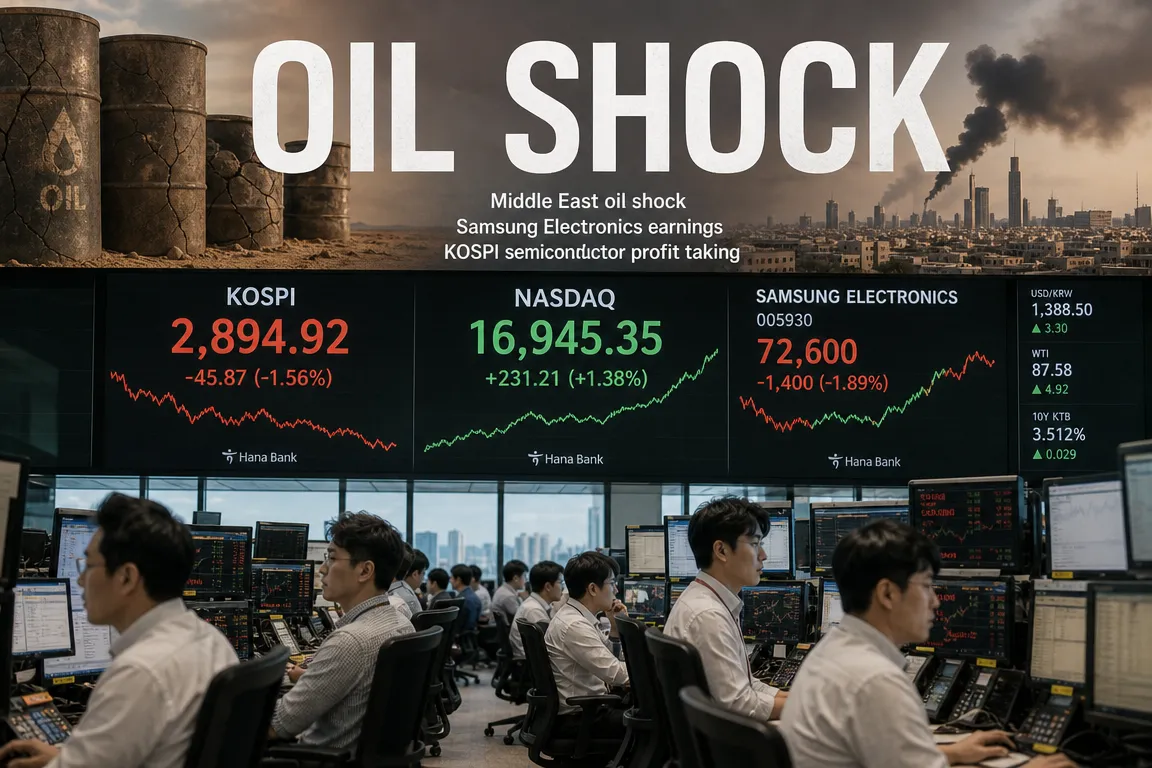
Nasdaq Hits a Record High, While the KOSPI Lags: Middle East Risk, Crude Oil, and Samsung Electronics Results Shaped the Session
The key takeaway from this move is not simply why the Nasdaq rose while the KOSPI fell.
The core issue is that renewed Middle East risk lifted crude oil prices, and that pressure quickly fed into Korean market sentiment and corporate earnings concerns.
In addition, a disappointing LG Electronics earnings release, profit-taking in semiconductors, and a wait-and-see stance ahead of Samsung Electronics’ results pushed Korean equities in a direction that diverged sharply from U.S. markets.
This session also showed that the assumption “a Nasdaq record high leads to a parallel rise in Korean stocks” no longer works automatically when assessing the KOSPI outlook.
1. Why the Nasdaq and the KOSPI moved in opposite directions
The Nasdaq set a record high, while the KOSPI failed to follow.
At first glance, this may appear inconsistent.
Normally, a strong Nasdaq would seem to support Korean technology shares as well.
However, market reactions were driven by different factors.
- U.S. equities were driven by AI, large-cap technology, and rate-cut expectations.
- Korean equities were more sensitive to Middle East risk, rising crude oil prices, and earnings pressure.
- Because the KOSPI has a large semiconductor weighting, uncertainty ahead of Samsung Electronics’ earnings release weighed heavily on sentiment.
In short, although both markets are technology-oriented, the drivers for the Nasdaq and the KOSPI were different.
The U.S. focused more on AI growth expectations, while Korea focused more on cost pressure and earnings confirmation.
2. The main factor behind today’s decline in the KOSPI: renewed Middle East risk
One of the main reasons behind today’s KOSPI decline was renewed tension in the Middle East.
News that Yemen’s Houthi rebels attacked an airport in Saudi Arabia increased geopolitical risk.
The Houthis are widely regarded as receiving support from Iran.
As a result, the market viewed the incident not as a localized event but as a potential escalation in broader Middle East tensions involving Iran and Saudi Arabia.
- Reports of a Houthi attack on a Saudi airport raised concerns.
- The market began to price in the possibility of broader Middle East risk.
- That concern quickly translated into upward pressure on crude oil prices.
- Higher oil prices increased worries about corporate costs and weaker consumption.
For investors, this is a familiar pattern.
When tensions rise in the Middle East, crude oil prices tend to move higher, and that is generally a negative for equities.
This is particularly relevant for Korea, given its high dependence on imported energy.
3. Why higher crude oil prices are more burdensome for Korean equities
Rising crude oil prices are not only a gasoline issue.
For an economy such as Korea, which imports most of its oil, higher crude prices raise corporate cost burdens.
Transportation, logistics, raw materials, and power costs can all increase.
- Manufacturing production costs may rise.
- Volatility may increase in airlines, chemicals, refining, and logistics.
- If inflationary pressure rises again, expectations for rate cuts may weaken.
- Additional pressure on the won may increase concerns over foreign capital outflows.
This matters because the KOSPI is highly sensitive to global growth, exchange rates, and oil prices.
The Nasdaq can be supported by AI and large-cap technology optimism, but the KOSPI is more vulnerable when higher oil prices and currency pressure occur at the same time.
4. LG Electronics’ earnings miss further weighed on sentiment
Among company-specific developments, LG Electronics was a negative factor for the market.
The company released preliminary earnings, and operating profit came in about 25% below market expectations.
In other words, it was an earnings miss.
- LG Electronics’ preliminary operating profit fell well short of consensus.
- Concerns increased over appliances, vehicle components, and cost structure.
- Stocks with elevated expectations saw faster selling after the miss.
Such an earnings miss affects not only one stock but also overall market tone.
Investors begin to ask whether other large-cap companies may also report weaker-than-expected results.
That is why the market became more sensitive ahead of Samsung Electronics’ earnings release.
5. Semiconductor weakness was more consistent with profit-taking than with a new negative trend
Semiconductor-related shares also weakened today.
However, this should not be viewed as a purely negative signal.
After a sharp rise driven by AI-related optimism, profit-taking was a natural response in the short term.
- Semiconductor shares had recently risen strongly on AI demand expectations.
- Stocks that have advanced quickly are vulnerable to selling even on small negatives.
- Middle East risk and earnings uncertainty provided a catalyst for profit-taking.
- The prevailing attitude was to reduce exposure before earnings confirmation.
What matters most is not the decline itself, but the reason behind it.
Investors need to determine whether prices are falling because demand is weakening, or simply because the rally had gone too far too fast.
At this stage, the latter interpretation appears more appropriate.
6. Market attention is now centered on Samsung Electronics’ earnings
The key event for this market phase is Samsung Electronics’ earnings release.
Samsung Electronics’ preliminary results are likely to determine the short-term direction of the KOSPI.
In Korea, Samsung Electronics is not just a single stock.
It is a proxy for overall sentiment, foreign flows, and expectations for the semiconductor cycle.
- If Samsung Electronics beats expectations, buying interest may return to semiconductor shares.
- If results fall short, the broader KOSPI may remain under pressure.
- Comments on memory chip recovery and AI server demand will be especially important.
- Foreign investors are likely to adjust their Korea exposure based on Samsung Electronics’ results.
That is why market participants closely watch Samsung Electronics for guidance on the broader market.
Its earnings can shape short-term sentiment across the KOSPI.
7. The main point that is often overlooked
The most important point is not simply that stocks fell because of Middle East risk.
The real issue is that Korean equities are now in a phase where both external risks and domestic earnings variables must be confirmed.
- External variables include Middle East risk and higher crude oil prices.
- Domestic variables include large-cap earnings and the pace of semiconductor recovery.
- Flow variables include profit-taking in recently strong semiconductor names.
- Sentiment variables include caution ahead of Samsung Electronics’ earnings release.
In other words, the KOSPI failed to follow the Nasdaq for multiple reasons.
The result reflected a combination of oil prices, earnings, semiconductor positioning, and geopolitical risk.
In such a market, investors need to focus on Korea-specific risks rather than assuming that U.S. market gains will automatically carry over.
8. What investors should monitor now
From here, the key is to monitor specific indicators rather than the index alone.
Whether trading short term or investing longer term, the following items matter.
- Whether Samsung Electronics’ preliminary earnings exceed market expectations.
- Whether foreign investors return to semiconductor shares after earnings are released.
- Whether crude oil prices continue to rise or begin to stabilize.
- Whether the Middle East situation remains isolated or shows signs of escalation.
- Whether earnings misses spread to other large-cap names, similar to LG Electronics.
- Whether the USD/KRW exchange rate moves sharply higher.
Even if Samsung Electronics delivers stronger-than-expected results, a continued rise in oil prices could limit the market rebound.
Conversely, if oil prices stabilize and Samsung Electronics beats expectations, the KOSPI could regain upward momentum.
9. One-sentence summary of the current market
The Nasdaq’s record high reflected optimism around AI and large-cap technology.
The KOSPI’s weakness reflected a combination of Middle East risk, rising crude oil prices, LG Electronics’ earnings miss, profit-taking in semiconductors, and caution ahead of Samsung Electronics’ results.
At present, Korean equities are no longer in a market that automatically follows the U.S.; they are in a market that must pass earnings validation on its own.
< Summary >
The Nasdaq hit a record high, while the KOSPI weakened on concerns about Middle East risk and higher crude oil prices.
Reports of a Houthi attack on a Saudi airport increased geopolitical anxiety and added pressure to Korean equities.
LG Electronics reported preliminary operating profit roughly 25% below expectations, marking an earnings miss.
Recently strong semiconductor shares corrected as investors locked in profits.
The key short-term driver for the KOSPI now appears to be Samsung Electronics’ earnings release.
If Samsung Electronics beats expectations, it could support a rebound in semiconductors and the broader KOSPI; if results disappoint, market pressure may deepen.
[Related Articles…]
- Samsung Electronics Earnings and the Semiconductor Outlook
- Crude Oil Rising and Global Equity Risk Analysis
*Source: [ 내일은 투자왕 – 김단테 ]
– 나스닥은 신고가인데 코스피는 왜? #코스피 #후티 #삼성전자
● AI-5, Semiconductor-Boom, Physical-AI, 2027-Shock
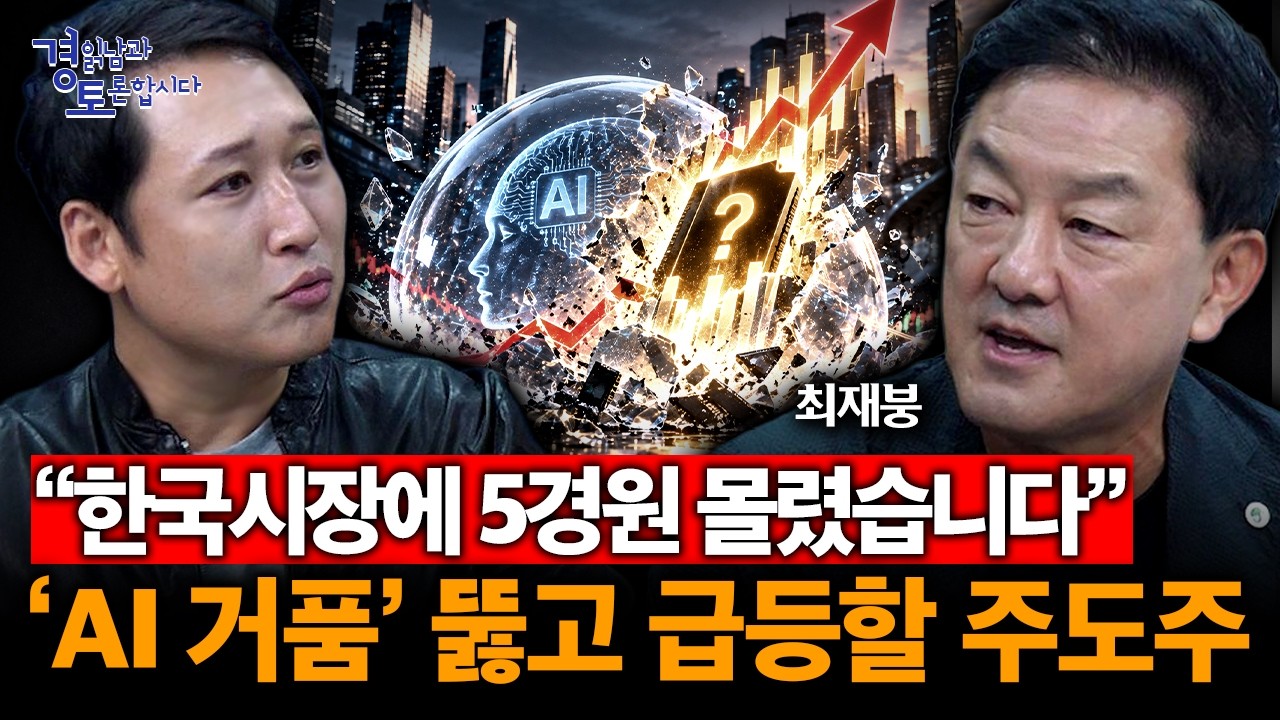
Why 5 Quadrillion Won Has Flowed Into AI and Where Capital May Move Next in 2027: Semiconductor, Data Centers, and Physical AI
The central point of this article is not simply that AI is rising.
It examines why global capital has committed approximately 5 quadrillion won to AI, how funding may shift from data centers to physical AI and robotics beginning in 2027, and which industries are likely to be reshaped first by the semiconductor supercycle and AI investment flows.
Three points are often overlooked in mainstream coverage: where AI investment capital is redeployed after it becomes realized profit, why Samsung Electronics and SK hynix may function not only as semiconductor companies but also as future sources of capital for industrial transition, and which companies can survive the AI bubble debate.
The key conclusion is that the primary battleground in 2027 remains semiconductors, followed by physical AI.
However, physical AI is still not a major profit center; it is closer to a capital- and talent-intensive contest for early positioning.
Accordingly, the most important question in the 2027 economic outlook is not whether AI is a bubble, but where AI-generated capital is redeployed next.
1. Why global capital has bet 5 quadrillion won on AI
The most forceful figure in the discussion is the market capitalization of AI-related companies.
As of 2024, a significant share of the global top 20 companies was classified as AI-related, with their combined market capitalization estimated at roughly 2.3 quadrillion won.
Within two years, this figure reportedly increased to about 5 quadrillion won.
For comparison, the total market capitalization of all listed companies in Korea was cited at around 2,500 trillion won.
In other words, the global market has committed far more capital to the AI future than the entire equity value of Korea’s listed market.
The important point is that this capital was not forced into the market.
Market capitalization reflects the aggregate price investors are willing to pay based on expectations of future growth.
For that reason, market capitalization can be interpreted as a form of collective conviction about AI as a structural transition.
Because investors allocate capital under conditions of survival and wealth preservation, the 5 quadrillion won AI capital flow should be viewed not as a short-term theme, but as a broad market bet on a civilizational shift.
2. AI is still early, not mature
The discussion repeatedly emphasized that AI remains at an early stage.
Many people feel AI has already become widespread because they have used generative tools such as ChatGPT, Gemini, and Claude.
However, relative to the smartphone cycle, AI is still in its initial phase.
Early smartphones were used mainly for games, email, and photos.
Today, however, smartphones function as the primary interface for finance, commerce, transportation, work, content consumption, and social interaction.
AI may follow a similar path.
At present it is mostly used as a work assistant, but it may evolve into an AI agent that manages schedules, analyzes information, drafts reports, and eventually supports purchasing and negotiation.
At that stage, AI would function less as software and more as an additional digital organ.
The essence of the AI trend is therefore not technology alone, but a shift in the standard of human life and work.
3. How to interpret the AI bubble debate
The AI bubble debate is likely to continue.
Market capitalization has expanded rapidly, data center investment has surged, and some AI startups are still valued more on expectations than on current revenue.
However, the discussion argues that the AI bubble and the AI industry’s long-term growth should be evaluated separately.
During the dot-com bubble in 2000, many internet companies collapsed.
Germany’s Neuer Markt effectively disappeared, and numerous internet firms in the United States went bankrupt.
That did not mean the internet itself was over.
Rather, after the iPhone’s launch in 2007, the internet combined with the mobile revolution to create today’s platform economy.
AI may follow a similar pattern.
Some companies may fail due to excessive valuations.
However, the underlying AI technological trend is difficult to stop.
Young talent has already entered the field, data center infrastructure is being deployed, and major technology and semiconductor companies continue to commit substantial capital.
The issue is therefore not whether AI is a bubble, but which companies will survive after the bubble phase.
4. Why semiconductors remain the top sector in 2027
The most important industry in 2027 is still expected to be semiconductors.
The reason is straightforward.
The real battleground in AI competition is compute capacity and memory, both of which depend on semiconductors.
As AI models grow larger, demand increases for GPUs, HBM, server memory, and advanced packaging technologies.
If AI agents become more widely adopted, data center usage is likely to rise further.
AI agents are not simple chatbots. They are systems that reason through multiple steps, call external tools, and collaborate with other agents.
This requires greater compute intensity than conventional generative AI.
That is why the semiconductor supercycle thesis continues to gain traction.
Samsung Electronics and SK hynix are frequently cited as direct beneficiaries of rising HBM and memory demand.
The discussion also highlighted the possibility that the substantial cash flow generated by these companies could be reinvested into the next wave of industrial development.
In this sense, semiconductor companies are not only component suppliers in the AI era; they may also become the starting point of capital formation for the next AI ecosystem.
5. Data center investment is not over
Many investors assume data center investment is already mature.
That view is challenged here.
As AI competition moves from chatbots to AI agents, data center demand may continue to expand.
The competition among ChatGPT, Gemini, and Claude is no longer just about model performance.
It is increasingly about who can build the most capable AI agents, provide the most personalized services, and automate the most enterprise workflows.
As AI agents scale, users will delegate more tasks to them.
Companies will also seek to assign customer support, development, marketing, financial analysis, logistics management, and security monitoring to AI systems.
That implies greater demand for data centers.
Power infrastructure, cooling systems, server hardware, networking equipment, and cloud spending therefore become major investment themes.
In effect, data centers are the factories of the AI industry.
The more AI is used, the larger these factories must become.
6. The next destination of capital in 2027: physical AI
The next major area after semiconductors is physical AI.
Physical AI refers to AI systems that perceive, decide, and act in the real world.
This category includes robotics, humanoids, autonomous driving, smart factories, logistics automation, defense robotics, and medical robotics.
While AI investment has so far concentrated on data centers and semiconductor infrastructure, capital is likely to move toward physical AI applications built on top of that infrastructure from 2027 onward.
However, physical AI is not yet at a stage of meaningful commercial profitability.
It remains early in the cycle, with expectations, technology development, talent acquisition, and initial commercialization driving the market.
The discussion suggested that around 2030, humanoid robots may begin to be used more broadly in automobile manufacturing, high-value manufacturing, and logistics centers.
Accordingly, 2027 should be viewed less as the year physical AI begins to generate significant revenue and more as the point at which capital and talent competition intensifies.
7. Why Samsung Electronics is serious about robotics and physical AI
An important point in the discussion was Samsung Electronics’ move to build a robotics organization and expand related investment.
Cash flow generated from semiconductors may be redirected toward robotics, AI devices, and the physical AI ecosystem.
In the AI era, the companies that generate cash are better positioned for the next phase of competition.
AI competition is both a technology contest and a capital contest.
Attracting talent requires substantial compensation and research infrastructure.
Building data centers requires investments on the scale of tens of trillions of won.
Commercializing robots requires sensors, actuators, batteries, control software, production lines, and verification systems.
As a result, companies with strong earnings can experiment more and sustain longer investment cycles.
From this perspective, AI semiconductor earnings at Samsung Electronics and SK hynix may extend beyond financial improvement and serve as funding for Korea’s broader industrial transition.
8. How AI agents may trigger another surge in data center demand
AI agents are the key link in the 2027 AI trend.
A chatbot answers questions when prompted.
An AI agent, by contrast, can set a plan, break down tasks, use external tools, and verify results.
For example, if asked to prepare a quarterly outlook report for the semiconductor market, an AI agent could search data, compare company earnings, incorporate exchange-rate and interest-rate variables, produce tables and charts, and draft the final report.
The issue is that this type of workflow requires far more compute than a simple response.
If multiple AI agents collaborate, data center usage could increase substantially.
Accordingly, the spread of AI agents implies simultaneous growth in data centers, semiconductors, power infrastructure, and cloud services.
9. How the AI power struggle may unfold
The AI power struggle is likely to develop along four axes.
First is the battle among platform leaders.
OpenAI, Google, Anthropic, Meta, Microsoft, and Amazon are trying to combine AI models with cloud, search, productivity tools, and social platforms to secure ecosystem dominance.
Second is the semiconductor supply chain battle.
Companies with critical assets such as NVIDIA’s GPUs, TSMC’s foundry capacity, Samsung Electronics and SK hynix’s memory, and ASML’s lithography equipment become strategic assets in the AI era.
Third is the competition around data centers and power infrastructure.
AI is an energy-intensive industry.
No matter how advanced a model is, it cannot scale without power, cooling, land, and transmission capacity.
Fourth is the standards battle in physical AI.
Whoever establishes the dominant platform in humanoid robotics, autonomous driving, smart factories, and defense robotics may shape industrial leadership after 2030.
AI dominance will not be determined by the model alone.
It is likely to be a combined contest involving semiconductors, data centers, power networks, software platforms, robotics manufacturing, and policy support.
10. The most important point often missed by other coverage
First, AI capital does not stop at expectations; it can be redeployed into real industry.
If semiconductor companies generate profits from data center demand, that capital can flow into robotics, AI devices, power infrastructure, and software ecosystems.
Understanding this capital recycling mechanism is essential to the 2027 outlook.
Second, physical AI is first a talent war, not a revenue war.
Even if robotics companies are not yet generating large revenues, the direction of the industry becomes clear once major technology firms and industrial conglomerates begin aggressively hiring the same talent pool.
Talent migration can be a leading indicator faster than capital allocation.
Third, the real risk in the AI bubble is not technology failure, but the timing gap in monetization.
Technology may advance while company revenues arrive more slowly than expected, creating valuation volatility.
As in the dot-com period, the technology thesis may be correct even if many individual companies fail.
Fourth, power infrastructure is a hidden bottleneck in the AI era.
As data centers and physical AI systems expand, electricity demand will rise sharply.
This is why future AI investment should also consider transmission networks, transformers, cooling systems, nuclear power, renewables, and energy storage.
Fifth, Korea’s opportunity may lie less in building a full AI platform and more in manufacturing-based AI.
If U.S. technology firms dominate AI models and platforms, Korea may have a more realistic opportunity in combining AI with semiconductors, batteries, displays, automobiles, robotics, and smart factories.
11. Which industries are likely to change first
Manufacturing is likely to be one of the earliest sectors to adopt physical AI.
Factory automation, quality inspection, predictive maintenance, material handling, and worker-assist robots can scale quickly.
Logistics is well suited for the simultaneous deployment of robots and AI agents.
Key applications include warehouse automation, route optimization, inventory forecasting, and delivery efficiency.
Mobility will center on autonomous driving and automotive AI.
Vehicles are likely to become both transportation tools and AI devices.
Defense and security may adopt AI faster than most sectors.
Drone systems, surveillance, cybersecurity, and unmanned equipment are directly linked to national security.
Finance is one of the areas where AI agents can most quickly improve productivity.
Research, risk management, customer service, investment analysis, and fraud detection are key use cases.
Healthcare is likely to expand through diagnostic support, drug discovery, medical imaging analysis, and personalized health management.
Content is already being transformed by generative AI.
Production methods in video, music, advertising, gaming, and webtoons are changing rapidly.
Retail and commerce are being reshaped by personalized recommendations, automated support, inventory forecasting, and pricing optimization.
12. Key checkpoints for investors
First, investors should verify whether AI companies are actually growing revenue.
Over time, companies valued primarily on expectations may diverge from those with paying customers.
Second, the extent to which data center investment leads to semiconductor orders should be monitored.
Demand for GPUs, HBM, server DRAM, SSDs, and networking equipment is central.
Third, physical AI companies should be assessed more by pilot projects and strategic partnerships than by near-term earnings.
For robotics, field deployment experience matters more than laboratory potential.
Fourth, the order flow of power infrastructure companies should be tracked.
As data centers expand, demand may rise for transmission, transformers, cooling, and generation equipment.
Fifth, alliance structures matter in the AI power race.
Which companies partner with NVIDIA, which semiconductors and cloud platforms the major technology firms choose, and which robotics platforms manufacturers adopt are important signals.
13. Conclusion: capital is moving from infrastructure into the real economy
If AI investment through 2025 and 2026 remains centered on data centers and semiconductors, then from 2027 onward capital is likely to spread toward sectors that transform the physical economy.
The sequence matters.
Data centers are built first, semiconductor companies generate earnings next, and only then do those profits and investment flows move into physical AI, robotics, smart factories, autonomous driving, defense, and healthcare.
In this sequence, semiconductors remain the top priority in 2027.
Physical AI follows as the second major theme.
However, physical AI is still at a stage where expectations, funding, and talent acquisition matter more than earnings.
For investors and industry participants, the key is to distinguish between where capital is currently being generated and where it is likely to flow next.
The real transformation of the AI era will not end at chatbot adoption.
It begins when AI becomes an agent beside the user, the brain inside robots, and the operating system of factories, logistics, finance, and healthcare.
That transition is likely to begin in earnest around 2027.
< Summary >
Approximately 5 quadrillion won of global capital has flowed into AI on a market-capitalization basis.
This is not simply a trend; it reflects a market bet that AI will reshape the standards of the next economic era.
In 2027, semiconductors are still expected to remain the leading sector, while the expansion of AI agents should continue to support demand for data centers and HBM.
The next major theme is physical AI.
Robotics, humanoids, smart factories, and autonomous driving are the core areas.
However, physical AI remains an early-stage contest in which talent and capital move ahead of earnings.
The AI bubble debate will continue, but the more important question is not whether AI has peaked, but which companies will survive and dominate the next industrial transition.
Korea may find greater opportunity not in platform-scale AI, but in manufacturing-based AI that combines semiconductors, industrial capacity, robotics, and power infrastructure.
[Related Articles…]
Semiconductor Supercycle and Data Center Outlook
AI Investment Flows and the Global Economic Outlook
*Source: [ 경제 읽어주는 남자(김광석TV) ]
– AI에 5경 원이 몰렸습니다… 2027년 돈이 향할 ‘다음 승부처’ | 경읽남과 토론합시다 | 최재붕 교수님 [2편]