● Market Rout, AI Panic, Buyer’s Desertion
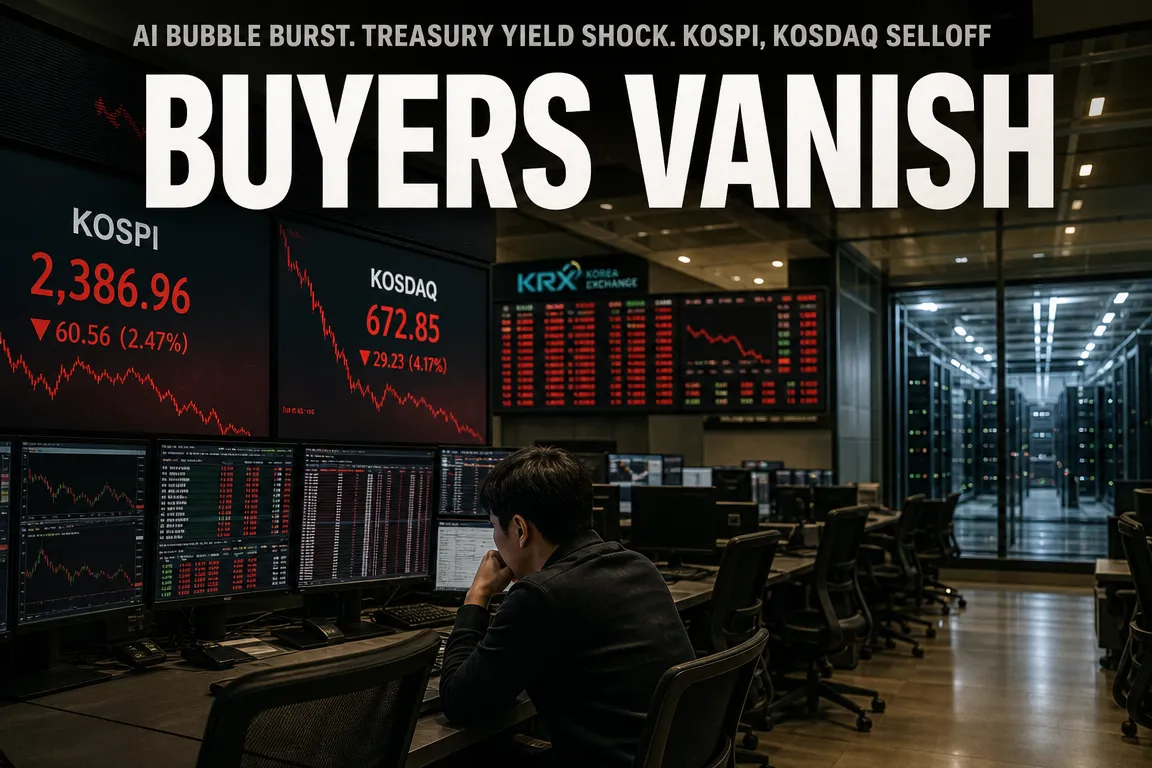
The real driver behind the KOSPI and KOSDAQ selloff is a lack of buyers, not OpenAI
This sharp decline in the KOSPI and KOSDAQ cannot be explained solely by OpenAI revenue concerns or the delisting issue involving an AI data center company.
The key point is that U.S. equities absorbed the negative news to some extent, while Korean equities fell much more sharply.
In other words, the visible trigger was AI-related news, but the real driver was a shortage of domestic buying power in the Korean market.
This report reviews OpenAI revenue concerns, weaker sentiment toward AI data center investment linked to Nvidia, the breakdown in KOSPI and KOSDAQ market flows, and the earnings resilience of Samsung Electronics and SK Hynix.
1. Why today’s KOSPI and KOSDAQ drop stood out
Both the KOSPI and KOSDAQ declined sharply today.
The most notable issue was the lack of a clear, large-scale negative catalyst.
When equities fall sharply, there is usually a visible trigger such as a rate spike, a currency shock, war, a severe earnings miss, or a sharp decline in U.S. markets.
Today’s decline did not follow that typical pattern.
-
AI-related stocks weakened in the U.S. market.
-
There were concerns over OpenAI’s reported revenue scale.
-
News emerged that an Nvidia-backed AI data center company had withdrawn its listing plan.
-
However, U.S. equities absorbed these developments to a degree.
-
Korean equities, by contrast, reacted far more sharply.
This suggests the decline in Korea was not driven by a single external shock, but by weakened market resilience that made the market vulnerable to relatively small shocks.
2. First issue: the substance of the OpenAI $20 billion revenue debate
The first market-moving issue was the debate over OpenAI’s revenue.
Some market participants interpreted OpenAI’s $20 billion revenue figure as overstated or effectively disappearing.
In practice, the issue was not that revenue suddenly vanished, but that the method of revenue recognition was being questioned.
The core debate centers on revenue recognized through cloud service providers.
For example, whether revenue generated via infrastructure providers such as AWS should be counted as 100% OpenAI revenue, or only partially recognized on a net basis, changes the final number materially.
-
On a gross basis, OpenAI appears larger in scale.
-
On a net basis, the revenue actually retained by OpenAI appears smaller.
-
Investors interpreted this gap as a question about AI sector profitability.
The market’s concern was not only OpenAI’s revenue number.
The larger concern is whether the substantial investment in AI semiconductors, cloud infrastructure, and data centers is generating sufficient returns.
3. Second issue: the Nvidia-linked AI data center listing withdrawal
Another negative factor was the reported withdrawal of a listing by Fermus, an AI data center company backed by Nvidia, in the Australian market.
The company reportedly pulled the listing due to insufficient capital raising.
This matters not simply because one listing failed, but because it signals that investors are applying far stricter standards to AI data center businesses.
-
AI data centers require very large investments in power, land, cooling, servers, and GPU infrastructure.
-
Upfront capital needs are significant, while payback periods can be long.
-
Even companies associated with Nvidia are no longer guaranteed funding momentum.
-
The market is now asking not just whether something is AI-related, but whether it can generate real profits.
This trend is also important from a broader economic outlook perspective.
AI remains a growth industry, but investors are increasingly focusing on cash flow and profitability rather than growth expectations alone.
4. Why did Korean equities fall more than U.S. equities?
The key question is why Korean stocks fell more sharply if the negative news was centered on OpenAI and AI data centers.
The most important explanation is market liquidity and supply-demand balance.
In simple terms, there were sellers, but not enough buyers.
-
Weak foreign inflows reduce support for large-cap stocks.
-
When institutional demand is cautious, buy-side support is limited during declines.
-
When retail investors are already under pressure, additional buying power is constrained.
-
Corporate buybacks are not unlimited.
In short, Korean equities fell more because buyer support was insufficient relative to the negative news flow.
That is the most practical explanation for today’s decline.
5. The real culprit behind the KOSPI drop: a shortage of cash ready to buy
In equity markets, prices are not determined by news alone.
Prices are set by who buys and who sells after the news is released.
Today, selling pressure existed in the Korean market, but there was not enough capital to absorb it.
As a result, news that would normally create only a short-lived pullback led instead to a much larger decline.
The KOSDAQ is especially vulnerable in this environment.
The KOSDAQ has a high concentration of growth stocks, biotech names, secondary battery companies, AI software firms, and semiconductor equipment stocks.
These sectors tend to correct more quickly when expectations for rate cuts weaken or risk appetite declines.
The KOSPI was not immune.
However, the KOSPI has greater structural resilience because large-cap semiconductor leaders such as Samsung Electronics and SK Hynix provide support.
6. Can the KOSPI avoid deeper losses if Samsung Electronics and SK Hynix remain firm?
The KOSPI’s main defensive pillar is semiconductors.
Samsung Electronics and SK Hynix continue to generate substantial earnings.
In particular, HBM, DRAM, NAND, and AI server demand remain central to the semiconductor cycle.
This is why it is difficult to argue that the Korean market is on the verge of a complete breakdown.
Although concerns about slower AI infrastructure spending are valid, global big tech has not stopped investing in AI.
Over the long term, AI semiconductor demand may continue to support earnings for major Korean companies.
-
Samsung Electronics remains central to the recovery in the memory semiconductor cycle.
-
SK Hynix continues to show strong competitiveness in the HBM market.
-
AI server investment supports demand for high-value memory products.
-
Improving earnings in large semiconductor names help establish a floor for the KOSPI.
For the KOSPI to fall further, the earnings outlook for semiconductors would need to deteriorate materially.
At present, there is no confirmation of that scale of deterioration.
7. The KOSPI is now near the lower end of its recent trading range
One constructive point in this decline is that the KOSPI has moved close to the lower boundary of its recent range.
At the lower end of a trading range, a technical rebound becomes more likely.
That said, proximity to support does not guarantee a rebound.
The more important issue is whether new buyers emerge to halt the decline.
That could come from renewed foreign inflows, institutional dip buying, or a slowdown in retail liquidation.
-
If the won stabilizes, foreign inflows may recover.
-
If U.S. technology stocks rebound, sentiment toward Korean semiconductor names may improve.
-
If expectations for rate cuts strengthen again, growth stocks and the KOSDAQ may stabilize.
-
If Samsung Electronics and SK Hynix rebound, broader KOSPI sentiment may also improve.
The key issue is not whether a rebound occurs tomorrow, but whether market flows recover.
A market bottom is formed when buying demand appears, not simply when prices decline.
8. The most important point that is often overlooked in other coverage
The main issue in this decline is not OpenAI’s revenue debate itself.
The real story is that the market’s standards for evaluating AI have changed.
The 2023 and 2024 AI rally was strong enough to be driven largely by the expectation that AI represented the future.
Now investors are asking more concrete questions.
-
How much actual revenue are AI companies generating?
-
How much of that revenue remains as net profit?
-
Can they absorb cloud costs and GPU investment?
-
Are AI data center investments becoming excessive?
-
Can companies command high valuations simply because they are tied to the Nvidia ecosystem?
This shift has direct implications for Korean equities.
Korea is more exposed to semiconductors, equipment, components, power infrastructure, and the data center value chain than to final AI service providers.
As a result, Korean stocks can react more sensitively than U.S. markets when global AI investment sentiment weakens.
At the same time, Korean semiconductor and equipment stocks can rebound quickly when confidence in AI investment returns.
Korean equities are both exposed to AI profitability concerns and positioned to benefit from AI infrastructure expansion.
9. Key indicators investors should monitor now
Rather than simply buying because prices have fallen, investors should monitor both liquidity and industry conditions.
-
First, foreign flows.
Investors should watch whether foreigners return to buying Samsung Electronics, SK Hynix, and KOSPI 200 large caps.
-
Second, U.S. AI stock performance.
If Nvidia, Microsoft, Amazon, and Google stabilize, sentiment toward Korean semiconductors may improve.
-
Third, the exchange rate.
Further weakness in the won can accelerate foreign outflows and increase domestic market volatility.
-
Fourth, expectations for rate cuts.
Growth stocks and the KOSDAQ are more likely to recover if rate-cut expectations strengthen.
-
Fifth, semiconductor earnings outlook.
If earnings expectations for Samsung Electronics and SK Hynix remain intact, the KOSPI may be able to hold its lower range.
10. Conclusion: today’s decline reflects market weakness more than an AI shock
The visible trigger for today’s KOSPI and KOSDAQ selloff was the OpenAI revenue debate and weaker sentiment toward AI data center investment.
However, a deeper reading suggests that the core issue was the weakening of buying support in the Korean market.
When sellers are present but buyers are scarce, even modest negative news can trigger a larger decline.
At the same time, the fact that the KOSPI is near the lower end of its recent range and that Samsung Electronics and SK Hynix still have strong earnings support is constructive.
Accordingly, investors should focus less on panic and more on whether market flows return and whether large-cap semiconductors continue to support the index.
A rebound may occur as early as tomorrow.
However, the more important issue is not a one-day bounce, but whether foreign and institutional investors begin buying Korean equities again.
The essence of this decline is closer to a liquidity shortage and a lack of buyers in Korea than to an AI bubble collapse.
< Summary >
The KOSPI and KOSDAQ selloff was triggered by OpenAI revenue concerns and the withdrawal of an AI data center listing.
However, U.S. equities absorbed the news to a degree, while Korean equities fell more sharply because of limited buying power.
The OpenAI issue is better understood as a debate over gross versus net revenue recognition rather than a collapse in revenue.
The AI data center listing withdrawal signals that the market is placing stricter scrutiny on AI business profitability.
The KOSPI is near the lower end of its recent range, and strong earnings from Samsung Electronics and SK Hynix may limit further downside.
Going forward, investors should monitor foreign flows, the exchange rate, U.S. AI stocks, rate-cut expectations, and the semiconductor earnings outlook.
[Related Articles…]
*Source: [ 내일은 투자왕 – 김단테 ]
– 코스피 코스닥 폭락의 주범 #코스피 #코스닥 #OpenAI
● Debt Bomb, Yield Shock, Fiscal Capture
IMF Warns on U.S. Debt Risk: The Greater Threat Is Treasury Yields and Fiscal Dominance, Not Default
The core issue is not simply that U.S. debt is large.
The key questions are why the IMF is issuing this warning now, how likely an actual U.S. default is, and where the more material risks are likely to emerge.
This trend connects U.S. Treasury yields, monetary tightening, expansionary fiscal policy, Middle East conflict, inflation, Big Tech funding conditions, and corporate financing stress into a single framework.
While monetary policy remains tight, fiscal spending continues to inject liquidity into markets, creating an unusual policy mix.
This is the central theme of fiscal dominance, which has become one of the most important issues in the global economic outlook.
1. The IMF’s warning to the U.S.: debt is accumulating too quickly
The IMF has issued a public warning about the pace of U.S. debt accumulation.
The U.S. is the issuer of the world’s reserve currency, which makes this warning particularly significant.
- U.S. federal debt continues to rise.
- The Treasury issuance required to finance fiscal deficits is increasing.
- Rising Treasury supply is putting upward pressure on yields.
- Higher Treasury yields increase the U.S. government’s interest burden.
- That burden can lead to further issuance, reinforcing the cycle.
The IMF’s concern is less about an imminent inability to pay and more about the long-term implications for financial stability and growth.
2. First key trend: the global economy is moving back toward monetary tightening
The global policy backdrop is once again leaning toward monetary tightening.
The original text notes that major economies, including the U.S., Korea, the euro area, and Japan, remain in tightening mode or retain the option of further hikes.
- The U.S. has already raised rates and still retains room for additional tightening.
- Korea remains in a policy environment that allows for further tightening.
- The euro area continues to keep rates elevated to address inflation.
- Japan is gradually moving away from its ultra-low-rate regime.
- Emerging markets face tightening pressure to defend inflation and currencies.
The important point is that this is not a one-country phenomenon.
The number of central banks cutting rates is declining, while the share of those maintaining or raising rates is increasing.
This shift affects bond markets, equity markets, real estate, and foreign exchange.
3. The unusual feature: monetary tightening alongside fiscal expansion
Under normal conditions, policy tools move in the same direction.
When inflation is high, central banks raise rates and governments reduce spending.
When growth weakens, central banks cut rates and governments expand fiscal support.
However, the current environment is different.
- Central banks are raising rates to contain inflation.
- Governments are increasing spending to support growth.
- Monetary and fiscal policy are moving in opposite directions.
- Rates are restrictive, but fiscal policy is still supplying liquidity.
This is what is commonly described as fiscal dominance.
Even when central banks tighten policy, large-scale fiscal spending can keep liquidity in the system.
As a result, it is no longer appropriate to equate rate hikes with broad liquidity contraction.
4. Why the Middle East conflict matters: it raises inflation and weakens growth
The original text identifies the Middle East conflict as a major variable.
Scenarios such as conflict involving Iran, a closure of the Strait of Hormuz, and a surge in oil prices are highlighted.
Such geopolitical shocks affect the economy in two ways.
- First, they raise inflation through higher energy prices.
- Second, they weaken consumption and business activity through higher input costs.
- Third, governments tend to increase fiscal spending in response to security and economic risks.
- Fourth, defense spending and military costs widen fiscal deficits.
A similar pattern appeared during the Russia-Ukraine war.
Sanctions on Russia constrained energy supply and pushed up oil and LNG prices.
Fertilizer prices rose, food prices increased, and broader inflation remained elevated.
A Middle East conflict could operate through the same channel.
Disruptions to oil supply would likely push up crude prices, which in turn would affect fertilizers, food, transportation, and manufacturing costs.
In such a case, central banks would find it harder to justify rate cuts.
5. The real nature of the U.S. debt risk: the yield regime is more important than default
When discussing U.S. debt risk, many investors focus on the possibility of default.
However, the original text argues that a real default remains unlikely.
The more relevant risk is the persistence of high Treasury yields.
When the U.S. government needs funding, it issues Treasuries.
As issuance increases, Treasury prices decline and yields rise.
The problem does not stop there.
- Higher Treasury yields increase the government’s interest expense.
- That burden can require more issuance.
- Additional issuance puts renewed upward pressure on yields.
- This creates a self-reinforcing cycle of high debt and high rates.
If this persists, U.S. Treasury yields may remain structurally higher than in the past.
In other words, a high-yield regime could become the new normal.
6. What fiscal dominance means: government spending is shaping markets more than monetary policy
Fiscal dominance refers to a condition in which fiscal policy exerts greater influence on markets than monetary policy.
Even if central banks raise rates to control inflation, large government spending can keep liquidity flowing through the economy.
The original text references the 2025 Fiscal Responsibility Act and an increase in the debt ceiling.
A higher debt ceiling allows the government to issue more Treasuries.
The proceeds are then used to fund fiscal spending and market support.
The resulting structure is as follows.
- The government issues Treasuries on a large scale.
- Treasury supply increases in the market.
- Yields face upward pressure.
- The government channels the proceeds into stimulus and defense spending.
- The effect of monetary tightening is partially offset.
In this environment, investors should not rely on policy rates alone.
The key is to monitor the interaction between restrictive monetary policy and expansionary fiscal policy.
7. If U.S. debt stress becomes more visible, the first risks are shutdowns and political gridlock
An immediate default scenario remains unlikely, but political risk can recur.
The most visible example is a federal government shutdown.
- If Congress fails to pass a budget, parts of the government may shut down.
- Delays in debt-ceiling negotiations can unsettle financial markets.
- After midterm elections, a lame-duck administration may have weaker negotiating power.
- If the opposition controls Congress, fiscal policy becomes harder to implement.
Such political gridlock can affect U.S. credit perception, Treasury markets, and the dollar.
This does not imply that the U.S. is approaching collapse, but it does suggest repeated episodes of market volatility.
8. Financial market stress: what the FVI indicates
The original text refers to the Federal Reserve’s Financial Vulnerability Index, or FVI.
This indicator is used to assess the level of fragility in the financial system.
Historically, financial vulnerability rose sharply during the 2008 global financial crisis and the 2020 pandemic shock.
The original text warns that current financial stress may be higher than during the pandemic period.
This matters because U.S. debt risk is less likely to appear as a sudden inability to pay and more likely to emerge through higher market fragility and amplified volatility after a smaller shock.
9. The overlooked mechanism: heavy Treasury issuance crowds out the private sector
One of the most important mechanisms is crowding out.
Much of the public discussion focuses on debt levels and IMF warnings, but the more immediate market impact can come from government borrowing displacing private financing.
Crowding out occurs when large government borrowing pushes private borrowers out of funding markets.
- The U.S. government issues Treasuries on a large scale.
- Investors buy Treasuries because they are relatively safe.
- Higher Treasury yields raise corporate borrowing costs as well.
- Private firms face more difficult and more expensive financing conditions.
- Investment, hiring, and capital expenditure may weaken as a result.
This does not affect all companies equally.
Large technology firms with strong profitability and cash flow can still access capital even in a high-rate environment.
By contrast, traditional manufacturers, smaller companies, and lower-margin businesses face greater financing pressure.
As a result, capital markets become more polarized.
The Nasdaq and large-cap technology stocks may remain resilient, while broader sectors come under pressure.
10. Why Big Tech can survive while conventional firms struggle
In a high-rate environment, the key issue is the ability to absorb interest expense.
Big Tech companies generally have high margins, faster growth, and stronger market confidence.
That makes it easier for them to raise capital even when rates are elevated.
The situation is different for ordinary firms.
- Lower operating margins make high interest expense harder to absorb.
- Higher corporate bond yields make new issuance more costly.
- Refinancing becomes more difficult as borrowing costs rise.
- Companies may need to reduce investment and cut costs.
The original text also points to declining net interest payments in the non-bank private sector as a sign of reduced funding activity.
This may suggest that firms are issuing less debt rather than benefiting from lower financing costs.
11. Capital flows are concentrating rather than spreading evenly through the economy
The original text describes this as a reverse flow of money.
Under normal conditions, fiscal spending and liquidity would spread through the real economy.
Today, however, capital is not circulating evenly.
- The government funds spending through Treasury issuance.
- Treasury yields remain elevated.
- Private financing becomes more difficult.
- Capital flows toward safe assets and a narrow group of high-quality growth stocks.
- The result is stronger concentration in Big Tech and the Nasdaq.
This is a form of market polarization.
It is not simply a case of broad liquidity shortage; rather, capital is being channeled selectively.
That can produce weak economic sentiment alongside strong performance in a limited set of assets.
12. Key indicators to monitor in assessing U.S. debt risk
To assess U.S. debt risk, investors should look beyond total debt levels.
The following indicators are more informative.
- Trends in the U.S. 10-year Treasury yield
- The pace of growth in U.S. interest expense
- Treasury issuance volumes and auction demand
- Changes in corporate bond spreads
- The financing gap between Big Tech and non-Big Tech firms
- The timing of Federal Reserve rate cuts and the pace of fiscal expansion
- External shocks such as Middle East conflict, oil prices, and food prices
If U.S. Treasury yields remain elevated, global financial markets are likely to stay under pressure.
13. Investment implications
First, U.S. debt risk should not be viewed only through a fear-based lens.
The more realistic risks are prolonged high rates and financial volatility rather than an imminent default.
Second, in an environment where monetary tightening and fiscal expansion coexist, policy rates alone are not sufficient for market analysis.
Investors need to follow fiscal spending, Treasury issuance, Treasury yields, and corporate credit conditions together.
Third, high rates are likely to increase dispersion across industries.
Companies with strong cash flow may outperform, while rate-sensitive sectors remain under pressure.
Fourth, if inflation becomes more persistent, expectations for rate cuts could be delayed further.
Oil prices and Middle East risks remain important variables.
Fifth, market gains are more likely to be concentrated than broad-based.
AI infrastructure, power infrastructure, semiconductors, and cloud-related names may remain relatively strong, while rate-sensitive industries face headwinds.
14. The key takeaway
The real issue in the current U.S. debt debate is not whether the U.S. will collapse.
The more important question is how long elevated Treasury yields will persist.
The U.S. government is unlikely to reduce fiscal spending quickly.
If geopolitical risks in the Middle East intensify, defense and stabilization spending may rise further.
That would likely increase Treasury issuance and make it harder for yields to decline.
At the same time, private companies would face greater financing pressure.
Large-cap technology firms and AI-related leaders are likely to remain more resilient than the broader market.
As a result, market leadership may become narrower, more expensive, and more concentrated.
The IMF warning should therefore be read less as a default signal and more as a warning about distortions in global capital allocation.
< Summary >
The IMF has warned about rising U.S. debt and widening fiscal deficits.
However, the greater risk is prolonged high Treasury yields rather than an immediate U.S. default.
The global economy is currently in a rare environment where monetary tightening and fiscal expansion are occurring simultaneously.
This can be understood as fiscal dominance.
Middle East conflict and higher oil prices could further support inflation and increase fiscal spending.
Large Treasury issuance may crowd out private borrowers and raise corporate financing stress.
Big Tech may remain resilient, while traditional companies face more pressure.
Investors should monitor Treasury yields, fiscal spending, corporate credit conditions, oil prices, and the timing of Federal Reserve easing.
[Related Articles…]
- U.S. Debt Stress and Global Market Risk Analysis
- How Rising Treasury Yields Affect Equities and the Real Economy
*Source: [ 경제 읽어주는 남자(김광석TV) ]
– [경읽남 266화] IMF도 혀 내두른 미국의 부채 상황, 도대체 얼마나 심각하길래?