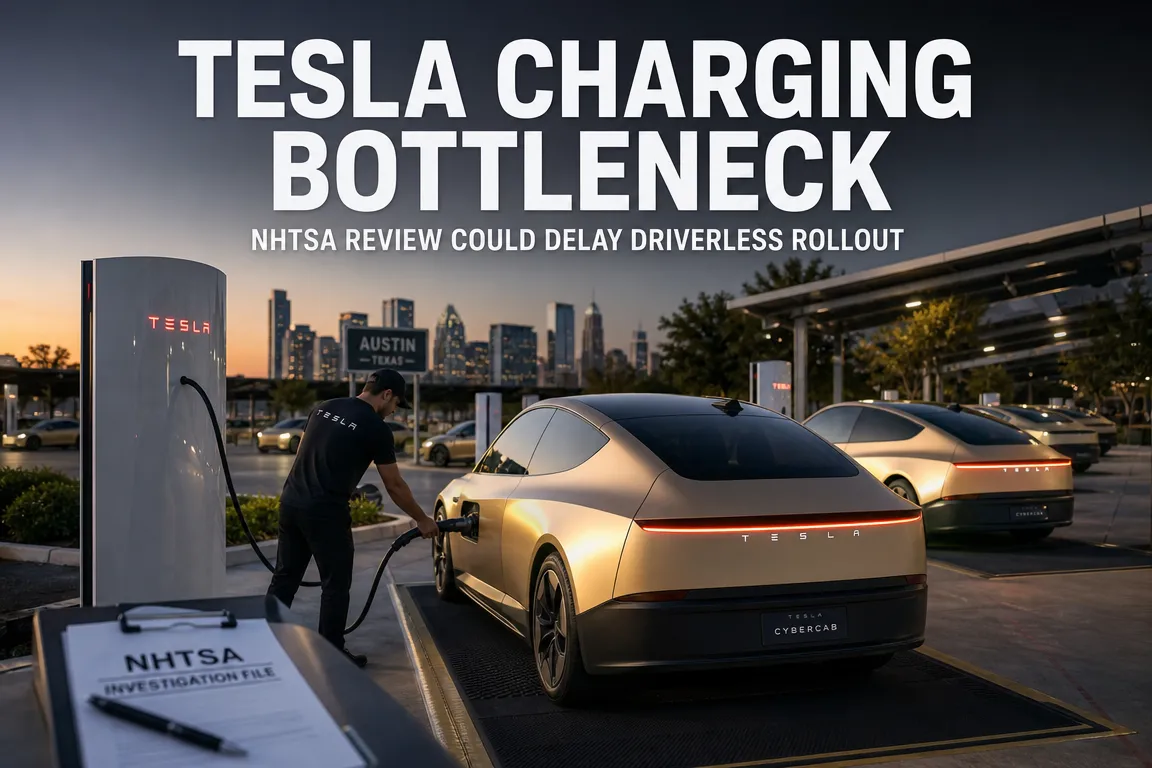
● Tesla Cybercab Surge, Charging Bottleneck, NHTSA Probe
Tesla Cybercab Tops 300 Units, But the Key Issue Is Charging Infrastructure
Tesla has reportedly expanded its Cybercab fleet operating on public roads in Austin to roughly 300 units within a month.
At first glance, this appears to signal that Tesla’s robotaxi rollout is entering large-scale expansion.
However, the real issue is different.
The fleet is growing quickly, but charging still requires employees to plug in the vehicles manually.
This comes as the U.S. National Highway Traffic Safety Administration, or NHTSA, has launched a preliminary review, school-zone speed compliance concerns remain unresolved, wireless charging hub construction is under way, and Tesla is approaching its third-quarter earnings release.
As a result, Tesla’s stock performance and broader AI investment trends must be viewed together.
This is not simply a Tesla story. It connects autonomous driving, EV charging infrastructure, the semiconductor market, U.S. equities, and competition across the AI industry.
1. Market Overview: Tesla Declines, U.S. Equities Close Mixed
Tesla closed at $378.3 in the original source.
The stock fell 1.22% on the day.
SpaceX closed at $163.42, up 0.52%.
U.S. equities ended mixed.
The Dow Jones Industrial Average rose 0.38%.
The S&P 500 fell 0.06%.
The Nasdaq declined 0.44%.
U.S. bond markets were closed for Columbus Day.
With Treasury yields unchanged, equities lacked a clear directional catalyst.
Technology shares, however, faced pressure from weakness in memory semiconductors.
The key point is not simply that Tesla declined for one session.
The more important issue is the simultaneous movement in Tesla’s robotaxi expansion expectations, semiconductor market concerns, and AI investment competition.
Autonomous driving and AI models ultimately depend on high-performance chips, HBM, and data center investment, making Tesla difficult to analyze in isolation.
2. Meta Rises as AI Assistant Competition Shifts Toward Practical Workflows
Meta gained 3.39%.
The move was driven by the launch of a new AI model, Muse Wonder.
The model was presented as capable of handling practical tasks such as insurance claims and lease agreement interpretation.
This is an important development in the AI sector.
Competition is no longer limited to chatbot performance. It is moving into workplace tasks, document processing, contract review, and customer support.
Enterprises are prioritizing AI systems that save time and reduce costs, rather than simply generate better answers.
Accordingly, Meta, Google, Microsoft, OpenAI, and Tesla are all accelerating AI investment in their own ways.
3. Oil and Political Risk: Russia Diesel Supply Reenters the Market Narrative
President Trump announced that Russia would supply 300,000 tons of diesel to the market, followed by 500,000 tons in November and an additional 1 million tons thereafter.
To support this, Russian fuel sanctions were reportedly eased temporarily.
However, Republican and Democratic senators have both opposed the move.
Their concern is that it may conflict with the 2022 law restricting Russian energy imports.
President Trump maintained that it was the correct decision.
With the November 3 midterm elections approaching, lowering fuel prices is politically important.
Oil price stability is closely tied to U.S. consumer inflation.
As a result, the market is focused on this week’s September Consumer Price Index release.
In an environment where U.S. equities remain sensitive to rates, oil, AI investment, and earnings, political developments cannot be ignored.
4. Key Events This Week: Bank Earnings, CPI, Tesla Event, and Q3 Results
Several major financial institutions are scheduled to report earnings this week.
JPMorgan, Goldman Sachs, Wells Fargo, and Citi are all set to release results.
On Wednesday, Bank of America and Morgan Stanley will also report earnings.
The September CPI release is scheduled for the same day.
Tesla-related events are also significant.
On October 15 U.S. time, Tesla is scheduled to unveil its Road event.
The event was originally planned for October 1 but was delayed by two weeks due to a Texas storm forecast.
Because it may be held outdoors, weather remains a variable.
Tesla’s third-quarter earnings are scheduled for October 21 U.S. time.
In Korea, that corresponds to 6:30 a.m. on October 22.
Investors should focus on more than revenue and EPS in this release.
Cybercab fleet size, robotaxi operating hours, wireless charging plans, and margin pressure may be more important.
5. Shanghai Factory Sales: Volume Improves, Discounts Pressure Margins
Tesla’s Shanghai plant reportedly sold 95,366 units in September, including exports.
That represents an increase of roughly 5% year over year.
The plant has now posted 11 consecutive months of growth.
At the same time, discounting continues in China.
Through the end of October, the Model Y is being discounted by 7,000 yuan and the Model 3 by 5,000 yuan.
Rising volume is positive, but discounts can weigh on margins.
For Tesla investors, both sales growth and profitability must be monitored.
As competition intensifies in the EV market, the key question is whether Tesla will continue cutting prices to defend share or prioritize margins.
6. Austin Cybercab Surpasses 300 Units: Roughly 8x Growth in One Month
The center of this news flow is Tesla’s Cybercab activity in Austin.
Tesla’s robotaxi account said the “floodgates are opening,” signaling rapid fleet growth.
At launch in early September, fewer than 40 Cybercabs were carrying public passengers.
Within roughly one month, that number had risen to about 300 units.
That is approximately an eightfold increase.
According to the Texas autonomous vehicle registry, 150 Cybercabs were added in a single day on October 8 U.S. time.
The registered fleet grew from 169 units to 319 units.
At this pace, Tesla appears to be pushing the robotaxi business beyond testing and toward commercial expansion.
The key question, however, is whether operating hours are increasing at the same pace.
And is the charging infrastructure scaling accordingly?
7. Tesla AI Vice President’s Comment: “We Are Learning How to Be On Time”
Tesla AI Vice President Ashok Elluswamy responded to the Cybercab expansion with a notable remark.
He referred to Tesla’s announcement from two years ago that Cybercab would arrive in two years.
He then said, “We are learning how to be on time.”
Tesla has long faced criticism for delays.
Full Self-Driving, robotaxi, Cybertruck, and Optimus have all slipped relative to market expectations at various times.
However, Cybercab is at least moving in line with the broad timeline Tesla originally outlined.
For investors, this is important.
It suggests Tesla may be moving beyond idea generation and into faster product and service deployment.
8. Next Expansion Cities: Houston, Miami, or Dallas
Houston has been discussed as a potential next city for Cybercab expansion.
That follows the appearance of nearly 200 Cybercabs at a Tesla lot in Houston.
Cybercabs have also been seen gathering in Miami.
However, the name Tesla has appeared to emphasize most directly is Dallas.
The Dallas robotaxi operating zone is estimated to be about 28 times the size of Yeouido.
Driverless Model Y robotaxis are already reportedly operating there.
Dallas is therefore not a completely new market for Cybercab.
It can leverage operating data from the existing Model Y robotaxi network.
That may support faster scaling.
9. NHTSA Preliminary Review: School-Zone Speed Compliance Under Scrutiny
As Cybercab and robotaxi fleets grow, regulatory oversight is intensifying.
On October 9, the NHTSA opened a preliminary review of Tesla’s robotaxi operations.
The main issue is a petition alleging that vehicles failed to follow reduced speed limits in school zones.
The petition was reportedly filed around September 23.
The vehicles involved are estimated at about 1,000 units, including Model Y robotaxis and Cybercabs.
NHTSA has identified four cases.
One was a formal report, and the other three were videos posted on social media.
No accidents or injuries have been confirmed so far.
This should be viewed as an early-stage review rather than a formal investigation.
The agency is reviewing the material before deciding whether to escalate.
Tesla is not the only company facing such scrutiny.
Waymo is also under federal review over school-bus-related incidents.
For robotaxi operators, regulatory review is a standard part of the operating environment.
10. Memory Semiconductor Selloff: Elon Musk Comments on China
One of the factors pressuring technology stocks in the U.S. market was memory semiconductors.
Micron fell 3.85%.
SanDisk fell 5.97%.
The semiconductor index declined 2.67% overall.
The selloff was driven in part by reports that China’s largest DRAM maker, CXMT, made progress in next-generation DRAM design.
That raised concerns about intensified competition with Samsung Electronics, SK Hynix, and Micron.
Micron also faced the added risk of a potential labor dispute at its Taiwan facilities.
The two plants there employ about 15,000 people and are considered important for HBM production.
Elon Musk also commented directly.
He said that once China figures out how to make something, it scales it larger than the rest of the world combined.
He cited lithium batteries and solar as examples.
He noted that SpaceX is a rare exception.
According to Musk, SpaceX launches about 10 times more cargo into space than the rest of the world combined, and excluding SpaceX, China already accounts for more than half.
This is not simply a comment on China.
It underscores how memory semiconductors have become strategic assets in the AI era.
HBM, in particular, is essential for AI data centers, autonomous driving training, and large-scale model development.
If Chinese firms advance from commodity DRAM into high-performance memory, the structure of the global semiconductor market could change materially.
11. Key Distinction: Commodity Memory and HBM Are Very Different
Three years ago, memory was widely viewed as a low-margin commodity product.
That is no longer the case.
Explosive growth in AI server and data center demand has elevated the strategic importance of HBM.
Standard memory used in smartphones can be caught up to relatively quickly by Chinese firms.
HBM is far more difficult.
It requires stacking chips in multiple layers, controlling heat, stabilizing yields, and mastering advanced packaging.
This remains a core strength for Samsung Electronics, SK Hynix, and Micron.
AI semiconductor competition is not only about GPUs.
Control of the HBM supply chain is now closely tied to AI industry competitiveness.
12. SpaceX Starship: Preparing for a Third Attempt at Upper-Stage Recovery
As Musk referenced China’s manufacturing scale, he also identified SpaceX as a major exception.
SpaceX may attempt to catch the upper-stage ship during Starship’s 15th flight.
The booster has already been caught several times.
The upper stage, however, has so far returned to the ocean.
If the upper stage is recovered this time, it would mark a major step toward full rocket reusability.
The 15th launch is expected in roughly four to six weeks, around November 26 near Thanksgiving, according to some reports.
Some have also mentioned a possible date of October 19, although delays beyond a month remain possible.
If the 15th flight succeeds, the 16th is expected to target full reuse of both booster and ship.
That would move rocket operations closer to aircraft-like turnaround.
13. Cybercab at Night: No Driver, But Charging Still Requires Human Labor
The most important visual from the source was a nighttime charging scene involving Cybercabs.
Driverless vehicles were seen entering the charging area in sequence.
A Cybercab and several Model Y units were also seen traveling together.
The Cybercabs reverse into the charging position.
The charging port is hidden under a cover near the corner of the vehicle.
After the vehicles are positioned, a Tesla employee moves between them and plugs in each charger manually.
If a vehicle is out of place and cannot reach the charger, the employee repositions it.
This is the key issue.
The driver has been removed, but charging labor remains manual.
If 10 vehicles once required 10 drivers, the current model replaces that with one employee managing charging.
That is efficient in the near term.
But the economics change materially at 300, 1,000, or 10,000 vehicles.
If charging still requires human intervention, the economics of fully autonomous robotaxis may remain constrained.
14. Cybercab Charging Problem: Current Operations Depend on Fast Charging
Cybercab currently appears to rely primarily on fast chargers.
The issue is that Cybercabs may need to share the same network used by regular customers on public Superchargers.
That could create waiting times.
Cybercab registrations have grown rapidly.
As of August 31, only seven units were registered.
In the fourth week of September, the number rose from 58 to 125 in a single week.
By October, it had reached about 300 units.
Charging infrastructure and operating hours have not scaled at the same pace.
Tesla does not appear to be actively expanding Cybercab night operations yet.
Elon Musk has previously said night driving is limited because of animal-related risks on the road.
This suggests the company is taking a cautious approach to autonomous driving safety.
As a result, charging activity appears concentrated during nighttime hours.
The bottleneck is therefore not how many vehicles Tesla can produce, but how long those vehicles can remain in service.
15. Tesla’s Solution: The St. Elmo Road Charging Hub in Austin
Tesla is preparing dedicated charging infrastructure for Cybercab.
According to design plans for the St. Elmo Road charging site in Austin, Phase 1 will include 48 fast chargers.
Phase 2 will add 80 wireless chargers.
The site was originally a logistics parking lot used for Tesla vehicle transport trucks.
Tesla plans to convert it into a robotaxi charging facility.
The company is also reportedly building a separate robotaxi charging hub.
Until that infrastructure is complete, employees are likely to continue plugging vehicles into Superchargers manually.
That may be sufficient in the short term, but wireless charging will be needed over time.
16. Why Wireless Charging Matters: From 17 Hours of Operation to 24 Hours
Tesla’s focus on wireless charging has a clear rationale.
Vehicles must be able to charge without human intervention.
Wireless charging allows a vehicle to park over a floor pad and begin charging automatically.
The vehicle can locate the pad via Bluetooth, align precisely using ultra-wideband signals, and start charging.
Tesla has reportedly received FCC approval for the system.
The company has said efficiency is above 90%.
If commercialized, this would materially change robotaxi operations.
Vehicles could move to charging spots independently, charge automatically, and return to service.
That would reduce human involvement.
The operating model could move from 17 hours per day toward something closer to 24 hours.
Robotaxi profitability depends less on vehicle cost than on utilization.
The key question is how many hours per day each vehicle can generate revenue.
Wireless charging is therefore not just a convenience feature. It is core infrastructure for robotaxi economics.
17. NHTSA’s Second Question: Certification of a Steering-Wheel-Free Cybercab
NHTSA’s questions extend beyond school-zone speed compliance.
The agency has also asked how Tesla certified a Cybercab without a steering wheel.
Tesla is expected to respond in formal documentation by October 30.
That response could affect the pace of Cybercab expansion.
Investors should focus not only on how many Cybercabs have been deployed, but also on how regulators evaluate steering-wheel-free vehicles.
If certification and safety review proceed smoothly, expansion could accelerate.
If additional disclosures or restrictions are required, commercialization could slow.
18. Key Questions for Tesla’s Q3 Earnings Call
Investors should listen carefully to Tesla’s October 21 earnings call for the following issues:
- How many Cybercabs are currently in operation?
- What is the average daily operating time?
- When will night operations begin?
- When will the wireless charging hub be completed?
- Which city will be next: Dallas, Houston, or Miami?
- What is Tesla’s response to the NHTSA inquiry?
- How much of the public Supercharger network is being used by Cybercabs?
- Is the sub-$30,000 consumer Cybercab plan still intact?
The era when investors focused only on revenue and vehicle deliveries is over.
Tesla’s core story is now whether it can build a robotaxi network as an AI company.
For Tesla to regain a premium valuation over the long term, it must demonstrate that it is more than an EV manufacturer.
19. Consumer Cybercab Dilemma: Below $30,000, But Difficult to Charge at Home?
Cybercab is not only being discussed as a robotaxi.
It is also intended to be available to consumers, with a target price below $30,000, or around 40 million won.
That makes the vehicle attractive on price alone.
However, major questions remain around charging.
According to the source, the vehicle may not support home charging and could require Supercharger access.
If individual buyers cannot charge Cybercab at home, usability would be significantly constrained.
This would be especially problematic for apartment residents and long-distance drivers.
If public Superchargers are shared between robotaxis and retail customers, congestion could increase.
Tesla has not yet provided a clear answer on this issue.
For the consumer version of Cybercab to succeed, charging experience must be addressed before pricing becomes the main selling point.
20. The Core Issue Not Often Highlighted: Cybercab’s True Bottleneck Is Not FSD, but Energy Operations
Many reports focus on the expansion to 300 Cybercabs.
However, the more important issue is energy operations rather than fleet size.
A robotaxi business does not succeed simply by producing more vehicles.
The vehicles must remain on the road and generate revenue continuously.
That requires automation across charging, maintenance, cleaning, dispatch, and regulatory compliance.
Tesla is moving quickly on autonomy.
Charging, however, still requires human intervention.
This gap is the practical bottleneck in the robotaxi model.
In simple terms, Tesla has shown progress in removing the driver.
The next step is removing the charging attendant.
Wireless charging hubs are the proposed solution.
If that problem is solved, Tesla’s robotaxi business could move into a materially different phase.
If not, Cybercab fleet growth could become an operational burden.
21. Investor Takeaway: The Key Metric Is Not “How Many Units,” but “How Many Hours”
The number Tesla highlights is fleet size.
Investors, however, should focus on operating hours.
300 vehicles operating six hours a day and 100 vehicles operating 20 hours a day have entirely different economics.
The core metrics for a robotaxi business are fleet size, operating hours, charging time, passenger utilization, and revenue per mile.
To build a strong business model, Tesla needs the following:
- Autonomous driving reliability
- Regulatory approval and trust
- Wireless charging-based automation
- Sufficient dedicated robotaxi charging hubs
- Expanded operating hours
- A solution to consumer Cybercab charging constraints
- A margin structure resilient to price cuts
Tesla’s stock may continue to fluctuate around the $378 level in the short term.
Over the long term, however, the key issue is whether Cybercab can generate real cash flow.
The valuation framework for an EV manufacturer is fundamentally different from that of a robotaxi network.
22. Overview at a Glance
| Category | Key Point | Investor Focus |
|---|---|---|
| Tesla stock | $378.3, -1.22% | Q3 earnings matter more than one-day weakness |
| Cybercab | About 300 units operating in Austin | Focus on operating hours and charging efficiency |
| Charging | Employees still plug in vehicles manually | Wireless charging hub timeline is critical |
| NHTSA | Reviewing school-zone speed compliance and steering-wheel-free certification | Tesla’s October 30 response is important |
| Semiconductors | Memory stocks fell on CXMT-related concerns | HBM supply chain remains central to the AI cycle |
| Earnings | Scheduled for October 21 | Robotaxi operating strategy will be closely watched |
< Summary >
Tesla’s Cybercab fleet in Austin has reportedly expanded to about 300 units within a month.
The key issue is not fleet size, but operating time and charging automation.
Charging still requires employees to connect the vehicles manually, which remains inconsistent with a fully autonomous robotaxi model.
Tesla is preparing a charging hub on St. Elmo Road in Austin with 48 fast chargers and 80 wireless chargers.
NHTSA is reviewing school-zone speed compliance and steering-wheel-free Cybercab certification, and Tesla must respond by October 30.
At the October 21 earnings release, investors should focus more on 24-hour operation plans, wireless charging timelines, and regulatory response than on vehicle count alone.
In semiconductors, memory stocks weakened after CXMT reportedly made progress in DRAM technology, while Elon Musk highlighted China’s manufacturing scale.
Ultimately, Tesla’s next growth narrative depends less on EV sales and more on the completion of a robotaxi network combining autonomy, AI, and charging infrastructure.
[Related Articles…]
*Source: [ 오늘의 테슬라 뉴스 ]
– 테슬라 사이버캡 한 달 만에 300대 — 근데 충전은 아직 직원이 손으로 꽂습니다, $378 주주는?
● AI Shockwave
[Breaking Analysis] IMF World Economic Outlook 2026-2027: AI investment is supporting the global economy, but it is now more exposed to high inflation and high interest rate shocks
The core message of this IMF World Economic Outlook can be reduced to one point.
The global economy is holding up better than expected, but that support is not working equally across countries.
Countries tied to AI investment, semiconductor exports, data centers, and power infrastructure are seeing upward revisions to growth forecasts.
By contrast, countries exposed to rising energy and food prices, high interest rates, and cost-of-living pressure are struggling to feel any recovery.
In particular, the IMF classifies Korea, together with Taiwan, as a key AI hardware trading economy and has revised Korea’s growth outlook sharply higher.
At the same time, the IMF warned that the global economy remains highly vulnerable to Middle East conflict, trade tensions, commodity price volatility, and a renewed inflation cycle.
In other words, this report is not simply saying that “AI is making things better,” but rather that the gap between economies connected to AI and those that are not is widening materially.
1. IMF’s main conclusion: the global economy is recovering, but it is more vulnerable to shocks
The IMF released its 2026 and 2027 global growth projections in the October World Economic Outlook.
In this report, the IMF said the world economy continues to hold up better than expected despite the prolonged Middle East conflict and trade tensions.
The main support is the expansion of artificial intelligence investment.
This means that spending on AI data centers, semiconductors, power grids, cloud infrastructure, and high-performance servers is materially supporting part of global demand.
- 2026 global growth forecast: 3.1%
- 2027 global growth forecast: 3.4%
- 2026 revision: +0.1 percentage point versus July
- 2027 revision: unchanged from July
On the surface, these figures are not weak.
Maintaining growth in the 3% range amid war, inflation, high rates, and trade fragmentation clearly demonstrates resilience.
However, the IMF’s key phrase is Shock-Prone World.
In practical terms, this means a world that is more vulnerable to shocks.
Even if headline growth holds, households and companies could face immediate pressure if energy prices rise again, food prices increase, or financial markets become unstable.
2. The long-term picture still points to a low-growth environment
The key point in this IMF outlook is that short-term resilience should not be confused with a structural rebound.
Since the pandemic, the global economy has remained below its long-term average growth trend.
The 2026 forecast of 3.1% and the 2027 forecast of 3.4% indicate recovery, but not a return to a strong expansion regime.
Looking at the IMF, OECD, and World Bank outlooks together produces a consistent message.
The global economy remains weak this year, improves somewhat next year, but is still not escaping its low-growth structure.
- The IMF views 2026 as a recovery phase within a low-growth environment.
- The OECD also says post-pandemic global growth remains below its long-term average.
- The World Bank likewise sees slower growth this year and only a moderate recovery next year.
In simple terms, the global economy is not collapsing.
But it is also not accelerating strongly.
AI investment has created a powerful growth engine, but its effects are concentrated in selected countries and industries, leaving overall sentiment subdued.
3. Growth paths are diverging between advanced and emerging economies
One of the most notable features of the IMF outlook is the widening divergence in country-level growth paths.
The IMF said growth outcomes will largely depend on two factors.
- First, exposure to the Middle East conflict and energy shocks.
- Second, the depth of participation in the AI technology value chain.
Countries embedded in the AI value chain are seeing upward revisions to growth forecasts.
Countries with high energy import dependence or strong exposure to food price shocks are likely to remain under pressure.
4. IMF growth forecasts by major country and region
The IMF forecast 2026 growth for advanced economies at 2.1%.
This was revised up by 0.4 percentage point from the July forecast.
The U.S. is expected to maintain growth of 2.3%, supported by technology investment and productivity strength.
- Advanced economies, 2026 growth: 2.1%
- U.S., 2026 growth: 2.3%
- Euro area, 2026 growth: 1.1%
- Japan, 2026 growth: 0.7%
The U.S. is among the economies most strongly benefiting from AI investment, hyperscaler capex, and cloud infrastructure expansion.
By contrast, the euro area and Japan face weaker growth due to energy costs, softer consumer sentiment, and subdued domestic demand.
Emerging and developing economies are forecast to grow 3.7% in 2026.
This is 0.1 percentage point lower than the July forecast.
- Emerging and developing economies, 2026 growth: 3.7%
- China, 2026 growth: 4.5%
- Middle East and Central Asia, 2026 growth: -0.3%
- Middle East and Central Asia, 2027 growth: 6.3%
China’s outlook was modestly lowered due to higher oil prices and weaker external demand.
The Middle East and Central Asia region is expected to contract in 2026 because of prolonged disruptions to energy exports, but to rebound sharply in 2027 as supply normalizes.
5. The IMF’s biggest warning: the cost-of-living crisis and inflation
The strongest warning in this report is the Cost-of-Living Crisis.
This refers to a situation in which prices keep rising while wages fail to keep pace, reducing real household income.
Energy and food costs are essential expenses that households cannot easily cut.
When electricity, heating, gasoline, diesel, or food prices rise, consumers are forced to reduce other spending.
This slows consumption and creates pressure on corporate sales and employment.
- Higher energy prices raise inflation pressure in both advanced and emerging economies.
- Higher food prices hit low-income households and low-income countries more severely.
- If real wages do not keep up with inflation, consumer spending power declines.
- Advanced economies with high consumption shares are especially sensitive to weaker household demand.
The IMF forecasts global inflation at 4.7% in 2026.
Inflation is projected at 3.0% for advanced economies and 5.6% for emerging economies.
Core inflation in major economies is expected to move gradually back toward target levels after mid-2027.
- 2026 global inflation: 4.7%
- Advanced economies inflation: 3.0%
- Emerging economies inflation: 5.6%
- Expected core inflation normalization: gradual convergence after mid-2027
It is important to note that lower inflation does not mean lower prices.
It means prices are still rising, but at a slower pace.
The burden from already elevated living costs is likely to remain.
6. The key assumption behind the IMF forecast: the Strait of Hormuz and energy normalization
This outlook is based on a critical assumption.
The IMF assumes the Strait of Hormuz reopens in November 2026 and that energy supply and logistics conditions normalize to pre-war levels by around February 2027.
If this assumption fails, the growth outlook could weaken.
The Strait of Hormuz is a critical global energy corridor.
If tensions in the region remain elevated or transport disruptions intensify again, crude oil, natural gas, and freight costs could rise.
That would re-accelerate inflation and force central banks to delay rate cuts or maintain a restrictive policy stance.
As a result, high interest rate pressure could again weigh on investment and consumption.
7. Korea outlook: why the IMF sharply upgraded growth forecasts
Korea stands out in this report.
The IMF forecasts Korea’s 2026 growth at 3.3%.
That is an upward revision of 0.7 percentage point from July.
For 2027, Korea’s growth forecast was raised to 2.8%, up 0.3 percentage point from the prior estimate.
- Korea, 2026 growth forecast: 3.3%
- 2026 revision: +0.7 percentage point
- Korea, 2027 growth forecast: 2.8%
- 2027 revision: +0.3 percentage point
The reason for the upgrade is clear.
Demand linked to semiconductors is offsetting the negative impact of the Middle East conflict.
In particular, the IMF identified Korea, together with Taiwan, as a key AI hardware trading economy.
This means Korea’s role goes beyond being a general export economy.
In the AI era, Korea has become strategically more important in high-performance memory, semiconductor components, server infrastructure, and manufacturing supply chains.
8. AI is creating a capital flow back toward manufacturing leaders
One of the most important shifts in global capital flows is AI investment.
AI services require AI models.
AI models require large-scale data centers for training and operation.
Data centers require advanced semiconductors, servers, cooling systems, power grids, and communications infrastructure.
In other words, the AI ecosystem is not only a software story.
It is a large investment cycle spanning semiconductors, power infrastructure, data centers, cloud services, telecom equipment, cooling systems, and materials and components industries.
- AI services: chatbots, generative AI, workflow automation, coding assistants, search services
- AI models: large language models, multimodal models, industry-specific models
- AI infrastructure: data centers, GPU servers, HBM, power grids, cooling systems
- AI hardware: semiconductors, memory, packaging, server components, network equipment
The challenge is that only a limited number of the world’s more than 200 countries are deeply integrated into this value chain.
The U.S. is strong in big tech, cloud, and AI models.
Korea and Taiwan are strong in semiconductors and AI hardware.
Some countries contribute through power infrastructure, raw materials, or manufacturing supply chains.
Countries outside the AI value chain are less likely to benefit from the AI investment cycle.
They are more likely to experience the direct impact of Middle East conflict, energy inflation, food inflation, high rates, and cost-of-living pressure.
That is why the main message of this IMF outlook is this:
AI is supporting the global economy, but it is not lifting all economies equally.
9. Korea’s exports and semiconductor share: the real basis for the upgrade
The IMF’s upward revision for Korea is supported by the recovery in semiconductor exports.
As AI server and data center investment expands, demand for high-performance memory and semiconductors has strengthened materially.
In particular, HBM, high-value-added memory, and AI server semiconductors are becoming key drivers of Korea’s exports.
The original report cited improved operating profit at Samsung Electronics, monthly export growth in Korea, and the rising share of semiconductors as core evidence.
The key point is that corporate earnings and macroeconomic indicators are moving in the same direction.
- Operating profit improvement at Samsung Electronics and SK hynix reflects AI demand.
- Semiconductors now account for a larger share of Korea’s exports.
- AI hardware demand is driving Korea’s overall export recovery.
- Export recovery is translating into higher growth forecasts for the Korean economy.
This is also important from an equity market perspective.
Improving semiconductor earnings are not merely a positive factor for individual companies; they are changing the growth outlook for the entire Korean economy.
At the same time, a higher dependence on semiconductors increases Korea’s sensitivity to a specific industry cycle.
10. The most important point often missed in other coverage: AI is not a stimulus policy, but a filter that separates outcomes
Many reports are likely to summarize this IMF outlook as “AI investment is helping the global economy hold up.”
But the more important point is different.
AI investment does not deliver the same growth effect across all countries.
Countries inside the AI value chain can benefit through investment, exports, corporate earnings, equity markets, and tax revenue.
Countries outside the AI value chain may feel only the burden of inflation and high rates more acutely.
The next phase of the global economy may no longer be divided simply into advanced and emerging markets.
It may instead split into AI producers, AI infrastructure suppliers, AI users, and AI laggards.
- AI producers: countries leading AI models and platforms
- AI infrastructure suppliers: countries supplying semiconductors, servers, power grids, and data center equipment
- AI users: countries adopting AI services but with limited exposure to the core supply chain
- AI laggards: countries with limited AI benefits but significant exposure to inflation and rate shocks
Korea is currently closer to the AI infrastructure supplier category.
This position is favorable.
However, it also means Korea remains highly exposed to the semiconductor cycle, U.S. hyperscaler investment pace, China demand, and U.S.-China technology tensions.
For that reason, it is not enough to say that Korea’s growth forecast has improved.
The more important question is whether that growth is sustainable, whether it can spread beyond semiconductors, and whether power infrastructure and talent supply can keep up.
11. What investors should watch: the real economy matters before the equity market does
This IMF outlook also has clear implications for investors.
AI investment is positive for semiconductors, power infrastructure, data centers, cooling systems, electrical equipment, and telecom equipment.
At the same time, renewed inflation and prolonged high rates may weigh on valuation multiples for growth stocks.
Investors should therefore avoid the simplistic view that “AI means everything rises,” and instead ask the following questions.
- Does the company convert AI investment into actual revenue and earnings?
- Can the company maintain cash flow in a high-rate environment?
- Is semiconductor export growth cyclical or structural?
- Will power infrastructure bottlenecks limit AI investment expansion?
- How much will the Middle East conflict and higher energy prices affect cost structures?
This is especially relevant for the Korean equity market, where semiconductors have a high index weight.
U.S. hyperscaler capex plans, Nvidia GPU supply, HBM demand, and data center power shortages can all become direct variables for Korean stocks.
12. IMF policy recommendations: targeted fiscal support, with monetary policy focused on price stability
The IMF urged governments and central banks to respond with agility.
The key message is that fiscal and monetary policy should serve distinct roles.
- Fiscal policy: temporary and targeted support for vulnerable households
- Medium-term fiscal policy: preserve fiscal space and maintain consolidation
- Monetary policy: keep price stability as the top priority
- Structural reform: improve labor mobility and regulatory efficiency
- International cooperation: restore mutually beneficial trade rules
In practical terms, governments have limited room to broaden stimulus.
Even if the cost-of-living crisis deepens, broad-based subsidies could re-ignite inflation.
That is why the IMF favors support for vulnerable groups without excessively stimulating aggregate demand.
For central banks, rate cuts must remain cautious until inflation is clearly under control.
High interest rates are therefore likely to remain an important global variable for some time.
13. Key variables to monitor going forward
The following indicators will remain important for global and Korean economic conditions.
- Crude oil prices: a key measure of Middle East conflict and Hormuz risk
- Food prices: a key indicator for living costs and lower-income household spending power
- U.S. interest rates: directly affect global liquidity and equity valuations
- AI capex: the durability of big tech data center spending is critical
- Semiconductor exports: a core driver of Korea’s growth and corporate earnings outlook
- Power infrastructure: may become a bottleneck for AI expansion
- Trade tensions: U.S.-China technology competition and tariff risk remain important
Korea is benefiting from AI semiconductor demand, but it is also an energy-importing economy.
That means semiconductor export strength and energy cost pressure are operating at the same time.
How that balance evolves will shape Korea’s actual growth experience in 2026-2027.
14. One-sentence summary of this IMF outlook
The global economy is being supported by AI investment, but it is becoming more vulnerable to high inflation, high interest rates, and shocks from energy and food prices.
Korea is in a favorable position thanks to AI hardware and semiconductor exports, but the key issue is whether that growth can spread into the broader economy and domestic demand.
< Summary >
- The IMF forecasts global growth at 3.1% in 2026 and 3.4% in 2027.
- AI investment is supporting the global economy, but the benefits are concentrated in selected countries and industries.
- The global economy remains vulnerable to Middle East conflict, energy prices, food prices, inflation, and high interest rates.
- Korea’s 2026 growth forecast was raised sharply to 3.3%, while 2027 growth is forecast at 2.8%.
- The IMF identified Korea, together with Taiwan, as a key AI hardware trading economy.
- Semiconductor exports and AI infrastructure investment are the main growth drivers for Korea.
- However, higher semiconductor dependence, energy import costs, and prolonged high rates remain key risks.
- The gap between countries integrated into the AI value chain and those outside it is likely to widen further.
[Related Articles…]
- AI Investment Cycle and Global Growth Outlook
- Semiconductor Export Recovery and Korea’s Growth Outlook
*Source: [ 경제 읽어주는 남자(김광석TV) ]
– [속보] IMF의 경제전망 : AI투자가 세계경제 떠받쳐. 고물가·고금리 충격에 취약해져. [즉시분석]