● AI Datacenter Supply Chain Bottleneck
Rice-grain-sized MLCCs and the shortage of ABF substrates are stopping AI data centers: The semiconductor supply-chain bottleneck created by next-generation memory CAMM
The real key point in today’s AI semiconductor market is not just a GPU shortage.
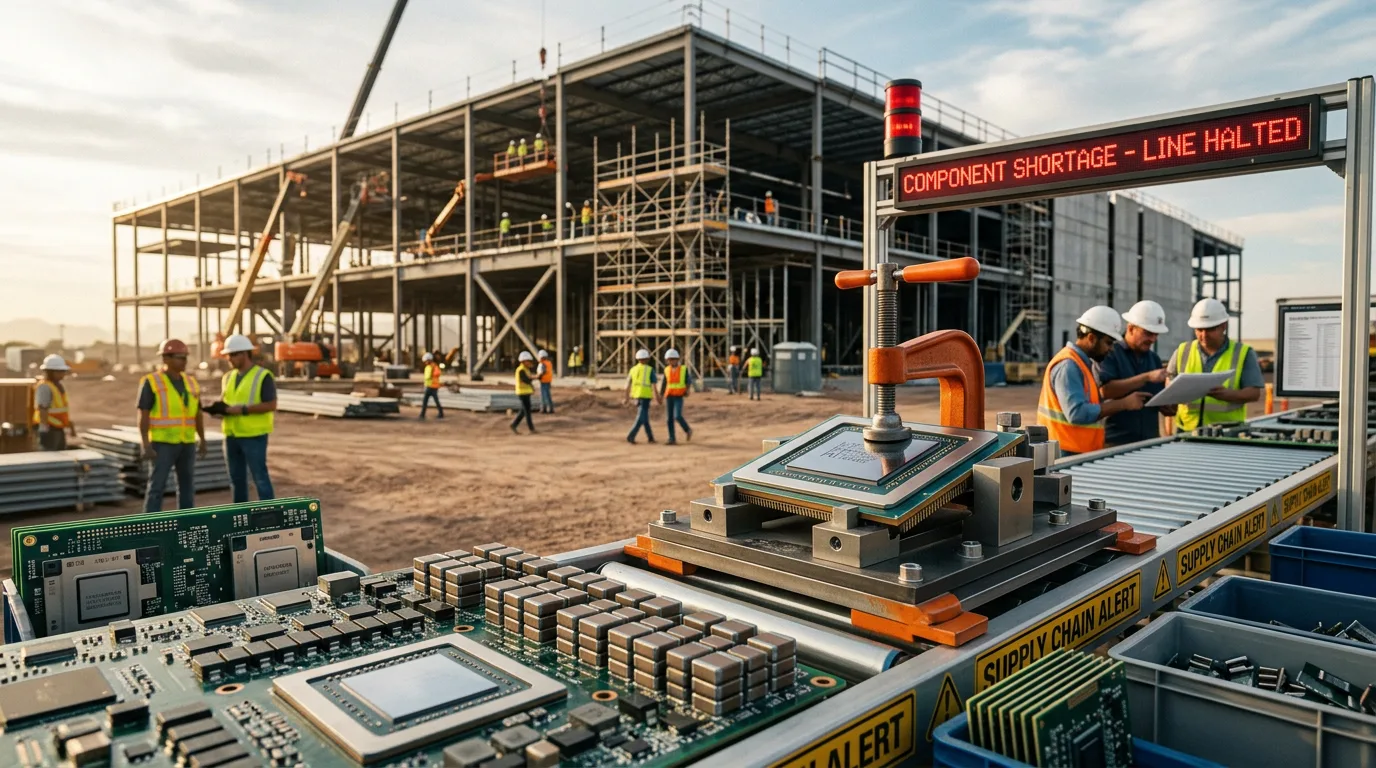
Even if you secure expensive NVIDIA GPUs, data center operations can be delayed if rice-grain-sized MLCCs and advanced ABF substrates are unavailable.
Especially as the AI agent era begins, the GPU-centered bottleneck is spreading to CPUs, memory semiconductors, substrates, MLCCs, and power infrastructure.
In this article, we will take a single look at the 48 to 56 week wait for ABF substrates, the 35 week wait for MLCCs, the explosive growth in demand for next-generation memory module CAMM, Samsung Electro-Mechanics’ 700 billion won investment, and the long-term supply agreement trend among NVIDIA customers.
1. Core point news: A situation is coming where there are GPUs, but data centers cannot run
Recent competition in AI data center investment is not simply a battle over how many GPUs can be secured.
Now, the entire semiconductor supply chain of materials, components, and equipment around GPUs has become the bottleneck.
- Advanced ABF substrates are said to take about 48 to 56 weeks from order to delivery.
- MLCCs, for some high-spec products, require a waiting period of about 35 weeks or more.
- Memory semiconductors, NAND Flash, HDDs, and server components are also showing shortages at the same time.
- TrendForce and Goldman Sachs Research, among others, also view AI server component bottlenecks as a major issue.
Simply put, it is like buying the engine, but lacking the wires, battery, connector board, and power stabilization devices needed to actually move the car.
As AI infrastructure investment grows, the value of even one small component is increasing even more.
2. Why are small components suddenly in short supply: The change brought by the AI agent era
In the past, generative AI was centered on a structure where a user asked a question, the GPU handled massive computation, and then generated an answer.
But in the AI agent era, the situation is a little different.
AI agents do more than just answer questions; they run code, open programs, process files, and carry out multiple tasks in sequence.
In this process, the role of the CPU grows significantly alongside the GPU.
- GPU is strong at the computation involved in answering questions.
- CPU plays a major role in program execution, task control, command processing, and system operations.
- As AI agents increase, demand for server CPUs also rises sharply.
- The original text mentions a trend in which server CPU shipments increase by more than 50% every year.
In the end, AI semiconductor demand does not end with GPUs.
It is a structure in which CPUs, memory, substrates, power components, cooling systems, and network equipment all increase together.
3. Why next-generation memory CAMM matters
The important keyword in this change is CAMM.
CAMM stands for Compression Attached Memory Module, a memory module format that gathers low-power DRAM onto a small board and places it close to the CPU.
In the past, many systems directly soldered memory beside the CPU.
But in next-generation AI servers, more memory must be connected more efficiently.
- The currently produced NVIDIA Blackwell rack is said not to include CAMM.
- For NVIDIA’s next-generation Vera Rubin rack, it is projected that up to 288 CAMM modules could be included.
- CPU memory capacity could expand from the existing roughly 17TB level to as much as 54TB.
- This means demand for memory around the CPU could more than triple.
The important point here is that CAMM itself requires an advanced substrate.
A standard server memory board uses about a 12-layer substrate, but CAMM uses a difficult 16-layer substrate.
As the number of layers increases, manufacturing difficulty and unit cost rise.
In other words, the next-generation memory semiconductor trend is not just about rising DRAM prices; it also means substrate companies that hold and connect that memory must be watched as well.
4. What makes ABF substrates so important that you have to wait nearly a year
AI chips and high-performance CPUs cannot rely on ordinary PCBs alone.
FCBGA and ABF substrates are needed to exchange high-speed signals stably.
FCBGA is short for Flip Chip Ball Grid Array.
It connects the chip upside down to the substrate with small metal bumps, and solder balls are arranged below in a grid pattern to connect it to the main board.
- Signal transmission distance is shorter than in conventional wire bonding.
- It is advantageous for high-speed data exchange.
- It helps reduce power loss.
- It is essential for high-performance semiconductors such as AI chips, server CPUs, and ASICs.
ABF stands for Ajinomoto Build-up Film.
Interestingly, the core material of ABF is effectively an area strongly dominated by the Japanese food company Ajinomoto.
Ajinomoto is famous for MSG, but today it is also a very important company in insulating films for advanced semiconductor packaging.
ABF substrates are a core component that connects chips and main boards in high-performance semiconductor packaging.
As GPU, CPU, and ASIC demand increases simultaneously with the expansion of AI data centers, the shortage of ABF substrates is worsening.
5. Why rice-grain-sized MLCCs determine AI servers
MLCC stands for Multi-Layer Ceramic Capacitor.
In Korean, it is called a multilayer ceramic capacitor.
MLCCs are tiny components made by stacking ceramic and metal electrodes in multiple layers.
They temporarily store electricity and supply it when needed, smoothing voltage fluctuations and reducing electrical signal noise.
In simple terms, they act like a small water tank that stabilizes power fluctuations around semiconductors.
- AI servers use far more power than ordinary servers.
- As power usage increases, voltage fluctuations also increase.
- If voltage is unstable, the stability of high-performance AI chips can fall.
- That is why AI servers need more high-performance MLCCs.
According to Samsung Electro-Mechanics, AI servers are said to require about 10 times more MLCCs than ordinary servers.
This figure matters because as AI data centers increase, MLCC demand may not just rise; it could grow explosively.
It is not something just any company can easily make simply because it is a small component.
MLCCs for AI servers must be smaller, more stable, and able to withstand higher power environments.
The current high-spec MLCC market is known to be dominated at roughly 90% combined by Samsung Electro-Mechanics and Japan’s Murata.
6. Why Samsung Electro-Mechanics’ 700 billion won investment will not solve the supply shortage immediately
Recently, news has emerged that Samsung Electro-Mechanics is considering or pursuing an investment of around 700 billion won to expand new production lines.
For a materials and components company to invest on this scale is a very large move.
However, an investment announcement does not immediately mean a supply increase.
It takes a long time to build a factory, bring in equipment, obtain quality certification, and pass customer testing.
- The new Sejong plant is mentioned as possibly beginning full-scale operations as early as after September 2028.
- Even now, a waiting period of nearly one year is already occurring.
- It will take at least two years for the effects of new capacity expansion to appear.
- Meanwhile, investment in AI data centers continues to expand.
In the end, the current semiconductor supply-chain bottleneck will be difficult to resolve in the short term.
Because supply is increasing slowly while demand is growing quickly, prices for high value-added components are likely to remain strong for the time being.
7. Why NVIDIA and global customers are directly bringing money to suppliers
The most interesting part of the original text is that global customers are directly visiting component suppliers with investment funds in hand.
This is not merely an order competition; it is a competition to secure the supply chain.
Large customers such as NVIDIA are increasingly providing funding for supplier capacity expansion or signing long-term supply agreements.
This is called an LTA, or Long-Term Agreement.
- Customers can secure stable volumes.
- Component suppliers can reduce the risk of large-scale investment.
- Prices are likely to be locked into long-term contracts at levels higher than in the past.
- As AI data center investment accelerates, these contracts become even more important.
This trend also has important implications for the global economic outlook.
That is because AI infrastructure investment is not just a one-time CAPEX event; it is leading to a long-term restructuring of the supply chain.
8. Investment perspective: After GPUs, the focus shifts to materials, components, equipment, and power infrastructure
Many investors think of NVIDIA, AMD, TSMC, Samsung Electronics, and SK hynix when they hear AI semiconductors.
Of course, these companies are key players.
But the current bottleneck is occurring further downstream.
In particular, the Korean market includes a more diverse range of companies related to materials, components, and equipment for AI servers than the U.S. stock market.
- Advanced package substrate companies
- MLCC and electronic component companies
- Memory module and substrate companies
- Power infrastructure companies
- Companies related to AI data center cooling and power efficiency
The original text also mentions a projection that Simtek’s SOC-2 related revenue could more than double from about 150 billion won this year to about 320 billion won next year.
This is a signal that demand for advanced substrates is spreading not only to GPUs, but also to ASICs, CPUs, and socket memory.
However, for individual stock investments, you need to look at earnings, valuation, customer concentration, expansion schedules, and yield risks together.
Rather than approaching it simply because it is an AI theme, it is important to confirm whether actual orders and margin improvement are happening.
9. The AI semiconductor active ETF and pension investment points mentioned in the original text
The original text also introduces content related to DS Asset Management’s AI semiconductor active ETF.
It is said to include Samsung Electronics, SK hynix, power infrastructure, and materials and components companies, with an advantage being that an active manager adjusts the weighting according to market conditions.
For investors seeking diversified exposure to AI semiconductors and the semiconductor supply chain in IRP or retirement pension funds, an ETF can be one option.
- It can lower the risk of individual stocks.
- It can include AI semiconductors, memory semiconductors, and power infrastructure together.
- It has the advantage of allowing portfolio adjustments depending on market changes.
- However, with active ETFs, you must always check management fees, holdings, and performance volatility.
The original text also includes a promotion stating that if you add “DS ETF” on KakaoTalk and participate in a quiz event, you can receive prizes such as an iPhone 15 Pro, Galaxy Z Fold 6, and Claude Pro subscriptions.
This part is more promotional than investment information, so it is better to treat it separately from actual investment decisions.
10. The most important point that other news articles do not highlight
Most news ends with “there is a GPU shortage.”
But the real important change is that the center of the AI semiconductor supply chain is shifting from a single GPU to the entire system.
Going forward, AI data center competitiveness is likely not determined by GPU quantity alone.
The winners will be the companies that can stably procure CPUs, CAMM, ABF substrates, MLCCs, power equipment, cooling systems, and networking all at once.
The points to watch especially are as follows.
- First, the spread of AI agents structurally increases demand for CPUs and memory.
- Second, the adoption of CAMM increases demand for both memory modules and multi-layer substrates at the same time.
- Third, MLCCs are small but essential components that determine AI server stability.
- Fourth, even if expansion investments are announced, actual mass production can take more than two years.
- Fifth, LTA contracts, where customers provide funding directly, can increase a component supplier’s pricing power.
From this perspective, the AI investment cycle is not over; it is rather moving into a second stage.
If the first stage was centered on GPUs and HBM, the second stage is centered on materials, components, equipment, and power infrastructure.
11. Core indicators to check going forward
When looking at AI semiconductor-related investments, watching stock price movements alone is not enough.
If you also check the indicators below, you can better read the market’s real direction.
- Whether ABF substrate lead times decline from 48 to 56 weeks
- Whether high-spec MLCC lead times ease from 35 weeks or more
- The scale of CAMM adoption in NVIDIA’s next-generation Vera Rubin rack
- Expansion schedules for MLCC companies such as Samsung Electro-Mechanics and Murata
- The growth rate of AI server revenue for substrate companies such as Simtek
- Samsung Electronics’ and SK hynix’s outlook for server memory semiconductor demand
- The growth rate of CAPEX by global big tech for AI data centers
- Order trends related to power grids, transformers, and cooling systems
If these indicators remain strong at the same time, the AI infrastructure investment cycle may last longer than expected.
Conversely, if lead times shorten quickly and customer orders slow, some component prices could adjust.
12. Conclusion: The bottleneck in AI data centers is now breaking at “small components”
AI data center investment continues to grow, but the market is still often only looking at GPUs.
However, on the ground, components such as ABF substrates, MLCCs, CAMM, memory modules, and power infrastructure are emerging as bottlenecks.
In particular, the spread of AI agents is greatly increasing CPU and memory usage.
This change is expanding the AI semiconductor market from a GPU-centered one to a server-system-wide one.
Going forward, when looking at AI investment in the global economic outlook, you must consider big tech CAPEX, data center power demand, memory semiconductor prices, and semiconductor supply-chain bottlenecks together.
The true winner of the AI era is likely not the company with the flashiest chip, but the one that controls the entire ecosystem capable of running that chip stably.
< Summary >
The bottleneck in AI data centers is expanding beyond GPU shortages to ABF substrates, MLCCs, CAMM, and memory semiconductors.
Advanced ABF substrates are said to require a wait of 48 to 56 weeks, and MLCCs over 35 weeks.
In the AI agent era, the role of CPUs grows, and accordingly demand for memory around CPUs and CAMM surges.
NVIDIA’s next-generation Vera Rubin rack may include CAMM on a large scale, which increases demand for multi-layer substrates.
AI servers require about 10 times more MLCCs than ordinary servers, making companies such as Samsung Electro-Mechanics and Murata more important.
Even with Samsung Electro-Mechanics’ large-scale expansion, actual mass production is expected only after 2028, so the supply shortage is difficult to resolve in the short term.
Going forward, AI semiconductor investment must consider not only GPUs but also materials, components, equipment, power infrastructure, and the entire data center supply chain.
[Related Articles…]
- AI semiconductor supply-chain bottlenecks and investment opportunity analysis
- Data center power infrastructure and the global economic outlook
*Source: [ 월텍남 – 월스트리트 테크남 ]
– 쌀알만한 ‘이것’ 없어서 데이터센터 중지.. 차세대 메모리라고?