● KOSPI-Rally, or Trap
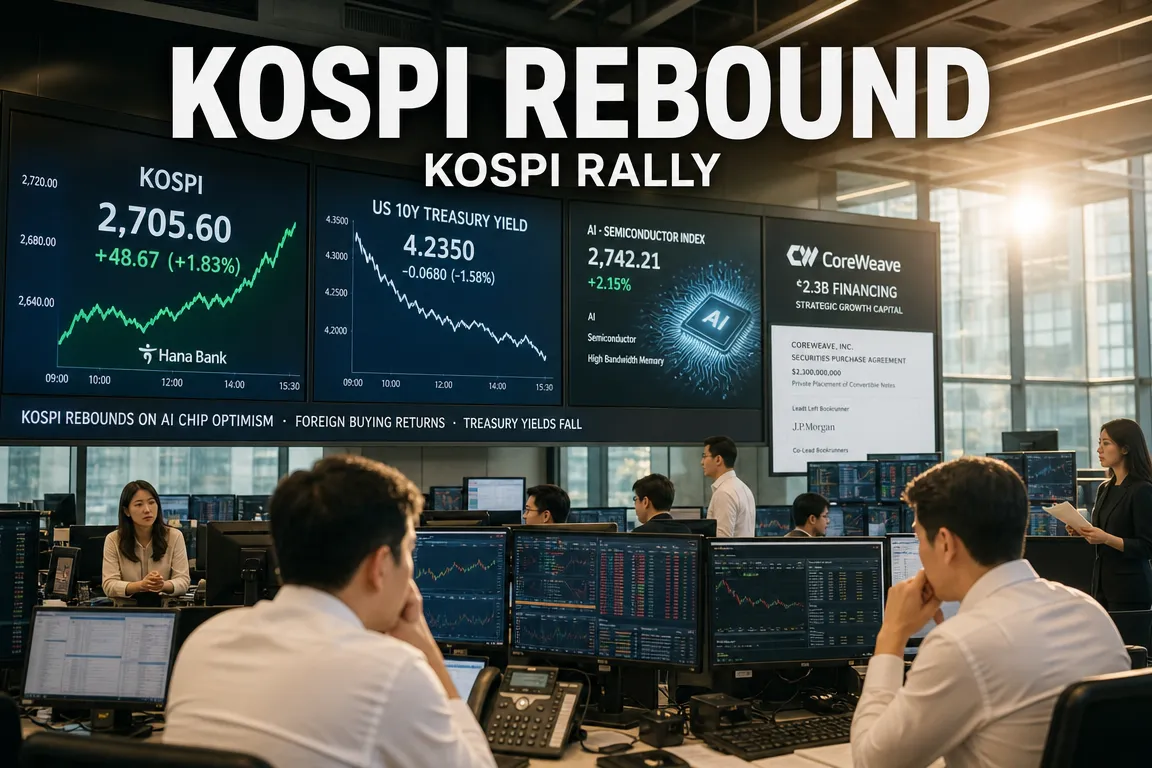
Kospi Rebound: A Technical Bounce or the Start of a New Uptrend? The Key Issue Is Not the Rally, but Why U.S. Treasury Yields Fell
Kospi rebounded today, but it is too early to call this the start of a sustained bull market.
The key issue is not that Kospi rose, but why U.S. Treasury yields declined.
The move is also linked to developments in SK hynix, AI semiconductors, and AI cloud companies such as CoreWeave, which point to signals more important than a simple equity rebound.
To assess the market properly, investors should evaluate Kospi outlook, U.S. Treasury yields, AI investment, semiconductor equities, and rate-cut expectations together.
1. Today’s Kospi rebound is best viewed as a technical rebound
Kospi fell nearly 20% over the past seven trading days.
After such a sharp decline, a one-day recovery is a normal market response.
For that reason, today’s gain should not yet be interpreted as the beginning of a new trend.
Rallies after large drawdowns are typically described as technical rebounds.
A technical rebound is driven by excessive short-term losses and bargain buying, not by a sudden improvement in fundamentals.
- Kospi declined sharply over a short period.
- Oversold conditions can attract bottom-fishing demand.
- A technical rebound is not the same as a trend reversal.
- A reversal requires new catalysts or clearer earnings improvement.
In short, today’s rise is constructive, but market conditions have not fully normalized.
2. The main external driver of the rebound is the decline in U.S. Treasury yields
The largest external factor behind today’s recovery is the drop in U.S. Treasury yields.
Lower Treasury yields are generally supportive for global equities.
The logic is straightforward.
When rates fall, funding costs for companies decline.
This matters especially for sectors requiring large capital expenditure, including AI data centers, AI servers, GPUs, and HBM.
Lower borrowing costs improve the sustainability of investment in these industries.
- Falling U.S. Treasury yields are positive for growth stocks.
- AI-related companies require substantial capital access.
- Lower rates reduce the burden of AI investment.
- Expectations for continued AI spending support semiconductor equities.
This has likely supported sentiment toward SK hynix, a key AI semiconductor name.
3. Lower yields are not automatically a positive signal
The critical point is that lower U.S. Treasury yields do not always signal a positive market backdrop.
Investors need to understand the reason behind the decline.
There are two broad interpretations.
4. Interpretation 1: Concerns over the financial stability of AI cloud companies may be rising
The first interpretation is less favorable.
It suggests growing concern that AI cloud companies may face financing constraints or broader balance sheet stress.
CoreWeave is one example frequently cited in market discussions.
These companies acquire large volumes of NVIDIA GPUs, build data center infrastructure, and provide computing capacity to AI firms.
The challenge is that this business model requires substantial capital.
- AI cloud companies require major spending on GPUs and data centers.
- GPU procurement and server build-outs are highly capital intensive.
- Many companies rely on debt, leases, and external funding.
- If AI demand slows, cash flow can deteriorate quickly.
If such companies weaken, AI investment could slow.
Borrowing demand for data center expansion would likely decline.
As a result, corporate bond issuance and other financing demand could ease, which may also pull Treasury yields lower.
In that case, lower yields would not be a positive signal.
They could instead indicate a weakening AI investment cycle.
5. Interpretation 2: Higher volatility in AI stocks may have increased demand for safe assets
The second interpretation is a shift toward safety.
AI-related equities have shown elevated volatility recently.
When volatility rises, investors often reduce risk exposure and move into safer assets.
U.S. Treasuries are a primary safe-haven asset.
Higher demand for Treasuries pushes prices up and yields down.
- Volatility in AI stocks has increased.
- Investors may be reducing risk exposure.
- Capital may be shifting into U.S. Treasuries.
- Higher Treasury demand can lower yields.
In this case as well, lower yields would not be entirely constructive.
The decline would reflect caution rather than optimism about growth.
6. Why SK hynix and Kospi should monitor CoreWeave
Many investors view SK hynix primarily as a memory semiconductor company.
However, its share price is now closely tied to the AI investment cycle.
HBM is a core component that moves with AI GPUs.
If AI data center investment remains strong, HBM demand can stay firm.
Conversely, if financing conditions tighten for AI cloud companies, HBM demand expectations could weaken.
- CoreWeave-type companies sit at the front line of AI infrastructure spending.
- When AI cloud companies buy GPUs, HBM demand rises as well.
- HBM demand is closely linked to SK hynix earnings expectations.
- SK hynix has a significant influence on overall Kospi sentiment.
Accordingly, Kospi should not be analyzed only through domestic market flows.
Investors also need to watch financing conditions for U.S. AI cloud companies, NVIDIA demand, HBM supply contracts, and U.S. Treasury yields.
7. The key question is not whether lower yields are good, but why yields are falling
The central issue is whether falling U.S. Treasury yields reflect an environment supportive of continued AI investment or a broader shift toward risk aversion and bubble concerns.
If yields are falling because of recession fears or concerns about AI-related balance sheet stress, the Kospi rebound may not last.
If, however, yields are falling because of easing inflation and stronger expectations for rate cuts, the environment would be more favorable for growth stocks and semiconductors.
- Good yield declines reflect improved liquidity and greater investment capacity.
- Negative yield declines reflect slower growth and risk aversion.
- The market currently reflects a mix of both interpretations.
- For that reason, one day of gains is not enough to confirm a trend change.
8. The key point often missed in other coverage
The most important point is that AI investment is not only a technology story, but also a financing story.
AI development requires more than strong technology.
Building data centers, buying GPUs, securing power, and operating servers all require substantial capital.
As a result, the AI investment cycle is highly sensitive to interest rates and credit conditions.
Many reports focus on NVIDIA, SK hynix, and AI semiconductor demand.
What matters more is whether AI cloud companies can continue raising capital.
If companies such as CoreWeave can fund operations and expand revenue steadily, the AI investment cycle can continue.
If their leverage or cash flow weakens, the outlook for AI semiconductor demand can deteriorate quickly.
This is the most important hidden variable in the current Kospi outlook.
The market is no longer driven only by domestic flows, but by global AI investment and U.S. credit conditions.
9. What should be confirmed before calling this a true Kospi rebound?
To determine whether today’s rebound is a genuine trend reversal, several conditions should be met.
- First, the decline in U.S. Treasury yields should be interpreted as rate-cut expectations rather than risk aversion.
- Second, major AI names should deliver new earnings or contract catalysts.
- Third, semiconductor stocks such as SK hynix and Samsung Electronics should show gains supported by trading volume.
- Fourth, financing concerns around AI cloud companies such as CoreWeave should ease.
- Fifth, foreign investors should return to buying Kospi large caps.
Without these conditions, today’s rise is likely to remain a technical rebound.
If these factors begin to align, Kospi could build a stronger recovery trend.
10. The right investment framework at this stage
At this stage, investors should focus on the quality of the rebound rather than taking a directional view too quickly.
A one-day rise does not justify aggressive chasing of the market without confirming the source of the move.
In particular, investors should distinguish between AI-led gains supported by fundamentals and rebounds driven only by oversold conditions.
The market currently reflects both AI growth expectations and concerns about the cost of financing AI investment.
Accordingly, the main issue is not technological progress alone, but the funding base that supports AI expansion.
For that reason, U.S. Treasury yields, AI cloud companies, semiconductor equities, and foreign flows into Kospi should all be monitored together.
< Summary >
Today’s Kospi rebound is more consistent with a technical bounce than the start of a broad uptrend.
Falling U.S. Treasury yields supported the market, but the reason for the decline matters.
If yields are falling because of AI balance sheet stress or a flight to safety, investors should remain cautious.
SK hynix and Kospi are closely tied to the financing environment of AI infrastructure companies such as CoreWeave.
A genuine Kospi recovery would require supportive AI catalysts, improved semiconductor flows, foreign buying, and stable U.S. rates.
[Related Articles…]
*Source: [ 내일은 투자왕 – 김단테 ]
– 코스피 대반등 오늘부터 시작? #코스피 #하이닉스 #코어위브
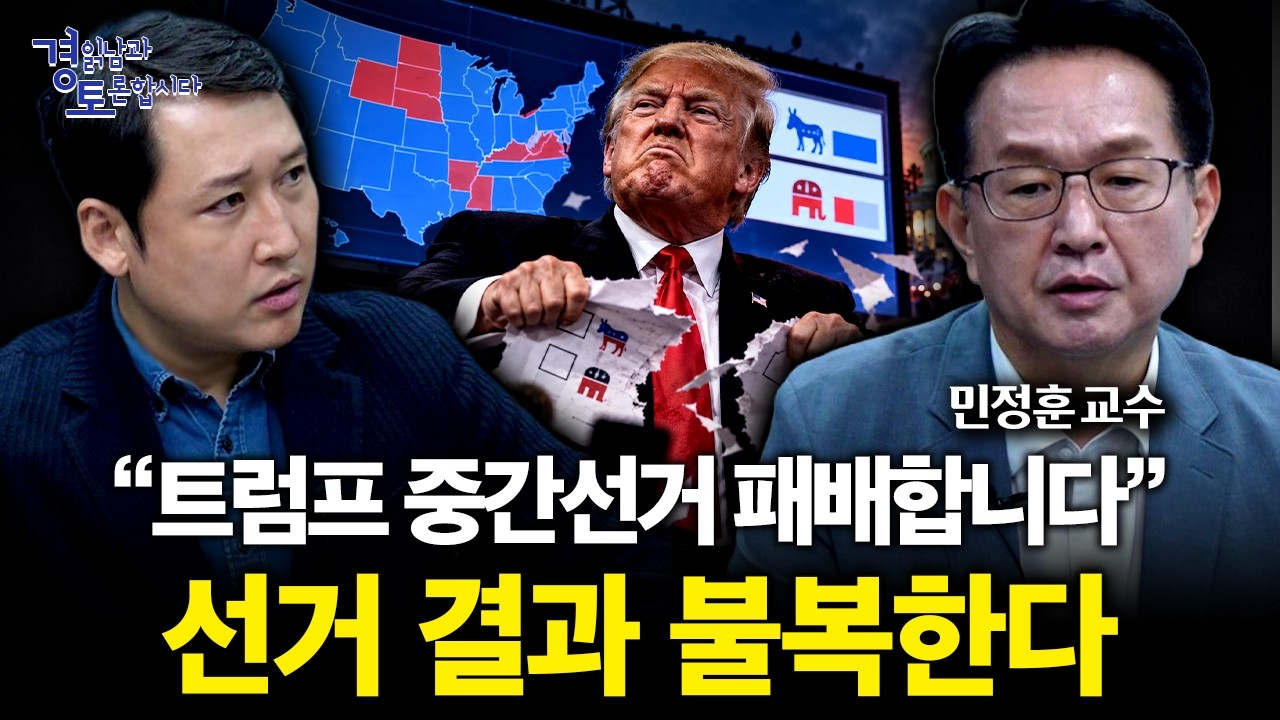
● Trump, Shock, Pressure, Korea
Will Trump Weaken After the U.S. Midterm Elections? Why Pressure on Korea Could Intensify
The key issue is not simply whether Republicans or Democrats win.
The more important point is that even if Trump suffers partial losses in the midterm elections, he may become more aggressive in foreign affairs, security, trade, and tariff policy.
For Korea, this could mean stronger demands for U.S. investment, greater tariff pressure, supply-chain restructuring amid U.S.-China tensions, and rising burdens in defense-cost and trade negotiations.
Although headlines may frame the result as “Trump lost the midterms,” the more important issue for the global economic outlook and the Korean economy is the scope of policy areas where Trump can act through executive authority without relying on Congress.
At the center of this are inflation, international oil prices, the U.S. stock market, the tariff conflict, and the strategy to revive U.S. manufacturing.
1. The basic midterm-election setup: Democrats are more likely to retake the House
The main forecast in the original text is that a full Republican sweep, or “red wave,” is unlikely.
U.S. midterm elections typically work against the incumbent party.
After the early honeymoon period of a presidency, voter dissatisfaction tends to build around inflation, growth, real income, and employment.
The Trump administration is also viewed as having added pressure on inflation by contributing to higher oil prices.
Voters are generally more responsive to gasoline prices, grocery costs, and borrowing costs than to foreign-policy achievements.
- House: Democrats are seen as having a high probability of retaking control.
- Senate: Republicans may narrowly hold it, or Democrats may win by a slim margin.
- Full Republican win: Considered unlikely.
- Democratic landslide: Possible, but not highly likely.
The House has 435 seats, with 218 needed for a majority.
The original text suggests Democrats could reach roughly 225 to 230 seats.
That would imply a Democratic advantage, but not a landslide.
2. The Senate is the real variable: Trump may still declare a political victory
The Senate matters more than the House in determining Trump’s political position.
The current balance is described as 53 seats for Republicans and 47 for Democrats.
Democrats would need at least 51 seats to control the Senate.
A 50-50 split would still favor Republicans in practice because of the vice president’s tie-breaking role.
As a result, Democrats need to gain at least four seats, not just one or two.
- Democratic target: Expand from 47 to 51 seats to take the Senate
- Key battlegrounds: Ohio, Maine, Alaska, Iowa, Texas, Michigan, Georgia, and New Hampshire
- Uncertainty factor: The presence of “shy Trump” voters not fully captured in polling
- Conclusion: A Democratic Senate takeover is possible, but difficult
The important issue is not only the election result, but also how Trump interprets it.
In the 2018 midterms, Republicans lost the House but kept the Senate.
Trump argued that retaining the Senate meant victory, and he later intensified the tariff conflict with China.
A similar pattern could emerge again.
If Republicans retain the Senate, Trump is likely to frame the outcome as a win rather than a defeat.
3. Why Trump could become stronger even if he loses the midterms
In general, a midterm loss weakens the sitting president.
Trump is a different case.
If Democrats gain power in Congress, Trump may face greater constraints on domestic legislation.
By contrast, he may become more aggressive in areas where presidential authority is stronger: foreign affairs, security, trade, and tariffs.
In short, if Congress becomes a constraint, Trump is likely to focus on areas he can influence without Congress.
- Domestic policy: Legislative approval may become more difficult
- Foreign policy: Presidential discretion remains relatively strong
- Trade policy: Tariffs, trade pressure, and import restrictions remain available tools
- Security policy: Pressure on allies over burden-sharing and defense costs may increase
- Industrial policy: Demands for expanded U.S. investment may intensify
As his term progresses, Trump is likely to seek a defining legacy.
U.S. presidents often pursue signature policies near the end of their term.
For Trump, that legacy could include the revival of U.S. manufacturing, tariff escalation, pressure on China, and greater cost-sharing demands on allies.
4. The most plausible scenario: Democrats take the House, Republicans keep the Senate
The scenario most often described as likely is a Democratic House and a Republican Senate.
That would closely resemble the 2018 political environment.
In 2018, Trump lost the House but retained the Senate, and then moved more aggressively on foreign policy.
The clearest example was the U.S.-China tariff conflict.
The same pattern could reappear.
| Scenario | Political meaning | Economic impact | Impact on Korea |
|---|---|---|---|
| Democrats take the House, Republicans keep the Senate | Trump may claim partial victory | Tariff and trade pressure continues | Potential increase in U.S. investment demands |
| Democrats control both chambers | Greater political burden for Trump | More constraints on domestic policy | Foreign and trade pressure may still remain firm |
| Democratic landslide | Early lame-duck risk | Weaker policy momentum | Pressure could ease |
| Republican outperformance | Stronger hardline Trump agenda | Risk of renewed tariff conflict | Higher burden for Korean companies |
The key point is that unless Democrats win decisively, Trump’s policy direction may not change materially.
He may instead argue that he still has a strong support base and pursue a more aggressive external strategy.
5. Would Trump weaken if Democrats take both chambers?
If Democrats win both the House and the Senate, Trump would face clear political pressure.
However, that does not necessarily mean a softer external policy.
Trump may respond by claiming election fraud or a stolen-election narrative rather than accepting defeat.
That is a central element of Trump’s political style.
He often turns defeat into a mechanism for mobilizing supporters.
- If Trump loses both chambers, he may clash more sharply with Congress.
- Domestic legislation would become harder, while executive actions may increase.
- He may strengthen pressure on China, tariffs, and burden-sharing demands to consolidate his base.
- Korea, Japan, and Europe could face stronger demands to invest more in the United States.
That said, if Democrats win with a very large margin, the situation changes.
A Democratic Senate majority of 60 seats or more would significantly weaken Trump’s room to maneuver.
In that case, the risk of an early lame-duck phase would rise.
However, the original text views such a sweeping Democratic victory as unlikely.
6. Why this matters for Korea’s economy: investment pressure and tariff risk
For Korea, the critical issue is not whether Trump weakens domestically after the election.
The real issue is what demands he may make on Korea.
One of Trump’s core objectives is the revival of U.S. manufacturing.
To support that goal, he is likely to demand that foreign companies build plants in the United States, create jobs there, and shift supply chains.
Semiconductors, electric vehicles, batteries, shipbuilding, steel, and autos are already central to U.S. industrial policy.
- Semiconductors: Further pressure for expanded U.S. production
- Batteries: Higher burden for Korean firms within China-excluding supply chains
- Automobiles: Tariff threats and localization pressure may rise simultaneously
- Steel and aluminum: Import restrictions and tariff tools could return
- Defense industry: Stronger linkage between security cooperation and cost-sharing demands
For Korean companies, the U.S. market may offer opportunity, but also higher cost pressure.
Failure to invest in the United States may increase tariff and regulatory risk, while investing there raises labor, construction, and policy-uncertainty costs.
This is the core dilemma of the Trump 2.0 environment.
7. Inflation drives elections: voters ultimately respond to prices
Another important point in the original text is that inflation remains the key variable in U.S. politics.
U.S. voters tend to react more strongly to rising living costs than to foreign-policy narratives.
Higher oil prices raise gasoline costs, logistics expenses, and food prices.
Inflation then increases pressure on the Federal Reserve to raise interest rates.
Higher rates raise mortgage, auto-loan, and credit-card burdens.
That reduces real income for the middle and lower income groups.
- Higher oil prices feed into consumer inflation in the United States.
- Inflation creates pressure for interest-rate hikes.
- Higher rates weigh on asset prices and the U.S. equity market.
- Lower real income increases dissatisfaction with the incumbent party.
- The midterm election becomes a referendum on economic conditions.
The Biden administration faced inflation pressure after the Russia-Ukraine war and the associated energy shock.
The Trump administration is now facing similar pressure from Middle East tensions and elevated oil prices.
The underlying causes differ, but in both cases inflation became a political liability.
8. Biden and Trump differ: the inflation effect is similar, but the political justification is not
The original text argues that both Biden and Trump faced political difficulty because of inflation.
However, the nature of those cases is different.
In Biden’s case, the Russia-Ukraine war was not initiated by the United States.
The administration framed its position around NATO obligations and the defense of European allies.
There was also concern that Russian expansion could threaten broader European security, including Poland and Hungary.
By contrast, the expansion of Middle East conflict under Trump is seen by the original text as having weaker justification.
It also notes criticism that Trump was influenced by Netanyahu’s position.
The result was seen as unnecessary conflict that fed higher oil prices and inflation.
| Category | Biden | Trump |
|---|---|---|
| Conflict background | Russia-Ukraine war | Expanded Middle East tensions |
| U.S. responsibility | Not a war started by the United States | Criticism over unnecessary involvement |
| Policy justification | Defense of NATO and European allies | Weaker policy rationale |
| Economic result | Energy-price inflation | Oil-driven inflation |
| Political effect | Stronger anti-incumbent sentiment | Unfavorable for the midterms |
9. The less discussed point: midterm losses can trigger tougher external policy
This is the most important point.
Most reporting treats the midterms only as a contest over seats.
For the global economic outlook, the more important issue is where Trump will direct his policy energy after the election.
If Congress becomes restrictive, Trump is likely to shift toward areas where presidential authority is stronger.
That means foreign affairs, security, trade, tariffs, and pressure on allies.
A weaker domestic position does not necessarily mean less pressure on Korea.
In fact, the more Trump is constrained domestically, the more he may seek results through external pressure.
- Hidden point 1: Trump’s power depends more on executive action than on seat counts.
- Hidden point 2: Retaining the Senate allows him to frame losses as a partial win.
- Hidden point 3: Congressional gridlock can make tariffs and trade pressure more attractive.
- Hidden point 4: U.S. investment by Korean firms may become a negotiation tool.
- Hidden point 5: Inflation is not only an economic indicator, but also a survival variable for the administration.
10. U.S. equities and investors: tariffs, oil, rates, and exchange rates must be viewed together
Investors should not treat the midterms as a purely political event.
If Trump intensifies the tariff conflict after the election, global supply chains and corporate earnings expectations may come under pressure.
Renewed U.S.-China tensions could directly affect semiconductors, electric vehicles, batteries, and AI infrastructure companies.
Persistent high oil prices could slow inflation disinflation and reduce expectations for Federal Reserve rate cuts.
That would create valuation pressure in U.S. equities.
- U.S. equities: Tariff risk and rate pressure may affect technology valuations
- Korean equities: Greater volatility in semiconductors, autos, and battery stocks
- Foreign exchange: Geopolitical risk and dollar strength may weigh on the won
- Bonds: Inflation reacceleration could increase rate volatility
- Commodities: Middle East tensions may keep oil prices elevated
This is also relevant from an AI Trend perspective.
AI data centers, semiconductors, power infrastructure, cooling systems, and grid investment are closely tied to U.S. industrial policy.
As Trump emphasizes manufacturing and infrastructure, AI-related supply chains may become even more U.S.-centered.
For Korean firms, that creates both opportunity and higher investment burden.
11. Policy response for Korea and Korean companies
The Korean government should focus less on which party controls Congress and more on Trump’s negotiating style.
Trump typically applies pressure through trade balances, investment scale, job creation, and defense contributions.
Korea should therefore prepare an industry-specific negotiation package rather than a reactive response.
- First, design policies that balance U.S. investment with domestic industrial protection.
- Second, negotiate semiconductors, batteries, and autos as a package rather than separately.
- Third, use U.S. job creation as a bargaining lever.
- Fourth, reduce China risk without weakening Korea’s domestic production base.
- Fifth, prepare for tariff risk with supply-chain and pricing strategies in advance.
For companies, U.S. investment should be treated not only as expansion, but also as a hedge against political risk.
At the same time, excessive investment in the United States could hurt profitability, making subsidies, tax incentives, and long-term purchase agreements important.
The correct strategy in the Trump 2.0 environment is to invest in the United States without entering on unfavorable terms.
12. Conclusion: Trump’s midterm loss may signal more pressure for Korea, not less
If Democrats perform well in the U.S. midterms, Trump may appear weaker.
However, unless the defeat is overwhelming, Trump is likely to reject the premise of weakness or reframe the result as a partial victory.
At the same time, he may pursue stronger results in foreign affairs, security, trade, and tariffs as Congress becomes more constrained.
For Korea, that could mean stronger pressure over investment, tariffs, supply-chain restructuring, and defense-cost sharing.
The broader issue includes U.S.-China tensions, oil prices, inflation, and market volatility.
The midterm election is therefore not only a political event, but also a structural factor that could affect Korea’s economy and the global outlook.
< Summary >
Democrats are likely to retake the House in the U.S. midterms, while the Senate may remain with Republicans or shift only narrowly toward Democrats.
Unless Democrats win decisively, Trump may become more aggressive in foreign affairs, security, trade, and tariff policy rather than weaker.
In 2018, Trump lost the House but kept the Senate, claimed victory, and then intensified the tariff conflict with China.
Korea should prepare for stronger demands on U.S. investment, tariff pressure, supply-chain restructuring, and defense-cost burdens.
Inflation and oil prices remain central to the U.S. election environment and can directly affect both U.S. and Korean equity markets.
The key conclusion is that even if Trump suffers partial losses in the midterms, pressure on Korea may not ease and could intensify.
[Related Articles…]
*Source: [ 경제 읽어주는 남자(김광석TV) ]
– 중간선거 져도 트럼프는 더 세진다? 한국 압박 커질 수 있다 | 경읽남과 토론합시다 | 민정훈 교수 [1편]