● AI, Sell, Signal, Risk
Samsung Electronics and SK Hynix Sell Timing: Risk Signals Investors Must Watch in the AI Semiconductor Cycle
The key issue in this article is not simply whether Samsung Electronics and SK Hynix should be bought or sold.
The more important question is when the AI semiconductor boom could begin to weaken, and which indicators will reveal that shift first.
In particular, investors should monitor hyperscaler CAPEX outlooks, memory semiconductor price trends, government bond yields and liquidity conditions, and foreign flows affecting the KOSPI.
The market is now too complex to assess based only on the earnings of Samsung Electronics and SK Hynix.
AI semiconductor demand remains firm, but interest rates and liquidity are also exerting stronger pressure on the broader equity market.
Accordingly, this article reviews the sell signals that semiconductor investors should watch, along with a staged accumulation strategy and a 2027 macro outlook covering interest rates and inflation.
1. Key News: The Investment Framework for Samsung Electronics and SK Hynix Has Changed
In the past, investors focused mainly on memory prices, inventory levels, and earnings outlooks when evaluating Samsung Electronics and SK Hynix.
That environment has changed.
With the full emergence of the AI semiconductor cycle, the industry’s key demand driver has shifted from smartphones and PCs to hyperscalers.
Hyperscalers refer to large cloud providers such as Amazon, Microsoft, Google, and Meta.
The scale of their spending on data centers and AI infrastructure now has a direct impact on the earnings of semiconductor companies including Samsung Electronics, SK Hynix, Nvidia, and Micron.
In other words, semiconductor investing is no longer a simple cyclical trade.
It has become a macro-driven investment theme tied to AI infrastructure spending, interest rates, liquidity, the global economic outlook, and KOSPI flows.
2. Most Important Sell Signal ① A Downward Revision in Hyperscaler CAPEX Guidance
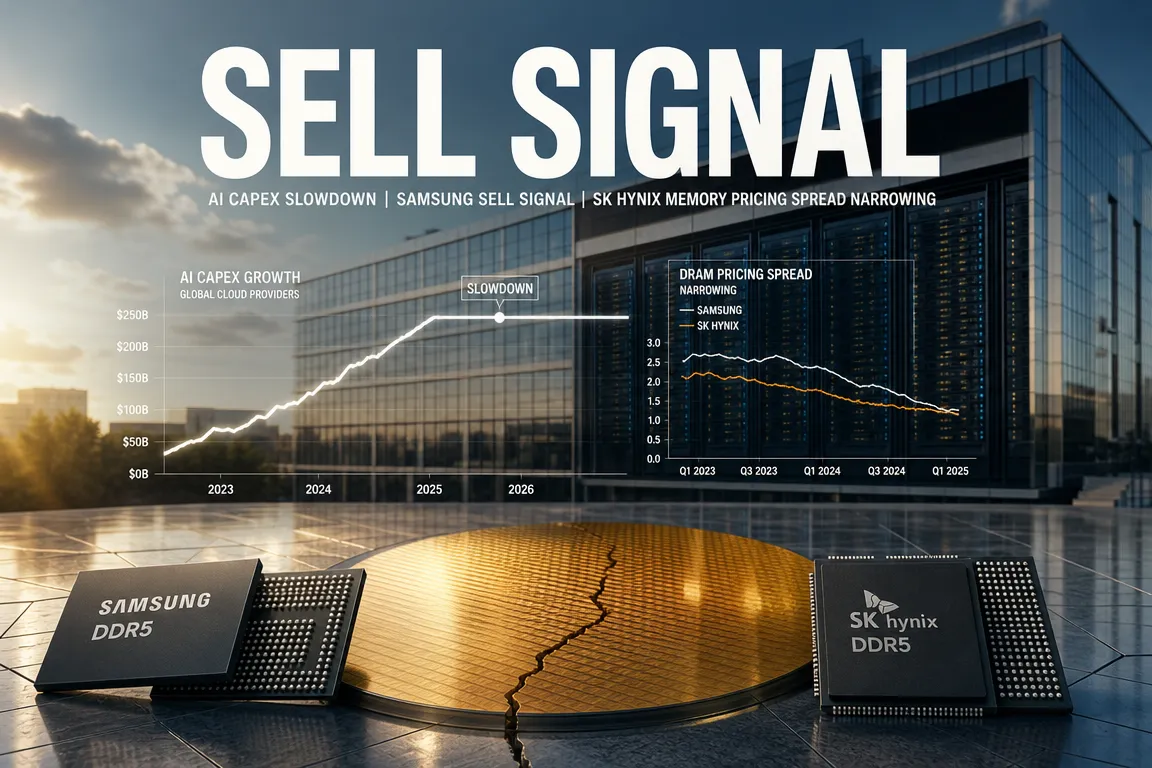
The first indicator to monitor is the CAPEX guidance of major technology companies.
CAPEX refers to capital expenditure, or the amount a company spends on servers, data centers, GPUs, network equipment, and related infrastructure.
The core source of AI semiconductor demand ultimately comes from this CAPEX.
The strongest risk signal discussed in the debate is the following.
If hyperscaler earnings calls begin to include language such as “we plan to reduce this year’s investment pace,” investors should become cautious.
-
When a company that originally planned to invest $200 billion signals a slowdown in spending.
-
When next year’s CAPEX growth rate is revised lower.
-
When AI data center investment plans are delayed or scaled back.
-
When rising financing costs lead management to adopt a more conservative investment stance.
This signal matters because the final demand for HBM, DRAM, and NAND produced by Samsung Electronics and SK Hynix comes from AI infrastructure spending by large technology customers.
Once major cloud providers indicate that they will reduce AI server investment, semiconductor stocks may react before earnings do.
The current view expressed in the discussion is that CAPEX guidance has not yet shown a broad-based reversal.
However, that outlook can change quickly, so investors should review CAPEX language closely during hyperscaler earnings releases.
3. Most Important Sell Signal ② A Narrowing Gap Between Spot Prices and Contract Prices for Memory
The second signal is memory semiconductor pricing.
In particular, investors should watch the spread between spot prices and contract prices.
Spot prices are short-term market transaction prices.
Contract prices are set through longer-term agreements with major customers.
Typically, when the memory cycle is strong, spot prices move first and contract prices follow later.
In the past, a death cross between spot and contract prices was often treated as a sell signal.
However, the discussion suggested that such a signal may arrive too late.
The more important indicator is a rapid narrowing of the spread between spot and contract prices.
-
Investors should check whether spot prices are converging quickly toward contract prices.
-
If the price gap narrows sharply, it may indicate a weakening supply-demand balance.
-
Even if contract prices remain firm, changes in the spot market may appear first.
-
By the time a death cross appears, a significant portion of the stock reaction may already be reflected in prices.
This is highly relevant for investors in Samsung Electronics and SK Hynix.
Equity prices in the semiconductor sector often respond to pricing changes before earnings announcements.
4. Most Important Sell Signal ③ Shorter Lead Times
The third signal is lead time.
Lead time is the period between customer order placement and actual product delivery.
When semiconductor supply is tight, lead times lengthen.
For example, if delivery takes 40 weeks after an order, supply is constrained.
By contrast, if lead times shorten quickly to 30 weeks or 25 weeks, supply is becoming more available.
Why does this matter?
Greater supply availability can weaken pricing power.
Even if demand remains strong, a faster increase in supply may pressure prices.
Accordingly, a sharp shortening of lead times is a meaningful warning signal for semiconductor investors.
5. A Variable That Must Be Monitored Alongside Sell Signals: Liquidity
One of the most debated points in the discussion was liquidity.
One side argued that the appropriate response is to reduce portfolio exposure and raise cash.
The rationale is that market liquidity is entering a vulnerable phase.
A simple analogy applies here.
When weather is favorable, the market resembles a game of shooting arrows from one meter away.
When a storm arrives, it is more like shooting arrows from 100 meters away while riding a horse.
In this analogy, weather represents liquidity.
When liquidity is strong, fundamentally sound stocks can rise more easily.
When liquidity dries up, even high-quality companies may struggle to appreciate.
In particular, persistently high government bond yields act as a drag on equities.
From this perspective, even if Samsung Electronics and SK Hynix remain fundamentally sound, portfolio reduction or partial profit-taking may be appropriate if broad market liquidity is weakening.
6. Counterview: This May Still Be a Staged Accumulation Opportunity
Another view is that the current period may still be a buying opportunity through staged accumulation.
This perspective holds that the underlying fundamentals of Samsung Electronics and SK Hynix remain solid.
AI semiconductor demand remains intact, and demand for higher-value memory products such as HBM continues.
However, the reason share prices may not be rising smoothly is seen as interest rates rather than company-specific weakness.
In this view, rates are acting as a gravitational force on equity valuations.
If rate pressures ease, Samsung Electronics and SK Hynix could regain upside potential.
Moreover, if the semiconductor cycle still offers opportunities through the first half of next year, investors may consider accumulating positions gradually and reviewing profit-taking around that period.
-
The fundamentals are still viewed as solid.
-
AI semiconductor demand is considered structurally resilient.
-
A moderation in bond yields could support re-rating.
-
The preferred approach is staged accumulation rather than a lump-sum entry.
7. Another View: A Trading Range May Be More Likely Than a Sharp Decline
A third view is that an abrupt selloff is not necessarily the most likely outcome.
However, this is not an unconditionally bullish position.
The key assumption is that a trading range may be more likely than a steep decline.
This perspective accepts the possibility that AI CAPEX growth may slow.
However, a slower growth rate does not mean total spending is falling.
For example, even if next year’s CAPEX growth rate is lower than this year’s, the absolute amount of investment may still be larger.
This distinction is important.
Markets often confuse slower growth with the end of growth.
Yet if absolute spending continues to rise despite a lower growth rate, semiconductor earnings can remain solid.
That said, leadership within the market may shift.
Instead of memory semiconductors remaining the primary focus, other companies in the AI infrastructure chain may take the lead.
In that case, Samsung Electronics and SK Hynix could remain fundamentally strong while their share prices move sideways.
8. The Most Important Point Often Missing in Other Coverage
The key point is that a liquidity squeeze does not necessarily mean the end of all AI investment.
Instead, liquidity pressure may reinforce a winner-takes-most structure within the AI industry.
Smaller AI startups and mid-sized firms are more likely to cut investment when rates are high.
By contrast, large technology companies with strong cash positions may invest more aggressively as weaker competitors exit the field.
In that scenario, overall CAPEX growth may slow even as spending by a few very large customers continues to expand.
For Samsung Electronics and SK Hynix, the more important issue is not whether the overall market is shrinking, but whether large cash-rich customers continue to place orders.
This is the central point that is often overlooked in mainstream coverage.
The AI semiconductor market is not a simple binary of improvement or deterioration.
It may evolve into a structure in which weaker players are displaced and stronger players become even more dominant.
For that reason, investors should not look only at aggregate CAPEX growth.
They should distinguish between which companies are reducing spending and which are still increasing it.
9. Supply-Demand Pressure in the Stock Market May Drive Declines Even if the Industry Remains Healthy
A decline in semiconductor stocks does not always mean the industry outlook has deteriorated.
In this discussion, part of the recent correction in semiconductors was attributed not to industry fundamentals but to market-level supply and demand for shares.
For example, leverage-related regulations, foreign selling, or pressure from specific fund flows can all weigh on share prices.
In such cases, the company outlook may remain intact while selling pressure in the equity market temporarily increases.
Investors should distinguish between these two dynamics.
-
Industry deterioration is a longer-term warning signal.
-
Equity supply pressure may be a temporary price shock.
-
If foreign selling continues, the broader KOSPI can weaken.
-
However, if fundamentals remain intact, a rebound may follow later.
10. Interest Rate Outlook: U.S. Policy Rates and Inflation Will Continue to Drive Semiconductor Valuations
U.S. interest rate expectations are highly important for Samsung Electronics and SK Hynix.
Higher rates suppress valuation multiples for growth stocks.
Industries with strong future growth expectations, such as AI semiconductors, are especially sensitive to interest rate changes.
The discussion presented different views on the likelihood of additional rate hikes in the United States.
One view was that wartime inflation pressures have already fed into inflation expectations and that AI growth itself is creating growth-driven inflation.
Under that scenario, rates would remain difficult to bring down, and liquidity pressure would persist.
Another view was that U.S. inflation may already have passed its peak.
While CPI, PPI, and PCE data need to be monitored, if inflation has already peaked, the rationale for further rate hikes becomes weaker.
From the perspective of the 2027 economic outlook, base effects in oil prices are especially important.
Inflation is measured on a year-over-year basis.
If crude oil rises to $100 in 2026 and remains at $100 in 2027, the year-over-year oil price increase would be 0%.
If oil falls below $100 in 2027, the year-over-year increase would turn negative.
In other words, inflation can ease simply if oil stops rising further.
Under this logic, inflationary pressure may moderate in 2027 and create room for a renewed discussion of rate cuts.
11. Three Investment Strategies for Samsung Electronics and SK Hynix
The conclusion of the discussion does not point to a single definitive answer.
Instead, investors should prepare for three possible scenarios at the same time.
Strategy 1: Reduce Exposure if Liquidity Risk Becomes the Primary Concern
If bond yields remain elevated and liquidity continues to weaken, reducing exposure may be reasonable.
The goal is not full liquidation.
The objective is to preserve cash so investors can respond more flexibly if better prices emerge.
If positions are not trimmed, investors may be forced to sell at less favorable levels during a further decline.
In that sense, reducing exposure is a defensive strategy intended to support long-term investing.
Strategy 2: Accumulate Gradually if You Trust the Fundamentals
If AI semiconductor demand and the memory cycle remain favorable, the current period may be suitable for staged accumulation.
However, buying all at once is risky.
Given the volatility in rates and supply-demand conditions, a phased approach is more prudent.
Under this strategy, investors would look to the first half of next year for potential semiconductor cycle improvement.
Later, if the market becomes overheated or CAPEX slowdown signals emerge, profit-taking may be considered.
Strategy 3: Long-Term Investors Should Favor Position Management Over Panic Selling
For investors already in a loss position, there may be no need to sell aggressively.
Samsung Electronics and SK Hynix remain core companies in the Korean equity market.
They also have a major influence on the direction of the KOSPI.
However, even if earnings remain strong, share prices may not rise immediately.
If market leadership shifts away from memory toward other AI infrastructure names, a prolonged trading range is possible.
Long-term investors should therefore combine holding, selective accumulation, and partial cash preservation.
12. Weekly Checklist for Investors
-
Hyperscaler CAPEX outlook: Monitor whether AI infrastructure spending plans at Amazon, Microsoft, Google, and Meta remain intact.
-
Memory spot and contract prices: Watch for a rapid narrowing of the spread.
-
Lead times: Look for signs that shortages are easing and supply is becoming more available.
-
U.S. Treasury yields: Persistently high long-term yields can weigh on semiconductor sentiment.
-
Foreign flows: Selling by foreign investors in Samsung Electronics and SK Hynix can affect the broader KOSPI.
-
Inflation indicators: CPI, PPI, and PCE can shift expectations for future rate increases or cuts.
-
AI semiconductor leadership: Monitor whether leadership shifts from memory toward GPUs, power infrastructure, data centers, or network equipment.
13. Conclusion: The Priority Is Not “Buy or Sell,” but “Wait for the Signals”
It is difficult to argue that investors should sell all Samsung Electronics and SK Hynix shares immediately.
At the same time, it is also difficult to say that this is a period for aggressive buying.
The market is currently in a mixed phase in which AI semiconductor demand and rate pressure coexist.
Accordingly, the key message is clear.
Investors should watch whether hyperscaler CAPEX weakens, whether the memory price gap narrows rapidly, and whether lead times shorten.
If all three signals emerge together, a defensive stance toward Samsung Electronics and SK Hynix would be warranted.
If those signals do not appear and only rate pressure eases, semiconductor stocks may regain upside potential.
Ultimately, the most important skill in the current market is not prediction but response.
Rather than committing to one side, investors should adjust cash and equity exposure while monitoring market signals.
< Summary >
The key sell signals for Samsung Electronics and SK Hynix are a reduction in hyperscaler CAPEX, a narrowing gap between memory spot and contract prices, and shorter lead times.
When liquidity tightens, even strong companies can face share price pressure, making partial cash preservation appropriate.
Conversely, if AI semiconductor demand and fundamentals remain intact, the current period may still offer a staged accumulation opportunity.
A major overlooked point is that liquidity pressure does not necessarily end AI investment; it may instead reinforce a winner-takes-most structure centered on large technology firms.
Investors should evaluate CAPEX, rates, flows, and semiconductor pricing together rather than treating buy and sell as a binary choice.
[Related Articles…]
*Source: [ 경제 읽어주는 남자(김광석TV) ]
– 삼전닉스 ‘이 신호’ 나오면 조심해야 한다…매도 시점은 언제? | 경읽남과 토론합시다 | 3자토론 이형수x장우진x김광석 [5편]