● AI, meltdown, CoreWeave, crisis, Nasdaq, selloff
Has the AI Stock Rally Ended? Nasdaq Pullback, CoreWeave Stress, and the Broadening AI Semiconductor Correction Across Micron, Samsung Electronics, and SK Hynix
Today’s market focus is not simply that AI stocks sold off sharply.
The key issue is that a weak point in the AI data center investment structure has become visible, and the impact is spreading from CoreWeave to Micron, Samsung Electronics, SK Hynix, and Nasdaq mega-cap technology stocks.
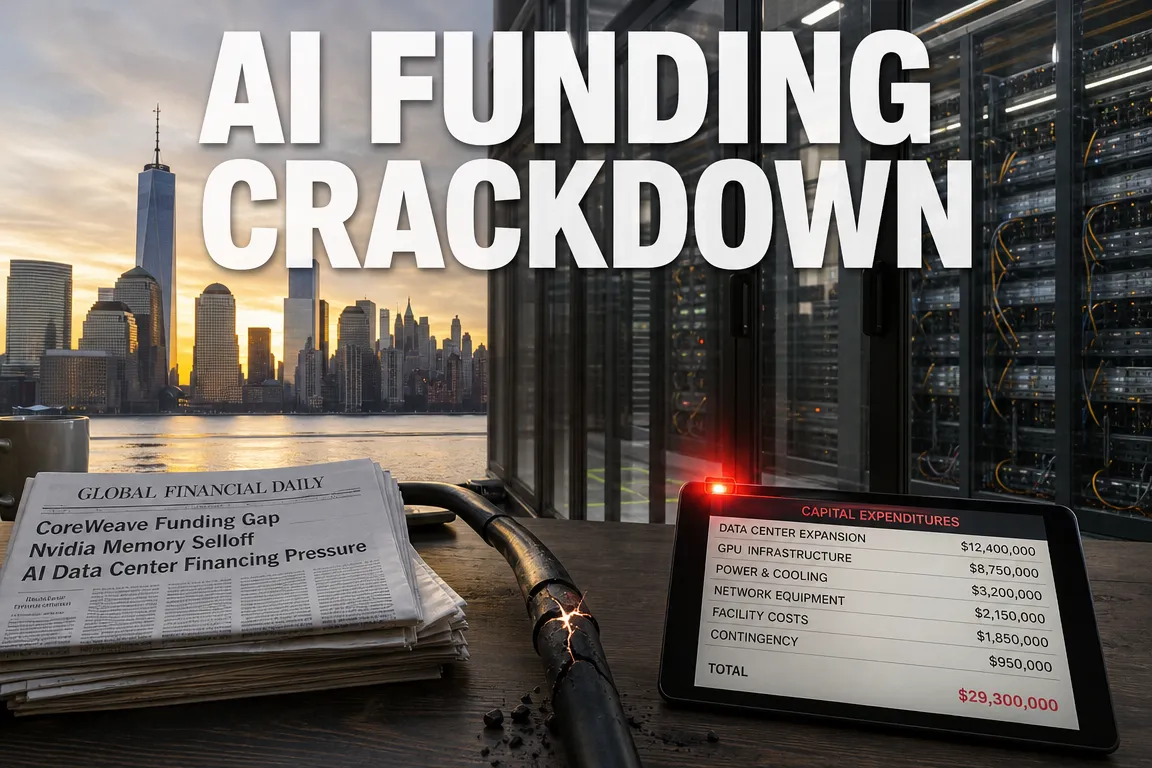
In particular, CoreWeave’s financing burden, insider selling by the founder and major investors, deterioration in the corporate bond market, and the possibility of a $35 billion funding gap over the next 12 months have intensified market concern.
At the same time, higher oil prices, a rebound in U.S. Treasury yields, better-than-expected results from China’s memory chip producer CXMT, and the possibility of a lower valuation for Anthropic’s IPO have all contributed to a rapid deterioration in sentiment across the AI equity complex.
This report summarizes the drivers behind the AI stock correction, why CoreWeave is being identified as a weak link in the sector, the implications for Micron and Korean semiconductor equities, and the conditions required for an AI semiconductor recovery.
1. Market Overview: AI Stocks Led Today’s Nasdaq Decline
Nasdaq fell by as much as 1.5% intraday, reflecting a persistently weak tone throughout the session.
The decline was notable for its steady deterioration rather than a brief, orderly correction, which heightened investor concern.
After a short pause in the prior session, Nasdaq and the KOSPI again came under pressure, led by renewed selling in AI-related names.
In summary, the market was not broadly risk-off; instead, companies directly tied to the AI investment cycle were hit the hardest.
- Nasdaq: down as much as 1.5% intraday
- CoreWeave: down about 11% additionaly
- AI semiconductors and data center-related stocks: broadly weaker
- Consumer staples, healthcare, and financials: relatively resilient
- KOSPI night futures: down about 1.42%
This indicates that the market is increasingly questioning the sustainability of AI data center investment and related capital expenditures.
2. Why CoreWeave Is Being Viewed as the Weak Link in AI
CoreWeave operates AI data centers.
Its business model is to secure GPUs and data center infrastructure and lease capacity to AI companies and large technology clients.
The challenge is that this model requires extremely large capital expenditures.
GPUs, servers, power capacity, data center facilities, and network equipment all require substantial investment.
As a result, CoreWeave has relied heavily on borrowing, and this dependence on debt financing is now seen as its most significant risk.
When AI demand is expanding rapidly, aggressive leverage can appear to be a growth strategy.
However, when rate expectations are uncertain and the corporate bond market weakens, the same strategy quickly becomes a financial risk.
Market participants are increasingly treating CoreWeave not as a beneficiary of the AI boom, but as one of the most vulnerable names in the AI capex cycle.
3. Three Factors Behind CoreWeave’s Sharp Decline
① Major Investor Brad Gerstner’s Full Sale of CoreWeave Shares
The first catalyst for negative sentiment was the sale of CoreWeave shares by Brad Gerstner, a well-known investor and early supporter of the company.
The market interpreted the full exit not as a simple portfolio adjustment, but as a sign that an informed backer may be reducing exposure.
For growth stocks, the departure of a prominent investor often has a significant impact on sentiment.
In an already fragile market, such news tends to accelerate selling pressure.
② Concerns Over Large-Scale Founder Selling
The second negative factor was reports that CoreWeave founders monetized approximately $3.3 billion, or about KRW 5 trillion, before the stock decline.
Insider buying is generally viewed positively.
By contrast, large insider selling is typically interpreted negatively.
Although such sales can reflect taxes, liquidity needs, or prearranged trading plans, in the current environment they have further undermined confidence amid broader concerns about financing and growth durability.
③ Deutsche Bank’s Funding Gap Estimate
The most important issue is Deutsche Bank’s analysis.
The bank estimated that CoreWeave will need additional capital over the next 12 to 18 months to fulfill its existing backlog.
The scale is significant.
- Expected operating cash flow over the next 12 months: about $10 billion
- Required capital expenditures over the same period: about $45 billion
- Estimated funding gap: about $35 billion
In other words, CoreWeave’s operating cash flow is insufficient to cover its investment needs.
Closing a $35 billion shortfall would require some combination of corporate bond issuance, project financing, or equity financing.
However, with CoreWeave’s bonds already under pressure, the cost of new borrowing has increased materially.
Deutsche Bank also estimated that financing just half of the gap with unsecured debt could result in an additional $2.6 billion in annual interest expense.
That amount exceeds the roughly $2.1 billion in net losses expected by analysts this year.
Put simply, borrowing more to fund growth could deepen losses rather than stabilize the business.
4. Why CoreWeave’s Stress Is Spilling Over to Micron, Samsung Electronics, and SK Hynix
CoreWeave’s weakness is not being viewed as an isolated company-specific issue.
The market is increasingly interpreting it as a challenge to the sustainability of AI infrastructure investment more broadly.
If AI infrastructure firms such as CoreWeave face funding constraints, the pace of new data center investment could slow.
A slowdown in data center spending would pressure demand not only for GPUs, but also for HBM, DRAM, and SSDs.
For this reason, CoreWeave’s decline has directly weighed on Micron and is also affecting sentiment toward Samsung Electronics and SK Hynix in Korea.
The 1.42% decline in KOSPI night futures also reflects this broader concern.
SK Hynix and Samsung Electronics have both benefited from AI and HBM expectations as key drivers of valuation.
If the market begins to question whether AI capex can continue to expand at the current pace, valuation premiums could compress quickly.
5. The Paradox: GPU Rental Prices Continue to Rise
One notable point is that GPU rental prices are still rising.
Normally, higher GPU rental prices indicate that AI compute demand remains strong.
In that case, CoreWeave should be able to sign new contracts at higher rates and expand revenue.
However, the market is currently focusing more on financing risk than on operating momentum.
In other words, actual demand remains solid, but financial markets are pricing in risk ahead of fundamentals.
This is a central feature of the current correction.
Investors are selling before any clear evidence emerges that end-market demand has weakened, driven by concerns that overinvestment could become an issue two years from now.
6. Why CXMT’s Results Add Pressure on Micron and Korean Semiconductor Stocks
Additional pressure came from preliminary third-quarter results from Chinese memory chip maker CXMT.
CXMT reportedly delivered better-than-expected results.
The improvement was attributed to capacity expansion, higher wafer yields, improved utilization, and economies of scale.
At first glance, this may suggest that Chinese semiconductor producers are also improving.
However, in the memory chip market, the implication is different.
If Chinese suppliers improve productivity and increase shipments faster than expected, this could add supply pressure to global memory pricing.
That would be negative for Micron, Samsung Electronics, and SK Hynix.
With AI data center investment concerns already weighing on sentiment, CXMT’s stronger results add another layer of pressure.
7. Anthropic IPO Valuation Risk Also Weighs on AI Sentiment
Negative news also emerged from the AI software segment.
Anthropic had been expected to pursue an IPO at a valuation of around $2 trillion, but recent expectations have shifted closer to $1.5 trillion.
The reason is a sign of slower revenue growth.
When growth expectations for AI software companies weaken, the market begins to reassess the economics of AI infrastructure investment.
The ultimate justification for spending on data centers and GPUs depends on whether AI service companies can generate strong returns.
If AI software growth slows, concerns naturally increase that data center and GPU spending may not earn adequate returns.
8. Higher Oil Prices and Rising U.S. Yields Also Weigh on Growth Stocks
Today’s session also included pressure from rates and energy markets.
Reports of Ukrainian attacks on Russian refining facilities pushed crude oil prices up by roughly 1% to 2%.
Damage to Russian energy infrastructure raises concerns about tighter supply and potential inflationary pressure.
Higher oil prices can feed into renewed inflation concerns and push U.S. Treasury yields higher.
In fact, the 10-year U.S. Treasury yield moved higher again, adding pressure on growth stocks.
AI semiconductors and software stocks are particularly sensitive to interest rates because they are often valued on expectations of future growth.
Higher yields reduce the present value of future earnings and increase borrowing costs.
This is especially challenging for companies such as CoreWeave that require substantial financing.
9. Federal Reserve Commentary: Rate Hike Risk Has Receded, but Markets Remained Unsettled
A Federal Reserve official, K, avoided giving a clear view on this month’s rate decision.
While he did not comment directly on the outcome, the market interpreted the remarks as suggesting that an immediate rate hike is unlikely.
As a result, expectations for a rate increase later this month eased gradually.
Normally, lower rate hike expectations would support equities.
However, today the effects of higher oil prices, rising Treasury yields, and CoreWeave-related concerns were stronger.
In effect, markets appeared more worried about the AI investment structure itself than about near-term Fed policy.
10. How This Cycle Differs From Prior Semiconductor Downturns
Previous semiconductor downturns were usually easier to identify.
For example, in 2018 and 2019, large customers such as Amazon were signaling more discipline around hardware spending and efficiency.
There were also clear signs in spot memory prices, inventory accumulation, and order slowdowns.
This time, the situation is different.
There is still limited evidence that AI semiconductor demand has clearly rolled over.
GPU rental prices remain elevated, and major cloud providers have not announced a major reduction in AI spending.
Yet share prices are falling in advance.
This suggests the market is moving faster than before.
Investors are selling before any confirmed deterioration in operating conditions appears.
In practical terms, this reflects a race to de-risk ahead of others.
11. The Market’s Main Concern Is Not Next Year, but Two Years Ahead
Most investors do not expect a weak outlook for AI next year.
There is still a broad view that AI data center investment, HBM demand, and GPU demand can remain strong for at least the next one to two years.
The real question is what happens after that.
The market is now asking whether AI capex can continue to expand two years from now.
If AI service companies fail to generate sufficient profits, major technology firms and data center operators will eventually have to slow investment.
In that scenario, valuations for AI semiconductor companies could face another reset.
The market is discounting that possibility now.
That is why stocks are weakening before any clear deterioration in fundamentals is visible.
12. The Key Issue Is Not Demand, but the Financing Structure of AI
The most important takeaway from this correction is that AI demand has not suddenly disappeared.
The real issue is that AI infrastructure requires enormous capital, and a significant portion of that capital is financed through borrowing.
AI data centers require heavy upfront spending.
GPUs must be purchased first, power must be secured, data centers must be built, and customer contracts must be signed.
If cash inflows arrive more slowly than investment spending, companies must keep raising external capital.
That model is manageable when rates are low.
But when rates are high and the corporate bond market is unstable, the same growth model becomes materially more risky.
This is why CoreWeave is receiving so much attention.
The key risk in AI is not that the technology lacks value, but that the cost of financing the infrastructure has become too high.
Viewed this way, the current correction is less about the end of an AI theme and more about the revaluation of the sustainability of the AI investment cycle in a higher-rate environment.
13. What Would Be Needed for AI Semiconductor Stocks to Recover?
① Interest Rates Need to Stabilize
For AI semiconductor stocks to recover meaningfully, U.S. Treasury yields and corporate borrowing costs must stabilize.
This is especially important for companies such as CoreWeave that rely heavily on debt financing.
If rates remain elevated, skepticism about AI data center expansion is likely to persist.
② Large Technology Firms Need to Demonstrate AI Profitability
The second requirement is clearer monetization from large technology firms.
Microsoft, Amazon, Google, and Meta need to show that AI services are translating into faster revenue and earnings growth.
Once AI profitability becomes visible, concerns about data center investment and AI semiconductor demand should ease.
If spending continues to rise while monetization lags, the market will keep questioning the durability of the capex cycle.
③ CoreWeave Needs a Credible Financing Solution
How CoreWeave secures additional funding also matters.
If the company has to issue debt on unfavorable terms or conduct a large equity raise, shareholder dilution concerns could rise.
By contrast, strategic capital, project financing backed by long-term customer contracts, or stronger partnership support could help ease market anxiety.
④ Memory Prices and Order Data Need to Hold Up
For Micron, Samsung Electronics, and SK Hynix, memory pricing and actual order trends remain critical.
If HBM demand remains strong, DRAM prices stabilize, and there are no major order cancellations from key customers, the current selloff may prove excessive.
However, if spot prices weaken and inventories begin to rise, market concern could become self-reinforcing.
14. Key Indicators for Investors to Monitor
- Changes in CoreWeave bond yields and credit spreads
- CoreWeave’s funding approach for new capital
- GPU rental price trends and actual contract pricing
- AI capex plans from Microsoft, Amazon, Google, and Meta
- AI revenue and margin improvement at large technology firms
- Micron’s earnings guidance and HBM demand outlook
- HBM supply contract trends for Samsung Electronics and SK Hynix
- The pace of capacity expansion among Chinese memory chip makers such as CXMT
- The direction of the 10-year U.S. Treasury yield
- Crude oil prices and inflation pressure
At this stage, the key question is not whether shares are cheap, but whether the financing structure behind the AI investment cycle is sustainable.
For AI semiconductor companies, customer spending durability matters as much as earnings forecasts.
If customers are investing with borrowed money, interest rates become the critical variable. If customers are not yet generating meaningful AI returns, investment sustainability becomes more uncertain.
15. Conclusion: AI Stocks Have Not Ended, but They Have Entered a Period of Validation
It is premature to conclude that the AI stock rally is over.
AI demand has not disappeared, and GPU rental prices and data center demand remain firm in many areas.
However, the market is no longer rewarding AI stocks on growth narratives alone.
Going forward, investors will want evidence that AI spending is translating into actual profit, that data center operators can withstand higher rates, and that memory supply does not move into oversupply.
CoreWeave is the first major company being tested in that process.
Its stress is also highlighting the broader risks across the AI infrastructure value chain, including Micron, Samsung Electronics, SK Hynix, and Nasdaq mega-cap technology companies.
Ultimately, a rebound in AI semiconductor stocks will likely require rate stability, confirmed AI monetization from large technology firms, a credible financing solution at CoreWeave, and improvement in memory supply-demand conditions.
< Summary >
The key driver of Nasdaq’s decline was AI stocks, led by concerns around CoreWeave and data center investment.
CoreWeave is facing a potential funding gap of about $35 billion over the next 12 months, triggering heavy selling pressure.
Major investor share sales, large founder monetization, and weakness in the corporate bond market have intensified the decline.
CoreWeave’s stress is also weighing on sentiment toward AI semiconductors and memory chip stocks, including Micron, Samsung Electronics, and SK Hynix.
CXMT’s better-than-expected results have renewed concern about global memory supply pressure.
Potential downside to Anthropic’s IPO valuation has added to doubts about AI software growth.
For AI stocks to recover, investors will need lower and more stable rates, clearer AI monetization from large technology firms, a financing solution at CoreWeave, and stronger memory supply-demand conditions.
For now, the market appears to be entering a phase of validation rather than declaring the end of the AI cycle.
[Related Articles…]
- CoreWeave Funding Pressure and AI Data Center Risk Analysis
- Micron and the Outlook for the AI Semiconductor Cycle
*Source: [ 내일은 투자왕 – 김단테 ]
– AI 주식들은 이제 끝?