● Tesla, SpaceX, Merger, Shock
Tesla Roadster Reveal Is Less Important Than the SpaceX Earnings Date: Tesla-SpaceX Merger Speculation, Stock Moves, and the AI Investment Cycle Explained
The key issue in this event is not simply that the Tesla Roadster appeared airborne.
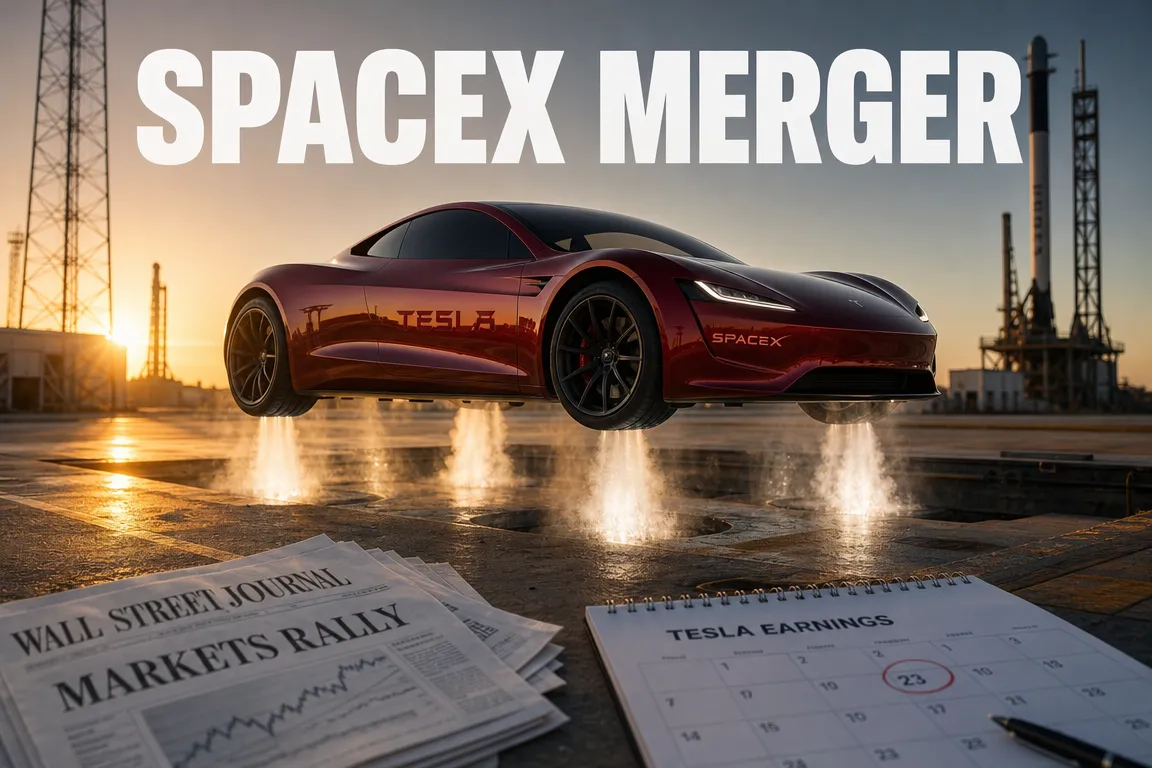
The more important point is that SpaceX moved its third-quarter earnings release to one day before Tesla’s earnings announcement.
The fact that the Roadster was unveiled at a SpaceX rocket test site rather than at a Tesla factory also suggests more than a routine promotional event.
Wall Street is now revisiting the possibility of a Tesla-SpaceX merger, Elon Musk’s expanded voting control, potential exchange ratios for Tesla shareholders, and related tax implications.
This report reviews Tesla’s stock decline, AI investment cycle concerns, semiconductor weakness, the Roadster’s technical features, the revised SpaceX earnings schedule, and merger scenarios involving Tesla and SpaceX.
It also highlights a point often overlooked in other coverage: governance may matter more than technical collaboration.
1. Market backdrop: Tesla’s decline was driven more by a broader tech selloff than by disappointment over the Roadster
According to the source material, Tesla closed at $354.74.
The stock fell 2.13% on the day.
SpaceX was cited at around $146.3, down 1.74%.
However, SpaceX is not a listed company, so the price should be understood as an internal valuation or secondary-market reference rather than a public trading price.
Tesla and SpaceX-related prices initially rose after the Roadster presentation.
They later declined as the broader technology sector weakened into the close.
The S&P 500 fell 1.09%.
The Nasdaq declined 2.15%.
The Dow Jones Industrial Average fell 0.34%.
For the week, the Nasdaq lost 4.5%.
This was the weakest weekly performance since late June.
The semiconductor index fell 11.4% over the week.
For Korean investors, the sharper declines in Samsung Electronics, SK Hynix, and Micron were likely more visible.
Over the week, Samsung Electronics fell 17.8%, SK Hynix 24.3%, and Micron 14.6%.
In practical terms, leading memory-chip companies lost as much as one quarter of their value in a single week.
Overall, Tesla’s decline on the day was more closely tied to a broader correction in Nasdaq, semiconductors, and the AI investment cycle than to the Roadster itself.
2. AI investment-cycle concerns: spending is surging, but the cost of AI outputs is falling
The market pullback also reflects growing skepticism about the AI investment cycle.
According to a Bank of America report, hyperscalers are expected to spend roughly $1 trillion in capital expenditures over the next year.
That amount is estimated at about 3% of U.S. GDP.
By comparison, railroad investment during the 1870s boom represented about 2.2% of the U.S. economy.
During the dot-com bubble in the 1990s, capex was about 1.1%.
The current AI infrastructure buildout may therefore exceed the scale of both the railroad boom and the dot-com era.
The concern is that while AI spending is rising sharply, the cost of generating each answer and the market price for AI services are falling rapidly.
This implies that companies are investing heavily in data centers, GPUs, power, and networking without clear visibility on how quickly those investments will be recovered.
As a result, Wall Street is weighing two scenarios at the same time: whether AI spending will drive a major productivity surge, or whether it will end in overinvestment.
Tesla is not insulated from this debate.
The company is increasingly valued not only as an EV manufacturer, but also as a platform tied to autonomous driving, robotaxis, Optimus, and AI infrastructure.
Stronger AI expectations can support Tesla’s valuation.
Conversely, concerns about an AI bubble can weigh on Tesla along with the rest of the sector.
3. Rates and safe-haven flows: gold rose, while bond yields declined
Rate markets showed signs of stabilization.
Comments associated with Kevin Warsh and the Federal Reserve were interpreted as indicating that policy decisions had not been pre-committed.
Following those remarks, the implied probability of another rate hike fell from 28% to 17% in one day.
In other words, markets slightly reduced the likelihood of further tightening.
At the same time, investors moved toward safe-haven assets rather than risk assets.
Gold rose to $4,170 per ounce.
Germany’s 10-year government bond yield fell to around 3.4%, its lowest level in a month.
Even with a modest easing in rate expectations, growth stocks weakened, indicating that the market is also reassessing AI overvaluation, semiconductor inventories, and big tech capex burdens.
In this environment, Tesla’s earnings call will matter for revenue, margin, cash flow, AI investment plans, and the robotaxi timeline.
4. Roadster reveal summary: this was closer to a SpaceX technology showcase than to a conventional electric sports car launch
The newly presented Tesla Roadster differs materially from the Roadster promised in 2017.
The original message in 2017 centered on a high-performance electric sports car capable of traveling roughly 1,000 km on a single charge.
This latest presentation emphasized hovering, compressed-air thrust, extreme acceleration, and underbody suction rather than long-range driving.
In the first demonstration, the car climbed a curved ramp.
The vehicle then moved while appearing inverted and suspended beneath the surface.
It later lifted into the air in an upside-down position, used air jets to correct its attitude, and then landed.
In the second demonstration, it jumped over a lineup of Tesla vehicles, including the Model 3, Model Y, Cybertruck, Cybercab, and Semi.
It also performed a full rotation in midair.
Tesla vehicle engineering executive Lars Moravy described the maneuver as a “kickflip” inspired by skateboard technology.
Both demonstrations were conducted without a driver.
The car was operating autonomously.
The source material states that it reached 96 km/h in 0.81 seconds, materially faster than the 1.9-second target discussed in 2017.
Elon Musk said the production version could be even faster.
5. Three Roadster versions: Performance, Thrust, and Rocket
The Roadster is currently described in three versions.
The first is the Performance version.
It is intended for road use.
It seats two.
The target acceleration to 96 km/h is under 1.6 seconds.
The second is the Thrust version.
It is positioned for track use.
It also seats two.
Using rear air outlets, it targets sub-0.9-second acceleration.
The third is the Rocket version.
It is described as available only to invited buyers.
It is effectively a single-seater under the current configuration.
The passenger-side area is expected to house an air tank.
The target acceleration is below 0.59 seconds.
Tesla said this version can “fly.”
In this context, the term should be understood as brief lift and attitude control using compressed air rather than free flight in the aviation sense.
6. Key specifications: 4680 battery, 150kWh, 10-minute charging, but reduced range
The Roadster features a yoke-style steering wheel.
The seats are integrated into the body structure.
The design appears to reduce weight by limiting movement to the seatback.
The pedals can move toward the driver.
The body uses magnesium, titanium, and carbon-fiber materials.
The battery is said to be approximately 150kWh.
The vehicle is reported to use Tesla’s new 4680 cells.
Tesla says charging from 15% to 85% can be completed in 10 minutes.
However, one major change stands out.
The 2017 Roadster was supposed to achieve about 1,000 km of range on a single charge.
The latest version is reported at more than 480 km.
That is less than half of the original target.
This indicates that Tesla has repositioned the Roadster.
It is no longer primarily a long-range electric sports car, but rather a high-performance platform incorporating SpaceX technology.
That shift reflects the allocation of battery space to air tanks and fan systems.
7. Production timing and pricing: production is planned for 2028, with deposits as high as $250,000
Roadster production is now described as starting in 2028.
Tesla has not yet disclosed an official price.
However, deposit amounts have been specified.
The deposit for the Performance version remains $50,000.
The deposit for the Thrust version is $250,000.
That is roughly KRW 330 million.
Tesla said the vehicle has not yet received approval for public-road use.
The Rocket version may not be available or legal in certain countries or regions.
Florida’s governor has suggested the possibility of legalization, but broader applicability remains unclear.
Elon Musk has not presented the vehicle as a major revenue driver.
Instead, he framed it as a symbolic product, possibly the last Tesla designed for direct human driving.
In other words, the Roadster is not a mass-market model that will materially change Tesla’s near-term sales.
It is a brand, technology, and SpaceX-linked showcase product.
8. How the Roadster stays inverted: fan-car and compressed-air systems
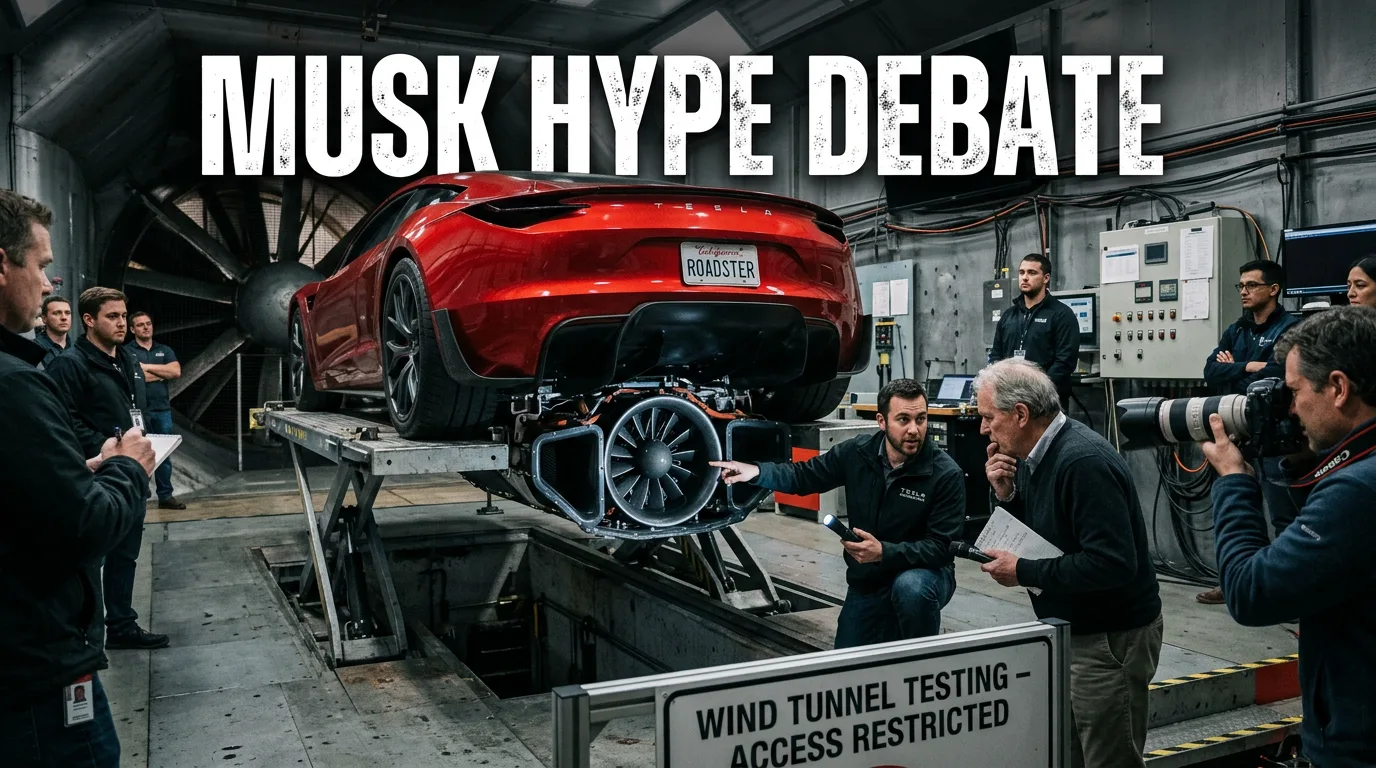
The Roadster’s ability to remain attached while inverted is based on a fan system that removes air from beneath the vehicle.
The principle is similar to a vacuum cleaner.
When a vacuum is turned on, the head adheres more strongly to the floor.
The Roadster uses a similar method to create a strong seal between the car and the road surface.
Conventional supercars generate downforce through a rear wing.
However, rear wings become effective only at higher speeds.
Their downforce is limited at lower speeds and during corner entry.
By contrast, the Roadster’s fan system can keep the vehicle planted regardless of speed.
In theory, this could create significantly stronger grip even in low-speed corners.
Tesla said the car can withstand more than 2G in corners.
If this can be implemented reliably in a production vehicle, it would offer cornering performance unlike that of traditional supercars.
9. The SpaceX technology connection: high-pressure air tanks and rocket-style attitude control
The Roadster’s hovering and attitude-control functions rely on high-pressure air tanks.
The vehicle is described as having two high-pressure tanks.
These can hold about 250 kg of compressed air, or roughly 600 liters by volume.
Short bursts through nozzles can lift the car or adjust its orientation.
This is not a combustion-based rocket engine.
Because it uses compressed air, Tesla says the system can be refilled while driving.
Tesla stated that the thrust force is four to five times greater than the force generated by the tires against the road.
This suggests a system designed to exceed the limits of tire-based traction through compressed air.
This is where the SpaceX connection becomes relevant.
The carbon-fiber-wrapped high-pressure tank concept is closely aligned with technology used in SpaceX Falcon rockets.
Elon Musk described the vehicle as a product made by “the world’s best car company and the world’s best rocket company.”
10. SpaceX and Optimus also appear in the exterior design
The white exterior finish is referred to as Arno White.
It is described as being inspired by rocket protective coatings.
The coating is said to withstand ultraviolet exposure, extreme cold below -180 degrees Celsius, static electricity, and salt air.
The glass was designed to have a gold tint similar to a space helmet visor.
The moving parts of the rear wing reportedly use components derived from Optimus robot joints.
This is significant.
The vehicle combines Tesla EV technology, SpaceX rocket technology, and Optimus robotics components.
Rather than introducing only a faster car, Tesla appears to have compressed its broader technology stack into a single product.
11. Why the presentation took place at a SpaceX test site rather than a Tesla factory
The Roadster was unveiled at a SpaceX rocket test site, not at a Tesla factory.
That choice is highly symbolic.
Tesla acknowledged that the vehicle is not expected to be a meaningful sales contributor, which suggests the presentation was not only about product marketing.
The underlying message may have been that Tesla and SpaceX are already operating as one integrated team.
Wall Street appears to be reading it that way.
Wedbush analyst Dan Ives said the event made the Tesla-SpaceX relationship more concrete.
Gene Munster said the event could be viewed as an engineering showcase with limited commercial value, but also as a signal that Elon Musk may want to combine the two companies.
That naturally shifts attention toward a possible Tesla-SpaceX merger.
12. Why the SpaceX earnings date is raising questions: it now sits one day before Tesla’s
SpaceX posted its third-quarter earnings schedule on its investor page.
According to the source, earnings will be released after the close on Tuesday, with management holding an audio call later the same day.
In Korean time, this corresponds to around 5:30 a.m. or 5:50 a.m. on Wednesday the 21st.
Tesla’s earnings announcement is scheduled for 6:30 a.m. on Thursday the 22nd in Korean time.
In effect, the two events are separated by only one day.
More importantly, SpaceX moved its release earlier than before.
In the previous quarter, it reported earnings 35 days after quarter-end.
This time, the report is scheduled roughly 20 days after the September 30 quarter-end.
That is about two weeks earlier than before.
In the prior cycle, there was a 13-day gap between SpaceX and Tesla earnings.
This time, the gap is only one day.
This may be coincidental.
However, in the context of ongoing merger speculation, investors are unlikely to dismiss it.
13. The Tesla shareholder Q&A deadline also overlaps unusually closely
Tesla collects shareholder questions in advance of its earnings call.
According to the source, the deadline for submitting questions is 5:00 a.m. on the 21st in Korean time.
That is roughly 30 minutes before SpaceX’s earnings call begins.
The significance is that investors can review both companies’ numbers within about 25 hours.
SpaceX’s earnings come first, followed by Tesla’s the next morning.
Investors will be able to review SpaceX’s revenue, losses, AI investment, and cash flow before Tesla’s earnings call.
Even if merger questions are not raised during Tesla’s call, investors will still be able to compare the two companies directly.
That is the main significance of the schedule alignment.
14. What to watch in SpaceX earnings: revenue growth, losses, and AI capex
In the previous quarter, SpaceX reported revenue of $7.8 billion.
That was up 92% year over year.
Net loss was $540 million.
AI-related capital expenditure was cited at $15.8 billion in the same quarter.
That implies spending more than twice quarterly revenue on AI equipment and infrastructure.
Wall Street also reportedly raised its target from $230 to $275 ahead of the earnings release.
One outlook suggested annualized revenue could exceed $100 billion by year-end.
These figures matter for Tesla shareholders as well.
If Tesla and SpaceX were to merge, they would directly affect exchange ratios and merger valuation.
The stronger SpaceX’s earnings, the higher its valuation is likely to be.
That in turn would influence the terms available to Tesla shareholders.
15. The central issue: the merger case may be driven more by voting control than by technology
There is an important point many investors may overlook.
Tesla and SpaceX already cooperate technically without merging.
The Roadster itself is evidence of that.
Using SpaceX high-pressure tanks, Optimus joint components, and Tesla vehicle architecture does not require a merger.
So if a merger is considered necessary, the reason may not be technology alone.
The more important reason may be governance.
Barclays reportedly expects a structure in which SpaceX acquires Tesla.
The transaction would likely be stock-based rather than cash-based.
In that scenario, Tesla shareholders would receive SpaceX shares.
A modest premium may also be included.
SpaceX stock is currently described as being divided into two classes.
Common shares carry one vote per share.
Shares held by Elon Musk are said to carry 10 votes per share.
Elon Musk reportedly owns 48% of SpaceX but controls 82% of the voting power.
By comparison, his Tesla stake is said to be around 20%.
Barclays estimated that after tax effects on 2028 compensation shares, his Tesla stake could fall to about 17%.
Musk has repeatedly said he needs roughly 25% ownership or control to guide Tesla as an AI and robotics company.
If SpaceX acquired Tesla at current market values, Musk could hold about 37% of the combined company and 56% of voting power.
In that case, he would have majority voting control.
At Tesla today, all shareholders other than Musk collectively hold about 80% of the voting power.
After a merger, all other shareholders together could fall to around 44%.
That is the most important aspect of the merger discussion.
Voting control may be the real motive, not just technology integration.
16. Would the deal necessarily be negative for Tesla shareholders?
From a Tesla shareholder perspective, a merger would not necessarily be negative.
SpaceX has attractive growth assets linked to Starlink, launch services, defense, satellite communications, and AI infrastructure.
If Tesla shareholders received SpaceX stock, they could gain exposure to a larger growth platform over time.
A merger could also include a premium for Tesla shareholders.
The main issue is the exchange ratio.
The value of one Tesla share in terms of post-merger equity would materially affect the outcome.
Tax treatment is also especially important for Korean investors.
In some jurisdictions, stock-for-stock mergers may be treated as tax-deferred transactions, but local treatment can differ.
If the legal structure or listing status changes, Korean tax law may treat the transaction as a deemed sale.
That could create a capital gains tax issue even without any cash proceeds.
International investors should confirm the tax treatment before and after any merger announcement.
17. The timeline is tight in relation to the shareholder meeting
Tesla has limited time if it wants to bring a merger proposal to a shareholder meeting.
According to the source, the company must hold its shareholder meeting by December 6.
At the time referenced, roughly 51 days remained.
To place a merger proposal on the ballot, Tesla would first need a formal announcement.
That would be followed by submission of merger documents to regulators.
Shareholder materials would then need to be distributed and votes collected.
That process can take several weeks.
For that reason, Barclays reportedly viewed even a late-October or early-November announcement as tight.
If Tesla intends to place the matter before this year’s shareholder meeting, it would need to act quickly.
By contrast, if no announcement emerges by early November, the merger discussion could be delayed by six to twelve months.
18. The SolarCity precedent: a related-company deal was announced shortly before earnings
Tesla has merged with a company associated with Elon Musk before.
That case was SolarCity.
On Monday, August 1, 2016, Tesla and SolarCity announced a merger agreement.
Tesla’s second-quarter earnings were released two days later, on Wednesday, August 3.
In other words, the merger announcement came immediately before earnings week.
This time, SpaceX earnings and Tesla earnings are separated by only one day.
That is why some investors are watching for a similar pattern.
There is also an important difference.
In the SolarCity case, an acquisition proposal had already been disclosed in June.
This time, there has been no official acquisition or merger proposal.
So the current situation should not be treated as a direct parallel.
Still, the fact that SpaceX accelerated its earnings date to sit directly before Tesla’s is drawing attention.
19. Key checkpoints going forward
- Watch SpaceX earnings for revenue growth, net loss, cash flow, and AI capex.
- Watch Tesla earnings for auto margins, FSD revenue recognition, robotaxi timing, and Optimus production plans.
- Confirm whether either company forms a special committee to evaluate a merger.
- Look for merger agreements, acquisition proposals, or investor presentation materials.
- If Tesla issues a routine shareholder-meeting notice, the probability of a near-term merger may decline.
- If merger-related materials appear before the shareholder-meeting notice, that would suggest the window has opened.
- Korean investors should verify whether any stock-for-stock merger would trigger capital gains taxation.
20. The most important point often missed in other coverage
The purpose of this Roadster reveal was not simply to show that a car can fly.
The broader message is that Tesla, SpaceX, and Optimus are increasingly converging into a single technology stack.
More importantly, that stack is already functioning without a formal merger.
If a merger becomes necessary, the reason may be capital structure and voting control rather than technology gaps.
Musk has repeatedly suggested that he needs greater control to transform Tesla into an AI, robotics, and autonomous-driving platform.
If Tesla and SpaceX were combined, his voting power could move above 50% almost immediately.
That would have implications far beyond ordinary strategic synergy.
If a merger were completed, Tesla shareholders could move from owning an EV company to owning a broader platform spanning space, satellite communications, AI infrastructure, robotics, and autonomy.
At the same time, existing Tesla shareholders would likely see their voting influence diluted.
For that reason, this issue should be evaluated primarily as a governance restructuring question rather than as a short-term stock catalyst.
21. Investment implications: short-term and long-term variables for Tesla stock
In the short term, Tesla stock will likely remain sensitive to Nasdaq performance, semiconductor conditions, rate expectations, and AI sentiment.
Even if the Roadster reveal is viewed positively, Tesla can still trade lower if the broader technology sector weakens.
In the medium term, Tesla’s earnings call will be critical.
Investors will focus on auto margin resilience, energy business growth, and the level of detail provided on FSD and robotaxi timing.
Over the long term, the key question is whether Tesla can be revalued as more than an EV manufacturer, into an AI autonomy platform, robotics company, and energy infrastructure player.
A possible SpaceX merger could further change the valuation framework.
However, a merger would involve shareholder approval, regulatory review, tax issues, exchange ratios, and voting-right considerations.
Investors should therefore focus not on whether a merger is simply positive or negative, but on the specific terms of any transaction.
22. Conclusion: the Roadster flew, and the market is now waiting for documents
This Roadster presentation demonstrated Tesla’s engineering capabilities.
For investors, however, the SpaceX earnings schedule may matter more than the car itself.
SpaceX’s decision to release earnings one day before Tesla may be a simple scheduling choice.
But merger speculation, the SolarCity precedent, the shareholder-meeting deadline, and Barclays’ analysis are causing the market to treat it as a signal.
Over the coming days or weeks, the key question is whether a special committee, merger review, shareholder-meeting proposal, or exchange-ratio disclosure appears.
If nothing is filed, merger speculation may fade.
If unexpected documents are released, Tesla and SpaceX could enter a materially different phase.
For Tesla investors, this earnings season should be viewed not only as a results update, but also as a potential governance event.
< Summary >
The more important issue than the Tesla Roadster reveal is that SpaceX moved its earnings release to one day before Tesla’s.
The Roadster now appears to be a technology showcase combining SpaceX rocket systems, Optimus components, and Tesla’s vehicle platform.
The market has also been pressured by AI investment excess concerns, semiconductor weakness, and shifting rate expectations, which have weighed on Tesla alongside the broader sector.
The core of the Tesla-SpaceX merger debate is likely voting control and governance, not just technical cooperation.
If a merger occurs, Tesla shareholders could gain exposure to SpaceX growth, but exchange ratios and tax treatment will be critical.
Going forward, the most important indicators will be any special-committee formation, merger filing, or shareholder-meeting disclosure.
[Related Articles…]
- Tesla Stock, Governance, and the SpaceX Merger Question
- AI Capex Cycle, Semiconductor Selloff, and Market Repricing
*Source: [ 오늘의 테슬라 뉴스 ]
– 로켓 기술로 날린 로드스터, 다음 날 스페이스X는 실적을 테슬라 하루 앞에 붙였다 — 솔라시티처럼 합병 발표? $354 주주는?
● Broken Economy, Surging Markets, Silent Collapse
The Real Reason the Stock Market and the Real Economy Have Fully Diverged in Korea’s Era of 1 Million Business Closures
The most serious signal in the Korean economy is not the rise in equity prices.
The key issue is that, while the KOSPI and semiconductor exports appear strong, small-business distress, household debt, youth bankruptcies, and closures among middle-aged entrepreneurs are all increasing at the same time.
This report summarizes why financial markets and the real economy are moving in opposite directions, why nearly 1 million self-employed workers are shutting down operations, and how higher interest rates are affecting household finances.
It also examines four issues that are often underreported: debt remaining after closure, the structural failure of franchises, the transmission of youth debt to parents, and the loss of entry-level jobs in the AI era.
1. Key Development: Equity Markets Are Strong, While the Real Economy Is Weak
The Korean economy appears to be in a recovery phase on the surface.
Semiconductor exports have improved, large corporate earnings have strengthened, and the stock market has shown solid momentum.
However, conditions in the consumer economy remain materially different.
Small-business owners face weak sales, higher rent burdens, rising interest expenses, and higher labor costs simultaneously.
The situation is particularly difficult in restaurants, franchises, small retail stores, and delivery-oriented businesses.
- Equity market: gains concentrated in semiconductors and large-cap stocks
- Real economy: slower consumption and rising business closures
- Labor market: fewer entry opportunities for younger workers
- Household finances: higher debt-service burden
- Middle-aged households: elevated risk from failed post-retirement entrepreneurship
This is a classic K-shaped divergence.
Asset markets and large corporations appear to be recovering, while small businesses, younger workers, and middle-aged households continue to weaken.
2. The Meaning of 1 Million Closures: This Is Not Simply Business Failure
The rise in closures toward the 1 million level does not mean that operators simply stopped trading.
Closure is usually the final option after prolonged losses.
Most small-business owners only shut down after exhausting available resources.
During that period, debt often increases further.
Operating loans, credit card borrowing, overdrafts, and loans from family or acquaintances are frequently used.
The problem is that closure does not end the burden.
In many cases, the real difficulties begin after operations stop.
- Franchise termination penalties
- Remaining inventory and raw material costs
- Interior demolition expenses
- Lease restoration costs
- Overdue rent and maintenance charges
- Repayment pressure from operating loans
In some cases, business owners are left with 200 million to 300 million won in debt after shutting down.
Even when the business was operating, it was difficult to accumulate meaningful savings; once closure occurs, large fixed costs are triggered at once.
3. Why Franchise Closures Are Increasing
One notable trend is the rise in failed franchise openings.
In the past, businesses such as chicken, pizza, Chinese food, and snacks were viewed as relatively stable small-business models.
Today, even long-running pizza and chicken stores are increasingly closing.
Franchises are risky because even when sales are generated, the operator retains only a limited share of the profit.
After royalties, ingredient costs, advertising fees, delivery commissions, labor, and rent, the remaining margin is often small.
As a result, it is difficult to build sufficient cash reserves even in good periods.
When business weakens, closure costs remain with the franchisee.
Trend-driven businesses such as tanghulu, malatang, and Taiwanese castella face similar dynamics.
Trends rise quickly and decline even faster.
Operators often fail to recover their initial investment before consumer demand declines.
4. The Starting Point of the Small-Business Crisis: Forced Entry, Not Voluntary Entrepreneurship
Korea’s self-employment share remains high by OECD standards.
Out of roughly 29 million workers, about 7 million are estimated to be self-employed.
This represents approximately 20% to 23% of total employment.
The critical point is that many are not voluntary entrepreneurs.
Many enter self-employment because reemployment is difficult after retirement and because available jobs do not match their prior experience.
This explains the high concentration of self-employed workers in their 50s and 60s.
Even workers with corporate or professional experience often cannot immediately transition into businesses that match their skills.
AI, manufacturing, sales, and technical businesses often require substantial capital.
When those options are unavailable, they are pushed toward low-barrier sectors such as restaurants, cafes, and franchises.
The problem is that these markets are already oversaturated.
More openings mean more competition, and more competition means a higher probability of closure.
5. Why Interest Rate Increases Are Especially Damaging for Small Businesses
Higher interest rates affect all economic participants, but the impact on small-business owners is more direct.
Employees are generally affected through higher living costs or mortgage payments.
By contrast, small-business owners often rely on debt to operate the business itself.
Business loans fall into two broad categories.
- Startup financing: deposits, interior build-out, and equipment investment
- Working capital loans: funding gaps in labor, materials, rent, and utilities
When sales decline, working capital borrowing rises.
When rates increase, interest costs rise.
Higher interest costs weaken cash flow further.
That in turn increases reliance on additional borrowing.
Repeated over time, this structure leads to multi-creditor debt burdens.
The highest-risk group is borrowers with three or more financial institutions, low income, and weak credit scores.
Many small-business owners fall into this category, which is now a major macroeconomic risk in Korea.
6. The Trap of Income Properties and Knowledge Industry Centers
One of the clearest effects of higher rates is visible in income-property markets.
Cases are rising of investors who purchased shops, officetels, and knowledge industry centers and can no longer service the debt.
For example, consider a 200 million won commercial unit.
Sales staff often explain that a 20 million won deposit is enough, with the balance covered by bridge loans and final-payment loans.
In some cases, buyers are encouraged to purchase multiple units on the assumption that one is insufficient for leasing.
That quickly raises total borrowing into the hundreds of millions of won.
In 2021, bridge loan rates were often in the 3% range, but after 2023 many cases moved into the 6% to 7% range.
If 700 million won is borrowed, the annual interest cost at 3% is about 21 million won.
That is roughly 1.75 million won per month.
At 6%, monthly interest rises to about 3.5 million won.
The problem does not end there.
Even one or two missed interest payments can damage credit scores.
Lower credit scores can block final-payment financing.
Without final financing, ownership registration becomes difficult and leasing also becomes harder.
As a result, debt and interest obligations continue even when the property is not generating income.
7. Semiconductor Strength Masks the Weakness Beneath the Surface
One major distortion in the Korean economy is the semiconductor effect.
When semiconductor exports surge, headline export figures improve.
Large corporate earnings strengthen.
The stock market also rises, led by semiconductor names.
However, direct employment in semiconductors remains limited relative to the total labor force.
Even combined employment at Samsung Electronics and SK hynix represents only a small fraction of Korea’s roughly 29 million workers.
Semiconductor strength does not translate directly into income growth for the broader population.
This is why export data and stock prices can improve while neighborhood commerce continues to weaken.
This is the core reason markets and the real economy have diverged.
Capital markets reflect future earnings and liquidity, while small businesses depend on today’s customer traffic and card sales.
8. The Structure Behind Rising Middle-Aged Bankruptcies
The 50s and 60s age group is exposed to bankruptcy risk for reasons beyond late entrepreneurship.
This generation carries three burdens at once.
- Income loss after retirement
- Support for children’s education and living expenses
- Elderly parent-care obligations
This is the generation responsible for supporting both upward and downward.
Children are becoming independent later.
Parents are aging into their 70s and 80s, increasing medical and care costs.
Middle-aged households must therefore continue generating cash flow.
However, reemployment is difficult.
As a result, many turn to entrepreneurship or investment.
The problem is that they often enter sectors they do not understand well.
Franchises, income properties, stock recommendation rooms, crypto assets, and high-yield products are common examples.
9. Why Investment and Stock-Picking Scams Are Increasing
Scams increase when the real economy is weak and equity markets are strong.
People see few opportunities to earn in daily life, while online markets appear to show someone making large profits.
Retirees and middle-aged investors, in particular, want to protect accumulated wealth while generating additional returns.
Scammers exploit this demand through stock-recommendation rooms, fake investment platforms, and market-manipulation schemes.
Access usually begins with free seminars.
Trust is built through chart analysis, wave theory, and macroeconomic commentary.
Participants are then moved into private group chats.
They are told that depositing money into a specific platform will generate returns.
In reality, these are often fraudulent schemes rather than investments.
Losses of several hundred million won to more than 1 billion won are reported in some cases.
The critical point is that the victims are not necessarily financially illiterate.
Even people familiar with economic media, stock investing, and financial markets can be deceived.
10. The Core of Youth Bankruptcy: Despair and Asset Inequality
Youth bankruptcy is not simply a matter of overspending.
Some cases involve excessive consumption, but the larger issue is structural despair.
Many people in their 20s and 30s understand clearly that it is extremely difficult to buy a Seoul apartment using labor income alone.
Even with a monthly income of 3 million won, after rent, food, communications, transportation, and utilities, little remains for savings.
Saving 1 million won per month equals 12 million won per year.
Over 10 years, that amounts to 120 million won.
Meanwhile, asset prices and housing prices often move faster than income accumulation.
As a result, some young people shift toward consumption.
If home ownership is unattainable, they choose to enjoy the present.
Others move toward high-risk investment.
Crypto assets, leveraged ETFs, inverse products, theme stocks, and short-term trading are common examples.
The problem is the return hurdle that young investors feel forced to clear.
Achieving 10% to 20% annual returns consistently for 10 years is difficult even for professional investors.
However, many young people believe they need 100% or 200% gains to move up economically.
That urgency often leads to excessive risk-taking and bankruptcy.
11. In the AI Era, Youth Jobs Disappear First
From an AI trend perspective, the youth employment problem is becoming more severe.
AI is currently displacing entry-level tasks before it displaces senior managerial roles.
Examples include junior work in law firms, entry-level accounting tasks, research support in think tanks, and routine document drafting and data collection within companies.
In the past, entry-level employees used such tasks to build experience and advance.
Now AI is beginning to perform that work.
Companies increasingly want experienced workers.
However, young people find it harder to obtain their first job.
If this continues, young workers will face delays in both income generation and debt repayment.
AI therefore increases productivity while also raising barriers to labor-market entry.
This is likely to become one of the most important issues in Korea’s economy and labor policy.
12. The Risk When Parents Repay Their Children’s Debts
The transfer of youth debt to parents is another major risk.
When children incur debt through failed investments, failed businesses, fraud, or related incidents, parents often step in to repay it.
Parents find it difficult to refuse support.
However, this can undermine the entire family.
Most parental wealth is tied up in real estate.
Selling a home quickly to cover a child’s debt often means accepting a lower price.
Real estate carries high transaction costs, and timing can change the proceeds by hundreds of millions of won.
After selling the home, parents may receive cash.
But if they lack experience managing liquid assets, that money can flow into risky investments again.
Losses can recur in income properties, knowledge industry centers, presales, and high-yield products.
In the end, youth debt can become parental insolvency, and parental insolvency can become family-wide poverty.
13. Why an Unconditional Drive to Repay Debt Can Be Risky
The principle that debt should be repaid remains important.
Contracts should be honored and obligations should be met.
However, forcing repayment in every situation is not always the correct response.
Taking on new debt to repay existing debt is highly risky.
Borrowing from family or friends and failing to repay can damage both finances and relationships.
Middle-aged workers who exhaust themselves trying to repay debt may also incur health-related expenses.
Personal rehabilitation and bankruptcy procedures do not exist to punish debtors.
They are social safety mechanisms designed to prevent total financial collapse.
Even in the United States and other capitalist economies, bankruptcy is used relatively actively.
The key issue is not simply endurance, but identifying the point at which legal restructuring should be considered.
This is especially relevant once business closure, multi-debt exposure, card-loan rollover, and family borrowing have begun.
14. Why Personal Rehabilitation Is Not Simply Debt Reduction
Personal rehabilitation is not only a debt-reduction mechanism.
It is also a process of rebuilding spending behavior.
During the process, individuals must live within a fixed monthly budget.
Dependence on credit cards and additional borrowing is restricted.
This is difficult at first, but it can help rebuild spending discipline within the limits of earned income.
More important than repayment itself is avoiding the same pattern again.
For small-business owners, younger workers, and middle-aged households alike, restoring cash-flow discipline and spending control is essential.
15. The Most Important Points Often Missing From Other Coverage
First, closure can be the beginning of new debt, not the end of the problem.
Most reporting focuses on closure counts.
The real issue is the debt and costs that remain after shutdown, including penalties, restoration costs, loans, and inventory.
Without the ability to absorb these costs, former business owners struggle to restart economic activity.
Second, semiconductor strength does not mean a full recovery in the Korean economy.
Even if export and stock indicators improve, the experience of small-business owners, younger workers, and small firms may remain weak.
Improving aggregate indicators does not necessarily mean household conditions have improved.
Third, youth debt can spread into parental debt.
Once parents repay their children’s obligations, an individual problem can expand into a household financial crisis.
This is likely to remain an important variable in household debt dynamics.
Fourth, AI may reduce first-job opportunities for younger workers.
Rather than replacing senior labor immediately, AI may first eliminate entry-level tasks, reducing the opportunity for young workers to gain experience.
Fifth, the ability to recognize failure and restructure quickly is essential to innovation.
Korea maintains a strong social stigma against failure.
After business failure, reentry is difficult and access to finance after bankruptcy is limited.
Yet entrepreneurship and innovation require a system that allows failure to be resolved quickly and restart to be possible.
16. Priorities for Individuals and Policy
Individuals should prioritize sustainable cash flow over aggressive expansion.
Small-business owners should focus on net cash flow, not only sales.
Younger workers should assess income-generation capacity and spending discipline before pursuing high-return investments.
Middle-aged households should avoid placing retirement savings and real estate proceeds entirely into risky assets at once.
From a policy perspective, closure support and restart support are becoming more important.
Policies that only encourage entrepreneurship are insufficient.
Korea needs lower closure costs and a structure that supports reemployment and re-entrepreneurship after failure.
In addition, labor-market policies that help young people secure their first career step will become increasingly necessary in the AI era.
The current problem cannot be solved by individual effort alone.
Interest-rate hikes, weaker consumption, asset inequality, AI-driven labor substitution, oversupply in small business, and household debt are all interacting at the same time.
< Summary >
Korea’s equity market and semiconductor sector may look strong, but the real economy remains under pressure from rising small-business closures and household debt.
The significance of the 1 million closure threshold lies not simply in business failure, but in the debt burden that remains after shutdown.
Higher rates are particularly damaging to small-business owners and income-property investors.
Young workers are exposed to asset inequality and the loss of entry-level jobs caused by AI.
Debt repayment by parents on behalf of children can expand into family-level insolvency.
In many cases, practical use of personal rehabilitation, bankruptcy, and debt-adjustment mechanisms is more appropriate than attempting to repay all debt at any cost.
[Related Articles…]
- Small Business Closures and Consumer Weakness in Korea
- Youth Employment and Structural Change in the AI Era
*Source: [ 경제 읽어주는 남자(김광석TV) ]
– [풀버전] “100만 명이 문 닫았습니다” 주식시장과 실물경제가 완전히 갈라진 이유 | 경읽남과 토론합시다 | 박기태 변호사