● AI Agent Era Demands Radical Org Overhaul
The core of working in the AI era is “small talk,” “eliminating fake work,” and “janitorial leadership”
The core point of this piece is not simply “let’s use AI well.”
The real reason companies fail in AI transformation is not a lack of technology, but the fact that they still work, evaluate, and report using old methods.
Especially as the 2027 AI agent era begins in earnest, corporate competitiveness is likely to be determined less by “who uses better AI tools” and more by “whether the organization has changed into a structure where AI can actually work.”
In this article, let’s organize in one place, from an economic perspective, the AI-era way of working, fake work, data sharing, KPIs, leadership, and changes in HR education discussed by former SK Telecom Vice President Jeong Do-hee.
1. Employees use AI, so why is the company still the same?
In many companies, individual employees are already actively using generative AI such as ChatGPT, Claude, Perplexity, and Gemini in their work.
Individual productivity improvements are happening fairly quickly, from drafting reports and organizing meeting minutes to researching materials, assisting with coding, and writing emails.
But the speed of the company as a whole does not increase nearly as much as expected.
The reason is simple.
Individuals have changed, but the reporting system, meeting structure, and evaluation system have remained the same.
- You can make a report in one day with AI, but approval and reporting lines still take a month.
- Leaders say “it’s okay to fail,” but year-end evaluations still rate failed challenges poorly.
- The company holds AI idea contests, but does not actually change work processes.
- AI training has increased, but the way work is done in the field remains the same.
Former Vice President Jeong explains this as an operating system, or OS, problem.
To install the latest apps, you need the latest operating system.
But many companies are trying to layer the latest AI apps on top of outdated organizational operating methods like Windows 95.
In that case, AI transformation is difficult to make work properly.
2. What must come before AI adoption is eliminating “fake work”
The most dangerous misconception when introducing AI is the idea that “we can just make everything we do faster with AI.”
But automating useless work with AI does not increase productivity; it creates even more useless work.
A representative example is reports.
You can certainly use AI to create a 100-page report that nobody really reads more quickly.
The problem is that this could turn one useless report a month into ten a week.
AI can reduce fake work, but conversely, it can also explosively increase the scale of fake work.
- Writing unread reports
- Producing formal presentation materials
- Organizing data unrelated to decision-making
- Document work designed to show off performance
- Work done just to prove that AI was used
Therefore, order matters.
First, we must identify what work should be eliminated.
Second, we must remove the fake work that has been repeated out of habit.
Third, AI should be applied to the real work that remains.
If this order is reversed, digital transformation can become a cost rather than a result.
3. The real work in the AI era begins with “small talk”
In the past, small talk was seen as a waste of time unrelated to work.
But in the AI era, small talk is more likely to become an important way of working.
Tasks like research, summarization, coding, and document writing are increasingly being handled by AI.
Then what important work remains for people?
It is new perspectives, problem definition, connecting ideas, and interpreting context.
These kinds of tasks do not emerge only inside scheduled meetings.
They often begin with an accidental conversation in the hallway, a question raised over coffee, or a small chat with a colleague.
A simple line like “Doesn’t something feel off lately?” can become the starting point for a new business idea.
After that, AI can be used to research the idea, simulate it, and review its market viability, creating a structure that leads to experimentation.
From this perspective, the office of the future is also likely to change.
Rather than a space where each person sits in front of a monitor making documents alone, a space where people talk, sketch on whiteboards, and develop ideas in an open café-style environment may become more important.
At the same time, quiet individual spaces for deep thinking will also be necessary.
In other words, the office of the future must be a structure where small talk and deep focus coexist.
4. We need to distinguish between what to entrust to AI and what people must do
One of the most important abilities in the AI era is the ability to distinguish between “what should be entrusted to AI” and “what should be done by people.”
Former Vice President Jeong explains this using writing as an example.
- Writing as communication: Writing that accurately conveys information, such as meeting minutes, announcement emails, summaries, and organized materials, is something AI can do well.
- Writing as an expansion of thought: Writing in which your thoughts change as you write, your perspective expands, and new logic is created should be led by a person.
The core point is ownership.
If your thoughts are developing through the writing process, then that work should still be done by a person.
Conversely, if the expansion of thought is finished and only organization and expression remain, then you can hand it over to AI.
AI is actually strong at organization and pattern analysis.
But contextual judgment, such as “Should we really do this now in our company?”, “To whom and how should we deliver this information?”, or “Is this the right timing to report this?”, must be done by people.
This ability to interpret context may become the standard that determines both individual competitiveness and organizational competitiveness in the labor market going forward.
5. If you work only with AI, your thinking may become one-sided
Working with AI definitely speeds things up.
The quality of materials improves, and draft-writing time decreases.
But there are side effects too.
If you only talk with AI, the risk increases that your thoughts will lock into a single direction.
AI continues its answers based on the user’s questions and the flow of the conversation.
So once a certain logic is set in one direction, it can keep producing increasingly plausible answers within that direction.
On the surface, it seems highly productive, but in reality, confirmation bias can be reinforced.
What is needed here is conversation between people.
A colleague asking, “But what happens if the situation changes?” can redirect the course of thinking.
If a leader asks, “What would this look like from a different customer’s perspective?”, the team member’s thinking expands again.
In the end, even in the AI era, conversations between people are not likely to decrease; they may become even more important.
6. Data sharing is not a technology issue, but an issue of evaluation and culture
In the AI agent era, data is the food of agents.
For AI to work properly, it must be able to access good data.
But in many companies, data is trapped within each department.
Marketing data, sales data, customer service data, and product team data are not connected to one another.
The reason is not simply that there is no system.
It is because there is no incentive to share data.
- Cleaning and sharing data takes a lot of effort.
- But that work is not well recognized in evaluations.
- If I give my data to another department and that department achieves results, only that department receives a good evaluation.
- In a relative evaluation structure, the team that provided the data may actually become disadvantaged.
In this structure, data sharing cannot work well.
Going forward, if AI agents are to collaborate across departments, the agents themselves must also exchange data.
But if the existing organizational culture is siloed, AI agents are also likely to replicate those silos 그대로.
Another important change is the way data is shared.
In the past, the mainstream approach was a data lake, where data was gathered in one place.
In the future, it will often be difficult to centralize all data.
Semiconductor design data that requires security, or sensitive customer data, is not easy to gather in a centralized way.
In such cases, it becomes important to create interfaces that allow each department to retain its data while still enabling AI agents to access it when needed.
This is one reason architectures such as MCP servers are drawing attention.
7. In the 2027 AI agent era, companies may be divided into three types
The 2027 perspective presented in the original text is quite important.
Once AI agents enter work in earnest, companies may be divided into three broad types.
- Organizations where agents work together with people
- Organizations where people work partially with chatbots or AI tools
- Organizations where people still work only with other people
The real difference here is not whether AI tools are used.
The key point is whether AI actually enters the work process as an operational subject.
Simply having employees use ChatGPT well is still just the level of individual productivity.
To connect it to corporate competitiveness, AI agents must actually work within the workflow, connect data across departments, and play a role in decision support.
But to do that, organizational culture, data access rights, security policies, evaluation systems, and leadership all need to change together.
It is not a problem that can be solved by technology alone.
8. In the AI era, a leader should become a “janitor,” not a conductor
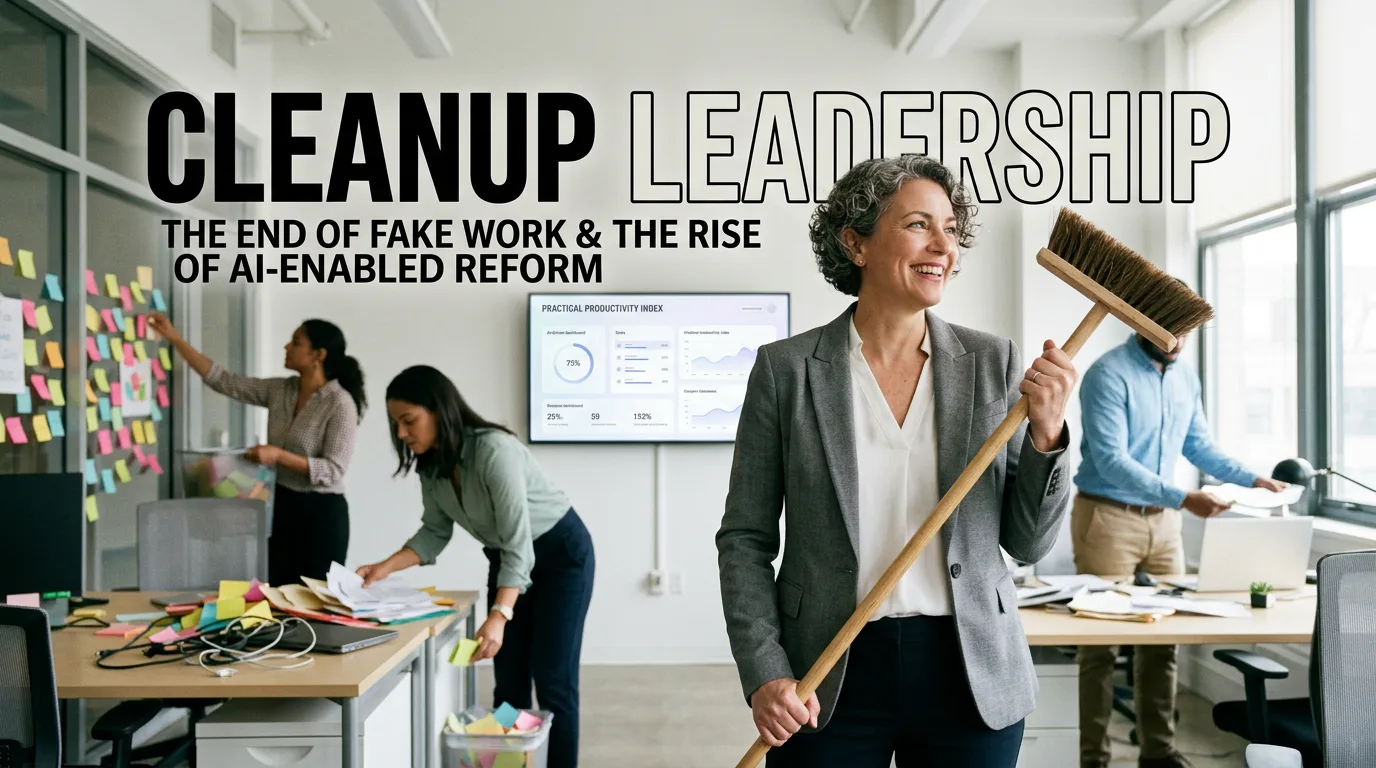
One of the strongest keywords former Vice President Jeong emphasized is janitorial leadership.
Traditional leadership was closer to a conductor.
The leader knew more, set the direction, gave instructions to team members, and received reports.
But in the AI era, that structure may no longer fit.
Younger practitioners may handle AI better and acquire information faster than leaders in certain areas.
If a leader thinks they must know everything, they may end up trapping the team’s capabilities within the limits of their own understanding.
The role of a leader in the AI era is not to directly teach and command, but to remove obstacles so that members can run better.
- Reduce unnecessary reporting procedures.
- Remove institutional obstacles in advance.
- Connect people to the departments they need.
- Create time for experimentation.
- Widen the team’s perspective with questions when they start leaning too far in one direction.
That is why janitorial leadership is more specific than simple servant leadership.
It is leadership that clears the path in front of and behind team members, removes bottlenecks, and creates an environment where experimentation is possible.
9. Future leadership will be question-based and coaching-based leadership
In the AI era, it becomes more important for leaders to ask good questions than to provide answers.
If you just say, “Do it this way,” team members may stop thinking.
On the other hand, if you ask, “What would happen if this situation arises?”, the team member’s thinking starts to work.
Question-based leadership is a way of expanding the thinking of members.
In an era where AI gives answers too quickly, people can easily lose the chance to think for themselves.
That is why leaders must help team members keep their mental muscles strong through questions so they do not outsource their thinking.
This part is very important.
If AI writes the text for you, summarizes for you, and even creates a draft of your judgments, people become increasingly comfortable.
But if thinking itself is handed over to AI, the human role can shrink rapidly.
A leader in the AI era must help the team use AI well while also preserving the ability to think independently.
10. KPIs should not be eliminated; they should be separated
In the AI era, KPIs are a very sensitive issue.
Companies need goals and performance measurement.
For budget allocation, workforce management, commitments to shareholders, and performance evaluation, KPIs are still necessary.
However, applying the same KPIs to everything creates problems.
In particular, existing KPIs may not fit new AI experiments.
It is similar to entering a cave you have never been in and demanding exact reporting on how many kilograms of gold will be mined.
Therefore, KPIs should not be eliminated; they should be separated.
- Normalized work: KPIs are needed for already proven businesses, repeatable operations, and stable processes.
- New experiments: For AI-based new attempts, highly uncertain projects, and work in the exploratory stage, learning metrics are needed more than KPIs.
In the initial experiment stage, you should look at learning speed, number of validations, insights gained from failure, and how much the work connects to the next experiment rather than immediate quantitative results.
Later, once some potential is confirmed, regular KPIs can be applied.
If the order is reversed, innovation gets blocked by the evaluation system before it even starts.
11. AI education must happen in the field, not in the classroom
At present, much of the AI education in companies focuses on prompt engineering, generative AI usage, and tool usage.
Of course, this kind of education is also necessary.
But by itself, it does not change the organization’s way of working.
Former Vice President Jeong says the core of successful education lies more in location than in content.
In other words, what matters more is whether education happens in a classroom separate from work, or inside the actual workflow.
The most ideal kind of education is one in which the boundary between education and work is blurred.
It is a structure where people learn while working and apply what they learn directly to their jobs.
To make this happen, HRD organizations must move into the field.
They must attend meetings, observe workflows, and see directly what capabilities are lacking.
They need to connect knowledge centrally so that one department does not repeat the same failed attempt made by another department.
Former Vice President Jeong describes this role as close to a Value Delivery Office.
HRD should not simply be a department that runs training programs, but a department that immediately supplies the capabilities needed in the field and spreads them across the organization.
12. The most important point that is easy to miss in other news or YouTube videos
First, the bottleneck in AI transformation is not technology, but the organization’s incentive structure.
If shared data is not recognized in evaluations and failures in experiments are rated poorly, then no matter how good the AI is, the organization will not change.
Second, AI can amplify bureaucracy before it improves productivity.
If you attach AI without eliminating fake work, reports, meeting materials, and document work may actually explode.
Third, in the AI agent era, access design may become more important than data lakes.
Relying only on a centralized model for all data has limits in terms of security and real-time work response.
A structure in which each department retains its data while AI agents can safely access it at the needed moment becomes important.
Fourth, KPIs are not the enemy of innovation; the issue is when they are applied.
KPIs are necessary for proven businesses, but if they are applied too strongly to exploratory AI experiments, attempts will shrink.
Fifth, the key risk in the AI era is not automation of work but outsourcing of thought.
It can be efficient to let AI handle writing, reading, and summarizing.
But if judgment and thinking are also handed over, human competitiveness can weaken.
13. From an economic perspective, AI is not a cost-cutting tool but pressure for organizational redesign
When companies look at AI, the first thing they think of is cost reduction.
The approach is often that if 10 people can do a job with 2 or 3, labor costs can be reduced.
But in the medium to long term, AI is not simply a cost-cutting tool.
Rather, it is pressure that forces organizations to redesign their structure, talent allocation, workflow, and evaluation system.
If some tasks are reduced through AI adoption, people must take on other roles.
Roles may shift toward going into the field to discover problems, creating new ideas through small talk with colleagues, and having AI agents conduct experiments.
Companies that succeed in this change can create new growth engines beyond productivity improvement.
Conversely, companies that remain focused only on automating existing work may increase digital transformation costs without improving actual competitiveness.
14. A checklist companies should review right now
- Have you made a list of fake work that should be eliminated before introducing AI?
- Are the outputs created by AI actually being used in decision-making?
- Are interdepartmental data-sharing efforts reflected in evaluations?
- Are AI experiments and regular business being evaluated by the same KPIs?
- Is the leader changing from someone who gives answers to someone who asks questions?
- Is HR education happening inside the real workplace rather than in a classroom?
- Are employees working only with AI and becoming mentally one-sided?
- Is the office space structured to support both small talk and deep focus?
- Is there a data access structure that allows AI agents to collaborate across departments?
- Is the goal not just to use AI, but to create valuable work?
< Summary >
The core point of the AI era is redesigning the way work is done rather than simply using technology.
If fake work is not eliminated first, AI can actually increase useless reports and bureaucracy even more.
People should focus on contextual interpretation, connecting ideas, and spontaneous creation in small talk—the things AI cannot do.
Leaders should be janitors, not conductors, clearing obstacles for their members.
KPIs should not be abolished; they should be applied separately to regular work and new experiments.
AI education should happen in the actual work environment, not in the classroom.
In the 2027 AI agent era, only companies that change their organizational culture, data sharing, and evaluation systems can achieve real productivity gains.
[Related Articles…]
*Source: [ 티타임즈TV ]
– “리더는 지휘자가 아니라 청소부가 돼야 한다” (정도희 전 SKT 부사장)