● Trump Shockwave, US Chaos, Korea Opportunity
Trump Post-Midterm Scenario: Emergency Powers, Election Disputes, War Escalation, and Opportunities for the Korean Economy
The key issue is not simply whether Trump wins or loses the midterm elections.
The more important question is how a Trump 2.0 administration would interpret a defeat and connect that outcome to domestic politics, tariff policy, U.S. manufacturing revival, U.S.-Korea relations, and geopolitical risk.
One of the most notable points in the original discussion is that the greater issue may not be a direct election refusal, but Trump’s likely use of election-fraud claims as a political survival tool.
Another critical point is that U.S. elections are administered by state governments rather than the federal government.
This structure creates the theoretical possibility of severe confusion, including a situation in which Republican-led and Democratic-led states conduct elections under different conditions.
The discussion also links election risk to Middle East war escalation, Iran-related risk, the Strait of Hormuz, a possible declaration of emergency, investment pressure on Korea, and negotiations over energy, shipbuilding, and semiconductors in the AI era.
In other words, this is not only a U.S. political issue. It is a variable that could affect global economic outlooks, investment strategy, and the international positioning of Korean companies.
1. Core News Summary: Direct election refusal appears unlikely, but the election-fraud narrative may remain in use
The main conclusion from the discussion is that Trump is not likely to fully reject a midterm election result.
The primary reason is the political and legal backlash following the January 6, 2021 Capitol attack after the 2020 presidential election.
That event was unprecedented in modern U.S. political history and led to deaths and prosecutions.
Trump survived politically, but the episode created substantial legal and political risk.
Had he lost the 2024 presidential election, litigation risk tied to election denial could have increased further.
However, after winning, several issues lost momentum or were politically resolved, and he returned to the center of power. That context shapes the discussion.
Against that backdrop, a full-scale refusal of a midterm result appears difficult.
That said, a different and more plausible scenario remains.
If Trump loses in the midterms, he may repeatedly claim that “fraud occurred in Democratic states” in order to avoid political blame.
In that case, the objective would be less about overturning the result and more about consolidating supporters and maintaining influence through 2028.
Thus, outright election refusal is a low-probability institutional crisis, while fraud allegations remain a high-probability political weapon.
2. The Democrats’ 150-Scenario Planning: Not Overreaction, but a Lesson Learned from 2021
The original discussion notes that Democrats have prepared multiple scenarios in response to possible Trump election interference or refusal.
This should not be dismissed as mere political messaging.
Having experienced January 6 directly, Democrats are likely to maintain a strong view of what Trump could attempt.
For that reason, they are preparing contingency manuals for extreme cases.
These may include emergency declarations, deployment of military or ICE personnel around polling places, voter intimidation among Democratic-leaning groups, and the possibility of delaying or neutralizing elections.
In particular, the concern is that such measures could discourage turnout among minority voters, immigrants, and Democratic supporters.
The actual probability remains low.
However, the U.S. political system is clearly entering a period in which institutional stability can no longer be assumed solely through precedent and procedure.
3. The Most Extreme Scenario: Emergency Powers and State-Level Electoral Fragmentation
One of the most important points in the discussion is that U.S. elections are managed by state governments, not the federal government.
In an extreme political crisis, this structure could amplify confusion.
For example, Trump could declare a national emergency on the grounds of election fraud and take measures close to martial law.
Republican-controlled states might follow federal guidance.
By contrast, Democratic-leaning states such as California, New York, and Michigan might ignore federal direction and proceed with elections as scheduled.
As a result, some states could hold elections while others do not.
This would create an unprecedented situation in which elected officials exist in some regions but not in others.
The seating of the next Congress would also become disordered.
Current members’ terms would end, while the legitimacy of newly elected members could be interpreted differently across states.
In the worst case, the U.S. federal government and Congress could face simultaneous functional paralysis.
That said, this should be viewed as a tail risk rather than a base-case scenario.
4. Middle East War Escalation: Can External Conflict Divert Internal Political Pressure?
The discussion also considers whether Trump could escalate Middle East conflict or tensions with Iran if he suffers a major midterm loss.
This would follow the classic political logic of shifting attention from domestic political weakness to external security threats.
The discussion does not rule out the possibility, but treats it as unlikely.
At the extreme, U.S. military action could be justified by references to Iran’s nuclear program, threats to the U.S. mainland, or security risks to cities such as Los Angeles and San Diego.
However, this remains a highly extreme scenario.
For investors, it should be treated not as a base expectation but as a low-probability geopolitical shock with potentially large market consequences.
In particular, the possibility of a blockade of the Strait of Hormuz was once viewed as nearly impossible, but it can no longer be ruled out in the current global environment.
Such an event could affect energy prices, shipping logistics, oil supply chains, defense stocks, shipbuilding, LNG carriers, and freight rates.
5. Wartime Extension of Presidential Power: An Ambiguous Constitutional Area
Another key issue raised in the discussion is whether a U.S. president can extend his term during war.
The U.S. Constitution limits presidential service through the two-term rule and related succession provisions.
George Washington established the tradition of stepping down after two terms, and Franklin Roosevelt’s four terms led to the constitutional amendment that clarified term limits.
In general, a U.S. president can be elected only twice, and total time in office is normally capped.
However, the Constitution is less explicit about how elections should be handled during war or a national emergency.
Ukraine, for example, is understood to have constitutional provisions that restrict elections during wartime, but the U.S. lacks similarly detailed rules in this area.
As a result, some room for interpretation exists.
In practice, however, even if Trump tried to use war to extend power, he would likely face significant resistance.
Potential successors within the Republican Party, including figures such as J.D. Vance or Marco Rubio, would have difficulty accepting such a move.
In addition, the MAGA base includes strong anti-war and isolationist sentiment shaped by the Iraq War era.
Conservative media figures such as Tucker Carlson would also likely oppose unnecessary military intervention.
In short, while legal ambiguity exists, the political feasibility of using war to extend power appears low.
6. The More Realistic Path: Tariffs and Investment Pressure Rather Than War
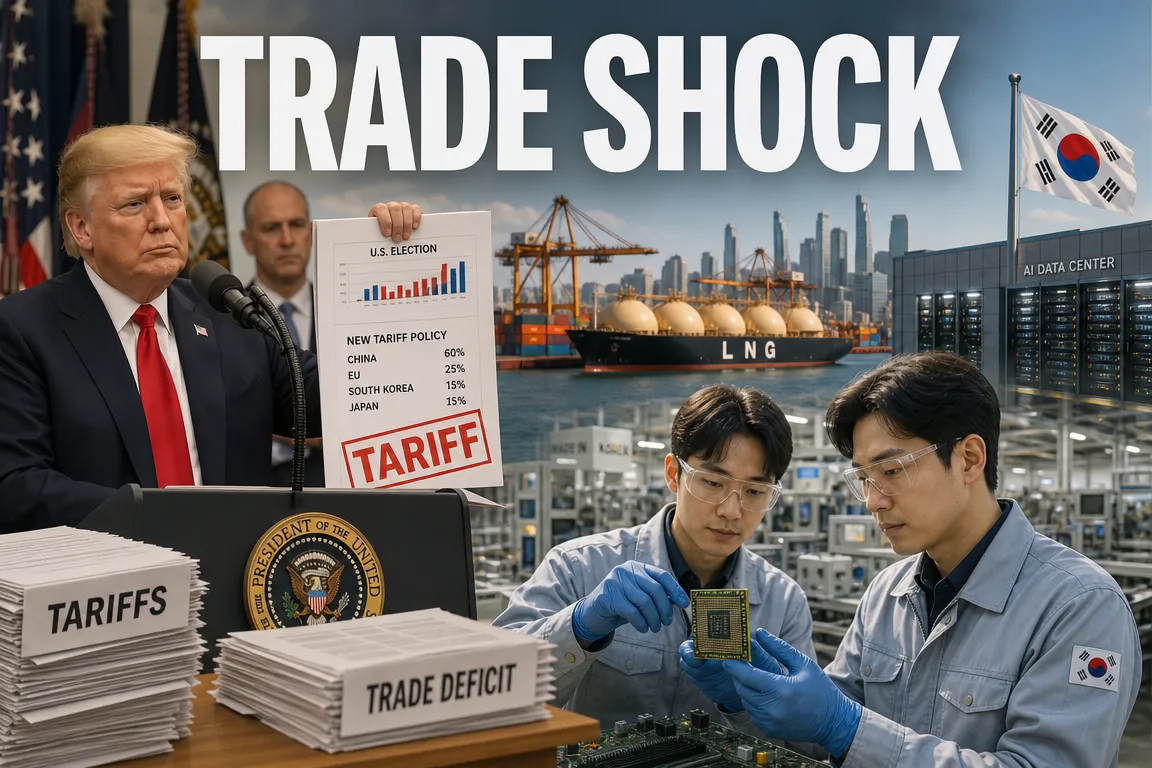
The most realistic conclusion from the discussion is that Trump is more likely to focus on tariffs than on martial law or war.
That would align with his effort to leave a legacy through U.S. manufacturing revival, job creation, and inbound investment.
Tariffs are likely to remain his primary economic tool.
Trump is a metrics-driven politician.
He is likely to highlight investment amounts, factory counts, job creation, and trade deficit reduction as indicators of success.
For Korean companies, this may mean greater pressure for U.S.-bound investment.
Key sectors may include shipbuilding, energy, semiconductors, batteries, power infrastructure, and AI data centers.
The discussion suggests that Korea may be viewed by the U.S. as a country from which significant value can be extracted.
While blunt, that is a realistic framing in international economics and strategic negotiation.
The U.S. sees Korea’s strength in shipbuilding, energy infrastructure, semiconductors, battery manufacturing, and AI-related power demand as strategically useful.
This creates both risk and opportunity for Korea.
7. Implications for the Korean Economy: Pressure Can Also Increase Negotiating Leverage
In a Trump 2.0 environment, Korea would not be in a purely passive position.
In the past, U.S. power was more overwhelming and Korea had fewer options.
That environment has changed.
The U.S. relative position has weakened, while Korea’s industrial capabilities have become more important.
In particular, AI competition has sharply increased the importance of semiconductors, power grids, nuclear energy, LNG, shipbuilding, batteries, and data-center infrastructure.
Korea has assets that the U.S. needs across several of these areas.
If the U.S. demands greater Korean investment, Korea should seek corresponding concessions.
For example, expanded investment could be paired with tax benefits, easier permitting, long-term purchase agreements, defense cooperation, technology protection, and supply-chain stability measures.
The core message is that alliance principles should be maintained, but a transactional approach is also necessary.
If the Trump administration behaves transactionally, Korea should respond with a disciplined transactional strategy of its own.
8. Why This Must Be Viewed Through the AI Trend: The Bigger Variable Is Power and Manufacturing, Not War
This discussion should not be seen only as a U.S. political issue.
Trump’s tariff policy, manufacturing revival strategy, and pressure on Korean investment are all linked to AI competition.
AI data centers require substantial electricity.
Power grids, transformers, nuclear energy, LNG, transmission equipment, cooling systems, and semiconductor supply chains all become critical.
U.S. pressure on Korea in shipbuilding and energy should not be viewed simply as traditional industrial cooperation.
It is part of a broader strategy to rebuild the industrial base needed for the U.S. to compete with China in AI infrastructure.
For Korean companies, this means that “the U.S. is asking for more investment” is not the full story.
The more relevant issue is how Korea can structure its role in U.S. production sites, power infrastructure, energy projects, AI semiconductor supply chains, and defense-shipbuilding cooperation.
From a global economic outlook perspective, U.S. political events are increasingly affecting not only equity markets but also industrial geography and supply-chain restructuring.
9. Scenario-Based Economic and Investment Impact
| Scenario | Probability | Core Issue | Economic and Investment Impact |
|---|---|---|---|
| Trump fully rejects election results | Low | Heavy political and legal costs after January 6 | Short-term market volatility |
| Continued fraud narrative | Relatively high | Used to shift blame and consolidate support | Prolonged political uncertainty; attention on USD, gold, and defense stocks |
| Emergency declaration | Very low | Possible attempt to delay or control elections | Sharp moves in U.S. Treasuries, equities, and FX markets |
| State-level electoral fragmentation | Extreme tail risk | Republican and Democratic states follow different election procedures | Damage to trust in the U.S. political system |
| Middle East war escalation | Low but not negligible | Iran, Hormuz, and energy security risks intensify | Higher oil prices; impact on shipping, shipbuilding, defense, and energy sectors |
| Stronger tariffs and investment pressure | High | Realistic strategy for manufacturing revival and job creation | More Korean investment in the U.S.; supply-chain reconfiguration |
10. The Most Important Point That Is Often Missing in Other Coverage
First, the real risk is not Trump’s personal refusal to accept an election result, but the possibility of state-level fragmentation in the U.S. electoral system.
U.S. elections are not administered centrally by the federal government.
Because states run elections, a severe political crisis could produce different responses across states.
This is the key systemic risk that markets may be underestimating.
Second, Trump is more likely to turn a fraud narrative into a political asset than to overturn the result itself.
In other words, consolidating supporters may be more realistic than overturning institutions.
If that happens, U.S. politics may remain unstable through 2028.
Third, Korea does not need to remain only in a defensive position.
If the U.S. pressures Korea, that also means the U.S. needs Korea’s industrial capabilities.
Shipbuilding, semiconductors, batteries, nuclear energy, power infrastructure, and AI data centers are all bargaining assets for Korea.
Fourth, Trump’s tariff policy is not just protectionism; it is the manufacturing version of AI competition.
Winning in AI requires more than semiconductors.
It also requires electricity, cooling, transmission networks, energy, factories, ships, ports, and raw-material supply chains.
Trump’s manufacturing strategy should be read as an attempt to reorganize this entire structure around the United States.
Fifth, Korean policymakers and companies must manage both alliance and transaction at the same time.
The alliance should not be weakened.
But if Korea gives something, it should receive something in return.
That is the most practical principle for U.S.-Korea relations in a Trump 2.0 environment.
11. Recommended Response Strategy for the Korean Government and Companies
The government should prepare a package-based negotiation strategy with the U.S.
Semiconductor investment, battery factories, shipbuilding cooperation, energy projects, and AI power infrastructure should not be handled as isolated issues.
They should be bundled into a broader industrial alliance package.
Companies should not treat U.S. investment risk as a simple cost item.
Trump-era pressure is burdensome, but it can also secure long-term access to the U.S. market.
Investment decisions should incorporate tax incentives, infrastructure support, permitting speed, power availability, labor costs, and tariff avoidance benefits.
Investors should focus less on political events and more on the industrial beneficiaries.
The key question is not short-term volatility around the midterm election, but which industries gain durable demand from tariffs and reshoring.
Power equipment, nuclear energy, LNG, shipbuilding, defense, semiconductor equipment, AI infrastructure, and data centers remain areas to watch.
Foreign policy should be designed in the language of negotiation, not emotion.
Trump-style bargaining emphasizes numbers and outcomes over symbolic goodwill.
Korea should present investment, employment, supply-chain stability, and security contributions in measurable terms and seek corresponding returns.
12. Final Conclusion: The Worst-Case Scenario Is Unlikely, but Real Pressure Will Increase
The probability that Trump would use a midterm loss to sustain power through full election refusal, emergency rule, or war escalation appears low.
However, he is likely to continue using election-fraud narratives to mobilize supporters and preserve political influence.
More importantly, the most realistic pressure point is not war or martial law but tariffs and investment demands.
Trump is likely to emphasize manufacturing revival, job creation, and inbound investment as part of his legacy.
That process could place heavy pressure on Korea.
At the same time, Korea holds strategically important industrial capabilities that the U.S. needs.
Accordingly, Korea’s response should not be defensive. It should be a disciplined and reciprocal negotiation strategy.
Alliance commitments should be maintained, but investment should be matched with concessions, cooperation should come with conditions, and Korea should maximize its leverage within the broader U.S. AI and manufacturing realignment.
[Related Articles…]
- Trump 2.0 Economic Policy and Global Market Shifts
- AI Infrastructure Investment and the Power Sector Outlook
*Source: [ 경제 읽어주는 남자(김광석TV) ]
– 비상사태·전쟁 확전까지? 트럼프 중간선거 이후 시나리오 | 경읽남과 토론합시다 | 민정훈 교수 [3편]
● AI-Rally-Risk
Kenn Fisher’s Warning: “AI Is Powerful, But the Market Has Priced in Expectations Too Quickly”
The key point here is not simply to “be cautious on AI-related stocks.”
Kenn Fisher, a Wall Street investor who manages more than $400 billion, is highlighting a deeper issue: the gap between the pace of AI technological progress and the pace of expectations already embedded in equity prices.
In simple terms, AI will clearly reshape industries, but the market is already pricing in a scenario in which corporate earnings improve sharply as early as next year.
This report reviews Fisher’s view on the U.S. midterm election effect, S&P 500 investment strategy, why gross margin matters, and the most serious misconception in AI investing.
1. Fisher’s recurring theme: the midterm election effect
Fisher has long emphasized a historical pattern in U.S. equities that he calls the midterm election effect.
He focuses on the roughly nine-month period from October of a midterm election year through July of the following year.
Based on nearly 100 years of data, he argues that U.S. equities have tended to rise during this window with a high frequency.
He has noted that the S&P 500 has historically delivered positive returns with a high probability in the fourth quarter of midterm election years, followed by favorable performance in the first and second quarters after the election.
From Fisher’s perspective, U.S. equities often strengthen when political uncertainty peaks and then begins to ease.
2. Why stocks tend to strengthen after midterm elections
Fisher’s explanation is straightforward.
Reduction in uncertainty.
Equity markets dislike uncertainty more than bad news itself.
Before midterm elections, investors worry about possible changes in taxes, regulation, fiscal policy, and industrial policy.
Once the results are known, uncertainty declines regardless of which party wins.
Markets then begin to price in realistic scenarios rather than worst-case outcomes.
This typically lowers the discount rate applied by investors, improves sentiment, and has historically supported gains in U.S. equities.
3. Fisher’s first investment criterion: does the company do something competitors cannot?
Fisher’s first question when evaluating a business is:
“Is this company doing something competitors cannot do?”
He does not focus only on whether revenue is growing.
Companies that sell similar products and grow in similar ways to peers are unlikely to command a sustained premium over time.
By contrast, firms with technology, brands, distribution networks, data, platforms, or cost structures that are difficult to replicate can widen their lead over time.
This framework is especially relevant in AI investing.
Many companies attach the AI label to their businesses, but far fewer possess AI infrastructure, proprietary data, model operations capabilities, or customer bases that competitors cannot easily replicate.
4. Fisher’s second investment criterion: is the gross margin high?
The second criterion is gross margin.
Gross margin indicates how much profit remains after direct production costs are removed from revenue.
The formula is:
Gross margin = gross profit ÷ revenue
For example, if a company generates 1 million won in sales and 400,000 won in cost of goods sold, gross profit is 600,000 won and gross margin is 60%.
Fisher values this metric because companies with high gross margins retain more capital to reinvest in research and development, marketing, hiring, and capacity expansion.
That reinvestment can strengthen competitiveness, which in turn helps sustain high margins.
In other words, gross margin is not just an accounting figure; it reflects a company’s ability to build long-term competitive distance.
5. Fisher’s view on AI: the technology is strong, but expectations are moving too fast
Fisher does not dismiss AI.
He views AI as a powerful technology capable of reshaping daily life and industrial structure in a way similar to the internet.
The issue, however, is the mismatch between the actual pace of AI adoption and the pace of investor expectations.
AI may take 3 years, 5 years, or even 10 years to materially affect productivity, cost structures, business models, and industry composition.
By contrast, market expectations are much shorter.
Many investors are positioning as if AI will drive a sharp improvement in earnings within 3 months, 6 months, or 1 year.
Fisher sees this as a form of speed mismatch.
AI may be highly positive over the long term, but too much of that future may already be embedded in short-term share prices.
6. The most dangerous misconception in AI investing: good technology does not automatically make a good stock
Many investors overlook one critical point.
Good technology and good stocks are not the same thing.
AI may be a strong technology, but that does not make every AI-related stock a good investment.
The internet transformed the world, yet not every internet company survived the dot-com bubble.
Smartphones were also a major innovation, but not every company in the smartphone ecosystem became a long-term winner.
AI is no different.
The key issue is not the AI theme itself, but whether a company can convert AI into revenue and earnings in a durable way.
Just as important is whether those profits can be sustained longer than competitors can match them.
7. Fisher’s paradox of market psychology
Fisher has also offered an interesting perspective on market psychology.
He argues that fear of risks that do not materialize can actually be constructive for markets.
The reason is that investors may already have sold in anticipation of danger, leaving room for prices to rebound if the feared event does not occur.
By contrast, excessive optimism and hope can be negative for markets.
If investors have already priced in a very favorable future, even a modest disappointment can pressure share prices.
Fisher suggests that current sentiment around AI may be closer to the latter case.
In other words, the issue is not that AI is weak, but that expectations may have moved too far ahead of fundamentals.
8. Investment strategy for the second half and the first half of next year: what should investors monitor?
Fisher’s comments can be summarized into three strategic points.
① During earnings season, start with gross margin
Revenue growth alone is not enough.
If costs rise faster than sales, the quality of the business can deteriorate.
This is especially important when evaluating AI infrastructure, semiconductor, cloud, and software companies.
A business that grows revenue while maintaining high gross margins is more likely to have a durable competitive edge.
By contrast, companies claiming AI demand but showing declining margins should be viewed more cautiously.
② If individual stock selection is difficult, the S&P 500 is a practical alternative
Fisher noted that, statistically, U.S. equities have often performed well after midterm elections.
For investors who find individual stock selection difficult, an S&P 500 index product can be a reasonable option.
The S&P 500 provides diversification across 500 major U.S. companies, reducing single-stock risk.
It also offers exposure to the broader U.S. economy through sectors such as AI, healthcare, financials, consumer staples, and industrials.
That said, index investing is not immune to short-term declines, so staged buying and a defined investment horizon remain important.
③ AI-related stocks should be evaluated with a long-term horizon
Time is the most important variable in AI investing.
It takes time for AI to be reflected in corporate results.
Companies must clean data, build systems, allocate capital, train employees, and review security before deployment can scale.
This process is often slower than expected.
As a result, investors who approach AI stocks with a short-term rally mindset may face significant volatility.
Investors should assess whether a company is likely to benefit from AI over the long term, whether its valuation is excessive, and whether improvements are translating into actual earnings.
9. The key point often missed in other coverage: the more important issue than an AI bubble is margin differentiation
Many reports frame the debate as a simple choice between an AI bubble and AI growth.
The more important question is different.
“Which companies can maintain high gross margins in the AI era?”
Providers of AI infrastructure may benefit strongly at first.
Over time, however, competition can intensify and pricing pressure may emerge.
The true winners are companies that can preserve high margins even under those conditions.
Among AI adopters, some firms may also improve margins by reducing costs and raising productivity.
In other words, the winners in the AI era are not only the companies that build AI.
Companies that use AI to improve cost structures, enhance customer experience, and increase the profitability of existing businesses can also become long-term winners.
That is the key point many investors miss.
10. Five questions investors should ask now
Investors in AI and U.S. equities should review the following questions.
First, does the company have something that competitors cannot easily replicate?
This includes technology, data, customer relationships, brand, and network effects.
Second, is the gross margin high and stable?
Strong companies often improve earnings quality as they scale.
Third, is AI enthusiasm translating into actual results?
Announcements are not the same as revenue.
Fourth, is the current share price already discounting too much future success?
Even excellent companies can deliver poor returns if bought at excessive valuations.
Fifth, can the investment horizon extend beyond 3 months and into 3 years or more?
AI is a long-term theme, and short time frames can distort judgment.
11. What Fisher’s comments mean for the global economic outlook
Fisher’s remarks should be viewed as a framework for assessing the global economy, not merely as a stock recommendation.
The market is currently balancing interest rate expectations, inflation, the risk of a U.S. slowdown, political events such as the presidential and midterm elections, and the growth outlook for AI.
In such an environment, share prices can move sharply on short-term news.
Over the long term, however, earnings power and capital efficiency remain the main drivers of equity returns.
That is why Fisher emphasizes gross margin.
When markets become volatile, companies that generate real profits matter more than those with attractive narratives.
The same applies to AI investing.
Investors should consider earnings quality, cash flow, competitive advantage, and valuation, not just the technology story.
12. Conclusion: AI is an opportunity, but expectations can create risk
Fisher’s message is balanced.
He is not arguing that AI is unimportant.
Rather, he sees AI as a major long-term force of change.
His warning is that investors may be pricing that change into stocks too quickly.
The medium- to long-term outlook for U.S. equities and the S&P 500 can remain constructive.
But when evaluating AI-related stocks, investors should examine actual earnings, gross margins, competitive advantages, and valuation rather than relying on sentiment alone.
In the end, sound investing is not about following themes; it is about identifying the businesses that can generate real returns even as the theme fades.
< Summary >
Fisher argues that U.S. equities have often strengthened after midterm elections as political uncertainty recedes.
In stock selection, he stresses the importance of differentiation and high gross margins.
AI is a powerful long-term technology, but investor expectations may be concentrated too far into the near term, creating valuation risk.
AI-related stocks should be assessed through earnings, margins, competitive advantage, and valuation rather than theme alone.
For investors who prefer a broader approach, the S&P 500 remains a practical diversification vehicle.
[Related Articles…]
- AI Bubble Concerns and Large-Cap Earnings Checkpoints
- U.S. Equity Outlook and S&P 500 Investment Strategy
*Source: [ Maeil Business Newspaper ]
– [빅머니 스페셜] 4천억불 운용하는 켄 피셔 회장의 ‘경고’ㅣ “AI 발전 속도에 비해 기대 너무 앞섰다”