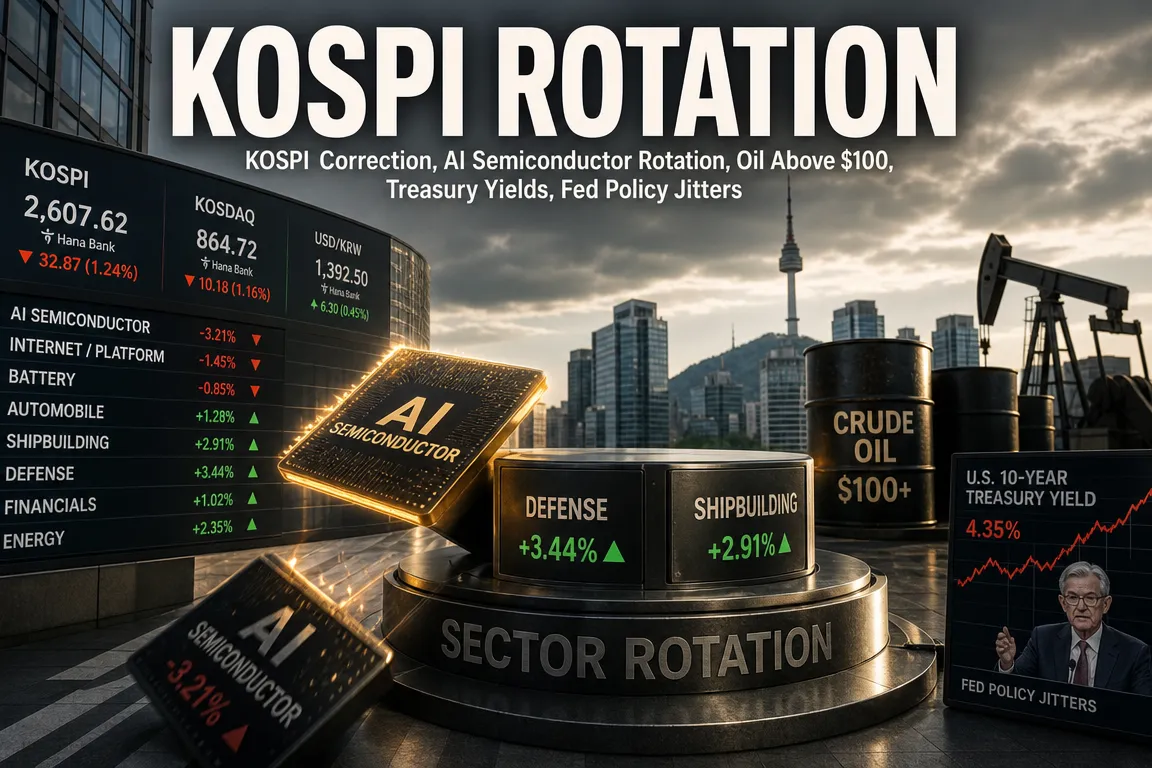
● KOSPI Shock, AI Rotation, Rate Jitters
KOSPI Correction May Signal a Rotation in Market Leadership Rather Than the End of the Cycle
The core issue in the current KOSPI correction is not simply that prices have fallen sharply.
The market is facing a combination of rising Treasury yields, renewed concern over the Federal Reserve’s policy path, crude oil volatility, U.S. political events, and a rotation in AI semiconductor leadership.
The key point is not that Samsung Electronics or SK hynix have fundamentally deteriorated, but that capital is shifting within the AI value chain.
This report reviews the current decline in the context of the KOSPI outlook, Treasury yields, policy rates, AI semiconductors, and the global economic outlook.
1. The Nature of the KOSPI Correction: Start of a Decline or End of a Move
The KOSPI has undergone a relatively sharp short-term correction.
Many investors are now asking whether they should reduce exposure or whether further downside is likely on Monday.
However, treating this move as a simple panic-driven selloff may miss the main structural point.
This correction reflects three factors acting simultaneously.
- Rising uncertainty ahead of a major U.S. political event
- Renewed concern over Treasury yields and policy rates
- Possible rotation in AI semiconductor leadership
In other words, the decline in the KOSPI is not explained solely by Korean corporate fundamentals.
It also reflects global risk reduction and a search for new opportunities within the AI value chain, which has weighed more heavily on Korean equities.
2. Why the U.S. Election Matters for Equities
The most frequently emphasized issue is the market impact of the U.S. election.
A midterm election is not only a political event; it is also a major source of uncertainty for global financial markets.
Markets generally dislike uncertainty.
When outcomes are difficult to predict, risk assets tend to be reduced and cash allocations increase.
There are four broad scenarios.
- A Democratic sweep of both chambers
- Republicans retaining the Senate
- Heavy Republican losses in both chambers
- Election disputes or broader political instability
The important point is that the market cannot know the outcome with certainty.
As a result, risk assets are often reduced ahead of the event.
This can create stronger pressure on emerging markets, including the KOSPI.
3. Why Korean Equities Have Been Weaker Than U.S. Equities
U.S. equities have multiple growth engines, including AI services, AI models, cloud platforms, data centers, power infrastructure, and physical AI.
By contrast, Korea’s exposure to the AI value chain is concentrated primarily in memory semiconductors.
In practical terms, the U.S. has a broader set of beneficiaries even when market leadership changes within AI.
In Korea, weakness in memory semiconductors can weigh on the entire index.
This structural difference is central to the recent KOSPI correction.
AI semiconductor demand remains important.
However, the market is increasingly asking whether memory can continue to dominate leadership.
If leadership shifts from AI memory to power infrastructure, AI services, physical AI, or data-center efficiency, Korean equities become structurally less favorable relative to the U.S.
4. CAPEX and U.S. Growth: What Happens After the Election Matters More
One of the most important drivers of recent U.S. growth has been corporate CAPEX.
CAPEX refers to capital expenditure.
It includes large-scale investment in AI data centers, semiconductor fabrication, power grids, and cloud infrastructure.
CAPEX accounts for a meaningful share of U.S. GDP growth.
For this reason, U.S. policymakers have strong incentives not to interrupt the investment cycle before the election.
AI investment remains an important support for the U.S. economy.
However, the market may reassess the outlook after the election.
Before the vote, support for growth and investment is likely to remain intact.
Afterward, policy priorities and the pace of investment may be re-evaluated.
This is an important variable for both the KOSPI outlook and the global economic outlook.
5. The Federal Reserve, Treasury Yields, and Policy Rates: Why the Market Is Nervous Again
Rising Treasury yields are another reason for the recent weakness.
Higher Treasury yields typically pressure growth and technology stocks.
As future earnings are discounted more heavily, valuations become more sensitive to rates.
The Federal Reserve’s policy path remains central.
Markets can stabilize when rate-cut expectations rise.
By contrast, if inflation, employment, or crude oil prices remain firm, the Fed may keep a more hawkish stance.
Market participants are also watching Fed-related personnel and policy signals.
These expectations and concerns are being reflected in rates markets.
Ultimately, policy rates, Treasury yields, and crude oil remain key variables in explaining the KOSPI correction.
6. China’s Low-Price Strategy and the Warning for Korea
One of the most important messages is the competitive strength of Chinese industry.
Some investors still assume that Korea and the U.S. retain clear technological leadership.
That view is only partially correct.
Markets do not always select the highest-performance products.
Price remains a decisive factor.
The report described this as a low-price strategy.
The risk is that companies may lose market share not because they fall behind technologically, but because they are outcompeted on cost.
For example, Ferrari is a leading brand with strong technology and performance.
However, most of the global auto market is not dominated by Ferrari, but by mass-market manufacturers such as Toyota.
This does not mean technology is unimportant.
It means that price, scale, and accessibility also determine market share.
7. China’s AI Model Share: Price Can Matter More Than Performance
A similar pattern is emerging in AI models.
U.S. AI models are generally regarded as more advanced.
However, the share of Chinese AI models is rising rapidly in actual use.
Companies do not always adopt the most expensive, highest-end model.
They often choose models that are sufficiently capable at lower cost.
This is a major change for the AI industry.
AI leadership may not be determined solely by model quality.
Pricing, API cost, implementation ease, local data usage, and policy support also matter.
For Korea, this trend should not be underestimated.
AI semiconductor demand may still rise, but that is separate from where profits within the AI industry ultimately accrue.
8. CXMT and the DRAM Market: The Most Sensitive Point to Watch
China’s CXMT is another important variable.
In the past, many investors did not view Chinese memory semiconductors as a major threat.
That view is changing.
While Samsung Electronics and SK hynix have maintained leadership in DRAM, CXMT’s share has been gradually increasing.
The key issue is not only high-bandwidth memory.
The semiconductor market includes both high-end and commodity products.
If China expands market share through lower pricing in standard memory products, overall industry profitability may come under pressure.
The U.S. is strengthening semiconductor self-sufficiency around Micron.
China is also expanding domestic procurement.
Korea is increasing capacity as well.
The risk is that if supply expands faster than demand, the price cycle may peak earlier than expected.
This is one of the most important risks in the AI semiconductor cycle.
9. Historical Industry Cases Show That Market Leadership Can Shift Even When Technology Leads
The report cited several examples of how Chinese pricing power has weakened established leaders.
These cases are relevant to Korea’s industrial outlook.
9-1. The LiDAR Market: The Decline of Velodyne
Velodyne was one of the earliest companies to commercialize LiDAR for autonomous driving.
Its initial product pricing was around $75,000, which was far too expensive for broad adoption.
Even after prices fell to around $30,000, large-scale mass adoption remained limited.
Chinese companies brought prices down to the hundreds of dollars, reshaping the market.
Velodyne, once a technology leader, eventually lost independence through consolidation.
9-2. The Solar Market: The Crisis at Q-Cells
Q-Cells was once a global leader in solar cells.
It relied on premium technology and the reputation of German manufacturing.
Chinese solar companies, however, used scale, subsidies, and aggressive price cuts to dominate the market.
Solar panel prices fell sharply over several years.
As a result, the European solar manufacturing ecosystem weakened significantly, and Q-Cells later became part of Hanwha Q CELLS.
9-3. The Drone Market: Leadership Shifted from 3DR to DJI
3DR was once a strong U.S. drone company.
DJI, however, offered integrated camera and gimbal solutions at much lower prices.
3DR drones required separate GoPro installation, which increased total cost.
DJI offered a more complete product at a lower price.
As a result, DJI captured overwhelming global market share.
3DR eventually moved away from hardware and shifted toward software.
9-4. The EV Market: Why BYD Should Not Be Underestimated
Chinese EVs are a similar case.
In the past, many dismissed Chinese EVs as irrelevant.
In reality, there is strong demand for affordable EVs.
High-income buyers may choose premium brands such as Tesla, while small business owners and middle-income consumers may prefer lower-cost alternatives.
Control of this segment can change the structure of the industry.
10. The Key Point Missing from Many Other Reports and Videos
The key issue is not that semiconductors are finished.
The real issue is that Korea’s position within the AI value chain is too narrow.
The U.S. has AI service companies, model developers, cloud providers, data-center operators, and power infrastructure firms.
As a result, capital can rotate within the market even when leadership changes.
If one AI service company weakens, another may benefit.
If one model company weakens, cloud or power infrastructure names can gain attention.
Korea remains heavily dependent on memory semiconductors within the AI value chain.
If Samsung Electronics and SK hynix weaken, sentiment across the KOSPI can also deteriorate.
This is a structural reason for Korea’s higher volatility relative to the U.S.
Another key point is that China should not be viewed only as a technological follower.
China can gain market share through price leadership even without being the technology leader.
This has already happened in steel, shipbuilding, displays, batteries, drones, solar, and EVs.
That pressure is now extending to AI semiconductors and the memory market.
11. Investment Strategy: Sell Now or Hold
The report’s investment principle is long-term investing.
For investors already holding losses at elevated entry prices, forced selling during peak fear may not be the best response.
At the same time, this does not imply that averaging down is always appropriate.
The key is to determine whether the market is undergoing a temporary pullback within an uptrend or a structural shift in leadership.
If the decline is temporary, staggered buying may be appropriate.
If this is a leadership rotation, aggressive averaging down may increase risk.
The current market tone is closer to risk aversion than exuberance.
In such phases, emotional selling should be approached carefully.
12. Key Events to Monitor
Several upcoming events will be important for market direction.
These include the Bank of Korea rate decision, the Federal Open Market Committee meeting, major tech earnings, and U.S. GDP and PCE data.
- Bank of Korea rate decision: the possibility of a hold or a hike remains open
- Hawkish hold: rates may be unchanged, but future hikes could still be signaled
- SK hynix earnings: confirmation of AI memory demand and profitability is essential
- FOMC meeting: the Fed’s policy path and Treasury yield response remain critical
- Samsung Electronics final earnings: important for memory-cycle and margin visibility
- Alphabet, Meta, and Microsoft earnings: useful for assessing AI CAPEX sustainability
- U.S. GDP and PCE data: key indicators for growth and inflation
- Apple and Amazon earnings: relevant for consumer demand and cloud spending
- Bank of Japan policy decision: important for the yen, the dollar, and global liquidity
PCE is one of the Fed’s most closely watched inflation measures.
If PCE is elevated, expectations for policy easing may weaken.
If inflation continues to cool, Treasury yields may stabilize and support growth stocks.
13. KOSPI Outlook: Structural Change Matters More Than Short-Term Fear
In the near term, the KOSPI may remain volatile.
The market is balancing political events in the U.S., Treasury yields, policy rates, major tech earnings, and semiconductor pricing expectations.
For investors, the more important issue is structural change rather than short-term price action.
For the KOSPI to strengthen, three conditions are needed.
- AI memory demand must continue to be confirmed through earnings
- Chinese memory supply must not materially damage pricing
- Korean equities must develop growth beyond semiconductors within the AI value chain
Ultimately, the KOSPI is not only about Samsung Electronics and SK hynix.
The broader question is whether Korea can expand into AI services, AI models, power infrastructure, physical AI, and data-center efficiency.
14. What Investors Should Do Now
First, avoid making impulsive decisions based on fear.
Second, when evaluating AI semiconductors, look beyond memory and assess the full AI value chain.
Third, do not underestimate China’s low-price strategy.
Fourth, monitor how Treasury yields and policy rates affect growth-stock valuations.
Fifth, focus not only on short-term rebounds but on where market leadership may shift by 2027.
The current market is better understood as a phase of leadership rotation than as a simple correction.
Memory semiconductors may recover.
However, market leadership may increasingly move toward power infrastructure, physical AI, AI services, and data-center efficiency.
< Summary >
The KOSPI correction reflects a combination of U.S. political events, Treasury yields, policy rates, and a rotation in AI semiconductor leadership.
The U.S. offers multiple opportunities across the AI value chain, while Korea’s concentration in memory semiconductors creates higher volatility.
China may not lead in technology, but it can still capture markets through low-price strategies, and CXMT’s rise is an important warning for Korean semiconductors.
Investors already holding losses should avoid emotional selling and consider both long-term discipline and risk management.
Key variables ahead include the Bank of Korea rate decision, the FOMC, major tech earnings, U.S. GDP and PCE data, and earnings from Samsung Electronics and SK hynix.
[Related Articles…]
*Source: [ 경제 읽어주는 남자(김광석TV) ]
– [생방송] 코스피, 조정의 시작인가? 끝인가? [즉시분석]
● Black Monday, AI Shock, Oil Surge, Korea Selloff
Assessing the Risk of a Black Monday: KOSPI Outlook, DeepSeek Shock, CoreWeave Risk, and the Simultaneous Surge in Oil Prices Toward $100
The key issue in this market is not simply how much the KOSPI may fall on Monday.
The more important point is that concerns over AI infrastructure investment bubbles, CoreWeave financial risk, DeepSeek’s low-cost AI model, crude oil returning to $100, and foreign selling combined with rising retail margin debt have emerged at the same time.
In other words, the current downside pressure is not driven by a single short-term negative catalyst, but by a cluster of risks that could flow from a pullback in U.S. equities → weakening AI sentiment → concerns over semiconductor and HBM demand → deterioration in KOSPI market breadth.
Among the variables the market has not yet fully priced in is DeepSeek’s new AI model.
What is more concerning than performance is pricing.
If the reported cost structure at up to one-fortieth of competing models is accurate, it could materially challenge the profitability assumptions across the AI industry.
1. Why the KOSPI Looks Vulnerable on Monday: Friday’s Rebound May Have Created Additional Pressure
The first point highlighted in the original text is Friday’s rebound in the KOSPI.
In a declining market, a sharp selloff followed by a weak close often creates expectations of a technical rebound on Monday.
However, in this case, the KOSPI had already rebounded by roughly 2% on Friday, while U.S. equities gave back intraday gains and weakened into the close, which adds pressure.
From a chart perspective, this appears less like a strong recovery and more like a minor retracement within a broader downtrend.
When the slope of decline is steep, a short-term rebound is rarely sufficient to confirm a trend reversal.
Instead, if additional negative news emerges immediately after a rebound, investors may interpret it as a selling opportunity, which can intensify supply.
What matters here is that the Monday KOSPI outlook is not being determined solely by domestic developments.
The current environment links the Nasdaq, AI semiconductors, the dollar exchange rate, oil prices, and foreign investor flows.
Because the Korean market has a heavy semiconductor weight, concerns over U.S. AI infrastructure companies can quickly affect sentiment toward large-cap Korean stocks.
2. The Core U.S. Equity Driver: Concerns Over Recouping AI Infrastructure Spending
The core driver behind the recent U.S. market correction is the question of whether AI infrastructure spending can be recouped.
For much of the past year, the market has valued companies such as Nvidia, semiconductor suppliers, cloud providers, and power infrastructure firms on the assumption that AI data center demand will continue to expand.
Recently, however, investors have again begun to question whether such large capital outlays can generate adequate returns.
The original text notes that this issue had surfaced before.
Concerns over AI fund redemption limits, data center investment burdens, and GPU-collateralized financing structures were previously raised, but the market recovered.
This time, however, the situation appears different.
The reason is that credit risk at companies such as CoreWeave is becoming visible through more concrete data.
3. CoreWeave Risk: What a 15% CDS Premium Implies
CoreWeave is widely cited as a major provider of AI data center and GPU infrastructure.
The key issue is that the original text refers to CoreWeave’s CDS premium reaching around 15%.
A CDS is a derivative used to hedge or speculate on a company’s default risk.
A higher CDS premium indicates that the credit market sees elevated default risk.
The original text interprets a 15% CDS premium as a level that reflects substantial concern about default risk.
Equity markets can remain optimistic about growth potential, but bond markets tend to focus more directly on cash flow and repayment capacity.
As a result, bond markets often send warning signals before equity markets do.
The core of CoreWeave’s model is to secure large quantities of GPUs, use those GPUs as collateral to borrow funding, build out data center capacity, and monetize AI demand through service revenue.
This structure is highly attractive during a growth phase.
With limited equity capital, the company can leverage GPU assets, and if AI demand remains strong, returns can be amplified.
However, this also means the model is highly sensitive to changes in conditions.
AI data center demand must remain strong.
GPU lease rates or AI compute prices must not fall too quickly.
A sharp decline in GPU prices would also be problematic.
Because the GPUs are used as collateral for borrowing, a fall in collateral value can create additional funding needs, including a margin-call-like cash burden.
4. Why the CoreWeave Structure Is Risky: Similarities to Leveraged Bitcoin Strategies
The original text compares CoreWeave’s business structure with earlier leveraged Bitcoin collateral strategies.
The analogy is to borrowing against Bitcoin and then using the borrowed funds to buy more Bitcoin.
When the asset price rises, leverage magnifies gains.
When the asset price falls, collateral deterioration, additional funding requirements, and forced selling risks can emerge simultaneously.
The same logic applies to GPUs.
At present, GPUs are being valued highly because AI demand remains strong, but if AI firms slow investment to reduce costs or if ultra-low-cost models become more widespread, the demand outlook for GPUs could weaken.
That would raise concerns about the financial stability of AI infrastructure companies and could spread to Nvidia, HBM, memory semiconductors, data center-related stocks, and power infrastructure names.
Investors are also watching whether Nvidia will provide any form of support to CoreWeave or other key customers and ecosystem partners.
However, the original text argues that Jensen Huang’s comments remained at the level of general confidence and did not provide clear evidence of financial support.
What the market wanted was not reassurance, but numbers.
The lack of specific visibility on revenue, cash flow, contract stability, and funding capacity weighed on sentiment.
5. Crude Oil Back Above $100: A Negative Combination for Equities
Another major negative factor is crude oil.
The original text states that oil quietly moved back above $100.
Oil remaining persistently above $100 tends to weigh heavily on equity markets.
Higher oil prices are not just about fuel costs.
For companies, logistics, raw materials, and power expenses rise.
For consumers, higher household energy costs reduce discretionary spending capacity.
For central banks, inflation can reaccelerate, making policy easing more difficult.
In effect, higher oil prices create both inflation pressure and interest-rate pressure.
This combination is particularly negative for growth and technology stocks.
AI-related shares are often valued by discounting future growth, and higher rates reduce the present value of those future earnings.
A similar pattern was seen during the 2022 period of high oil prices.
Equities and bonds were pressured at the same time, and investors rotated toward defensive sectors such as consumer staples and dividend-paying names.
Relative strength in Coca-Cola, P&G, and Hershey followed the same logic.
6. There Is Little Room for Oil to Ease: Why the Numbers Matter More Than the Headlines
One important phrase in the original text is that investors should not focus on the elegance of the wording, but on the numbers behind it.
Markets regularly hear news that appears to point to lower oil prices.
Strategic reserve releases, imports of Russian diesel, producer consultations, and potential supply increases are typical examples.
However, the actual figures may have only limited impact on the market balance.
For example, if Russian diesel imports amount only to roughly one day of U.S. consumption, the headline may appear large, but it is unlikely to materially change the supply-demand equilibrium.
Releasing strategic reserves also means they must eventually be replenished.
Unless geopolitical risk fully disappears, the outlook for oil prices is unlikely to stabilize quickly.
In this environment, oil holding in the $90 to $100 range remains a burden for both U.S. equities and the KOSPI.
For Korea in particular, which relies heavily on imported energy, high oil prices affect the trade balance, the exchange rate, and corporate margins at the same time.
7. DeepSeek’s New AI Model: A Weekend Risk Not Yet Fully Reflected
One of the most important variables in the original text is DeepSeek’s new AI model.
Because it was announced over the weekend, the key issue is how the market interprets it on Monday.
DeepSeek has already once before disrupted global AI markets.
Initially, it raised concerns that the technological lead of U.S. AI companies could be challenged.
The market later developed some resilience, but this time the pricing issue appears more significant.
According to the original text, DeepSeek’s new model reportedly scored 77 points in its own evaluation, compared with 74 for Claude Opus 5 and 73 for GPT-based models.
However, this is an internal assessment and not independently verified.
Accordingly, the score should not be treated as a definitive fact, but rather as a narrative that may shape market reaction.
The real shock is pricing.
There are reports that the model may be priced at up to one-fortieth of competing offerings.
If a competing model costs 1 million won and DeepSeek offers similar functionality for around 25,000 won, customers are likely to shift toward the lower-cost option in many general-purpose use cases.
8. The Core of the AI Price War: Profitability Erosion Is More Damaging Than Performance Competition
Lower AI model pricing is beneficial for users.
For investors, however, the implications are different.
Companies such as OpenAI, Anthropic, Google, and Meta are absorbing substantial compute-related costs.
GPU, data center, power, cooling, and network infrastructure expenses are substantial.
If AI token prices fall sharply, revenue per unit declines.
Investors who previously supported these firms on the assumption of 2030 profitability may now question whether the break-even timeline is being pushed further out.
The concern is that if a company remains unprofitable while pricing is also falling, its investment case becomes more difficult to defend.
Reduced investment could slow the expansion of compute capacity.
Lower compute expansion could weaken model competitiveness.
That, in turn, could reduce data center demand.
Weaker data center demand would then affect outlooks for GPUs and HBM.
In effect, DeepSeek’s low-price strategy is not just an issue for the AI application layer.
It could affect profitability assumptions across the entire value chain, including Nvidia, SK hynix, Samsung Electronics, data center REITs, power infrastructure firms, and cooling equipment suppliers.
9. The Strategic Choice for U.S. AI Companies: Preserve Listing Valuations or Join the Price War
The original text argues that the next step for U.S. AI companies will be important.
The first option is to maintain pricing as much as possible until an IPO or new capital raise.
This would help preserve the short-term profitability narrative, but it could result in losing market share to lower-cost competitors.
The second option is to join the price war, even if that means delaying an IPO.
This would help protect the user base, but it could push the break-even point further out.
Such a move would likely undermine the profitability timeline investors had expected.
Rumors surrounding a potential Anthropic listing can be interpreted in this context.
For AI companies, an IPO is not only a corporate event, but also a signal of how the market is pricing the long-term profitability of the industry.
10. The Market Lacks News That Would Support Risk Appetite
Equity markets are ultimately driven by fear and greed.
Strong earnings surprises, technological breakthroughs, rate-cut expectations, and policy stimulus tend to support risk appetite.
By contrast, default risk, high oil prices, interest-rate pressure, credit tightening, and price wars tend to drive fear.
At present, the market lacks news that would strongly encourage buying.
Long-term optimism toward AI remains intact, but in the short term, investment recoupment, pricing pressure, and credit risk are dominating.
In such an environment, one negative headline can have a larger impact than one positive headline.
In a falling market, buying simply because prices are lower can be risky.
Retail investors often buy into the early stages of a decline, but if the correction deepens, those positions are frequently turned into stop-loss selling.
11. Why the Supply-Demand Setup Is More Fragile: Declining Deposits and Rising Margin Debt
Another key data point cited in the original text is customer deposits and margin debt.
Customer deposits represent idle funds held in brokerage accounts for future stock purchases.
A decline in deposits indicates weaker dry powder for new buying.
By contrast, rising margin debt means a larger share of investments is being financed with borrowed money.
A combination of declining deposits and rising margin debt is unfavorable.
It means cash-based buying power is weakening while leverage risk is increasing.
If prices fall further, forced liquidations or margin calls may emerge.
This can create a negative feedback loop in which falling prices trigger more selling.
If margin debt is concentrated near market highs, selling pressure can intensify when the index corrects.
12. Foreign Selling and Slowing Share Buybacks: Who Will Support the Market?
Share buybacks are currently cited as one of the more consistent sources of demand.
However, the original text says that even buyback amounts are declining.
Share repurchases can support the market in a downturn, but if the scale shrinks, the defensive effect also weakens.
Meanwhile, foreign investors are described as selling in the trillions of won per day.
It is important to note that foreign broker research and actual trading may differ.
Reports may still describe the KOSPI as near a bottom and argue that Samsung Electronics and SK hynix are attractive buying opportunities, while actual trading flows remain negative.
Investors should therefore focus on actual money flows rather than commentary.
The key is not what analysts say, but where capital is actually moving.
Foreign flows matter especially because they are tied to the exchange rate, U.S. interest rates, and global risk appetite.
13. A Common Retail Pattern in Downturns
The original text also describes a common pattern among retail investors in downturns.
When the initial decline begins, retail investors often view it as a buying opportunity.
However, if the drop is deeper than expected, sentiment weakens.
The next stage is typically selling by investors who can no longer tolerate losses.
At that point, foreign and institutional investors often absorb supply near the lows.
Later, when the market recovers, retail investors frequently re-enter near the highs.
As a result, assets tend to be cheap when sentiment is weak and expensive when attention is strongest.
The key investment lesson here is more about psychology than arithmetic.
When everyone around you is talking about buying, it may be time to reduce risk gradually.
When everyone says they have left the market, it may be time to look for opportunities.
14. Why Monday Cannot Be Assumed to Be a Black Monday
That said, Monday cannot automatically be assumed to be a Black Monday.
The original text approaches this cautiously.
In bull markets, Monday is often the day when buying pressure returns.
If weekend fear eases and the initial shock is reduced, the reaction can be much milder than expected.
If early buying appears on Monday, the decline may be more limited than forecast.
However, when multiple negatives are aligned, the market must distinguish between a technical rebound and a genuine trend reversal.
In particular, foreign flows, the exchange rate, Nasdaq futures, and large-cap semiconductor performance should be monitored together.
15. The Most Important Point Not Always Covered in Other Commentary
First, AI infrastructure risk is not just a growth-stock correction; it is a collateral-financing risk.
Many reports simply describe the move as a pause after a strong AI rally.
More importantly, however, the risk lies in leverage built on GPU collateral.
If GPU prices, lease rates, and data center demand weaken at the same time, the issue can become a credit event.
Second, the real impact of DeepSeek is pricing, not performance.
The performance score may be disputed because it is self-evaluated.
But the narrative of pricing at one-fortieth of competitors can directly pressure revenue assumptions and the timing of profitability across AI companies.
If the industry’s profitability assumptions weaken, data center investment plans may also be revised.
Third, high oil prices and AI price competition are different risks, but together they pressure technology valuations.
Higher oil prices weaken expectations for rate cuts.
AI price competition weakens future earnings assumptions.
That creates a combination of a higher discount rate and lower earnings expectations.
Fourth, actual trading flows matter more than foreign research reports.
Even if reports are constructive on the KOSPI, continued foreign selling in the market will weigh more heavily.
Investors should track capital flows, not just written forecasts.
Fifth, the current decline is not about isolated negatives, but about a chain reaction.
DeepSeek’s price cuts pressure AI profitability.
Concerns over AI profitability lead to slower data center investment.
Slower data center investment then affects GPU and HBM demand expectations.
As a result, sentiment toward Korean semiconductor leaders and the broader KOSPI can weaken.
16. Key Indicators for Investors to Monitor
1) Nasdaq and the Philadelphia Semiconductor Index
These are the fastest indicators of AI semiconductor sentiment.
Investors should also monitor Nvidia, AMD, Broadcom, and Micron.
2) CoreWeave credit indicators
CDS premiums, bond yields, and funding news are important.
The bond market may price in risk before the equity market does.
3) Crude oil
If oil remains above $100, inflation and rate pressure will rise.
This affects both U.S. equities and the KOSPI.
4) The dollar exchange rate and foreign flows
If the won weakens sharply and foreign selling continues, domestic market support may deteriorate.
Large-cap semiconductor flows are especially important.
5) Customer deposits and margin debt
Falling deposits and rising margin debt are a dangerous combination in a downturn.
If forced selling risk rises, volatility can expand further.
17. Which Sectors May Be More Defensive
In periods of high oil prices and rate pressure, defensive sectors may outperform growth stocks.
Consumer staples, dividend stocks, and companies with stable cash flows may attract attention.
During the 2022 oil-price shock, global markets also showed relative strength in defensive consumer names and dividend-oriented equities.
By contrast, AI infrastructure, high-valuation growth stocks, and leveraged business models may remain volatile.
In semiconductors, the long-term growth story remains intact, but in the short term, investors must weigh AI investment recoupment concerns and DeepSeek’s pricing pressure.
In the Korean market, Samsung Electronics and SK hynix are likely to remain the main drivers of KOSPI direction.
However, when large caps weaken, some defensive mid-cap names, domestic consumption plays, beauty, and food and beverage stocks may show relative strength.
18. Conclusion: The More Important Point Is That the Nature of the Risk Has Changed
No one can say with precision how much the KOSPI will fall on Monday.
What is clear, however, is that the current risk is no longer a simple short-term correction.
AI infrastructure investment may continue, but the market is now demanding clearer proof of returns and profitability.
DeepSeek’s low-cost model is pressuring pricing power and the profitability timeline of AI companies.
Crude oil above $100 is renewing inflation and rate concerns.
Foreign selling and rising margin debt can intensify supply pressure in the KOSPI during a downturn.
Accordingly, this is a market in which risk management is more important than aggressive chasing of rebounds.
Even if the market bounces, investors should verify whether the rebound is supported by improving foreign flows, lower oil prices, easing AI credit risk, and a recovery in semiconductor leaders.
Rather than buying solely because prices have fallen, a more prudent approach is to wait for concrete evidence that market fear is easing.
< Summary >
The current KOSPI downside risk reflects a combination of AI infrastructure concerns, high oil prices, credit risk, and foreign selling, rather than a single isolated event.
CoreWeave’s rising CDS premium highlights market concern over a GPU-collateralized leverage model.
DeepSeek’s new AI model is more significant for its low-cost pricing strategy than for its performance score, and it may challenge profitability assumptions across the AI sector.
Crude oil above $100 increases inflation and rate pressure, creating headwinds for growth and technology stocks.
Falling deposits and rising margin debt increase the risk of forced selling in a downturn.
While Monday cannot be assumed to be a Black Monday, risk management is more important than chasing a rebound at this stage.
[Related Articles…]
*Source: [ Jun’s economy lab ]
– 검은월요일, 코스피는 얼마나 떨어질까?(ft.딥시크, 코워위브)