● AI-Driven Semis, Money-Power-CAPEX Bottleneck
Semiconductor Peak Debate: The Key Variables Are Not HBM Prices, but Capital, Power, and CAPEX
The central issue in this discussion was not simply whether to buy Samsung Electronics or sell SK Hynix.
The main questions were whether the semiconductor cycle is shifting from a price-driven P-cycle to a volume-driven Q-cycle, how resilient AI semiconductor demand can remain, and how far U.S. Treasury yields and data center CAPEX can be sustained.
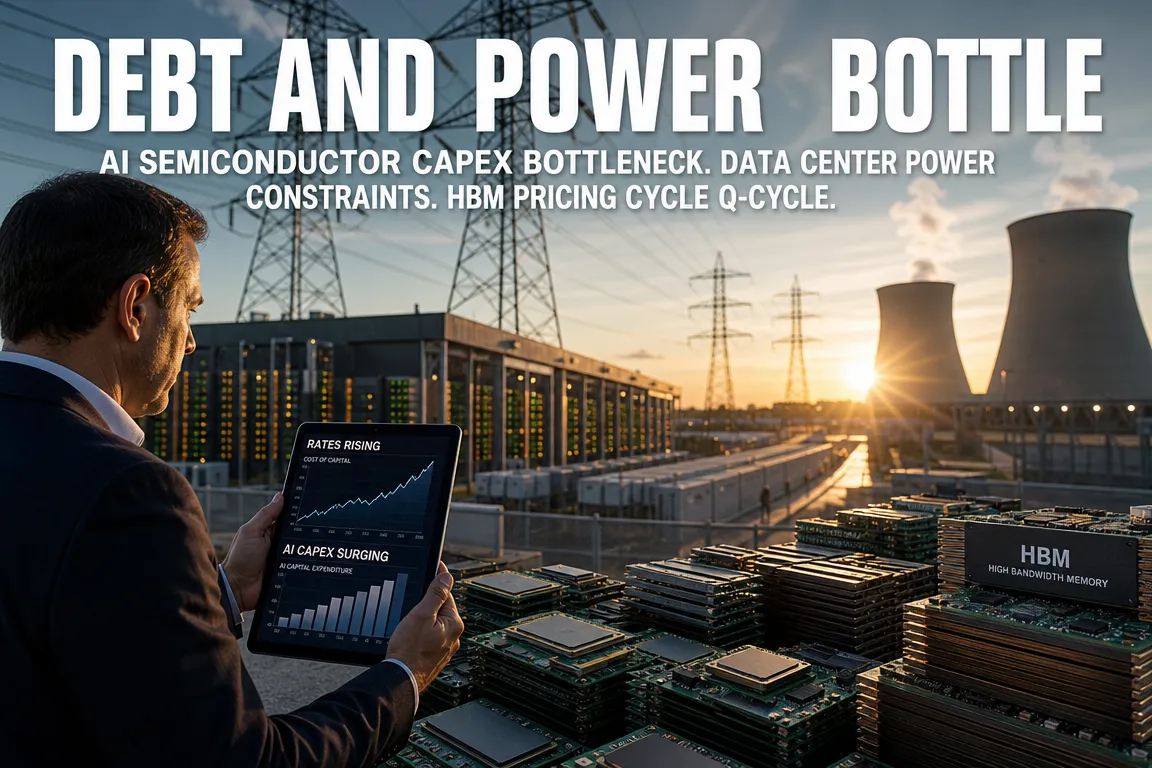
A critical point often missed in other coverage is that strong AI demand does not prevent semiconductor stocks from weakening first if financing and power become bottlenecks.
In other words, to understand why the industry can remain fundamentally strong while stock prices move sideways, HBM alone is no longer sufficient.
Investors now need to track hyperscaler investment capacity, U.S. Treasury yields, power infrastructure, the rise of Chinese memory semiconductors, and the platform competition around AMD and Nvidia in AI infrastructure.
1. Semiconductor Equity Performance This Year: Why the Sector Surged in the First Half and Moved Sideways in the Second
Semiconductor stocks performed strongly in the first half of the year.
The drivers were expanding AI infrastructure investment, surging HBM demand, rising memory prices, and policy expectations.
Samsung Electronics, SK Hynix, and semiconductor materials, components, and equipment stocks all posted strong gains.
Momentum weakened in the second half.
The main reason was liquidity.
AI semiconductor earnings expectations remained intact, but higher Treasury yields slowed market liquidity.
As leveraged capital exited and foreign investors sold, the sector failed to sustain a strong rebound.
- First-half drivers: AI investment expansion, HBM price increases, memory recovery, policy expectations
- Second-half headwinds: Higher Treasury yields, tighter liquidity, deleveraging, foreign selling
- Current state: Fundamentals remain strong, but stock prices are range-bound
The market has increasingly separated improving semiconductor earnings from the valuation environment required to support higher multiples.
This is the first key point for understanding Samsung Electronics and SK Hynix.
2. From P-Cycle to Q-Cycle: The Peak Debate in Memory Pricing
The discussion centered on the distinction between P-cycles and Q-cycles.
A P-cycle is a phase in which prices rise and earnings improve.
A Q-cycle is a phase in which price growth slows or moderates, while shipment volumes support earnings.
Memory semiconductors have historically been highly price-cycle dependent.
In the past, demand was led by PCs and smartphones, so downturns in the broader economy quickly weakened demand.
As a result, stock prices often peaked quickly once pricing topped out.
This cycle is different.
The demand center has shifted from smartphones and PCs to AI data centers.
AI infrastructure is closer to capital infrastructure than consumer demand.
Once investment starts, it is difficult to stop, and firms must keep investing to avoid falling behind.
- Past memory cycle: PC and smartphone-led B2C demand
- Current AI memory cycle: Data center and AI server-led B2B infrastructure demand
- Key change: Lower cyclical sensitivity, higher CAPEX durability
Supply structure has also changed.
HBM is different from conventional DRAM.
It is more customer-specific, harder to produce, and requires more wafers and process time per unit of capacity.
Converting existing DDR5 lines to HBM also tightens supply in conventional DRAM.
As a result, expanding HBM output can make overall memory supply tighter.
This is why pricing may not collapse immediately, but instead may correct gradually near high levels while shipment growth continues to support earnings.
3. When Will Memory Prices Peak?
Views in the discussion diverged.
One side argued that memory price gains could continue at least until the middle of next year.
The rationale was that AI infrastructure demand remains strong and HBM and other high-performance memory supply remains constrained.
The opposing view was that the price peak could arrive earlier than expected.
The reason is U.S. Treasury yields and funding costs.
AI data centers require very large CAPEX.
When interest rates are high, bond issuance and external financing become more expensive.
As a result, investment pace can slow.
- Bull case: Persistent HBM shortages, continued AI data center investment, transition into a Q-cycle
- Base case: Prices approach a peak, but shipment growth supports earnings
- Bear case: Higher Treasury yields and slower CAPEX bring the price peak forward
A price peak does not necessarily mean a collapse in the industry.
Even if price growth slows, earnings can remain resilient if shipment volumes continue to expand.
However, equity markets tend to be highly sensitive to peak pricing signals.
Because semiconductor stocks often move ahead of earnings, the market may price in concerns before actual price declines occur.
4. The Real Variable Is Not HBM, but Treasury Yields and Capital
The most repeated variable in the discussion was Treasury yields.
AI infrastructure investment is capital intensive.
Major hyperscalers such as Amazon, Microsoft, Google, Meta, and Oracle are making large investments in data centers, GPUs, HBM, and power infrastructure.
The issue is that the scale has become extremely large.
The discussion noted that the AI infrastructure CAPEX of leading hyperscalers has become comparable in scale to the U.S. defense budget.
At that size, internal cash flow alone is insufficient, making bond issuance and external funding essential.
When Treasury yields are high, corporate financing costs rise as well.
If yields remain near 5% for an extended period, data center investment will face pressure.
Even with strong AI growth potential, insufficient funding can slow execution.
- AI demand: Still strong
- Problem: High cost of capital
- Result: Slower CAPEX could lead to downward revisions in semiconductor demand expectations
This is the most important real-world variable in semiconductor investing today.
It is no longer sufficient to say that AI will keep growing.
Investors must assess who will finance that growth, at what interest rate, and for how long.
5. Data Center Bottlenecks: After Capital, Power Becomes the Constraint
Another major bottleneck is power.
A data center is not just land and servers.
It requires electricity, cooling, transmission infrastructure, water, and permits.
In the United States, local opposition to data center construction is also increasing.
Large facilities can strain local infrastructure when built in areas with limited power or water capacity.
This NIMBY dynamic can slow investment.
- Bottleneck 1: Power shortages
- Bottleneck 2: Cooling infrastructure constraints
- Bottleneck 3: Permitting delays
- Bottleneck 4: Water usage concerns
This bottleneck also affects semiconductor demand.
If data centers are delayed, orders for GPUs, HBM, SSDs, and networking equipment may also be delayed.
In that sense, the biggest risk to semiconductor demand may originate not in the semiconductor industry itself, but in power infrastructure.
6. The Rise of Chinese Memory Semiconductors: A Medium-Term Risk More Than a Near-Term One
The rise of Chinese memory suppliers was also discussed.
In particular, the growing share of companies such as CXMT raised concern.
Given Korea’s past experience with Chinese low-cost competition in displays, steel, shipbuilding, and batteries, participants asked whether memory semiconductors could follow a similar path.
In the near term, however, Chinese memory is unlikely to enter U.S. hyperscaler data centers at scale.
AI data centers are highly sensitive to security concerns.
It would be politically and strategically difficult for U.S. hyperscalers to widely adopt Chinese memory in core infrastructure.
- B2B data center market: Chinese adoption may remain limited due to security concerns
- B2C device market: Greater potential for Chinese memory expansion
- Medium-term risk: Greater Chinese influence in on-device AI, robotics, and edge devices
Accordingly, the Chinese risk is less likely to undermine Samsung Electronics and SK Hynix immediately, but it is likely to matter more in the next cycle.
As physical AI, robotics, and on-device AI expand, low-cost memory demand is expected to rise.
If Chinese suppliers gain share in those markets, it could pressure the long-term competitiveness of Korea’s memory industry.
7. The Real Strategy for Korean Semiconductors: Memory Must Become a Platform
One of the most important takeaways from the discussion was that memory semiconductors are increasingly becoming more like foundry businesses.
In the past, memory was an industry in which scale and cost leadership mattered most.
In the AI era, however, customer-specific memory, memory optimized for GPUs and CPUs, and packaging integration are becoming more important.
HBM must be optimized for Nvidia GPUs.
Servers may require new memory architectures such as CXL, LPCAMM, and SOCAM.
In robotics and on-device AI, low-latency performance may require closer integration between processors and memory, or even single-package solutions.
The competition is no longer just about unit cost.
What matters is entering the design phase early with customers, helping set standards, and creating ecosystem lock-in.
- Past memory competition: Mass production, cost reduction, generic products
- AI-era memory competition: Custom design, packaging, platform integration, customer lock-in
- Opportunity for Korean firms: HBM, advanced packaging, customer-specific solutions
From this perspective, Samsung Electronics and SK Hynix are not merely memory suppliers. They are strategic participants in the AI infrastructure ecosystem.
To maintain that position, collaboration with Nvidia, AMD, Intel, and hyperscalers will become increasingly important.
8. AMD’s Visit to Korea and the AI Infrastructure Standard Race: Why This Could Be an Opportunity
The visit by AMD’s CEO to Korea and discussions with Samsung Electronics should not be viewed as a routine business meeting.
AI infrastructure is no longer a market centered on GPUs alone.
GPU, CPU, memory, networking, storage, packaging, cooling, and software must all be integrated into one platform.
Nvidia is moving quickly in this direction.
It is no longer just a GPU vendor, but a company building an AI infrastructure platform that includes CPUs, GPUs, server racks, networking, cooling, and the CUDA software ecosystem.
The interconnect structure of AI data centers is also important.
Scale-up, scale-out, and scale-across architectures are becoming core elements.
Nvidia has built a strong standard through NVLink, InfiniBand, and CUDA.
AMD needs an open ecosystem to challenge Nvidia’s dominance.
In that process, cooperation with Korean memory companies could become more important.
Samsung Electronics, in particular, has memory, foundry, and packaging capabilities, which could create structural opportunities if collaboration with AMD expands.
- Nvidia strategy: Expanding from a closed ecosystem toward controlled openness while maintaining dominance
- AMD strategy: Building an open AI infrastructure ecosystem
- Opportunity for Korea: HBM, advanced packaging, foundry, custom memory cooperation
Korean semiconductor companies should not focus only on Nvidia.
Participation in Nvidia’s ecosystem is important, but long-term bargaining power also requires access to AMD and other alternative ecosystems.
9. Can Samsung Electronics and SK Hynix Become Leading Stocks Again?
The discussion also addressed whether these companies can regain leadership.
One view was that the Korean market currently lacks a true leadership stock.
Semiconductors are not lifting the market, and the KOSPI remains range-bound.
The opposing view was that Samsung Electronics and SK Hynix remain the leadership stocks, but are currently underperforming.
Semiconductors account for a very large share of Korean exports.
From a real-economy perspective, the sector remains Korea’s leading industry.
- No-leadership view: There is no stock currently driving the market higher
- Semiconductor-leadership view: Samsung Electronics and SK Hynix remain the leaders, but are stuck in a range
- Shared conclusion: A renewed semiconductor rally is likely needed for the KOSPI to strengthen
For Samsung Electronics and SK Hynix to regain leadership, three conditions are needed.
First, investors need confidence in HBM pricing and volume.
Second, hyperscaler CAPEX must remain intact.
Third, Treasury yields must stabilize and market liquidity must improve.
10. The Themes to Watch Into 2027: Companies with Bottlenecks Will Command Premiums
Going forward, bottlenecks will matter most.
Companies with bottlenecks can raise prices and pass costs on to customers.
In contrast, industries where supply expands quickly may see lower valuations even if earnings improve.
The bottleneck candidates discussed were as follows.
- DRAM: Tightening lead times despite pricing concerns
- HBM: Korea’s competitive position remains strong in the core AI bottleneck
- HDD: Data storage demand may extend lead times
- ABF and FCBGA substrates: Supply constraints from advanced packaging demand
- MLCC: Demand growth from servers, automotive electronics, and AI hardware
- Enterprise SSDs: Rising demand from data centers
- CPUs: Potential tight supply as AI servers expand
GPUs have long symbolized supply shortages, but some areas are now showing signs of normalization.
As a result, the next leadership theme may shift from GPUs themselves to the bottlenecks around them.
11. Power Infrastructure and On-Site Generation: A Hidden Core Theme in the AI Era
Power infrastructure is also becoming a major theme.
However, large-scale infrastructure such as nuclear power plants and transmission lines takes time to materialize, which means earnings recognition will also lag.
For that reason, on-site power generation may attract more attention in the near term.
On-site generation refers to power produced directly near the data center.
Relevant segments may include fuel cells, solar, LNG generation, small modular reactors, and energy storage systems.
- Long-term power themes: Nuclear power, transmission, transformers, power equipment
- Medium-term power themes: LNG generation, ESS, power management solutions
- Near-term themes: On-site power, fuel cells, solar, data center power solutions
As the AI infrastructure race extends, power supply capacity becomes a national competitive advantage.
Korea’s strengths in LNG, Japan’s nuclear capability, and Europe’s renewable power base could all become relevant to U.S. AI infrastructure investment.
12. Physical AI and Robotics: Still Early, but Worth Monitoring
Physical AI was also identified as a key next-stage theme.
It refers to AI operating in the physical world, including robotics, autonomous driving, drones, and smart factories.
Data center AI remains the center of the current cycle, but the next phase is AI moving into the real world.
The pace of production for Tesla’s Optimus humanoid robot is particularly important.
Just as Model 3 helped mainstream EVs, a mass-production robotics model could significantly expand demand for related semiconductors and components.
- Core physical AI areas: Robotics, autonomous driving, drones, factory automation
- Required semiconductors: Low-power memory, sensors, AI processors, edge computing chips
- China risk: Potential global share gains through low-cost mass-produced robots
That said, robotics still requires more time than data center AI.
It is therefore a medium- to long-term theme rather than an immediate leadership area.
13. Three Sell Signals Investors Should Monitor
The most practical part of the discussion was the list of sell signals.
Investors holding semiconductor stocks should monitor the following three indicators.
- First, downward revisions to hyperscaler CAPEX guidance.
If Amazon, Microsoft, Google, Meta, or Oracle lower their AI investment plans during earnings releases, caution is warranted. - Second, narrowing gaps between spot memory prices and contract prices.
If spot prices converge quickly toward contract prices, investors should begin to question whether pricing has peaked. - Third, shorter lead times.
A sudden reduction in delivery times suggests that supply is becoming more available.
In the past, investors could rely on the crossover between spot and contract prices, but several participants argued that waiting for that signal may now be too late.
Market reactions are much faster than before.
14. Investment Views Were Split: Reduce Exposure or Buy in Stages?
The discussion produced differing investment conclusions.
One side argued that exposure should be reduced and cash raised because liquidity pressure remains strong.
In a period of tightening market liquidity, even high-quality companies can weaken.
The other side argued that this is a stage for staged accumulation.
Memory fundamentals remain solid, and if rate pressure eases, a Q-cycle could support further upside.
A third view was that a rapid sale is unnecessary, but range-bound trading is likely.
Even if semiconductor earnings improve, Samsung Electronics and SK Hynix may remain range-bound if leadership shifts toward power, physical AI, or AI infrastructure bottlenecks.
- Conservative view: Reduce exposure due to liquidity pressure
- Positive view: Accumulate on weakness because fundamentals remain strong
- Neutral view: Earnings are solid, but leadership rotation could keep the stocks range-bound
For individual investors, cash allocation is critical.
Without sufficient cash, volatility can become psychologically difficult to manage.
By contrast, for long-term investors with adequate cash, corrections can create opportunities.
15. Positive Catalysts That Could Restore Strength in Samsung Electronics and SK Hynix
Several catalysts would be needed for semiconductor stocks to regain strength.
- Extended AI cycle: Hyperscalers continue investing rather than cutting CAPEX
- Stable Treasury yields: Lower financing pressure and improved valuation support for growth stocks
- Higher HBM pricing: Upward revisions to next year’s HBM pricing and volume guidance
- HBM4 competitiveness: Sustained technical advantage in the next generation of HBM
- Stronger shareholder returns: Buybacks, cancellations, and dividend growth
- AMD and hyperscaler cooperation: Broader adoption of Korean memory beyond Nvidia’s ecosystem
HBM4 is particularly important.
HBM3E has already seen a relatively established competitive structure, but HBM4 is likely to place greater emphasis on customer-specific design and packaging capabilities.
If Samsung Electronics and SK Hynix secure leadership in that segment, they could earn a higher valuation within the AI semiconductor value chain.
16. Key Points That Are Often Understated in Other Coverage
First, the real bottleneck in AI semiconductors is capital, not chips.
Even if AI demand remains strong, high Treasury yields can slow CAPEX.
To assess the semiconductor cycle, investors must look beyond Nvidia GPU shipments and HBM prices.
They also need to monitor hyperscalers’ bond issuance, cash flow, and interest costs.
Second, power constraints can delay semiconductor demand.
Without power, data centers cannot be built.
If data centers are delayed, GPU and HBM orders can also be delayed.
Power infrastructure is therefore not just a thematic trade, but a leading indicator for AI semiconductor demand.
Third, memory semiconductors are shifting from generic products to customer-specific platforms.
This is a major opportunity for Korean firms.
Even if Chinese suppliers gain share through low-cost memory, it will be difficult for them to replicate high-value memory that is jointly designed with AI infrastructure customers.
Fourth, if semiconductor leadership remains range-bound, the KOSPI may also remain range-bound.
Samsung Electronics and SK Hynix are too large a share of the Korean market to ignore.
If semiconductors pause, it is difficult for the broader index to trend strongly higher.
Fifth, companies with bottlenecks are likely to command premiums.
Investors should therefore monitor DRAM, HBM, ABF substrates, enterprise SSDs, power infrastructure, on-site generation, and AI-RAN.
17. Investor Checklist
- U.S. Treasury yields: Watch whether the 10-year yield stabilizes
- Hyperscaler CAPEX: Track whether major tech firms maintain investment plans in earnings updates
- HBM pricing: Monitor next year’s pricing and volume guidance
- Memory lead times: Watch for changes in delivery periods
- Spot vs. contract pricing: Track whether the gap is narrowing rapidly
- Data center power issues: Watch for worsening shortages and permitting delays
- Chinese memory share: Track expansion in B2C and edge AI markets
- Shareholder returns: Monitor buybacks, cancellations, and dividend policy at Samsung Electronics and SK Hynix
[Related Articles…]
- AI Semiconductor Cycle and Samsung Electronics Strategy
- Data Center Power Bottlenecks and the Global AI Infrastructure Outlook
*Source: [ 경제 읽어주는 남자(김광석TV) ]
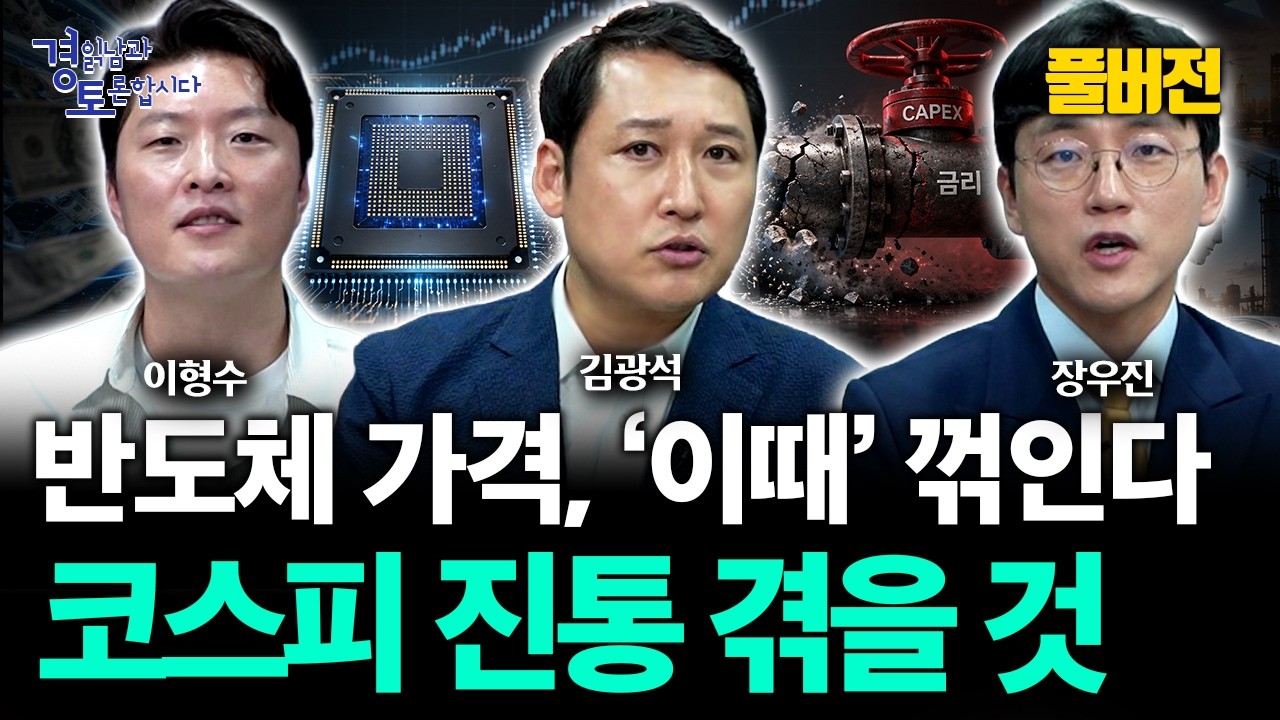
– [풀버전] 반도체 가격 정점이 온다…다음 Q사이클, 문제는 ‘돈’이다 | 경읽남과 토론합시다 | 3자토론 이형수x장우진x김광석