● Nvidia-Driven Nasdaq Surge
The Real Drivers of Nasdaq’s Advance: CoreWeave Rebound, Higher Big Tech CAPEX, and the Hidden Risks in the AI Infrastructure Cycle
The recent Nasdaq rally is difficult to explain as a simple value-driven rebound or a technical bounce.
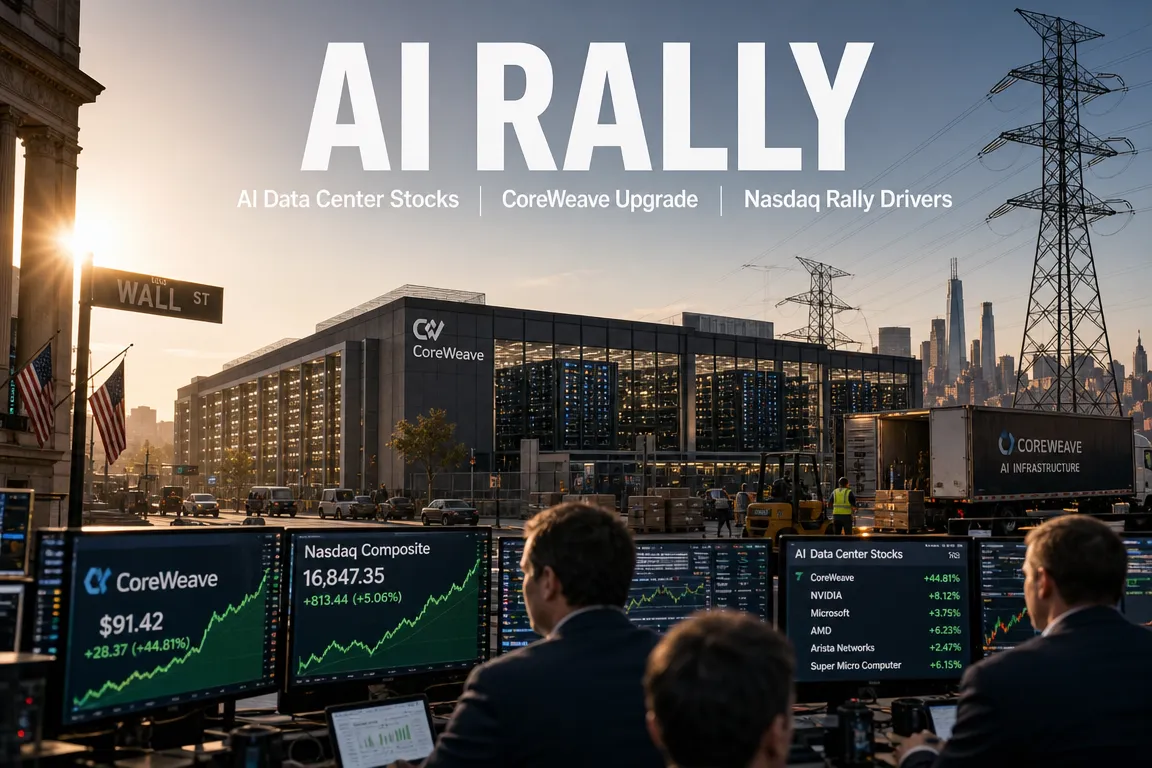
The key catalysts were Goldman Sachs’ constructive note on AI data-center lessor CoreWeave, Morgan Stanley’s upward revision to Big Tech CAPEX assumptions, and the market’s view that AI infrastructure demand has not yet meaningfully deteriorated.
While U.S. equities and AI semiconductors have regained momentum on the surface, the underlying picture includes post-2027 data-center investment, GPU lease pricing, the spread of Chinese open-source AI models, and profitability challenges at frontier AI companies such as OpenAI and Anthropic.
This report focuses on the deeper variables that matter for AI hardware companies including Nvidia, Samsung Electronics, SK Hynix, and Micron.
1. Immediate reasons behind today’s Nasdaq strength
The Nasdaq rose by roughly 1.4% intraday, posting a broad-based rebound in technology stocks.
Large-cap technology names, semiconductors, and AI infrastructure-related stocks all strengthened.
Memory and storage names such as Micron and SanDisk also traded higher.
By contrast, Korea’s overnight futures were relatively weak, reflecting some prior front-running in the local market.
-
First driver: Goldman Sachs issued a positive report on CoreWeave.
-
Second driver: Morgan Stanley raised its outlook for Big Tech AI CAPEX.
-
Market interpretation: Investors viewed this as evidence that AI data-center investment and GPU demand remain intact, supporting the Nasdaq and AI semiconductor stocks.
2. Why CoreWeave became central to the Nasdaq move
CoreWeave has become one of the most closely watched names in the market.
The company leases AI data-center capacity.
Its model is to build GPU-based data centers and lease them to hyperscalers and other large customers.
The business is straightforward: borrow capital, purchase GPUs and servers, build infrastructure, and earn a higher return by leasing that capacity.
The key equation is simple:
If data-center rental returns exceed funding costs, the model works; if not, it becomes problematic.
Market sentiment toward CoreWeave had turned negative as investors grew more concerned about low lease returns and high financing costs.
Goldman Sachs took a different view.
3. Goldman Sachs’ core argument: “The stock has already fallen too far”
Goldman Sachs set a $106 price target for CoreWeave.
That implied approximately 73% upside from the prevailing share price at the time.
The firm’s main argument was that valuation expectations had reset, but the stock had already discounted more downside than fundamentals justified.
Goldman highlighted two key points:
-
First, GPU lease rates remain elevated.
Rising demand for AI model training and inference continues to support pricing for high-performance GPU infrastructure.
CoreWeave reportedly secured strong pricing in early short-term contracts, with approximately 25% price increases in July and an additional 10% in October.
This suggests that AI data-center leasing revenue may remain more resilient than the market had assumed.
-
Second, funding costs may be lower than feared.
The market had worried that CoreWeave would rely on unsecured borrowing, increasing financing pressure.
Goldman argued that future funding is more likely to be secured by GPUs, server equipment, and customer contracts.
Collateralized financing would likely carry lower costs than unsecured debt.
In short, Goldman Sachs viewed CoreWeave not simply as a highly levered AI infrastructure company, but as a business whose recent share price decline may have been excessive relative to its revenue and financing profile.
4. Why Morgan Stanley’s CAPEX revision matters more
One of the more important drivers of the rally was Morgan Stanley’s upward revision to Big Tech CAPEX forecasts.
The firm raised its assumptions for hyperscaler AI infrastructure spending.
It projected that major Big Tech CAPEX could reach about $1 trillion in 2026, followed by an additional increase of roughly 60% in 2027, with growth of close to 20% potentially continuing into 2028.
This matters because Nvidia, Broadcom, Micron, Samsung Electronics, and SK Hynix are ultimately exposed to hyperscaler data-center investment.
Higher spending on servers, GPUs, HBM, networking equipment, and power infrastructure supports the AI semiconductor value chain.
The market interpreted Morgan Stanley’s revision as evidence that the AI infrastructure cycle remains active.
That supported both Nasdaq and semiconductor stocks.
5. A negative headline was also in play: Microsoft’s withdrawal from the Nscale project
The market also received a negative headline today.
Microsoft reportedly withdrew from a U.K. data-center project involving Nscale, a NeoCloud company.
Nscale follows a business model similar to CoreWeave, borrowing capital to build data centers and lease them to large technology customers.
This was sensitive because it could have been read as a sign of weakening AI infrastructure demand.
However, the market did not price this as a meaningful demand warning.
The withdrawal was viewed more as a project execution issue, particularly given persistent delays tied to power constraints.
In other words, investors interpreted it as a timing and execution problem rather than evidence that AI data-center demand is fading.
As a result, the broader Nasdaq rally held.
6. Elon Musk’s comment on SpaceX equity distribution and rising social pressure on AI companies
Another notable development was Elon Musk’s comment about giving SpaceX equity to all U.S. children.
Although the remark may have appeared unrelated, it reflects growing pressure on AI companies regarding social responsibility.
Anthropic recently announced that it would donate 5% of its equity to a public-interest fund.
The move appears intended to address criticism of AI firms and present a more socially constructive image.
Musk responded by suggesting that direct distribution may be preferable to an indirect public-interest structure.
The comment also intersects with the U.S. administration’s proposed children’s investment accounts, or Trump Accounts.
Overall, the discussion reflects increasing political and reputational pressure on AI firms.
This suggests that AI companies and major platforms may increasingly be judged not only on technology and earnings, but also on labor impact, inequality, data concentration, energy usage, and social contribution.
7. Anthropic’s new model: User expansion matters more than model quality alone
According to The Information, Anthropic is preparing a new AI model.
The model is said to focus on understanding user intent and goals with minimal input, while delivering more creative and less conventional responses.
If the model performs as described, it could become an important positive catalyst for Anthropic.
The company has faced concerns that growth in API and AI-related product revenue is slowing more than expected.
Market concerns also increased after third-quarter earnings.
However, the more important issue is that superior model performance no longer automatically translates into mass user adoption.
Even if one model scores meaningfully higher on benchmark tests, developer traffic may increase only modestly, by perhaps 20% or so.
This suggests that the AI market is moving beyond initial adoption and toward competition among existing advanced users and developers.
In practice, users are shifting among OpenAI, Anthropic, Gemini, and Chinese open-source models rather than entering the market for the first time.
8. The most important shift: cost-efficient AI is gaining share over “smarter” AI
The key structural change is that the spending share of frontier AI apps appears to be declining.
The share directed toward top-tier AI model companies such as OpenAI and Anthropic is shrinking, while adoption of Chinese open-source and lower-cost models is increasing.
The reason is straightforward: Chinese AI models have improved faster than expected.
Earlier this year, they lagged in quality, but recent versions have become sufficiently capable for document drafting, coding assistance, data organization, and search-related tasks.
Most companies and individuals do not need the most advanced model for every task.
If a cheaper model is good enough for day-to-day use, cost efficiency becomes the deciding factor.
This creates pressure for OpenAI and Anthropic.
Both companies have committed to large, long-duration compute contracts, and those obligations require sustained revenue growth to remain economically viable.
If users migrate to lower-cost alternatives, the economics of expensive AI infrastructure become more challenging.
9. The key risk not emphasized enough elsewhere: the real downside for the AI hardware cycle may come after 2028
Markets are currently focused on CAPEX growth in 2026 and 2027.
That has kept sentiment constructive toward Nvidia, HBM suppliers, memory makers, and data-center power infrastructure names.
But the more important question is whether AI model companies can generate enough revenue to justify continued use of expensive compute resources.
If companies such as OpenAI and Anthropic fail to produce sufficient cash flow, they may reduce contracted GPU usage, delay new commitments, or seek lower-cost alternatives.
In that case, AI semiconductor demand could remain solid in 2026 to 2027 but slow meaningfully after 2028.
Samsung Electronics, SK Hynix, Micron, and Nvidia are all highly sensitive to this investment cycle.
Current demand remains strong, but weaker monetization at the AI application layer could eventually weigh on hardware demand.
The central issue is not whether GPUs are scarce today.
The critical question is whether AI service providers can generate enough revenue to absorb the cost of those GPUs over time.
10. Key variables to monitor from an investment perspective
-
CoreWeave financing cost: Collateralized borrowing would reduce risk.
-
GPU lease pricing: Stable pricing would support NeoCloud profitability.
-
Big Tech CAPEX: Spending by Microsoft, Amazon, Google, and Meta remains the main driver for AI semiconductor demand.
-
AI service revenue growth: Slower growth at OpenAI and Anthropic could eventually affect hardware demand.
-
Expansion of Chinese open-source AI: Lower-cost models could reduce pricing power for frontier AI companies.
-
Rates and financing conditions: Data-center investment is highly sensitive to borrowing costs.
11. Conclusion: The Nasdaq rebound is constructive, but the AI cycle has become more complex
The latest Nasdaq advance is a positive signal.
Goldman Sachs’ constructive view on CoreWeave and Morgan Stanley’s higher CAPEX forecast indicate that the AI infrastructure cycle is still active.
At the same time, the market structure is becoming more complex.
AI data centers continue to be built, but profitability at AI model companies has not yet been fully validated.
Chinese open-source models are improving, and users are increasingly price-sensitive.
The focus should therefore be less on whether AI semiconductors can still rally and more on which businesses can actually monetize the cycle and which are absorbing the cost.
The near-term Nasdaq rebound is favorable, but the sustainability of data-center investment after 2027, the monetization of AI services, and changes in Big Tech CAPEX are likely to matter more over time.
< Summary >
The main drivers of the Nasdaq rally were Goldman Sachs’ constructive report on CoreWeave and Morgan Stanley’s upward revision to Big Tech CAPEX assumptions.
CoreWeave is a GPU data-center leasing company, and the key issue is whether lease returns exceed borrowing costs.
Goldman Sachs argued that rising GPU lease rates and the potential for collateralized funding support the company’s valuation.
Morgan Stanley expects AI infrastructure spending by Big Tech to continue rising through 2026 to 2028.
However, the expansion of Chinese open-source AI models and slower growth at OpenAI and Anthropic remain long-term risks.
The key question is whether AI companies can generate enough revenue after 2028 to support continued spending on expensive GPUs and data centers.
[Related Articles…]
- Nasdaq Rebound and U.S. Tech Stock Trends
- AI Semiconductors and Big Tech Data-Center Investment Outlook
*Source: [ 내일은 투자왕 – 김단테 ]
– 나스닥 상승의 진짜 이유
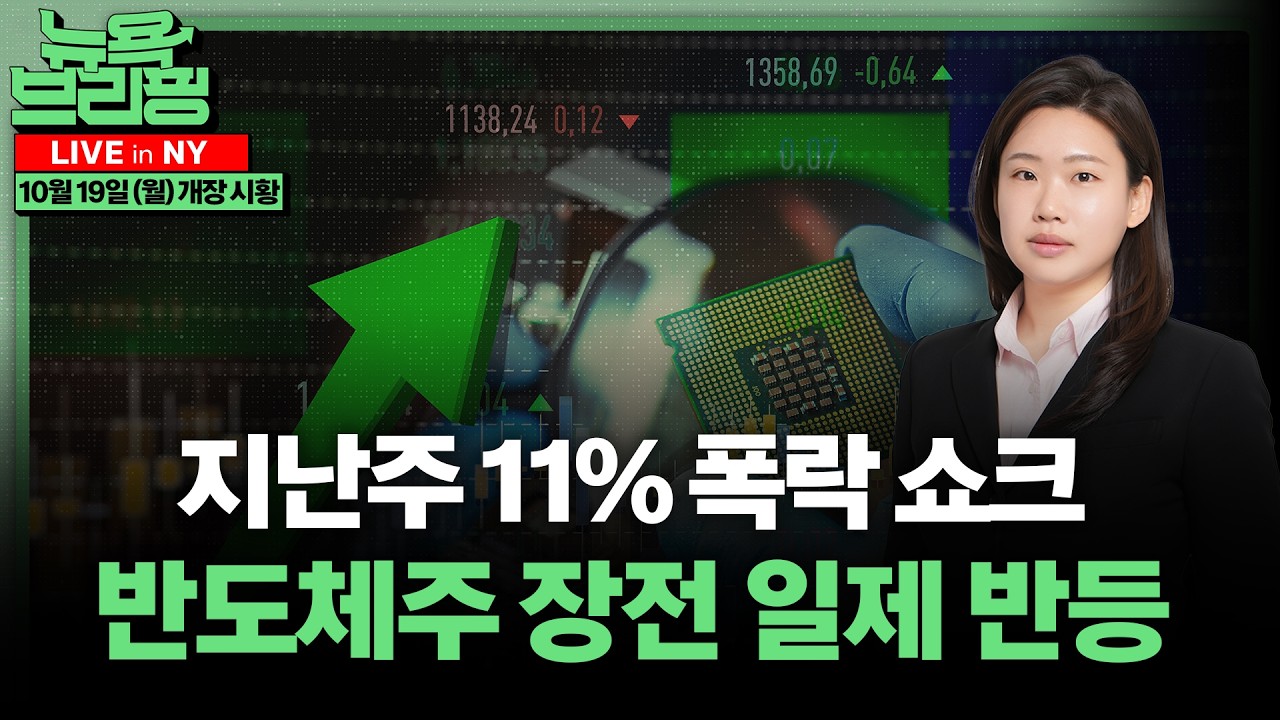
● AI Shock, Power Bottleneck, Credit Risk, Supply Chain Crisis
New York semiconductor stocks rebound, but the real issue is not AI investment overheating; it is power, bond, and supply chain risk
The most notable move in today’s New York market is the rebound in semiconductor and AI infrastructure-related stocks after last week’s sharp selloff.
However, the more important points are not simply that Nvidia rose or that Intel recovered.
CoreWeave’s corporate bond yield is approaching 15%, yet data center-backed bonds remain relatively stable.
Microsoft’s withdrawal from a UK AI data center agreement appears tied not to AI chip shortages, but to power grid delays.
China is expanding export controls on drones and industrial machinery, while JPMorgan is directly investing $5 billion in U.S. national security industries, extending U.S.-China supply chain competition into finance and industrial equipment.
France’s riots and the energy shock are pushing European bond yields higher and reshaping the global rate outlook.
Indonesia’s market also fell more than 11% in a single day after an MSCI removal warning, showing how global capital is being redirected and disrupted.
Today’s market was not simply a rebound in technology stocks, but a clear indication of where global capital flows are tightening and where they are concentrating.
1. Pre-market New York trading: Nasdaq rebounds, Dow lags
Before the October 19 New York open, futures showed a clear rebound in technology shares.
S&P 500 futures rose about 0.46%.
Nasdaq 100 futures gained about 1.26%, leading major indices.
Dow Jones futures fell about 0.25%.
Russell 2000 futures rose about 0.48%.
The session reflected selective buying in semiconductors and AI data center-related names rather than broad market strength.
The VIX fell to around 18.3, down more than 8%, suggesting some easing in risk aversion after last week’s technology selloff.
2. Regional market tone: U.S. and Japan rebound, Europe weakens
In Asia, Nikkei 225 futures rose about 1.38%.
In Europe, the tone was weaker.
Euro Stoxx 50 fell about 1.41%.
Germany’s DAX declined about 1.51%.
Political unrest in France, policy uncertainty, and rising energy prices weighed on European financial markets.
Concerns over lower natural gas inventories have also revived winter energy risk.
Volkswagen, a key indicator for German manufacturing, is pursuing job cuts and a wage freeze through 2030.
Competition from Chinese EV makers, rising costs, and a weakening European economy are putting increasing pressure on the sector.
3. Commodities: Crude oil nears $110 before easing
Crude oil gave back part of its weekend gains ahead of the New York open.
WTI traded at about $97.40 per barrel, down 1.57%.
Brent traded at about $107.79 per barrel, down 1.76%.
Brent had briefly approached $110, reaching a five-month high.
However, expectations that U.S. restrictions on Russian crude and diesel could be partially eased supported a pullback in prices.
The U.S. administration has moved to grant certain exemptions related to Russian exports.
The U.S. Energy Secretary said gasoline and diesel prices had likely already peaked.
Officials are also discussing possible diesel inventory releases with European allies.
Geopolitical risk in the Middle East remains elevated.
Reports of a tanker incident near the Strait of Hormuz and a sharp decline in Gulf crude transport volumes added to market concern.
Reported Gulf crude shipments fell from about 20 million barrels per day the prior week to around 8.5 million barrels per day last week.
Oil prices are now caught between U.S. price stabilization efforts and persistent supply risk in the Middle East.
4. Semiconductor rebound: Nvidia, Micron, AMD, and Intel all rise
Semiconductors were the center of attention today.
Nvidia rose about 2% in pre-market trading.
TSMC gained about 2.5%.
Broadcom rose more than 3%.
Micron advanced about 4%.
AMD also rose about 4%.
Intel gained about 4.5%, posting a strong rebound.
Semiconductor equipment names also moved higher.
Applied Materials, Lam Research, and KLA each rose by around 4%.
This looked less like a simple tech rebound and more like broad dip buying across the AI infrastructure value chain after last week’s sharp decline.
Apple and Microsoft saw more limited rebounds.
They had held up better during last week’s selloff, so their recovery was also more restrained.
Financials, energy, healthcare, and defensive sectors were generally weaker.
That helped drive the divergence between a stronger Nasdaq and a weaker Dow.
5. CoreWeave rebounds, but credit markets remain cautious
CoreWeave was one of the main names behind last week’s AI data center selloff.
The stock fell about 25% over the week.
Today it rebounded about 6% to 7% in pre-market trading.
The move followed Goldman Sachs’ upgrade from Neutral to Buy.
Notably, Goldman lowered its target price from $139 to $106.
Even so, with the stock near $65, the firm judged that the risk-reward profile had improved.
Goldman said CoreWeave remains competitive in AI-focused cloud services.
It also expects the company to secure funding for expansion and not face materially worse borrowing costs in the near term.
Credit markets remain much more cautious.
CoreWeave’s 2030 corporate bond yield is near 15%.
Its CDS premium has risen above 1,100 basis points.
That indicates the market is assigning a meaningful default risk to the company.
CoreWeave provides computing services to AI clients using large-scale Nvidia GPU capacity.
Its financing conditions are therefore tied not only to its own balance sheet, but also to Nvidia GPU demand, HBM demand from SK Hynix and Samsung, and the broader AI data center investment cycle.
6. Key detail: CoreWeave debt is weak, but data center-backed debt remains relatively stable
This is the most important takeaway from today’s market.
CoreWeave’s corporate bond yield has risen to around 15%.
By contrast, bonds issued to finance the data centers CoreWeave uses are yielding around 8%.
Although both are linked to AI data center investment, the market values them very differently.
This shows that credit markets are not treating AI as a single, uniform asset class.
CoreWeave’s own bonds depend on whether the company itself can service its debt.
Data center-related bonds are supported by physical assets, long-term leases, and collateral structures that protect investors.
Even if CoreWeave weakens, the underlying assets remain and may be leased to other operators.
As a result, asset-backed data center bonds trade at materially lower yields than CoreWeave’s corporate debt.
The share of data center bonds in U.S. dollar issuance linked to AI has risen from 16% last year to about 25% this year.
This does not signal a collapse in AI investment; it suggests investors are increasingly distinguishing between corporate credit risk and the value of tangible collateral.
7. China’s CXMT falls sharply as markets focus on slowing growth momentum
China’s memory maker CXMT also drew attention.
Shares linked to CXMT on the Shanghai exchange fell as much as 9% intraday.
Fundamentals were still strong.
Revenue for January through September was projected at up to 270 billion yuan.
That would be more than 50 trillion won.
Revenue is estimated to have increased about eightfold year over year.
Net income is also expected to turn positive from a loss last year.
Even so, the stock sold off sharply.
The reason was slowing earnings momentum.
Quarterly net income growth was 246% sequentially in the first quarter and 113% in the second quarter, but only around 1% to 4% in the third quarter.
Even with stronger memory prices and rising AI demand, the market is now focusing less on whether growth exists and more on whether the pace of growth can be maintained.
This dynamic is also relevant for Korean semiconductor companies.
Margins, inventory levels, demand durability, and the capex cycle are becoming more important than headline revenue growth.
8. Intel jumps on JPMorgan upgrade and Tesla foundry speculation
Intel rose about 4% in pre-market trading.
The move followed JPMorgan’s upgrade from Underweight to Neutral.
The bank kept its target price at $85.
JPMorgan said Intel’s valuation had improved after the stock fell about 36% from its June peak.
It also noted progress in next-generation process development under CEO Lip-Bu Tan.
The bank said rising AI demand could create new opportunities in data center CPU markets.
Investor sentiment was further supported by reports that Tesla may use Intel’s next-generation 14A process for chip production.
Intel has long faced skepticism over its ability to secure major external foundry customers.
If a Tesla contract materializes, it could become an important step toward restoring confidence in Intel’s foundry business.
JPMorgan still said a full turnaround would take years.
Intel must regain share in server and PC CPU markets and prove that its foundry business can generate stable profitability.
9. Microsoft exits UK AI data center deal: the real bottleneck is power, not GPUs
Microsoft reportedly withdrew from a major AI data center project in the UK.
The original plan reportedly involved deploying about 23,000 Nvidia AI chips, but power supply delays were cited as the key obstacle.
Concerns were raised that local grid construction could be delayed into the 2030s.
The precise reason for the withdrawal was not officially disclosed, but the market is treating power infrastructure delays as the most important factor.
This is a critical signal for the AI investment cycle.
Until now, the market has focused on Nvidia GPUs, HBM, and server demand.
But without power capacity, data centers cannot operate, even if the chips are available.
That implies future AI data center investments may depend more on power equipment, transformers, transmission networks, cooling systems, gas-fired generation, nuclear power, and storage infrastructure.
If data center projects are delayed or canceled, orders for GPUs and HBM could also be affected.
AI semiconductor investors now need to track not only chips, but also grid approvals and regional power capacity.
10. Major U.S. earnings this week: Wednesday is the key inflection point
This week features a heavy lineup of third-quarter earnings reports from major U.S. companies.
On Tuesday before the open, GE Aerospace, RTX, and General Motors will report results.
With tensions elevated in the Middle East, guidance for aerospace and defense demand will be closely watched.
Netflix will report after the close on Tuesday.
Key items include advertising growth and progress toward its $3 billion annual ad revenue target.
On Wednesday after the close, Meta, Tesla, Lam Research, Texas Instruments, and IBM will report together.
Wednesday is the main market test this week.
For Tesla, investors will focus on auto profitability, autonomous driving progress, and production timing following the new Roadster announcement.
For Meta, AI spending is the central issue.
With capital expenditure expected to reach roughly $130 billion to $150 billion this year, investors will assess how much of that cost can be supported by advertising revenue.
Lam Research will provide insight into the durability of memory and semiconductor equipment demand.
On Thursday, earnings are due from P&G, Blackstone, Union Pacific, Lockheed Martin, Spotify, Honeywell, and Nasdaq.
On Friday, American Express and SLB will report.
These results will help gauge consumer and energy-sector resilience.
11. Key U.S. economic data this week: housing, labor, PMI, and inflation expectations
This week’s U.S. data calendar centers on housing, labor, consumer sentiment, and inflation expectations.
On Monday, the NAHB housing market index will be released.
Consensus expects a reading of 32.
Since 50 is the threshold for expansion, 32 indicates that homebuilder sentiment remains weak.
On Tuesday, September housing starts, building permits, and pending home sales will be released.
With the 30-year mortgage rate above 7%, the key question is how much the housing market can hold up.
On Wednesday, crude oil inventories and the U.S. 20-year Treasury auction are scheduled.
A further drop in inventories could support elevated oil prices.
The 20-year auction will provide a read on long-duration demand, the stop-out yield, and bid-to-cover ratios.
On Thursday, weekly jobless claims will be released.
Consensus is around 200,000.
That would still suggest a resilient labor market.
If employment remains strong while inflation stays elevated, expectations for Fed rate cuts could fade.
On Friday, preliminary S&P Global manufacturing and services PMIs will be released.
Both are expected to remain above 50, implying continued expansion, though at a slower pace.
The final University of Michigan consumer sentiment index will also be released Friday.
Consensus is 46.3, down from 48.1 previously.
One-year inflation expectations are forecast at 4.7%, and five-year expectations at 3.5%.
If growth perceptions weaken while inflation expectations remain elevated, the Fed’s policy challenge becomes more complicated.
12. France unrest and bond yield spike: European market risk rises
France is experiencing one of its most severe riot episodes in recent years.
The interior minister offered his resignation, but President Macron rejected it, extending political uncertainty.
The stress has spread into the bond market.
French 10-year government bond yields rose to around 4.873%, up about 9.2 basis points from the prior day.
Yields rose across the curve from two years to 30 years.
That indicates investors are selling French government debt.
The spread between French and German 10-year yields recently exceeded 150 basis points and remains around 141 basis points.
German government bonds are regarded as the safe haven within Europe.
A spread above 140 basis points signals that the market is assigning significantly higher credit risk to France.
France is already burdened by a large fiscal deficit and high debt.
Rising yields increase the government’s funding costs further.
Moody’s is scheduled to review France’s sovereign rating on October 23.
Political instability and fiscal pressure will be key factors in that review.
13. Euro weakness and the energy shock: the ECB faces a harder policy backdrop
French market stress also weighed on the euro.
EUR/USD briefly fell to around 1.122 before recovering some ground.
However, the broader trend remains weak.
The dollar is firming, while French political risk and higher European energy prices are adding pressure.
European natural gas prices rose above 89 euros, reaching a four-year high.
Because Europe depends heavily on energy imports, higher oil and gas prices feed directly into inflation.
That leaves the region in a difficult position: inflation is rising while growth is slowing.
In that environment, the European Central Bank faces a more difficult policy tradeoff.
The relative stance of the Fed and the ECB will also influence the euro-dollar exchange rate.
14. JPMorgan’s national security investment: Wall Street capital is shifting into supply chain reconfiguration
JPMorgan released details of its investment activity in national security-related industries.
Over the past year, it has directly invested $5 billion in such sectors.
Its financing support, including lending and capital markets activity, exceeded $230 billion.
This suggests that the bank’s $1.5 trillion, 10-year economic security financing plan is now moving into execution.
Key target sectors include defense, energy, manufacturing, critical minerals, battery materials, and supply chain infrastructure.
Bloomberg highlighted JPMorgan’s support for Korea Zinc’s recycling project in Tennessee as one example.
The U.S. is working to reduce dependence on China by bringing key materials and production capacity onshore.
Wall Street capital is increasingly following that shift.
This could become a long-term theme for U.S. listed defense, energy infrastructure, power equipment, and critical minerals companies.
15. China expands export controls: U.S.-China competition extends beyond semiconductors
China’s Ministry of Commerce announced expanded export controls on drones and industrial machinery.
The new rules will take effect on November 18.
They cover selected drones, related parts, related technologies, dredging equipment, and tunnel-boring machines.
China says the measures are intended to control dual-use technology that can support both civilian and military applications.
Drones, dredging equipment, and tunnel-boring machines are important for civilian infrastructure but can also have military uses.
Special permits may be required for exports to countries or regions involved in disputes with China.
The U.S. is strengthening domestic supply chains through capital allocation and financial system support.
China is restricting the overseas supply of equipment and technologies where it has competitive strength.
U.S.-China competition is now spreading from semiconductors to critical minerals, drones, industrial machinery, production equipment, finance, and energy infrastructure.
16. Indonesia market shock: MSCI warning triggers a near-16% blow to the index
Indonesia’s stock market plunged 11.6% in a single day on Friday.
That was the largest daily decline since the 1998 Asian financial crisis.
On October 19, the market fell more than 5% intraday to a six-year low.
The immediate trigger was an MSCI warning.
MSCI raised concerns about shareholder composition and trading transparency in Indonesia.
It also said it was considering reclassifying Indonesia from an emerging market index to an independent market.
If that happens, passive global funds would need to sell Indonesian equities.
Goldman Sachs estimates that passive outflows could reach as much as $5.6 billion.
Indonesian authorities have responded with enforcement actions and emergency measures.
If the issues identified by MSCI are not resolved by April 30 next year, a downgrade could follow in June.
The episode shows how index inclusion and exclusion can quickly reshape capital flows into a market.
17. Key points often missed in other coverage
First, AI investment risk is not uniform.
CoreWeave corporate bonds are viewed as risky, but data center asset-backed bonds remain relatively stable.
The market is not treating AI as a simple bubble; it is distinguishing between corporate credit risk and tangible collateral value.
Second, the real bottleneck for AI data centers is power, not GPUs.
Microsoft’s UK withdrawal shows that power infrastructure, transformers, and transmission capacity must now be part of any AI semiconductor investment analysis.
Third, France’s risk is not merely a political headline.
Rising French bond yields point to wider European fiscal risk, euro weakness, and a potentially more volatile global rate outlook.
Fourth, U.S.-China competition has moved beyond semiconductor export controls.
The U.S. is using finance, while China is tightening controls on drones and industrial machinery.
This is now a longer-term contest across factories, equipment, minerals, finance, and energy.
Fifth, Indonesia’s MSCI issue is a warning for emerging-market investors.
Index inclusion and exclusion can drive stronger selling pressure than earnings alone.
Emerging-market investing requires attention not only to growth, but also to transparency, governance, and foreign access.
18. Investment view: the rebound is constructive, but many issues remain unresolved
Today’s rebound in semiconductor stocks largely reflects a technical recovery after last week’s sharp declines.
Goldman Sachs’ upgrade on CoreWeave, JPMorgan’s upgrade on Intel, and opportunistic buying after the selloff all contributed.
However, the core concerns around AI data center investment have not been fully resolved.
The credit market still assigns elevated risk to CoreWeave.
Microsoft’s UK data center withdrawal reinforces the view that power constraints remain a binding issue.
France’s political instability and rising bond yields are adding to European market risk.
Crude oil remains vulnerable to geopolitical shocks despite U.S. efforts to stabilize prices.
Wednesday’s earnings from Meta, Tesla, and Lam Research are likely to be the key drivers for technology sentiment this week.
In particular, Meta’s AI spending, Tesla’s profitability, and Lam Research’s equipment demand outlook could shape the next move for semiconductors and AI infrastructure names.
< Summary >
U.S. equities rebounded, led by semiconductors and AI infrastructure-related stocks.
CoreWeave recovered after a Goldman Sachs upgrade, but its 15% bond yield remains a concern.
Intel rose on JPMorgan’s upgrade and speculation about a Tesla foundry contract.
Microsoft’s withdrawal from a UK AI data center deal highlighted power grid bottlenecks as a key constraint in the AI cycle.
Crude oil eased after approaching $110, following U.S. moves to soften restrictions on Russian exports.
France’s unrest and energy shock pushed bond yields higher and weighed on the euro.
JPMorgan’s national security investments and China’s export controls on drones and industrial machinery show that supply chain competition is widening.
Indonesia’s market sold off sharply after an MSCI warning, highlighting the risk of index-driven capital outflows.
This week’s key event is Wednesday’s earnings from Meta, Tesla, and Lam Research.
[Related Articles…]
- AI Data Center Power Bottlenecks and the Semiconductor Cycle
- Crude Oil Surge and the Global Rate Outlook
*Source: [ Maeil Business Newspaper ]
– 뉴욕 반도체주 반등|코어위브·인텔 상향|창신메모리 매출 8배에도 급락|MS 英 계약 철회|트럼프 러 제재 면제|프랑스 폭동에 국채금리 급등|인니 16% 폭락 왜?|뉴욕브리핑