● KOSPI Shock, No Buyers, AI Fade, Samsung Slips, Market Panic
Why the KOSPI Decline Has Become More Dangerous: The Bigger Problem Is the Absence of Buyers, Not Samsung Electronics or SK Hynix
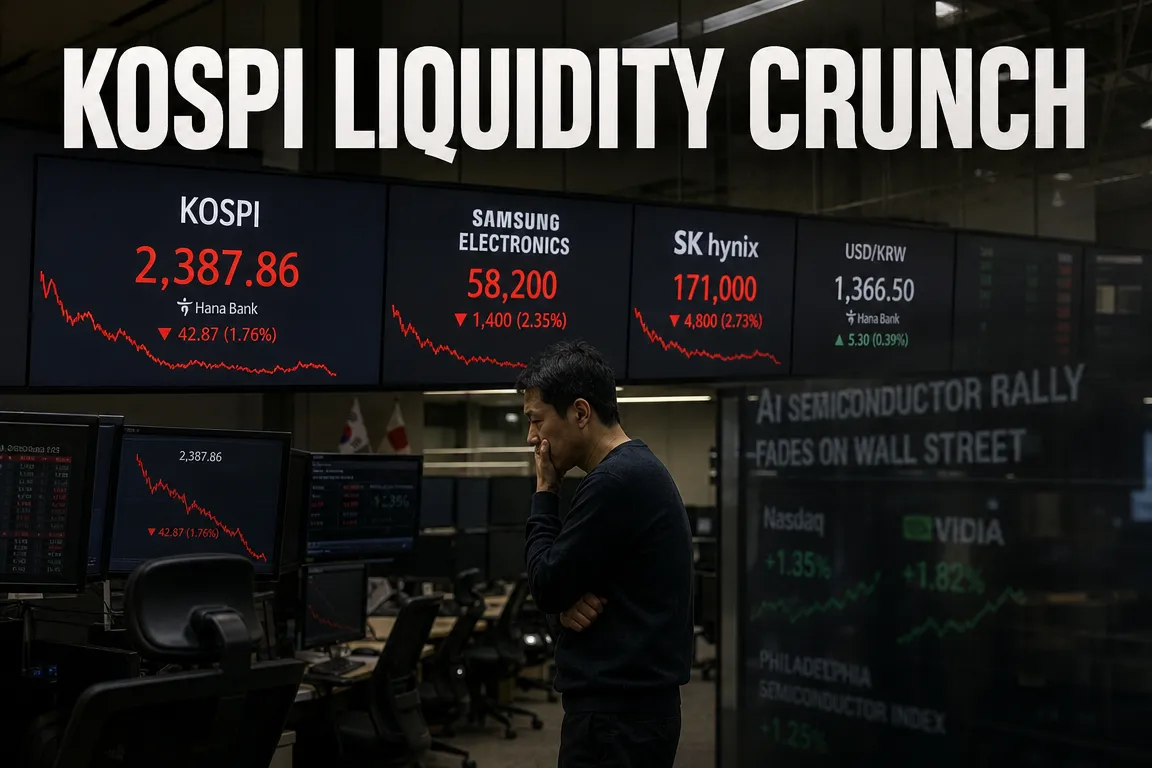
This KOSPI decline is not simply a matter of the index falling.
The core issue is that buyers in the Korean equity market have effectively disappeared.
Weakness in large-cap semiconductor stocks such as Samsung Electronics and SK Hynix is a burden, but the more serious problem is the market-wide liquidity gap.
Even as U.S. AI semiconductor stocks advanced, the Korean market failed to respond.
This is not just a correction; it suggests investors are approaching a phase where confidence in the Korean market itself is eroding.
In particular, the 35% first-day decline in Alice Group, a domestic AI company that had drawn attention, symbolized how fear has outweighed expectations for Korea’s AI sector.
1. The key issue in today’s KOSPI decline: a market that does not react is more dangerous than bad news
When stock markets fall sharply, there is usually a clear negative trigger.
Examples include rising U.S. interest rates, a stronger won-dollar exchange rate, geopolitical risk, earnings shocks, or regulatory concerns.
This decline is more concerning because the market weakened without a major obvious shock.
In such conditions, investors are not simply selling in response to news; they are withdrawing in advance as confidence in the market itself deteriorates.
-
There are many investors willing to sell.
-
There are few buyers stepping in aggressively.
-
Price declines do not attract meaningful dip-buying.
-
As a result, the index becomes highly vulnerable even to modest selling pressure.
This is a classic liquidity breakdown.
The main risk in the Korean market is not only company-specific fundamentals, but also the drying up of liquidity across the market.
2. Why the weakness in Samsung Electronics and SK Hynix continues
Samsung Electronics and SK Hynix are the two key pillars of the Korean equity market.
When these stocks weaken, market sentiment on the KOSPI deteriorates accordingly.
More recently, the market has been driven by expectations around AI semiconductors, HBM, data center investment, and a recovery in the memory semiconductor cycle.
However, when these expectations fail to translate into share-price performance, or when disappointment continues to generate selling pressure, sentiment weakens quickly.
-
Samsung Electronics is a benchmark stock with a large base of domestic retail investors.
-
SK Hynix is the representative stock for AI semiconductors and HBM expectations.
-
When both stocks weaken at the same time, the KOSPI loses its main source of upward momentum.
-
When foreign demand weakens, the index’s ability to hold up declines sharply.
The issue is that U.S. AI semiconductor stocks are rising while Korean semiconductor stocks are failing to keep pace.
This should be viewed less as an industry issue and more as a market allocation issue.
Global investors appear to acknowledge AI growth, but are increasingly questioning whether they need to express that view through Korean equities.
3. Why U.S. AI semiconductor stocks rose while Korean equities fell
The most notable feature of this decline is the divergence between the U.S. and Korean markets.
U.S. AI semiconductor-related stocks advanced.
Under normal circumstances, this would support Samsung Electronics, SK Hynix, semiconductor equipment stocks, and AI-related names in Korea.
Instead, the Korean market declined.
This indicates that investors no longer fully accept the idea that when the U.S. rises, Korea will automatically follow.
AI remains a strong growth theme, but concerns are rising over whether the Korean market can convert that growth into equity performance.
-
The U.S. has stronger AI ecosystem platforms and semiconductor design firms.
-
Korea has strengths in memory semiconductors and manufacturing capabilities.
-
However, markets tend to assign higher valuations to platforms, software, and ecosystem control than to manufacturing alone.
-
This structural difference is reflected in valuation gaps.
As a result, Korea remains part of the broader AI semiconductor theme, but global investors may view it as a relatively less attractive market.
4. What Alice Group’s 35% first-day decline revealed about the Korean AI market
The 35% decline on the first day of trading for Alice Group, a domestic AI company that had attracted attention, sent a strong signal to the market.
This is not merely a single-company issue.
It suggests that investor expectations for Korean AI companies are weaker than previously assumed.
The market no longer assigns a premium simply because a company is labeled “AI.”
Investors are now applying a much stricter standard.
-
They are assessing how quickly revenue is actually growing.
-
They are assessing whether the company can reduce operating losses.
-
They are assessing whether the technology can compete with global big tech.
-
They are assessing whether AI services can be monetized effectively.
-
They are assessing whether the IPO valuation was excessive.
The Alice Group case does not mean expectations for Korea’s AI sector have disappeared.
It does mean the market is now demanding AI earnings rather than AI themes.
Failing to distinguish between the two can lead to significant volatility in AI-related stocks.
5. The real problem in the Korean market is the lack of capital
The most important point is that capital is not flowing into the market.
This does not simply mean a lack of cash.
More precisely, it means there is insufficient capital willing to take on risk assets.
Equity markets ultimately move on supply and demand.
Even strong companies struggle to rise when there are no buyers.
Conversely, companies with weaker fundamentals can still rise in the short term if buying demand is strong enough.
The current problem in the KOSPI is not just the presence of bad news, but the weakness of the buying base.
-
Retail investors have limited additional buying capacity after prolonged losses.
-
Foreign investors may prefer U.S. AI semiconductors, Japanese equities, and global growth stocks over Korea.
-
Institutional investors may increasingly focus on risk management rather than index support.
-
Weak performance in newly listed stocks can further reduce risk appetite.
In this environment, even small disappointments can trigger sharp declines.
And rebounds, when they occur, often fail to sustain momentum.
6. Why a market that falls without major news is more dangerous
A market that declines because of a clear negative catalyst is often easier to interpret.
The source of the problem is visible.
For example, if concerns center on higher rates, investors can monitor the policy path; if earnings disappoint, they can assess the next quarter’s outlook.
But a market that falls without major news is more difficult to manage.
In that case, the driver is not news flow but sentiment and positioning.
Those factors are harder to quantify and more difficult to time.
-
Market participants become inclined to sell first and ask questions later.
-
Even when a rebound occurs, selling pressure persists.
-
Preference shifts from buying dips to preserving cash.
-
Even positive news fails to lift share prices.
This is the key risk in the KOSPI at present.
A market that fails to respond to good news is often one with weakened internal support.
7. The point missing from most coverage: Korea is becoming an AI validation market, not an AI beneficiary market
Most coverage focuses on the visible outcomes: KOSPI weakness, Samsung Electronics underperformance, SK Hynix volatility, and the sharp decline in Alice Group.
The more important issue is that Korea is not simply a market that benefits from the global AI rally; it is increasingly becoming a market where AI business models are being tested.
In the U.S., AI is viewed as a major driver of future growth.
NVIDIA, cloud companies, and large platform companies are benefiting directly from increased AI spending.
In Korea, investors are asking different questions.
-
Where do Korean companies sit within the AI ecosystem?
-
Are they component suppliers or core platform operators?
-
Does AI demand translate into actual earnings growth?
-
Do domestic AI startups and listed companies have global competitiveness?
-
Has valuation already priced in too much future growth?
If these questions cannot be answered clearly, AI themes may become a drag on share prices.
The phase in which the word “AI” alone attracted capital is over.
Investors now require revenue, earnings, cash flow, customer base, and technological barriers.
8. Key indicators investors should monitor now
At this stage, investors should focus less on short-term dip-buying and more on whether sentiment and liquidity are recovering.
When evaluating a KOSPI rebound, it is important to monitor the following factors alongside the index level.
-
Whether Samsung Electronics and SK Hynix rebound together.
-
Whether foreign investors return as net buyers of large-cap Korean stocks.
-
Whether gains in U.S. AI semiconductors feed through to Korean semiconductor stocks.
-
Whether fear in the IPO market begins to ease.
-
Whether volatility in exchange rates and interest rates stabilizes.
-
Whether retail margin exposure begins to decline.
Among these, the most important indicators are foreign flows and a synchronized recovery in semiconductor large caps.
Because semiconductors still account for a large share of the Korean market, Samsung Electronics and SK Hynix often determine the direction of the index.
9. Short-term outlook: a rebound is possible, but confidence will take time to recover
A technical rebound in the KOSPI is possible in the short term.
After a sharp decline, dip-buying can emerge, and a strong rally in U.S. equities can support a partial recovery in Korea.
However, the key issue is sustainability.
For this market, the more important question is not whether it can rebound once or twice, but whether investors believe it is worth buying again.
To avoid being left behind in the global AI cycle, Korea needs more than sentiment; it needs evidence of earnings improvement.
-
The semiconductor cycle must show up clearly in the numbers.
-
AI semiconductor demand must be reflected in Korean corporate earnings.
-
Domestic AI companies must demonstrate both growth and profitability.
-
Policy support and valuation-up initiatives must translate into actual capital inflows.
In the end, the real recovery in the KOSPI will begin when capital flows change, not when chart patterns improve.
Until liquidity returns, gains may remain fragile and declines may remain sharp.
10. One-sentence summary of the market
U.S. AI semiconductor stocks are rising, while Korean equities are falling.
Samsung Electronics and SK Hynix are failing to anchor the market.
The IPO of an AI company has highlighted fear rather than optimism.
Most importantly, there is insufficient buying capital entering the KOSPI.
This decline is therefore not just a correction.
It is a test of the Korean market’s resilience and investor confidence.
< Summary >
The key issue behind the latest KOSPI decline is not a major shock, but the disappearance of buyers and the resulting liquidity gap.
Weakness in Samsung Electronics and SK Hynix is weighing on broader sentiment in the Korean market.
U.S. AI semiconductor stocks have risen, but Korea has failed to respond, increasing concerns about divergence.
Alice Group’s 35% first-day decline reflected the market’s more cautious assessment of Korean AI companies.
The market is now demanding earnings, profitability, and global competitiveness rather than AI narratives alone.
For the KOSPI to recover meaningfully, foreign inflows, a rebound in semiconductor large caps, and an improvement in IPO sentiment will need to occur together.
[Related Articles…]
*Source: [ 내일은 투자왕 – 김단테 ]
– 오늘 코스피 하락이 더 문제인 이유 #코스피 #하이닉스 #삼성전자
● Market Shock, AI Bubble, Supply Flood
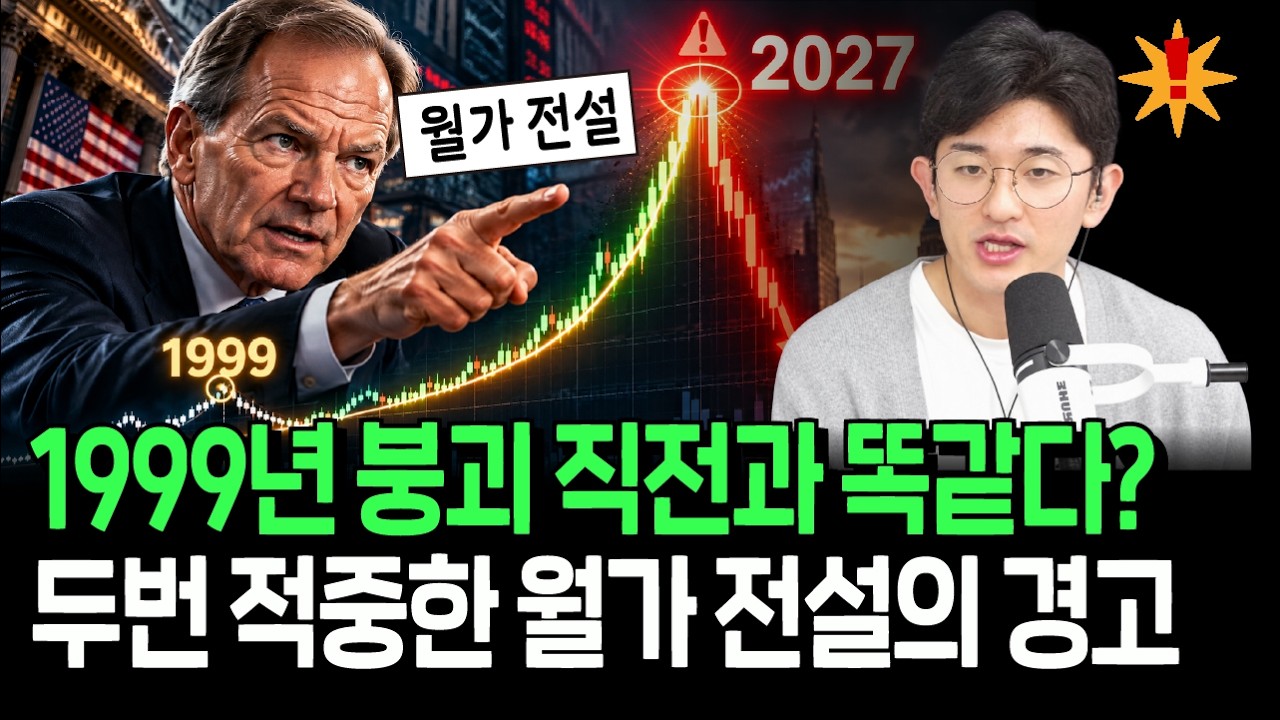
Paul Tudor Jones Says the Market Resembles the Dot-Com Bubble Era Ahead of 1999, and Explains Why He Has Turned Defensive
The key issue is not simply whether the AI market is in a bubble.
Paul Tudor Jones said U.S. equities could still rebound into year-end, but warned that market structure may turn unfavorable from 2027 onward.
He highlighted the AI infrastructure investment boom, Nasdaq volatility, heavy IPO supply, reduced buybacks by large-cap technology companies, and pressure from interest rates and bond issuance.
The central issue is not just that AI stocks have rallied sharply, but that the supply of available stock could outpace demand for capital entering the market.
This report summarizes his latest comments in a news-style format, focusing on the probability of a fourth-quarter rally and the risk of a correction in the years ahead.
1. Paul Tudor Jones’ conclusion: “Good into year-end, but the risk rises next year”
Paul Tudor Jones said in a recent interview that U.S. equities may have further upside in the near term.
He viewed the current pullback as a temporary move driven more by pre-midterm-election uncertainty and weaker sentiment than by the start of a broader market breakdown.
He suggested the market could form a bottom between late October and early November.
He added that once midterm-election uncertainty clears, a strong year-end rally could follow.
In other words, the current decline may be a period of fear, while year-end could present another opportunity for a rebound.
His more important warning is for 2027.
Paul Tudor Jones said market conditions could shift into one of the weakest supply environments of the past 20 years starting next year.
He used unusually strong language, saying he might consider maintaining short exposure for an entire year.
This is less a call for a routine correction than a warning that the structural forces supporting the market may weaken.
2. Why he compares it with the dot-com period before 1999
Paul Tudor Jones compared the current market with 1999 because of the extreme divergence between technology and non-technology stocks.
At that time, internet-related shares and non-internet shares followed very different paths.
Today, AI-related stocks and non-AI stocks are similarly diverging.
The Nasdaq and large-cap technology names remain strong, while many stocks across the broader market are not participating.
This creates the appearance of a strong bull market at the index level, but one increasingly dependent on a small number of stocks.
He has been discussing the possibility of a final rally for some time.
He previously said a strong advance could occur from after October 2025 for roughly one year, with speculative participation from retail investors becoming more visible.
Recent flows into AI infrastructure, semiconductors, data centers, and power-related stocks have come from both retail and institutional investors.
From his perspective, this type of speculative activity often appears in the later stages of a market cycle.
3. Fourth-quarter rally potential: midterm-election uncertainty as the key variable
The most important near-term event is the U.S. midterm election.
Before the election, investors tend to hold more cash and wait for clarity.
Policy direction, taxes, regulation, fiscal spending, and support for the AI industry can all be affected by the outcome.
Once the election is over, the market may interpret the removal of uncertainty as a positive catalyst.
In that case, U.S. equities and the Nasdaq could regain momentum into year-end.
Fourth quarter seasonality is also typically supportive for U.S. equities.
Institutional rebalancing, pension inflows, corporate buybacks, and year-end rally expectations often coincide.
This year, however, volatility may remain elevated because of earnings results from large-cap technology companies and rising concerns over AI investment costs.
4. Next year’s main risk: a surge in equity supply
The key point in this outlook is market supply and demand.
Put simply, the question is whether there will be more sellers than buyers, or vice versa.
Over the past 20 years, U.S. equities have generally benefited from a shrinking supply environment.
Large technology companies used excess cash to buy back shares, and in some cases to retire them.
Merger and acquisition activity among listed companies was also active.
As a result, the number of investable high-quality stocks narrowed, which helped support valuations in a concentrated set of names.
Paul Tudor Jones said this trend may reverse next year.
If major AI companies and firms tied to space, semiconductors, and data centers move toward public listings, the market could face a large increase in stock supply.
OpenAI, Anthropic, and SpaceX were cited as examples of potential large-scale listings.
These would not be ordinary IPOs.
They could create supply events large enough to affect market structure.
5. The bigger risk than IPOs is lockup expiration and insider selling
The risk from large IPOs is not limited to the initial offering.
The larger concern is the period after listing, when employees, early investors, and founders can begin selling shares once lockup restrictions expire.
After an IPO, insiders are typically restricted from selling for six months to one year.
Once that period ends, large blocks of stock may enter the market.
For AI companies in particular, valuations in private markets have risen sharply in recent years, which can increase the incentive to take profits.
For example, if SpaceX were to list and later become eligible for post-lockup sales, major holders including Elon Musk could gain the option to reduce exposure.
Even if they do not sell, the possibility of future selling can weigh on sentiment.
The same applies to OpenAI and Anthropic.
If shares of leading AI companies become broadly investable, capital could rotate away from the large-cap technology names that have dominated flows.
6. Slower buybacks by large-cap technology companies reduce market support
One of the most important supports for U.S. equities has been large-cap technology share repurchases.
Apple, Microsoft, Alphabet, and Meta have consistently bought back shares using strong cash flow.
When companies step in as buyers during market weakness, downside support becomes stronger.
In particular, resumed buybacks after earnings season have often supported Nasdaq rebounds.
That support may weaken going forward.
The reason is AI infrastructure spending.
Large technology companies need to invest heavily in data centers, GPUs, power grids, cloud infrastructure, and AI model training.
Whereas excess cash once went into buybacks, it may now be redirected toward capital expenditure to remain competitive in AI.
If so, buyback volumes could decline and market downside protection could weaken.
7. The AI infrastructure paradox: a growth story that also increases funding pressure
AI infrastructure investment is a core part of long-term industrial change.
In the near term, however, it can increase funding pressure on companies.
AI companies and large technology firms need more GPUs, larger data centers, and greater access to electricity.
This may lead to higher share issuance, bond issuance, debt financing, and strategic capital raises.
The issue is that this could occur at the same time as increased U.S. Treasury issuance.
The U.S. government also needs to issue substantial debt to finance fiscal deficits.
France and other European countries are also facing fiscal pressure and bond-market stress.
When governments, AI companies, and large technology firms all need capital at once, the rate outlook becomes more complicated.
Greater bond supply can make it harder for interest rates to decline, which can weigh on growth-stock valuations.
8. AI accident risk: one event could quickly affect valuations
Another risk highlighted by Paul Tudor Jones is the possibility of an AI-related accident.
He pointed to ongoing concerns over cybersecurity, hacking, model errors, privacy breaches, and system failures.
He warned that if an uncontrollable AI incident were to occur, current valuations could be repriced quickly.
This may sound extreme, but it is a risk the market cannot ignore.
A useful comparison is autonomous driving.
One fatal robotaxi accident could trigger public backlash, regulatory pressure, litigation, and political scrutiny at the same time.
AI carries similar risks.
A major breach of critical infrastructure, a financial-system malfunction, a military-system error, or a large-scale data leak could sharply affect AI-related valuations.
The timing is difficult to predict, but the market may react more strongly when valuations are already elevated.
9. The key issue is not the bubble debate, but the direction of market supply
Most coverage focuses on whether AI is a bubble.
In this case, however, the more important issue is not the bubble debate.
The key point is that the supply structure that supported U.S. equities over the past 20 years could reverse.
In the past, large technology companies were buying shares.
The number of listed companies declined.
Investors had fewer options and were forced to concentrate capital in names such as Apple, Microsoft, Nvidia, Amazon, and Meta.
That helped create a market structure in which expensive stocks kept getting more expensive.
Going forward, the picture may change.
If major private companies such as OpenAI, Anthropic, and SpaceX go public, the number of investable options could rise sharply.
At the same time, large technology companies may reduce buybacks as they fund AI investments.
Governments may issue more debt, while AI companies raise more equity and bond capital.
In effect, the market could face a faster increase in available supply than in available capital.
That is the supply environment Paul Tudor Jones described as the most difficult.
10. Short-term indicators investors should monitor
First, monitor whether the VIX has reached a peak.
When fear becomes extreme and the VIX begins to decline, that can signal a market bottom.
Investors seeking a short-term rebound should watch this closely.
Second, track extreme fear readings on the fear-and-greed index.
When the market becomes overly pessimistic, staged accumulation opportunities can emerge.
However, it may be preferable to keep cash available and scale in gradually rather than allocate aggressively at once.
Third, monitor major earnings releases from large-cap technology companies.
Earnings from companies such as Netflix, Tesla, and Meta can have a major impact on Nasdaq direction.
The market may focus more on AI spending, margin pressure, and data-center investment plans than on revenue growth alone.
Fourth, watch Nvidia’s GTC and related AI investment announcements.
New partnerships, investment plans, or demand outlook updates from Nvidia’s Europe GTC event could support a short-term rebound.
If the AI infrastructure cycle still shows momentum, the market may respond positively to renewed growth expectations.
11. Investment positioning: opportunity this year, defense next year
There is no reason to become overly pessimistic for the fourth quarter.
If post-election uncertainty fades and large-cap technology earnings are not materially weaker than expected, a year-end rally remains possible.
AI infrastructure, semiconductors, cloud, and power-related stocks that have already corrected may see short-term rebounds.
That said, the strategy changes if the focus extends into next year.
Investors should closely monitor IPO timing, lockup expirations, insider-selling risk, and corporate funding plans.
Assuming that a strong company will continue rising without considering supply dynamics can be risky.
Even strong companies can see their shares pause if supply increases too quickly.
For high-valuation AI stocks, the key question is no longer only revenue growth but also the capital structure behind that growth.
If sales rise quickly but cash burn remains high and additional equity issuance is needed, dilution could pressure existing shareholders.
That is likely to become one of the most important decision factors in AI investing going forward.
12. The market in one sentence
Into year-end, the market still has room for a rally if midterm-election uncertainty fades, but next year could bring a difficult combination of IPO supply, lockup expirations, reduced buybacks, heavier AI funding needs, and higher rate pressure.
In short, near-term rebound potential remains, but risk management becomes more important over the medium term.
[Related Articles…]
- AI Infrastructure Investment Cycle and Global Equity Market Shifts
- How Large IPOs Affect U.S. Equity Market Supply
*Source: [ 소수몽키 ]
– “1999년 붕괴 직전과 완벽히 똑같다” 월가 초고수의 변심, 적중할까