● Musk Shock, Tesla-SpaceX Merger Bombshell
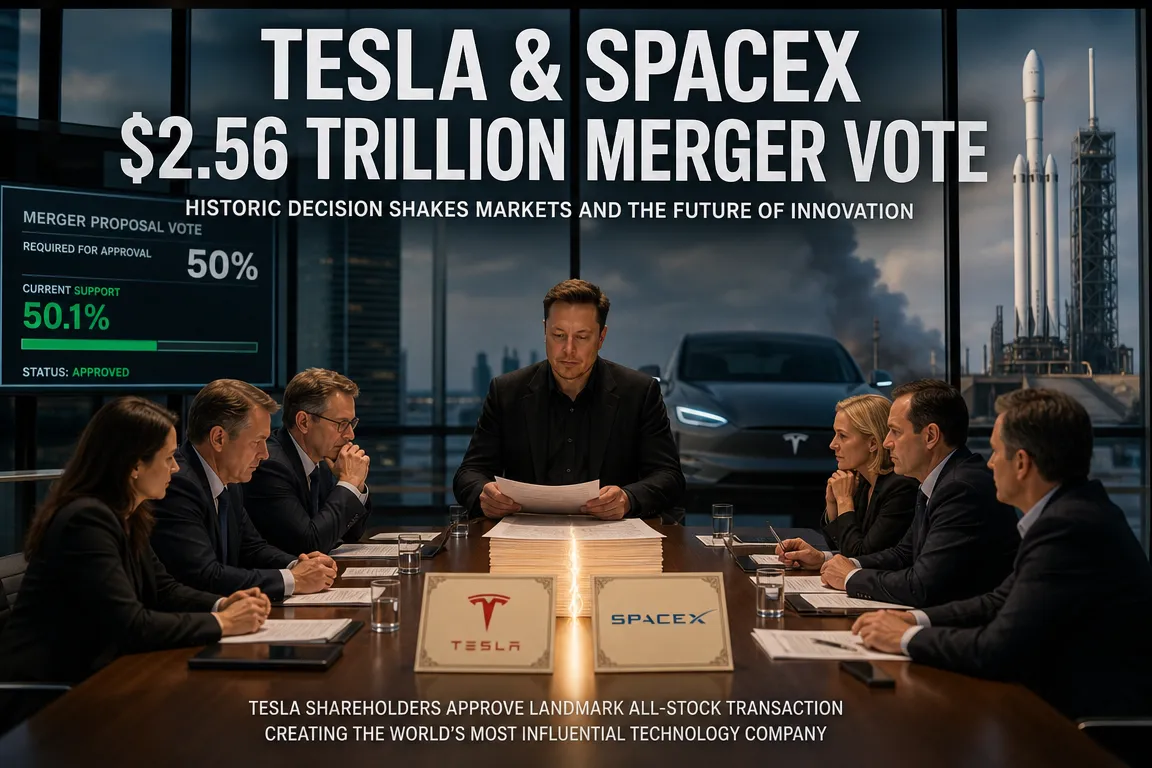
Musks First Confirmation of a Tesla–SpaceX Merger Special Committee: The Key Issue Is “50% of All Shares Must Approve”
The real point in this issue is not simply whether Tesla and SpaceX will merge.
Musks first public confirmation that both companies have established special committees to discuss a potential merger.
SpaceX reporting its first large-scale profit since the original reference period after listing.
The fact that the profit is being driven not by rockets, but by Starlink and AI infrastructure.
And for Tesla shareholders, the more important issue than merger support or opposition is the structure in which abstention is effectively equivalent to a no vote.
In particular, with Tesla shares trading around $374, this merger discussion should be viewed not as a simple theme, but as a major variable that could affect AI infrastructure, space communications, autonomous driving, robotics, and overseas equity investing at once.
This summary is a news-style reorganization based on the figures and statements cited in the original source. Investors should verify Tesla and related regulatory filings before making any investment decision.
1. Musk’s First Confirmation: “Both Tesla and SpaceX Have Formed Special Committees”
At SpaceX’s earnings presentation, Elon Musk made his first detailed reference to the process surrounding Tesla–SpaceX merger discussions.
The key statement was:
“Both Tesla and SpaceX have formed special committees to discuss the idea in response to shareholder requests.”
This is materially different from a simple rumor.
It implies that merger discussions have moved beyond market speculation and into an internal formal process.
At the same time, Musk drew a clear boundary.
“It would be an exaggeration to say the merger is certain.”
“The special committees have not agreed on any deal terms.”
“There is no guarantee that an agreement will be reached.”
In other words, this is not a completed merger stage, but a stage in which formal discussions on transaction terms can begin.
2. Why Musk Is Not Directly Involved: The Conflict-of-Interest Structure
Musk explained that he cannot directly participate in these discussions.
The reason is straightforward.
He is both Tesla’s CEO and largest shareholder, while also holding significant control over SpaceX.
If Musk were to negotiate the terms personally, shareholders on either side could later challenge the transaction as unfair.
For that reason, both companies created special committees composed of independent directors, with Musk formally excluded from the negotiations.
Musk described the process as “a strange kabuki dance.”
The meaning is that two groups are negotiating while he is unable to participate directly.
This structure is similar to the process used in Tesla’s acquisition of SolarCity.
At that time, special committees handled the negotiations and Musk was excluded from the vote.
The current Tesla–SpaceX merger discussion appears to be following a similar legal safeguard.
3. The Real Shock in SpaceX’s Earnings: It Is Becoming an AI Infrastructure Company, Not Just a Rocket Company
According to the original source, SpaceX reported third-quarter revenue of $14.575 billion.
That figure was well above Wall Street expectations of about $12.8 billion.
It was described as a 161% increase from a year earlier and nearly double the prior quarter.
Net income was cited at $4.4 billion.
In won terms, that is approximately 5.8 trillion KRW.
Based on the original source, this can be viewed as the company’s first large-scale profit since listing.
However, the more important issue is not simply that it was profitable.
The key point is that SpaceX’s earnings model is changing fundamentally.
4. SpaceX’s Business Structure: Starlink, AI, and Launch Services
The original source breaks SpaceX into three main segments.
The first is communications, led by Starlink.
The second is AI, centered on data centers and superintelligence infrastructure.
The third is traditional rocket launch and space operations.
However, the business generating the most value is not the one most people associate with SpaceX.
While rockets remain the company’s symbol, revenue is increasingly concentrated in Starlink and AI infrastructure.
5. Starlink: 13.6 Million Subscribers, 85% of Operating Profit
In the current quarter, SpaceX’s operating profit was cited at $2.79 billion.
Of that amount, $2.37 billion reportedly came from the communications business that includes Starlink.
That represents roughly 85%.
Starlink subscriber count reached 13.6 million, nearly doubling from a year earlier.
At the same time, average monthly revenue per user reportedly declined from $83 a year earlier to around $69.
This is an important detail.
Although pricing per user has fallen, rapid subscriber growth has improved overall profitability.
In effect, Starlink is moving from a premium service toward a mass-market platform.
From a global economic perspective, Starlink is not just an internet service. As a low-Earth-orbit satellite communications infrastructure asset, it can affect defense, logistics, aviation, shipping, and remote-area connectivity.
6. AI Business: The Largest Segment, Accounting for More Than Half of Revenue
The AI segment was one of the most notable elements in the original source.
AI revenue was cited at $7.56 billion, accounting for more than half of total revenue.
It was described as more than nine times higher than a year earlier.
Importantly, this revenue did not come only from the sale of AI services.
The source, citing Reuters, noted that a significant portion came from leasing data center capacity to other companies.
Clients mentioned included Anthropic, Google, and Reflection AI.
In simple terms, SpaceX is not merely selling AI services. It is acting as an “AI landlord” by providing computing infrastructure to AI companies.
This structure is highly important.
In the AI era, the most profitable participants are not only the model developers.
Companies that control power, data centers, GPUs, networking, cooling, and server infrastructure can generate stable cash flow.
Accordingly, the core question from this earnings release is whether SpaceX can be revalued as an AI infrastructure company rather than only a space company.
7. AI Investment Intensity: 84% of Capex Went to AI
The source states that SpaceX spent $19.59 billion on capital expenditures during the quarter.
Of that amount, 84% was allocated to the AI segment.
CFO Bret Johnson reportedly said fourth-quarter capital expenditures could rise to $35 billion to $40 billion.
That would be nearly twice the third-quarter level.
This suggests that SpaceX is reinvesting aggressively in future infrastructure, well beyond current earnings capacity.
Investors can interpret this in two ways.
One is a positive view emphasizing significant growth potential.
The other is a cautious view highlighting a high-risk structure with substantial cash consumption.
AI infrastructure competition can create major barriers to entry if successful, but the capex burden can rise sharply if demand underperforms or competition intensifies.
8. Why the $4.4 Billion Net Income Figure Should Not Be Taken at Face Value
Under the original source, SpaceX reported net income of $4.4 billion.
However, this should not be interpreted as entirely operating earnings.
The source said about $1.6 billion, or roughly 37%, came from non-operating items.
These included interest income on cash raised through listing, other investment gains, and tax benefits.
Accordingly, operating profit is the better measure of business strength.
Based on the source, SpaceX’s operating profit was $2.79 billion.
Even this figure shows a strong profitability profile relative to Tesla.
9. Comparison with Tesla: The Operating Profit Gap Will Shape Merger Negotiations
The source said Tesla’s operating profit in the previous quarter was $398 million.
Its operating margin was cited at about 1.4%.
By comparison, SpaceX’s operating profit for the quarter was $2.79 billion.
On a simple basis, SpaceX’s operating profit is about seven times higher than Tesla’s.
This is the most sensitive point in any merger discussion.
A merger ultimately comes down to how much equity each shareholder group receives in the combined company.
If SpaceX is recognized as having stronger growth and profitability, Tesla shareholders could receive a smaller ownership stake.
Conversely, if Tesla’s autonomous driving, Optimus robotics, energy storage, and vehicle platform potential are valued more highly, Tesla shareholders could secure better terms.
Ultimately, the central issue is not sentiment but the exchange ratio.
10. Why Tesla’s Earnings Release Has Become Even More Important
The source said Tesla’s third-quarter earnings release was scheduled for the day after SpaceX’s presentation.
Wall Street revenue expectations were cited at around $28 billion.
Earnings per share were expected at $0.43 to $0.44, down from $0.50 a year earlier.
The market is now comparing both companies back to back.
SpaceX is building expectations through AI infrastructure and Starlink growth.
Tesla, by contrast, must prove progress on EV margin pressure, price competition, autonomous-driving monetization, and the timing of Optimus commercialization.
With Tesla trading near $374, a weak earnings message could make the merger debate more complicated for Tesla shareholders.
11. Difference in Presentation Style: SpaceX Used Video, Tesla Used Audio
The source included an interesting comparison.
SpaceX’s earnings presentation was livestreamed on video, with Musk, President Gwynne Shotwell, and CFO Bret Johnson appearing together.
They showed Starship flight simulations, Starlink satellite deployment, and future technology plans visually.
By contrast, Tesla’s past earnings calls were audio-based, and in one cited case the stock fell sharply the following day.
Presentation format alone does not determine valuation.
However, markets evaluate not only numbers but also how future growth is communicated.
This matters especially for businesses such as AI infrastructure, robotics, and autonomous driving, where future value remains a major component of the thesis.
Whether Tesla can present a vision as compelling as SpaceX’s at its next release may have a meaningful effect on near-term sentiment.
12. The Most Important Sentence: “Approval from 50% of All Shares Is Required”
One statement is essential for Tesla shareholders to remember.
“Approval from a majority of all outstanding shares is required, not merely a majority of shares that vote.”
This distinction is significant.
In many shareholder meetings, proposals pass with a majority of votes cast.
But when approval must come from more than 50% of all outstanding shares, shares that do not vote effectively function like opposing votes.
This is why Musk described the hurdle as high.
13. Musk’s 20.3% Stake Is Not Enough
The source said Musk holds about 20.3% of Tesla shares.
If approval from 50% of all shares is required, Musk alone is far short of the threshold.
He would need roughly another 29.7 percentage points of support.
Institutional and retail shareholders become decisive.
This is particularly important because Tesla has a high retail ownership base.
That means if retail investors do not vote, the merger’s approval probability could decline materially.
14. Even Full Institutional Support Would Leave Limited Cushion
The original source assumed institutional ownership of about 42.6%.
If all institutions voted and all supported the merger, Musk’s stake combined with theirs would exceed 50%.
But reality is not that simple.
Institutions do not vote at 100% participation.
The source assumed an institutional voting rate of about 77%.
That would mean only about 32.8% of total shares would actually be voted by institutions.
Adding Musk’s 20.3% stake brings the total to about 53%.
That leaves only about 3 percentage points of cushion.
Any institutional opposition or abstention could quickly change the outcome.
15. Retail Shareholder Abstention Is the Real Variable
The source said retail investors hold about one-third of Tesla shares.
The retail voting rate was cited at around 30%.
That means only about 10% of total shares held by retail investors would actually be voted.
The remaining roughly 23% would be left unvoted.
In a structure requiring approval from 50% of all shares, that 23% effectively acts like a no vote.
This is the most important feature of the merger vote.
For example, if a Tesla shareholder owns 100 shares and does not vote, those 100 shares do not support approval and effectively work against it.
Whether the shareholder supports or opposes the proposal, silence works against merger approval.
16. Historical Precedent: Tesla Has Already Experienced Similar Votes
The source noted that Tesla has faced similar voting structures twice before.
In 2024, there was a proposal to move the company’s headquarters from Delaware to Texas.
That proposal required approval from a majority of all shares and passed amid high shareholder attention.
By contrast, in 2025, a proposal to eliminate the special-resolution requirement failed.
At that time, 73.6% of all shares participated, and 54% of the votes cast were in favor.
However, only 39.4% of all outstanding shares were in favor.
In other words, the proposal passed among votes cast but failed to meet the requirement based on all shares outstanding.
This precedent could apply directly to the current merger vote.
The failure may come not from a large opposition bloc, but from insufficient turnout.
17. Why an Automatic Voting Program Matters
The source also mentioned that Tesla is preparing an automatic voting program.
Under this structure, retail shareholders could preselect how their votes will be cast on future shareholder matters.
Options reportedly include voting in favor of all proposals or excluding certain items.
This matters because it can reduce the problem of low retail participation.
As noted above, unvoted retail shares are highly unfavorable for merger approval.
If the automatic voting program is widely adopted, part of that unvoted block could shift into actual approval votes.
The market may therefore view it as a preparatory step for the merger process.
18. If the Merger Happens, Musk’s Control Could Increase Further
The source cited a Barclays analysis suggesting that after a merger, Musk could hold 37% ownership and 56% voting power.
If accurate, that would give Musk a majority of voting rights in the combined company.
This is highly relevant for Tesla shareholders.
Before a merger, shareholder approval is decisive.
After a merger, Musk’s voting power could become even stronger.
In that sense, if a merger vote proceeds, it may represent the last major opportunity for Tesla shareholders to strongly influence the company’s future structure.
19. Market Reaction: Strong Response at SpaceX, Limited Response at Tesla
Under the source, Tesla closed up 1.54% at $373.71.
SpaceX closed down 0.11% in regular trading at $147.79, but rose more than 7.5% in after-hours trading following the earnings release.
Tesla rose only about 1.6% in after-hours trading.
This reaction suggests which company the market is currently revaluing more aggressively.
SpaceX received stronger support on earnings strength and AI infrastructure growth, while Tesla still faces questions it must answer in its next earnings release.
20. The Core Point Missed by Many Reports: The Real Battle Is Not Merger Approval, but the Exchange Ratio
Most reports and videos focus on whether Tesla and SpaceX will merge.
But for shareholders, the more important issue is not the merger itself.
It is the terms of the merger.
If SpaceX is valued more highly because of its profitability, Tesla shareholders could end up with a smaller ownership share in the combined company.
If Tesla’s autonomous driving and Optimus robotics potential are valued more highly, the terms could favor Tesla shareholders.
Accordingly, Tesla shareholders should not evaluate the issue as simply good or bad.
The exchange ratio, voting structure, Musk’s control, and possible dilution of existing shareholders all need to be considered together.
21. Another Key Point: SpaceX’s AI Revenue Is Closer to “AI Leasing” Than “AI Model Development”
One of the most interesting parts of the original source is the structure of SpaceX’s AI revenue.
Many people associate AI business with chatbots, generative models, or software subscriptions.
But the revenue described for SpaceX’s AI business appears to come largely from data center leasing and computing resource provision.
That makes it similar, from an investment perspective, to infrastructure businesses rather than software companies.
In the AI era, the bottleneck is ultimately computing power.
If SpaceX controls that infrastructure, it could become not just a space company but a core part of the global AI supply chain.
This is also relevant to Tesla shareholders.
Tesla’s FSD, robotaxi, and Optimus initiatives all require large-scale AI training and inference infrastructure.
If SpaceX’s AI infrastructure and Tesla’s real-world data are combined, the synergy could become a key argument for the merger.
22. The Bull Case for the Merger: Combining AI, Robotics, and Space Communications into One Platform
Musk described the benefits of a merger in terms of superintelligence software, chip design, tera-fab capacity, robotics, and Starlink connectivity.
This does not mean simply combining the two companies financially.
It implies building one technology ecosystem that includes AI semiconductors, data center infrastructure, robot production, satellite communications, autonomous vehicles, and space logistics.
If realized, the combined company would be neither a pure EV company nor a pure space company.
It would become a large technology platform spanning AI infrastructure and physical-world automation.
23. The Bear Case for the Merger: Tesla Shareholders Could Inherit SpaceX’s Capital Burden
There is also a strong cautious view.
SpaceX has substantial growth potential, but it also carries a very heavy capital expenditure burden.
The source cited fourth-quarter capex guidance of $35 billion to $40 billion.
That level of spending can create a powerful barrier to entry if successful, but it can also impose a major burden on shareholders if execution falls short.
From Tesla shareholders’ perspective, they may have invested in EVs, autonomous driving, and robotics, but after a merger they could also absorb the risks of space communications and AI data center investment.
If Musk’s voting power increases after the merger, shareholder oversight could also weaken.
Accordingly, the bear case is not that the future is negative, but that unfavorable terms should be avoided.
24. Five Signals to Watch Next
First, watch how strongly Musk presents the vision at Tesla’s earnings release.
It will matter whether he offers a presentation as concrete as SpaceX’s, or whether the company stays closer to its usual format.
Second, watch whether Tesla’s operating margin improves.
If Tesla’s profitability remains weak in the merger discussion, the terms may be less favorable to Tesla shareholders.
Third, watch for formal disclosure of the special committee and advisors.
If Tesla officially discloses committee members, investment banks, or legal advisers, the discussion would move beyond rumor and into a substantive negotiation phase.
Fourth, the exchange ratio will be the key issue.
Depending on how both companies are valued, the future ownership stake of Tesla shareholders could change materially.
Fifth, watch retail voting participation.
If 50% of all shares are required for approval, unvoted retail shares could become the largest factor in a failed merger vote.
25. The Practical Questions Tesla Shareholders at Around $374 Should Be Asking
With Tesla shares around $374, shareholders should be asking more than one question.
First, can Tesla be re-rated as an AI and robotics company without the merger?
Second, would a merger with SpaceX improve Tesla’s weaker margin structure?
Third, would the merger terms be fair to Tesla shareholders?
Fourth, would stronger control by Musk be beneficial over the long term?
Fifth, can SpaceX’s AI infrastructure investment be converted into future cash flow?
These questions must be answered before the merger issue can be assessed properly.
26. Bottom Line
Musk’s latest remarks do not mean a Tesla–SpaceX merger has been finalized.
However, they do confirm that the discussion has entered a formal process.
From this point forward, the market is likely to view Tesla as more than an EV company.
Tesla’s valuation may increasingly reflect merger probability, AI infrastructure value, Starlink growth, and the link between robotics and autonomous driving.
The essence of this issue is therefore not simply a merger headline, but a restructuring of the broader Musk ecosystem’s governance and control framework.
[Related Articles…]
Tesla Merger Debate and Stock Outlook: Key Takeaways
AI Infrastructure Investment and Shifts in Global Technology Stocks
*Source: [ 오늘의 테슬라 뉴스 ]
– 머스크가 처음 확인한 합병 특별위원회 — 스페이스X 첫 44억 달러 흑자 날, 테슬라 실적 하루 전, $374 주주는?
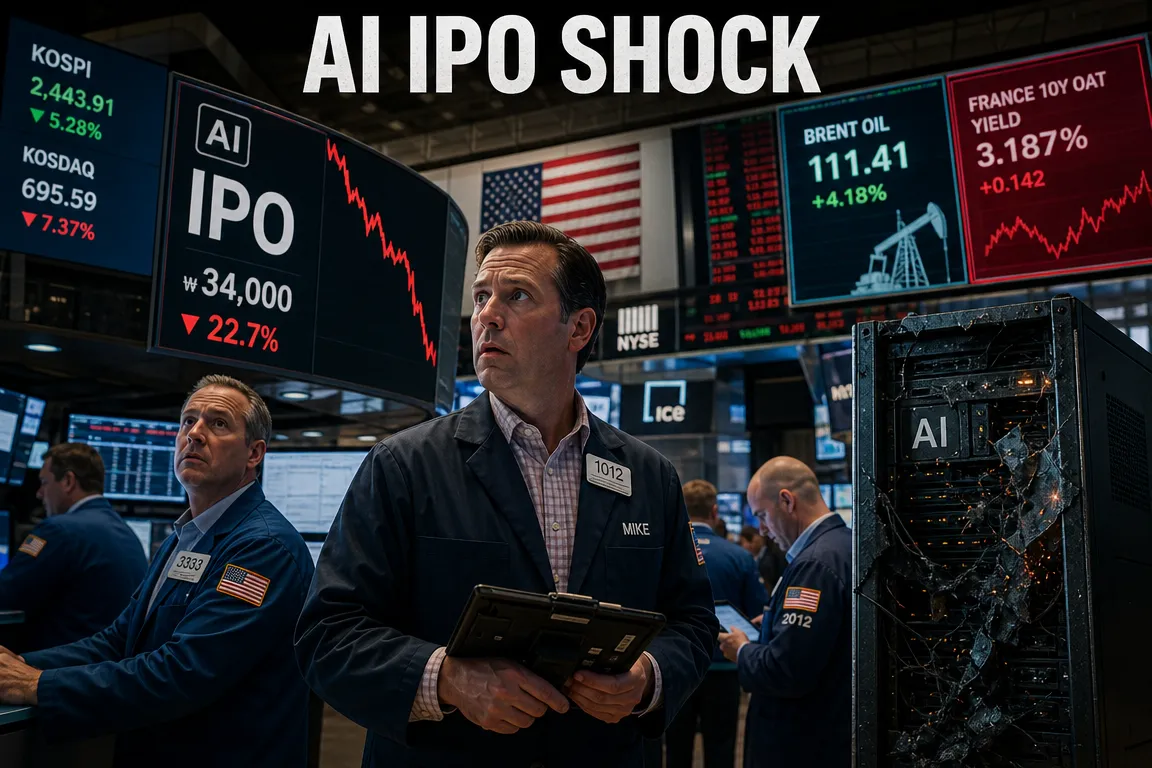
● AI Shock, China Crush, Nvidia Lifeline
Signaling that the KOSPI correction may not be over yet: China AI, open-weight models, and the Nvidia credit cycle reshaping AI investing
The core issue in this market is not simply whether the KOSPI will fall further or rebound.
The more important question is whether the flow of money into the AI industry is starting to slow at the top, or whether this is only a temporary credit-related disruption.
Three points in particular stand out from the discussion.
First, Anthropic’s stagnating ARR growth may be an early signal of a slowdown in the AI cycle.
Second, Chinese AI open-weight models are beginning to pressure the revenue structure of U.S. big tech firms.
Third, the final line of defense for the AI investment cycle may be Nvidia and Jensen Huang rather than the Federal Reserve.
When these factors are connected, they help explain the outlook for the KOSPI, memory semiconductors, data center investment, and AI valuations.
1. The current KOSPI correction: early innings or the sixth or seventh inning
All speakers broadly agreed that the correction is not yet over.
They differed, however, on how far the correction has progressed.
-
Kim Dante’s view: the correction is still in its early stage, roughly the third inning in baseball terms.
-
Lee Hyo-seok’s view: the market has already recognized the issue, placing it around the fourth or fifth inning.
-
Kim Kwang-seok’s view: from the KOSPI’s perspective, the correction is in the late stage, around the sixth or seventh inning.
The key point is not whose number is correct.
All three agreed that the correction remains in progress.
The difference lies in where they see the source of the correction.
The current decline is being interpreted less as simple profit-taking or rate pressure and more as concern over the sustainability of the AI investment cycle.
2. The most uncomfortable signal: stagnation in Anthropic’s ARR growth
Kim Dante focused most on Anthropic’s ARR.
ARR refers to Annualized Recurring Revenue, a metric that annualizes the current revenue run rate.
In simple terms, it indicates how much a company would generate over a year if current conditions remain unchanged.
The key discussion points were as follows.
-
Anthropic’s ARR rose very rapidly from January through June this year.
-
However, third-party estimates suggest that growth may have stalled after July.
-
If the AI cycle were still healthy, revenue at frontier AI companies should continue to rise steadily.
-
If revenue growth at the top of the AI stack stops, the entire downstream value chain may be affected.
This matters because of the structure of AI investment.
The current AI industry depends on frontier AI companies such as Anthropic and OpenAI to generate large-scale compute demand.
As they train and deploy more models, they require more data centers.
Data centers in turn require GPUs, networking equipment, power infrastructure, cooling systems, and memory semiconductors.
That chain ultimately extends to Nvidia, Samsung Electronics, SK Hynix, power infrastructure firms, and data center REITs.
In other words, stagnation in Anthropic’s revenue is not just a company-specific issue.
It may indicate that the top-level faucet of AI investment is starting to release less water.
3. How China AI is reshaping the market: price disruption and open-weight models
One of the most important themes in the discussion was the rise of China AI.
Chinese AI models, led by open-weight systems such as DeepSeek, Qwen, and GLM, are spreading rapidly.
Open-weight models make the model weights available so that companies or developers can host and use them directly on their own servers.
The issue is pricing.
U.S. closed frontier models offer strong performance but are expensive.
By contrast, Chinese open-weight models are improving quickly while remaining much cheaper.
Earlier this year, Chinese AI models were often viewed as inexpensive but lower quality.
Over time, however, they have become usable for translation, summarization, research, basic coding, and document processing.
The key point is how users actually consume AI.
Most users do not need maximum intelligence for every query.
Common use cases are summarization, translation, organization, search assistance, and simple automation.
These tasks do not necessarily require the most expensive model.
4. How startups are actually using AI: routing models
An interesting point in the discussion was how developers and AI startups are using models in practice.
Many AI startups initially relied on OpenAI or Anthropic APIs.
As costs increased, however, they have begun shifting to different architectures.
One common approach is AI routing.
-
When a user submits a query, the system first assesses its difficulty.
-
Simple queries are routed to lower-cost Chinese open-weight models such as Qwen or GLM.
-
Only complex or high-value queries are sent to premium models such as OpenAI or Anthropic.
This approach is highly rational from a corporate perspective.
It preserves service quality while significantly reducing AI costs.
The problem is that, as this pattern spreads, it may slow revenue growth at frontier AI companies.
From an investment standpoint, this is not just a technology trend.
It is a structural shift that affects pricing, revenue, margins, and capital expenditure capacity for AI model companies.
5. What OpenRouter data suggests: declining share for closed models
The discussion also referenced OpenRouter data.
OpenRouter is a platform that connects multiple AI model APIs and can provide a useful indicator of which models developers are actually using.
The trend described in the discussion was as follows.
-
Earlier this year, closed frontier models accounted for more than 90% of revenue share.
-
Recently, that share has reportedly fallen to the low 70% range.
-
On a token-usage basis, Chinese and open-weight models have already penetrated much faster.
What matters here is revenue share, not token share.
Token share shows how much a model is being used.
Revenue share shows where the money is flowing.
For frontier AI companies, a decline in revenue share is a much more sensitive issue.
Ultimately, China AI is not necessarily winning on performance alone; it is eroding the market through price-performance advantages.
If that trend continues, it could lower revenue growth expectations for OpenAI and Anthropic, which would then affect data center investment and memory semiconductor demand.
6. Why the traditional AI investment formula is weakening: the belief that more CAPEX means better performance
Over the past two years, a powerful formula has driven AI investment.
More capital expenditure means more GPUs.
More GPUs enable larger model training.
Larger models produce better performance, and better performance attracts more paying users.
That cycle then feeds back into revenue growth and additional investment.
However, the rise of Chinese open-weight models is challenging that formula.
The market is no longer structured around one high-performance model dominating all use cases.
Instead, sufficiently capable models are being distributed at very low cost.
As a result, companies that deployed large amounts of CAPEX to build premium models may face a longer payback period.
This is the core of the AI bubble debate.
It does not mean that AI is a bubble in the broad sense.
The long-term direction of AI remains strong.
The question is whether current valuations and investment levels have already priced in too much of the future too quickly.
7. Lee Hyo-seok’s view: Anthropic alone is not enough; OpenAI competition must also be considered
Lee Hyo-seok acknowledged the slowdown in Anthropic’s ARR but added another interpretation.
The slowdown in Anthropic’s growth does not necessarily mean that overall AI demand is weakening.
The reason is competition with OpenAI.
Some users who previously relied heavily on Claude may have shifted to ChatGPT.
In particular, OpenAI’s early popularization of agentic AI features may have increased ChatGPT usage among general users.
Therefore, Anthropic’s stagnation may reflect a combination of three factors.
-
Price pressure from Chinese open-weight models.
-
Intensifying competition with OpenAI.
-
Natural deceleration after an initial period of very rapid growth.
This matters because the market may overreact to a single data point.
It is risky to conclude that the entire AI cycle is ending based only on Anthropic’s numbers.
At the same time, it is equally risky to ignore price disruption from Chinese AI and assume that AI will keep growing regardless of economics.
8. The essence of the AI cycle: everyone is using leverage
Lee Hyo-seok’s key framework was that AI is a market in which everyone is using leverage.
Because the future of AI appears so certain, investors, companies, data center operators, and semiconductor firms are all pulling forward capital.
This structure is powerful in a rising market.
It brings future demand into the present, lifting both valuations and investment.
However, once doubts emerge, the mechanism works in reverse.
Credit tightens, financing costs rise, and questions emerge about contract fulfillment.
CoreWeave and similar data center and AI infrastructure firms were mentioned as symbolic examples.
The issue is not whether a specific company will fail.
The real question is whether AI infrastructure firms have grown on excessive leverage and whether they can fulfill their commitments.
9. The problem is not a lack of money; it is a lack of credit
The true issue behind the current market correction is not that money is unavailable, but that confidence has weakened.
Lee Hyo-seok described this as a shortage of credit.
Bond investors and institutions do not move based on growth stories alone.
They look at principal recovery, cash flow, collateral value, and contract stability.
AI infrastructure firms are raising large amounts of capital to build data centers.
If revenue growth at the model layer does not accelerate as expected, what happens?
The stability of long-term data center contracts may come into question.
At that point, the market begins to price the sector not as a growth story but as a credit risk.
This matters for the KOSPI as well.
Recent gains in the Korean market have been driven by expectations for memory semiconductors, HBM, and AI data center demand.
If the AI infrastructure credit cycle weakens, expectations for Samsung Electronics and SK Hynix earnings may also be affected.
10. The final lender of resort in AI markets may be Nvidia, not the Federal Reserve
In financial markets, the lender of last resort is usually the Federal Reserve.
When systemic stress appears, it provides liquidity to prevent credit contraction.
But within the AI industry, Nvidia may end up playing that role.
Why Nvidia?
Because it has the strongest cash flow and market power in the AI infrastructure ecosystem.
Nvidia sits at the center of the GPU supply chain, AI data centers, cloud partners, and startup funding structures.
Simple verbal reassurance from Jensen Huang may not be enough.
If market stress intensifies, Nvidia may need to support the ecosystem through capital participation, contract reinforcement, partner support, or equity investment.
In practical terms, the structure looks like this.
-
Credit stress emerges at AI infrastructure firms.
-
Bond investors become more cautious.
-
Data center investment plans may be delayed.
-
GPU orders and memory semiconductor demand expectations then weaken.
-
Nvidia can reduce market stress by reinforcing credit in the ecosystem.
This perspective is important.
The next rebound in AI equities may depend not only on rates or earnings, but also on how aggressively Nvidia supports the ecosystem.
11. The impact on the KOSPI: why Samsung Electronics and SK Hynix are moving together
The Korean market is closely tied to the AI cycle.
In particular, Samsung Electronics and SK Hynix are directly linked to HBM, DRAM, NAND, and server memory demand.
When revenue at AI model companies rises, data center investment increases.
When data center investment rises, demand for GPUs and HBM rises.
That in turn raises earnings expectations for SK Hynix and Samsung Electronics.
This has been one of the drivers behind the KOSPI’s rise.
Conversely, if revenue growth at AI model companies slows or credit concerns emerge at data center firms, the same chain works in reverse.
Investors then begin to question whether HBM demand can remain strong through the cycle.
That is one reason behind the recent KOSPI correction.
A balanced view is still necessary, however.
AI demand has not disappeared.
In fact, AI usage continues to increase.
The issue is whether rising usage still translates directly into revenue growth for premium frontier models.
If that linkage weakens, valuation adjustment may be unavoidable.
12. The key issue often missed elsewhere: the real AI risk is not technology, but falling unit economics
Most commentary on the AI bubble focuses on whether demand exists.
However, the more important issue raised in this discussion is pricing.
AI usage can continue to grow.
But if users increasingly choose cheaper models and companies reduce costs through routing, revenue growth at frontier AI firms may slow.
This resembles patterns seen in semiconductor cycles.
Demand exists, but competition and pricing pressure weaken profitability.
The same could happen in AI.
Using more AI is not the same as AI companies making more money.
That distinction matters.
The most important sentence for investors is this:
A surge in AI usage does not necessarily guarantee a surge in revenue for AI companies.
13. Key indicators to watch going forward
When evaluating the KOSPI outlook and AI investment strategy, the following indicators should be monitored together.
-
Revenue growth at Anthropic and OpenAI: this will help determine whether demand for frontier models remains strong.
-
Model-level revenue share on OpenRouter: this shows how much of the actual money flow is being captured by Chinese open-weight models.
-
Credit spreads for AI infrastructure firms such as CoreWeave: this reflects the sustainability of data center investment.
-
Nvidia earnings and guidance: these provide insight into GPU demand, customer health, and ecosystem support.
-
HBM order trends at Samsung Electronics and SK Hynix: these indicate whether AI data center demand is translating into actual semiconductor revenue.
-
U.S. rates and global liquidity: leveraged AI investment remains highly sensitive to changes in funding conditions.
14. Investment interpretation: the game is not over, but the difficulty has increased
This correction does not signal the end of the AI industry.
Rather, it marks the first stage in which the market is seriously questioning profitability and credit quality as AI expands too quickly.
Going forward, it will be harder to simply buy any company with an AI label.
Investors will need to distinguish between firms with real cash flow, firms that can withstand price competition, and firms with credit support capacity.
For AI investing, the key criteria are as follows.
-
Does growth in AI usage translate into actual revenue?
-
Can the business withstand price competition from Chinese AI and open-weight models?
-
Is data center CAPEX dependent on excessive leverage?
-
Does the company hold a strategic position within the Nvidia ecosystem?
-
Is memory semiconductor demand supported by long-term contracts rather than only short-term inventory build-up?
In conclusion, the KOSPI correction may be in its later stages, but validation of the AI cycle has only just begun in earnest.
Equities tend to decline first, while earnings and credit indicators are confirmed later.
At this stage, neither panic nor blind dip-buying is appropriate.
The focus should remain on whether money continues to flow through the AI industry.
< Summary >
The KOSPI correction should not yet be viewed as complete.
The key variables are Anthropic’s stagnating ARR growth, price pressure from Chinese AI open-weight models, and credit risk in AI data centers.
Chinese AI is eroding the revenue share of high-cost frontier models, while companies are using routing models to lower AI expenses.
AI usage may continue to rise, but there is no guarantee that this will translate directly into strong revenue growth for OpenAI and Anthropic.
Nvidia is likely to become the final line of defense for the AI investment cycle.
Going forward, investors should monitor Nvidia earnings, OpenRouter market share, data center credit risk, and HBM demand at Samsung Electronics and SK Hynix together.
[Related Articles…]
*Source: [ 경제 읽어주는 남자(김광석TV) ]
– 코스피 조정 아직 안 끝났다…중국 AI가 판을 흔들고 있다 | 경읽남과 토론합시다 | 3자토론 이효석x김단테x김광석 [1편]